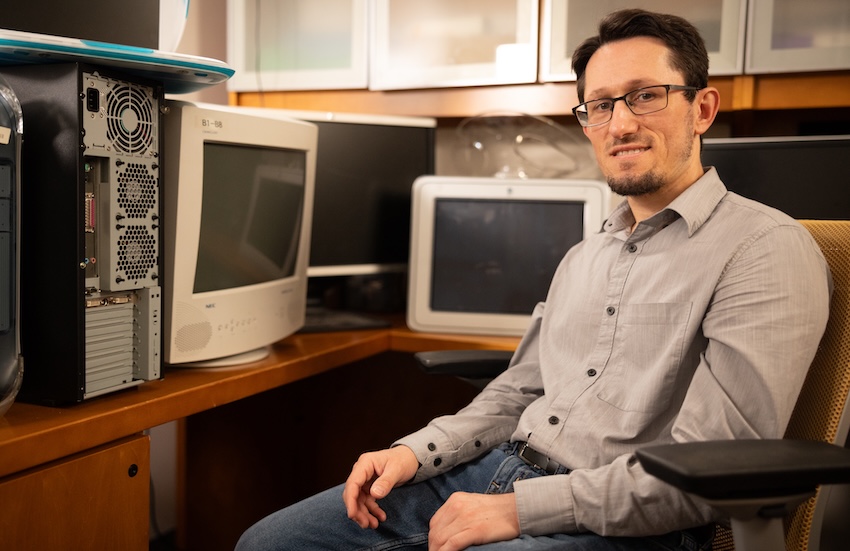
D.J. Wu, professor of Information Technology Management at the Scheller College of Business, smiles in a dark suit jacket and white collared shirt.
What if people's immediate reactions could reveal insights that surveys sometimes miss? Survey responses can be influenced by factors ranging from question wording to social pressure. D.J. Wu, professor of information technology management at Georgia Tech's Scheller College of Business, is exploring whether brain activity can provide another way to understand opinions.
His paper, “Brain Speaks Louder Than Words: Neurophysiological Opinion Inference via Cognitive Dissonance Triggers,” recently received the 2026 Dr. Hermann Zemlicka Award for the most visionary paper at the NeuroIS Retreat.
Wu discusses the research, its potential applications, and the ethical and privacy considerations it raises.
Q&A With D.J.
What was your reaction when you learned your paper received the 2026 Dr. Hermann Zemlicka Award for “most visionary” research?
The Dr. Hermann Zemlicka Award is presented annually at the NeuroIS Retreat to the paper selected as the year’s “most visionary.” I was surprised and deeply honored to receive it. The recognition was especially meaningful because it affirmed our vision of bringing neuroscience and information systems research together to explore a new way of understanding human opinions.
For readers unfamiliar with your research, what problem were you trying to solve?
We wanted to find a better way to understand people’s opinions in situations where traditional methods, like surveys or tracking behavior, may be biased, intrusive, slow, or difficult to use. Our research explores whether brief brain activity measured by electroencephalography (EEG) can reveal when a statement matches or conflicts with a person’s beliefs. If so, it could provide another way to understand opinions without relying only on what people say or how they behave.
Most people are used to answering surveys, reviews, and polls. What made you wonder if there might be a better way to understand what people really think?
Surveys are extremely useful, but they depend on people actively participating. Those answers can be shaped by factors such as memory, the way a question is worded, social pressure, or a person’s ability and willingness to respond. We wondered whether brain activity could offer another way to understand people’s opinions, especially in situations where those challenges come into play. We wanted to see whether we could capture an immediate reaction before a person has to translate it into words.
The paper title, “Brain Speaks Louder Than Words,” is interesting. Can you give an example of what that means in everyday life?
Imagine someone is asked to rate the statement, “I like this product or service.” Even if they feel pressure to give a positive answer, their brain may respond differently depending on whether the statement matches their experience. Our method looks for patterns of brain activity that occur when there is a mismatch between what a person truly believes and what they are evaluating. It is not mind-reading or lie detection. Instead, it uses the brain’s response to conflicting information as one signal that may help us understand whether a statement reflects someone’s genuine opinion.
Were there any findings that surprised you or challenged what you expected going into the project?
One finding was that cognitive conflict depended on more than whether a statement contradicted someone’s opinion. When a heuristic cue, a simple signal that offers a mental shortcut, was present, the brain response to a conflicting statement became weaker. Put intuitively, some contextual cues can soften our immediate sense that “this does not match what I believe,” even when our underlying opinion remains unchanged.
Privacy is a growing concern in today's digital world. Can you compare the privacy implication of the proposed approach versus the traditional methods?
Our approach could reduce the need to store information such as browsing histories, ratings, or written survey responses. Instead of continuously tracking a person’s behavior, it focuses on collecting a specific brain response during a defined interaction with the user’s consent.
At the same time, brain activity is sensitive biometric information and could reveal more than what is needed for a particular task. Any privacy benefits therefore depend on robust safeguards, including data minimization, meaningful informed consent, clearly defined limits on data use and retention, and strong data security through offline, locally controlled processing and calibration.
Our study offers some initial guidance on these issues, but more research is needed to fully understand the privacy implications of this approach.
How could this research change the way organizations understand customers, employees, or other stakeholders in real time?
In situations where surveys may not tell the whole story, receiving feedback is difficult, or past behavioral data are unavailable, our research could eventually help organizations better understand how people are reacting in near real time. For example, it could help identify whether stakeholders' immediate responses suggest agreement or disagreement with a message, product, digital experience, or decision.
These insights would not replace surveys. Instead, they could complement them by showing where people's immediate reactions align with, or differ from, what they later report. Any use at the individual level, however, would require informed consent, a clearly defined purpose, and strong privacy safeguards.
The paper points to opportunities for helping people who may have difficulty communicating through traditional methods. What possibilities do you see for making technology more inclusive?
Brain-computer interfaces have already shown promise in helping people with severe motor or communication impairments interact with technology. Our research explores one possible way to better understand a person's opinions or preferences through brain activity during specific tasks. Over time, this type of work could contribute to technologies that are more responsive to individual needs and more accessible for people who face challenges communicating through traditional methods.
For readers who haven’t thought about neuroscience or brain-computer interfaces before, what’s the one takeaway you hope they remember from this research?
Brain signals do not provide a direct window into a person's thoughts. They reflect many different processes happening in the brain and body, which means they can be difficult to interpret.
That is why theory and experimental design matter. Rather than searching brain data for patterns without a clear explanation, our research focuses on a specific mechanism: how people respond to information that conflicts with their beliefs. By testing that idea in a controlled setting and calibrating the approach for each individual, we can make the results more meaningful and easier to interpret.