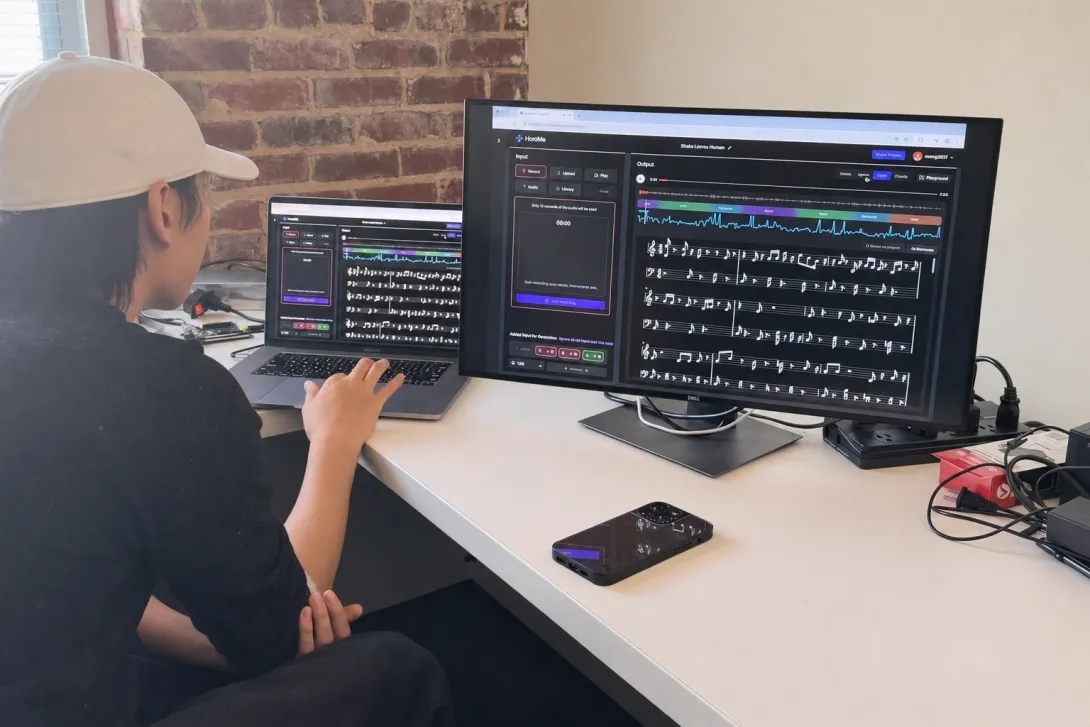
Max (ZhengHao) Wang, a master's in music technology student in the Robotic Musicianship Group, explores the piano transcription of his newly created HearMe song.
Imagine an R&B song about grapes. With today’s generative artificial intelligence (AI) tools, creating one can be as simple as typing a prompt and pressing enter. But if AI does the composing, what does the human musician actually do?
That question concerned Gil Weinberg, a Regents’ Professor in the Georgia Tech School of Music and founding director of the Georgia Tech Center for Music Technology .
“When you use these apps, you are not engaged in music, you don't learn music, and you don't understand music,” he said. “It's completely devoid from any human agency in the music creation process. Music should be played, not prompted.”
That philosophy inspired his Robotic Musicianship lab to create HearMe, a web and mobile AI app designed to keep people actively involved in songwriting. Rather than simply entering a prompt and receiving a finished song, users play instruments, sing, write lyrics, and develop their own musical ideas. HearMe supports that process with musical visualizations and learning activities that help explain musical concepts and build users’ skills.
“The software is designed to enhance the composition process with AI while keeping creative control for humans,” said Elaine Tang, a fourth-year computer science student and lifelong composer and pianist. “You’re still supposed to come up with the inputs yourself and learn about the music that you create.”
Composing HearMe
Take the grape song. With a typical generative AI music app, a prompt asking for an R&B song about grapes could produce a complete song. With HearMe, however, users remain part of the process. Instead of generating finished lyrics, the app offers line-by-line suggestions, including synonyms, antonyms, and rhymes, along with ideas for structuring a song.
HearMe also gives users more control over the resulting music. If someone wants to change a single lyric, for example, the app can make that targeted change without generating an entirely new song.
“In HearMe, we can support changing a word or a line of lyrics but keeping everything else — the vocal timbre and accompaniment — exactly the same,” said Kelvin Yang, a songwriter, keyboardist, and music technology Ph.D. student whose own research became the genesis for the app.
Learning Through Making
HearMe’s focus on learning has even pushed Weinberg, a lifelong musician who had never considered himself a lyricist, to expand his own musical skills. He released an album titled HearMe created with the help of the app.
“I had never written lyrics for anything myself or sang,” he said. “But using HearMe was the first time I tried to sing my own lyrics. The app encouraged me to.”
That emphasis on learning also shaped how HearMe looks and works.
Ling Qi, a second-year School of Music master's student, worked on the app's user interface, visualizations, and playground. Her work turns generated music into aesthetic, educational visualizations that reveal musical information like pitch and song structure. She also gamified playground modes such as Groove, which let musicians add their own beats and help non-musicians learn to follow the beat. These features encourage users to learn about music by playing with it.
“I always try to think from the user perspective of how we can attract both musicians and non-musicians to use this app and how we can actually let them feel the authority and the explainability of the AI,” said Qi, who also plays piano.
A Student Symphony of Research
HearMe has brought together undergraduate and graduate students in Weinberg’s lab, giving them a chance to apply their own musical and technical backgrounds to the project. For some, that experience has also influenced what they want to do next.
Alexander Liu, a fourth-year computer science student who has played piano since age 5, first joined the project through a Vertically Integrated Projects course and continued working on HearMe. He has helped develop tools that let users record instruments with a laptop or a digital music keyboard like a MIDI, play back recordings, and edit individual notes. He is now working on a collaborative lyric-writing interface where users can workshop ideas and develop lyrics line by line with AI.
“Since joining the Robotic Musicianship Lab and working on HearMe, my interest in applying my CS knowledge to music technology has only grown,” Liu said. “I'm currently applying to graduate school programs and have several music technology programs on my shortlist, and I want to work in this field someday.”
That human involvement is exactly what HearMe is designed to preserve. Rather than asking what AI can create for people, Weinberg and his students are exploring what it can help people create for themselves.
News Contact
Tess Malone, Senior Research Writer/Editor
tess.malone@gatech.edu