Mark Losego, Shreyas Kousik, and Animesh Garg lead the Autonomous Research for Materials program at the Institute for Matter and Systems (IMS). Losego is a professor in the School of Materials Science and Engineering. Kousik is an assistant professor in the George W. Woodruff School of Mechanical Engineering. Garg is a Stephen Fleming Early Career Assistant Professor at School of Interactive Computing.
In this brief Q&A, they discuss their research focus, how it connection to IMS’s research priorities, and the national impact of this initiative.
What is your field of expertise?
I’m an expert in materials processing, particularly in gas-phase processing of materials, which is commonly used for the manufacturing of microelectronics.
Most materials scientists have a story like mine, when they discovered that the field simply exists. For me, it was in high school when I attended an engineering career fair at our local science center. I was already enamored with atoms, but I couldn’t understand why in chemistry all we talked about was liquids and gases when most of the objects I saw around me were solids. Turns out, all the science of solids was in the field of materials science and engineering — so I was hooked!
What questions or challenges sparked your current research?
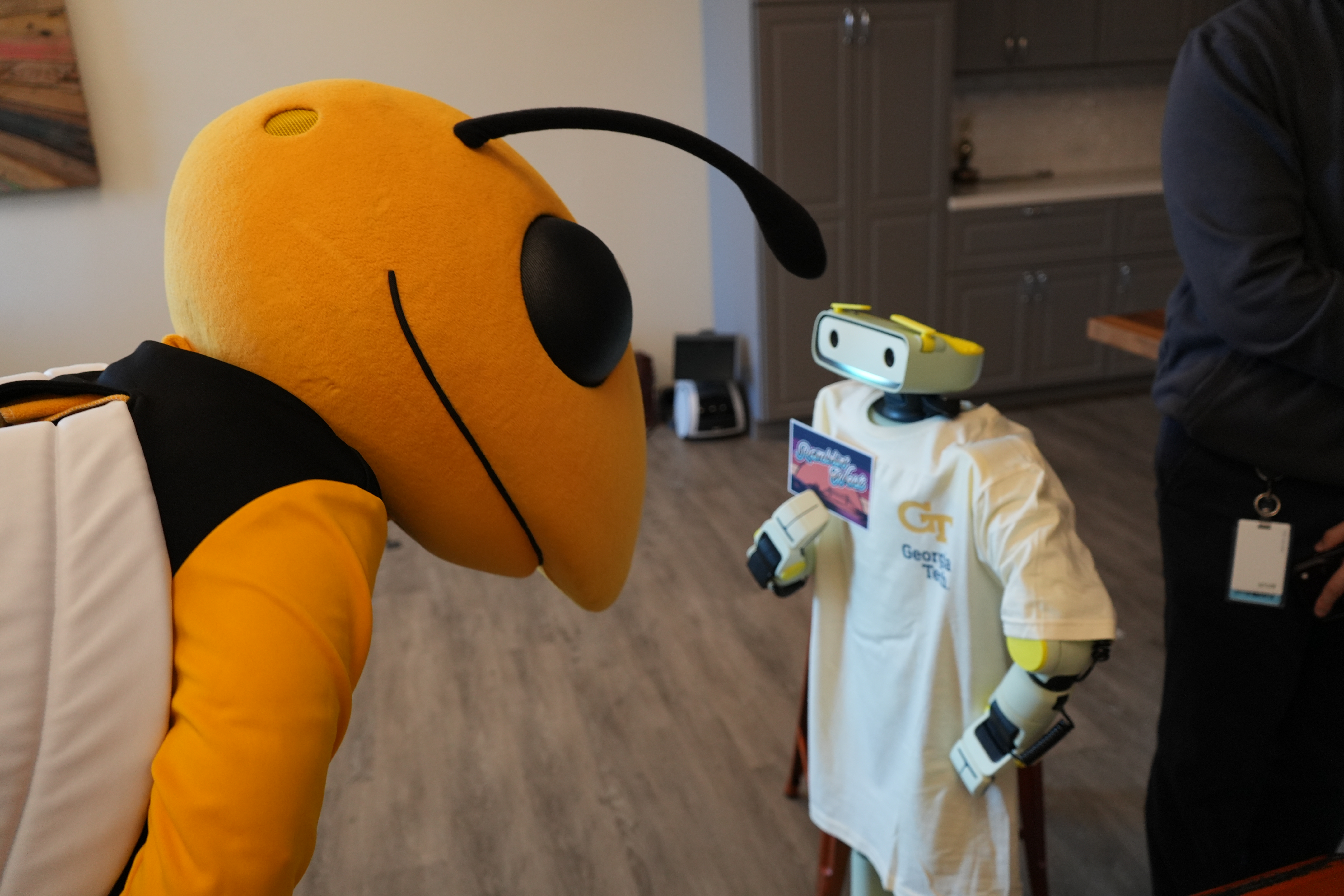
Data science is really powerful at quickly finding connections that the human brain is unable to readily make. These connections can lead to predictions which could rapidly advance technology development that can benefit society. However, the key to unlocking the benefits of data science is the data, and unfortunately, today, we often simply cannot collect enough data on new materials to adequately train these data science models to make predictions for the next crack-proof asphalt or higher energy storage battery material. We need some extra pairs of ARMs and legs to help us — and that is where we hope collaborative robots can make a contribution.
Matter and systems refer to the transformational technological and societal systems that arise from the convergence of innovative materials, devices, and processes. Why is your program important to the development of the IMS research strategy?
We are at the nexus of trying to build complex research systems that integrate robotics, data architecture, and machine learning predictions with the research and physical experimentation needed to develop new materials that can benefit society. Such a grand goal requires contributions from so many different fields ranging materials research experimentalists to roboticists to data scientists, and the ability to understand the friction points of trying to tie these different communities together.
What are the broader global and social benefits of the research you and your team conduct?
We are seeking to develop easy-to-use robotics platforms that can assist in any lab space to increase productivity of materials research and development. For human researchers, the challenges we most enjoy tackling are designing the experiments necessary to collect the data of interest for a given problem — repeating those experiments to explore the entire experimental space and achieve good statistical accuracy is not usually an enjoyable task. That’s where generalized robotics come in. If we could provide a robotics platform that you could easily train to do such repetitive tasks, it could revolutionize how we do materials research.
What are your plans for engaging a wider Georgia Tech faculty pool with the Institute for Matter and Systems research?
We have been and will continue to run a successful lunch series, bringing together a diverse cross-section of our campus to talk about how roboticists, data scientists, materials researchers and others can collaborate
News Contact
Amelia Neumeister | Communications Manager
The Institute for Matter and Systems