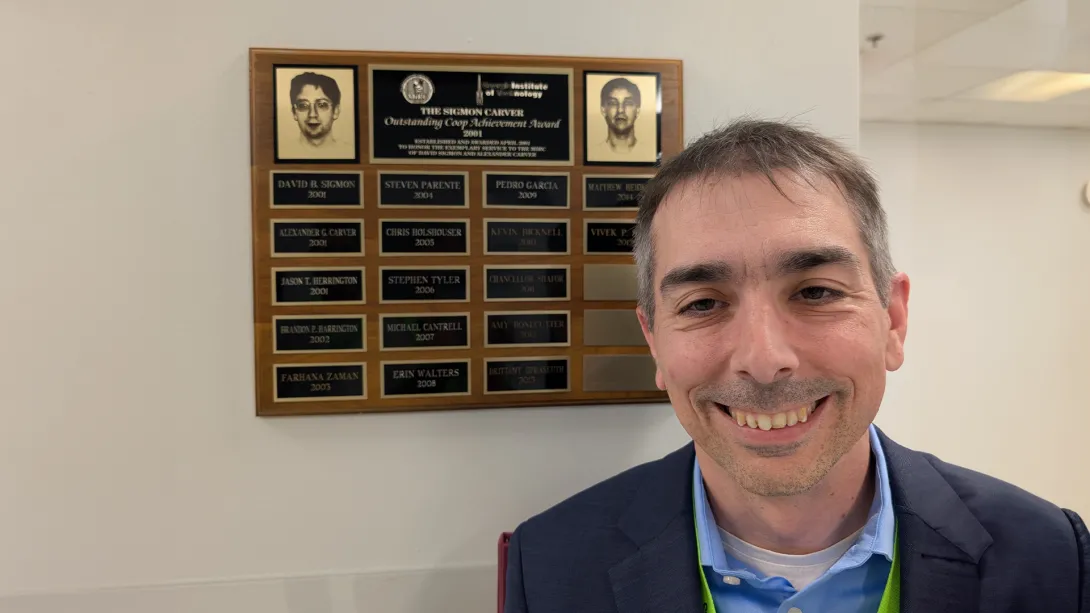
The most unassuming actions can have the greatest outcomes. For Brandon Harrington, CmpE 2005, M.S. CmpE 2008, walking through the doors of the Pettit Microelectronics Building, then home to the Microelectronics Research Center (MiRC), during his freshman year 25 years ago changed the course of his career.
Each week on his way to the Howey Physics Building, Harrington passed the MiRC, wondering what happened behind its doors.
“One day I got the courage to walk in. I went to the front desk and I asked, ‘Hey, do you have any jobs for freshmen?’” Harrington recalled. “I was pointed to Bob Rose, so I walked down and had a brief conversation with him where he hired me on the spot.”
That moment—walking in with curiosity and leaving with a job— shifted Harrington’s career path from pursuing a bachelor’s degree in computer engineering and working in electronic design automation (EDA) to a life in the laboratory advancing microelectronics research.
When he began working for the MiRC in the early 2000s, the cleanroom facilities had only three full-time employees. The small staff gave Harrington opportunities to contribute. He started with smaller tasks, from changing pump oil to sorting nuts and bolts, but his dedication quickly led to greater responsibility.
At the time, Gary Spinner, director of cleanroom operations for the Institute for Matter and Systems (IMS), played a key role in mentoring students and expanding access to the Institute’s microelectronics facilities. Known for his hands-on approach and commitment to student development, Spinner helped guide the growth of cleanroom operations and the people who worked within them.
“Gary took note of me and said, ‘Brandon, please join the co-op program,’” Harrington said. “I quickly found my way into the cleanrooms, and from that point on, I touched basically every system, whether it was the billing software, the access control system, or the toxic gas monitoring.”
As an undergraduate co-op, Harrington advanced through the MiRC, training graduate researchers on tools and developing new or modifying existing efficiency systems. By the time he earned his undergraduate degree, he had accumulated extensive experience in the cleanrooms and graduated with an offer to be a full-time electrical engineer for the MiRC while pursuing his master’s degree.
An unexpected outcome of this role was a friendship that led him to a Ph.D. in electrical engineering. While working full-time, Harrington became good friends with then-Ph.D. student Reza Abdolvand. After Abdolvand joined Oklahoma State University as a faculty member, he asked Harrington if he would come help him start his research group.
“I was really good friends with Reza and I thought this was a way I could get his career going,” Harrington said. “So I left Georgia Tech, around 2008, to pursue my PhD from Oklahoma State.”
Today, Harrington supports the industry in a variety of ways, providing consultation for startups and large corporations alike. His work includes early feasibility studies, prototype development, productization, transfer to volume-production foundries, and yield improvement activities.
He is now the director of microelectromechanical systems (MEMS) development at AMFitzgerald, where he leads a team delivering innovative solutions to clients—all because he followed his curiosity.
Harrington’s journey reflects the broader impact of Georgia Tech’s cleanroom facilities—spaces where curiosity can turn into hands-on experience, mentorship, and career-defining opportunities. By providing students access to advanced tools, real-world problem-solving, and a collaborative research environment, the cleanrooms continue to shape the next generation of engineers and innovators, just as they did for a curious freshman who decided to walk through an open door.
News Contact
Writer: Gabriel Buggi | Communications Student Assistant
Media Contact: Amelia Neumeister | Communications Manager
The Institute for Matter and Systems