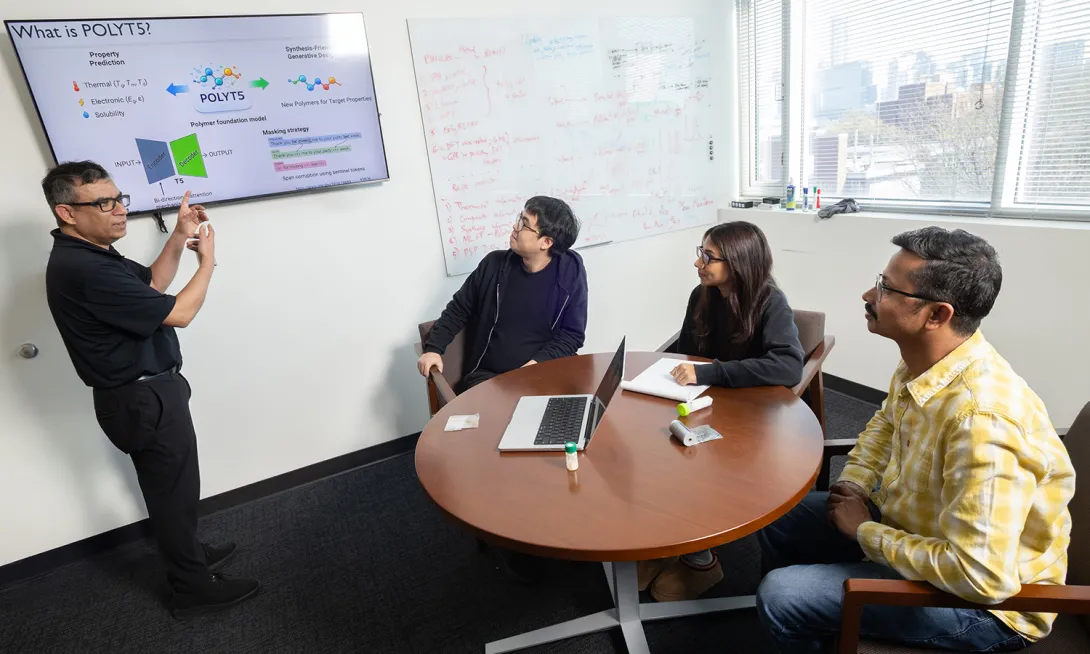
Researchers have created a chemical language AI model to generate new polymer structures based on the properties those polymers need to exhibit. Led by Rampi Ramprasad, standing, the team included postdoctoral scholar Wei Xiong, Ph.D. student Anagha Savit, and research scientist Harikrishna Sahu, who are seated left to right. (Photo: Candler Hobbs)
The words on this page mean something because they are assembled in a particular order and follow the complex rules of grammar and syntax. Creating new chemical polymers follows a similar kind of structure, with rules about what elements and groups of atoms go together and how to assemble them to make sense.
Thinking about polymers in that way has led Georgia Tech materials scientists to create new generative artificial intelligence tools that are like Claude or ChatGPT for new materials.
These are the first foundational models for generative polymer design that have also been validated through physical experiments: users specify the properties they need in a polymer and the model will suggest a chemical structure.
Led by Regents’ Entrepreneur Rampi Ramprasad, the researchers described their latest model this month in the Nature journal npj Artificial Intelligence — including a test material they created and validated in the lab to prove the models work.
News Contact
Joshua Stewart
College of Engineering