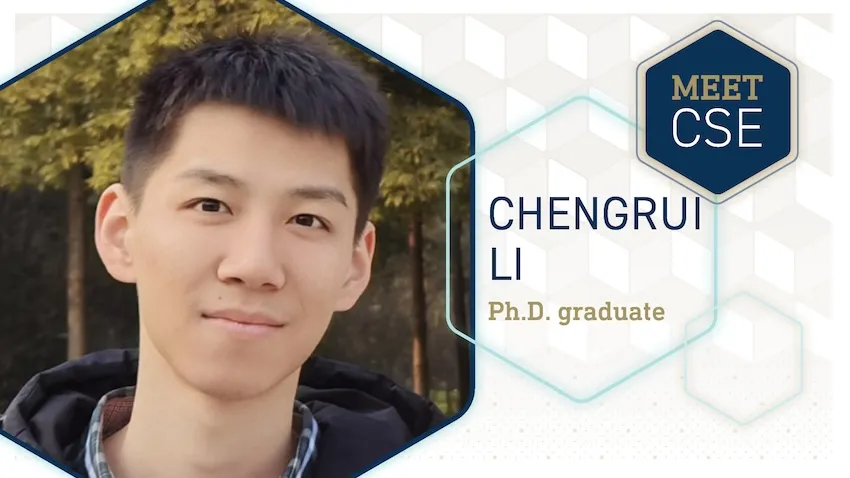
When Chengrui Li walks across the stage this Thursday at Commencement, it will be his final, and perhaps easiest, performance at Georgia Tech.
Between orchestra concerts, magic shows, and yo-yo exhibitions, Li thrives in the limelight. In fact, not much rattles his nerves considering the five years of pressure he endured studying computational neuroscience at Tech.
Before he returns to New York City to continue building brain-interface technologies at Meta, we caught up with Li to learn how he keeps such a cool head at Georgia Tech and beyond.
Graduate: Chengrui Li
Research Interests: Computational neuroscience, eye-tracking experiments and data analysis, statistical machine learning
Education: Ph.D. in Computational Science and Engineering (CSE)
Faculty Advisor: School of CSE Assistant Professor Anqi Wu
What persuaded you to attend graduate school at Georgia Tech?
My undergraduate was at Sichuan University in China. We knew that the most cutting-edge technology and research were in the United States, so I participated in an undergraduate exchange program at the University of Tennessee, Knoxville, during my third year.
I wanted to pursue a Ph.D. in neuroscience while also becoming very proficient in math and computer science (CS). This led me to apply to the CSE Ph.D. program over others. Georgia Tech’s CS ranking is very high, and the CSE program is very interdisciplinary, which matched my expectations super well. I did attain a solid education in math and CS at Georgia Tech. I also advanced my interest in neuroscience and its application by studying mathematical models and algorithms.
What research project from Georgia Tech are you most proud of?
My variational importance sampling paper is a favorite. That one was based heavily on statistical inference. I spent many hours working through complicated derivation calculations, often half-awake and half-asleep after several late nights.
This paper confirmed to me, though, that innovative research requires both hard work and inspiration, and that this endeavor can be rewarding. The paper was selected as a top 5% spotlight paper at ICLR 2024, a world-leading conference on artificial intelligence research.
Could you share more about your role as a research scientist at Meta?
I have been working on Meta’s electromyography (EMG) neural band. This next-generation human-computer interaction device connects with and navigates Meta’s AI glasses.
With the neural band, you can use finger gestures to control the display content you see through the glasses, like swiping your thumb to scroll the screen, or writing on your lap as if you had a pen in your hand to send WhatsApp messages.
How did your Georgia Tech education prepare you for this role?
By pursuing my Ph.D., I am more proficient in critical thinking, math, coding, and presentation. During my interview, I demonstrated these skills and provided my publication records. This helped me land an internship, enabled my success in that role, and led to a full-time position. Additionally, my background in computational neuroscience best matched the work on the EMG neural band team at a big tech company.
What advice would you give someone interested in graduate school?
First, be clear whether a bachelor’s or master’s degree meets your work needs, or if you are truly interested in a scientific research topic. This interest should be based on your own passion, not the current trends. Interest is an important factor in deciding to pursue a Ph.D. because you have to like the topic and like it for a long time. A Ph.D. will require you to dive deep into a subject you must be genuinely curious about.
Second, we are in a new era with rapid advances in information technology. Time is an invaluable resource and is shaped by technology. You have to think more about your time, consider where and how you spend it, and embrace ways to use it more efficiently.
Can you tell us more about your hobbies and how you keep up with them?
I started learning violin when I was five years old, and magic tricks when I was 11. The brain is a supercomputer suitable for functional computation. Our brain is an interface between the objective and subjective, where computation plays a core role in integrating these exact mechanics into interpretations of the world. This realization was one of the important factors that inspired me to pursue my Ph.D. research in computational neuroscience.
Another comparison I’ve learned after playing violin for 23 years is that the cochlea in our inner ear is a fast Fourier Transformer that simultaneously computes the aesthetic of music for us. Performing magic tricks for 17 years taught me that all the occurrences of seemingly low-probability magic phenomena are achieved by either letting it be a certain event or exhausting all possibilities.
I also have other hobbies, like yo-yo balls. I enjoy performing all these skills in front of audiences. Performing brings me satisfaction when I see excitement and happiness from the people I entertain. I am very grateful to my parents for their cultivation and encouragement in doing things that bring me fulfillment. They taught me to be curious and explore my interests, to enjoy pastimes, and instilled the habit to not give up my passions. These were not secondary things that distracted me from coursework or Ph.D. research, but rather complementary parts of my life that bring out the best in me.
What is your favorite Georgia Tech memory?
I have a lot. For my research, I debated frequently with Anqi Wu, my advisor. These often went late into the night to defend my stances. These challenged my beliefs and made me a stronger scholar, for which I am grateful to Anqi for her time and patience.
I also enjoyed performing in the Georgia Tech symphony orchestra with our great conductor, Chaowen Ting. I was involved with the Georgia Tech Chinese Students and Scholars Association, where I showcased magic and yo-yo performances at organization events.
News Contact
Bryant Wine, Communications Officer
bryant.wine@cc.gatech.edu