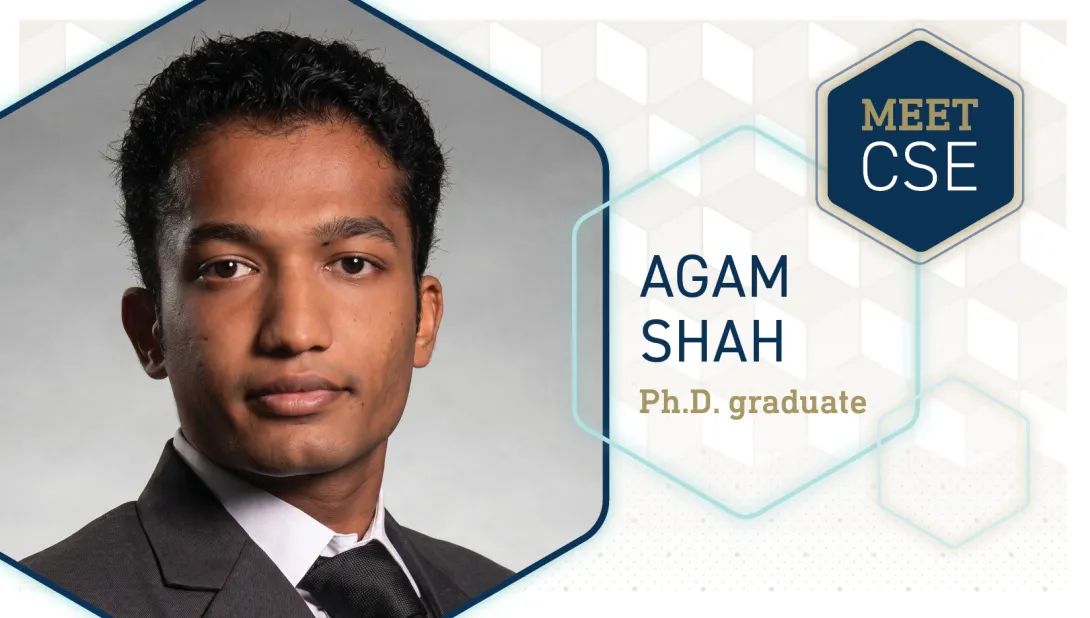
Investment is the best word that summarizes Agam Shah’s journey as a graduate student at Georgia Tech.
That is clearest on the surface, where Shah studied how public statements by businesses and financial institutions shape market behavior. At a deeper level, though, his success was buoyed by support from professors and his mentorship of younger students.
Shah’s ability to connect and invest in others led him to partner with Georgia Tech colleagues and start a financial technology business. He returns to campus this week to officially graduate from Tech, giving us a chance to catch up about his grad school experience and life as an entrepreneur.
Graduate: Agam Shah
Research Interests: Quantitative and computational finance, artificial intelligence, natural language processing, large language models (LLMs)
Education: Ph.D. in Machine Learning, home unit in the School of Computational Science and Engineering (CSE)
Faculty Advisors: Scheller College of Business Professor Sudheer Chava and School of CSE Associate Professor Chao Zhang
What persuaded you to attend graduate school at Georgia Tech?
Georgia Tech’s dedicated College of Computing strongly appealed to me. I was particularly drawn to the interdisciplinary nature of its machine learning Ph.D. program and the School of Computational Science and Engineering, both of which align well with my research interests.
What research project(s) from Georgia Tech are you most proud of and why?
I am proud of all 20-plus research papers I have had the opportunity to contribute to at Georgia Tech. However, if I had to choose one, it would be my work on Federal Open Market Committee (FOMC) text analysis, which was also highlighted in the news.
This work is not only well-cited in academic literature, but the language model developed in the paper is also actively used by economists at many of the world’s top central banks, including researchers at the FOMC and the Bank of England. It is also used by leading financial institutions such as BlackRock and Daiwa Securities. Since its release, the model has achieved over 100,000 downloads on Hugging Face.
What can you tell us more about your startup, ZettaQuant?
ZettaQuant aims to solve one of the biggest challenges in using LLMs and agents: working effectively with massive underlying datasets. We serve as a layer between raw data and LLMs, helping distill billions of tokens into the relevant context that models can use.
As a deep-tech startup, we are actively engaging with industry practitioners to better understand how to design and engineer our system to integrate seamlessly with their evolving AI workflows. Given the complexity of the problem we are tackling, particularly in advancing document intelligence systems, we are currently very focused on research and foundational development.
How did your Georgia Tech education prepare you for starting ZettaQuant?
Not just my education, but my entire experience at Georgia Tech, extending beyond the classroom, prepared me for this journey. I met my co-founders at Georgia Tech, and many of the initial use cases we are exploring at ZettaQuant are built on open-source research I conducted there.
In addition to research, I mentored more than 300 students through the Vertically Integrated Project “NLP for Financial Markets.” This experience taught me how to manage teams and think about building systems with a long-term vision.
What advice would you give someone interested in graduate school?
Most people pursue graduate school after already completing more than 15 years of education. Also, people who are admitted to a top school like Georgia Tech are often already well-positioned to secure strong job opportunities. So, graduate school should provide value beyond what you could learn outside the classroom.
Before deciding, think carefully about what you hope to gain from graduate school that you cannot otherwise. Once you enroll, take full advantage of the faculty, research labs, networks, and seminars. Many students underutilize these opportunities during their undergraduate and graduate years.
I would also like to quote the epilogue of my Ph.D. thesis: ‘Advice is abundant; conviction must be your own.’ Build a strong conviction about what you want to achieve from graduate school before committing to it.
What did you do for fun and relaxation while attending Georgia Tech? Do you still keep up with these now?
This may sound unconventional, but I spent a significant amount of time mentoring and teaching throughout my Ph.D. Many of my mentees went on to gain admission to top graduate programs. This included two students I mentored for all four years of their undergraduate studies who later joined the ML Ph.D. program at Georgia Tech. They are now teaching and mentoring students, completing a full-circle journey.
Working with mentees and supporting their growth gives me a strong sense of fulfillment and serves as a form of relaxation. In addition, I enjoy listening to music, especially while coding, and I continue to do that today.
What is your favorite Georgia Tech memory?
If I had to choose one favorite memory, beyond the many exciting late nights in the lab, it would be proposing to my wife on Tech Green at Georgia Tech. She is also a Yellow Jacket, having completed her undergraduate degree here and currently pursuing her Ph.D. Our home truly is a hive of Yellow Jackets.
News Contact
Bryant Wine, Communications Officer
bryant.wine@cc.gatech.edu