
May. 02, 2024

Quantum sensors detect the smallest of environmental changes — for example, an atom reacting to a magnetic field. As these sensors “read” the unique behaviors of subatomic particles, they also dramatically improve scientists’ ability to measure and detect changes in our wider environment.
Monitoring these tiny changes results in a wide range of applications — from improving navigation and natural disaster forecasting, to smarter medical imaging and detection of biomarkers of disease, gravitational wave detection, and even better quantum communication for secure data sharing.
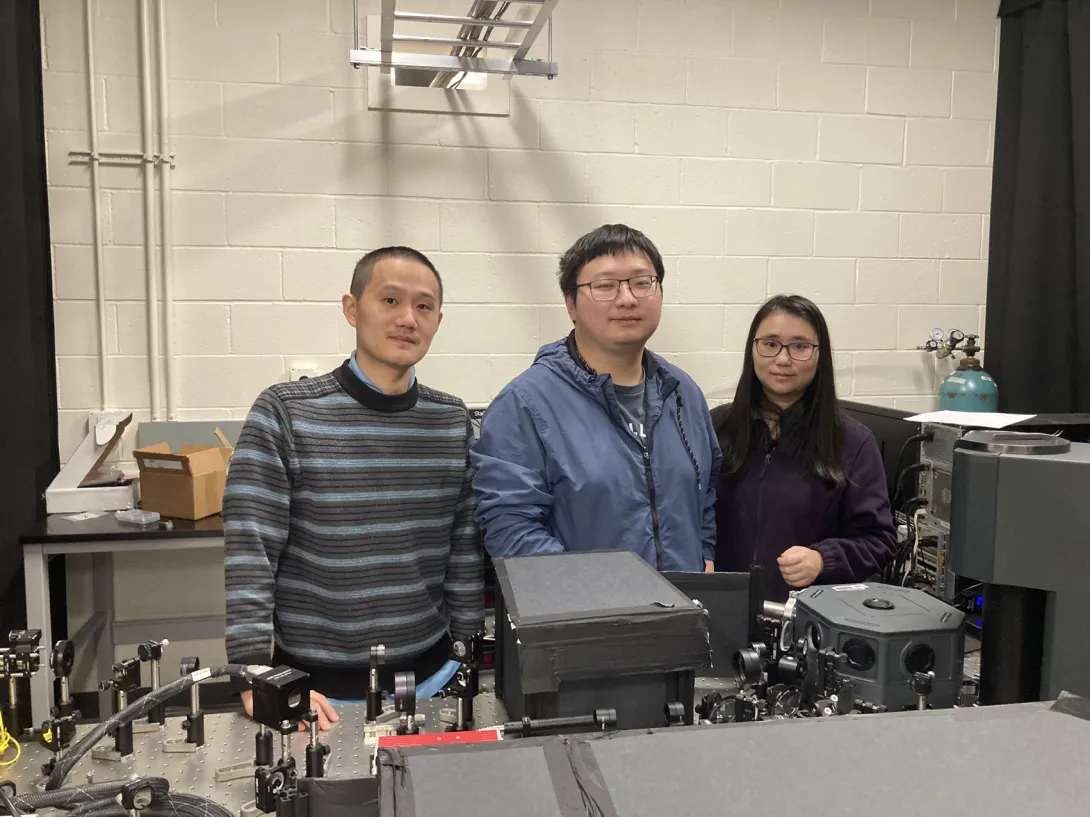
Georgia Tech physicists are pioneering new quantum sensing platforms to aid in these efforts. The research team’s latest study, “Sensing Spin Wave Excitations by Spin Defects in Few-Layer Thick Hexagonal Boron Nitride” was published in Science Advances this week.
The research team includes School of Physics Assistant Professors Chunhui (Rita) Du and Hailong Wang (corresponding authors) alongside fellow Georgia Tech researchers Jingcheng Zhou, Mengqi Huang, Faris Al-matouq, Jiu Chang, Dziga Djugba, and Professor Zhigang Jiang and their collaborators.
An ultra-sensitive platform
The new research investigates quantum sensing by leveraging color centers — small defects within crystals (Du’s team uses diamonds and other 2D layered materials) that allow light to be absorbed and emitted, which also give the crystal unique electronic properties.
By embedding these color centers into a material called hexagonal boron nitride (hBN), the team hoped to create an extremely sensitive quantum sensor — a new resource for developing next-generation, transformative sensing devices.
For its part, hBN is particularly attractive for quantum sensing and computing because it could contain defects that can be manipulated with light — also known as "optically active spin qubits."
The quantum spin defects in hBN are also very magnetically sensitive, and allow scientists to “see” or “sense” in more detail than other conventional techniques. In addition, the sheet-like structure of hBN is compatible with ultra-sensitive tools like nanodevices, making it a particularly intriguing resource for investigation.
The team’s research has resulted in a critical breakthrough in sensing spin waves, Du says, explaining that “in this study, we were able to detect spin excitations that were simply unattainable in previous studies.”
Detecting spin waves is a fundamental component of quantum sensing, because these phenomena can travel for long distances, making them an ideal candidate for energy-efficient information control, communication, and processing.
The future of quantum
“For the first time, we experimentally demonstrated two-dimensional van der Waals quantum sensing — using few-layer thick hBN in a real-world environment,” Du explains, underscoring the potential the material holds for precise quantum sensing. “Further research could make it possible to sense electromagnetic features at the atomic scale using color centers in thin layers of hBN.”
Du also emphasizes the collaborative nature of the research, highlighting the diverse skill sets and resources of researchers within Georgia Tech.
“Within the School of Physics, Professor Zhigang Jiang's research group provided the team with high-quality hBN crystals. Jingcheng Zhou, who is a member of both Professor Hailong Wang’s and my research teams, performed the cutting-edge quantum sensing measurements,” she says. “Many incredible students also helped with this project.”
Du is a leading scientist in the field of quantum sensing — this year, she received a new grant from the U.S. Department of Energy, along with a Sloan Research Fellowship for her pioneering work on developing state-of-the-art quantum sensing techniques for quantum information technology applications. The prestigious Sloan award recognizes researchers whose “creativity, innovation, and research accomplishments make them stand out as the next-generation of leaders in the fields.”
This work is supported by the U. S. National Science Foundation (NSF) under award No. DMR-2342569, the Air Force Office of Scientific Research under award No. FA9550-20-1-0319 and its Young Investigator Program under award No. FA9550-21-1-0125, the Office of Naval Research (ONR) under grant No. N00014-23-1-2146, NASA-REVEALS SSERVI (CAN No. NNA17BF68A), and NASA-CLEVER SSERVI (CAN No. 80NSSC23M0229).
News Contact
Written by Selena Langner
Contact: Jess Hunt-Raston
Director of Communications
College of Sciences at Georgia Tech
Apr. 30, 2024
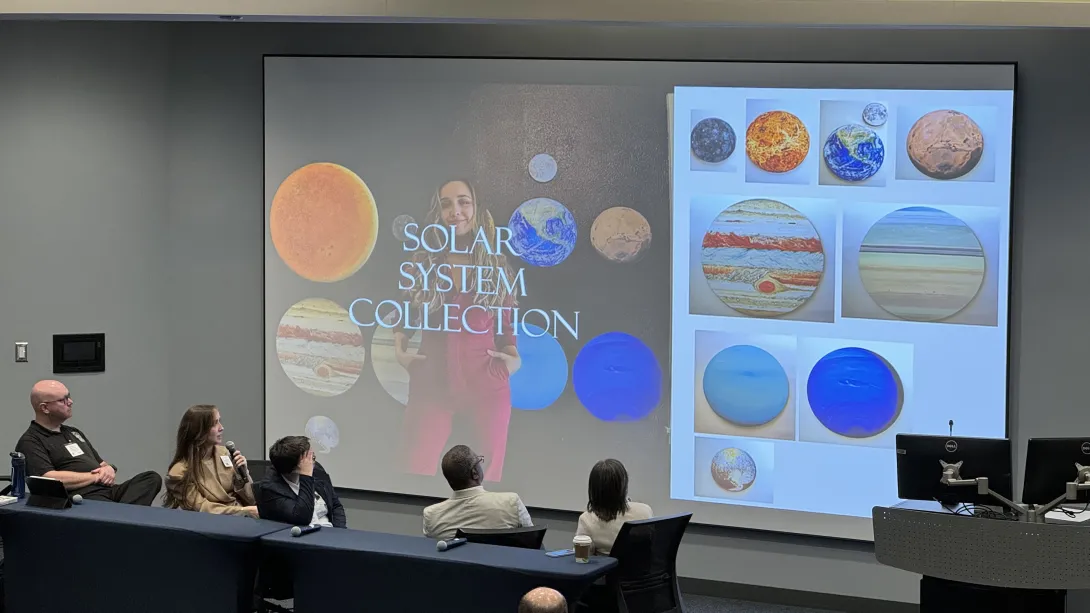
April 12 is a significant date in the history of exploration, as it marks the first space flight of a human, Yuri Gagarin, in 1961. This year on April 12, the Georgia Tech Space Research Initiative (Space RI) hosted an event highlighting the Institute’s interdisciplinary space research. The Yuri’s Day Symposium was Space RI’s first public event.
A multidisciplinary initiative, the Space RI brings together faculty, researchers, and students from across campus who share a passion for space exploration. Their combined research explores a broad array of space-related topics, all considered from a human perspective.
“Launching Georgia Tech’s Space Research Initiative reinforces our commitment to advancing our understanding of space and our universe,” said Executive Vice President for Research Chaouki Abdallah. “It is also a testament to Georgia Tech's unwavering dedication to pushing the limits of what is possible and to fostering innovations that benefit humankind.”
The symposium was organized by Glenn Lightsey, interim executive director of the Space RI, and the Space RI steering committee, which consists of representatives from the Georgia Tech Research Institute (GTRI) and the Colleges of Engineering, Computing, and Sciences, the Ivan Allen College of Liberal Arts, and the Scheller College of Business. The day began with remarks from Research leadership and an overview of the Space RI and its mission. “This is an exciting time for space exploration at Georgia Tech and across the world,” Lightsey said. “Space research is a critical part of solving our world’s most challenging problems and improving life for everyone on Earth.”
Space research and exploration yield many societal benefits that improve life on Earth and even foster economic growth. These advances include rapidly evolving technologies, improvements in medicine, and the development of enhanced materials — such as self-healing materials and those designed for extreme environments. Additionally, space research provides essential tools, data, and insights for climate scientists.
Sessions and panels throughout the day covered space science, space media, NASA’s Moon to Mars program, GTRI’s space research program, commercial space initiatives, and space in popular culture. A.C. Charania, NASA’s chief technologist and a Georgia Tech alumnus, delivered the keynote address. He shared insights into his work at NASA and Moon to Mars.
Following the symposium, the Space RI hosted a “star party” at the Georgia Tech Observatory. People of all ages gathered at the event, where they could use the observatory’s telescope to observe the moon, Jupiter, and the Orion Nebula, an immense cloud of dust and gas from which new stars are born.
“It was a clear night, and we were able to view the lunar terminator — the boundary where the sun is setting on the moon — which accentuates craters and mountains,” said Lightsey. “It was exciting to officially launch our initiative on a day when the world celebrated space exploration and the star party was a fantastic way to end our event.”
In July 2025, the Space RI will transition into one of Georgia Tech’s Interdisciplinary Research Institutes. Learn more about the initiative at space.gatech.edu.
Sign up to receive space news and event updates from the Space RI.
News Contact
Laurie Haigh
Research Communications
May. 05, 2023
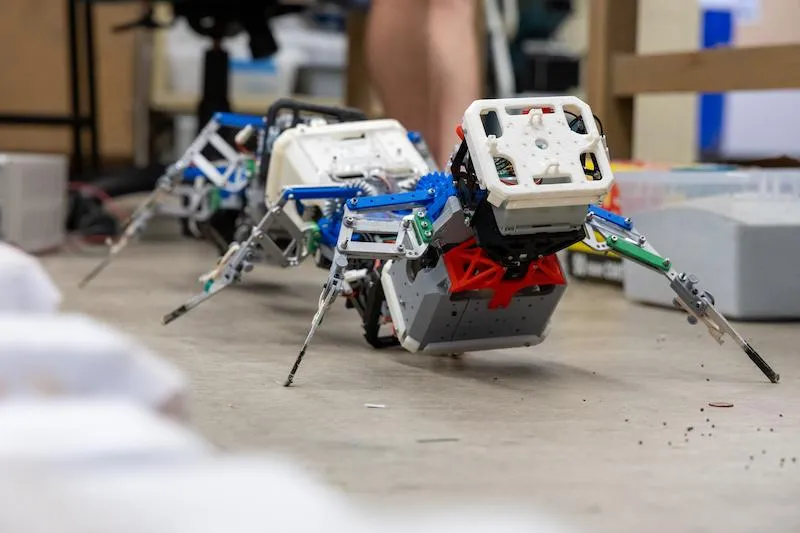
Centipedes are known for their wiggly walk. With tens to hundreds of legs, they can traverse any terrain without stopping.
“When you see a scurrying centipede, you're basically seeing an animal that inhabits a world that is very different than our world of movement,” said Daniel Goldman, the Dunn Family Professor in the School of Physics. “Our movement is largely dominated by inertia. If I swing my leg, I land on my foot and I move forward. But in the world of centipedes, if they stop wiggling their body parts and limbs, they basically stop moving instantly.”
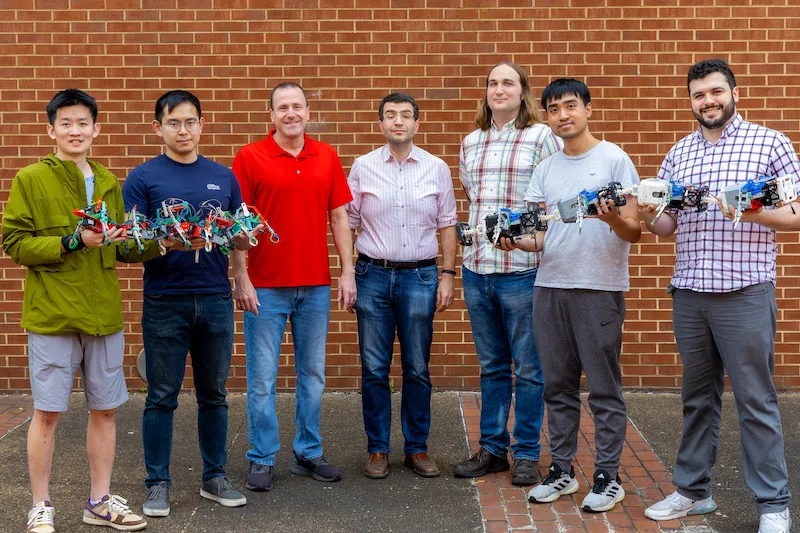
Intrigued to see if the many limbs could be helpful for locomotion in this world, a team of physicists, engineers, and mathematicians at the Georgia Institute of Technology are using this style of movement to their advantage. They developed a new theory of multilegged locomotion and created many-legged robotic models, discovering the robot with redundant legs could move across uneven surfaces without any additional sensing or control technology as the theory predicted.
These robots can move over complex, bumpy terrain — and there is potential to use them for agriculture, space exploration, and even search and rescue.
The researchers presented their work in the papers, “Multilegged Matter Transport: A Framework for Locomotion on Noisy Landscapes,” in Science in May and “Self-Propulsion via Slipping: Frictional Swimming in Multilegged Locomotors,” in Proceedings of the National Academy of Sciences in March.
A Leg Up
For the Science paper, the researchers were motivated by mathematician Claude Shannon’s communication theory, which demonstrates how to reliably transmit signals over distance, to understand why a multilegged robot was so successful at locomotion. The theory of communication suggests that one way to ensure a message gets from point A to point B on a noisy line isn’t to send it as an analog signal, but to break it into discrete digital units and repeat these units with an appropriate code.
“We were inspired by this theory, and we tried to see if redundancy could be helpful in matter transportation,” said Baxi Chong, a physics postdoctoral researcher. “So, we started this project to see what would happen if we had more legs on the robot: four, six, eight legs, and even 16 legs.”
A team led by Chong, including School of Mathematics postdoctoral fellow Daniel Irvine and Professor Greg Blekherman, developed a theory that proposes that adding leg pairs to the robot increases its ability to move robustly over challenging surfaces — a concept they call spatial redundancy. This redundancy makes the robot’s legs successful on their own without the need for sensors to interpret the environment. If one leg falters, the abundance of legs keeps it moving regardless. In effect, the robot becomes a reliable system to transport itself and even a load from A to B on difficult or “noisy” landscapes. The concept is comparable to how punctuality can be guaranteed on wheeled transport if the track or rail is smooth enough but without having to engineer the environment to create this punctuality.
“With an advanced bipedal robot, many sensors are typically required to control it in real time,” Chong said. “But in applications such as search and rescue, exploring Mars, or even micro robots, there is a need to drive a robot with limited sensing. There are many reasons for such sensor-free initiative. The sensors can be expensive and fragile, or the environments can change so fast that it doesn’t allow enough sensor-controller response time.”
To test this, Juntao He, a Ph.D. student in robotics, conducted a series of experiments where he and Daniel Soto, a master’s graduate in the George W. Woodruff School of Mechanical Engineering, built terrains to mimic an inconsistent natural environment. He then tested the robot by increasing its number of legs by two each time, starting with six and eventually expanding to 16. As the leg count increased, the robot could more agilely move across the terrain, even without sensors, as the theory predicted. Eventually, they tested the robot outdoors on real terrain, where it was able to traverse in a variety of environments.
“It's truly impressive to witness the multilegged robot's proficiency in navigating both lab-based terrains and outdoor environments,” Juntao said. “While bipedal and quadrupedal robots heavily rely on sensors to traverse complex terrain, our multilegged robot utilizes leg redundancy and can accomplish similar tasks with open-loop control.”
Next Steps
The researchers are already applying their discoveries to farming. Goldman has co-founded a company that aspires to use these robots to weed farmland where weedkillers are ineffective.
“They’re kind of like a Roomba but outside for complex ground,” Goldman said. “A Roomba works because it has wheels that function well on flat ground. Until the development of our framework, we couldn’t confidently predict locomotor reliability on bumpy, rocky, debris-ridden terrain. We now have the beginnings of such a scheme, which could be used to ensure that our robots traverse a crop field in a certain amount of time.”
The researchers also want to refine the robot. They know why the centipede robot framework is functional, but now they’re determining the optimal number of legs to achieve motion without sensing in a way that is cost-effective yet still retains the benefits.
“In this paper, we asked, ‘How do you predict the minimum number of legs to achieve such tasks?’” Chong said. “Currently we only prove that the minimum number exists, but we don't know that exact number of legs needed. Further, we need to better understand the tradeoff between energy, speed, power, and robustness in such a complex system.”
CITATION:
Baxi Chong et al., Multilegged matter transport: A framework for locomotion on noisy landscapes.Science380,509-515(2023).DOI:10.1126/science.ade4985
News Contact
Tess Malone, Senior Research Writer/Editor
Apr. 20, 2023
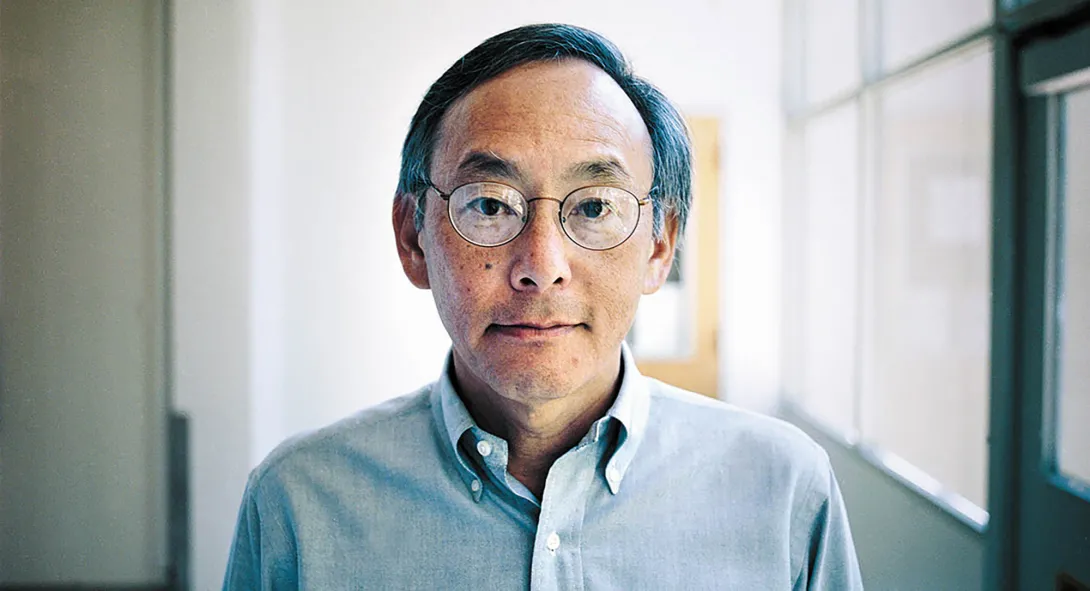

On April 26, 2023, the School of Physics and College of Sciences at Georgia Tech will welcome Stanford University physicist Steven Chu to speak on climate change and innovative paths towards a more sustainable future. Chu is the 1997 co-recipient of the Nobel Prize in Physics, and in his former role as U.S. Secretary of Energy, became the first scientist to hold a U.S. Cabinet position.
About the Talk
The event is part of the School of Physics “Inquiring Minds” public lecture series, and will be held at the Ferst Center for the Arts. The talk is free and open to campus and the Atlanta community, and no RSVP is required. Refreshments begin at 4:30, and the lecture will start at 5 p.m. ET.
“The multiple industrial and agricultural revolutions have transformed the world,” Chu recently shared in an abstract for the lecture. “However, an unintended consequence of this progress is that we are changing the climate of our planet. In addition to the climate risks, we will need to provide enough clean energy, water, and food for a more prosperous world that may grow to 11 billion by 2100.”
The talk will discuss the significant technical challenges and potential solutions that could provide better paths to a more sustainable future. “How we transition from where we are now to where we need to be within 50 years is arguably the most pressing set of issues that science, innovation, and public policy have to address,” Chu added.
The event’s faculty host is Daniel Goldman, Dunn Family Professor in the School of Physics at Georgia Tech.
About Steven Chu
Steven Chu is the William R. Kenan, Jr. Professor of Physics and a professor of Molecular and Cellular Physiology in the Medical School at Stanford University.
Chu served as the 12th U.S. Secretary of Energy from January 2009 until the end of April 2013. As the first scientist to hold a U.S. Cabinet position and the longest serving Energy Secretary, Chu led several initiatives including ARPA-E (Advanced Research Projects Agency – Energy), the Energy Innovation Hubs, and was personally tasked by President Obama to assist in the Deepwater Horizon oil leak.
In the spring of 2010, Chu was the keynote speaker for the Georgia Tech Ph.D. and Master's Commencement Ceremony.
Prior to his cabinet post, Chu was director of the Lawrence Berkeley National Laboratory, where he was active in pursuit of alternative and renewable energy technologies, and a professor of Physics and Applied Physics at Stanford, where he helped launch Bio-X, a multi-disciplinary institute combining the physical and biological sciences with medicine and engineering. Previously he also served as head of the Quantum Electronics Research Department at AT&T Bell Laboratories.
He is the co-recipient of the 1997 Nobel Prize in Physics for his contributions to laser cooling and atom trapping. He is a member of the National Academy of Sciences, the American Philosophical Society, the American Academy of Arts and Sciences, the Pontifical Academy Sciences, and of seven foreign academies. He formerly served as president, and then chair of the American Association for the Advancement of Science.
Chu earned an A.B. degree in mathematics and a B.S. degree in physics from the University of Rochester, and a Ph.D. in physics from the University of California, Berkeley, as well as 35 honorary degrees.
He has published over 280 papers in atomic and polymer physics, biophysics, biology, bio-imaging, batteries, and other energy technologies. He holds 15 patents, and an additional 15 patent disclosures or filings since 2015.
News Contact
Jess Hunt-Ralston
Director of Communications
College of Sciences at Georgia Tech