

From Top Left (Clockwise): Ana Mazmishvili, Ryan Anthony, Samin Alipour, Faeze Fahimi Aghda
Four Georgia Tech doctoral students spent the summer working on their dissertation research through the Energy Policy and Innovation Center's (EPIcenter) Summer Research Program. The competitive program provides a full summer-semester stipend, along with mentorship and professional development opportunities, to support emerging energy scholars.
"One of the goals of the program is to give students the time and support needed to make meaningful progress on their dissertation research while helping them understand the broader policy, economic, and societal implications of their work," said Laura Taylor, director of EPIcenter.
The stipends enable participants to focus exclusively on clearly defined research goals. The program also supports peer discussions, communication training, and interdisciplinary learning opportunities designed to strengthen both their research and professional development.
This year's cohort explored topics ranging from electricity markets and air pollution to critical mineral supply chains and grid modernization, highlighting the breadth of energy-related research taking place across Georgia Tech.
Exploring Complex Energy Challenges
Ana Mazmishvili, who studies environmental and energy economics, used the summer to examine how climate policies affect communities across state lines.
"My research measures who is actually exposed to pollution from power plants when some states adopt climate regulations to cut emissions while neighboring regions do not," Mazmishvili said. "Because air doesn't stop at state borders, the key question is what happens once the pollution is emitted, and who ends up breathing it."
Her work focuses on the Regional Greenhouse Gas Initiative (RGGI), a cap-and-trade program in the Northeast, and investigates whether the benefits and burdens of emissions reductions are distributed equitably between regulated and neighboring states.
Mazmishvili said the program provided valuable time to focus on her job-market paper, a central component of her dissertation.
"The regular meetings with the program director and other fellows create useful accountability checkpoints and let me hear perspectives from people in very different fields," she said. "We're also learning how to make academic research understandable to a general audience, a skill I expect to use well past this summer."
Industrial and systems engineering doctoral student Faeze Fahimi Aghda spent the summer developing an optimization model for the U.S. gallium supply chain, a critical component of many advanced technologies.
Her research uses mathematical modeling to examine where and when domestic gallium processing facilities should be established under the threat of supply disruptions.
"Working on my research through EPIcenter has taught me to look at my problem from a policy point of view rather than focusing only on the math," Fahimi Aghda said. "The feedback within the meetings helped me improve my model."
Ryan Anthony, in the Jimmy and Rosalynn Carter School of Public Policy, explored how one of the largest oil shocks in U.S. history affected electricity customers and whether utility ownership influenced the impact on consumers.
"So far, my research suggests that it mattered a lot,” Anthony said. “Municipal utilities held rates down and absorbed many of the costs, while private, investor-owned utilities passed more costs through to their customers."
Anthony said the program provided critical support for the archival research required for the project.
"My project depends on data that only exists in old government reports, and that kind of archival work is difficult to fund," he said. "EPIcenter gave me the time and space to do it properly."
Connecting Research to Real-World Impact
For Samin Alipour, the summer provided an opportunity to explore how electric grids can adapt to growing numbers of distributed energy resources.
"Most electric distribution systems were built like one-way roads, carrying power from a substation to homes and businesses," Alipour said. "Rooftop solar, batteries, and electric vehicles are turning those roads into two-way systems."
Her research examines how these emerging technologies can be coordinated to increase grid flexibility and clean energy adoption while maintaining safety and reliability and ensuring that costs and benefits are distributed fairly.
With support from EPIcenter, Alipour focused on the economic and policy dimensions of those challenges. "I did not want my research to remain only a technical model," she said. "The program has helped me connect the technical results of my dissertation to economic value, reliability, equity and compensation policy."
One study developed during the summer was accepted for presentation at a specialized power systems conference, an achievement Alipour credits in part to the opportunity to focus on the broader implications of her work.
Building the Next Generation of Energy Scholars
Beyond advancing individual research projects, the Summer Research Program encourages students to engage with colleagues from different disciplines and develop skills for communicating complex ideas to broader audiences.
“Through regular cohort meetings, participants build a community of accountability, discuss research challenges, explore interdisciplinary energy topics, and develop communication skills,” said Gil Gonzalez, program support coordinator for EPIcenter. “Students also write a research-focused blog post for EPIcenter and present their work at the program's fall workshop, which allows them to share their research with the broader Georgia Tech energy community.”
As EPIcenter continues to support interdisciplinary energy scholarship at Georgia Tech, the Summer Research Program equips future leaders with the tools to address complex energy challenges through technological innovation, informed policy, and economic analysis.
News Contact
Priya Devarajan | SEI Communications Manager
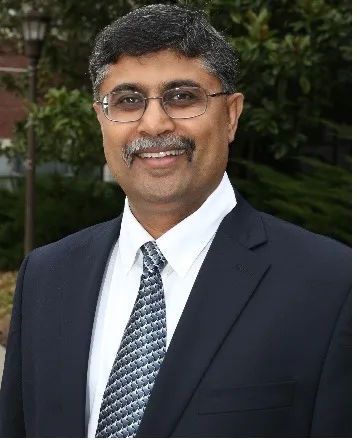
Shreyes N. Melkote
Shreyes N. Melkote, Morris M. Bryan Jr. Professor in the George W. Woodruff School of Mechanical Engineering and executive director of the Novelis Innovation Hub at Georgia Tech, has been named interim associate vice president of Corporate Engagement, effective Sept. 1. He will report to Executive Vice President for Research Tim Lieuwen and will lead the Office of Corporate Engagement (OCE) during a national search for the position’s permanent successor.
Melkote succeeds J. Mark Nolan, who announced he will step down from the role effective Aug. 31 after helping establish and grow Georgia Tech’s integrated approach to corporate engagement and industry partnerships.
“I am grateful to Shreyes for stepping into this important leadership role during this transition,” said Lieuwen. “Throughout his career, he has demonstrated an exceptional ability to build meaningful partnerships between academia and industry. His deep understanding of research, innovation, and corporate collaboration makes him uniquely qualified to lead our corporate engagement efforts as we continue advancing Georgia Tech’s mission and strengthening relationships with industry partners around the world.”
Melkote brings extensive experience building industry partnerships and collaborative research programs. He serves as executive director of the Novelis Innovation Hub at Georgia Tech and has led the Institute’s strategic engagement with The Boeing Company since 2012 through its University Innovation Program. An internationally recognized manufacturing researcher, Melkote has authored more than 300 publications and is a fellow of ASME, SME, and CIRP.
“I am honored to serve in this role and build upon the strong foundation established by Mark Nolan and the Office of Corporate Engagement team,” said Melkote.
A national search is underway for the permanent associate vice president of Corporate Engagement. The search is being led by Chris Jones, John F. Brock III School Chair and Professor in the School of Chemical and Biomolecular Engineering, with support from executive search firm WittKieffer.
Learn more about the position and search process.

LEARNING FROM EXPERIENCE: Georgia Tech industrial design student Olivia Chan (left) works alongside A.G. Rhodes resident Essie Bailey-Demic during a horticultural therapy session. By observing and designing with residents rather than for them, students developed tools that help restore independence.
Georgia Tech industrial design students traveled to an Atlanta nursing home expecting to redesign gardening tools for older adults. Instead, they discovered that the residents themselves were their most important teachers. Working alongside horticultural therapy participants at A.G. Rhodes, the students observed how aging changes the way people interact with everyday objects and learned that good design begins with listening, not assumptions. Together, they developed practical solutions that restored small but meaningful moments of independence, proving that the people living with a problem are indispensable partners in solving it.
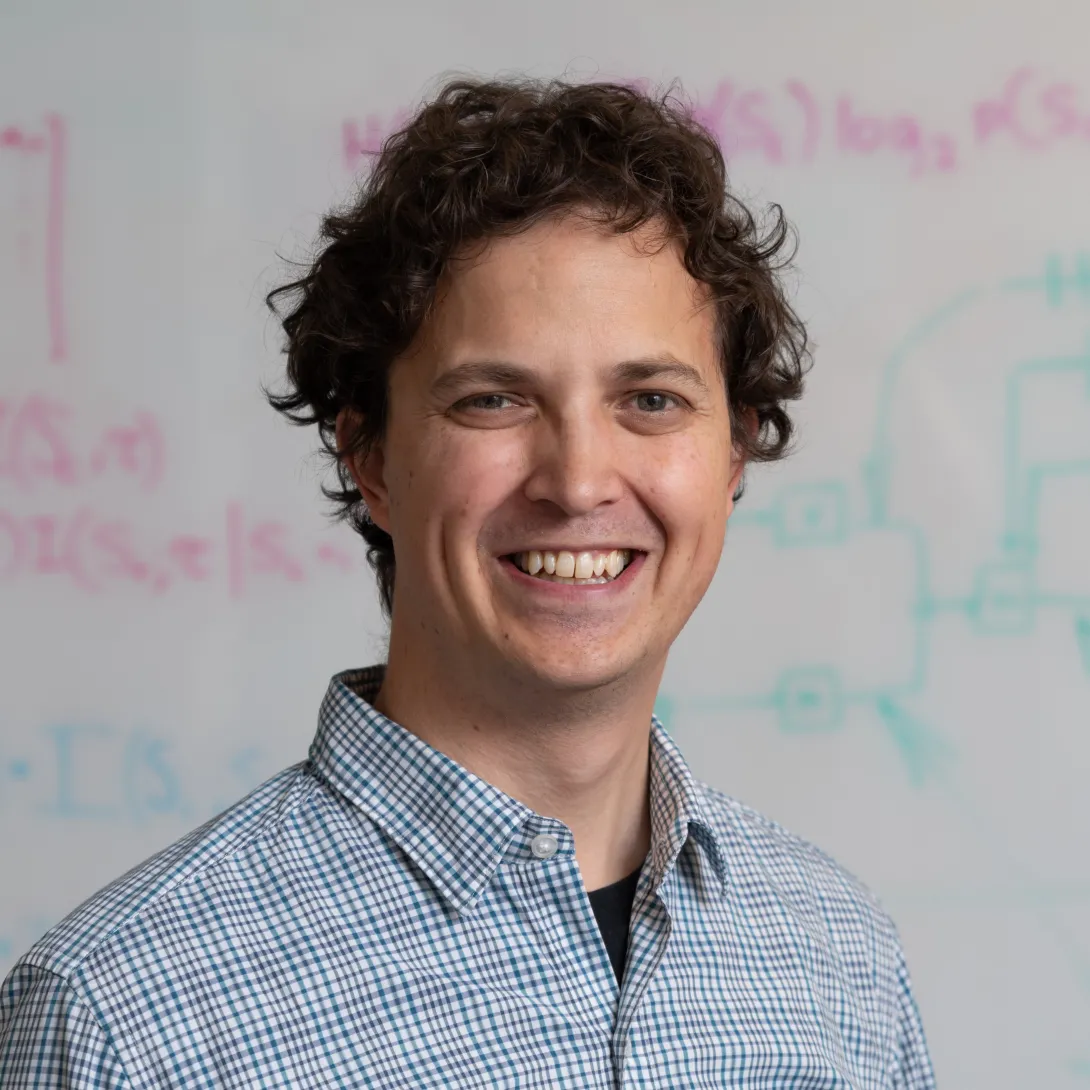
In addition to his new leadership role at INNS, Simon Sponberg leads a multidisciplinary research program spanning neuroscience, biology, physics, engineering, and robotics.
The Georgia Institute of Technology's Institute for Neuroscience, Neurotechnology, and Society (INNS) has appointed Simon Sponberg as associate director for Interdisciplinary Research, where he will help foster collaborations, support emerging research initiatives, and advance interdisciplinary neuroscience research across campus.
Launched in 2025, INNS serves as a hub for neuroscience and neurotechnology research, connecting researchers across disciplines to advance discovery, innovation, and societal impact.
“A core part of INNS's mission is helping people find one another, connect around shared interests, and build something bigger than they could accomplish alone,” says Executive Director Christopher Rozell. “Simon has spent his career bringing together people, perspectives, and disciplines to tackle complex challenges. I can't think of a better person to help lead our interdisciplinary research efforts and support the next generation of collaborative neuroscience research.”
A longtime leader in Georgia Tech's neuroscience community, Sponberg helped shape the institute's early foundations through the Neuro Next Initiative, which evolved into INNS. As associate director, he will help guide research strategy, foster new collaborations, and support interdisciplinary work across the neuroscience ecosystem.
“Neuro-related research touches so many fields that we inevitably have a problem of finding all the potential right people and opportunities to tap into,” he said. “A core responsibility of this role is helping catalyze the ideas of new teams of talented researchers, educators, and trainees from inception to realization.”
Sponberg is the Glen Robinson Professor in Complex Systems with appointments in the School of Physics and the School of Biological Sciences, where he directs the Agile Systems Lab. His work also connects him to the Institute for Bioengineering and Bioscience (IBB) and the Institute for Robotics and Intelligent Machines (IRIM), underscoring the cross-disciplinary approach that defines both his research and leadership.
Since joining Georgia Tech in 2014, he has built a highly collaborative research program spanning neuroscience, biology, physics, engineering, and robotics while helping foster interdisciplinary connections across campus. He currently leads a Multidisciplinary University Research Initiative (MURI) that brings together neuroscientists and engineers from five universities to understand how brains achieve fast, flexible perception and decision-making in complex sensory environments. He also co-leads the Integrative Movement Sciences Institute, an NSF Biological Integration Institute focused on understanding movement and muscle function across scales.
His contributions have been recognized through numerous honors, including a Young Investigator Award from the International Society for Neuroethology, a Klingenstein-Simons Fellowship in the Neurosciences, and the Leddy Family Dean’s Faculty Excellence Award.
As associate director, Sponberg will focus on helping researchers identify new opportunities for connection and collaboration. In addition to overseeing seed funding programs, he hopes to create pathways for researchers to build teams, access support resources, pursue ambitious interdisciplinary research ideas, and team with Georgia Tech’s undergraduate and graduate neuroscience degree programs.
“I look forward to being a resource for our community when people are looking for help in building teams or finding opportunities to support their ideas,” he said. “Bring your best ideas and please reach out if you want to talk about ideas in the interdisciplinary neuro space that you want to see realized.”
News Contact
Audra Davidson
Communications Manager
Institute for Neuroscience, Neurotechnology, and Society
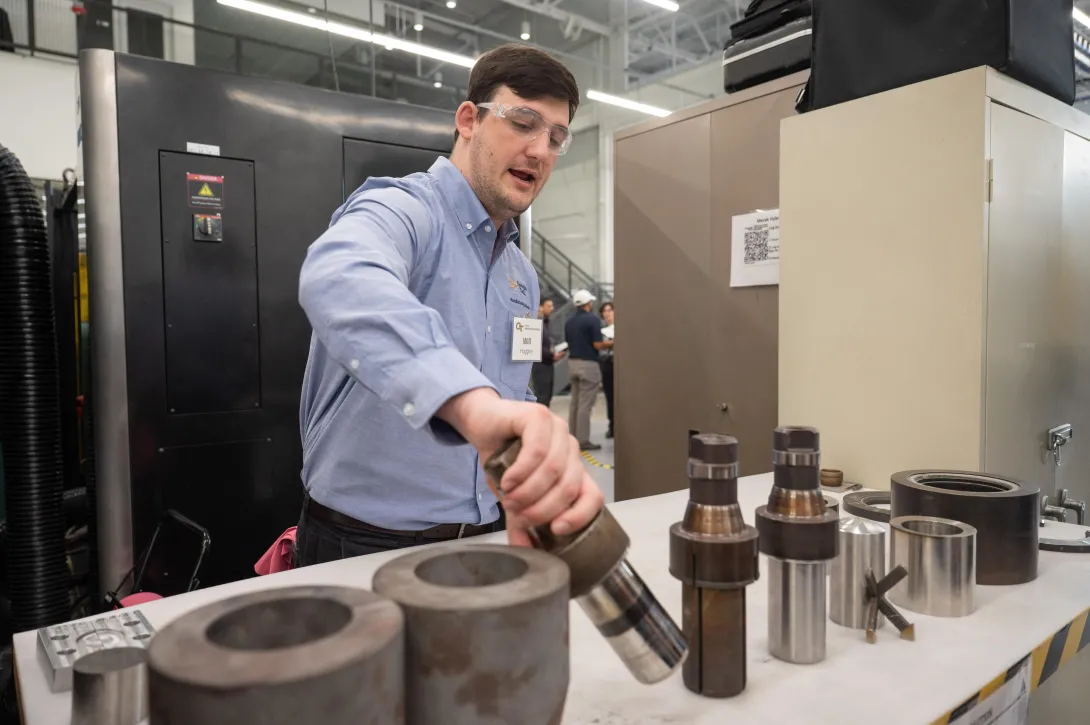
Georgia Tech doctoral candidate Will Huggins presents findings of an AMPF case study featuring the manufacture and repair of high-value parts used by the railway industry.
Counterfeit and out-of-spec components are entering U.S. defense supply chains through thousands of small and midsized suppliers that make up the lower tiers of the industrial base. Researchers at the Georgia Tech Manufacturing Institute (GTMI) say the fix isn't just better parts, but better proof: verified digital records, secured against tampering, that travel with each component from raw material to installation.
A landmark 2012 Senate Armed Services Committee investigation documented 1,800 cases involving more than 1 million suspect counterfeit electronic parts in the defense supply chain, traced to more than 650 companies relying on their own unvetted networks of distributors and brokers. In one case, parts changed hands five times before reaching a Raytheon subcontractor.
The Pentagon has separately estimated that up to 15% of the spare and replacement electronic parts it buys are counterfeit. Without verification built into the supply chain, officials warn, a single bad part, or a single exposed manufacturing controller, can compromise a weapons system or halt a production line. That risk hasn't eased: a 2025 Government Accountability Office report found that Department of Defense now depends on more than 200,000 suppliers, and a deeper look at the MQ-9 Reaper drone's supply chain found Chinese components at the lower tiers despite U.S.- and Europe-based top-tier suppliers.
Manufacturers are adopting a QR-coded digital record, sometimes called a digital passport, that documents a part's full production history and can be scanned at any point in the supply chain. According to GTMI Executive Director Tom Kurfess, a member of the National Academy of Engineering who previously oversaw federal manufacturing R&D policy at the White House, the core requirement of this digital infrastructure is straightforward: apart must prove it is what it claims to be.
"I am not a counterfeit part; I was made according to specifications, and you can insert me into that jet engine with high confidence that I'm going to perform as specified," Kurfess said, describing what the scan of a digital passport for a replacement jet engine turbine blade needs to confirm before it goes into an F-35.
How the Tracking Works
While a fighter jet represents the apex of tracking stakes, Kurfess notes that the underlying infrastructure is already proven on much more ordinary assembly lines. He points to a plumbing fixture plant near Hartsfield-Jackson Atlanta International Airport, where every unit carries a QR code that pulls up the humidity conditions during manufacturing, the processing steps, and who worked on the part. Defense components use the same method, where an untraced failure carries far higher stakes.
The technology itself is cost-effective. Shops have swapped standard calipers for Bluetooth-enabled versions that cost only a few dollars more, Kurfess said. Paired with a smartphone or tablet and a cloud account, those calipers automatically and securely feed measurements into a spreadsheet rather than a handwritten log, building a documentation record for every part in a batch.
"Before shipping it off, you essentially signal that you are ready. You click the print button, and a QR code prints out to go right on the shipping bin," Kurfess said. "Whoever receives that bin, whether a commercial OEM or a defense prime, scans the code and can pull up the part’s full record.” The same approach covers more complex components. Electric motors built for the automotive industry now upload test-stand performance data to the cloud before shipping; once installed, a vehicle's control system scans the motor's passport and calibrates accordingly, Kurfess said. On automotive assembly lines, cameras and scanners verify that every part in a kit is present before workers seal and code it, catching shortages before they halt the production line.
For defense suppliers, Kurfess said the documentation lets prime contractors, and the Department of Defense confirm that a part meets specifications and traces it through its full production history. "We know it's a good blade, and you can insert it into the F-35," he said. "We can track all of it."
The Cybersecurity Risk
That documentation only works if the underlying systems stay secure. Saman Zonouz, associate professor in the School of Cybersecurity and Privacy and Electrical and Computer Engineering, said manufacturing is one of 16 sectors the Department of Homeland Security, through the Cybersecurity and Infrastructure Security Agency (CISA) classifies as critical infrastructure, dependent on energy and water to operate while other sectors depend on it in turn.
His research shows adversaries can insert what his team calls "logic bombs" into design files: code that leaves a manufactured part looking normal until it fails on command, whether that part is a drone propeller or a power grid transformer. He also pointed to supply chain attacks, where imported machine tools arrive with vulnerable or deliberately compromised software already installed, the same pattern behind the SolarWinds breach that hit critical infrastructure nationwide.
Scanning the internet, Zonouz's team found manufacturing controllers exposed and reachable by outside actors. Manufacturing hasn't developed cybersecurity measures at the pace of sectors such as finance or energy, he said, in part because engineers built legacy equipment for reliability, not to resist a deliberate attack.
AI cuts both ways, according to Zonouz. It powers new attack-detection systems, including the Georgia AI in Manufacturing (Georgia AIM) technology corridor, a $65 million initiative that includes a pilot project at the Advanced Manufacturing Pilot Facility to enable shops to monitor for anomalies without constant human oversight. But AI systems also introduce new, often unknown vulnerabilities that attackers can exploit.
Zonouz encourages manufacturers to build cybersecurity into systems from the start, borrow lessons from more mature sectors already operating under frameworks such as North American Electric Reliability Corporation Critical Infrastructure Protection for the power grid, and prepare for manufacturing standards, including the Department of Defense's Cybersecurity Maturity Model Certification framework, to tighten over time.
Much of GTMI's work runs through the small and midsized manufacturers that supply nuts, bolts, and castings to prime contractors such as Lockheed Martin and General Motors, companies that typically lack the in-house IT resources of a major OEM. Kurfess said GTMI configures the same cloud tools that automate measurement tracking to meet Department of Defense documentation and cybersecurity requirements, working directly with smaller suppliers to build that capability instead of leaving them to develop it alone.
Tracking Choke Points Before They Become Failures
The same connectivity that verifies individual parts also shows manufacturers where a supply chain is vulnerable before a disruption hits. Kurfess cites the 2011 Fukushima disaster, which knocked out a single Japanese plant supplying a chip used in the machine tool industry worldwide, and the Covid-era shipping container shortage that forced companies to truck castings across the country when no containers were available at U.S. ports for shipping via rail. Mapping a supply chain in both directions, he said, reveals where a single supplier, region, or disruptive event such as inclement weather or a power outage could stop production.
Kurfess compares GTMI's approach to "being the Google Maps for manufacturing," using real-time connectivity to flag bottlenecks and reroute them in the best possible manner. That logic also drives GTMI's push for distributed manufacturing: spreading production of a component, such as electric vehicle motors, across many smaller regional plants instead of one large facility so a local disruption can't affect the whole chain. GTMI's Factory Information Systems Center builds the secure supply chain architectures and machine-to-cloud connectivity behind that work.
Chris Gaffney, managing director of Georgia Tech's Supply Chain and Logistics Institute, reached a similar conclusion in a June 2026 research brief, calling cyberattacks on physical supply chains "a defining executive risk" and trusted operational data possibly "the most valuable" asset a supply chain organization holds.
Verifying Quality Without Shipping Parts Across the Country
GTMI is applying AI directly to quality verification at its Advanced Manufacturing Pilot Facility (AMPF), where manufacturers can build and verify a part under one roof instead of shipping it elsewhere for testing. "Right now, in manufacturing, a piece of equipment, a turbine rotor blade, for example, is created in one place, then sent somewhere else for testing," said Aaron Stebner, an associate professor who leads AMPF's work under the Georgia AIM initiative. "Often it goes across the country to check its interior structure, then is shipped to a second location to test its chemical composition."
AMPF's connected machines "talk" to each other using AI and a knowledge management system, verifying a part’s material composition and durability as it's made rather than after the fact, so manufacturers can confirm they're building what they intend to build without shipping delays. "No other facility in the nation is built to do this autonomously," Stebner said. "Georgia Tech will be the first." GTMI is also opening AMPF to remote materials research through a new AI-driven cloud lab (see sidebar).
GTMI's Role
Kurfess and Zonouz both credited close collaboration between manufacturing and cybersecurity researchers at Georgia Tech, including a dedicated School of Cybersecurity and Privacy, as the basis for GTMI's work in this area. That collaboration drives research into cyber-secure manufacturing platforms designed with security built in from the outset, and AMPF gives those systems a place to run on production-scale equipment.
Kurfess said the next test is scale: whether digital passports, secure cloud tracking, and AI-verified quality checks can move from a handful of pilot programs and flagship facilities to the thousands of small shops that make up the defense industrial base. The technology, from Bluetooth calipers to readily available and cost-effective cloud accounts, is already cheap enough that cost isn't the barrier. What remains is installing, securing, and standardizing those tools across a supply chain that still runs largely on paper.
To learn more about how GTMI can help defense manufacturers build supply chain resilience, visit https://manufacturing.gatech.edu/engage
# # #
GTMI to Build AI-Driven Cloud Lab for Remote Materials Research
Georgia Tech is building a Programmable Cloud Laboratory that will let researchers across the country direct materials experiments at the Georgia Tech Manufacturing Institute's Advanced Manufacturing Pilot Facility (AMPF) without traveling on-site. The National Science Foundation is funding the project with $18.1 million as part of a planned national network of 20 AI-enabled cloud labs.
Researchers will submit a request, and AI agents will translate it into a detailed workflow, coordinating robots, equipment, and data collection across the facility. "Researchers can ask a question, have work recommended by AI agents, have experiments carried out at the facility using robotics, and get the results back," said Aaron Stebner, GTMI associate director, Eugene C. Gwaltney Jr. Chair, and James R. and Sarah R. Borders Faculty Fellow in the George W. Woodruff School of Mechanical Engineering. "They can use AMPF resources to advance their own research without having to be experts in each piece of equipment or send students to AMPF for weeks at a time."
AMPF is approaching autonomous workflow capability across about 38 of its 160 pieces of equipment. The cloud lab aims to push that past 100. Pascal Van Hentenryck, director of the NSF AI Institute for Advances in Optimization, said the system will rely on digital twins, virtual models of the facility, to plan and monitor experiments, and will improve its scheduling and machine tuning as it learns from each run.
The project also integrates Duke University's Automatic FLOW for Materials Discovery platform and a knowledge and data management platform from Contextualize to connect researchers, instruments, and IT systems across the network. Organizers expect more than 400 users from 150 academic, industry, and government institutions, with more than half participating remotely.
Tom Kurfess, GTMI's executive director, said the lab will let industry partners test new ideas before committing to large-scale deployment. "This initiative will shorten development cycles and make it easier to bring promising technologies into production, enabling our partners and us to innovate at the speed of thought," he said.
News Contact
Jennifer Martin
Assistant Director of Research Communications Services
Writer: Anne Wainscott-Sargent
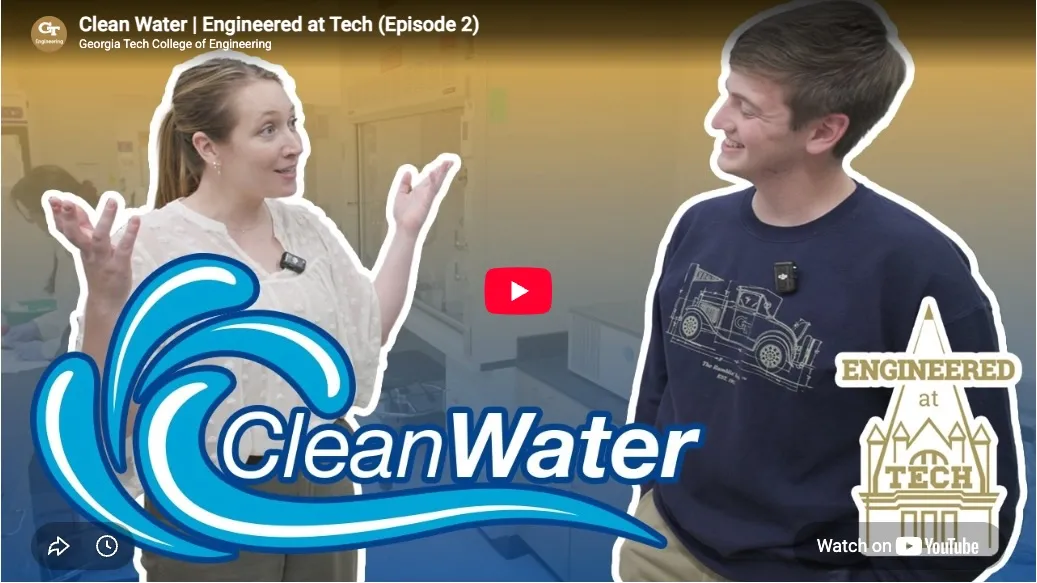
Katherine Graham is an assistant professor in the Georgia Tech School of Civil and Environmental Engineering who studies the fate and transport of pathogens and their indicators in water, including E. coli. Her research focuses on what happens when pathogens get into water, where they go, and how it affects public policy decisions related to health. This includes looking at bacteria and conditions in Atlanta’s Chattahoochee River.
Join Georgia Tech undergraduate Harrison Burnside on this latest episode of Engineered at Tech as he tours Katherine Graham's lab and discovers how to track pathogens in the Chattahoochee River. The goal is to help local agencies pinpoint sources of pollution in rivers and reservoirs to protect public health.
News Contact
Candler Hobbs, College of Engineering

As manufacturing systems become more connected, the cyberthreat grows with them. Saman Zonouz has spent years documenting how vulnerable smart manufacturing environments are. He’s an associate professor in the School of Cybersecurity and Privacy and the School of Electrical and Computer Engineering, where he co-leads the Cyber-Physical Security Lab with Raheem Beyah, Georgia Tech’s provost and executive vice president for Academic Affairs.
"Disrupting the manufacturing sector doesn't just shut down individual shops. It can directly impact national security and public safety," Zonouz said. Because manufacturing is one of 16 federally designated critical infrastructure sectors, it is deeply intertwined with energy, water, and defense, meaning disruptions can cascade far beyond the factory floor.
The threats Zonouz documents go beyond ransomware. His research has demonstrated how adversaries can insert logic bombs into design files, compromising Computer Numerical Control machines or 3D printers.
"We've shown how logic bombs can be inserted remotely into design files so that everything looks normal when the part is printed, but once it's in operation, the attacker can decide when it fails," Zonouz said, citing drone propellers, aircraft wings, and power grid transformer components as examples where invisible sabotage could have catastrophic consequences.
Internet-wide scans conducted by his team found that many shop-floor controllers are directly exposed to the internet, with no meaningful barrier between an adversary and the machines running a production line. Imported equipment compounds the risk, because controllers and firmware from unknown developers may carry unintentional vulnerabilities or deliberately planted backdoors. "In manufacturing, many controllers and machines can still be accessed easily from outside," Zonouz said, echoing the kind of supply chain exposure seen in high-profile attacks on widely used software platforms.
His prescription is straightforward but still largely unimplemented across the sector: Build security into the system design rather than adding it afterward. "The number one principle is to think about cybersecurity and risk when you design the system, not as an afterthought once everything is already built," Zonouz said.
His team has explored this through the $65 million Georgia AIM initiative, a collaboration with Aaron Stebner, Steven Ferguson, and Animesh Chhotaray, led by Ph.D. student Twisha Chattopadhyay. Using AI for automated anomaly detection allows complex production lines to be monitored continuously without requiring constant human oversight.
Georgia Tech's standing at the intersection of manufacturing and cybersecurity is, by most measures, singular. "Georgia Tech is the only top university with a dedicated School of Cybersecurity and Privacy, with about 30 professors focused solely on cybersecurity, and you rarely see this level of collaboration between cybersecurity and manufacturing faculty anywhere else," Zonouz said. That collaboration is already producing joint publications and a patent application for AI-driven attack detection systems developed through Georgia AIM.
Not every attacker wants a quick payoff. Zonouz also tracks advanced persistent threats, where a nation-state actor quietly compromises a controller and does nothing for months, waiting for the right geopolitical moment to act. "They get into the house and just sit there, because by sitting still nobody can detect them," Zonouz said. That patience turns an idle, exposed controller into tomorrow's leverage.
"Manufacturers do not need to solve every problem at once," Zonouz said. Finance and energy already operate under mandatory cybersecurity frameworks, while manufacturing's own standard, the Cybersecurity Maturity Model Certification, is still being phased in. "The security of these systems right now is so weak that basic, easy-to-deploy solutions would stop the majority of attacks that are succeeding simply because the door is wide open," he said. The hardest attacks will always be the patient, targeted ones, and closing the obvious gaps first is what buys manufacturers time.
News Contact
Jennifer Martin
Assistant Director of Research Communications Services
Writer: Anne Wainscott-Sargent
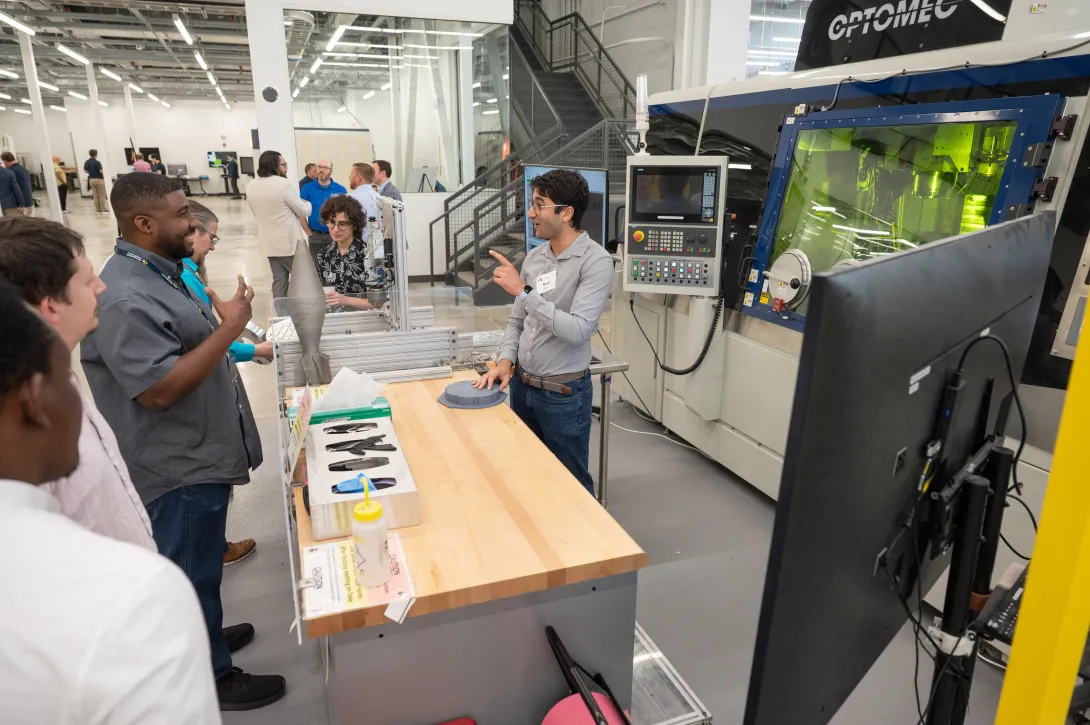
Georgia Tech doctoral candidates Neel Shah and Jamila Khanfri discuss how smart factories have the potential to autonomously incorporate domain expertise into additive manufacturing process development, saving industry partners time and money.
The U.S. has seen its printed circuit board market share plummet to 4% while becoming dangerously dependent on foreign rare earth processing. Now, with global supply chains fracturing, defense industrial capacity under pressure, and adversaries looking to dominate advanced production, the country is in a race to rebuild — and to rebuild smarter.
Two converging trends are shaping what that looks like on the factory floor. The first is the rise of the lighthouse factory, where AI-driven systems, autonomous mobile robots, and centralized digital control work with a skilled human workforce rather than replacing it. The second is physical AI, in which machine learning moves off the server rack and into the manufacturing process itself, making real-time decisions at the machine level that no human operator could match at scale. Together, these shifts are rewriting the economics and the security calculus of American production.
At the forefront of both is the Georgia Tech Manufacturing Institute (GTMI) and its Advanced Manufacturing Pilot Facility (AMPF), a first-of-its-kind, shared-use facility at a research university that is already doing what federal agencies are only beginning to fund. The AMPF is the proving ground where new manufacturing solutions are stress-tested before they reach the shop floor — where a scrap rate that plagued a major automobile supplier was cut in half in 45 days, and where capabilities are being realized faster than ever thought possible.
"The expectation was that building a capability like this would take decades," said Steven Ferguson, principal research scientist and GTMI deputy director. "Instead, we've compressed that timeline dramatically and are already applying these technologies to solve real manufacturing challenges."
The future Ferguson describes has already displaced the old “lights‑out” myth of fully dark, fully automated factories. What modern smart manufacturing demands is tighter integration between machines and the people who define what those machines should accomplish.
Georgia is well positioned to lead that charge. According to the Georgia Association of Manufacturing, the state supports more than 426,000 manufacturing jobs with average earnings of $86,372, contributing $77.1 billion to the state's gross regional product. Projected employment growth of 8% between 2024 and 2029 reflects not just expansion but transformation; the sector needs a different kind of worker, and a different kind of research partner than it did a generation ago.
GTMI and the AMPF have staked out a national leadership position in exactly those capabilities. The facility is pioneering the deployment of physical AI in a university R&D and demonstration environment, using machine learning to monitor and adjust manufacturing processes in real time. When printing a component from a $30,000 barrel of specialty powder or a newly developed superalloy, a process failure is not acceptable. AI-driven systems continuously analyze thousands of optical, thermal, acoustic, and process signals to identify patterns, optimize performance, and detect anomalies.
"In an R&D facility, you program it once, and it changes a million times," Ferguson said. "We're using AI and mobile robots to intelligently coordinate production scheduling, material movement, and manufacturing processes, all while humans define the experiments and interpret the results."
The facility also connects the full innovation chain from materials discovery through manufacturing process to quality assurance, demonstrating in one space what others are still planning.
Smart Manufacturing as a National Security Imperative
The stakes extend well beyond production efficiency. Ferguson points to pandemic-era chip shortages that left tens of thousands of finished vehicles waiting on a single component and to current constraints on the critical minerals and chips needed to build AI data centers and defense systems.
"Our ability to manufacture at scale underpins both our economic competitiveness and our national security," he said. "If we can't build what we need when we need it, we're at a strategic disadvantage."
From the Shop Floor: IAC Group
For Tom Boney, chief operating officer for the Americas at IAC Group, the question wasn’t whether to modernize; it was who could help the company move fast enough to keep plants competitive and workers employed. Georgia Tech, he said, offered something IAC couldn’t build on its own.
“Georgia Tech brings the brains and computing power we don’t have,” Boney said. “You’ve got some of the smartest people in the world on that campus, plugged into world-class infrastructure, and we put them side by side with our operators on the shop floor.”
An automotive interior components manufacturer with plants across the U.S., Mexico, and beyond, IAC is competing daily with facilities in lower-cost regions. “For us, smart manufacturing and AI are really about job and plant future security,” Boney said. “We’re competing every day with plants in China, Mexico, and the U.S., and we already have tons of production data, but we can’t analyze it fast enough on our own.”
IAC’s first project with GTMI focused on a complex adhesive manufacturing process at a plant in Vance, Alabama. The facility had rich production data but lacked computational power and AI modeling to act on it in real time. GTMI students and researchers connected Georgia Tech’s systems directly to the plant’s equipment, working with line operators. The result was a 50% reduction in scrap in roughly 45 days, with those gains then extended to other IAC locations.
The pace of the partnership was another sign that this wasn’t a typical university engagement. A framework agreement that usually takes 12 to 15 months was executed in 35 days, enabling the two organizations to move through new project cycles quickly. IAC now runs five active projects with GTMI, each advancing in turn or making way for the next initiative, a cadence Boney sees as essential to staying competitive on the factory floor.
Building the Workforce of Tomorrow
IAC’s success with GTMI underscores a hard truth: technology can unlock new performance, but only if there’s a workforce ready to run it. Technology alone cannot sustain a manufacturing renaissance. Ferguson is candid about the workforce challenge posed by automation, particularly the erosion of entry-level roles that once served as the first rung of a career ladder.
"The industry has an image problem. People still picture dark, dirty, and dangerous, when the reality is safer, cleaner, and far more interesting," Ferguson said. "Now we're trying to convince kids, 'You don't have to, you get to.' We don't need button pushers. We need thinkers and creators working alongside robots."
GTMI's response runs from K-12 engagement through technical college partnerships to university engineering programs at Georgia Tech, UGA, Georgia Southern, Kennesaw State, and others. For example, UGA partnered with the Russell Innovation Center for Entrepreneurs (RICE) to launch the Georgia AIM Mobile Studio. This traveling advanced-technology lab visits K-12 schools across the state to give students hands-on experience with interactive engineering vignettes and robotics. Teacher boot camps bring high school educators to campus for hands-on training in CAD design, CNC milling, and additive manufacturing, equipping them to return to their classrooms as informed advocates. Dual-enrollment pathways through Georgia's Technical College System give students an on-ramp well before they graduate from high school.
This workforce strategy extends beyond traditional education. Through programs such as Advanced Manufacturing Pathways, teacher professional development, dual-enrollment partnerships, undergraduate research experiences, graduate research opportunities, and industry-sponsored projects, GTMI is helping develop the technicians, engineers, researchers, and manufacturing leaders needed to support the nation's next generation of smart factories.
But the workforce pipeline is only one strand of a much larger web. The AMPF is also where partners pressure-test how AI, automation, and new materials behave under real-world constraints like cost, quality, uptime, safety, and security. At GTMI, AI-driven process control, autonomous material handling, critical-mineral research, and cyber-physical security work in concert to create trusted, resilient production capacity that can scale when it counts, whether that means building lightweight components for vehicles, accelerating drone production to meet national needs, or hardening the critical infrastructure that underpins defense and the economy.
In that context, smart manufacturing is no longer a niche technical initiative. It is the connective tissue between research labs, industry partners, and national readiness, and a platform for new kinds of careers. GTMI’s role is to ensure that those connections are real, tested, and ready to perform under pressure, while opening doors for students, teachers, and workers who will run the next generation of factories. In Georgia, that ecosystem is already taking shape on the ground.
News Contact
Jennifer Martin
Assistant Director of Research Communications Services
Writer: Anne Wainscott-Sargent

The Kakhovka Dam in southern Ukraine was destroyed on June 6, 2023. The event unleashed a catastrophic flood that forced thousands of residents to evacuate their communities as water levels rose 10 feet above normal.
For most floods caused by dam or reservoir breaks, known as outburst floods, current data is nearly impossible to find. By the time researchers can safely reach the site, only the aftermath remains. But in the case of Kakhovka, a newly launched NASA satellite happened to be collecting measurements over the region, providing a unique view of the flood in real time.
Using those observations, Georgia Tech researchers tested how well existing outburst flood models reproduced the actual event. The results revealed a discrepancy: The models consistently underestimated flood conditions. Even improved models struggled to accurately capture both the height and timing of floodwaters.
The findings suggest that commonly used flood simulations may not fully capture the dynamics of large outburst floods. Models need improvement to be effective for hazard assessment and emergency planning.
Putting Models to the Test
Flood models are essential for estimating how deadly and costly outburst floods can be.
“Models allow us to understand which communities could be affected by an outburst flood,” said Karl Lang, an assistant professor in the School of Earth and Atmospheric Sciences. “They also help us estimate how long floodwaters will remain on the landscape. In many places, prolonged flooding can be just as devastating as the initial event because it can damage infrastructure, disrupt livelihoods, and contribute to public health risks.”
Until recently, however, scientists didn’t have a way to evaluate how accurate the models were. But when NASA launched its Surface Water and Ocean Topography (SWOT) satellite, a serendipitous opportunity arose. The satellite passed over the Kakhovka flood zone repeatedly during and after the dam failure, producing detailed daily measurements across the flood plain. SWOT uses two antennas and a technique called interferometry to measure water elevation with approximately 10-centimeter accuracy across rivers, lakes, wetlands, reservoirs, and oceans.
“SWOT doesn’t observe every flood that happens, but when it does, it provides exactly the information we’ve needed to understand how floodwaters move across the landscape,” said Tamlin Pavelsky, professor at the University of North Carolina at Chapel Hill. “Those observations help us improve computer models used to anticipate future flood events.”
Reality Versus Simulation
Researchers compared the satellite observations with models that simulate depth and spread of flooding. They found that models relying on commonly available global data consistently simulated floodwaters that were lower and slower than those SWOT observed.
The team then improved the model inputs by incorporating more realistic estimates of the reservoir and river-bottom topography. Those changes brought model results closer to real-world conditions, but they still failed to accurately reproduce both flood height and flood timing simultaneously.
“It’s really challenging to collect real-world data from these huge floods because they’re so localized, unpredictable, and energetic,” said Karin Lehnigk, a postdoctoral fellow and lead author of the study. “Because SWOT gave us a new image every day covering the entire flood path, we could compare the model with real-world conditions across many locations and points in time in ways that previously were only possible in a laboratory.”
The results suggest model limitations extend beyond simply having better maps of reservoir depth or river channels. Instead, they point to broader challenges in how scientists simulate large outburst floods and their movement across complex landscapes.
As aging infrastructure, extreme weather, and other hazards increase flood risks around the world, researchers say better models are essential for helping communities prepare for the floods.
This research was funded by NASA and the Partnership for an Advanced Computing Environment at Georgia Tech.
CITATION: Lehnigk, K.E., Pavelsky, T.M., & Lang, K.A. (2026). SWOT satellite observations of the Kakhovka Dam break flood highlight limitations of outburst flood models. Geophysical Research Letters, 53, e2025GL120832. https://doi.org/10.1029/2025GL120832
News Contact
Tess Malone, Senior Research Writer/Editor

Casey Wichman, Associate Professor, Georgia Tech School of Economics.
Wildfires in the United States are getting bigger and the season is getting longer, fueled by hotter and drier weather from climate change. Even when fires are hundreds of miles away, the wildfire smoke can still harm people's health and create economic costs through air pollution, said Casey Wichman, an associate professor in Georgia Tech’s School of Economics.
The Air Quality Index (AQI) measures how clean or polluted the air is. A healthy AQI is between zero and 50, but when wildfire smoke blows in and settles over cities, the AQI can reach levels of 500 or more. Poor air quality changes where and how people spend their time and money, reduces productivity (even for those working indoors), and increases healthcare costs.
“Environmental regulations like the Clean Air Act dramatically improved our air quality over the past 40 years, but as wildfire season becomes the new normal, wildfire smoke is eroding those gains,” Wichman said. According to recent research, wildfire smoke has erased about a quarter of the progress made over previous decades, and more than half in many western states.