
May. 01, 2025
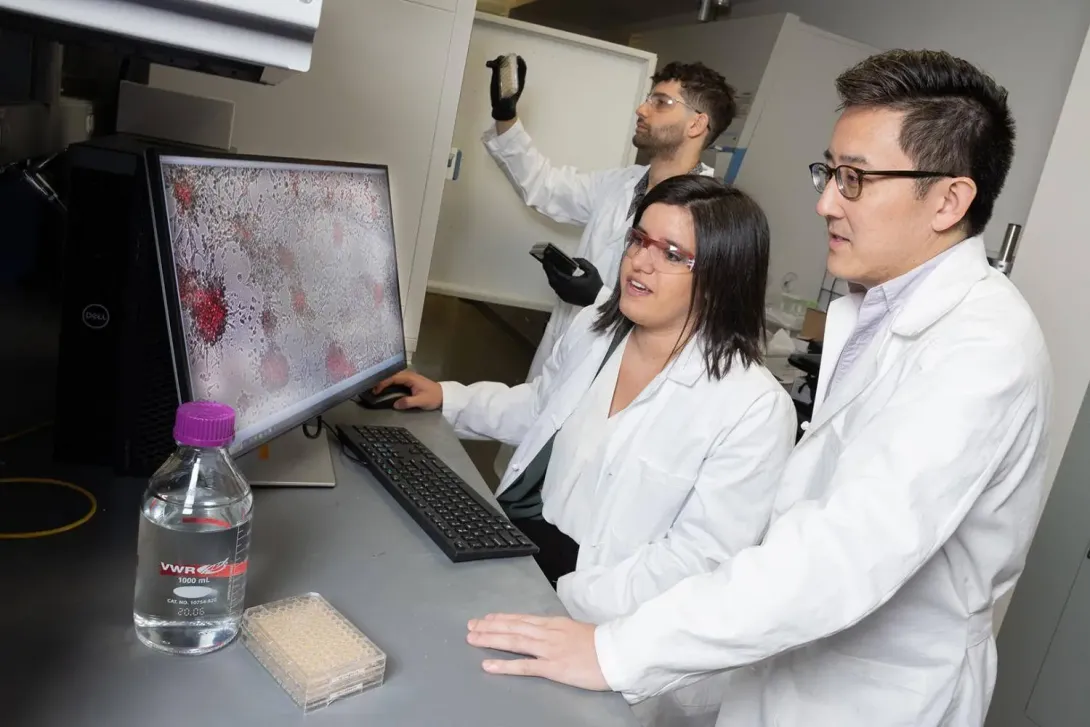
Trenton Gantt and Hugh (Ka Yui) Chen work together in the lab

Early on, Georgia Tech graduate students William Trenton Gantt and Hugh (Ka Yui) Chen imagined working in the space industry.

“When I was 14, I dreamed about being in space one day,” recalls Chen, 22, a native of Hong Kong and a Ph.D. student in aerospace engineering. “I think the industry has been making space more accessible to everyone. Commercialization is a big part of enabling this.”

Gantt, an engineer and former U.S. Army veteran graduating with an MBA from the Scheller College of Business this spring, remembered seeing the space shuttle retire and companies begin privatizing space as he entered young adulthood. 

“I’ve always been interested in space, and a lot of it comes from the challenge of going to space,” he observes. “Seeing how hard it is to get to space and seeing it become achievable — that to me was the most attractive thing about it.”

For Gantt, the feeling always brings to mind John F. Kennedy’s famous line that spelled out America’s space ambitions: “We choose to go to the moon in this decade and do the other things, not because they are easy, but because they are hard.”

Recognizing Georgia Tech’s aerospace strengths, Gantt didn’t waste time building bridges within Scheller and in other parts of Georgia Tech. He founded the Scheller MBA Space Club, a first at the College, to track the industry as it grows and develops. 

“I came from a military background, so I had my eye on the defense industry going into the MBA program. Georgia Tech, being the No. 2 aerospace engineering undergraduate school in the nation, I knew they already had strong industry connections. Making connections was a big goal coming into this program.”

Assessing Early-Stage Space Tech 

He took part in the Entrepreneurship Assistants Program (EAP), which pairs a Scheller MBA student with a faculty or student inventor to evaluate early-stage technology for potential commercialization. He evaluated two space-related technologies, one with Chen’s support. 

“The EAs conduct technology commercialization assessments and develop a business model canvas. By applying an entrepreneurial strategy compass, they predict potential go-to-market strategies for new technology,” says Paul Joseph, principal in the Office of Commercialization’s Quadrant-i unit, who created the EAP.

 (See sidebar to read more about the EAP and the specific technologies assessed.)

Tapping Into a Nearly $2T Industry

According to McKinsey & Co., the space technology market, fueled by advancements in satellite technology, commercial space travel, and 5G networks, is projected to reach $1.8 trillion by 2035.

“We're seeing an industry shifting from a multibillion-dollar market cap to a multitrillion-dollar market cap in less than a decade. If you look at this from a business perspective, this is a massive addressable market for entrepreneurs," says Gantt.

From its Center for Space Technology and Research to the new Center for Space Policy and International Relations and labs like the Space Systems Design Lab, which focuses on areas such as CubeSat propulsion, lunar research, and hypersonic flight, Georgia Tech excels in space research across disciplines. In July, Georgia Tech will launch the Space Research Institute (SRI), one of its newest Interdisciplinary Research Institutes (IRI), to foster additional collaboration in this growing field.

“At Georgia Tech, there are competencies across every single College that will help to augment our understanding of space,” says Alex Oettl, professor of strategy and innovation in Scheller College, whose interest in the new space economy spans the last 20 years. “When you look at the technologies coming from Georgia Tech, they can impact this future trillion-dollar industry.”

 An economist by training, Oettl led Georgia Tech’s involvement in the Creative Destruction Lab-Atlanta, a multi-university program that helped commercialize early-stage scientific technologies.

Leveraging Affordable Launch

The emergence of affordable launch, spurred by SpaceX’s introduction of the Falcon 9 rocket using reusable rocket technology, has made space much more accessible, from biomedical companies to academic institutions.

“Because there has been a drop in the cost of accessing space, it allows experimentation to flourish,” says Oettl. 

He recalls Mark Costello, former chair of the Daniel Guggenheim School of Aerospace Engineering, explaining how he could launch a CubeSat into Low Earth Orbit out of his research budget, whereas before it would have been cost-prohibitive.

Today, Georgia Tech students and researchers are poised to capitalize on the new space economy stack — from new launch capabilities to new development in propellants and in-space operations and maintenance to more powerful sensors on Earth-observation satellites.

“I’ve seen firsthand the traction occurring on the commercial side. There are a lot of social scientists waking up to the opportunity that exists and thinking about business dynamics that will emerge as a result of this great opportunity,” he says.

Georgia Tech, an interdisciplinary, tech-focused university, brings significant capabilities across its Colleges to drive new and emerging technologies that have implications for space. 

“Space hits on all the strengths that exist at the various Colleges,” Oettl explains. “Faculty at Georgia Tech are pushing the boundary and showing our students innovations that will emerge in the space economy that are not immediately obvious — such as in adjacent industries.”

Oettl calls these first-order and spillover impacts of new technology. By first-order impacts, he means businesses can take advantage of these opportunities and create new products on top of the original innovation. By spillovers, he cites as an example an Earth-observation satellite enabling other industries to take advantage of data from the ground. For instance, insurance companies are one of the largest users of space technology by way of satellite imagery.

Bringing Capabilities Together Through New Space IRI

The SRI will bring together the best in engineering, computer science, policy, and business research across Georgia Tech. Along the way, it could help engineers and computer scientists think with a more business-minded approach to pitch their innovations to the commercial space sector. 

“You don’t see a lot of engineers having that inherent ability,” notes Gantt. “The Space IRI can shine by fostering collaboration between business students and engineers, enabling them to develop innovative go-to-market strategies and clearly define the unique value propositions these technologies offer to end users. You can bring these people together and create some forward momentum in the space industry.”

News Contact

News Contact: Laurie Haigh

Writer: Anne Wainscott-Sargent

May. 07, 2025
Man with crossed arms standing in a hallway with many windows

Mikkel Thomas has loved comic books since he was a kid, but he didn’t expect to relate to them as an adult. Just like Peter Parker didn’t intend to be a superhero, Thomas didn’t plan to be a research engineer. When he came to Georgia Tech in 1993 as an undergraduate, a bit of serendipity led him to the field of microelectronics (very small electronic components and circuits). Nearly three decades later, his superpower is demystifying the world of microelectronics for students.

Read more »

Apr. 28, 2025
From left to right, Jack Rose, Team Carchive; Angela Duodu, Hadley Williams,  Brandon Parker, Oluwatooni Alade , and Jesus Sierra Jr., Team Sensible; and  Yasmine Green, Team Onyc.

The winners of the 2025 Spring I2P Showcase, from left to right, Jack Rose, Team Carchive; Angela Duodu, Hadley Williams, Brandon Parker, Oluwatooni Alade , and Jesus Sierra Jr., Team Sensible; and Yasmine Green, Team Onyc.

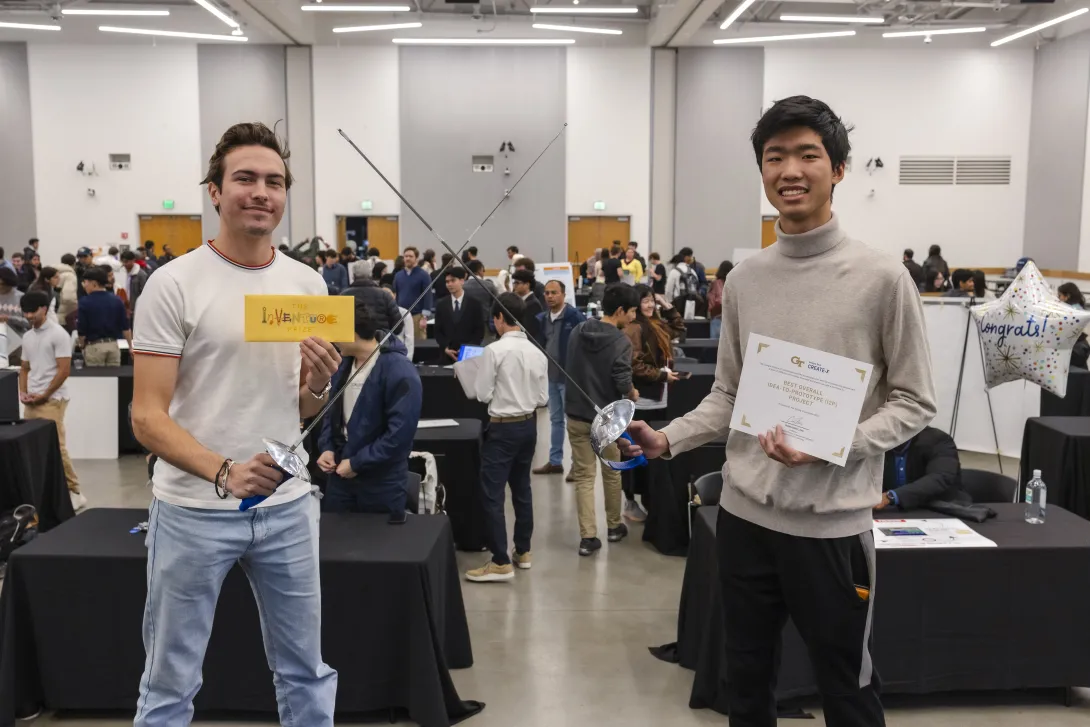
At the Spring 2025 Idea to Prototype (I2P) Showcase, a prototype helping car enthusiasts find niche vehicles and their histories came out on top. Jack Rose, a junior in computer science, took home first place, a golden ticket to CREATE-X’s summer accelerator, Startup Launch, and advancement into the semifinal round of the InVenture Prize, a faculty-led innovation competition for undergraduate students and recent Tech bachelor’s graduates.

Second place was awarded to Team Sensible, made up of juniors Oluwatooni Alade, computer science; Brandon Parker, computer science; Angela Duodu, computer science; Jesus Sierra Jr., computer science; and Hadley Williams, computer engineering. Sensible is a browser extension that rates the sustainability of products users find online and offers alternative products for items that score low. 

Third place went to Team Onyc, which includes Yasmine Green, a first-year mechanical engineering student. Onyc replaces the computer mouse with a wearable alternative that allows users to control computer navigation with the movement of their fingertips and fingernails.

Dozens of teams competed at the showcase, which is the culmination of I2P, a CREATE-X course focused on supporting students in creating solutions. The course offers research credit (for undergraduates only), up to $500 in reimbursements for physical material expenses, the opportunity to work collaboratively across majors, and faculty mentorship. It is held in the spring, summer, and fall, and it’s open to undergraduate and graduate students from all majors.  

Read our Q&A with the winner and stay tuned for our interviews with the other winning teams.

Team Carchive

Jack Rose, Junior, Computer Science

Why did you pursue your startup? 

Rose: I’ve been into cars my whole life. Trying to track cars is my hobby. There are always edge cases, and how are you planning to attack them? Because I spent so much time, especially working with other people, getting this data, and trying to figure this out, I became very adept at understanding the data. The dealers, collectors especially, were trying to understand the whole story, so they would come to me. But the way I had to do it was spreadsheets all over the place, and I was trying to find a solution to keep it all in one spot. I couldn’t find a way to do it, so I said, “Well, I’ll build it.” And then I got into I2P.

What was challenging about building your prototype over the semester? 

Rose: This semester, it was mainly trying to come up with the schema and how to physically account for the edge cases. It’s not easy; it took a lot of deep thought, discussions with other people who are into these niche cars, and understanding what details we needed. I’m still trying to add more things and figure it out. It’s not perfect, but it’s enough.

What was your favorite part about I2P? 

Rose: Adding features that I was looking for. For example, let’s say I was looking for a car. Filter all the cars over 25 years old and imported to the U.S. — I can easily search my database.

What would you say to students who are interested in entrepreneurship? 

Rose: It’s always, “You should have started sooner.” I’ve always thought about it. My biggest advice is to just start doing it, even if it’s a little bit here, a little bit there. If it doesn’t work out, at least you’ve tried.


A photo gallery from the Spring 2025 I2P Showcase can be viewed on the CREATE-X Flickr page.

Students interested in the I2P program can register for the upcoming summer and fall semesters. The deadline for Summer 2025 is May 14, and the deadline for Fall 2025 is May 16.

CREATE-X's next event, Demo Day, will take place on Aug. 28 at Exhibition Hall, where more than 100 startups will be on display. Attendees can experience the newest batch of founders leveraging the latest technology to solve pressing challenges. The event offers an opportunity to network with entrepreneurs, industry leaders, and passionate enthusiasts, and supports the next generation of innovators. Register for Demo Day today and be a part of these founders’ journeys!  


News Contact

Breanna Durham

Marketing Strategist

Apr. 24, 2025
Instead of relying on traditional methods like cognitive tests and image scans, this new approach leverages data science and algorithms.

Instead of relying on traditional methods like cognitive tests and image scans, this new approach leverages data science and algorithms.

Md Abdur Rahaman
Ph.D. candidate Md Abdur Rahaman’s dissertation studies brain data to understand how changes in brain activity shape behavior.

Ph.D. candidate Md Abdur Rahaman’s dissertation studies brain data to understand how changes in brain activity shape behavior.

A Georgia Tech doctoral student’s dissertation could help physicians diagnose neuropsychiatric disorders, including schizophrenia, autism, and Alzheimer’s disease. The new approach leverages data science and algorithms instead of relying on traditional methods like cognitive tests and image scans.

Ph.D. candidate Md Abdur Rahaman’s dissertation studies brain data to understand how changes in brain activity shape behavior. 

Computational tools Rahaman developed for his dissertation look for informative patterns between the brain and behavior. Successful tests of his algorithms show promise to help doctors diagnose mental health disorders and design individualized treatment plans for patients.

“I've always been fascinated by the human brain and how it defines who we are,” Rahaman said. 

“The fact that so many people silently suffer from neuropsychiatric disorders, while our understanding of the brain remains limited, inspired me to develop tools that bring greater clarity to this complexity and offer hope through more compassionate, data-driven care.”

Rahaman’s dissertation introduces a framework focusing on granular factoring. This computing technique stratifies brain data into smaller, localized subgroups, making it easier for computers and researchers to study data and find meaningful patterns.

Granular factoring overcomes the challenges of size and heterogeneity in neurological data science. Brain data is obtained from neuroimaging, genomics, behavioral datasets, and other sources. The large size of each source makes it a challenge to study them individually, let alone analyze them simultaneously, to find hidden inferences. 

Rahaman’s research allows researchers and physicians to move past one-size-fits-all approaches. Instead of manually reviewing tests and scans, algorithms look for patterns and biomarkers in the subgroups that otherwise go undetected, especially ones that indicate neuropsychiatric disorders.

“My dissertation advances the frontiers of computational neuroscience by introducing scalable and interpretable models that navigate brain heterogeneity to reveal how neural dynamics shape behavior,” Rahaman said. 

“By uncovering subgroup-specific patterns, this work opens new directions for understanding brain function and enables more precise, personalized approaches to mental health care.”

Rahaman defended his dissertation on April 14, the final step in completing his Ph.D. in computational science and engineering. He will graduate on May 1 at Georgia Tech’s Ph.D. Commencement

After walking across the stage at McCamish Pavilion, Rahaman’s next step in his career is to go to Amazon, where he will work in the generative artificial intelligence (AI) field. 

Graduating from Georgia Tech is the summit of an educational trek spanning over a decade. Rahaman hails from Bangladesh where he graduated from Chittagong University of Engineering and Technology in 2013. He attained his master’s from the University of New Mexico in 2019 before starting at Georgia Tech. 

“Munna is an amazingly creative researcher,” said Vince Calhoun, Rahman’s advisor. Calhoun is the founding director of the Translational Research in Neuroimaging and Data Science Center (TReNDS).

TReNDS is a tri-institutional center spanning Georgia Tech, Georgia State University, and Emory University that develops analytic approaches and neuroinformatic tools. The center aims to translate the approaches into biomarkers that address areas of brain health and disease.    

“His work is moving the needle in our ability to leverage multiple sources of complex biological data to improve understanding of neuropsychiatric disorders that have a huge impact on an individual’s livelihood,” said Calhoun.

News Contact

Bryant Wine, Communications Officer
bryant.wine@cc.gatech.edu

Apr. 24, 2025
Interactive Computing Professor Mark Riedl co-organized the 2024 Summit on Responsible Computing, AI, and Society, where AI literacy was a key topic. Photo by Terence Rushon/College of Computing

Interactive Computing Professor Mark Riedl co-organized the 2024 Summit on Responsible Computing, AI, and Society, where AI literacy was a key topic. Photo by Terence Rushon/College of Computing

If you’re worried about artificial intelligence (AI) taking your job, Georgia Tech’s Mark Riedl says that probably won’t happen. However, losing your job to someone who knows how to leverage AI tools in the workplace is something to be concerned about.

To help people beyond campus understand what AI tools are available and how to use them effectively, Riedl recently co-taught an online course by CNBC Make It titled How to Use AI to Be More Successful at Work.

“The running joke right now is that AI will not replace people, but people who use AI will replace people who do not use AI,” said Riedl, professor in the School of Interactive Computing

The 90-minute course offers tips and hacks to users who are:

  • Inexperienced in using AI tools in the workplace and are looking to grow in professional development
  • Small business owners who are overwhelmed with administrative tasks, marketing, industry research, and data analysis
  • Job seekers looking to stand out from the crowd
  • People seeking to improve their work-life balance

Riedl, whose research focuses on human-centered and explainable AI, taught sections of the course on the foundation of AI. One of the biggest sections of the course covers large-language models (LLMs). 

“When large language models were put forward as chatbots, this was the first time that any person out in the world could naturally interact with an AI system without having to learn to program or write code,” Riedl said.

For less than $100, the on-demand course includes a detailed workbook that helps users consider each aspect of their jobs and daily lives and how AI can improve them.

The Big Picture

CNBC’s use of Riedl’s expertise is one of many examples of how College of Computing faculty are leading the way in teaching AI literacy.

David Joyner, executive director of online education, said Georgia Tech’s Online Master of Science in Computer Science (OMSCS) program continues to innovate with AI literacy in mind.

[RELATED: Experts Say Life-long Learning is a Must to Keep Pace with Generative AI]

He said companies and employees alike are learning to navigate AI. Companies are considering AI from a general perspective, focusing on how it can make their businesses more efficient, while employees are using it to become more versatile and valuable workers.

“It’s an interesting dichotomy,” Joyner said. “If companies are trying to figure out how to operate more efficiently, and you have people using these tools to be more productive, at what point does the company need to prioritize using these tools instead of letting their use be organic? We’re still in this experimental phase.”

In a conversation with former College of Computing interim dean Alex Orso, Joyner discusses how OMSCS is staying at the forefront in equipping students with the latest technology skills they need to be successful in a fluctuating industry.

“We must figure out what generative AI can do well and properly leverage it so we’re not cutting out the foundation of a building and replacing it with sticks,” Joyner said.

The complete conversation between Joyner and Orso is available on the College's Youtube channel.

News Contact

Nathan Deen, Communications Officer

Georgia Tech School of Interactive Computing

nathan.deen@cc.gatech.edu

Apr. 16, 2025
Default Image: Research at Georgia Tech

EmCool, a Georgia Tech spinout, is tackling one of tech’s biggest challenges: overheating.Developed by Ph.D. alum Daniel Lorenzini, EmCool’s patented microfluidic cooling system is embedded directly into silicon chips—making it faster, smaller, and more efficient than traditional fans or heat sinks.

What’s the hottest thing in electronics and high-performance computing? In a word, it’s “cool.”

To be more precise, it’s a liquid cooling system developed at Georgia Tech for electronics aimed at solving a long-standing problem: overheating.

Developed by Daniel Lorenzini, a 2019 Tech graduate who earned his Ph.D. in mechanical engineering, the cooling system uses microfluidic channels — tiny, intricate pathways for liquids — that are embedded within the chip packaging.

He worked with VentureLab, a Tech program in the Office of Commercialization, to spin his research into a startup company, EMCOOL, headquartered in Norcross.

“Our solution directly addresses the heat at the source of the silicon chip and therefore makes it faster,” Lorenzini said. “Our design has our system sitting directly on the silicon chips that generate the most heat. Using the fluids in the micro-pin fins, it carries the heat that’s produced away from the chip.”

That cooling solution is directly integrated into the electronic components, making it significantly more efficient than conventional cooling methods, because it enhances the heat dissipation process.

The result is a much lower risk of overheating and reduced power consumption, he said.

Lorenzini, who researched and refined the technology in the lab of Yogendra Joshi at the George W. Woodruff School of Mechanical Engineering, was awarded a patent for the technology in September 2024.

Now, EMCOOL, which has five empoloyees, is actively pursuing venture capital funding to scale its technology and address the escalating thermal management challenges posed by AI processors in modern data centers.

The system uses a cooling block with tiny, pin-like fins on one side and a special thermal interface material on the other. There's also a junction attached to the block, with ports for the fluid to flow in and out. The cooling fluid moves through the micro-pin fins and helps to carry away the heat.

Since the ports are designed to match the shape of the fins, it ensures that the fluid flows efficiently and the heat is dissipated as effectively as possible at chip-scale. 

As electronic devices — from high-performance personal computers to data centers used for artificial intelligence processing — become more powerful, they generate more heat. This excess heat can damage components or cause the device to underperform.

Traditional cooling methods, which include fans or heat sinks, often struggle to keep pace with the increasing demands of the newer model electronics. Lorenzini’s microfluidic system addresses the challenge of overheating with his patented, more effective, compact, and integrated cooling solution.

With the guidance of Jonathan Goldman, director of Quadrant-i in Tech’s Office of Commercialization, Lorenzini secured grant funding through the National Science Foundation and the Georgia Research Alliance to further the research and build design prototypes.

“We immediately had the sense there was commercial potential here,” Goldman said. “Thermal management, or getting rid of heat, is a ubiquitous problem in the computer industry, so when we saw what Daniel was doing, we immediately began to engage with him to understand what the commercial potential was.”

Indeed, the initial focus for the technology was the $159 billion global electronic gaming market. Gamers need a lot of computing power, which generates a lot of heat, causing lag.

But beyond gaming systems, the company, which manufactures custom cooling blocks and kits at its Norcross facility, is eyeing more sectors, which also suffer from overheating, Goldman said.

The technology addresses similar overheating electronics challenges in high-performance computing, telecommunications, and energy systems.

“This work propels us forward in pushing the boundaries of what traditional cooling technologies can achieve because by harnessing the power of microfluidics, EMCOOL's systems offer a compact and energy-efficient way to manage heat,” Goldman said. “This has the potential to revolutionize industries reliant on high-performance computing, where heat management is a constant challenge.”

News Contact

Péralte C. Paul
peralte@gatech.edu
404.316.1210

Apr. 14, 2025
An illustrative image of Earth with debris orbiting around it

Debris presents not only a physical hazard but also a complex issue for satellite operators trying to navigate these invisible threats. (Credit: Adobe Stock)

Mariel Borowitz and Thomas González Roberts

Mariel Borowitz and Thomas González Roberts

In 1957, the Soviet Union launched Sputnik. Several months later, the U.S. sent Explorer I into space. With two small objects, the space race began. 

As of March 2025, more than 11,000 satellites are orbiting Earth. According to some estimates, there could be as many as 60,000 by 2030. 

“In the Space Age, space activity was overtly geopolitical, and that’s never really gone away,” said Mariel Borowitz, associate professor in the Sam Nunn School of International Affairs and director of the recently launched Center for Space Policy and International Relations. “But the major shift now is the rapid rise of commercial activity and the number of actors in space.”

Space traffic is global by nature — satellites cross over myriad countries while orbiting. Thanks to the Outer Space Treaty, every country has the right to access space. More actors in space, though, mean more trash and more potential collisions. 

Borowitz and her colleagues in the Nunn School analyze and help develop policies on protecting space so it remains safe and usable in the future. In other words, they’re doing everything they can to make sure things don’t blow up. 


Taking Out the (Space) Trash

Thomas González Roberts, a postdoctoral fellow in the Nunn School, has a research portfolio that unites his background in astrodynamics with space governance. One area he specializes in is space debris and its impact on the sustainability of space operations. 

"We define space debris as objects in Earth orbit that are no longer actively being controlled," Roberts said. "A satellite that has run out of fuel, for example, becomes a piece of floating garbage.” 

The issue, he notes, isn't just the large pieces of debris but also the many tiny fragments that go undetected. 

"We can track objects the size of a softball, but anything smaller is more challenging to spot with current technology," he explained. "These small pieces can still destroy satellites because of their velocity, like a bullet can harm a human."

As such, debris presents not only a physical hazard but also a complex issue for satellite operators trying to navigate these invisible threats. Roberts also highlights the rising number of satellites in popular orbital regimes. Low Earth orbit (LEO) is the closest orbital regime to Earth. Beginning at the upper reaches of the Earth’s atmosphere, it hosts communication and observational satellites and is by far the most congested region of all. 

"There are only a few spots in the near-Earth space environment where satellite operators want to be, effectively making these regions limited natural resources,” he said. “Without proper coordination, these valuable spaces will be overcrowded, making it harder to avoid collisions and creating more debris."

To address these issues, Roberts advocates for better international coordination and the development of more effective space policies. "How operators choose to control their satellites is a form of space policy," he noted. "We need transparent, collaborative policies that encourage more responsible space operations. When a satellite mission is completed, operators should clean up after themselves, ensuring the long-term viability of these orbital regions."


Space Situational Awareness

Space situational awareness (SSA) involves tracking objects in space, predicting their movements, and identifying potential collisions. If a potential collision is detected, the next step is determining whether to issue a warning. Currently, the U.S. military operates the most globally advanced SSA system, providing collision warnings free of charge to spacecraft operators worldwide. However, there is an ongoing effort to shift this mission to a civil agency, the Office of Space Commerce (OSC), because so much of space activity is now international and commercial.

In 2022, Borowitz testified before Congress on transitioning from a military to a civilian SSA system. A few months later, she was invited to join the OSC on a detail to help implement this transition. Currently, she spends half her time there as head of International SSA Engagement. Her work bridges the gap between research and government operations, ensuring that advances in academia inform policy and operations.

Borowitz and Brian Gunter, a professor in the Daniel Guggenheim School of Aerospace Engineering, launched a joint project tackling the complex issue of space traffic coordination, supported by a grant from NASA.

Their detailed simulation model — the Georgia Tech Virtual Environment for Space Traffic Analysis (VESTA) — incorporates real satellite data from military space situational awareness systems to test out possible space traffic coordination rules. 

“One question we’re trying to answer is whether, when we see the possibility of a collision in space, we should have right-of-way rules,” Borowitz said. “We have them on the ground for cars, and we have them in the air and at sea. In space, we have no real concept of right of way.”  

Through this approach, Borowitz and Gunter can test different traffic rules and collision scenarios over months and even years. Their model also assesses the impact of these rules on different countries and companies, and what might happen if some actors choose not to follow them.

“The results of these simulations are crucial for shaping international agreements; they provide concrete data on the potential costs and benefits of unilateral versus multilateral approaches to space governance,” Borowitz said. “This kind of research not only brings technical astrodynamics into policy discussions but also offers valuable insights for negotiating space traffic coordination at a global scale.”

By combining cutting-edge research with real-world policy work, Borowitz, Roberts, and their colleagues are helping ensure that space remains usable for everyone. With their work, the path to a safer space environment is becoming clearer.

News Contact

Catherine Barzler, Senior Research Writer/Editor
Institute Communications
catherine.barzler@gatech.edu

Apr. 11, 2025
Default Image: Research at Georgia Tech

For centuries, innovations in structural materials have prioritized strength and durability — often at a steep environmental price. Today, the construction industry accounts for approximately 10% of global greenhouse gas emissions, with cement, steel, and concrete responsible for more than two-thirds of that total. As the world presses for a sustainable future, scientists are racing to reinvent the very foundations of our built environment.

Paradigm Shift in Construction

Now, researchers at Georgia Tech have developed a novel class of modular, reconfigurable, and sustainable building blocks — a new construction paradigm as well-suited for terrestrial homes as it is for extraterrestrial habitats. Their study, published in Matter, demonstrates that these innovative units, dubbed eco-voxels, can reduce carbon footprints by up to 40% compared to traditional construction materials. These units also maintain the structural performance needed for applications ranging from load-bearing walls to aircraft wings.

“We created sustainable structures using these eco-friendly building blocks, combining our knowledge of structural mechanics and mechanical design with industry-relevant manufacturing practices and environmental assessments,” said Christos Athanasiou, assistant professor at the Daniel Guggenheim School of Aerospace Engineering.

Housing Affordability Solutions

Their work offers a potential solution to the growing housing affordability crisis. As climate-driven disasters such as hurricanes, wildfires, and floods increase, homes are damaged at higher rates, and insurance costs are skyrocketing. This crisis is fueled by rising land prices and restrictive development regulations. Meanwhile, the growing demand for housing places an increasing strain on global resources and the environment. The modularity and circularity of the developed approach can effectively address these issues. 

The New Building Blocks

Eco-voxels — short for eco-friendly voxels, the 3D equivalent of pixels — are made from polytrimethylene terephthalate (PTT). PTT is a partially bio-based polymer derived from corn sugar and reinforced with recycled carbon fibers from aerospace waste (scrap material lost during the manufacturing of aerospace components). Eco-voxels can be easily assembled into large, load-bearing structures and then disassembled and reconfigured, all without generating waste. Consequently, they offer a highly adaptable, sustainable approach to construction.

The team tested eco-voxels and found they can handle the pressure that buildings usually face. They also used computer simulations to show that changing the shape of eco-voxels makes them suitable for many different building needs.

The researchers compared the eco-voxel approach to other emerging construction methods like 3D-printed concrete and cross-laminated timber (CLT), finding that eco-voxels offer significant environmental advantages. While traditional and alternative materials are often heavy and carbon-intensive, the eco-voxel wall had the lowest carbon footprint: 30% lower than concrete and 20% lower than CLT.

These results highlight eco-voxels as a promising low-carbon, high-performance solution for sustainable and affordable construction, opening new possibilities for faster, more sustainable building solutions. In addition to residential uses, emergency shelters built with eco-voxels could be used for disaster-relief scenarios, where quick assembly, modularity, and minimal environmental impact are crucial.

This study exemplifies how advances in structural mechanics, sustainable composite development, and sustainability analysis can yield transformative solutions when coupled. Eco-voxels  —  our modular, reconfigurable building blocks — provide a scalable, low-carbon alternative that redefines our approach to building in both terrestrial and extraterrestrial environments," said Athanasiou. 

Building in Space

Beyond their terrestrial potential, eco-voxels can also offer a promising solution for off-world construction where traditional building methods are unfeasible. Their lightweight, rapid assembly — structures can be erected in less than an hour — and reliance on sustainable or locally sourced materials make them ideal candidates for future Martian or lunar shelters.

“The ability to build these structures quickly is a significant advantage for space construction,” said Athanasiou. “In space, we need lightweight units made from locally sourced materials.”

Perhaps most importantly, the researchers envision a future where the built environment not only minimizes harm but actively contributes to the preservation of planetary health.

This research was led by Georgia Tech, in collaboration with teams from the Massachusetts Institute of Technology, the University of Guelph in Ontario, Canada, and the National University of Singapore.


News Contact

Monique Waddell

Apr. 11, 2025
Elizabeth Cherry SIAM Fellow

Two faculty members represented Georgia Tech as new fellows to the world’s leading organization dedicated to applied mathematics, computational science, and data science.

The Society for Industrial and Applied Mathematics (SIAM) selected Elizabeth Cherry and Katya Scheinberg as Class of 2025 fellows. The two Georgia Tech faculty join an illustrious class of 23 other researchers from around the globe in this year’s class. 

SIAM selected Cherry to recognize her contributions to mathematical and computational modeling and extensive service to the SIAM community. She studies the electrical behavior of cardiac cells and tissue.

Cherry’s computer models and simulations improve understanding of cardiac dynamics in normal and diseased states. Using these tools, she designs advanced strategies for preventing and treating arrhythmias.

“SIAM has played a huge role in my professional development—the first conference I attended as a graduate student was a SIAM conference, and I’ve attended at least one SIAM conference almost every year since then,” Cherry said. 

“Given this long history, it means a lot to me for SIAM to acknowledge my contributions in this way.”

Scheinberg, from Georgia Tech’s College of Engineering, was selected for her foundational contributions to derivative-free optimization and optimization applications in data science and her dedicated service to the optimization community.

[Related: Coca-Cola Foundation Chair Katya Scheinberg selected for 2025 Class of SIAM Fellows]

Cherry is the fifth faculty member from the School of Computational Science and Engineering (CSE) to be selected as a SIAM Fellow.

Cherry’s announcement as a SIAM Fellow comes weeks after serving in a leadership role at a SIAM conference. She co-chaired the organizing committee of the SIAM Conference on Computational Science and Engineering (CSE25).

In 2023, SIAM members reelected Cherry to a second term as a council member-at-large. She began her three-year term in January 2024.

"SIAM Fellows are selected for deep mathematical contributions. Receiving Fellow status is a high honor for any applied mathematician," said Regents’ Professor Srinivas Aluru, senior associate dean of the College of Computing and Class of 2020 SIAM Fellow. 

"Not only are Elizabeth's contributions technically outstanding, but her work also provides deep insights into the functioning of the heart and its abnormalities."

Cherry’s leadership and service extends outside of SIAM, influencing students and faculty across Georgia Tech. 

In December, the College of Computing appointed Cherry as associate dean for graduate education. Before this appointment, she served as associate chair for academic affairs of the School of CSE. 

With her new role as associate dean, Cherry continues serving as director of CSE programs at Georgia Tech. 

In March 2024, Cherry was among five Georgia Tech faculty members selected for the ACC Academic Leaders Network (ACC ALN) Fellows program. The ALN program fosters cross-institutional networking and collaboration between ACC schools, increasing each institution’s academic leadership capacity.

Cherry was part of a team of Georgia Tech and Emory University researchers who won a Georgia Clinical and Translational Science Alliance award in 2023. The group earned the Team Science Award of Distinction for Early Stage Research Teams award for work that captures high-resolution visualizations of spiral waves that create heart arrhythmias.

SIAM will recognize Cherry, Scheinberg, and Class of 2025 fellows during a reception at the SIAM/CAIMS Annual Meetings this July in Montréal.

“It is such an honor to be recognized as a SIAM Fellow,” Cherry said. “I’m thrilled to join my CSE colleagues who have also received this recognition.”

News Contact

Bryant Wine, Communications Officer
bryant.wine@cc.gatech.edu

Apr. 10, 2025
Georgia Quick Start Deputy Commissioner Scott McMurray (center left) and Georgia Tech Executive Vice President for Research Tim Lieuwen (center right) gathered with members of the Georgia Tech Manufacturing Institute, Georgia AIM, and more to officially commemorate the partnership on April 8.

Georgia Quick Start Deputy Commissioner Scott McMurray (center left) and Georgia Tech Executive Vice President for Research Tim Lieuwen (center right) gathered with members of the Georgia Tech Manufacturing Institute, Georgia AIM, and more to officially commemorate the partnership on April 8.

McMurray and Lieuwen signed a Memorandum of Understanding to mark the collaboration.

McMurray and Lieuwen signed a Memorandum of Understanding to mark the collaboration.

Georgia Tech researchers will work with Georgia Quick Start to develop extended reality training programs for manufacturing workers to make training more consistent and efficient.

Georgia Tech researchers will work with Georgia Quick Start to develop extended reality training programs for manufacturing workers to make training more consistent and efficient.

In a significant move to bolster Georgia's workforce, Georgia Tech has partnered with Georgia Quick Start to advance manufacturing training and skill development. This collaboration, formalized by the signing of a Memorandum of Understanding on April 8, aims to elevate the quality and efficiency of manufacturing workforce training across the state.

“At Georgia Tech, innovation isn’t just about discovery — it’s about solving real-world challenges,” said Executive Vice President for Research Tim Lieuwen. “Georgia Quick Start ensures that cutting-edge research in advanced manufacturing translates into practical training solutions. Together, we are equipping Georgia’s workforce with the skills needed to drive economic growth and industry advancement.”

As manufacturing technologies and artificial intelligence continue to evolve, U.S. manufacturers increasingly require skilled workers experienced in advanced manufacturing. For decades, Georgia Quick Start, administered by the Technical College System of Georgia, has been addressing this need and has been recognized as the country’s top workforce training program for 15 years. 

Now, researchers at Georgia Tech will collaborate with Georgia Quick Start to enhance these efforts by developing Extended Reality (XR) training programs, providing a scalable and experiential solution to meet the growing demand for training. 

“We have been so successful for so many years because we stay focused on relevance, flexibility, and responsiveness,” said Scott McMurray, deputy commissioner for Georgia Quick Start. “This partnership is an example of how Quick Start is able to develop and deliver effective training even for companies working on the leading edge of advanced manufacturing technologies.”

Extended Reality, Scaled Training

XR technologies use a combination of virtual and augmented reality to create immersive, interactive experiences. By simulating real-world manufacturing environments and processes, XR has the potential to allow trainees to practice and refine their skills in a controlled, risk-free setting through standardized training experiences. This not only enhances the learning experience but also ensures consistency in training quality across a large workforce.

“Virtual reality scales training by gamifying complex tasks and removing the need for costly or hazardous physical equipment. Augmented reality scales on-the-job training by providing adaptive, context-aware guidance exactly when and where it’s needed, reducing the need for expert supervision,” said manufacturing XR researcher Mohsen Moghaddam, Gary C. Butler Family associate professor in the H. Milton Stewart School of Industrial and Systems Engineering and the George W. Woodruff School of Mechanical Engineering. “Together, they make training more consistent, up-to-date, accessible, and safe, especially for workers who may hesitate to ask for assistance from peers or supervisors out of fear of judgment.”

The collaboration will leverage Moghaddam’s research and the AR/VR training space within the expanded Advanced Manufacturing Pilot Facility, providing a state-of-the-art environment for developing and deploying XR training technologies. Researchers from the Georgia Tech Manufacturing Institute (GTMI) and Georgia AIM(Artificial Intelligence in Manufacturing) will also play pivotal roles in the development of these training programs.

“Partnerships like these highlight the power of the integrated University of Georgia and Technical College System of Georgia’s workforce development ecosystem,” said Thomas Kurfess, Regents’ Professor and GTMI executive director. “Our country not only needs the creation of new jobs but also the skilled workforce to fill them. At Georgia Tech and GTMI, we are serving as an enabler of innovation in that workforce development.”

News Contact

Writer: Audra Davidson
Research Communications Program Manager
Georgia Tech Manufacturing Institute

Subscribe to Research Horizons