
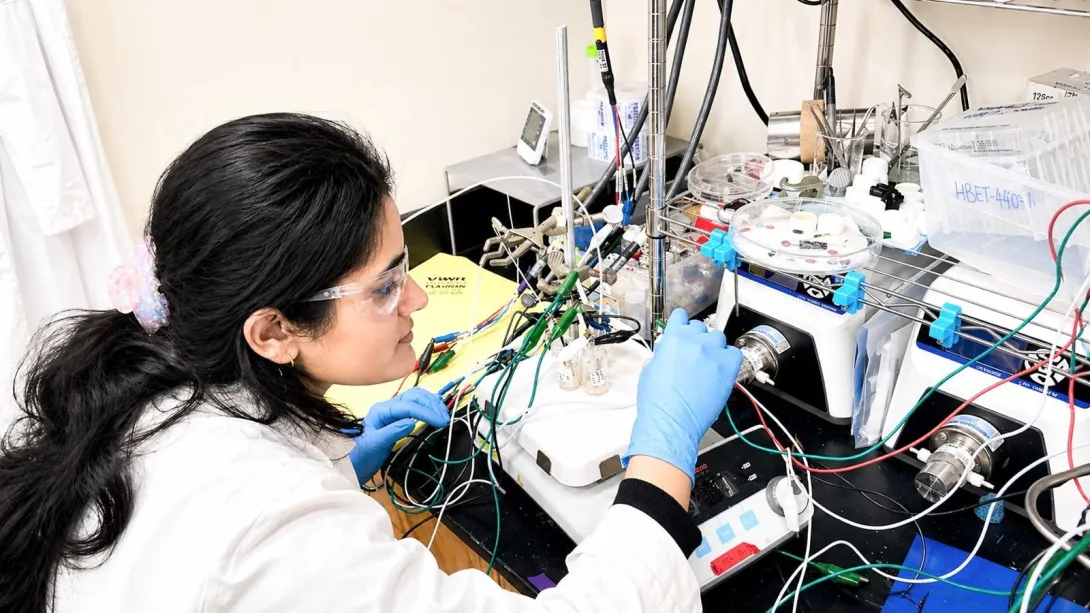
Anuja Tripathi works in a lab developing an energy and environmentally friendly method for extracting rare earth elements from coal fly ash.
Anuja Tripathi grew up in Kanpur, India, where coal fly ash from a nearby power plant coated rooftops, windowsills, and laundry hung outside to dry.
“I used to see ash settling on our terrace from time to time and thought it was just waste,” Tripathi said.
Years later, at Georgia Tech, Tripathi started looking at that ash differently. What once appeared to be ordinary industrial waste became the focal point for her work.
As a postdoctoral researcher in the School of Civil and Environmental Engineering, Tripathi, along with Ching-Hua Huang, Turnipseed Family Chair and Professor, and Xing Xie, Carlton S. Wilder Assistant Professor, both in the School of Civil and Environmental Engineering, developed a method to recover rare earth elements from coal fly ash.
Rare earth elements (REEs) help power electric vehicle motors, wind turbines, MRI machines, smartphones, and defense systems because of their unusually strong magnetic and electrical properties. Despite the name, most REEs are not actually rare in quantity. They’re rare in concentration. REEs are scattered through the Earth’s crust in amounts too small to mine easily, and much of their global supply chain remains concentrated outside of the United States.
That imbalance has turned REEs into both an economic and national security concern. Countries are competing for the materials sustaining advanced manufacturing, energy systems, and military technologies, increasing pressure to find domestic sources. That urgency has pushed researchers like Tripathi, Huang, and Xie to look at coal fly ash differently: not just as industrial waste but as a potential source of materials that modern technology depends on.
Coal naturally contains trace amounts of rare earth elements. Burning the coal concentrates those elements in the ash left behind.
Tripathi developed a method for extracting rare earth elements that avoids the corrosive chemicals used in conventional extraction. The same ash that once coated her rooftop could now become a secondary domestic source of critical materials.
Mining What Was Left Behind
Coal fly ash already exists in enormous quantities across the United States. About 2 billion tons are stored in impoundments, such as storage ponds and landfills, according to the Department of Energy.
Those sites require long-term monitoring because coal fly ash can release contaminants into soil and groundwater. Major storms can also damage storage sites and spread the material into surrounding communities and waterways.
Inside that ash, REEs are dispersed in tiny concentrations. Recovering them is a challenge; recovering them cleanly is an even greater one. Many existing recovery methods rely on concentrated acids, large amounts of water, or extreme heat during extraction. Some techniques require temperatures high enough to rival industrial furnaces. Others create additional waste streams.
Tripathi and her team wanted a different approach.
They built the system around a recyclable ionic liquid, a salt-based substance stable enough to operate under conditions that would break down water-based systems. The liquid pulls rare earth elements away from the ash. An applied electrical current then causes the recovered elements to collect onto a surface where they can be removed. Afterward, the liquid can be cleaned and reused.
“The beauty of this system is that it works beyond the limits of water,” Tripathi said.
“The ionic liquid allows us to recover rare earth elements under conditions that water-based systems just can’t handle.”
The process also changes depending on the voltage applied. At lower voltages, the system selectively recovers neodymium, an REE used in high-strength permanent magnets found in electric vehicles, wind turbines, and defense systems. At higher voltages, it recovers a broader mixture. The system recovered nearly half of the available neodymium during testing.
Beyond Coal Ash
Tripathi has shown that the chemistry works in small batches. The next challenge is scale: whether the system can recover enough rare earth elements efficiently enough to make the process commercially practical.
The same approach could extend beyond coal fly ash. Batteries, discarded electronics, and medical waste all contain valuable metals that often end up buried in landfills or destroyed during disposal.
For Tripathi, the idea began at home, where fly ash would settle on her terrace. What once seemed like an ordinary nuisance could help reshape how critical materials are recovered from waste.
Tripathi’s research is published in Environmental Science and Technology.
It was supported by the U.S. Department of Energy.
News Contact
Michelle Azriel
Senior Research Writer – Editor
Institute Communications
mazriel3@gatech.edu
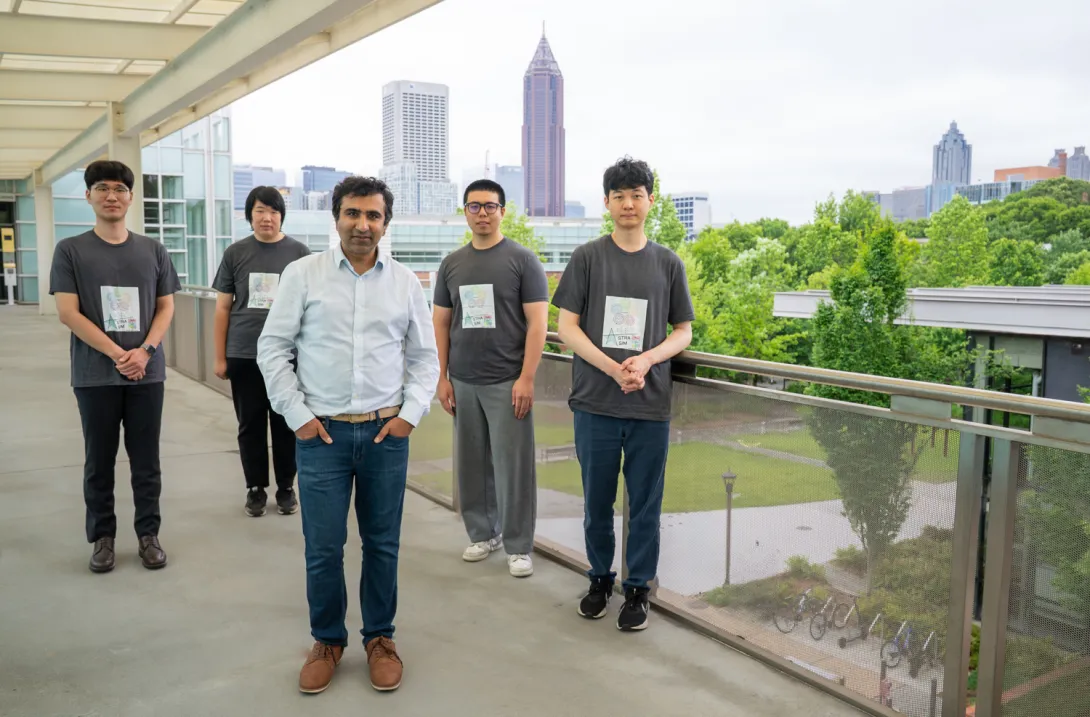
Associate Professor Tushar Krishna (center) and members of his research team — William Won (recently graduated, now at AMD), Changhai Man, Hanjiang Wu, and Jinsun Yoo — have announced Chakra, a new shared platform for understanding and improving complex AI systems.
There’s a simple idea that shows up in just about every engineering discipline: you can’t improve what you can’t measure.
That principle is especially relevant today across the artificial intelligence (AI) landscape. As systems scale, they increasingly become harder to measure, compare, and fix, particularly within proprietary environments.
A team led by Georgia Tech, working with collaborators across industry, has developed a new approached called Chakra to bring greater clarity to complex AI systems.
“Imagine a room where everyone is trying to collaborate, but each person speaks a different language,” said Tushar Krishna, an associate professor in the School of Electrical and Computer Engineering, who is leading the effort. “That’s a bit like today’s AI ecosystem. The internet worked because it was built on shared practices and protocols. In AI, we’re still building that kind of common foundation.”
The work, which Krishna leads through the nonprofit MLCommons, was released alongside a paper at the 2026 Conference on Machine Learning and Systems(MLSys) in Bellevue, Wash.
Understanding Systems Without Exposing Them
Cloud companies, chip designers, software developers, and infrastructure providers all describe their systems differently, relying largely on internal, proprietary approaches that are not publicly shared.
This slows innovation, reduces efficiency, and increases the cost of running AI at scale.
Chakra, named after the Sanskrit word for “wheel” to reflect a continuous cycle of improvement, is designed around that reality. Its release is not a single finished system, but a set of shared tools and building blocks.
Researchers are making available a standardized format for representing AI workloads, along with tools for collecting and analyzing data from what’s known as an execution trace.
“An execution trace is essentially a recording of how an AI system behaves,” Krishna said. “Rather than focusing only on outcomes like speed or accuracy, it captures what computations happened, when machines needed to communicate, and where delays or bottlenecks occurred.”
Those traces don’t expose the underlying code or data. Instead, they reflect patterns of behavior.
Those traces don’t expose the underlying code or data. Instead, they reflect patterns of behavior.
“It’s a bit like sharing a map of traffic patterns in a city, instead of handing over the blueprints for every building,” Krishna said.
The approach can also be used to explore how future systems might behave, giving researchers a way to test ideas and identify potential bottlenecks before those systems are built.
“All of this dramatically lowers the barrier to participating in AI systems innovation,” Krishna said.
Building a Shared Standard
The Chakra project began in 2023 as a collaboration between Georgia Tech and Meta, building on parallel efforts to better understand how AI workloads behave across production systems and simulation environments.
Part of that work built on ASTRA-sim, an open-source distributed AI system simulator developed and maintained by Krishna’s group, which models how large-scale AI systems perform across hardware and software.
“We knew that for AI to scale responsibly, we needed better ways to understand what’s happening under the hood,” Krishna said. “Companies struggle to compare systems fairly or reproduce why something worked well—or failed—because everyone uses different tools and proprietary setups.”
The early collaboration expanded into a broader effort called the Chakra Working Group (CWG) within MLCommons, a consortium that brings together companies and researchers to develop shared benchmarks and standards for AI systems, including widely used efforts like MLPerf.
David Kanter, co-founder of MLCommons and head of MLPerf, has praised the group for “defining an industry roadmap for AI workload tracing support and benchmarking.”
Today, CWG includes industry partners such as NVIDIA, AMD, Meta, HPE, and Keysight, along with contributions from multiple Georgia Tech faculty, students, and alumni (seven of whom are now working across partner organizations).
“Chakra is a fantastic showcase of the role ECE and Georgia Tech play in connecting academic research with real-world systems,” said Arijit Raychowdhury, Steve W. Chaddick School Chair of ECE. “We can bring together expertise spanning the full AI stack in really the only way that makes complex work like this possible.”
That level of collaboration is essential to developing something that can be used across the broader AI ecosystem, according to Winston Liu, a chief architect at Keysight Technologies and a member of CWG.
“What the Chakra community has built is meaningful, but the collaboration model that produced it is worth recognizing just as much,” he said. “That combination—early enough to shape the spec together and open enough that the output belongs to everyone—is genuinely rare.”
A Real-world Testbed at Georgia Tech
Much of the team’s work has depended on access to infrastructure capable of running AI systems at a realistic scale. Georgia Tech has built that capability through its AI Makerspace, one of the largest computing clusters in the world dedicated to supporting student-driven AI workloads while also serving as a real-world testbed for large-scale systems research.
In collaboration with the Partnership for an Advanced Computing Environment (PACE), CWG researchers utilized the AI Makerspace to run workloads across 128 advanced GPUs and collect execution traces from systems operating under real conditions.
“The AI Makerspace was built on a simple belief: AI should be accessible to as many as possible,” said Matthieu Bloch, associate dean in the College of Engineering. “It’s exciting to see our colleagues using it to amplify impact and give back to the broader community.”
That level of access allowed the work behind Chakra to move beyond theory and into environments where performance challenges actually emerge.
In one case study, Chakra helped identify a hidden communication bottleneck that only appeared under realistic conditions when different types of workloads were running at the same time. More simplified tests failed to surface the issue.
What Comes Next
As the Chakra tools and standards are released, the focus now turns to how they will be adopted and extended.
Krishna sees the current moment less as a finish line and more as a starting point for broader participation across the field.
“Five years from now, Chakra will help make AI systems development dramatically more reproducible and accessible,” he said. “Researchers could test ideas against realistic workloads without needing access to massive datacenters, and companies could identify problems much earlier in the design process.”
As AI infrastructure grows more costly, the ability to model new system designs allows researchers and companies to make informed decisions before committing to large-scale investments.
“Longer term, it could move us toward a ‘digital twin’ of AI infrastructure,” Krishna said. “A way to model and optimize systems before they’re ever built.”
News Contact
Dan Watson
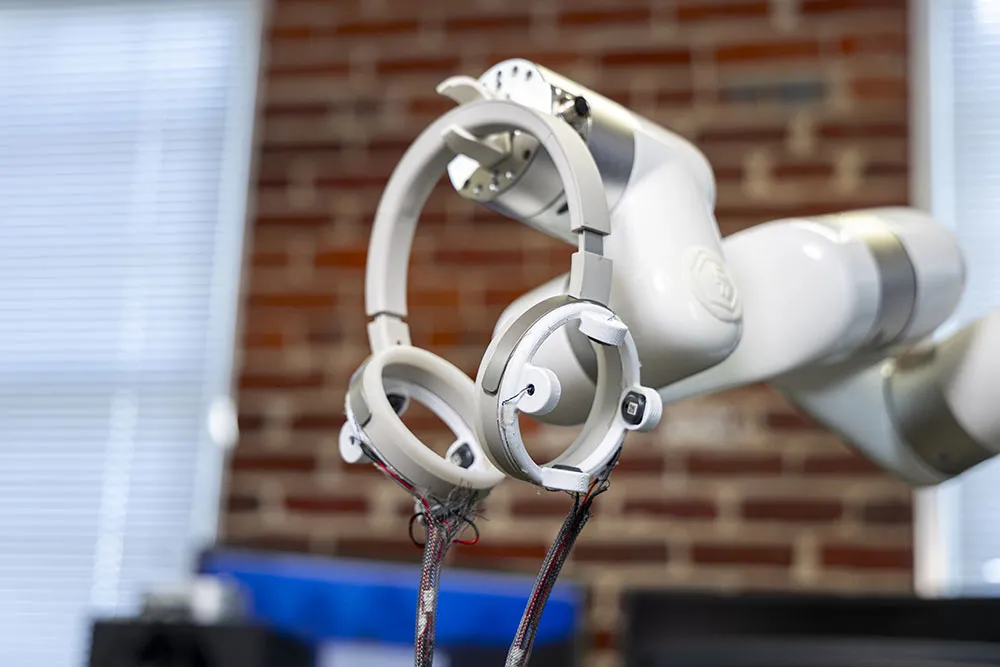
Robotic arm holds a prototype Spherephones headset, a Georgia Tech–developed wearable that uses spatialized sound to help users anticipate movement around them.
Georgia Tech researchers have developed Spherephones, a wearable system that uses spatialized music instead of alarms to help people anticipate movement around them — such as approaching robots — by conveying direction, distance, and timing through sound. Created in the Robotic Musicianship Lab, the technology aims to improve safety and awareness in human-robot environments while also showing promise for applications in virtual reality, gaming, and assistive navigation.
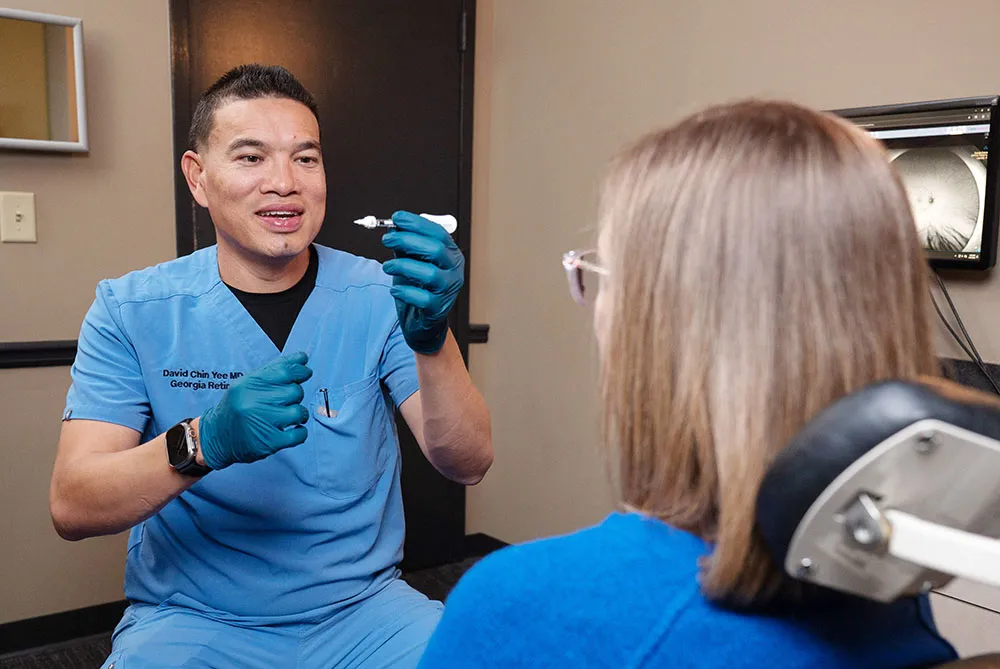
Dr. David Chin Yee is an Atlanta-based retina specialist who collaborates with Georgia Tech researchers on advancing microneedle technology for targeted drug delivery in eye care.
For Dr. David Chin Yee, a Georgia Tech microneedle is opening new possibilities for treating debilitating eye disease. Developed over two decades, it delivers medication precisely where it’s needed, helping to preserve vision, ease pain, and prolong relief. For patients, that can mean fewer treatments — and more time for daily life.
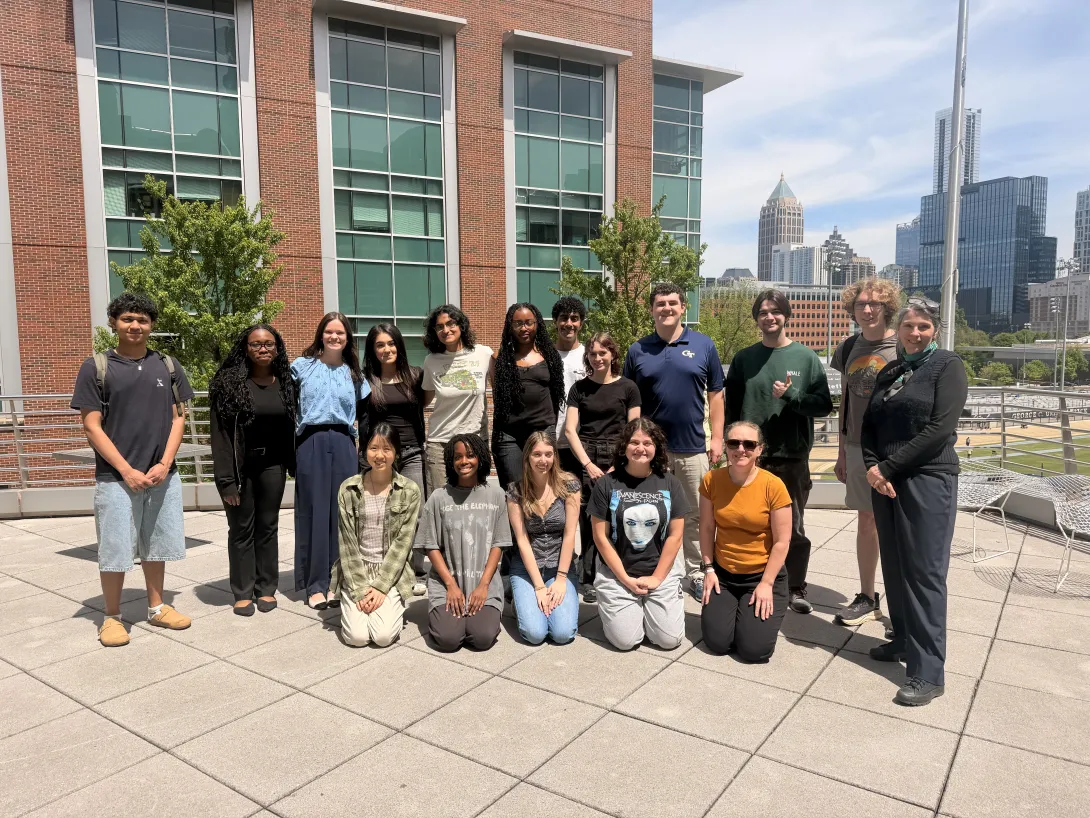
The most recent VIP class.
In just one course, Georgia Tech student Diya Godavarti helped develop a tool that could improve workers' responses to chemical spills or open containers.
Godavarti, then a second-year chemical and biomolecular engineering (ChBE) student, joined a course on chemical equity focused on reducing chemical exposure in vulnerable communities. The class, part of Georgia Tech’s Vertically Integrated Projects (VIP) program, embeds students in long-term research teams that span disciplines and semesters.
She and her classmates developed a computational model that estimates how dangerous chemical vapors build up in enclosed spaces, such as tanker trucks. Their work culminated in a paper, “Modeling Time-Dependent Chemical Concentrations in Confined Spaces for General Safety Applications,” published recently in ACS Chemical Health & Safety.
For Godavarti, the experience helped clarify her future career endeavors.
“I was always motivated to keep going on this project because chemical equity is something I genuinely care about,” she said. “I realized I really enjoyed working on open-ended projects after this class, and this confirmed my desire to pursue a Ph.D.”
She will begin her ChBE doctoral studies at Northwestern University this fall.
Bridging Disciplines
The VIP class grew out of a gap between research labs and reality. Pamela Pollet, a faculty member in Tech’s School of Chemistry and Biochemistry, is used to working in controlled lab settings with safety measures like vent hoods. But after she consulted on a project where commercial workers were accidentally exposed to harmful chemicals, she started to think about safety differently.
“There was a disconnect between what we do with chemicals in our controlled environments, which we understand very well, and how people interact with chemicals every day,” she said.
To bridge that gap, Pollet partnered with Jenny Houlroyd, the occupational group health manager of the Enterprise Innovation Institute’s (EI2) Safety, Health, and Environmental Services Program. Houlroyd works with Georgia businesses to reduce workplace hazards and protect employee health.
“We realized how siloed this work can be,” Houlroyd said. “Chemical safety researchers and chemists often operate separately, but their skills are complementary. That’s how we came up with the idea for the class.”
The VIP format made that collaboration possible. The 20-student team included majors from chemistry, biochemistry, biology, computer science, neuroscience, and ChBE. In addition to research, students heard from guest speakers — including journalists, lawyers, and policymakers — whose work intersects with chemical safety.
Modeling a Real-World Risk
The students focused on a practical problem in industrial hygiene: quickly estimating a person’s exposure to hazardous chemicals after a spill or open container in a confined space.
“If you hire an industrial hygienist like me, it’s going to take time to schedule, and it’s going to be expensive,” Houlroyd said. “But if there’s a chemical spill event happening, you need that safety data right away.”
To address this, the students built a computational model that simulates how chemicals evaporate and spread through air in enclosed environments. Using benzene, a common solvent, as a test case, the model predicts how benzene concentrations change over time, from minutes to hours after a spill or residual pool in an enclosed space. It can also estimate exposure at different heights, accounting for whether someone is standing upright or crouching in a chemical-heavy area.
“We’re addressing important gaps in modeling chemical exposures,” said John Pederson, a chemistry Ph.D. student who mentored the student team. “There’s been strong work in industrial settings, but less attention to environments found in transportation, agriculture, and sanitation, for example. It's an easily overlooked fact that working with paints, coatings, cleaning solutions, and other solvents presents a risk of acute or chronic exposure.”
From Classroom to Impact
The team ultimately hopes to make the model widely accessible and create a user-friendly app. While that work is ongoing, Pollet and Houlroyd say the project already demonstrates the power of interdisciplinary learning.
“This project was a very nice overlap of our fields,” Pollet said. “It helps students understand real-world scenarios in a way you can’t replicate in a traditional classroom.”
For Houlroyd, the collaboration also extended her impact beyond the field.
“I work for EI2, and we’re primarily external-facing and helping businesses out across the state of Georgia, but this has been a great opportunity to take what I'm learning in the field and then share it with the students,” she said. “I am so proud of the students. To see them take this big issue and make it into something the industry can use is so exciting.”
Modeling Time-Dependent Chemical Concentrations in Confined Spaces for General Safety Applications
Diya Godavarti, Waynell Simbafo, John Pederson, Jenny Houlroyd, and Pamela Pollet
ACS Chemical Health & Safety Article ASAP
DOI: 10.1021/acs.chas.6c00021
News Contact
Tess Malone, Senior Research Writer/Editor
tess.malone@gatech.edu
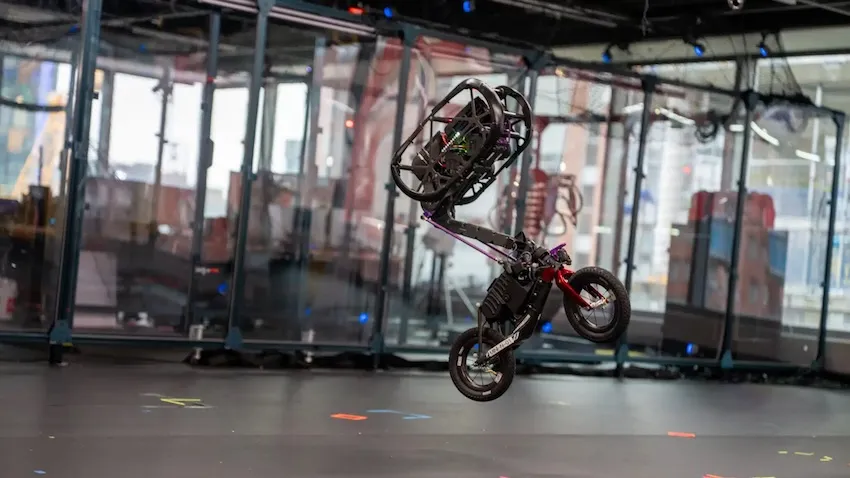
Photo courtesy of the Robotics and AI Institute
A bicycle robot from the Robotics and AI Institute (RAI) in Cambridge, Mass., has become the first to perform an unassisted acrobatic front flip.
RAI calls the bicycle robot an ultra-mobility vehicle (UMV). It can reach a height of 3 feet and can jump from the floor onto a platform.
The contributions of a Georgia Tech Ph.D. student helped make these feats possible through a robot control policy he developed.
Jeonghwan Kim, who is pursuing a Ph.D. in robotics under the advisement of Associate Professor Sehoon Ha, spent two semesters interning at RAI. His task was to design a policy to teach the UMV to land after a flip.
The result was iterative motion imitation (IMI), a novel method that imitates flip trajectories generated from prior examples. Kim said the robot bases its flip on a demonstration, and human engineers reconstruct and refine the flip path through simulation to fill in the gaps.
“To guide the robot to flip, we started with an imperfect trajectory generated by a motor-based controller and then ran simulations,” Kim said. “It’s an unstable trajectory, but we use it as a guide to train a single policy that can track it as it lands and tries to balance itself.”
Sticking the Landing
Kim interned under the supervision of Shamel Fahmi, a research scientist at the RAI Institute. RAI has been developing the UMV for nearly three years.
“We wanted to work on a different robot morphology that wasn’t legs or legs with wheels,” Fahmi said. “That’s when we thought of working with bikes.
“We want to merge the athleticism of (Boston Dynamics’) Atlas with the mobility of a bike. We wanted a robot that can go anywhere, do parkour, and acrobatics.”
Fahmi said that before Kim arrived, the research team had trouble getting the UMV to land consistently without breaking or falling.
The UMV has two joints — an upper and a lower. The upper joint contains the motors and pulls the lower joint along as it propels into the air. The problem is getting the lighter lower joint to absorb the impact of landing without being crushed by the heavier upper joint.
“That’s what brings reinforcement learning into the equation,” Fahmi said. “We teach the robot to minimize its impact on the ground to land gracefully.”
Fahmi said that Kim proved the imitation examples the robot learns from don’t have to be perfect. The process takes some time, but all it needs is a rough idea to get started.
“You can have an imperfect sketch and then constantly refine it,” Fahmi said. “The first time, it’s not going to go well.
“We don’t care about torque or power limits as long as it does the motion. Then we’ll have a slightly better reference, repeat it, and imitate it again. In every iteration, we can add more parameters.”
Up Against the Clock
Kim said he felt the pressure of time constraints during his two semesters with RAI as he worked to achieve consistent, successful landings. Even though he had multiple UMVs to experiment with, they broke down dozens of times. Each time one broke, a hardware team at RAI had to repair it.
“There was a lot of pressure to not only get this working before my internship ended, but also knowing there are costs behind every failed attempt, and every time the robot breaks, it takes time to repair it,” Kim said.
“It took almost five months for it to land without breaking. Then we needed two more months for it to stay balanced after the landing. It requires a lot of engineering effort to achieve a robust control policy for a safe flip.”
By the time Kim left RAI, the IMI policy had achieved consistent, seamless landings.
“The jump right now is what we call the visitor demo,” Fahmi said. “If there are guests coming over to see it, we want to show them something that is extremely impressive, but also, more importantly, extremely reliable. It never fails.
“It was only possible because of the huge effort we put into designing, maintaining, and continuously improving the robot.”
Kim authored a paper on his framework and will present it at this week’s International Conference on Robotics and Automation (ICRA) in Vienna.
For more information about the UMV project, please visit the RAI blog or watch their video on YouTube.
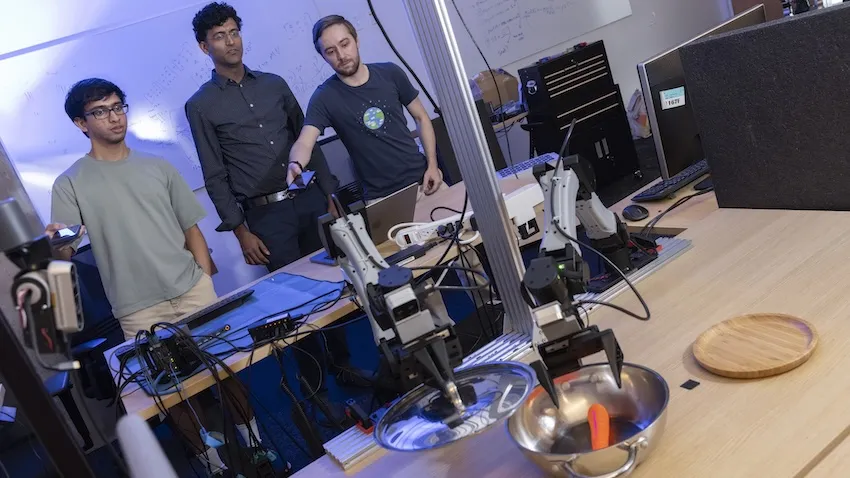
Someone with no computing experience may soon be able to remotely control a robot from anywhere on the planet using a smartphone, thanks to new technology developed by Georgia Tech.
The new technology is also set to revolutionize the scale of policy training data collection, which is essential to advancing robotic capabilities and meeting growing production demand.
COBALT is a mobile app that turns smartphones into controllers for robot arms. With a secure Wi-Fi connection to a server, users can move their phones in any direction, and the robot arm will mirror the motion — from anywhere in the world.
Ayush Agarwal, a Ph.D. student in Georgia Tech’s School of Interactive Computing who leads a research team developing COBALT, said it works like the games people play on smartphones. Users can press a button to have the arm grasp an object, move it, and release it with another button.
Agarwal conducted several user studies with participants in nine countries who remotely operated robot arms inside Georgia Tech’s People, AI & Robotics (PAIR) Lab. The lab is directed by Assistant Professor Animesh Garg, who advises Agarwal.
“We built an entire distribution system for remote teleoperation scaled to where we had people from Indonesia, India, and Pakistan operating for us,” Agarwal said. “They were novice operators who had never done it before. By collecting data from these new users, we showed that we can train policies to automate certain tasks.”
Garg envisions a world where data collection for policy training is done through crowdsourcing. He began working toward this goal 10 years ago as a postdoc at Stanford University, when he developed RoboTurk, an earlier version of COBALT.
“There is a large-scale data collection requirement for mass robot production to be possible, and it will not be solved purely through simulation,” Garg said.
“Our idea was, what if we could get almost every person on the planet to be a passive source for data collection? There are almost five billion people who have smartphones and know how to use them.”
Education and Economy Impact
Another major implication of COBALT could be expanded access to CS and robotics education.
Students can learn to operate a robot remotely in any classroom. In fact, Garg and his lab recently hosted students from Midtown High School in Atlanta to demonstrate COBALT and let them control robot arms from a phone.
Garg also sees the possibility of a “gig economy” in which people pay remote operators to control assistive robots in their homes and complete household chores for them.
“It could be Uber for robots,” he said. “People who want to log onto the platform can do so at their convenience and for as long as they want.”
Companies with robot-dependent labor tasks could also use the platform to enable human oversight.
“If I deploy a robot in a factory that achieves high autonomy for most tasks, but there are still times it needs help, a human could operate the robot from anywhere in the world,” Garg said.
Building a Network
Agarwal’s studies showed that people prefer to interact with and control a robot using a smartphone rather than virtual reality (VR) headsets, controllers, keyboards, mice, or other devices.
“The phone is a more intuitive interface and can provide data quality that’s on par with other commonly used devices,” he said.
Agarwal also said there is minimal latency in the video feed sent back to operators on the other side of the world. That’s because the amount of data being processed is small.
The data is carried over Web Real-Time Communication (WebRTC), the same technology used by many streaming services and web conferencing platforms such as Zoom and Google Meet.
“There’s a connection from your phone to the teleoperation server, which is connected to the robots,” Agarwal said.
“Then there’s another connection from the teleoperation server back to the user, which allows for a video stream. We need low latency on both because you don’t want the user to move their phone and wait 10 seconds to see the visual feed.”
Agarwal is the co-lead author of a paper on COBALT that is being presented at the IEEE International Conference on Robotics and Automation this week in Vienna. He said the paper stands out because it has moved from theory to the implementation of an entire distribution network.
“The real novelty of our paper is the systems that we build around it to actually support the scaling of remote operation and data collection at a global level,” he said.
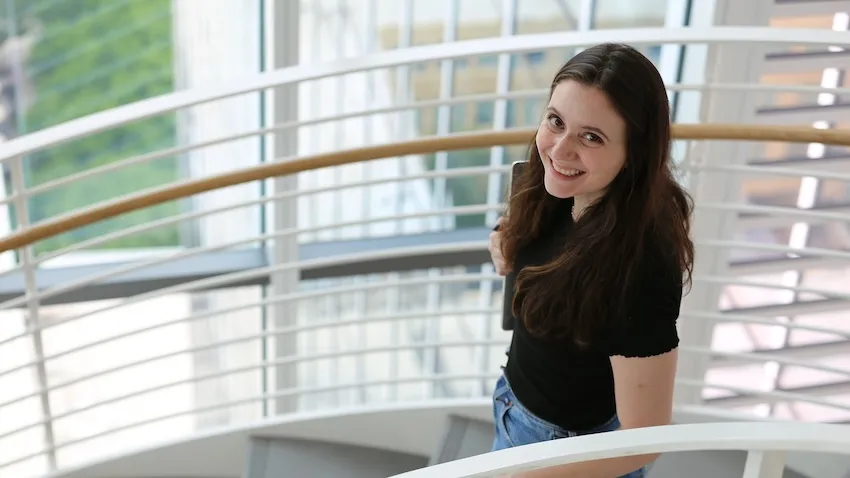
Augmented reality (AR) devices like smart glasses may soon be able to predict where a user will look and provide an enhanced interactive experience.
Fiona Ryan, a Ph.D. student in Georgia Tech’s School of Interactive Computing, is pioneering research that tracks and predicts user gaze from a first-person perspective in 3D environments.
Currently, most AR devices react to where users look, playing catch-up. Ryan’s method could give these devices a heads-up and make the user experience more seamless.
“It allows an AR system to anticipate what the person will interact with next and where they’re going to look next so it can proactively render the experience,” she said.
Ryan is the lead author of the paper Forecasting 3D Scanpaths in Egocentric Video, which she will present next week at the IEEE Conference on Computer Vision and Pattern Recognition (CVPR) in Denver.
While there is existing research on predicting user gaze from 2D still images, her work is the first to address the issue through a 3D framework.
“Because we live in a 3D world and people are dynamically moving around from multiple points of view, we need to predict gaze in 3D rather than 2D,” she said. “What we’re seeing is a path of the person’s attention in 3D through space. Our paper is the first to attempt to model this.”
Ryan conducted most of the research while interning at Meta, where she used data from Meta’s Aria Digital Twin dataset. The dataset contains first-person video footage of users interacting with objects in an apartment.
“We chose that dataset because it has a high-fidelity 3D reconstruction of a full environment, which helps us get a ground-truth 3D gaze,” she said. “We can trace eye movement and see how it intersects with the environment.”
A video demonstration of Ryan’s work shows her software tracking a user’s path toward a table with a cup on it. Once the user picks up the cup, the software correctly predicts the direction the user will turn next.
“When we look at a scene, we don’t take in everything in full detail all at once,” she said. “We fixate on certain areas, and our gaze is a sequence of fixations, which might depend on what we’re trying to do. If we want to pick up a cup, we might look toward that and then the next step would be looking at where we’re going to put it down.”
Ryan said the software can predict, on average, up to three seconds into the future — and as far as 10 seconds in some cases. That’s enough time for the AR system to proactively render a more enhanced environment.
“We’re not looking that far into the future right now, but it would be interesting to explore longer forecasting windows,” she said. “I think potential futures would diverge pretty quickly, so we’re trying to explore what can reasonably be predicted from a short segment of a person looking and moving through space.”
Ryan said her paper served as a proof-of-concept, and that there is still much future work to be done. She already has some ideas.
“I think future models can include different scenarios to help narrow down possibilities. Sometimes a person’s gaze stays on one thing for a long time. If we know what someone is trying to do, we’ll have a better idea of the likely path their attention might go.”
There could also be future implications for her work in robotics research.
“It could potentially be used for training algorithms for robots to emulate active human perception. If we can understand what a person looks at as they perform a task, we could use that to facilitate a robot learning to do that same task.”
Augmented reality (AR) devices like smart glasses may soon be able to predict where a user will look and provide an enhanced interactive experience.
Fiona Ryan, a Ph.D. student in Georgia Tech’s School of Interactive Computing, is pioneering research that tracks and predicts user gaze from a first-person perspective in 3D environments.
Currently, most AR devices react to where users look, playing catch-up. Ryan’s method could give these devices a heads-up and make the user experience more seamless.
“It allows an AR system to anticipate what the person will interact with next and where they’re going to look next so it can proactively render the experience,” she said.
Ryan is the lead author of the paper Forecasting 3D Scanpaths in Egocentric Video, which she will present next week at the IEEE Conference on Computer Vision and Pattern Recognition (CVPR) in Denver.
While there is existing research on predicting user gaze from 2D still images, her work is the first to address the issue through a 3D framework.
“Because we live in a 3D world and people are dynamically moving around from multiple points of view, we need to predict gaze in 3D rather than 2D,” she said. “What we’re seeing is a path of the person’s attention in 3D through space. Our paper is the first to attempt to model this.”
Ryan conducted most of the research while interning at Meta, where she used data from Meta’s Aria Digital Twin dataset. The dataset contains first-person video footage of users interacting with objects in an apartment.
“We chose that dataset because it has a high-fidelity 3D reconstruction of a full environment, which helps us get a ground-truth 3D gaze,” she said. “We can trace eye movement and see how it intersects with the environment.”
A video demonstration of Ryan’s work shows her software tracking a user’s path toward a table with a cup on it. Once the user picks up the cup, the software correctly predicts the direction the user will turn next.
“When we look at a scene, we don’t take in everything in full detail all at once,” she said. “We fixate on certain areas, and our gaze is a sequence of fixations, which might depend on what we’re trying to do. If we want to pick up a cup, we might look toward that and then the next step would be looking at where we’re going to put it down.”
Ryan said the software can predict, on average, up to three seconds into the future — and as far as 10 seconds in some cases. That’s enough time for the AR system to proactively render a more enhanced environment.
“We’re not looking that far into the future right now, but it would be interesting to explore longer forecasting windows,” she said. “I think potential futures would diverge pretty quickly, so we’re trying to explore what can reasonably be predicted from a short segment of a person looking and moving through space.”
Ryan said her paper served as a proof-of-concept, and that there is still much future work to be done. She already has some ideas.
“I think future models can include different scenarios to help narrow down possibilities. Sometimes a person’s gaze stays on one thing for a long time. If we know what someone is trying to do, we’ll have a better idea of the likely path their attention might go.”
There could also be future implications for her work in robotics research.
“It could potentially be used for training algorithms for robots to emulate active human perception. If we can understand what a person looks at as they perform a task, we could use that to facilitate a robot learning to do that same task.”
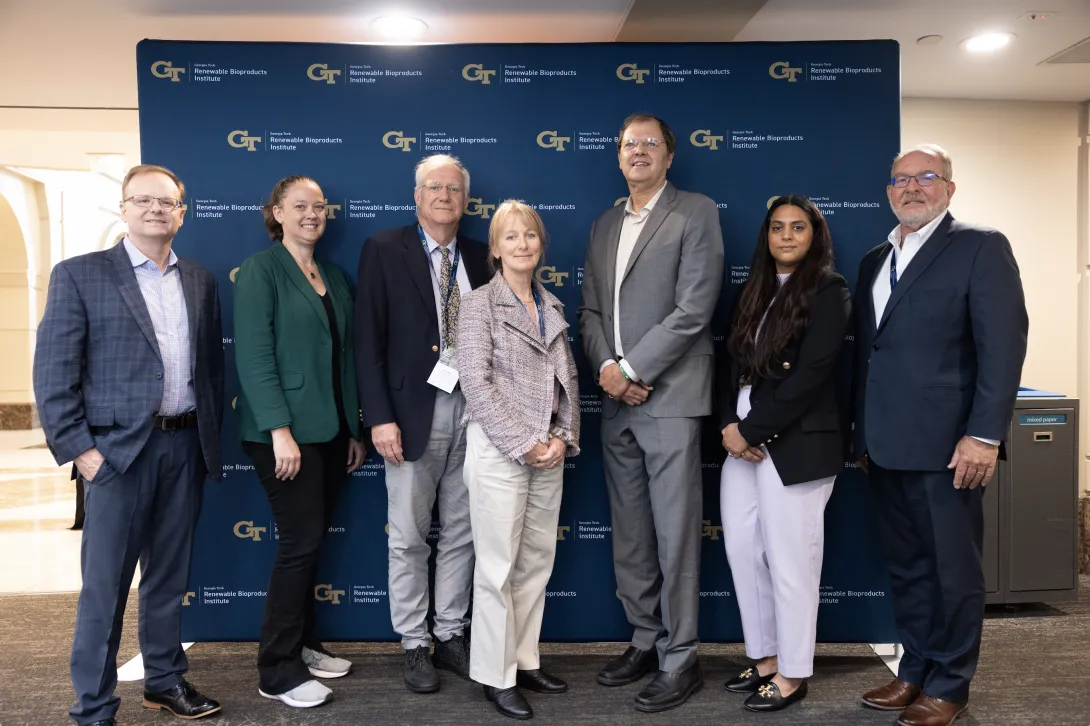
From left: Carson Meredith, Blair Brettmann, Andreas (Andy) S. Bommarius, Ulrika Egertsdotter, Joel Kostka, Titiksha Fernandes and Chris Luettgen.
The Renewable Bioproducts Institute (RBI) at Georgia Tech hosted its Spring 2026 Workshop, “Resilient Forests to Renewable Futures,” on May 11 and 12. The workshop brought together university researchers, scientists, and industry partners to discuss new developments shaping the future of the bioeconomy.
Preceded by an Industry Advisory Board meeting, the two-day workshop focused on how renewable materials, biotechnology, and advanced manufacturing can support more sustainable industrial systems. Discussions throughout the event explored topics ranging from forest health and biotechnology innovations to sustainable packaging and high-value biochemical products derived from forest resources.
Opening the workshop, RBI Executive Director Carson Meredith emphasized the institute’s focus on interdisciplinary collaboration and real-world impact.
“Our goal is to catalyze a community of researchers who focus on solving real-world challenges by investing in team building across interdisciplinary boundaries,” Meredith said.
Meredith also highlighted the growing need to create higher-value products from renewable resources in addition to traditional commodity materials.
That focus connected closely with updates on Georgia Tech’s Center for a Renewables-based Economy from Wood (ReWOOD). The center supports research aimed at turning sustainable plant-based materials into products such as aviation fuels, specialty chemicals, solvents, and pharmaceutical ingredients while strengthening connections between research and industry.
Several presentations focused on improving the long-term health and productivity of working forests. Caterina Villari from the University of Georgia and David Weston from Oak Ridge National Laboratory shared research aimed at protecting trees from diseases such as fusiform rust and brown spot needle blight. Their work combines biotechnology, genetic screening, and artificial intelligence tools to help identify tree varieties that are more resilient to disease and environmental stress.
The workshop also explored how forest fibers can be used to create more sustainable packaging materials. Patritsia Stathatou from Georgia Tech’s School of Chemical and Biomolecular Engineering presented research on manufacturing methods designed to reduce water and energy use in paper and packaging production.
Industry speakers discussed the challenges of bringing those materials into large-scale manufacturing. Michael Joyce, Senior Associate Principal Engineer at Mondelēz International, emphasized that paper-based alternatives must still meet the strength, durability, and performance standards required for existing packaging systems.
Additional discussions focused on how forest-derived materials can be used to create higher-value products beyond traditional paper and lumber applications. Speakers highlighted a growing interest in converting wood residues and byproducts into specialty chemicals, fuels, and biomaterials that can strengthen the long-term economics of renewable manufacturing.
Larissa Fenn from Rayonier Advanced Materials discussed the company’s work converting wood-derived materials into natural prebiotics for livestock. In collaborative studies with researchers at the University of Georgia, the products improved livestock gut health and feed efficiency while performing similarly to traditional antibiotics in certain diseased conditions.
The workshop also included a student poster session and networking event, giving attendees an opportunity to engage directly with RBI Fellows and researchers working across renewable materials and manufacturing research.
“What made the workshop especially valuable was having people from different backgrounds and sectors all in the same room looking at these challenges from different perspectives. Those conversations are what move ideas from research into real-world applications,” said Meredith. “RBI will continue to host these workshops as part of our commitment to interdisciplinary research advancing the bioeconomy.
News Contact
Yanet Chernet
Communications Officer