
Aug. 05, 2025
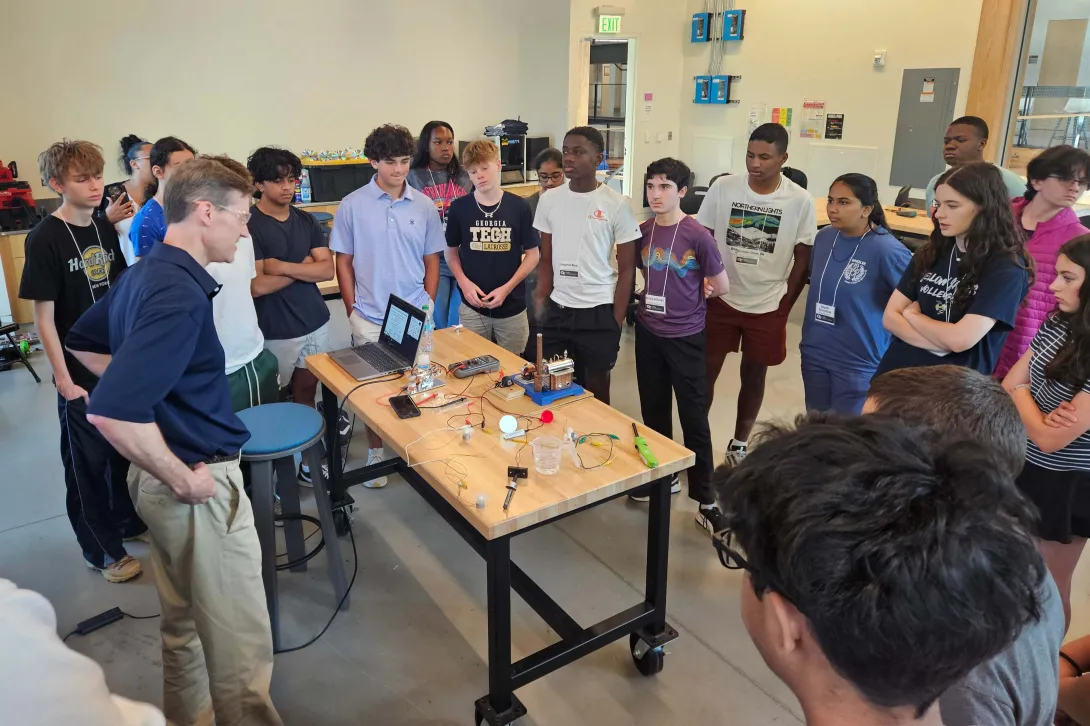
Rich Simmons and the Energy Unplugged participants during the final day presentations
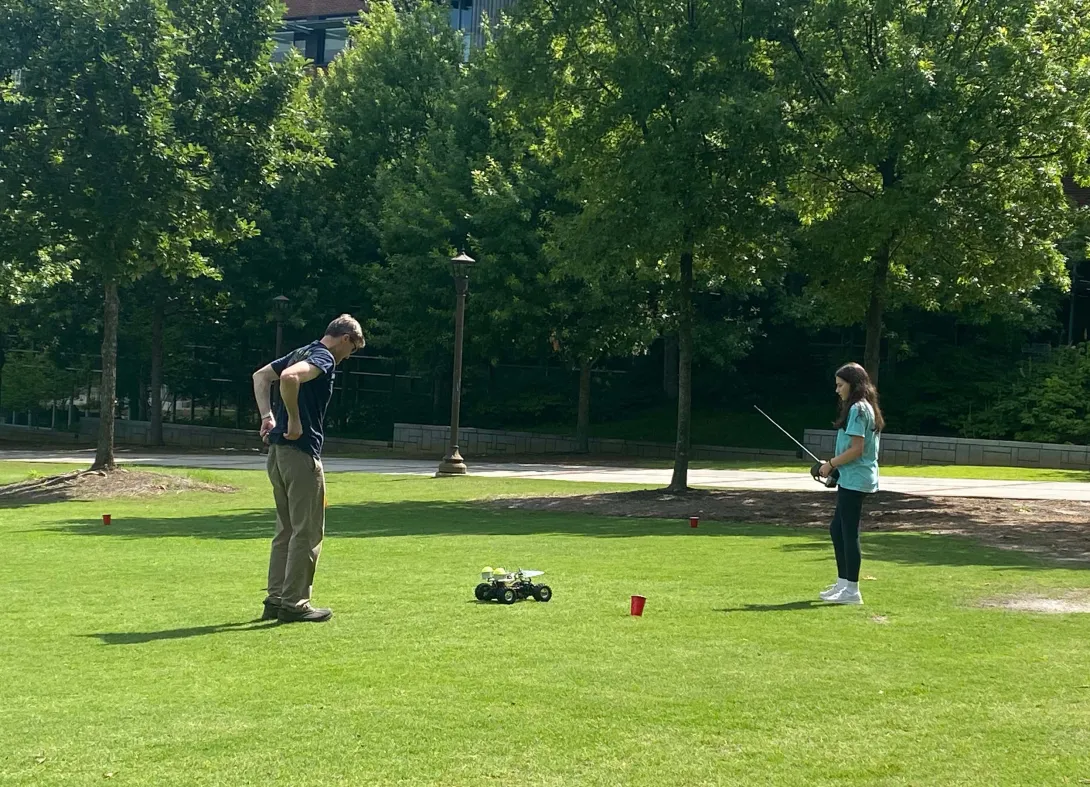
Energy Unplugged camper testing a remote car at Georgia Tech Green
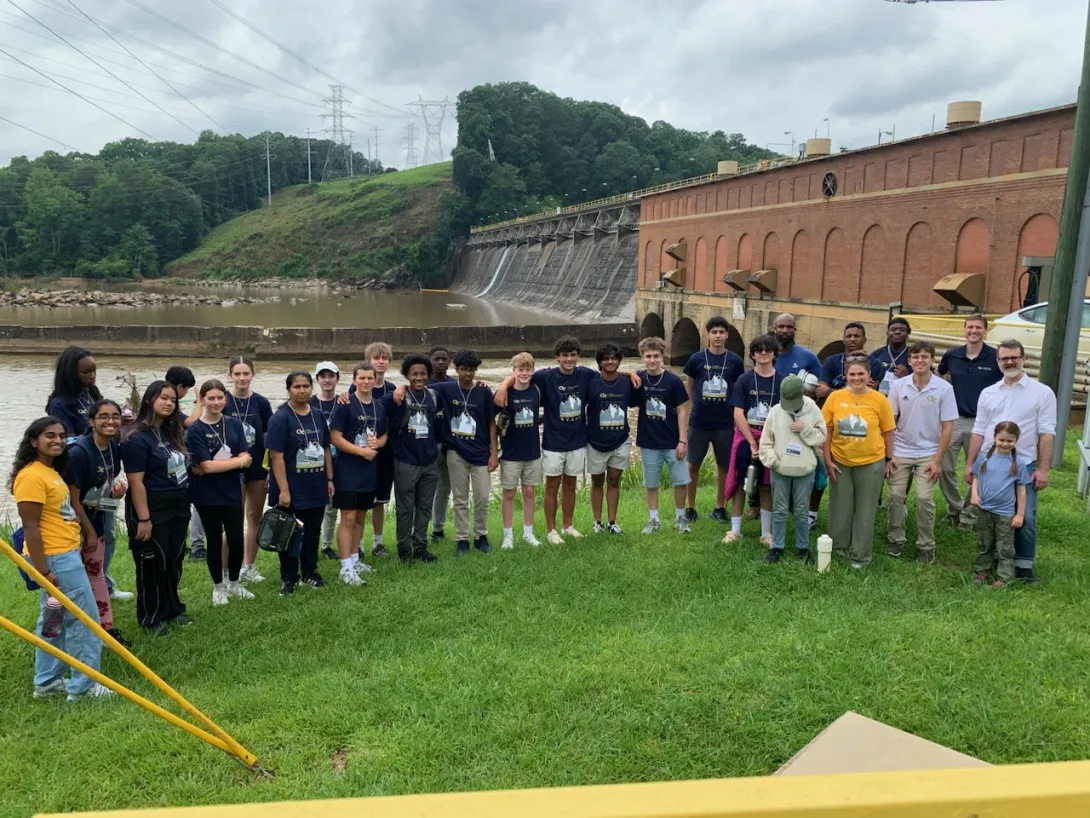
Energy Unplugged camp visit to the Morgan Falls hydroelectric plant
This summer, the Strategic Energy Institute (SEI) and the Energy Policy and Innovation Center (EPIcenter) hosted Energy Unplugged, an education and outreach program focused on science, technology, engineering, art, and mathematics (STEAM). The annual summer camp is organized through the Center for Education Integrating Science, Mathematics, and Computing (CEISMC), a unit of the College of Lifetime Learning at Georgia Tech. As one of Tech’s most sought-after programs for high school students, the weeklong summer camp continues to spark interest in energy innovation and develop foundational skills in science.
“Energy Unplugged introduces high school students to Georgia Tech’s vibrant innovation ecosystem, engaging young minds in shaping a more forward-thinking energy future,” said Christine Conwell, interim executive director of SEI.
Rich Simmons, SEI’s director of Research and Studies and a George W. Woodruff School of Mechanical Engineering faculty instructor, has led the camp’s curriculum since 2019. Under his leadership, students engage in applied learning experiences that introduce energy efficiency principles, foster creative thinking, and encourage real-world decision-making.
“Energy Unplugged features interactive activities and field trips which provide students tangible exposure to working energy facilities and STEM careers,” Simmons said. “As an integral part of our education and outreach efforts, the camp continues to inspire the next generation to think critically about energy and its impact on their communities and the world.”
“Collaborating with SEI on Energy Unplugged allows us to amplify CEISMC’s mission of expanding access to high-quality STEM experiences,” said Sirocus Barnes, director of Expanded Learning Programs at CEISMC. “By connecting students with real-world energy challenges and Georgia Tech’s research ecosystem, we’re helping them envision themselves as future innovators and problem-solvers.”
The week began with a hands-on workshop where students constructed mousetrap-powered cars, applying core physics concepts and the mechanics of energy conversion. In another activity, students raced remote-controlled cars to highlight the importance of swift decision-making while accounting for external variables. These experiments offered students a dynamic understanding of the relationship between energy and physics. Camp participants also explored electricity use in everyday life by experimenting with solar charging setups, learning how devices like cellphones can be powered through solar energy.
One participant, a rising high school senior, noted the program's differentiation from the typical classroom model: “We had a lot of experiences that aren’t typically offered in high school, which gave me a greater understanding of physics.”
The camp also featured site visits, including a tour of The Kendeda Building for Innovative Sustainable Design — the first building in the Southeast to meet the standards of the Living Building Challenge. Students explored the building’s facilities, including its rooftop garden and photovoltaic canopy. Additional field trips included tours of Oglethorpe’s Georgia System Operations plant and the Morgan Falls hydroelectric power plant, which offered students firsthand exposure to how energy is generated and managed across the state.
To conclude the week, students collaborated in teams on a mini design challenge: devising a sustainable taco business. They were tasked with cooking beans efficiently using either a slow cooker or a pressure cooker and learning how to balance time, energy use, and customer satisfaction. This final project reinforced lessons in energy trade-offs and problem-solving. Teams presented their findings to an audience of parents, faculty, and staff — a memorable opportunity that allowed them to develop public speaking and technical presentation skills as well.
“The presentation on the last day of camp encourages students to use their creativity in different ways to form new solutions and ideas,” said Jake Churchill, graduate student and former camp counselor, “which provides great exposure to an open-minded, nonlinear approach to engineering — and a great teacher, Rich Simmons.”
Contributed by: Katie Strickland
News Contact
Priya Devarajan || SEI Communications Program Manager
Aug. 04, 2025
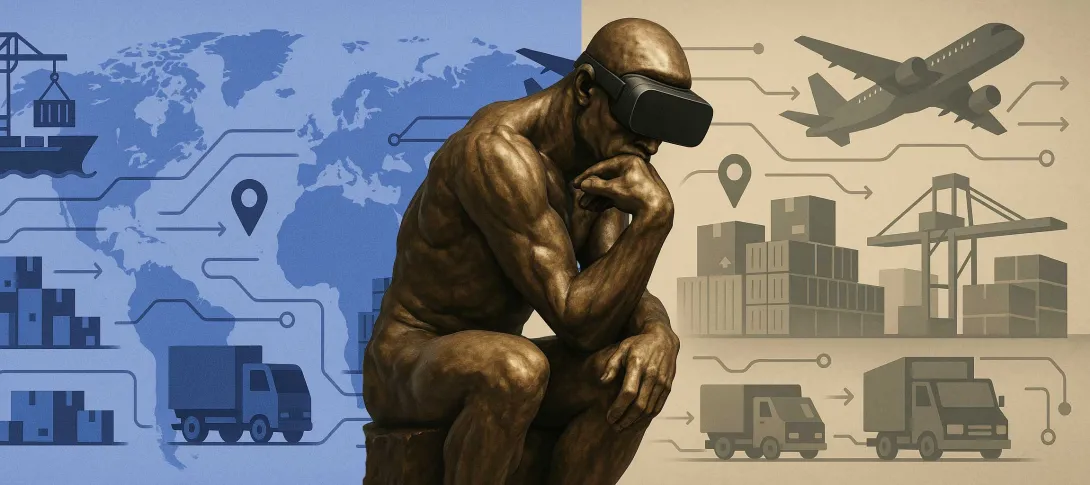
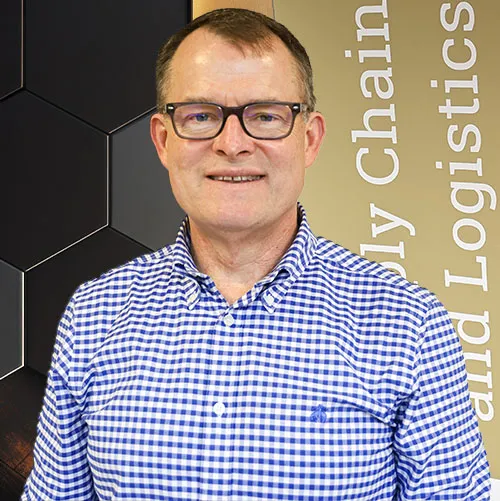
By Chris Gaffney, Managing Director, Georgia Tech Supply Chain and Logistics Institute | Supply Chain Advisor | Former Executive at Frito-Lay, AJC International, and Coca-Cola
A Personal Wake-Up Call
I’ve always considered myself a reasonably strong critical thinker—someone who asks good questions, challenges assumptions, and doesn’t adopt a viewpoint just because it’s popular. But a recent experience humbled me. I took an open-source critical thinking test and didn’t do nearly as well as I expected.
This led me down a deeper path of inquiry. I was already concerned about how two decades of social media have shaped the way we consume and respond to information—short, sensational content delivered by algorithm. And now, with the rapid rise of generative AI, I worry we may be trading our thinking for speed and scale.
I use AI tools daily, and I advocate for their use—especially in supply chain applications. But I’ve also come to believe this: if we’re not careful, we risk outsourcing the very thinking that makes us human and effective decision-makers.
Why Critical Thinking Matters More Than Ever—Especially in Supply Chain
Critical thinking isn’t just a defense mechanism—it’s a differentiator. In a world where AI can generate answers instantly, the professionals who ask the right questions will stand out.
Supply chain professionals operate in environments where second and third-order consequences matter. We are called on to make decisions under uncertainty, weigh risks, balance competing priorities, and understand interdependencies.
Judgment—tempered by experience, structured analysis, and humility—is the edge. Tools can help you scale, but they cannot replace the human responsibility to challenge, reflect, and adjust.
What Is Critical Thinking?
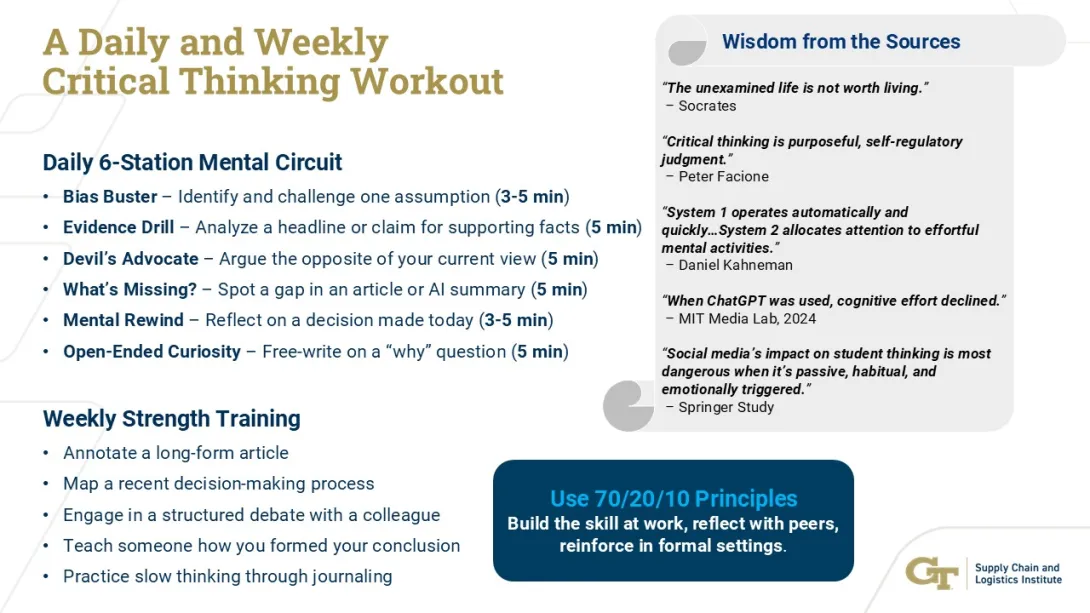
Critical thinking is the ability to think clearly and rationally about what to do or believe. It involves:
- Questioning assumptions
- Evaluating evidence
- Recognizing biases (ours and others’)
- Drawing reasoned conclusions
- Reflecting on one’s own thought process
Said simply, it’s self-awareness of your thinking style—how you form your views, test them, and revise them when new evidence emerges.
It requires effort. It requires slowing down. It requires, at times, being wrong.
Facione, in his Delphi Report, defines it as "purposeful, self-regulatory judgment."
Kahneman reminds us that our brains are wired for shortcuts—“System 1” thinking is fast and efficient but often error-prone. True critical thinking requires “System 2” effort: slow, reflective, and disciplined.
Are We Losing It?
There’s growing evidence we are.
Social media echo chambers reduce exposure to opposing views. Short-form content conditions us to expect fast answers. And according to the MIT Media Lab (Kosmyna et al., 2024), students using ChatGPT retained less, showed reduced cognitive effort, and had lower originality.
“When ChatGPT was used, cognitive effort declined.”
And yet—this is not a moment for despair. It’s a call to discipline. Because critical thinking, practiced intentionally, can become a personal and professional superpower.
Applying Critical Thinking in Supply Chain Decisions
Supply chain professionals face complexity daily—inventory tradeoffs, supplier uncertainty, resource constraints, policy risk. Many of these decisions can’t be answered by tools alone—they require judgment. Critical thinking lives in that judgment.
Whether you're building a forecast, evaluating a supplier, responding to a disruption, or modeling risk exposure, structured thinking provides a path. The steps are familiar:
- Define the problem clearly
- Clarify what information is available—and what’s missing
- Analyze root causes or future implications
- Generate multiple options
- Establish decision criteria
- Choose a path—and test it before launch
- Monitor and adjust as feedback arrives
This process resembles A3 thinking or supply chain analytics. But what makes it powerful is doing it intentionally—even under pressure.
The best professionals I’ve worked with practice it on small decisions as well as large ones. They don’t confuse speed with clarity.
Practicing Critical Thinking When Using Generative AI
AI tools are powerful—but without deliberate use, they can dull our thinking. Here's how to make AI work with your brain—not instead of it:
- Document your assumptions before prompting
- Journal your intent: What are you trying to decide or explore?
- Ask AI to provide counterarguments or alternative views as well as sources for you to research and draw your own conclusions
- Look for what’s missing or oversimplified
- Summarize AI output in your own words
- Track and reflect on how AI influenced your decisions
Treat AI like a research assistant—not a strategist. Use it to extend your reach, not replace your reasoning.
Final Thought and Your Next Steps
Critical thinking is no longer optional. Not in business. Not in education. Not in leadership.
It is a skill. A discipline. And a mindset that pays dividends over a lifetime.
If you’ve read this far, take this challenge seriously:
- Write out how you form your opinions—on paper.
- Practice structured thinking on small problems weekly.
- Use AI with intention—never outsource your judgment.
- Teach someone else how you reached a conclusion.
- Be humble. Ask yourself: what if I’m wrong?
- Keep a thinking journal for 30 days.
The goal isn’t to be right all the time. It’s to be reflective, rigorous, open to challenge, and consistent over time. That’s what the world needs more of. That’s the edge AI can’t replicate.
So think before you automate.
And never stop questioning.
Jul. 17, 2025
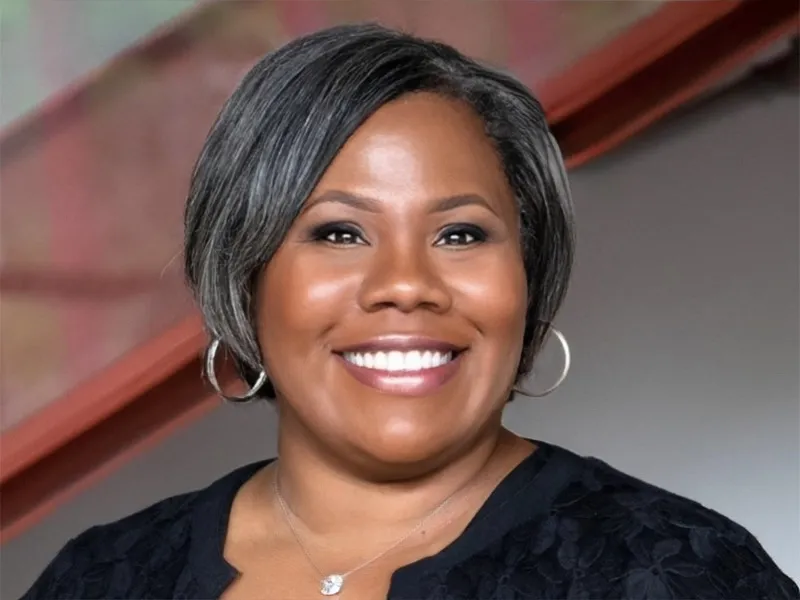

Candace Washington never thought she’d one day run her own business or teach the next generation of project management leaders in construction and engineering. But that’s exactly what she’s doing thanks to Georgia Tech.
In 2012, Washington, a seasoned construction veteran with 25 years of expertise and a master’s degree in building construction from Georgia Tech, noticed a shortage of project managers. She oversaw capital improvements and construction buildouts nationally and was consistently getting asked by clients to oversee the construction buildouts. This would spark the idea to start her business and launch Cancave Management & Engineering.
Over the next decade, Washington built a successful company and yet she continued to see this recurring shortage of project managers. According to Associated Builders and Contractors, the construction sector still grapples with a significant talent shortage that extends beyond the skilled trades to include construction management positions, with a projected need for nearly half a million additional workers in 2025 alone.
“We have fewer people entering the industry. With the pandemic, we had a great exodus where a lot of people decided to get out of the industry and retire early, and then you have the emerging housing market and infrastructure needs, creating demand for construction in general — the perfect storm,” Washington said.
Determined to find more ways to address the problem, she joined Georgia Tech’s School of Building Construction as a part-time instructor and, in 2024, began pursuing her Ph.D. at Tech, where she learned about the Jim Pope Fellowship.
“Being a Pope Fellow has been transformational to my experience as an entrepreneur,” Washington said. “When I started my company, I wish I had something like this. Through this fellowship, I was able to dig deeper into my idea, validate assumptions, and shape it into a solution that addresses the pain points of labor shortages and compliance bottlenecks in the underutilization or over-utilization of resources.”
As a fellow, Washington was also awarded $15,000 in discretionary funds to support her teaching and entrepreneurial efforts. With the resources from Jim Pope, Washington has been able to make meaningful impacts for students and her company.
Over the last year, she has worked on the next evolution of her business by building Extend the Ladder®, a workforce resource and compliance platform built around an industrywide shared resource model for construction professionals. One application of her platform would allow general contractors to share resources by enabling them to find and coordinate talent from a single database.
In addition to helping her pursue a construction job-matching platform, the fellowship has reinforced her love of teaching and mentoring entrepreneurial-minded students. As a part of the fellowship, Washington taught CREATE-X’s Startup Lab, which teaches the fundamentals of evidence-based entrepreneurship.
One student, Vivianne Akerman, a rising junior in industrial engineering, became Washington’s mentee after her spring Startup Lab class. Bitten by the entrepreneurial bug, Akerman decided to continue her entrepreneurial journey in CREATE-X’s Idea-to-Prototype (I2P) course. She turned an idea into action with guidance from Washington, building a solution for a problem she identified during Startup Lab.
“Candace is an amazing mentor who pushes students to be their best selves,” said Akerman, who is developing a makeup platform designed “to make makeup practical and less overwhelming.” The platform will enable consumers to compare and review products and ultimately find what brands work best for them, given their skin type and desired look.
“I love how positive she is,” adds Akerman. “This is new for me — it’s very exciting but also very overwhelming. She helps me stay focused on my priorities and what’s most important.”
Washington emphasizes that there is no guidebook to becoming an entrepreneur; rather, the path must be discovered through conversations, relationship-building, and learning from the experiences of others.
“This experience deepened my appreciation for the spirit of entrepreneurship — it’s been invaluable for me,” she says. “I would tell anybody who's trying to start a business, you need to go through this process.”
Now, as a mentor herself, Washington credits her fellowship in CREATE-X for giving her the confidence and framework to help others. And she credits her path as a mentor and teacher of entrepreneurship to the home she’s found at Georgia Tech.
Drawing from her own experiences, both the challenges and the triumphs, she offers a piece of advice that she believes aspiring entrepreneurs should carry with them.
“Start now — you don’t need all the answers. Focus on the process, stay committed, and be open to real-world feedback.”
Applications are now open for the 2025 Jim Pope Fellowship until Sept. 2. Interested faculty can learn more at https://create-x.gatech.edu/faculty/jim-pope-fellowship.
News Contact
Written by Anne Wainscott-Sargent
Internal Contact
Breanna Durham
Marketing Strategist
Jul. 14, 2025
By Chris Gaffney, Managing Director, Georgia Tech Supply Chain and Logistics Institute | Supply Chain Advisor | Former Executive at Frito-Lay, AJC International, and Coca-Cola
Every few weeks these days, a new AI breakthrough makes headlines. Models get sharper and more capable. Language tools get more fluent. Claims of agent breakthroughs and embedded autonomy in tools are everywhere.
And each time, the question resurfaces: What’s left for people to do as this wave progresses?
It’s a fair question. But from what I’ve seen throughout my career—from managing logistics in a Frito-Lay regional DC to transportation and distribution operations at AJC International and Coca-Cola, and now through executive education, consulting, and applied research at Georgia Tech—I believe we’re asking the wrong question.
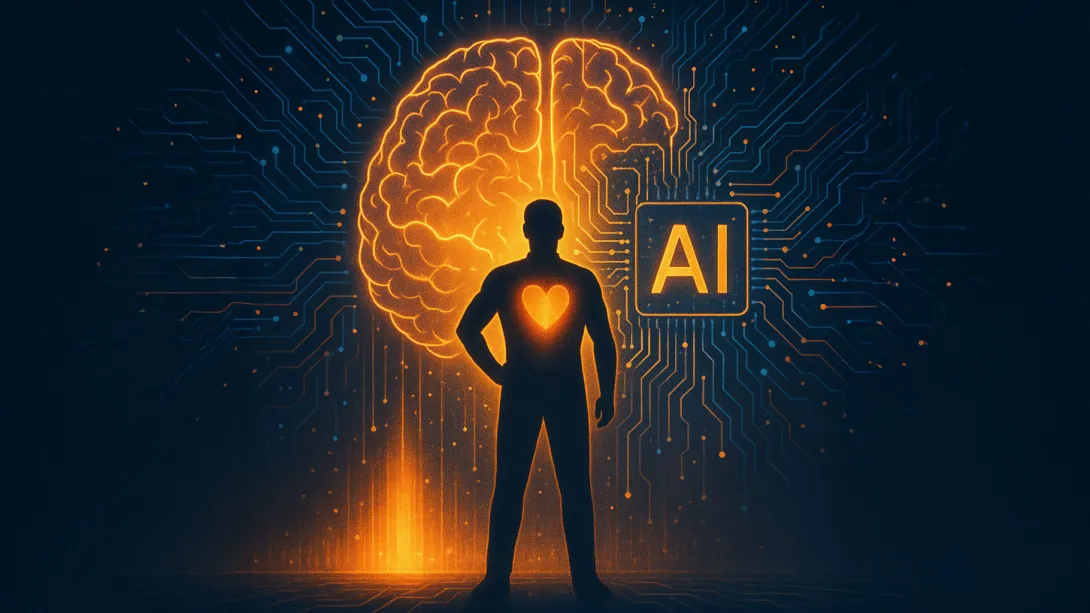
Instead of asking what AI can do, we should be asking: Where is the human edge—and how do we keep it sharp?
1. Collaboration Across Boundaries Still Wins the Day
Whether in manufacturing, logistics, commercial and customer teams, or strategy, success still hinges on people working together—often across silos, systems, or supply chains. At Coca-Cola, some of the most impactful progress we made didn’t come from technology upgrades. It came from aligning teams that didn’t naturally collaborate—finance with planning, supply chain with sales, bottlers with company.
From what I see in my advisory work and interviews with supply chain leaders, that hasn’t changed. AI can improve visibility. It can suggest decisions. But it doesn’t build consensus, resolve conflicts, or create shared understanding. That’s human work—and it often makes the difference between potential and progress.
2. When the Plan Breaks, People Step Up
During my time in global logistics at AJC International, unexpected events were the norm: shipping delays, capacity shortages, regulatory changes. AI may help flag risks, but when the plan breaks, it’s still people who step in, prioritize under pressure, and find creative solutions.
This same theme came up in a recent SCM Talent podcast conversation. When I asked a senior supply chain leader what traits define her most effective team members, she didn’t hesitate:
“A drive for results. Problem solving. The ability to work in teams. And the ability to influence others.”
Those aren’t going out of style. They’re still what carries teams forward when the data model breaks or the shipment gets stuck.
The professionals I see excelling—especially in moments of disruption—aren’t just technical experts. They’re problem solvers who own the outcome and stay focused when others get stuck.
Drive, persistence, and adaptability aren’t things you automate. They’re human qualities that remain essential.
3. Hands-On Context Isn’t a Field Trip—It’s a Foundation
At Frito-Lay, I worked in a regional distribution center and breakbulk operation managing warehouse activities and dispatching drivers. Later, I spent a full year as an operations manager at one of our plants, where I led drivers and worked with plant warehouse teams and schedulers to ensure load readiness and on-time dispatch to local DCs.
Those weren’t just jobs—they were formative experiences. They taught me how decisions affect execution in the real world, and how the rhythm of operations shapes everything else in the supply chain.
That’s why I firmly believe professionals—especially early in their careers—should spend 3 to 5 years in front-line roles. No AI tool can replicate the kind of intuition you build by seeing how things work, where they break, and how people respond in real time. That foundation lasts an entire career.
4. Communication and Leadership Will Always Matter
In every role I’ve had—from the plant floor to corporate teams to Georgia Tech—I’ve seen that clear communication and authentic leadership are force multipliers. They carry more weight now, not less.
AI might help with drafting, summarizing, or visualizing, but it doesn’t earn trust. It doesn’t mentor a new team member or guide a group through a difficult change. That takes listening, emotional intelligence, and personal credibility.
Those leading change in today’s organizations—whether rolling out a new system or rebuilding after disruption—are the ones who can communicate with clarity and lead with steadiness. That’s not something AI can learn.
5. The Edge Is Where Humans Live
There’s a space at the boundary of every operation—the “edge”—where plans meet real-world variability. And that’s where humans remain essential.
Whether it’s spotting an issue before it escalates, reading between the lines of a conversation, or connecting seemingly unrelated problems across functions, that kind of judgment is rooted in experience. It can’t be downloaded or inferred from data alone.
In my work at Georgia Tech, across executive education, consulting, and applied research, I regularly see the difference it makes when decision-makers bring not just technical knowledge, but lived context from the field. That human edge is where resilience is built—and where strategy becomes reality.
6. Humans and AI: Better Together
To be clear: this isn’t about rejecting AI. The smartest teams I work with aren’t afraid of it—they’re learning how to use it. AI tools can improve productivity, identify trends, and help people make better decisions. But they need to be paired with human insight.
AI suggests. People choose. AI speeds up planning. People keep it grounded. The professionals who combine digital fluency with interpersonal skill, operational awareness, and strategic judgment? Those are the ones who will lead in the next era.
So What Should You Do?
If you want to build a career that endures—and evolves—with AI, here are seven things I recommend:
- Invest in the front line. Not just a tour. Spend 3–5 years in a real operations or customer-facing role. It will shape how you lead for decades.
- Build bridges. Learn how sales thinks. Understand finance’s constraints. Connect systems, teams, and people.
- Volunteer when the extra project comes up. These stretch roles are often tied to strategic initiatives and senior leadership. Saying yes can accelerate learning and visibility—especially when others hesitate.
- Take roles at the intersections—not the cul-de-sacs. Look for positions that connect functions, partners, or ecosystems. Exposure to diverse perspectives sharpens insight and multiplies your value.
- Sharpen your communication. Speak with intent. Write with clarity. Listen deeply. These skills amplify everything else.
- Evolve with AI—or fall behind. You don’t need to code, but you do need to understand how AI is changing your domain. Through continuing education, hands-on learning, or professional development, stay curious and current.
- Never stop learning. At Georgia Tech, I see firsthand how ongoing learning—through executive education, research engagement, or new assignments—helps professionals lead through change. Keep asking: what haven’t I seen yet? Who could I learn from?
Final Thoughts
The future of work isn’t about humans vs. machines. It’s about people who can lead, decide, and connect—with AI as their force multiplier.
We may automate tasks. But judgment, trust, and empathy? Those are human domains. And in times of uncertainty, it’s the people who can navigate complexity, rally teams, and adapt with integrity who make the difference.
So yes, learn the tools. Embrace the change. But never underestimate the power of experience, context, and connection.
That’s your edge. And that’s not going anywhere.
Jun. 11, 2025
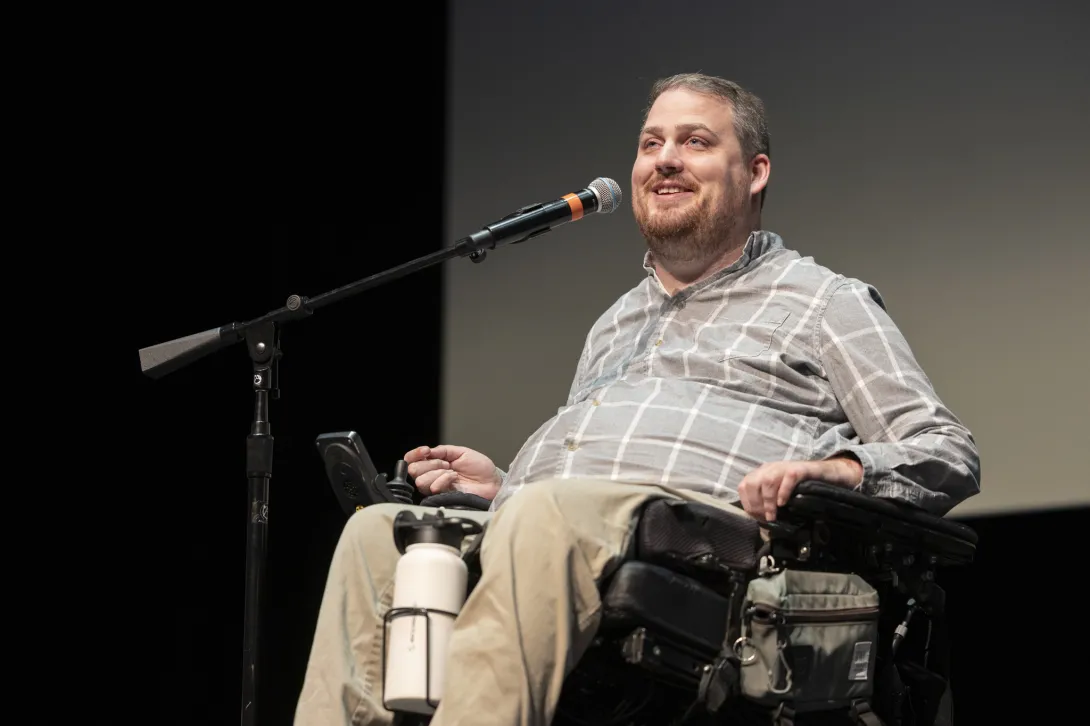
From clinical trial participant to BCI advocate, Ian Burkhart shares his story at “Wired Lives,” organized by Georgia Tech’s Neuro Next Initiative. Photo: Chris McKenney
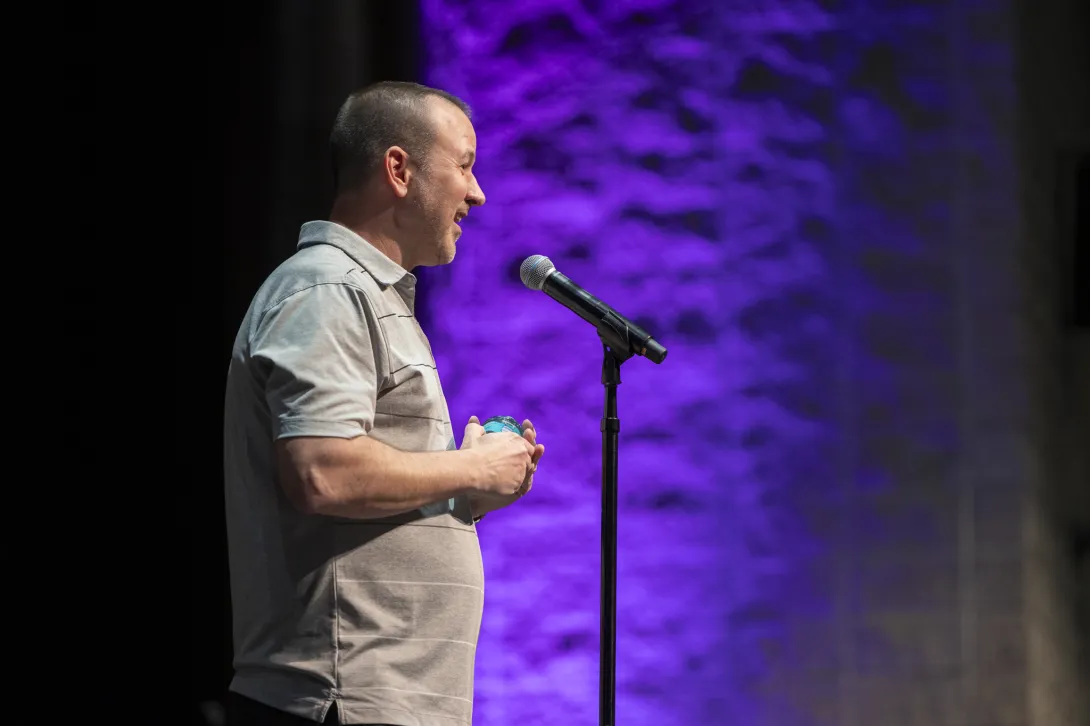
Brandan Mehaffie shares how deep brain stimulation transformed his life after an early-onset Parkinson’s diagnosis. Photo: Chris McKenney

Jennifer Walden reflects on the emotional and physical challenges of epilepsy — and the relief that came with a breakthrough treatment. Photo: Chris McKenney

Scott Imbrie shares his decision to undergo brain surgery — not for personal benefit, but to advance research that could help others. Photo: Chris McKenney
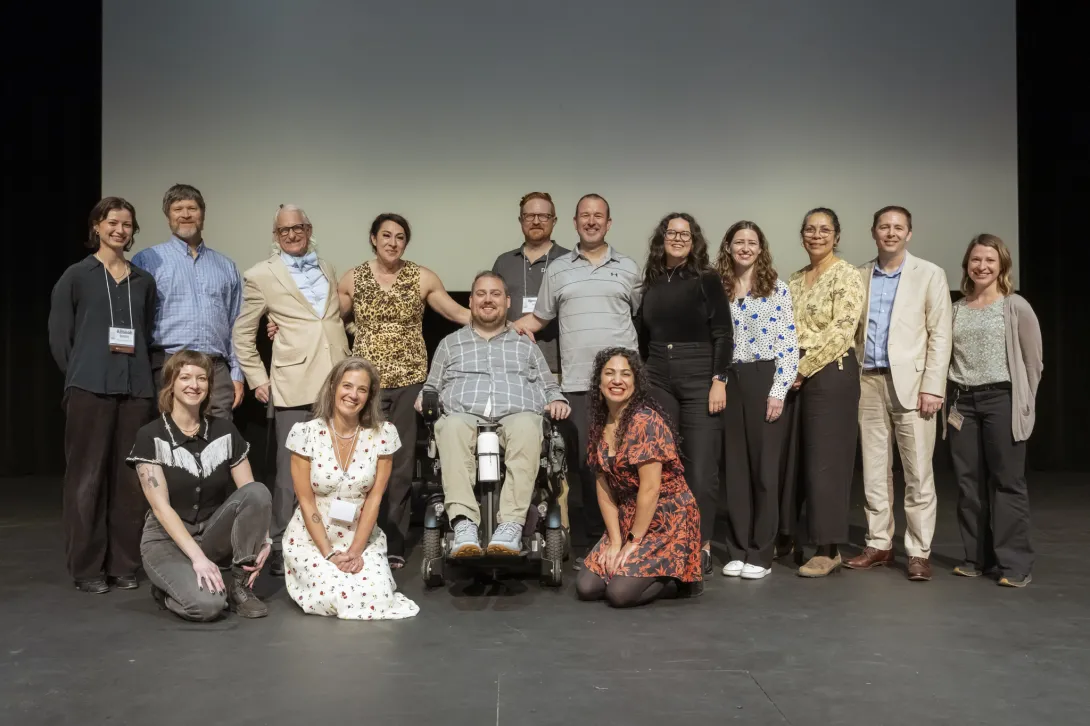
Storytellers, event organizers, and sponsor representatives at "Wired Lives."
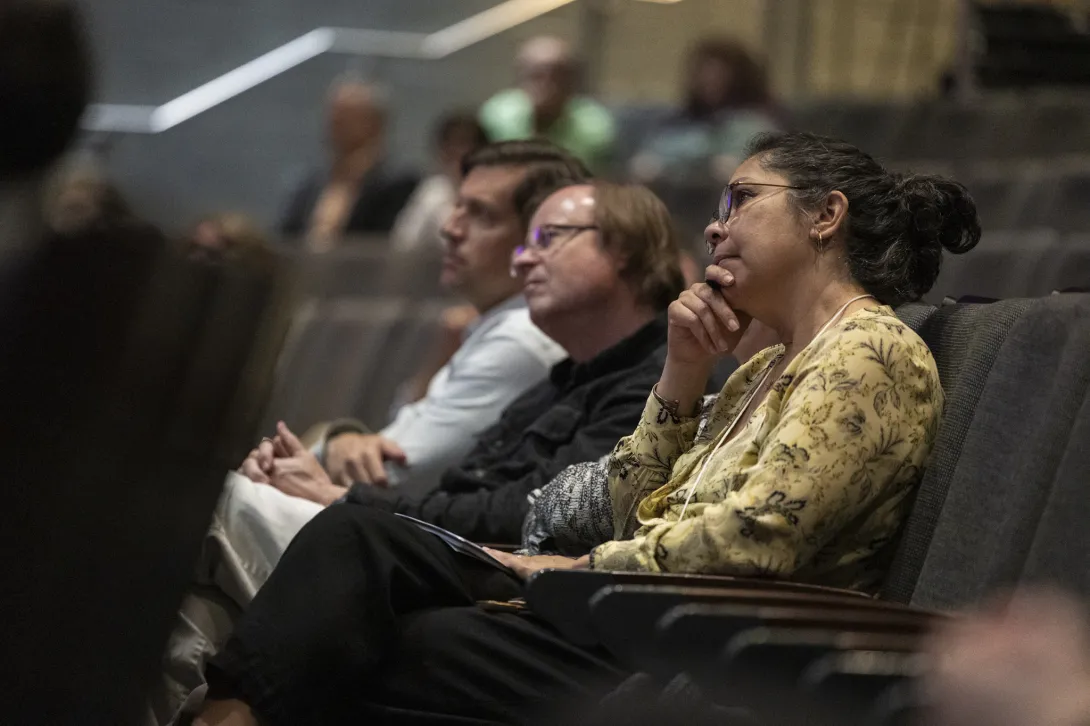
Researchers, students, and community members came together to explore the lived experiences behind cutting-edge neurotechnology. Photo: Chris McKenney
Electing to have invasive brain surgery isn’t something most people have done. Ian Burkhart isn’t most people.
“When I finished rehabilitation, my doctors and therapist and, most importantly, the insurance company said, ‘For someone with your condition, we feel like you've made all the improvement that you will, have a nice life,’” said Burkhart, who was left with limited feeling and mobility below the neck after a 2010 diving accident injured his spinal cord. “That didn't sit well with me.”
Hoping even a fraction of hand mobility would increase his independence, Burkhart turned to a clinical research trial on a brain-computer interface (BCI) designed to detect movement signals in the brain and send them to a computer to stimulate the arm muscles, bypassing the spinal cord in the hopes of restoring movement.
“I had had four and a half years of never thinking my hand was going to move again,” he recalled. When testing to see if he qualified for the study, researchers stimulated his hand muscles. “I saw my hand move, and that was all I needed to know — I was ready to risk it all for something that may or may not work.”
Burkhart’s story is one of many that reveal the deeply personal side of neurotechnology research. Centering lived experiences like his is central to the mission of the Institute for Neuroscience, Neurotechnology, and Society (INNS), a new Interdisciplinary Research Institute launching this July at Georgia Tech.
“If we want to build neurotechnology that truly serves people, their voices should be part of the scientific process from the very beginning,” said Chris Rozell, a professor in the School of Electrical and Computer Engineering and one of the many researchers at Georgia Tech working to understand and advance BCIs. “Hearing from individuals who live with these devices helps guide more ethical, inclusive, and effective research. The entire field benefits from inclusive conversations like these.”
Life With a Brain Implant
Burkhart and three others recently shared their stories live on the Ferst Center stage at “Wired Lives: Personal Stories of Brain-Computer Interfaces, an event organized by Georgia Tech’s Neuro Next Initiative. Their stories gave over 200 attendees a rare, honest glimpse into the realities of neurological conditions and the path to brain-computer interface research.
“I was at a crossroads in my life at 47 years old,” said Brandan Mehaffie, who told his story of living with early-onset Parkinson’s disease. “I was trying to figure out, do I continue with the status quo and watch my career dwindle into nothing? Watch my life with my family, my kids, not being able to go on hikes or family vacations?”
Mehaffie eventually qualified for deep brain stimulation (DBS) treatment, a procedure where a pacemaker-like device is implanted into the brain to provide electrical stimulation. “It changed my life for the better in ways that I can't even tell you.”
When former U.S. Air Force Sgt. Jennifer Walden’s doctor told her about a clinical trial testing DBS as an epilepsy treatment, she jumped at the chance. “The 48 hours after those seizures are 48 hours where you don't want to live anymore.” Walden explained that her response to medication had dwindled after years of traditional treatment, increasing the frequency and severity of her seizures. “I feared suicide. It's something I didn't want to do, but if something happened in those 48 hours to end my life, I didn't care,” she said.
“I am now probably 99% seizure-free,” she beamed as she recalled her response to DBS on stage. “I don't know how I got so lucky in life, but I don't take it for granted.”
Common themes in their stories were resilience, hope, and a deep desire to give back.
“When I joined the study, it had no physical benefit to me, but that's not why I joined it,” said Scott Imbrie, who experienced a major spinal cord injury and participates in a clinical BCI study at the University of Chicago. “I decided to have invasive brain surgery and have electrodes implanted on my brain to help other people.”
A New Approach to Interdisciplinary Research
Timed alongside the InterfaceNeuro conference at Georgia Tech, the gathering offered a rare opportunity for scientists, engineers, and clinicians to engage directly with the lived experiences of individuals using brain-computer interfaces — a perspective often missing from traditional research settings.
“It makes you think about how we ethically conduct research and how we recruit and interface with patients,” said Eric Cole, a postdoctoral researcher at Emory University, who was reminded that many patients participating in BCI research have been on a long, difficult journey before interacting with researchers. “We should remember to take their experiences seriously and respect them. They're giving up something for research — that part we should always remember.”
“Wired Lives” was one in a series of events highlighting the lived experience of individuals with neurological conditions organized by the Neuro Next Initiative, which has served as the precursor to INNS.
“A core mission of INNS is to consider how neuroscience and neurotechnology impact people’s lives,” said Jennifer Singh, associate professor in the School of History and Sociology, a member of NNI’s executive committee, and a co-organizer of the event. “Their stories matter when it comes to the types of science and technology we pursue and how they benefit the human condition. Many scientists and engineers may never encounter people living with neurological conditions outside of events like this. That will be a priority for INNS — to bring the expertise of lived experiences to the research process.”
Ian Burkhart’s lived experience reminded the audience that not every clinical trial has a happy ending. His BCI was ultimately removed after seven years as research funding ran short, taking his newly improved hand mobility with it. Despite this, Burkhart remained positive.
“I'm so glad I was able to take that risk and have that voluntary brain surgery and participate in this type of research because it's defined my life.” Burkhart went on to found the BCI Pioneers Coalition and his own nonprofit because of his research participation. “It gave me a lot of hope for the future, and a lot of hope that these types of devices are going to be able to help people and improve their quality of life.”
This event was produced in partnership with The Story Collider and made possible through support from Blackrock Neurotech and Medtronic.
News Contact
Audra Davidson
Research Communications Program Manager
Neuro Next Initiative
May. 28, 2025
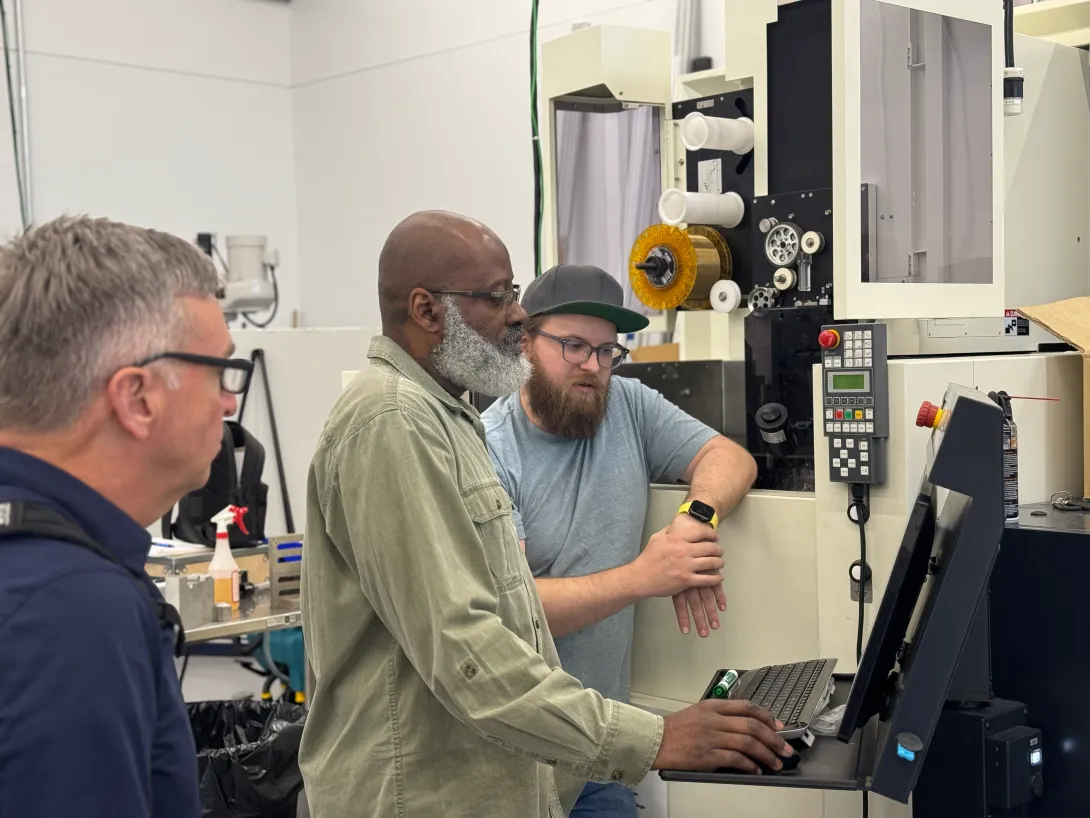
As part of the partnership, Southern Regional Technical College Instructor Marvin Bannister (center) received hands-on training on advanced machining equipment to prepare for teaching Georgia’s next generation of manufacturers. Photo: Audra Davidson.
Thomasville, Georgia, is a hub of training and talent for local manufacturers. But Mason Miller could tell there was something missing.
“We didn't have any training for advanced manufacturing in our area,” said Miller, vice president of Academic Affairs at Southern Regional Technical College (SRTC), which offers education and training programs in technical and manufacturing fields. “Companies had to go out and recruit people from Michigan to run their machines. That's when we said, ‘We don’t want that to happen — we need to be doing that right here.’”
That’s where the Georgia Tech Manufacturing Institute (GTMI) stepped in. Working with partner program Georgia Artificial Intelligence in Manufacturing (Georgia AIM), GTMI helped connect SRTC with the resources and expertise needed to develop a robust training program tailored to the needs of local manufacturers.
Miller said at first, he was skeptical. “When GTMI said they wanted to be partners, I thought, ‘OK, this is another situation where we're going to talk for a minute, everybody says things and then goes away — and that’s it,’” said Miller. “That's not how it's been at all.”
Rather, it’s been a true partnership driven by SRTC, with curriculum focused on automation and robotics developed by the Technical College System of Georgia and GTMI. The curriculum is also shaped by local industry input to directly address workforce gaps in the region’s manufacturing sector.
“As a state institution, we're here to serve you,” said Steven Sheffield, senior assistant director of Research Operations at GTMI and a point person of the partnership. “Tell us the problem, and we will work hard to try to solve it with you.”
Filling the Workforce Gap
Miller was committed to giving SRTC students the advanced manufacturing skills needed to stand out in the workforce. Yet the evolving manufacturing landscape and the needs of local manufacturers revealed gaps in SRTC’s curriculum, particularly in AI, automation, and robotics.
With GTMI and Georgia AIM researchers contributing key expertise to the expanded smart manufacturing curriculum, Miller noted the partnership is “opening our eyes to what we can do with AI. We're going to start integrating that into our programs.”
Beyond AI and robotics, SRTC leadership identified a crucial gap in their program: training in precision machining, a skill that local manufacturers like Check-Mate Industries sorely needed.
“If we want to attract new business and industry to Georgia, we need to be able to show them we can provide a skilled workforce,” said Miller.
To address this missing piece, GTMI and Georgia AIM helped procure funding to acquire and refurbish precision-machining equipment from longtime partner Makino. Georgia AIM also supported the renovation and outfitting of two SRTC lab spaces with additional updated equipment.
Last fall, SRTC launched its new Precision Manufacturing & Engineering and Manufacturing Engineering Technology programs, with instructors trained by GTMI faculty in precision manufacturing. The new program at SRTC is one example of the ways GTMI experts are working with communities across the state to expand access to training and new technology.
“Not a lot of technical colleges have this type of machinery,” said Marvin Bannister, SRTC precision machining and manufacturing program chair. Instructors like Bannister received specialized training at GTMI’s Advanced Manufacturing Pilot Facility to ensure they felt confident teaching students how to operate the machinery. “Not only is it something else to add to my skill set, but the most important thing is that I'll be able to train other students who desire to learn on a machine like this.”
Because of SRTC’s expanded offerings, the technical college has strengthened partnerships and developed new internship programs with local manufacturers. “We all want the same thing,” said Miller, “which is to grow industry partnerships and to create a talent pipeline for our state.”
GTMI and Georgia AIM also support STEM programs with Thomasville area schools and internship programs for K-12 teachers with local manufacturers such as Check-Mate. These efforts deepen the connections between students and manufacturers, opening doors to future careers in the sector.
“We’re here to connect the dots and enable these types of partnerships,” says Steven Ferguson, a principal research scientist with GTMI and co-director of Georgia AIM. “When teams and their networks come together to solve a challenge for just one manufacturer, the impact can reach across an entire region.”
News Contact
Audra Davidson
Research Communications Program Manager
Georgia Tech Manufacturing Institute
May. 19, 2025

You’re managing the Texas Panhandle’s power grid. Heavy winds are blowing, and a worn-out utility pole ignites a fire by crashing onto a transmission line. Luckily, the fire department arrives quickly, putting out the fire before it spreads to nearby cities. But the same thing may happen again with gusty conditions predicted for the next 24 hours. Should you shut off miles of power lines to reduce that risk, causing outages for thousands of residents? Should you add batteries to the grid or move some power lines underground to lessen the impact of future fires? That sounds useful, but paying for these upgrades would require raising electricity rates.
Players of the Current Crisis video game are pondering these questions, similar to professional grid managers during the Texas Smokehouse Creek fire in 2024. But the players did not purchase Current Crisis at a run-of-the-mill gaming store. They might have played it at Georgia Tech’s Dataseum, which featured the game in a recent exhibition. Or they might have helped develop it in weekly meetings with Daniel Molzahn, associate professor in the School of Electrical and Computer Engineering and EPIcenter initiative lead.
“Current Crisis started as a computer simulation I programmed in Summer 2020 for a senior-level course I taught that fall,” says Molzahn. “My students had to dispatch crews to maintain or repair a simplified model of the Georgia power grid. In the middle of the Covid-19 pandemic, each dispatch had a risk of infection and quarantine, which meant losing the crew for the rest of that round. The students had a fixed budget to balance two competing goals: operating a power system with minimal outages and keeping the repair crews healthy.”
The class project was popular, and its scope began to grow. Molzahn proposed turning his simulation into a video game in a July 2021 grant application to the National Science Foundation. He received the five-year award that fall and launched his “Vertically Integrated Project” on power grid gaming the following spring. It soon attracted about 35 students per semester, from sophomores to those pursuing graduate degrees in various disciplines. Most students stay for three to four semesters.
Tristan Ziegler joined the VIP as a computational media sophomore in Spring 2022 — and still works on it three years later as a professional programmer. “I found the project by searching for ‘game’ on the VIP website,” says Ziegler, who graduated in 2024. “It offered much more freedom than traditional classes but still allowed me to earn credits and grades, unlike a student organization where you volunteer your time.”
The students quickly discovered the benefits of working toward a shared goal in smaller groups, focused on coding, grid modeling, graphic design, or artistic creativity. Some volunteered to lead initiatives, such as organizing the Dataseum exhibition or the 2025 Seth Bonder summer camps, where they will teach high schoolers the basics of game programming.
Another long-term member of the VIP team is Ryan Piansky, a doctoral student, who studies the resilience of power grids to wildfires. He combines well-known engineering tools — algorithms for finding a mathematically optimal problem solution — with historical wildfire data to evaluate grid management decisions.
“I have examined if policies based on established engineering principles help the people who need the most help, reduce the risk of outages broadly across the whole grid, and optimally allocate limited resources,” explains Piansky, who works in Molzahn's research lab. “To do that, I combine power grid models with realistic wildfire simulations to assess if those policies would likely generate desirable outcomes in a range of plausible scenarios.”
The VIP work on grid modeling has informed Piansky’s research, but the climate models he uses to mimic the spread of wildfires are too complex for a fast-moving video game. That’s why he has helped the students develop simplified versions of these models. Humidity and vegetation, for example, influence both real fires and those popping up in Current Crisis.
Piansky’s research is part of Molzahn’s long-term goal: developing computer tools that help professional grid managers improve the grid’s resilience to natural disasters — from pandemics and wildfires to hurricanes, heat waves and floods.
“We plan to record the choices made by Current Crisis players in crowdsourced datasets that will support our research,” says Molzahn. “By using these datasets to train machine-learning algorithms, we can harness the power of AI to develop better disaster response policies.” (The European Space Agency uses a similar gamification strategy to map moon craters.)
The project’s benefits go well beyond these research contributions. Its educational value includes experience working in multidisciplinary teams of students at different levels and leadership development. Molzahn also hopes the game will help build public acceptance of disruptive actions during real disasters.
“Recognizing the tradeoffs inherent in grid management is important, whether it’s understanding why power shutoffs reduce fire risks or why service restorations are time-consuming,” says Molzahn. “This may also generate broader public support for electricity rate increases and tax allocations to pay for infrastructure hardening.”
Written by: Silke Schmidt
News Contact
Story Written by: Silke Schmidt
Priya Devarajan || Research Communications Program Manager
Apr. 24, 2025
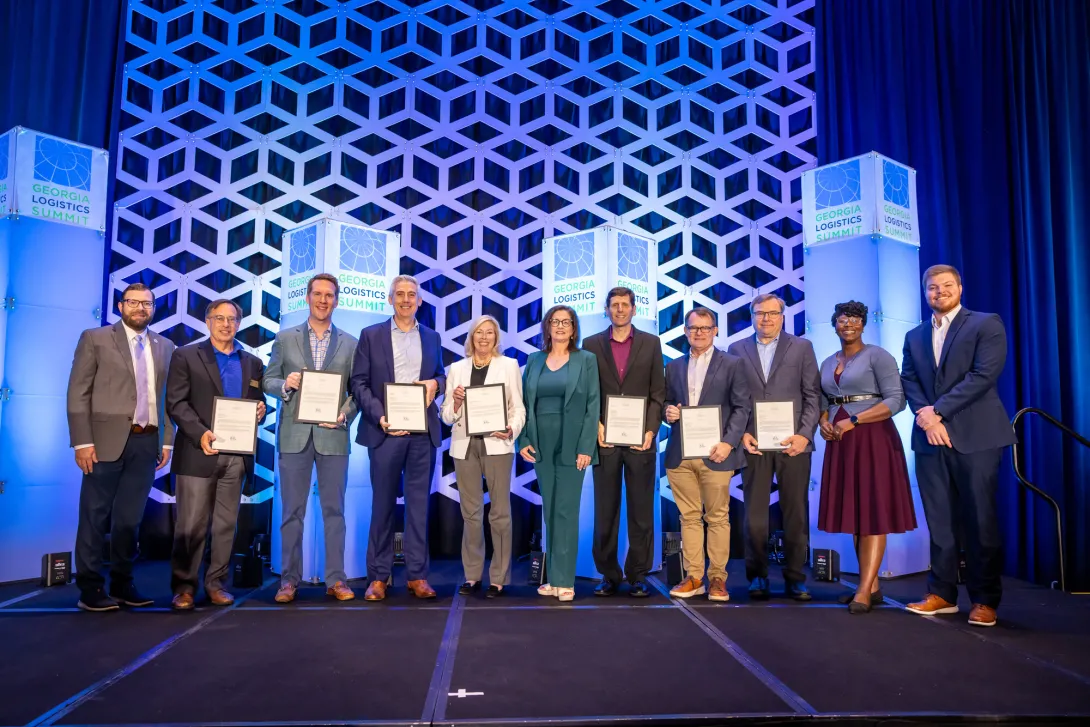
Members of the Georgia Center of Innovation – Logistics Advisory Board gathered at the 2025 Georgia Logistics Summit, where each received a personal note of recognition from Governor Brian Kemp for three years of dedicated service. Their collective efforts have advanced freight and logistics across Georgia—strengthening collaboration between industry, government, and academia to drive the state’s economic growth.
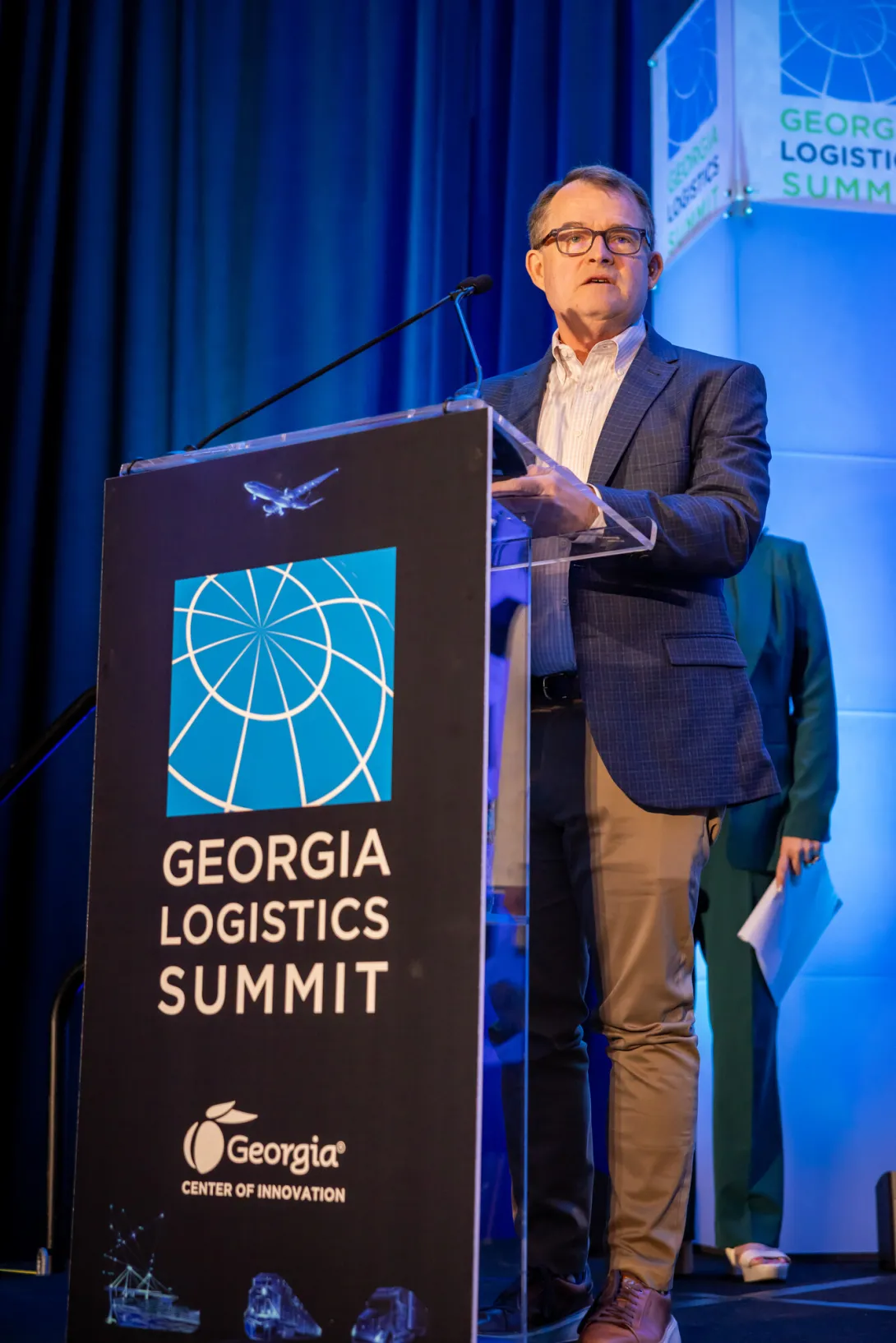
Chris Gaffney of Georgia Tech’s Supply Chain and Logistics Institute addresses the Georgia Logistics Summit, reflecting on the power of public-private collaboration. “It’s that bridge between dialogue and execution that makes this group so valuable. Together, we’re building the capabilities that help Georgia’s communities and businesses grow, thrive, and lead.”
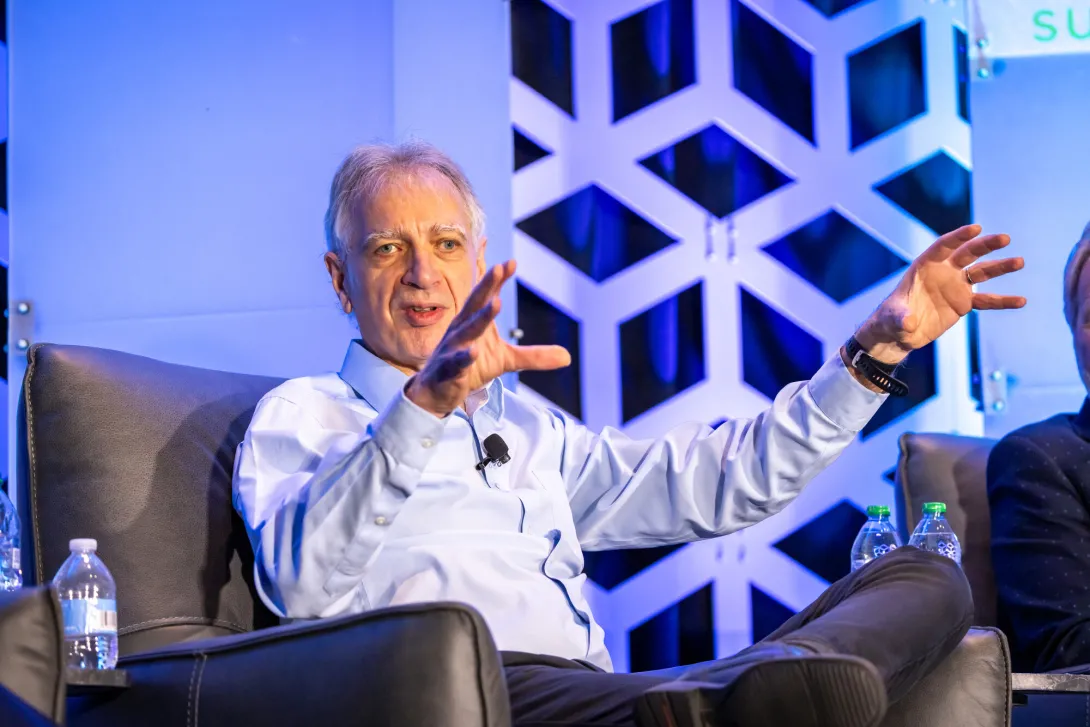
Pascal Van Hentenryck participated in a panel discussion of how AI and digital technologies are reshaping supply chains, including future predictions and real-world examples of their impact on logistics.
The Georgia Center of Innovation, a strategic arm of the Georgia Department of Economic Development (GDEcD), hosted hundreds of attendees at the 2025 Georgia Logistics Summit, where experts offered insights on the intersection of technology and logistics, updates on infrastructure investments, and how the state is preparing the future workforce to support growth. Established in 2009 as the first state-led event of its kind, the Georgia Logistics Summit is one of the Southeast’s key logistics and supply chain events, connecting industry professionals for networking and knowledge-sharing.
The economic impact of Georgia’s transportation and logistics industry was $107 billion in 2023, according to an economic impact study by the University of Georgia’s Selig Center for Economic Growth. These industries supported more than 578,000 Georgia jobs, or one in nine jobs in the state. From 2010 to 2023, transportation and logistics jobs in Georgia grew by 68%, outpacing the national growth rate of 52%. Additionally, in 2023 and 2024 alone, new logistics and distribution sector investments, including cold storage and ecommerce fulfillment centers, totaled $3.8 billion and created over 9,000 new jobs.
“Georgia’s unmatched global connectivity is one of the driving forces behind our economic success. Decades of strategic investment in our logistics and supply chain infrastructure – from our ports and rail lines to our highways and air cargo capabilities – have led to record-breaking economic investments and trade,” said Georgia Department of Economic Development Commissioner Pat Wilson. “The Logistics Summit brings together private sector, government, and education leaders to learn from experts, exchange best practices, and explore opportunities in the rapidly evolving logistics landscape to maximize opportunities. Events like this strengthen collaboration and spark new ideas that keep Georgia businesses competitive on a global scale.”
Georgia Department of Transportation Commissioner Russell R. McMurry highlighted Georgia’s strategic investments and how the Georgia Department of Transportation (GDOT) is leveraging technology to improve freight flow. He cited the leadership of Governor Brian P. Kemp and support from the General Assembly to allocate $1 billion to the newly created Georgia Freight Program over the past two years. Additional investments in transportation infrastructure are advancing the timing for key planned transportation projects that will maintain and improve Georgia’s interstate highway system, roads, and bridges. Georgia’s multimodal transportation network carried nearly half a billion tons of freight in 2019, valued at $673 trillion. Projections show that freight volume is expected to nearly double to 900 million in tonnage and freight value to more than double today’s value by 2050. Working with partners that include the Center of Innovation and the Georgia Institute of Technology, GDOT is focusing on enhancing safety and efficiency, including projects to add 50% more truck parking and installing fiber internet on Georgia interstates.
Georgia Ports Authority Vice President of Operations Susan Gardner provided updates on strategic investments to expand capacity at the ports, and how Georgia Ports Authority (GPA) is leveraging live data to improve safety, track vessel productivity and containers, and eliminate congestion. Gardner emphasized building a technological culture and prioritizing hiring creative employees, as well as harnessing data insights to boost efficiency. GPA is investing in $4.5 billion in improvements over the next decade as part of its port master plan to expand cargo handling capabilities and support future supply chain requirements.
This year’s feature panel, “AI and Beyond: Embracing Digital Transformation in Logistics,” included leadership from The Home Depot, Havertys Furniture, and TOTO USA, as well as research perspectives from the Georgia Institute of Technology. Panelists highlighted the ways digital technologies are reshaping supply chains, including a three- to five-year outlook for the industry, and provided insights attendees can use to shape their strategies to move more efficiently as AI and automation transform the industry.
“Digital technologies are reshaping supply chains in various ways, and Georgia is working to stay ahead of the curve,” said Center of Innovation Executive Director David Nuckolls. “The Center of Innovation and our specialized logistics team work alongside this dynamic industry, helping to position businesses for growth. The annual Georgia Logistics Summit is a powerful opportunity to build connections and equip businesses with crucial knowledge and resources.”
Educating the needed talent was the focus of the event’s final panel, with University System of Georgia Chancellor Sonny Perdue and Technical College System of Georgia Commissioner Greg Dozier providing updates on how the state’s post-secondary institutions are developing a globally competitive workforce. Discussion focused on how these institutions are ensuring the skills they are teaching match the jobs logistics companies are looking for, including creative problem-solving and effective use of new AI and automation tools. The breadth of Georgia’s technical college programs was also discussed, including the High Demand Career Initiatives program and a pilot program called “Dual Achievement” that enrolls students who withdrew from high school in a technical college program, enabling them to earn a high school diploma alongside a technical college certificate, diploma, or degree. Panelists focused on the importance of helping students get where they want to go faster, upskilling the existing workforce, and how connections between industry leaders and educators can help foster greater outcomes.
The Center of Innovation’s Logistics Industry Advisory Board also recognized the winners of the inaugural Future Innovators in Supply Chain competition. The competition invited college students to create videos about supply chain careers, reflecting the Center’s commitment to developing future logistics leaders. Led by professor Parisa Pooyan, student team “The Masters of Logistinomics” from Kennesaw State University won first prize and a $3,000 grant for the university. Eli Hampton, Angeline Harris, Joe Johnson, and Dana Pazhouhesh created the winning video, which can be viewed here.
For additional information on the 2025 Georgia Logistics Summit and to stay up-to-date on next year’s plans, visit galogisticssummit.com.
Participants in the 2025 Georgia Logistics Summit also included leaders from S&P Global Market Intelligence, Boost Phase Ventures, and M.D. Livingstone Consulting.
About the Georgia Center of Innovation
Exclusive to Georgia, the Center of Innovation helps Georgia businesses of all types and sizes find inspired solutions to challenges and opportunities. The Center connects new and expanding businesses with a team of experts, external partners, and independent mentors to tap into the technical expertise and guidance they need. By encouraging collaboration across six key industries: Aerospace, AgTech, Energy Technology, Information Technology, Logistics, and Manufacturing, the Center helps Georgia prepare for growth in strategic industry ecosystems.
About GDEcD
The Georgia Department of Economic Development (GDEcD) is the state’s sales and marketing arm. It is Georgia’s lead agency for attracting new business investment, encouraging the expansion of existing industry and small businesses, and locating new markets for Georgia products. As the state’s official destination marketing organization, it drives traveler visitation and promotes the state as a location for film and digital entertainment projects. GDEcD is responsible for planning and mobilizing state resources for economic development, fostering innovation and the arts to drive opportunity from the mountains to the coast.
News Contact
Allie Dean, Communications Manager, Georgia Department of Economic Development | adean@georgia.org
Mar. 08, 2025

Reagan Cook stood at a career crossroads when her undergraduate degree in mechanical engineering intersected with her recent master’s in data analytics.
She wanted to connect her experience in manufacturing with her burgeoning interest in data science but wasn’t sure which way to turn. Then, she stumbled upon a job opportunity that brought both into one path forward: A fellowship focused on artificial intelligence in manufacturing through the Partnership for Inclusive Innovation, or PIN.
“I happened upon this fellowship and the vertical I landed on was AI in manufacturing, which was a good marriage of the two disciplines,” said Cook, who began the one-year paid position over the summer. The PIN fellowship, part of Georgia Institute of Technology’s Enterprise Innovation Institute, places early career professionals into public and private opportunities.
The fellowship is made possible through support from Georgia Artificial Intelligence in Manufacturing, or Georgia AIM. Georgia AIM supports several PIN fellows each year through the AI in Manufacturing vertical. Participants spend six months working on a research project through the Georgia Tech Manufacturing Institute (GTMI) and then six months with a partner company where they focus on a project that enhances the use of smart technologies.
Cook recently completed her first six-month rotation as a researcher with the Melkote Advanced Manufacturing Research Group at Georgia Tech, working with GTMI Associate Director Shreyes Melkote. She is now in her next role at Carbice, an Atlanta semiconductor manufacturer.
That’s the interesting part of the PIN fellowship: those accepted into the program gain experience in both the public and private sectors. Upon completing the program, fellows enter the workforce with a unique, innovative skillset that contributes to the emerging roles AI is creating in manufacturing.
The PIN program also helps address a gap in the workforce. There is a growing need for professionals who understand AI and smart technologies, and the program’s public/private partnership provides useful training and experience to early career professionals who are eager to solve these challenges.
In Cook’s case, her first job after college was with a small manufacturer doing engineering design and CAD work. Her role expanded a bit to accommodate her data analytics background while working on her master’s degree practicum project. But due to the size of the company, her work returned to strictly engineering after she graduated. In contrast, through the PIN fellowship, Cook is working on developing machine learning models that can be used to search for parts in a database of CAD designs. This would allow manufacturers looking for CAD drawings or 3D models to find similar parts with designs already created, saving time by giving engineers a starting point. This research allows her to leverage both her analytics and engineering knowledge.
"I feel like I am learning a lot,” said Cook. The research position allows her to apply theoretical knowledge from her master’s degree in a research environment. “That’s been very interesting and eye-opening. I’m still early in my career and my only experience is fairly traditional corporate jobs, so working in the realm of the unknown is a different situation. With research, you’re just exploring and have no assurances that what you’re doing is going to work. ”
Moving to Carbice for the second half of her fellowship adds another layer of learning, she added, because it’s one thing to test out a theory in a lab; it’s different when you are working for a company that needs to see results.
“Working in the private sector allows you to identify and reality-check the needs of actual workplaces,” she added. “Because sometimes you have a compelling idea and interesting research, but in a corporate setting, first, is it useful, and second, if it is useful, is it even something the industry wants or is willing to adopt?”
This is a paradox Cook will face not only during the second half of her fellowship, but also going forward in her career. The foundational experiences attained through the PIN fellowship will give Cook an edge as she moves into her next role. Many manufacturers are interested in adopting AI and smart technologies, but the challenge is in identifying problems to solve.
Cook said she is confident the fellowship will give her new insights that can be beneficial to future employers. The program also offers networking opportunities and connections with respected professionals that will be beneficial in years to come, she added.
“It’s really good to have both the public and private perspectives. And because I’ve worked in a couple different manufacturing environments, I’m interested in how different my manufacturing rotation will be and if I can identify patterns, similar issues, or inefficiencies. And all that is useful knowledge to have,” she said. “For me specifically, the content of this work is going to be very helpful in tying my whole resume together.”
For more details on the AI and Manufacturing-focused PIN fellowship supported by Georgia AIM, visit the PIN website.
News Contact
Apr. 14, 2025
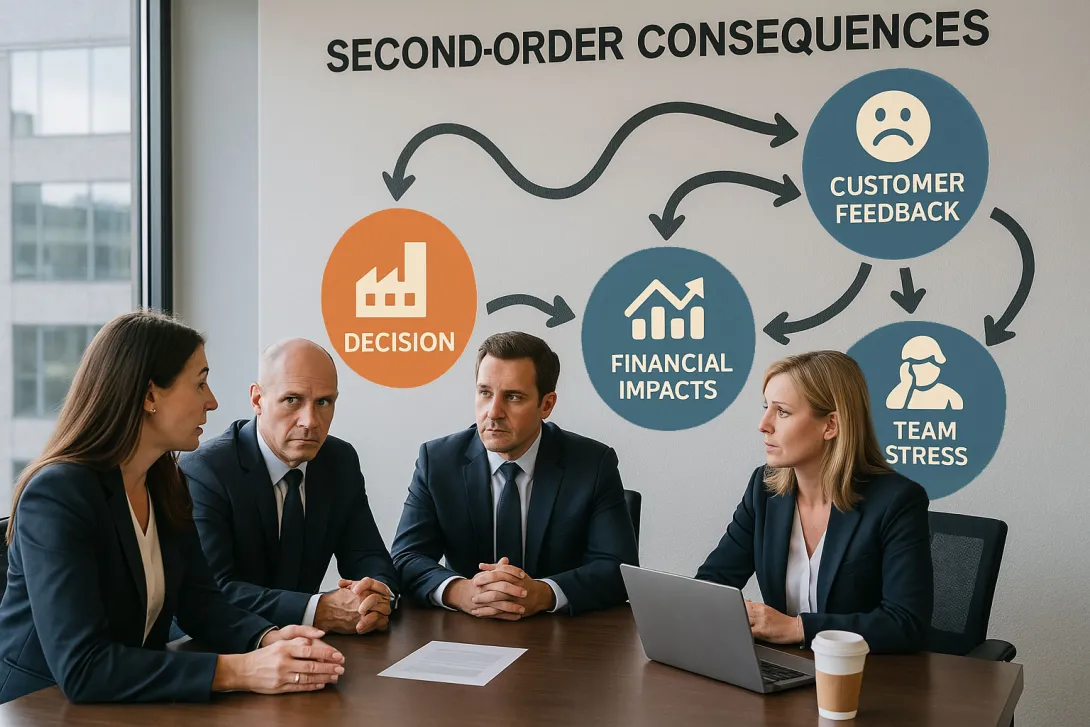
In the world of strategic decision-making—whether in Supply Chain Management and Engineering or in policy—we tend to focus our energy on the immediate problem in front of us. That makes sense. Big decisions like acquisitions, divestitures, or product innovations are complex enough without adding more layers. But in my experience—especially during my time at Coca-Cola and across broader industry engagements—what often gets left out of the room are the second-order effects. These are the unintended consequences that don’t show up in the PowerPoint deck, but show up months or years later on your P&L, in your customer feedback, or in your team’s stress levels.
Some of these outcomes are manageable. Others are problematic. Occasionally, they’re game-changing—but not in the way we hoped.
The Core Challenge: Complexity Crowds Out Curiosity
In my time in industry, I’ve seen high-stakes decisions unfold under tight timelines. The rigor is there: financial models, market analysis, legal due diligence. But the same pressure that brings focus often narrows the field of vision. Once the strategic goal is clear, the push becomes “get the recommendation ready” or “get the deal done.” Often, the team disbands before the ripple effects have even begun to appear.
In fact, studies of managerial behavior find that decision-makers often prioritize short-term outcomes over long-term implications, making it easy to overlook those downstream impacts.
We rarely paused to ask:
- What happens to our partners, our systems, or our people two or three steps down the line?
- Are we shifting bottlenecks or creating future misalignments?
- Could this solution lock us into a path that becomes hard to reverse?
- Will we be happy with this decision in 5 years?
Not asking these questions isn’t negligence. It’s often a result of how we structure decision processes: focused, time-bound, and oriented toward closure.
When Good Decisions Still Cause Trouble
Let's make this real. I've seen:
- Procurement strategies that focused on driving down cost but over time forced suppliers to reduce investment in quality and continuous improvement resources—eventually leading to a significant quality issue for a key customer.
- Multiple outsourcing efforts that reduced future capital requirements but also reduced flexibility in scheduling and responsiveness to rapid demand shifts or new product innovation.
- Plant closures that optimized total network cost on paper but not in reality, because the remaining plants were not actually equipped to take on more volume and increased complexity.
- A new warehouse management system implementation that promised efficiency gains but created chaos in distribution—not because the software was flawed, but due to unforeseen complexities during implementation.
In each of these, the first-order decision was sound. But the downstream effects caught teams off guard, requiring backtracking, remediation, and even reputational repair.
Even recently, retailers trying to fix 2021 product shortages by ordering more stock found themselves “overwhelmed with inventory” in 2022 when demand eased—a textbook second-order surprise. Likewise, logistics executives admitted they “didn’t anticipate” that 2020’s e-commerce boom would spark a warehouse labor crunch—a side effect that underscores how easily ripple effects can catch us off guard.
Why This Matters—and Why It's Often Skipped
Let’s be honest. Most leaders are moving fast. The idea of adding more process—or imagining abstract future problems—can feel like a luxury. Typical objections sound like:
- "We don't have time for hypotheticals."
- "That's someone else's job—let's just move."
- "We'll deal with it if it becomes a problem."
But here’s the catch: in a complex system like a global supply chain or a tightly coupled stakeholder network, second-order effects are not edge cases—they're part of the landscape.
In fact, recent research in supply chain management finds that such second-order effects are likely ubiquitous and must be anticipated rather than ignored. Ignoring them doesn’t make them go away. It just delays the pain—and multiplies the cost.
Where This Applies in Supply Chain
These second-order thinking practices are especially useful in supply chain decisions where complexity and interdependencies are high. Think about:
- Network redesigns or footprint consolidation
- Sourcing shifts or dual sourcing strategies
- Technology implementations like a new TMS or WMS
- Inventory policy changes that affect fulfillment, customer service, or working capital
- Sustainability initiatives that touch suppliers, packaging, and compliance
Each of these decisions may seem straightforward at first glance, but often carry ripple effects that only surface months later—making this kind of foresight not just useful, but essential.
A Pragmatic Playbook: Small Steps, Big Impact
To embed this thinking into your organization’s DNA, you don’t need to launch a task force. You need lightweight, repeatable tools that shift how teams think. Here are a few that punch above their weight:
✅ Pre-Mortem Workshop
- Time: 60–90 minutes
- What It Is: Imagine the decision failed spectacularly. Ask: what went wrong?
- Value: Surfaces hidden risks early and creates a safe space for dissent.
"This is an insurance policy, not red tape.”
✅ Ripple Mapping
- Time: 1–2 hours
- What It Is: Visually chart the impact of a decision across systems, partners, and people.
- Value: Turns abstract consequences into visible risks and opportunities.
"Helps teams see around corners—and ask better questions.”
✅ Mini FMEA (Failure Modes and Effects Analysis)
- Time: 60 minutes
- What It Is: Identify how key decision elements could fail and what to do about it.
- Value: Helps prioritize monitoring and mitigation during rollout.
"Adapt it from engineering—it works just as well for strategic moves.”
✅ Early Warning Indicators
- Time: Minimal setup, integrated into standard dashboards
- What It Is: Define and track metrics tied to second-order risks (e.g., employee attrition, service delays).
- Value: Helps you course-correct before small issues become systemic.
"It's not just about making the right decision—but making the decision work.”
Culture Shift: From Transaction to Trajectory
The real unlock comes when we shift the definition of a successful decision. It’s not just about getting a green light. It’s about ensuring the decision holds up over time—operationally, culturally, and reputationally.
To institutionalize this mindset:
- Add a "second-order checkpoint" to strategic review decks or governance templates
- Ask for a "consequence map" alongside the business case
- Celebrate teams who surface risks early, not just those who execute quickly
- Conduct post-mortems (not just pre-mortems) to harvest lessons
"Strategic foresight is not about predicting everything. It's about avoiding the predictable surprises.”
Backed by Big Thinkers
This isn't just operational wisdom—it's grounded in thoughtful literature:
- Peter Senge, in The Fifth Discipline, emphasizes how organizations struggle when they fail to see the system-wide consequences of localized actions.
- Nassim Nicholas Taleb, in Antifragile, argues that systems become more vulnerable when decisions are made without consideration for stress-testing and adaptive feedback loops.
- Cass Sunstein, writing on regulatory and policy decision-making, promotes the idea of "decision hygiene”—a systematic process to reduce bias and surface risk.
- Atul Gawande, in his book Better and in his commencement address at Stanford, shared how the habit of asking "just one more question" often uncovered crucial, overlooked insights—just like the disheveled detective Columbo. That final question, the one nobody else asks, frequently makes the difference between surface-level understanding and meaningful action.
Sometimes the last question is the best one. The more complex our systems become, the more important it is to keep asking until we find what we didn’t know we were missing.
Closing Thought: Be the Person Who Asks One More Question
As supply chains become more interconnected and policy environments more volatile, decision quality will increasingly depend on ripple-awareness. You don’t need perfect foresight. But you do need a culture that pauses—briefly—to ask: what might happen next?
Those few extra minutes may be the difference between a great decision—and a regrettable one.
News Contact
info@scl.gatech.edu