
Oct. 27, 2025

By Chris Gaffney, Managing Director, Georgia Tech Supply Chain and Logistics Institute | Supply Chain Advisor | Former Executive at Frito-Lay, AJC International, and Coca-Cola
The Moment That Changed How I Listen
When I chaired the National Product Supply Group at Coca-Cola, one of our most respected board members was Jeff Edwards. Jeff had decades of experience and commanded respect without ever seeking attention. In a four-hour meeting, Jeff might speak two or three times—never more. But when he did, everyone stopped to listen.
What made Jeff so impactful wasn’t the number of words he used—it was the care behind them. He listened intently, gathered information, built context, and added value only when his perspective would move the conversation forward. His real skill was not speaking—it was listening with purpose.
That experience stayed with me, especially because earlier in my own career, I had a very different experience. While working at AJC International, I attended a leadership program at the Center for Creative Leadership. Early in the program, a cohort of about twenty of us sat in a facilitated discussion. What we didn’t know was that we were being filmed.
Later that day, each of us reviewed our videos one-on-one with an instructor. Watching myself was humbling. I saw a young professional trying too hard to prove himself—talking far too much, jumping in before others, and dominating the conversation. It was uncomfortable to watch, but invaluable. It forced me to face how insecurity can manifest as over-talking and how much more powerful restraint and self-awareness can be. I’ve been on a "less is more" journey ever since.
Why Communication Is a Supply Chain Differentiator
We often talk about supply chain as end-to-end, but that phrase means something deeper than process visibility—it implies constant collaboration. Supply chain professionals must connect with suppliers, customers, and internal stakeholders across every function.
That means communication is the connective tissue of our profession.
- Upstream and downstream, we are translators—interpreting complex data, system logic, and network realities for people who make decisions.
- Inside organizations, we act as bridges between technical teams and commercial leaders.
- Across tiers, we negotiate, influence, and build trust with partners who don’t see what we see every day.
Even as automation expands, supply chains remain messy, human, and physical. Systems can handle the routine, but edge cases, disruptions, and exceptions still rely on judgment—and judgment relies on communication. The ability to see, listen, and convey context in real time is what keeps operations resilient when variability strikes.
In our earlier SCL articles, we wrote that skills that survive AI are the ones that emphasize human discernment—and that critical thinking is about interpreting and questioning rather than accepting data at face value. Communication is where these two intersect. It is how human understanding flows across the supply chain network.
When Communication Breaks Down
I once worked with a technically gifted colleague—let’s call him Forrest—who had deep analytical capability but struggled to speak up in group settings. His insights were sharp, but his inability to communicate them left him isolated. Eventually, he left the organization. It was a tough reminder that technical strength without communication is unrealized potential.
In a global supply chain, it’s not enough to know the answer. You have to make others understand why it’s the answer—and what to do with it. Communication is how insight becomes action.
The Many Dimensions of Communication
We tend to equate communication with speaking, but it’s much broader. Great communicators master four dimensions:
- Speaking – Conveying information clearly, concisely, and confidently.
- Writing – Capturing ideas and decisions in a way that travels across teams and time zones.
- Listening – Absorbing context before contributing, and letting others be heard.
- Observing – Seeing what others miss and using that insight to guide action.
The fourth one—observing—is often overlooked.
Recently, while reading with my granddaughter, she picked out a children’s book titled Bud Finds Her Gift. It’s about discovering one's special ability, and Bud's gift turned out to be observation—simply noticing things others missed. Watching her read that story reminded me how powerful observation really is.
I thought of my former colleague, Tim Harville, with whom I worked at Coregistics. Tim often walked the warehouse with new supervisors, teaching them to "see the operation"—to notice what looks good, what's out of place, and where waste or opportunity hides in plain sight. His goal wasn't to test them—it was to train their eyes. Observation, in that sense, is a key communication skill. You can't describe, explain, or improve what you haven't first seen clearly.
Can Communication Be Taught? Absolutely.
I’ve seen it done.
At Frito-Lay, we invested in communication training for new managers—everything from eliminating filler words to using purposeful body language and structuring messages with intent. At Coca-Cola, Toastmasters chapters gave leaders a safe space to practice public speaking, storytelling, and feedback.
And beyond formal training, there's practice in the everyday moments—taking notes in meetings, volunteering to summarize a discussion, representing a project team, or offering to speak at a class or event. Every repetition builds comfort and clarity.
My own Center for Creative Leadership experience was the beginning of that practice for me. Decades later, I still catch myself needing to slow down, listen, and wait for the right moment. The lesson never stops.
Painting the Picture: When It Works and When It’s Missing
When communication works, credibility follows. Jeff Edwards didn’t have to compete for airtime; his credibility made his words count. When it's missing, even talented people like Forrest can struggle to influence or grow.
Both extremes teach the same lesson: communication isn't about more or less—it's about meaning. It's knowing when to speak, what to say, and how to connect it to the needs of others.
Practical Ways to Build Communication Strength
- Listen to learn. Take notes, paraphrase what you've heard, and confirm understanding
- Translate technical into practical. Explain what data means for the business, not just what it shows.
- Observe before you act. Practice "seeing" your operation or process with fresh eyes.
- Simplify your writing. Clarity beats cleverness every time.
- Seek feedback. Ask trusted peers to tell you how your communication lands.
- Prepare with intent. Know your audience, outcome, and key message before you speak.
Reflection Questions
- Where in my current role does communication make or break outcomes?
- When was the last time I adjusted how I communicate to fit my audience?
- Do I listen more than I speak—and what might I learn if I did?
- How can I model communication that builds understanding rather than winning airtime?
Closing Thought
Technical skills and analytics may earn you a seat at the table, but communication determines whether your ideas move the organization forward.
In a world of AI, automation, and constant change, the ability to listen, observe, and translate context into action remains our most human—and most valuable—differentiator.
Oct. 21, 2025
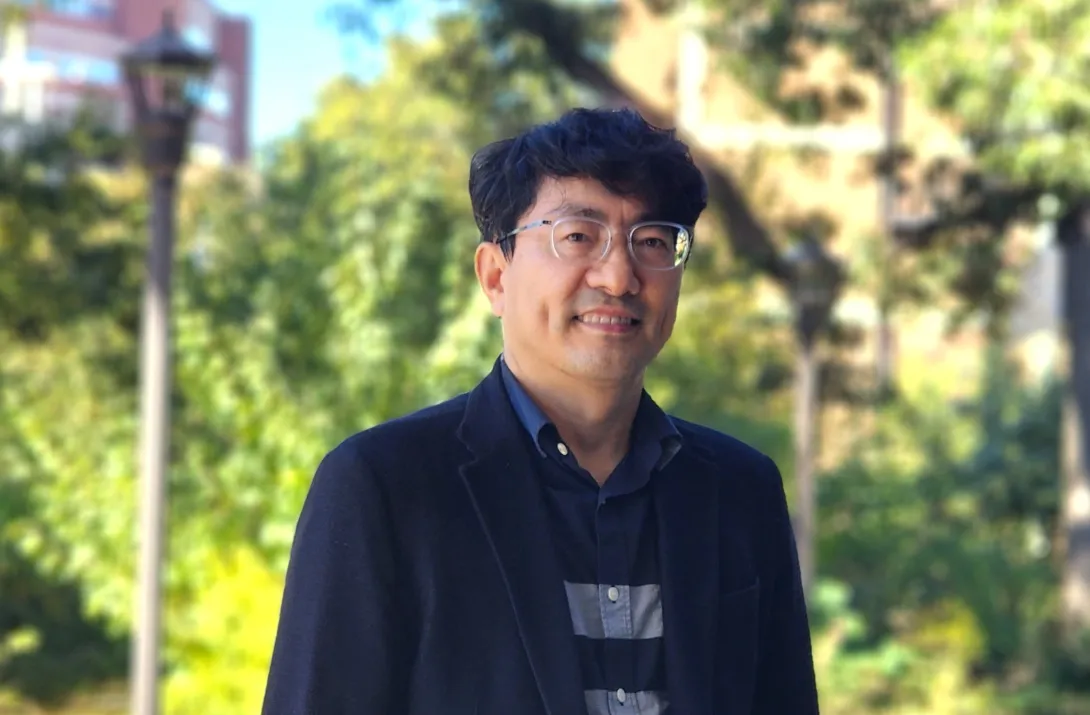
The Center for 21st Century Universities (C21U) is excited to announce that Sanghyun Jang will join Georgia Tech as a C21U visiting research scholar starting on October 20, 2025. He comes from South Korea, where he served as director of the education data center at the Korea Education and Research Information Service (KERIS). For one year, he will be based in Atlanta, Georgia, collaborating with C21U faculty and researchers to develop AI-based learning systems and leverage educational data to improve student outcomes.
“We are pleased to welcome Sanghyun Jang to C21U as our visiting scholar. His leadership and expertise in Korea’s national digital and AI education initiatives offer an invaluable global perspective to our goal of promoting innovation in lifelong learning. His visit will assist us in exploring new models of AI-enabled education that link K–12, higher education, and lifelong learners worldwide,” said C21U Executive Director Stephen Harmon.
Sanghyun has extensive experience leading national education data initiatives in South Korea and collaborating with international organizations like UNESCO and the World Bank. This aligns well with C21U’s mission to promote personalized, data-driven teaching and learning at scale. His expertise highlights our commitment to global collaboration and leadership in AI-powered education.
“I deeply appreciate the opportunity to join C21U and collaborate with Georgia Tech’s outstanding researchers. Their innovative work in AI and lifelong learning provides a strong foundation for meaningful international collaboration and innovation. I am excited that this visiting scholar experience will help build a global network for AI and education research by connecting KERIS, Korean universities, and Georgia Tech,” said Sanghyun Jang.
C21U’s team looks forward to sharing updates on Sanghyun’s work throughout the year. Stay tuned for upcoming events and research highlights.
Sanghyun Jang holds a doctorate in computer engineering from Dongguk University.
News Contact
Yelena M. Rivera-Vale, M.A. (she/her(s)/ella)
Communications Program Manager
C21U, College of Lifetime Learning
Georgia Institute of Technology
Strategic, Learner, Relator, Intellection, Input
Oct. 20, 2025
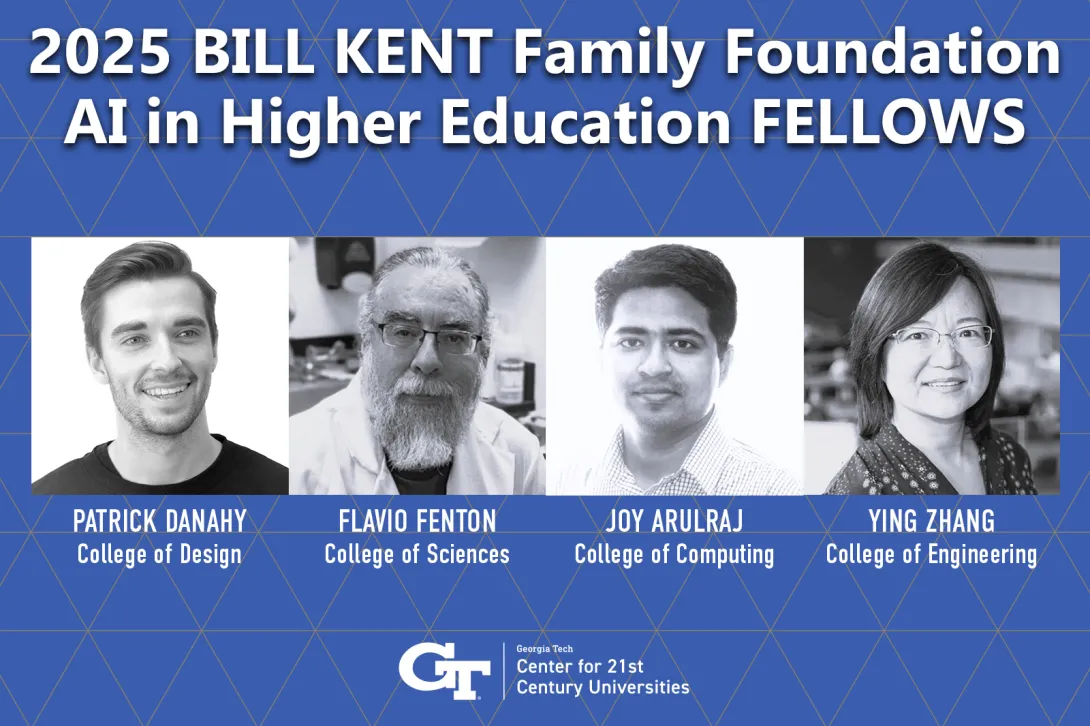
The Center for 21st Century Universities (C21U) has announced the inaugural cohort of Bill Kent Family Foundation AI in Higher Education Faculty Fellows for 2025–26. This C21U-led fellowship program supports faculty projects that explore innovative, ethical, and impactful uses of artificial intelligence in teaching and learning.
The fellows are Professor Flavio Fenton from the College of Sciences, Joy Arulraj from the College of Computing, Patrick Danahy from the College of Design, and Professor and Associate Chair of the School of Electrical and Computer Engineering Ying Zhang, from the College of Engineering. Each fellow will lead a project that advances AI’s role in higher education.
“We deeply appreciate the generosity of the Dr. Bill Kent family in establishing this first philanthropic gift to our new College. Their generous support will allow us to encourage practical applications of AI and foster an appreciation for its ethical use,” said William Gaudelli, inaugural dean of the Georgia Tech College of Lifetime Learning. “This Fellowship will ensure we grow and learn about its use thoughtfully, developing highly innovative and engaging pedagogical experiences for all life’s stages.”
Arulraj’s TokenSmith: Fast, Local, Citable LLM Tutoring introduces a privacy-conscious AI tutoring system for database courses that provides verifiable, course-aligned answers. Fenton’s AI as a Learning Assistant develops AI-enabled instructional modules for physics, neuroscience, and scientific writing to improve conceptual understanding and promote ethical AI use. Danahy’s AI-Enabled Design Ideation and Robotic 3D Printing with Open-Source Platforms integrates AI-driven design and robotic fabrication into architecture education while addressing ethics and sustainability. Zhang’s AI-Enabled Personalized Engineering Education expands personalized learning in large engineering courses through AI tutoring frameworks and integrates AI literacy into the curriculum.
“The Bill Kent Family Fellowship gives our faculty the resources and flexibility to experiment with AI in ways that directly benefit students and inform the future of higher education,” said Stephen Harmon, executive director of C21U.
The fellowship received 21 applications from all seven Georgia Tech colleges, reflecting the educational AI subject-matter experts for their units and the Institute as a whole. Fellows will develop and implement their projects during the 2025–26 academic year and share outcomes through C21U Learning Labs and other campus events.
The Bill Kent Family Foundation partnered with C21U to establish this fellowship and support faculty innovation at Georgia Tech. Through this program, the Foundation invests in projects that explore responsible and impactful uses of artificial intelligence in teaching and learning. By funding this initiative, the Foundation aims to empower educators to develop scalable instructional models, promote ethical AI practices, and prepare students for a future shaped by emerging technologies.
News Contact
Yelena M. Rivera-Vale, M.A. (she/her(s)/ella)
Communications Program Manager
Center for 21st Century Universities
College of Lifetime Learning
Georgia Institute of Technology
Strategic, Learner, Relator, Intellection, Input
Oct. 15, 2025
Instructors creating online courses have long faced a tradeoff: use text-based materials that are easy to update, or invest in engaging but time-consuming video formats. As a result, learners often get either flexibility or immersion, but rarely both.
“In a field that moves as fast as artificial intelligence, it’s important to be able to update material frequently,” says David Joyner, executive director of online education in the College of Computing. “That’s usually a problem because re-recording means going back into the studio and trying to make the new content fit in with the old.”
Joyner’s latest massive open online course (MOOC), Foundations of Generative AI, uses artificial intelligence to solve that challenge. Images for the course are created using Sora and DALL·E 3, while early drafts of quizzes were generated by GPT-5. The course also uses Grady, an AI autograder that provides feedback on open-ended essays.
The most striking innovation is DAI-vid (pronounced day-eye-vid), a video avatar of Joyner that leads the instruction. To create it, Joyner uploaded a five-minute clip of himself to the generative AI platform HeyGen, along with course scripts and other inputs. The result is a lifelike digital instructor who can let Joyner update his lessons far more easily.
“With AI, we can just modify the text and have the updated video pop right out,” Joyner says. “It takes minutes at my desk instead of an hour in the studio.”
This approach allows Joyner to keep course materials current and produce new videos entirely on his own. “It’s strange, but in a lot of ways this course feels more like it’s mine than the ones where I’m on camera,” he says. “Because AI lets me handle every part of production myself, the finished product feels like my complete work.”
Joyner sees this experiment as an example of AI’s potential to enhance human talent rather than replace it. “Give me AI and I can do five times more than I could alone,” he says. “But give it to our professional video producers, and they will still far outpace me, because expertise matters most. AI just amplifies it.”
Foundations of Generative AI is now available on edX, and the same material is also part of the OMSCS course CS7637: Knowledge-Based AI.
Oct. 13, 2025
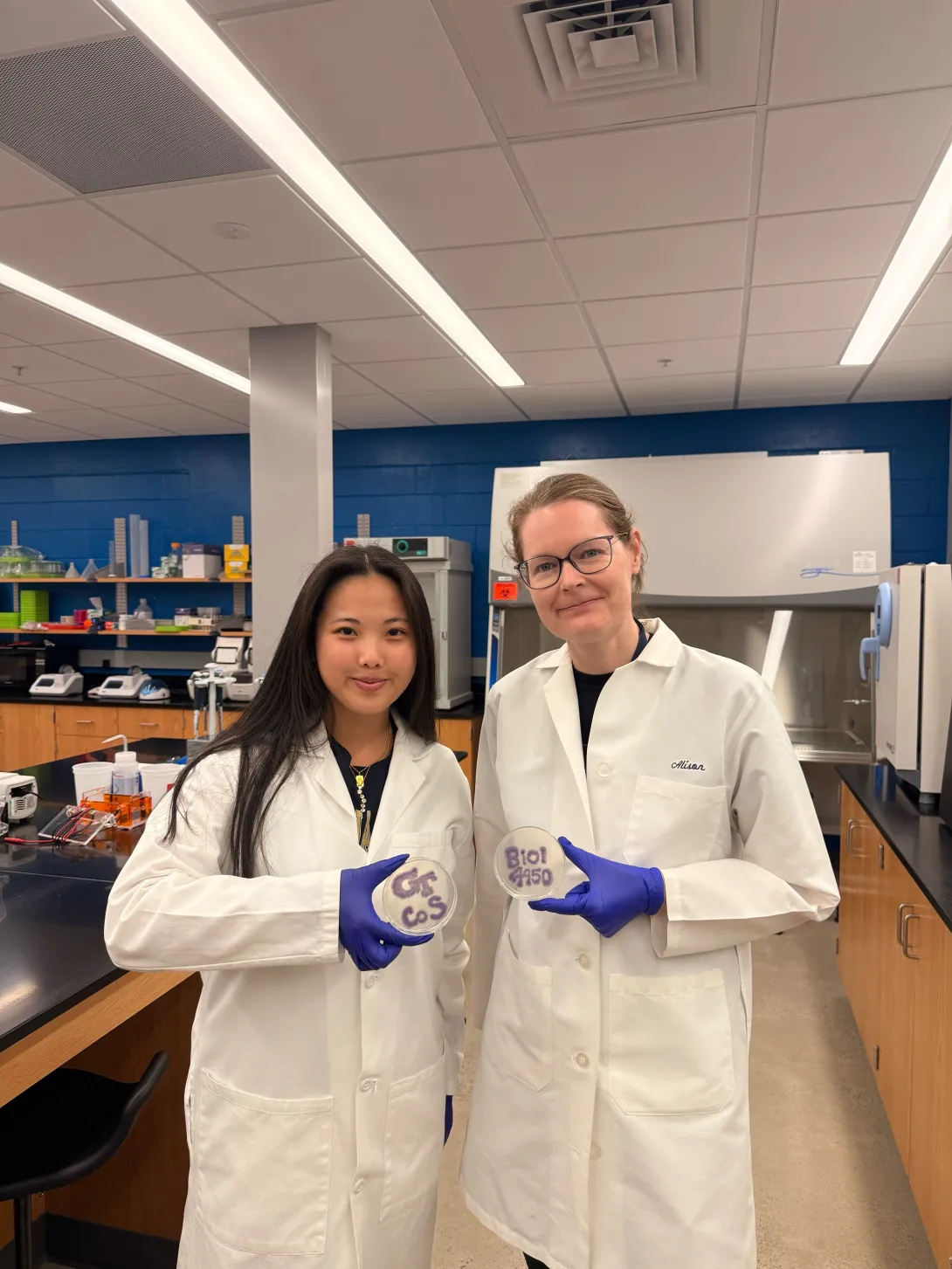
Grace Tang (Left) and Alison Onstine (Right) holding bacteria plates that spell "BIOL 4590" (Credit: Tang and Onstine)
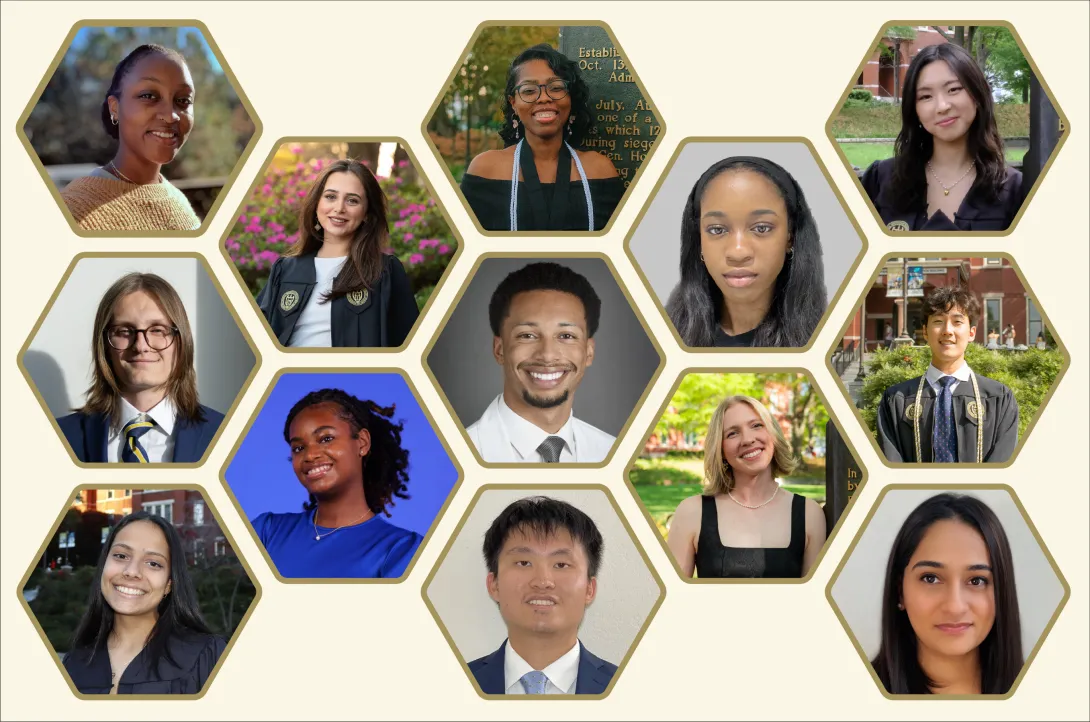
A collection of the undergraduate students who co-authored the paper. (Credit: Tang and Onstine)
This fall, 20 Georgia Tech students published a peer-reviewed scientific paper — the culmination of work done during a semester-long laboratory course. During the semester, students analyzed genomes sequenced from marine samples collected in Key West, Florida — doing hands-on original bioinformatics research on par with graduate students and working with bioinformatics tools to explore drug discovery potential.
The course, BIOS 4590, is a research project lab for senior biology majors that provides an opportunity for professors to share their expertise with students in a hands-on environment. In his class, Associate Professor Vinayak (Vinny) Agarwal, who holds joint appointments in the School of Chemistry and Biochemistry and School of Biological Sciences, aimed to introduce undergraduates to advanced bioinformatics tools through applied research using new-to-science raw data.
The resulting paper, “Phylogenomic Identification of a Highly Conserved Copper-Binding RiPP Biosynthetic Gene Cluster in Marine Microbulbifer Bacteria,” which was recently published in ACS Chemical Biology, involves the historically understudied genus of Microbulbifer, a type of bacteria often associated with sponges and corals. These microbial communities are rich sources of natural products, small biological molecules often associated with medicine and drug discovery.
"This class, and the resulting research, is a testament to the transformative power of hands-on learning,” says Susan Lozier, dean of the College of Sciences, Betsy Middleton and John Clark Sutherland Chair, and professor in the School of Earth and Atmospheric Sciences. “The success of this course — and the students’ remarkable achievement — reflects Georgia Tech's commitment to fostering curiosity, collaboration, and scientific rigor and to empowering the next generation of scientists and leaders."
Funded by Agarwal’s 2023 National Science Foundation CAREER grant and Camille and Henry Dreyfus Foundation Teacher-Scholar award, the class also received support from leadership in the College of Sciences, School of Biological Sciences, and School Chemistry and Biochemistry. The study’s lead author, graduate student Yifan (Grace) Tang, served as the class teaching assistant, and was funded in part by a Biochemistry and Biophysics Graduate Assistance in Areas of National Need fellowship.
“The students in this class are working on important, novel work — this cohort worked with real genomic data that had never been sequenced before,” she says. “Typically, researchers might work with one or two genome sequences, but we provided students with 42 — this might be the first time anyone has looked at Microbulbifer at such a wide scope.”
From classroom to publication
To prepare for the class, Tang worked alongside Laboratory Manager Alison Onstine, who manages the School of Biological Sciences teaching laboratory spaces, to sequence the Key West bacterial genomes.
“Our work in the Agarwal Lab is in natural product discovery. We focus on finding new pharmaceutical drugs through marine bacteria — but with a bioinformatics spin,” Tang explains. “We wanted to bring this type of experience to undergraduates, so we gave fully sequenced genomes to students and asked them to look for potential properties.”
Throughout the class, students learned different techniques for analyzing bacterial genome sequences and extracting data with various tools — gaining both lab and computational skills through hands-on experiences, live demos, and troubleshooting sessions.
“The highlight was showing students just how much we can learn about a bacterial genus, especially one that hasn’t been studied at this scale before,” Tang shares. “This is a growing field, so there are so many opportunities for students to make meaningful contributions while learning new skills.”
Empowering future students
For many students, it was their first time using these types of tools, but Agarwal says that it’s something they'll likely encounter in both industry and research. He sees this type of research experience as especially helpful for seniors, who are often deciding between entering the workforce or continuing their education.
“Bioinformatics is increasingly important for analyzing big data. Students need the ability to manipulate and understand data using computational tools, and this class plays an important role in familiarizing them with this process,” he shares. “Our goal is to demystify research and give students the confidence and tools for both graduate school and for the workforce after graduation.”
The class will be offered for a third time in Fall 2026. While the exact course of research hasn’t yet been decided, “we always aim for something new that can produce publication-quality research — students don’t repeat past year’s work,” Agarwal says. This recent cohort of students built on the success of 18 undergraduates who took the class in 2023, who also published a paper. “This course truly underscores Georgia Tech’s commitment to pioneering meaningful undergraduate experiences — no other peer institution I know of is exposing undergraduates to bioinformatics at this level.”
Funding: NSF CAREER and the Dreyfus Foundation
News Contact
Written by Selena Langner
Sep. 25, 2025

By Chris Gaffney, Managing Director, Georgia Tech Supply Chain and Logistics Institute | Supply Chain Advisor | Former Executive at Frito-Lay, AJC International, and Coca-Cola
Introduction
This year has felt like a lifetime in the Generative AI (GenAI) world. Tools, capabilities, and best practices are shifting monthly, sometimes weekly. For supply chain professionals, the message is clear: ongoing development is not optional. Like lean, analytics, or S&OP in prior decades, GenAI proficiency is quickly becoming a differentiator. The question is not if you’ll integrate GenAI into your workflow, but how quickly and effectively.
The Evolution of GenAI in 2025
When we look back to January, it’s striking how much progress has been made in less than a year. Early in 2025, the conversation centered on agentic AI and larger models. GPT-5 and Claude 4 improved reasoning and context windows, while OpenAI introduced ChatGPT Agent in preview, able to carry out bounded multi-step tasks like retrieving files, browsing the web, and drafting structured outputs. In supply chain, this translated into early experiments with automating shipment steps or running contract reviews in a single query — tasks that were pilot-level at best in January.
By mid-year, multimodal capabilities and enterprise copilots began shifting from concept to daily use. Users could combine text, image, and voice inputs to detect defects or summarize complex documents, and copilots became embedded inside SAP, Oracle, Microsoft, and Google platforms. For the first time, GenAI wasn’t just a tool "off to the side" but something integrated directly into the systems supply chain professionals rely on.
In the second half of the year, new capabilities started layering on: memory, specialized small models, and synthetic data with digital twins. Memory allowed copilots to recall context from prior chats or S&OP cycles, reducing rework. Domain-tuned models made GenAI lighter, cheaper, and faster for logistics, procurement, and planning tasks. And digital twin integration allowed organizations to stress-test networks under disruption scenarios, from weather to labor shortages.
Enterprises also moved closer to operations with AI at the edge, using IoT data for predictive maintenance or real-time routing. At the same time, guardrails and compliance became a central topic, with more organizations creating clear "green/yellow/red" tiers for safe use. And in Q4, collaboration AI and hybrid architectures came to the forefront — copilots that can negotiate contracts in multiple languages, and architectures that blend closed and open-source models to balance sovereignty, cost, and security.
For mainstream individual users, the picture is simpler but still powerful. Anyone with ChatGPT Plus or Copilot today can take advantage of:
- Memory and custom instructions to save preferences and formats across sessions.
- Project-only memory (rolling out) to organize work by context.
- Agent previews like Operator to see how automation might work on bounded tasks.
- Connectors and file uploads to bring internal data into conversations.
For leaders, the focus is on policy, safe pilots, and scaling. They are:
- Sponsoring agent experiments in low-risk domains (like supplier alerts).
- Embedding copilots in enterprise systems for daily planning and reporting.
- Formalizing AI use policies so employees know what’s encouraged, conditional, and off-limits.
The net result: what started in January as experimentation has, by October, become a layered landscape. Individual users now have practical tools to reclaim time, while leaders are piloting more ambitious integrations and building the governance to make adoption sustainable.
1. Action Planning is Critical
The pace of change makes a one-and-done training activity insufficient. Think of GenAI skills like fitness: it requires steady reps over time. Professionals who set quarterly development goals — experimenting with new tools, building prompt libraries, testing workflows — will not only stay current but pull ahead.
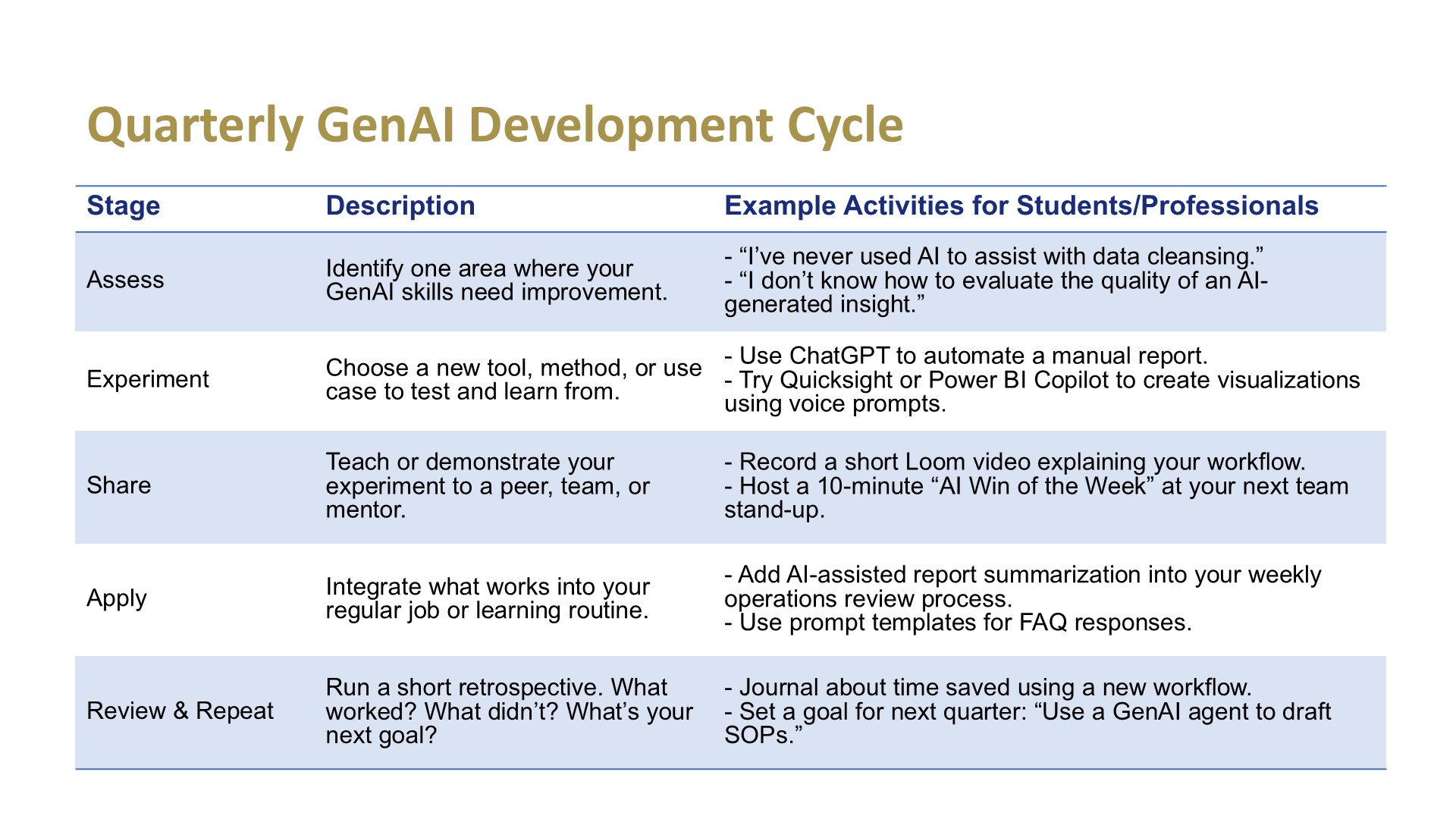
💡 Try This Quarter:
- Build a custom prompt library for routine tasks (e.g., supplier follow-ups, KPI summaries).
- Test one open-source tool such as LangChain or Haystack.
- Use AI to summarize two recent meetings and validate output with your notes.
2. Prompt Maturity is the New Literacy
I’ve personally learned the most about prompting by asking ChatGPT to critique my style against a 12-step framework. The feedback gave me a process improvement plan I still use today. Prompt maturity isn’t abstract — it’s a measurable, improvable skill.
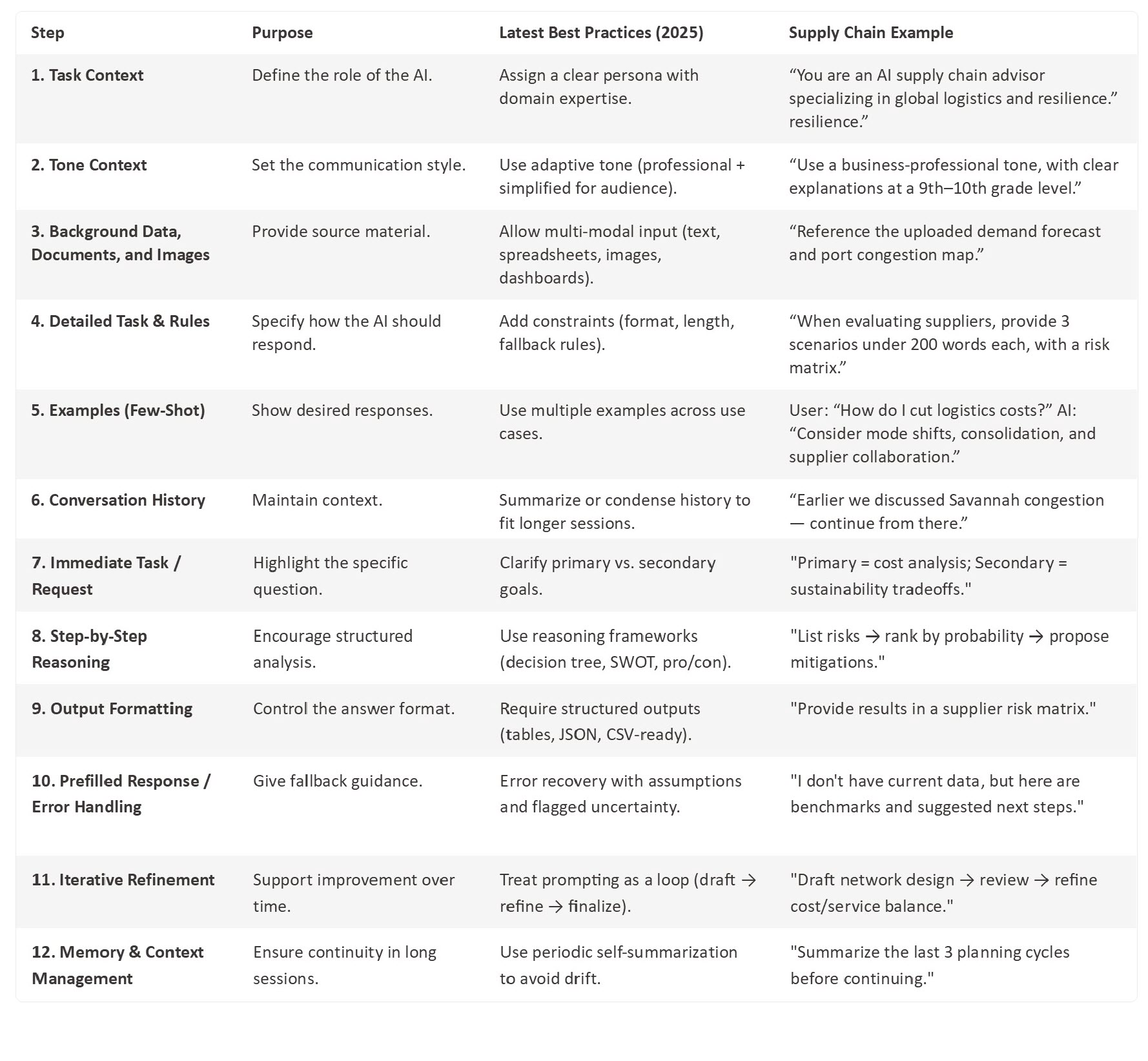
💡 Applied step: Rewrite one work prompt per week by climbing the ladder.
3. Unlocking Personal Productivity
One of the fastest returns from GenAI comes from personal productivity. In our short courses this year, I’ve seen learners gain comfort and lower stress as they practice more with the tools. Many reclaimed time by using GenAI for emails, presentations, meeting notes, and data prep.
While the list of GenAI time-saving strategies is broad, some uses are already mainstream and validated by thousands of professionals. The table below organizes these strategies into categories, provides guidance on how to accomplish them, and highlights common watch-outs to ensure they deliver value without risk.

💡 Try this week: Track one workflow where AI saved time and estimate the hours reclaimed.
4. Critical Thinking: Ironically More Important than Ever
We wrote about critical thinking and added it to our curriculum after studies raised concerns about overreliance on AI. The smarter the tools become, the more important it is to validate their outputs.

💡 Applied step: Take one AI output this week and run it through the checklist — you’ll see both strengths and blind spots.
5. Advocating for Strategy and Guardrails
We’ve seen firsthand how AI policies can evolve. One major retailer shifted in less than a year from a rigid “only data scientists experiment” model to encouraging all employees to try safe versions of multiple LLMs. This shift shows why professionals should advocate for strategy and guardrails that evolve with the technology.
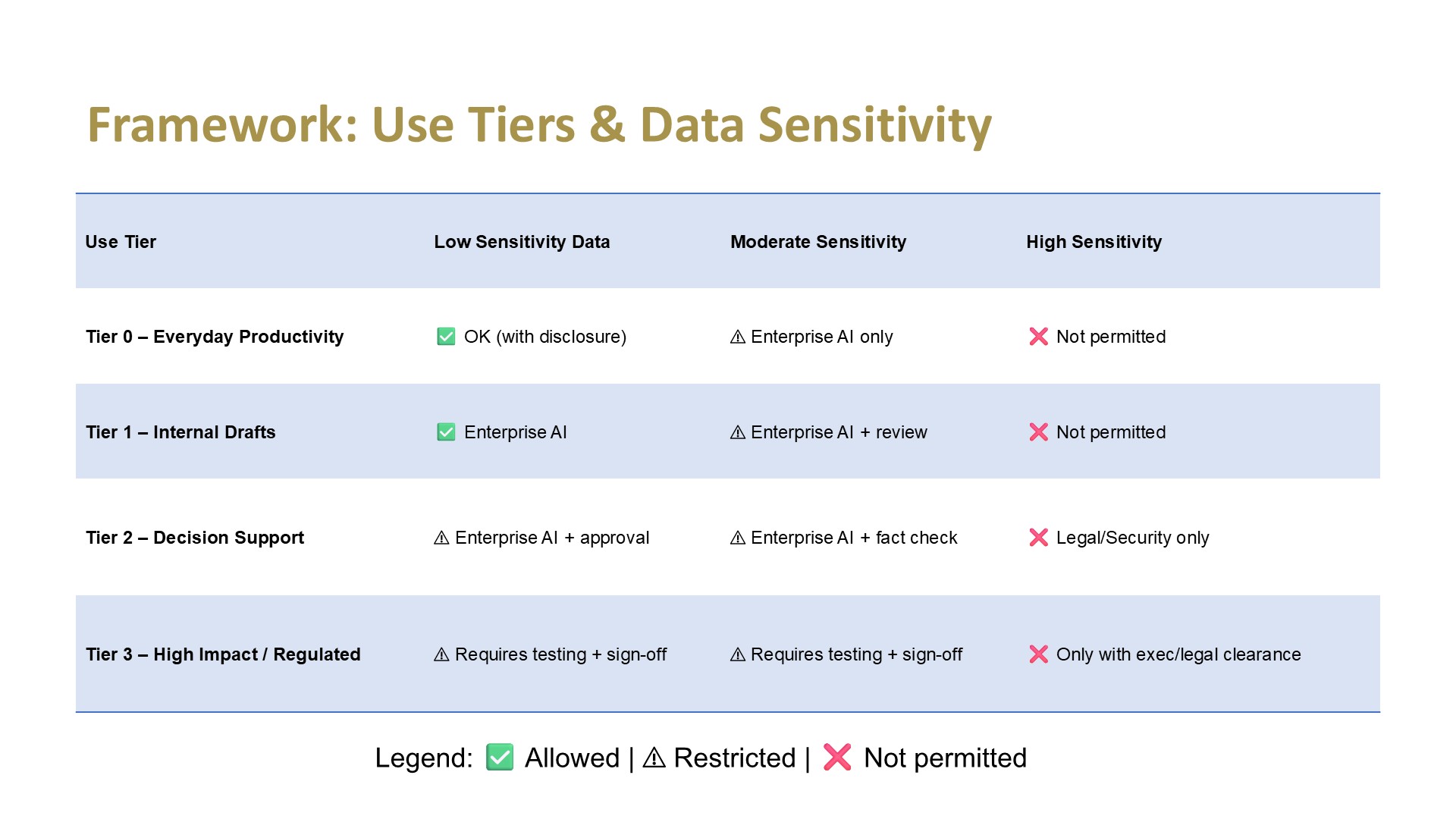
💡 Ask your manager: Which of our daily tasks fall into green, yellow, and red today?
6. Agents: Early but Essential
Many industry partners are actively testing agents. Our software partners are hitting singles and doubles now, with bigger “home run” opportunities still developing. Agents aren’t fully reliable yet, but they are advancing quickly and will increasingly appear in ERP, TMS, and WMS platforms.
In practice, most organizations today sit between Level 1 (Exploratory) and Level 2 (Task-Specific Agents), with early pilots pushing into Level 3 (Augmented Workflows). Tech-forward enterprises — particularly in retail, e-commerce, and global manufacturing — are building domain-specific agents for forecasting, procurement support, and transportation planning, often embedded inside ERP or planning platforms. These companies are experimenting with multi-agent coordination but keep humans firmly in the loop. By contrast, mainstream companies are still largely in the exploratory stage: individuals using general copilots for drafting documents or ad hoc analysis, without enterprise integration, security controls, or governance. The gap is widening — forward-leaning firms are developing playbooks for orchestrated workflows, while many organizations are just beginning to set policies and figure out where AI fits safely into their operations.

Looking ahead, Level 4 (Collaborative Automation) is where the near-term breakthroughs will happen. In the next 3–5 years, we can expect multi-agent orchestration to become a practical tool for managing recurring disruptions — think transportation rerouting during weather events or automated supplier alerts when delivery milestones are missed. Early adoption will occur in large, tech-forward enterprises with strong governance and secure infrastructure. Level 5 (Autonomous Resilience) remains aspirational: while the vision of end-to-end supply chain automation is compelling, regulatory hurdles, trust, and explainability challenges mean human oversight will remain essential. The more realistic trajectory is that enterprises will selectively automate narrow disruption scenarios while maintaining tight human control, with broader autonomy coming only as governance, standards, and trust mechanisms mature.
💡 Applied step: Identify one repetitive process in your work that could be a candidate for an agent.
7. Human in the Loop: Non-Negotiable
Competition has improved model quality this year — but hallucinations and memory issues remain. That’s why “human in the loop” is not just a principle; it’s operational reality. AI is still an assistant, not a replacement.
💡 Applied step: Write down one checkpoint you always apply before sharing AI outputs.
Conclusion
These observations — from teaching courses, updating curriculum, and watching partners experiment — motivated this article. GenAI is evolving at extraordinary speed, and our profession must evolve with it. Build your plan, refine your prompts, reclaim time, apply critical thinking, advocate for strategy, explore agents, and always keep the human in the loop. Those who do will thrive in 2026 and beyond.
Sep. 23, 2025

Students across Georgia are designing and 3D printing pinewood derby cars as part of a new hands-on advanced manufacturing initiative.
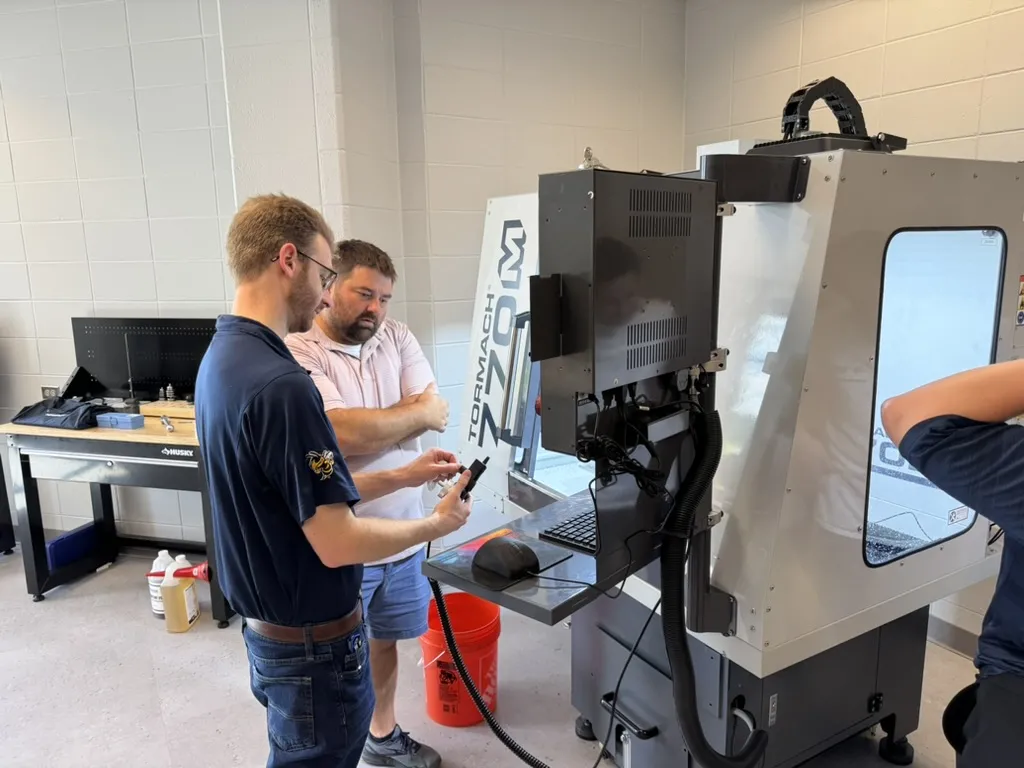
Kyle Saleeby (left) works side-by-side with a teacher to set up precision milling equipment, a key part of the AMP Program’s hands-on curriculum.
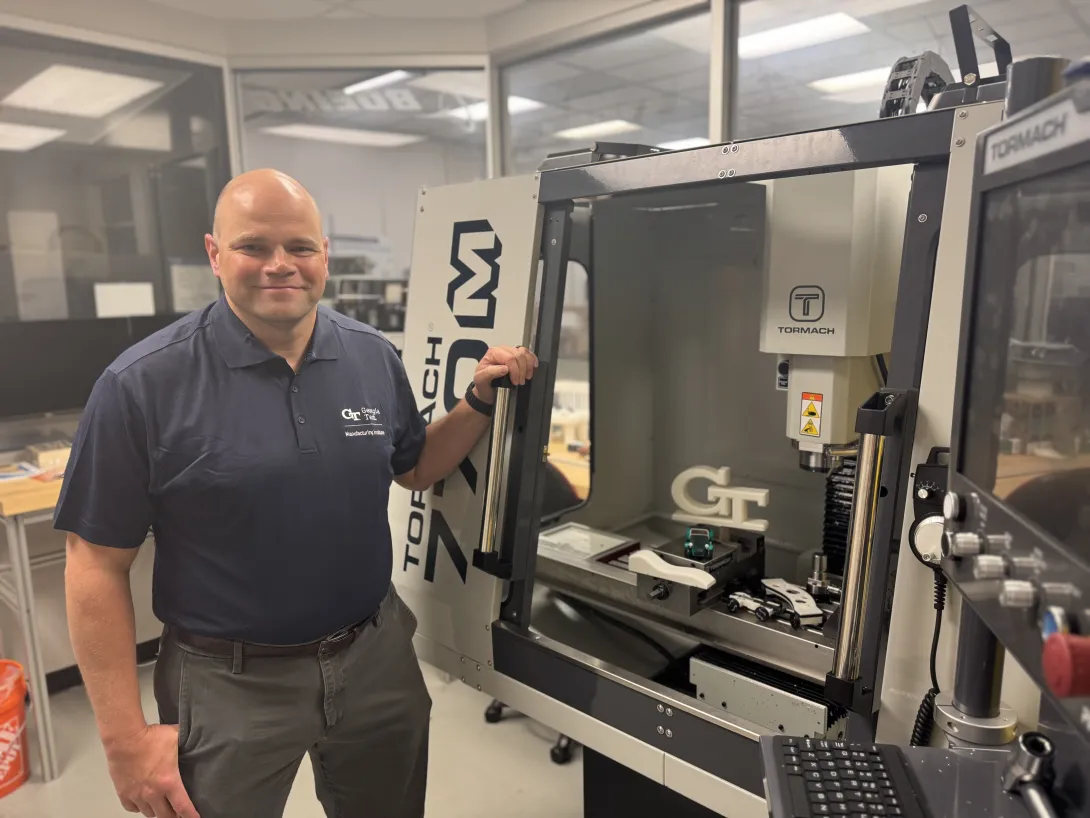
With more than two decades of workforce development experience, Steven Ferguson is helping launch a new era of hands-on learning through the AMP Program.
Smart manufacturing, data-driven design, and artificial intelligence aren’t just buzzwords — they are fields that are creating high-paying, high-tech careers across the country. In rural communities across Georgia, these advanced manufacturing roles are growing, but the talent pipeline isn’t keeping pace.
“It’s not just about creating jobs, it’s about filling them,” says Tom Kurfess, Regents’ Professor in mechanical engineering and executive director of the Georgia Tech Manufacturing Institute (GTMI). “To do that, we need to show students how exciting and innovative manufacturing can be. Manufacturing has really changed over the past few years. Today, going from an idea to a physical part is much easier to do. It is fun and exciting to bring ideas to life and to actually hold the results in your hands.”
GTMI is working to reignite student interest in the art and science of making through its new K–12 initiative: the Advanced Manufacturing Pathways (AMP) Program. Modeled after Georgia Tech’s Rural CS Initiative, AMP empowers schools with faculty expertise, cutting-edge equipment, and a hands-on curriculum to give students early exposure to the tools, technologies, and creativity behind modern manufacturing while building a pipeline of future talent ready to thrive in high-tech careers.
Funded by the Southwest Georgia Regional Commission (SWGRC), AMP is kicking off in three school districts this fall — Decatur County, Thomas County, and the city of Thomasville — with plans to expand to additional schools in the spring of 2026. The program will start by engaging more than 200 students through hands-on learning, virtual instruction, and in-person lab experiences led by Georgia Tech researchers and faculty.
“Here in Southwest Georgia, we believe that opportunities like this are vital for integrated learning in schools and for growing our future workforce,” says Beka Shiver, economic development and transportation planner for SWGRC. “Workforce development and K-12 integration are at the heart of our Southwest Georgia Ecosystem Building Project, and we are so pleased to be able to provide funding for this program.”
The launch of the AMP Program is centered around Design, Build, Race, a course putting a modern spin on the classic pinewood derby. Students will use digital design, 3D printing, and machining to build and race custom cars, while also learning how to collect and analyze performance data to improve their designs and predict outcomes. The course blends engineering with data science, sparking curiosity and showing students how modern manufacturing is powered by both technical skills and smart data.
“This program delivers real-world industry experience to students while strengthening the talent pipeline that drives innovation, competitiveness, and resilience in advanced manufacturing”, says Steven Ferguson, interim director of operations at GTMI and one of the project’s leaders. “After more than 20 years of driving education and workforce development innovation, I’m more energized than ever to help launch the AMP program to open doors for students and advance U.S. manufacturing leadership.”
Building the Blueprint
Before it evolved into the AMP Program, Design, Build, Race was a course developed by GTMI research engineer Kyle Saleeby in 2023. Originating in GTMI’s Advanced Manufacturing Pilot Facility (AMPF), the course was designed to introduce Morehouse and Georgia Tech students to the possibilities of modern manufacturing through digital design, 3D printing, machining, and competitive creativity.
“Even after the first week, it was powerful to watch students discover how exciting it is to design and manufacture a competition-ready car in a matter of hours,” said Saleeby. “That’s when I knew we were onto something special.”
Saleeby teamed up with Ferguson to transform the course into a broader initiative. The duo engaged colleagues from STEM@GTRI and secured funding from SWGRC to modify the curriculum and scale the course for a high school audience.
“We are thrilled that we have been able to take the lessons learned during the development of the Rural Computer Science Initiative and expand opportunities for students in Southwest Georgia,” says Sean Mulvanity, a senior research associate in the Georgia Tech Research Institute. Mulvanity is one of the founders of the initiative and has been a key contributor to the AMP Program. “We hope this program can grow and expose students across the state to the field of advanced manufacturing.”
Though granted by the SWGRC, funds for the program were provided by Georgia Artificial Intelligence in Manufacturing, a statewide initiative founded by GTMI and Georgia Tech’s Enterprise Innovation Institute to advance AI-driven manufacturing.
To bring AMP into classrooms, Southern Regional Technical College helped set up labs and provide technical support, ensuring schools were ready to launch.
“At all levels, the community has rallied around this program,” says Saleeby. “Providing students with a unique experience learning advanced manufacturing technologies will open countless career opportunities. I cannot wait to see where they go.”
News Contact
Audra Davidson
Research Communications Program Manager
Georgia Tech Manufacturing Institute
Sep. 16, 2025

Lukas Berg (right), who flew several variants of the UH-60 Blackhawk over the course of his career, celebrated his final flight before joining the Georgia Tech Manufacturing Institute in August.
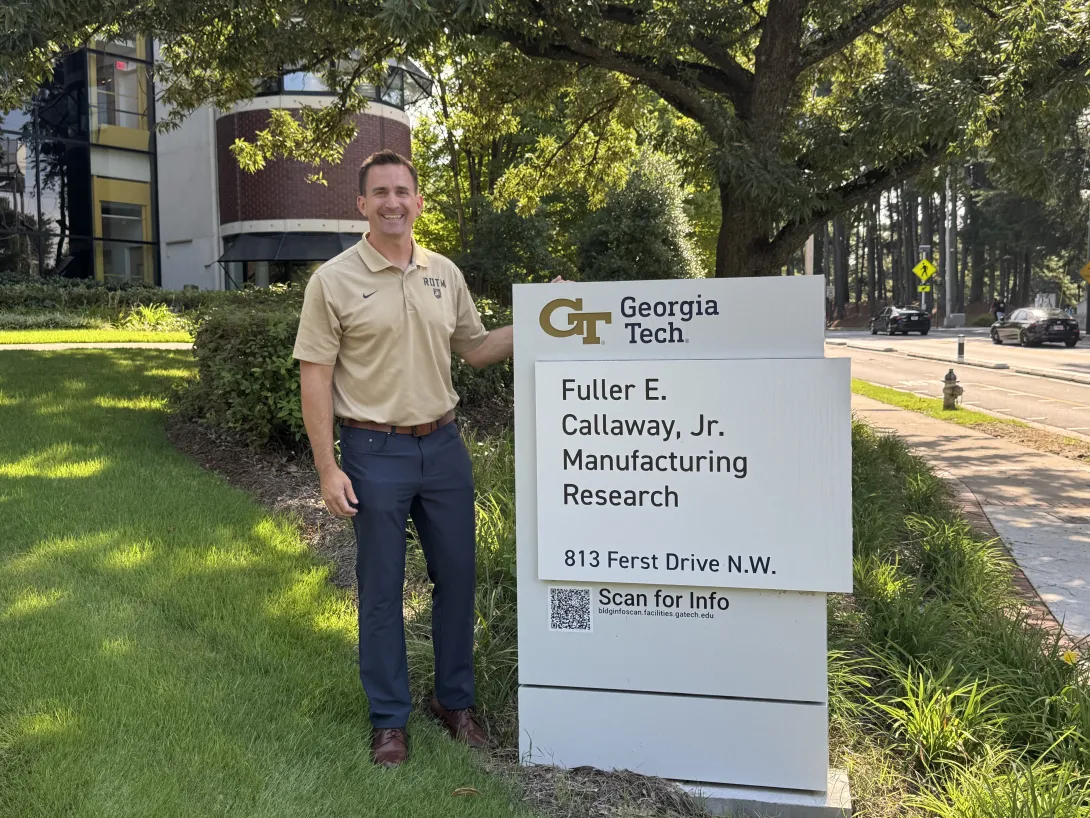
Berg will be working with GTMI for the course of his fellowship with the Hiring Our Heroes program.

Maria Venable, Berg's grandmother, joined the Georgia Tech faculty in 1963 as a 28-year-old native German speaker.
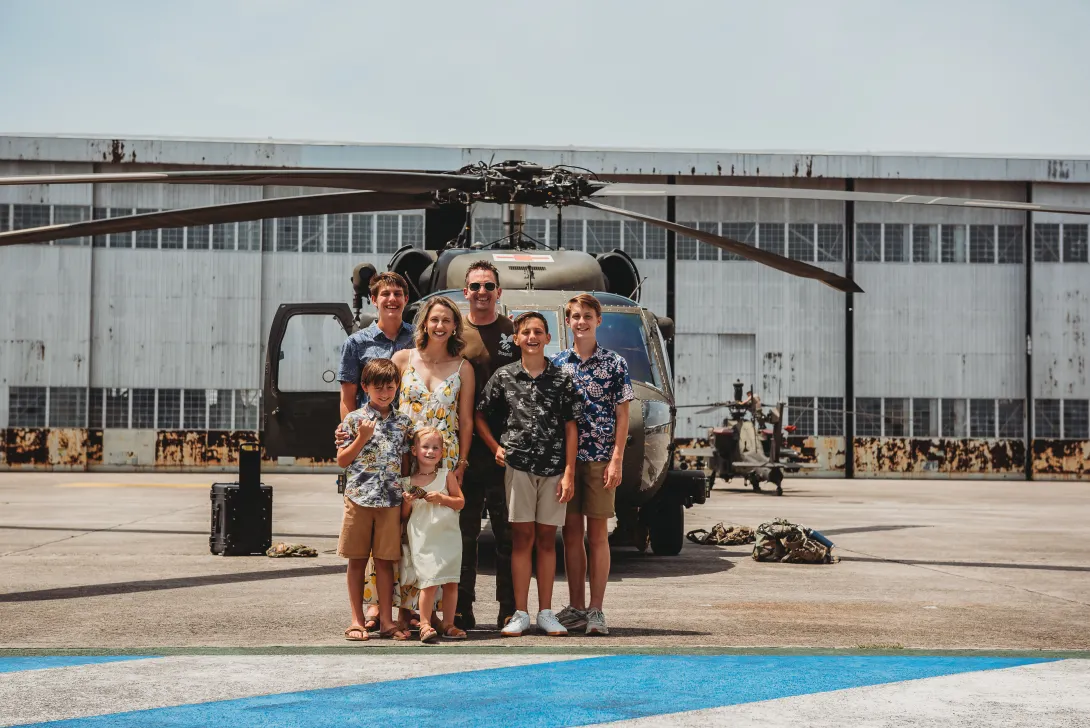
Berg and his family stand next to the model of helicopter frequently flown during his career.
As the U.S. works to strengthen its industrial base and reshore critical manufacturing capabilities, workforce development has emerged as a central challenge — and opportunity.
The Georgia Tech Manufacturing Institute (GTMI) recently welcomed its first Hiring Our Heroes (HOH) Fellow to help address this growing need. Lukas Berg, a retiring U.S. Army officer, will be working with GTMI to support new education and training programs aimed at preparing Georgians for careers in advanced manufacturing.
“Lukas Berg brings a unique blend of operational experience, academic insight, and a deep commitment to service,” said Thomas Kurfess, executive director of GTMI. “His perspective will be invaluable as we work to build stronger connections between Georgia’s communities and the advanced manufacturing sector.”
Hiring Our Heroes is a nationwide initiative led by the U.S. Chamber of Commerce Foundation that helps veterans and military spouses transition into civilian careers through short-term fellowships. Since 2021, Georgia Tech has hosted more than two dozen HOH fellows, beginning with U.S. Army veteran Erik Andersen, who now serves as interim deputy director for the Research, Electronics, Optics, and Systems Directorate at the Georgia Tech Research Institute (GTRI), where he also helps lead the HOH program.
Berg is the first fellow to be placed outside of GTRI, a sign of the program’s growing reach across campus and its potential to support a broader range of workforce development efforts.
“It’s been exciting to see how the Hiring Our Heroes program has grown at Georgia Tech,” said Andersen. “Berg’s placement at GTMI reflects the Institute’s commitment to connecting military talent with real-world innovation and workforce development. Veterans bring a unique perspective and skill set to these challenges, and I’m proud to see the program expanding to new parts of campus.”
Berg’s military career includes aviation command roles, teaching positions at West Point and the Joint Special Operations University, and deployments across multiple regions. At GTMI, he will be contributing to a new initiative that partners with rural school districts to introduce students to hands-on learning in advanced manufacturing, an effort designed to spark interest in high-potential career paths and support long-term workforce readiness.
With personal ties to Georgia Tech and a strong sense of purpose, Berg sees this fellowship as a meaningful next step. We spoke with him to learn more about what brought him to GTMI and how he views the role of manufacturing and workforce development in shaping the country’s future.
What inspired you to pursue a fellowship at the Georgia Tech Manufacturing Institute after your military service?
Last year, I visited Georgia Tech with many of the junior officers and pilots assigned to my helicopter battalion in Savannah. Our agenda included stops at the Georgia Tech Manufacturing Institute and the Advanced Manufacturing Pilot Facility, both of which struck me as being absolutely vital to maintaining the technological edge required to fight and win on the modern battlefield. Pursuing a fellowship at GTMI felt like a natural extension of my military service, and I suspected that it would put me back at the intersection of thinkers and doers (where I have always felt most at home).
You mentioned your grandmother taught at Georgia Tech for over 30 years — how has her legacy influenced your academic and professional journey?
My grandmother, Maria Venable, was the first woman to serve as a full-time faculty member in Georgia Tech’s School of Modern Languages. She poured herself into both her family and her students, and I was lucky to count myself in both populations, as she agreed to tutor me for the AP German exam in high school (but only if I behaved as well as her students at Tech). Her example inspired me to pursue a teaching assignment at West Point halfway through my Army career, and I experienced the same joy in teaching that she did. It’s something that I will continue to do for the rest of my life, whether in a formal or informal capacity.
Can you share more about the specific initiatives you'll be working on at GTMI related to advanced manufacturing education?
Most immediately, I am joining a new GTMI initiative that partners with rural school districts to deliver several weeks’ worth of curriculum and hands-on practice in advanced manufacturing. We just kicked off a pilot program with Bainbridge High School in Decatur, and it’s exciting to see their students leveraging sophisticated systems to design and build Pinewood Derby cars that would make Cub Scouts across the country green with envy. Beyond this initiative, I hope to contribute to other efforts that get young people excited about careers in manufacturing and that assist adult learners in re-skilling and up-skilling for this high-potential industry.
What are you most looking forward to as you begin your fellowship at GTMI?
Georgia Tech feels like a physical and intellectual crossroads of modern civilization. I’m excited to not only contribute as a member of GTMI but also to learn about the countless other departments, institutes, and programs that are convening talent to solve the world’s thorniest problems.
What skills or insights are you hoping to gain during your time at GTMI that will support your next career chapter?
As an Army officer, I’ve been stationed across the country and deployed around the world, but Georgia has always been home. (Gladys Knight’s “Midnight Train to Georgia” has been a fixture on my playlist since I left for West Point at the age of 17.) Now back with my family, I look forward to using my time at GTMI to learn about my home state and identify ways that I can contribute to its near and long-term prosperity, whether through roles in academia, government, or private industry. I also look forward to expanding my network in all these communities, as no single one has a monopoly on problem-solving.
Why do you believe rebuilding America’s industrial base and manufacturing workforce is critical to national security today?
As a career aviator, much of my professional life was spent agonizing over the availability of parts to repair my helicopters. It seemed like there were never enough, and they always took too long to get to me. This experience, coupled with lessons learned from our support of Ukraine’s self-defense, contrasted starkly with my recent study of America’s 20th-century role as the “arsenal of democracy.” I’m convinced that we need to regain that reputation, and I would like to see Georgia at the forefront of associated design, manufacturing, and education initiatives.
How do you see veterans playing a unique role in strengthening the U.S. manufacturing workforce?
I think veterans are the most natural candidates in the world for roles in the manufacturing workforce. They possess the knowledge, skills, and abilities to be successful in most endeavors, but most are looking for ways to extend their service beyond their time in uniform. What better way than to contribute to a field that is so vital to our national security and prosperity?
What does “Progress and Service” mean to you, and what does it mean to you personally to be contributing to that mission?
I love Tech’s motto. I grew up in a family and community that reinforced at every turn the idea that our highest potential as human beings is realized when we serve others. This motivated my choice to serve in the military for the past 20 years, and it remains my North Star for this next chapter. I also love the idea of technological progress being the vehicle by which Georgia Tech collectively serves others, and I hope to accelerate this progress during my time at GTMI.
If you could give one piece of advice to other service members considering a fellowship like this, what would it be?
Inventory your passions and define your purpose. Then start reaching out to people in related fields. I have been amazed at how generous people have been with their time and how eager they have been to help me find my second calling and related opportunities.
News Contact
Audra Davidson
Research Communications Program Manager
Georgia Tech Manufacturing Institute
Aug. 25, 2025
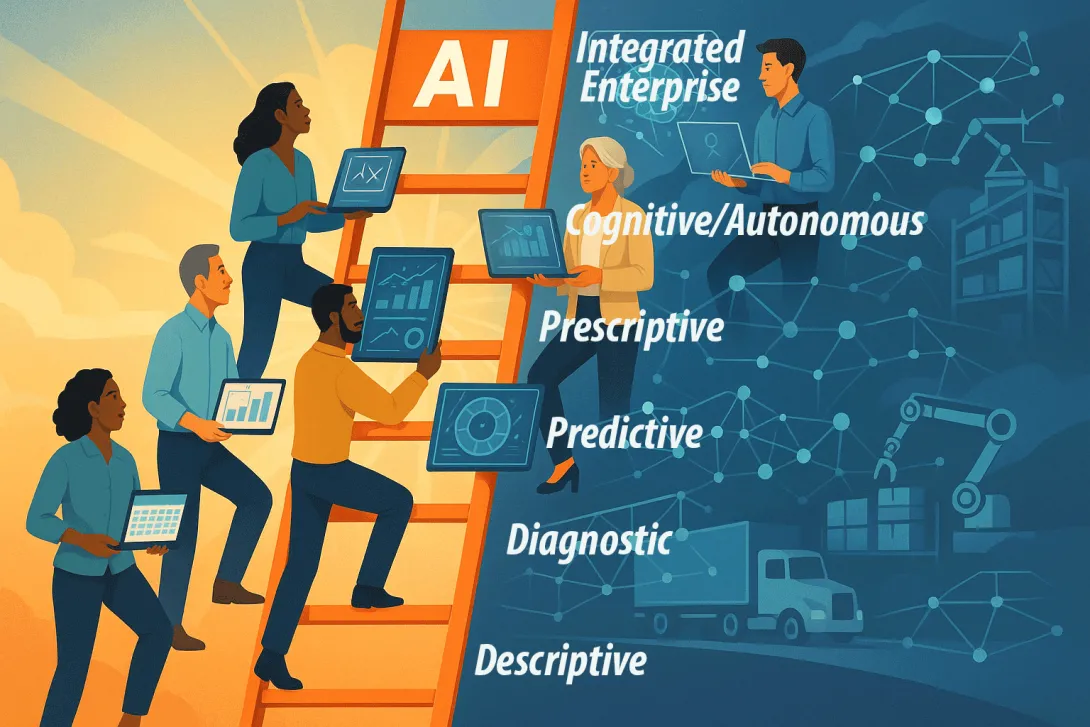
In this special episode, guest host Brian Kennedy sits down with Chris Gaffney to explore how supply chain professionals can take control of their careers by embracing artificial intelligence. Chris introduces the “AI Maturity Ladder,” a step-by-step roadmap that helps individuals and teams evolve from foundational tools like Excel to advanced capabilities like predictive analytics, machine learning, and AI agents.
By Chris Gaffney, Managing Director, Georgia Tech Supply Chain and Logistics Institute | Supply Chain Advisor | Former Executive at Frito-Lay, AJC International, and Coca-Cola
Introduction
Artificial intelligence has entrenched itself in almost every aspect of the professional world. From copywriting tools to search engine optimization and image generation, professionals and laypeople alike use this new technology to streamline daily activities. But, before AI, there was high-level analytics and machine learning in supply chain. Analysts across the supply chain used machine learning to interpret high volumes of data and turn it into predictive algorithms for inventory planning, demand planning, and more. Now, AI is generating these analytics at a much faster, real-time pace.
This shift raises important questions. What does this mean for technology professionals in the supply chain world who once made a living doing these jobs? And what can we expect for aspiring supply chain pros or mid-career professionals who want to increase their value to the team in an age of accelerated technological advances?
The fact of the matter is that AI is now everybody’s job. Standing still will ensure that you get left behind by your peers or the talent pipeline from colleges and universities. The question then becomes, how can I upskill and use what I already know to add value to my role and ensure that my AI competencies allow me to compete in today’s supply chain workforce?
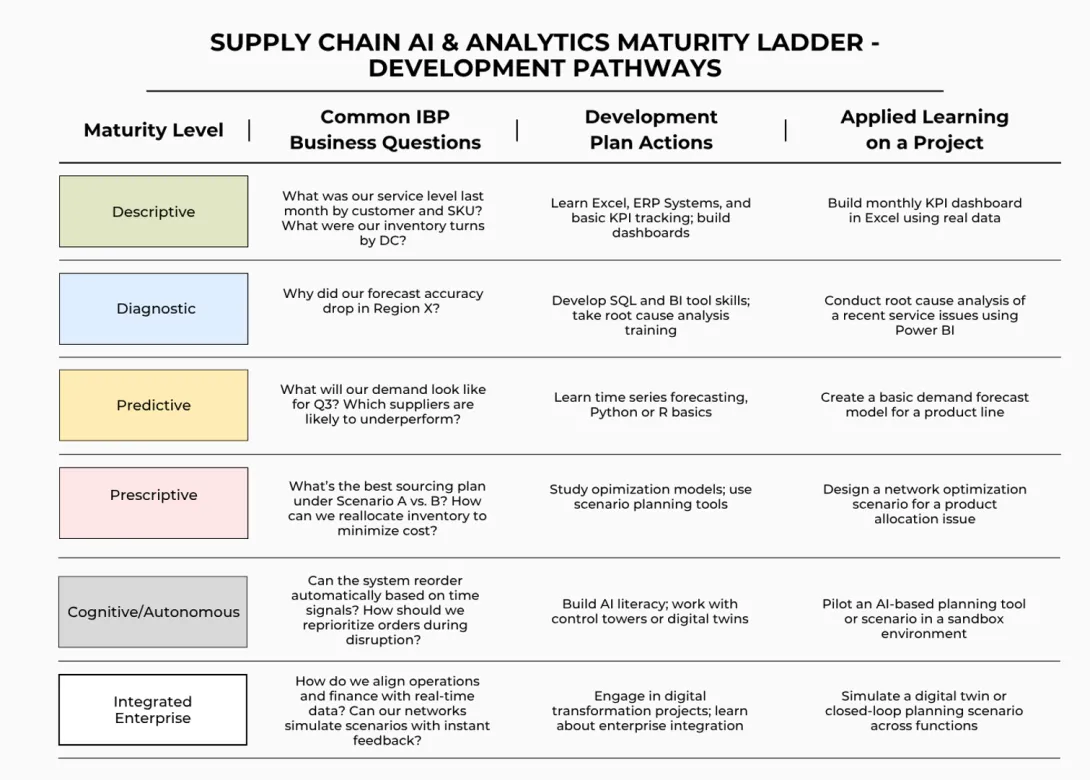
We’ll look at the ladder as a series of increasing levels of complexity and AI activity—what we’ll call ‘maturity levels’: descriptive, diagnostic, predictive, prescriptive, cognitive/autonomous, and integrated enterprise.
Some things to bear in mind as we progress through this topic:
- Everybody is somewhere on the ladder, so everyone has the opportunity to climb the ladder.
- Analytics are no longer just for specialists. AI allows analytics to be an access point to the ladder. You no longer have to rely on someone else higher up on the ladder, and it’s in your best interest to climb higher, regardless of your job description.
- There are lots of resources freely available to allow you to climb the ladder. But in most companies, you can find a mentor who is further along on a ladder, and perhaps they can help you up-skill your operational knowledge and help you advance your capabilities to ascend the ladder.
We’re here to discuss to what degree you should so you can optimize your career opportunities and not be left behind.
How Did We Get Here?
In the field of supply chain we’ve always been ahead of the curve when it comes to these types of innovations. Before AI, we were using machine learning and predictive analytics to enhance our understanding of real-time supply issues. We worked a lot on optimizations at Coke and started utilizing machine learning tactics almost 10 years ago. While I wasn’t the hands-on user of the technology, I took it upon myself to try and understand exactly what was happening and how it was working.
That was a large corporate machine–one of the biggest brands in the world–utilizing the latest in predictive analytics technology. And now we have a democratization of this technology being spread across industries. You no longer need to be part of such a high-powered team to make use of these tools.
We have now entered into an era where artificial intelligence has become omnipresent across almost every supply chain practice and industry, or any other career discipline. The key is understanding best practices is making use of AI in your field, and how you can add value and incorporate it into your everyday work-life.
Descriptive Level: From Rearview Mirror to Forward Thinking Decisions
“If you have some proficiency in Excel, then you’re on the ladder.” - Chris Gaffney
The lowest rung on the AI ladder is the descriptive level. Excel knowledge and experience resides here and can be the access point for most people. This level helps us describe what is happening with numbers and data. Reporting dashboards can be crafted here, and we can run trend analysis using basic inference to see what is happening and where to make adjustments, if necessary.
Excel tells us what did happen - not what could happen. These are important functions, to be sure. However, they only look behind us. They tell us what and why. Today’s supply chain landscape requires tools that allow us to make decisions based on what could happen in the future. We don’t have the power to make proactive decisions or to navigate uncertainty and factor in variables of change.
Our competitive edge is sharpened by having the capability to shape the future, not just explain the past. In order to do so, we need to move up into predictive and prescriptive AI territory.
Up until very recently, this descriptive capability was enough. Analysts, planners, and buyers were all able to produce data that helped others to understand what was happening. The data then required synthesis and analysis. The whys and so whats were human functions performed by different team members and used to measure the efficacy of various inputs and outputs throughout the supply chain. As one moves up the chain of command, so to speak, the ability to interpret the data and findings becomes even more important. However, the numbers crunching and analytics were more siloed.
And now, everyone has access to AI’s ability to synthesize and analyze raw data. But very few “off-the-shelf tools” can answer the why, let alone the ‘what should we do about it’ questions. Planners and managers need to upskill and ensure that they are up to speed on the capabilities and deficiencies of these platforms and insert themselves and their skillsets to close those gaps.
Roles at this level:
- Transportation analysts
- Warehouse supervisors reviewing daily throughput metrics
- Demand planners tracking forecast accuracy from the last quarter
Working in hindsight by monitoring and measuring data is important, albeit limiting. This looking backward in the world of supply chain decision making at a time when forward thinking is essential for future proofing your supply chain organization. Staying here too long limits your ability to prevent problems before they escalate.
What to do next?
- Learn Power BI or Tableau for interactive dashboards
- Get comfortable using large data sets from your ERP or WMS
- Start asking, “why” and “so what”
Diagnostic Level - Information into Insight
“This is where you start to become more valuable because now you can help the team avoid repeat issues.”
So you’ve now measured what happened. The next logical question is why? Here’s where many companies fall short by relying on only internal historical data. The real learning happens when you bring in external variables like weather, economy, labor, or competitive actions. Diagnostics help uncover root causes and patterns across time and systems. What does this mean for you and the AI ladder?
This could mean combining two different datasets using SQL to pull deeper reports or identifying correlations between variables. You need to be able to get inside of your supply chain to see what’s really going on, much like a physician will draw blood or perform various scans to get a more vivid and comprehensive picture of what’s happening.
Examples from the field:
- A demand planner diagnosing why forecasts were consistently off by adding external factors outside your control.
- A transportation analyst finding route disruptions correlated with labor strikes and weather trends - kinda like WAZE.
What you can do
- Add layers of internal and external factors
- Use Power BI or Excel to show the impacts of external events
- Start to track leading indicators, not just lagging ones.
Predictive - Seeing What’s Coming
“Most of the tools we have heavily leverage your own history. But your ability to sell a product next year is different because you don’t control everything.”
Predictive analytics enables supply chain professionals to see trends, forecast disruptions and plan proactively.
As we mentioned earlier, most forecasting tools rely too much on internal history. Predictive power comes from adding things like economic trends, labor availability, weather, etc., to your forecasting models.
My first exposure to the broader umbrella of machine learning, falling under AI, was while working at Coke. Every night, our machines processed enormous volumes of data to track how much of each type—across countless product combinations—was being used. This data was being used to predict when the fountain machines would fail so that we could prepare a replacement without losing time or operational capacity. Basically, this meant we could allocate maintenance resources proactively instead of reactively.
This machine learning doesn’t have to be intimidating. In fact, machine learning was the #1 skill in supply chain job postings in 2024. Python and machine learning are much more accessible tools than they once were, and many professionals are teaching themselves the basics using online resources that are much more prevalent than they once were. Again, the democratization of AI tools means everyone can level up a lot faster.
Roles Seeing This Shift
- Demand planners and sourcing managers are combining historical sales information with things like inflation, trade wars, and taste evolutions.
- Transportation teams are integrating weather trends and traffic data to reroute loads
What Can You Do:
- Learn the basics of Python’s forecasting libraries
- Pull in a single external variable, like weather or labor availability, into your demand forecast.
- Track model accuracy over time to see where it succeeds and, most importantly, fails.
Prescriptive: Deciding What to Do About It
"We don’t want analytics experts. We want people who are applied analytics or applied AI experts.”
It’s not just identifying the risk. The key is choosing a more effective path forward. And this requires modeling scenarios in a way that lets you take action rather than just be an observer.
A lot of companies stop at prediction. The ones that get ahead of the pack are those that are able to simulate outcomes and use this logic in daily decisions. Just remember that context is everything. Those with very impressive technical skills can sometimes miss the mark because they didn’t understand the business. There are also supply chain planners with moderate technical skills who can make major contributions because they knew what mattered and where to apply it.
The supply chain AI ladder is crucial, but only as effective as the depth of the supply chain knowledge base.
Cognitive and Integrated is When AI Starts to Work With You
This is the very top of the ladder or the tip of the AI ladder iceberg, if you will. This is the realm of AI agents that are learning and acting in an intelligent and sometimes autonomous manner. The cognitive tier blends into the integrated enterprise, where systems and data are connected. Warehouses talk to the forecast, which communicates with sourcing, which can adjust production. This is kind of futuristic, but based on how AI has evolved, it will likely be ubiquitous within a couple of years.
How to Apply Cognitive and Integrated AI:
- Learn how to build a basic GenAI or logic-based agent using online tutorials or sandbox tools
- Make sure the AI Agent’s work is sound before turning it loose on our business. The human element is still crucial in these cases.
Role of Leadership in Deploying the Supply Chain AI Ladder
“This can’t be a black box to you.”
Leaders need to know just enough about AI to advocate for it. If you’ve hired the right people, then you trust them to do the job that you hired them to do. If they’re telling you that AI tools will help them do their jobs better, then listen to them. Find out what your team needs and get them to explain to you how AI can unlock more benefits for your business.
Encourage them to pursue professional development courses and to experiment in a safe environment until they feel confident integrating the tools into regular operation.
Conclusion: Don’t Stand Still and Be Left Behind
The supply chain AI ladder is real, and it’s climbable. You are not too late to get on board and begin using AI to increase your personal value at your company. It doesn’t matter how old you are - whether you’re an entry-level professional with an MBA, a mid-career professional, or a seasoned C-suite executive. There is a place on the ladder for you.
The most valuable assets that employees can bring to bear right now in this tech immersion context. Those who have been in the workforce for a few years are able to mix their experiential knowledge with the tools and assets available through AI to translate technology into real-world wins for your supply chain teams. Your value increases significantly if you pair your knowledge with proactive learning tools.
Take the time to self-assess and figure out where you are on the ladder.
Don’t try to jump too high up on the level. Take it one rung at a time. Then reassess.
Commit to the 70/20/10 rule. 70% on-the-job learning, 20% learning from peers and mentors, and 10% formal training.
Apply what you’ve learned and stay curious. Just don’t get complacent. This is not the time to rest on your laurels because someone who is hungry for knowledge will be on your heels.
This content was developed in collaboration with SCM Talent Group, a supply chain recruiting and executive search firm.
Aug. 21, 2025
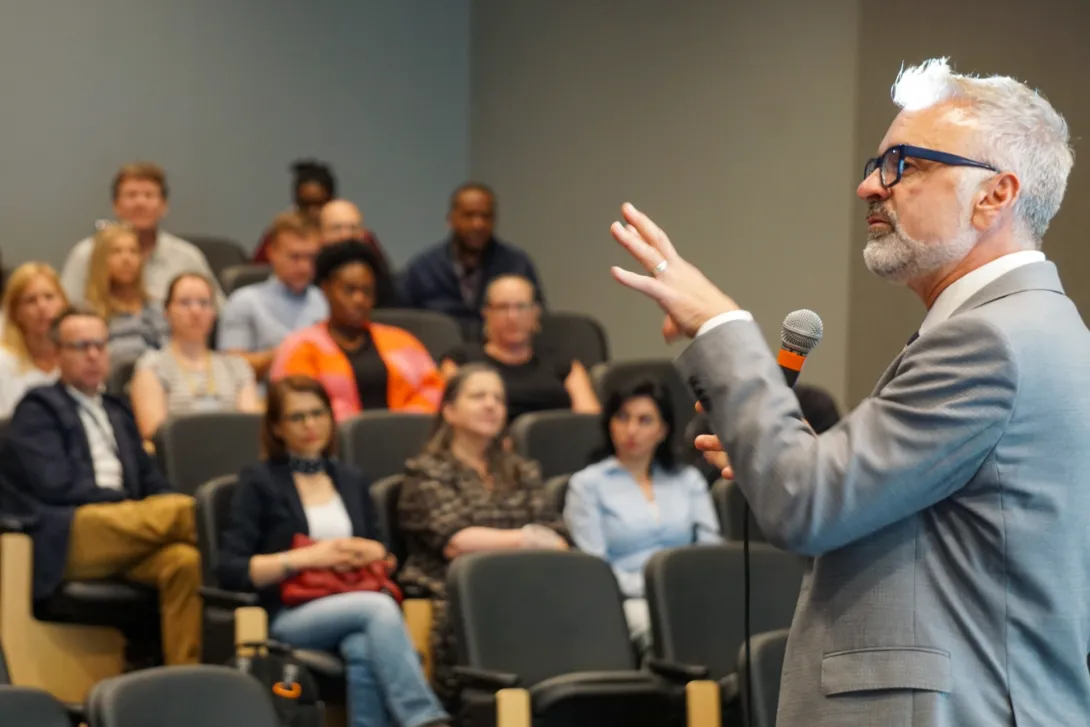
In the first town hall with its new Dean, College of Lifetime Learning colleagues came together to explore a central question: what does it mean to learn, and how can that spirit shape the way we work?
Bill Gaudelli, Ed.D., joined the College Aug. 1 as the inaugural dean. He brings more than 35 years of experience as an educator, researcher, and academic administrator to this role.
Rather than beginning with charts or plans, the Dean opened with two polls. The first asked: What did you learn? What did you notice about your learning? How did you feel before, during, and after? The second posed a broader challenge: What is a learning organization? Colleagues shared learning experiences that ran along a fairly common path: anticipation, uncertainty, frustration, and, ultimately, accomplishment.
“Not one of you said I had no emotional response to the learning. Not a person. There was joy. There was a lot of laughter. And everyone had something to share because that is how fundamental learning is,” Dean Gaudelli observed. “And so, as a learning organization. We've got to think about how we meet the moment and the learner in a context that's totally new. We've got to figure that out in a new space, using new tools, recognizing that the desire to learn is permanent in humans.”
With these shared experiences in mind, Gaudelli introduced the concept of a learning organization, drawing from Peter Senge’s landmark work The Fifth Discipline. He outlined the five disciplines (personal mastery, mental models, shared vision, team learning, and systems thinking) and invited colleagues to see them not as abstract theory, but as a practical framework for how the College might operate.
Becoming a learning organization, Dean Gaudelli said, is not a label but a way of working: embracing curiosity, being adaptable, questioning assumptions, and understanding that the whole is stronger than its individual parts. “If we’re going to promote learning in the world, then we have to be learning ourselves,” he noted. That means committing to continuous improvement, viewing mistakes as opportunities, and aligning every role with a shared purpose.
This vision brings to life the College’s mission to support learning across the lifespan and positions the College to respond to a rapidly changing educational landscape. By building systems and culture that make learning continuous, collaborative, and transformative, Gaudelli sees an opportunity to lead not just in what the College teaches, but in how it works together.
Dr. Roslyn Martin, Director of Professional Education Programs for the College and GTPE , later reflected on the meeting. “It was powerful to reflect on the learning journey and experience the process organically to deepen our understanding,” she shared. “And I’m excited about this pivotal chapter for Georgia Tech, as the College creates more impactful learning experiences and pathways to transformative education for communities around the globe!”
In the months ahead, the College will begin crafting a new strategic plan rooted in these ideas. Gaudelli encouraged everyone to take an active role in shaping the future. His closing challenge: learn something new in the coming month, and not for the skill alone, but for the insight into how you learn. That awareness, he said, is the foundation for building a true learning organization.