
Mar. 04, 2026

Alison Sizer started as someone who loved innovation and problem-solving. For 14 years, she worked at Apple and Nike, where she learned how to blend innovation with customer insight: how to spot patterns, translate problems into opportunities, and turn ideas into strategies for growth.
Applying what she’d learned along the way, Sizer started Growth Impact to support startups and stakeholders in the innovation ecosystem. As a part of her business, she created partnerships and networks between the U.S. and South Africa, bridging the gap between startups and corporations to encourage co-creation and pilot projects. During this time, she saw how much early‑stage founders needed clear frameworks, honest guidance, and hands‑on support.
“I started Growth Impact to support startups and stakeholders such as venture studios, investors, and accelerators. I support early-stage startups in finding product-market fit, customer understanding, go-to-market strategy, and business model development,” she said. “I also help startups with fundraising readiness and enterprise readiness. I support stakeholders by helping to assess viability, and de-risk new ventures, as well as connecting startups to enterprises.”
Eventually, her work brought her in contact with Georgia Tech. She was working with a South African innovation lab to enable pilot projects between startups and enterprises with the goal of facilitating the co-creation of digital solutions, which led her to Rahul Saxena, director of CREATE-X.
Sizer said she reached out to see if any potential CREATE-X startups or enterprises would want to connect to the companies she was working with in South Africa.
“Over the last few years, there's been quite a lot of interest in Georgia Tech and Atlanta in terms of a tech and innovation hub in the U.S., and there's a lot of investment happening too, in both the city of Atlanta and in Georgia Tech, in entrepreneurship and innovation and technology,” she said. “I think it's an interesting market.”
Once connected, she kept meeting Georgia Tech founders, many from CREATE‑X.
Quietly, she began helping where she could, making introductions for CREATE-X founders outside of Atlanta. For Augment Health, she made investor and potential partner introductions. For the founder of Strapt, she made introductions to investors, shared market insight, and highlighted the company in her own newsletter, which has an audience of innovation ecosystem stakeholders, including more investors. And for ZenVR, she made a connection to WeFunder for funding, which resulted in $250,000 raised.
Collaborating with CREATE-X on a webinar, Sizer also taught Startup Launch alumni about customer understanding and segmentation, value proposition, and other topics for health and wellness founders. Beyond connecting, Sizer shaped mindsets.
In her business, one founder she worked with was building non‑toxic performance apparel for women — a product selling through Amazon, REI, and even the U.S. military. The founder had ambition but struggled to balance DTC (direct to consumer) sales, retail, and B2B opportunities. Sizer helped her analyze her data, identify her real early adopters, and rebuild her value proposition and messaging. With a clearer customer understanding and stronger brand direction, the founder revamped her website and refined her pitch.
“I love that thrill of them being excited about implementing some of the ideas and things we talk about, seeing the growth in their business, and the positive change in their business. That really excites me,” she said.
Atlanta is an enterprise-heavy city with Fortune 500 companies, SaaS (Software as a Service) companies, and a growing biotech sector. The startup ecosystem is growing in Atlanta, and with that comes advantages.
“I have noticed that there's a lot of strong support for Atlanta and Georgia entrepreneurs from other Atlanta and Georgia entrepreneurs,” she said. “They all support each other.”
Over the years, Sizer has advised or mentored over 100 startups and built investor connections.
“My business is Growth Impact, because growth and impact are part of my core values. I'm glad to give back and support early entrepreneurs, sharing knowledge, tools, and resources,” she said.
As a founder, Sizer went through her own learning curve. When she first launched her company, she assumed her target customers would be venture capital firms and spent months talking to pre‑seed and seed investors, only to discover that VCs either didn’t fund the kind of operational support she offered or they expected founders to pay for it themselves. Meanwhile, the founders she spoke with said they needed her help but didn’t have the budget. She said it was a classic chicken‑and‑egg problem.
“I said, OK, this is not my target customer. The target customer is the startup,” she said. “That's where the pivot point was for me.”
That shift reshaped her entire business and reinforced the same advice she now gives students: Talk to customers, listen deeply, and don’t be afraid to adjust when the data points you in a new direction.
She officially joined the CREATE‑X mentor community last year to help more founders, guiding them in finding product-market fit, and understanding who needs this solution and why.
One thing Sizer emphasized, however, is the need for founders to continue to take initiative and be resilient in the face of challenges.
“A mentor can guide you or ask the right questions, but the founder has to find the path,” she said.
Ready to build something real?
Meet mentors like Alison Sizer in Startup Launch, where you can develop a startup to solve real-world problems and build entrepreneurial skills. Apply to Startup Launch today; applications close Tuesday, March 17.
Interested in mentoring?
Want to mentor and support the next generation of Georgia Tech founders?
Fill out our engagement form to join CREATE‑X’s mentor network.
Feb. 24, 2026

Two research teams within the College of Lifetime Learning are piloting new approaches to online education that integrate artificial intelligence and immersive virtual reality with thoughtful instructional design. More than technology experiments, these projects show how the College refines learning innovations before scaling them across programs.
Research Scientists Eunhye Grace Flavin, Abeera Rehmat, and Jeonghyun (Jonna) Lee are developing an AI-assisted course titled Design of Learning Environments. The course is being piloted within the College to gather feedback and data before broader implementation.
“We want to study how AI can meaningfully support learning,” Flavin said, “and how it can deepen engagement and enhance instructional design rather than distract from it.”
Faculty and staff are contributing in two ways: some are enrolling in the course and participating in AI-supported activities and surveys, while others are reviewing instructional models and providing feedback. Insights from both groups will guide refinements before future rollout.
Meanwhile, Research Scientists Meryem Yılmaz Soylu and Jeonghyun (Jonna) Lee, along with Research Associate Eric Sembrat, are piloting an immersive VR module within the Online Master of Science in Analytics (OMSA) program. The module features case-based scenarios with a virtual agent, enabling students to practice leadership and workplace decision-making in realistic environments.
“Technical expertise alone is no longer enough. Our students need opportunities to practice leadership, navigate conflict, and communicate across stakeholders in realistic settings. Virtual reality allows us to create emotionally resonant, high-stakes scenarios in a safe environment where students can experiment, reflect, and grow,” Yılmaz Soylu said.
The VR experience uses branching 360° scenarios in which students’ communication choices and strategic decisions influence virtual stakeholders’ responses in real time. Insights from the pilot will inform refinements to strengthen usability, instructional alignment, and scalability before broader implementation.
“In many ways, we are building the future of online learning. We’re asking what works and what supports learning. It’s incredibly exciting to be part of a college that embraces this sort of thoughtful experimentation. Innovation like this can help us responsibly design courses for the individuals we serve,” Flavin said.
The VR module is being developed in collaboration with Lifetime Learning colleagues in instructional design, media production, and technology, as well as partners across Georgia Tech, including OMSA leadership and faculty collaborators.
Together, these initiatives reflect the College’s approach to innovation: integrating research, technology, and delivery to improve learning systems. By piloting and refining new models before scaling, the College strengthens its capacity to expand access while preserving quality and meaningful outcomes for learners across career stages.
News Contact
Yelena M. Rivera-Vale (she/her(s)/ella)
Communications Program Manager
C21U, College of Lifetime Learning
Feb. 24, 2026
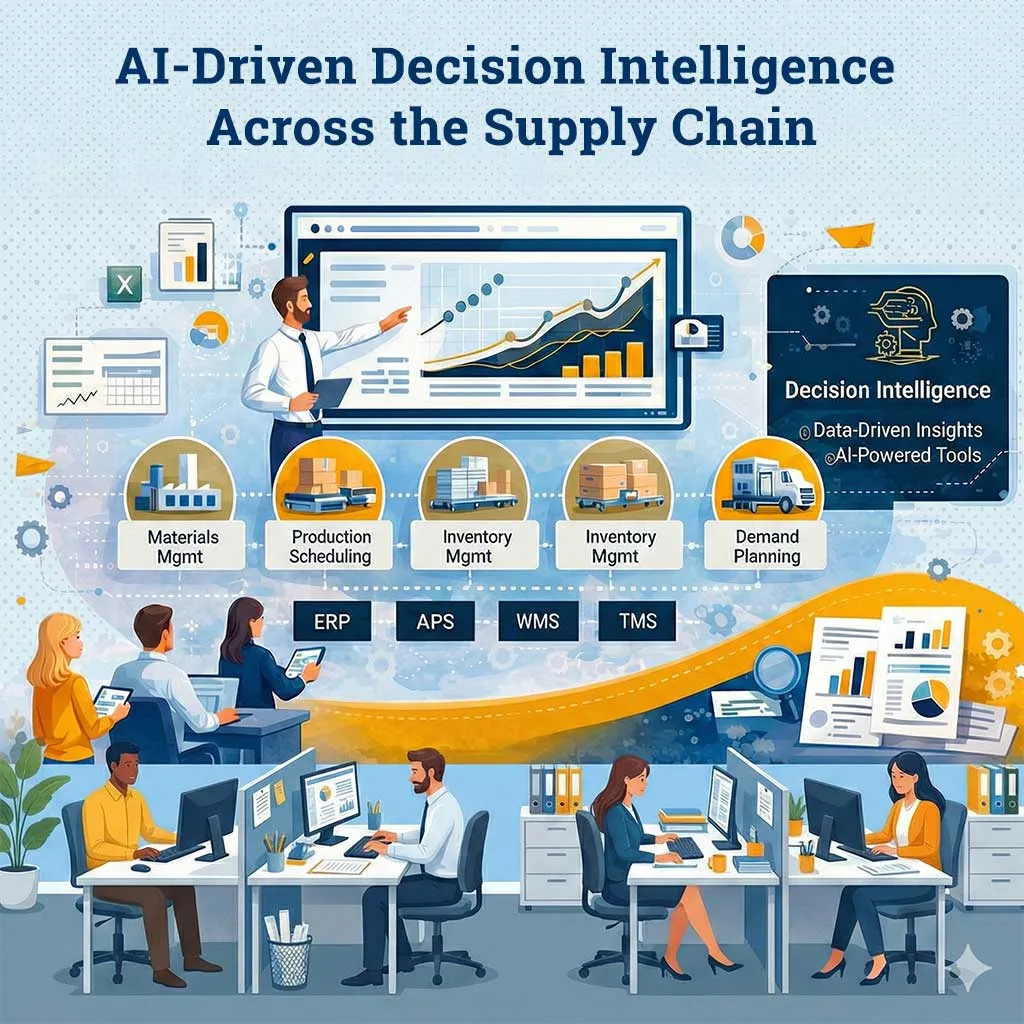
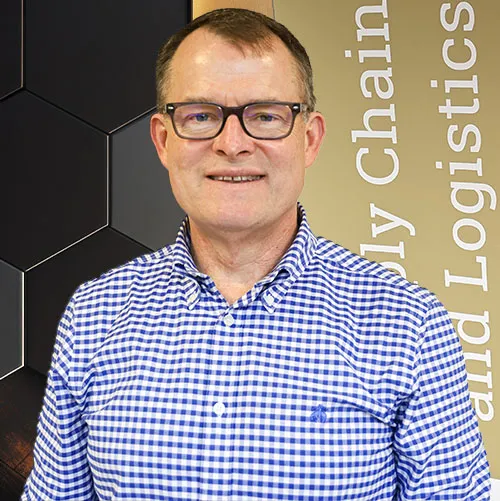

By Chris Gaffney, Managing Director of the Georgia Tech Supply Chain and Logistics Institute, Supply Chain Advisor, and former executive at Frito‑Lay, AJC International, and Coca‑Cola, and Michael Barnett, Founder and Principal of Synaptic SC, former global leader of Supply Chain AI at BCG, and former executive at Aera Technology and Koch Industries.
Entering 2026, one thing is clear: staying on the sidelines is no longer a viable option. We both agree that 2025 was the last year when being “behind” on AI adoption could be rationalized. In 2026, leaders cannot stay in the foxhole. They need to move forward, doing so in a way that reduces the risk of failure.
The past two years have been full of promise for AI in supply chain: we have seen impressive pilots, compelling research findings, and no shortage of claims about what agents and large language models can do. At the same time, many supply chain leaders are frustrated; there has been significant activity and investment in centralized capabilities without meaningful results in the supply chain. Too many efforts stall. Too many pilots never scale. Many organizations feel they have kissed a lot of frogs and are still waiting for something that works reliably.
The question for 2026 is no longer whether to engage with AI, but how to do so in a way that consistently delivers results. This is the year to put points on the board through disciplined, repeatable progress rather than moonshots.
Two Principles Separate Progress from Experimentation
Across our work and conversations with supply chain leaders, organizations that are driving tangible results tend to follow two principles, sometimes explicitly, sometimes intuitively:
1. Leverage GenAI Where It Adds Differential Value
Large language models are exceptionally strong at working with language. They summarize, explain, code, and translate intent into logic. This makes them powerful tools for accelerating development, analysis, and communication.
Much of supply chain execution, however, depends on precision. Planning rates, forecasts, production schedules, routing logic, and inventory policies rely on structured data, mathematical relationships, and deterministic logic. In these environments, hallucinations or probabilistic answers are not just inconvenient. They can be operationally disruptive.
Many early failures stem from applying LLMs where deterministic logic is required, rather than using them to support the creation, maintenance, and monitoring of that logic. In practice, GenAI is most effective upstream, helping teams build analytics faster, surface issues earlier, and lower the friction of development and maintenance.
2. Design with People in the Loop
This is not only a philosophical stance. It reflects technical reality. While recent research shows that collections of agents can outperform humans in controlled settings, production supply chains are not laboratories. They are complex, interconnected processes and organizations that operate in a dynamic, ever-changing environment. In contrast to AI that augments workers, fully autonomous systems introduce risks—technical, organizational, and reputational—that erode the incremental value relative to the increased costs to develop and maintain them.
Human-in-the-loop is not a concession. It is a design principle.
From Ideation to Error-Proofed Execution
Most supply chain organizations are not short on AI use cases. What they lack are clear, high‑probability paths to value creation.
A familiar pattern plays out: organizations rush into pilots without a clear view of where AI adds value. Results are mixed and hard to interpret. When early efforts disappoint, leaders become more cautious, not because they doubt AI’s potential, but because they are wary of repeating visible failures.
One executive described this dynamic as being "tired of kissing frogs." After aggressively leaning into new technologies early, the organization became skeptical, insisting on external proof and peer validation before investing further.
The more productive question is no longer "What is the most advanced thing we can try?" but instead: "What can we do today that has a high probability of working, scaling, and building our capabilities?"
How to Put Points on the Board in 2026
Across our experimentation and advisory work, two areas consistently emerge where GenAI is already delivering value.
Enterprise Productivity: The Safest On-Ramp
The most reliable progress comes from improving everyday productivity.
Most organizations take a restrictive approach, limiting AI access to a small group or tightly controlled pilots led by centralized technical teams, only to realize they were slowing learning and adoption across the enterprise. In one large retailer, leadership initially centralized AI use due to security and governance concerns. Over time, they shifted to enterprise licensing that centralized risk management while allowing broader employee access within guardrails.
The result was not chaos or "shadow IT." It was productivity: meeting summaries, analysis support, presentation development, and faster access to internal knowledge.
These gains may sound modest, but they matter. Giving people five to ten hours per week back changes how employees experience AI. It becomes a tool that helps them do their jobs better, not a signal that their jobs are being automated away.
For leaders, this means actively enabling access to approved tools, supporting skill development, and encouraging experimentation within clear boundaries. This is one of the most straightforward ways to quickly and visibly put points on the board.
Decision Intelligence: Rewiring the Operating Model
Advanced analytics, optimization, and planning systems predate GenAI. What is new is not the math, but rather the speed, accessibility, and maintainability of building and sustaining advanced analytics solutions.
GenAI acts as an accelerator. It reduces the friction of writing code, standing up, monitoring logic, and explaining results. It brings advanced capabilities closer to the business, rather than confining them to a small central team.
A concrete example comes from production planning. Planned production rates are often set during commissioning or early ramp up and then reused for long periods. Over time, changes in labor mix, maintenance practices, or product complexity cause actual throughput to drift. Plans continue to run, but they quietly degrade.
In effective implementations, GenAI does not update the planning system autonomously. Instead, it operates adjacent to it. It helps teams build monitoring logic that compares planned versus actual performance, surfaces statistically meaningful drift, and generates candidate adjustments with supporting context. Planners review and approve changes before they are re-ingested into the APS.
The system of record remains intact. Human accountability is preserved. What improves is the speed, frequency, and quality of assumption hygiene, enabling earlier detection of problems before they cascade into service, cost, or inventory issues.
Avoid Kissing Frogs: Technology and Organizational Choices
Many organizations “kiss frogs” not because the new technology is flawed, but because they are not ready to adopt it.
To avoid this fate, successful efforts often include the following elements:
- Leverage existing, approved AI platforms rather than onboarding new technologies
- Accelerates time to value
- Helps define the true limitations of your current technology stack to guide future platform selection
- Maximize the value of current systems (e.g., APS, production scheduling software) instead of chasing new applications
- Existing, complex supply chain software often under-delivers on its promised value
- AI agents and workflows are highly effective at improving master data quality and ensuring planning parameters are accurate
- Foster ideation and solution development with internal teams, while using third parties to accelerate capability building—not to replace it
- Make progress visible by sharing early wins, curating employee-driven experiments, and scaling what works
Change management is not an option; it must be designed into every aspect of an AI program from the start. When organizations invest heavily in advanced capabilities at the top while doing little to equip everyday employees, the message received is often, "This is happening to you, not for you." That perception creates resistance, fear, and organizational drag.
Effective leaders communicate a clear vision for how new capabilities will augment, not replace, their teams, so that scarce human intellect is applied where it adds the most value.
Key Actions to Win in 2026
The principles are clear. The opportunity is real. The question now is execution.
If 2026 is the year to put points on the board, supply chain leaders must move from experimentation to engineered progress. That begins with clarity.
1. Define a Multi-Year AI Value Vision
Develop a concrete view of how AI will create value in your organization over the next several years. Not a collection of pilots. Not a list of tools. A clear articulation of where and how AI will improve productivity, strengthen decision quality, and increase operational reliability.
That vision should:
- Clarify where AI will augment human decision-making versus automate tasks
- Identify the business outcomes you expect to improve (service, cost, inventory, resilience, productivity)
- Guide decisions on organizational design, platform selection, governance, and partnerships
- Establish sequencing - what you will enable now versus what must wait
Without a defined direction, AI efforts default to software deployment. With it, technology becomes a lever for measurable operational improvement.
2. Enable Broad, Responsible Access
Capability development accelerates when access is not unnecessarily constrained. Ensure that team members at every level - from executives to frontline planners - have access to approved enterprise AI tools and agent-building capabilities, along with practical training tied to real workflows.
Effective enablement includes:
- Enterprise licensing and governance that remove friction while protecting data
- Hands-on guidance tied directly to day-to-day supply chain work - reporting, master data cleanup, production monitoring, inventory analysis, schedule validation
- Clear operating guardrails that define appropriate data use and boundaries
- Leadership support for responsible experimentation
Restricting access may feel prudent. In practice, it slows learning and reinforces dependency on centralized teams. Broad enablement builds capability across the organization.
3. Create Local Ideation and Scaling Mechanisms
Durable progress does not originate only from centralized programs. It often begins at the front line.
Leaders should create simple, visible mechanisms for individuals and teams to experiment within defined guardrails and to share what they are building.
This includes:
- Recurring forums or showcases where teams present working solutions
- Curated libraries of effective prompts, workflows, and agents
- Clear channels for submitting ideas and documenting results
Most importantly, organizations must be able to move from local experimentation to scaled adoption. That requires:
- Identifying the strongest minimum viable solutions emerging from the field
- Refining and hardening them into repeatable workflows
- Productizing and scaling what demonstrably improves performance
The objective is not activity. It is building capability that compounds over time.
These steps are straightforward. They require intention and follow-through. That is what separates durable capability from scattered experimentation.
It is not too late to lead. The last several years have provided lessons - technical, organizational, and cultural. Leaders who absorb those lessons and design deliberately for scale will build AI capabilities that strengthen over time.
That kind of progress is not flashy. It does not depend on moonshots or fully autonomous systems operating in isolation. It depends on clarity, access, discipline, and accountability.
In 2026, novelty will attract attention. Durability will create an advantage.
The organizations that win will not be the ones with the most pilots. They will be the ones who consistently translate AI into measurable operational improvement.
This is the year to move from experimentation to engineered results.
Put points on the board.
Jan. 23, 2026
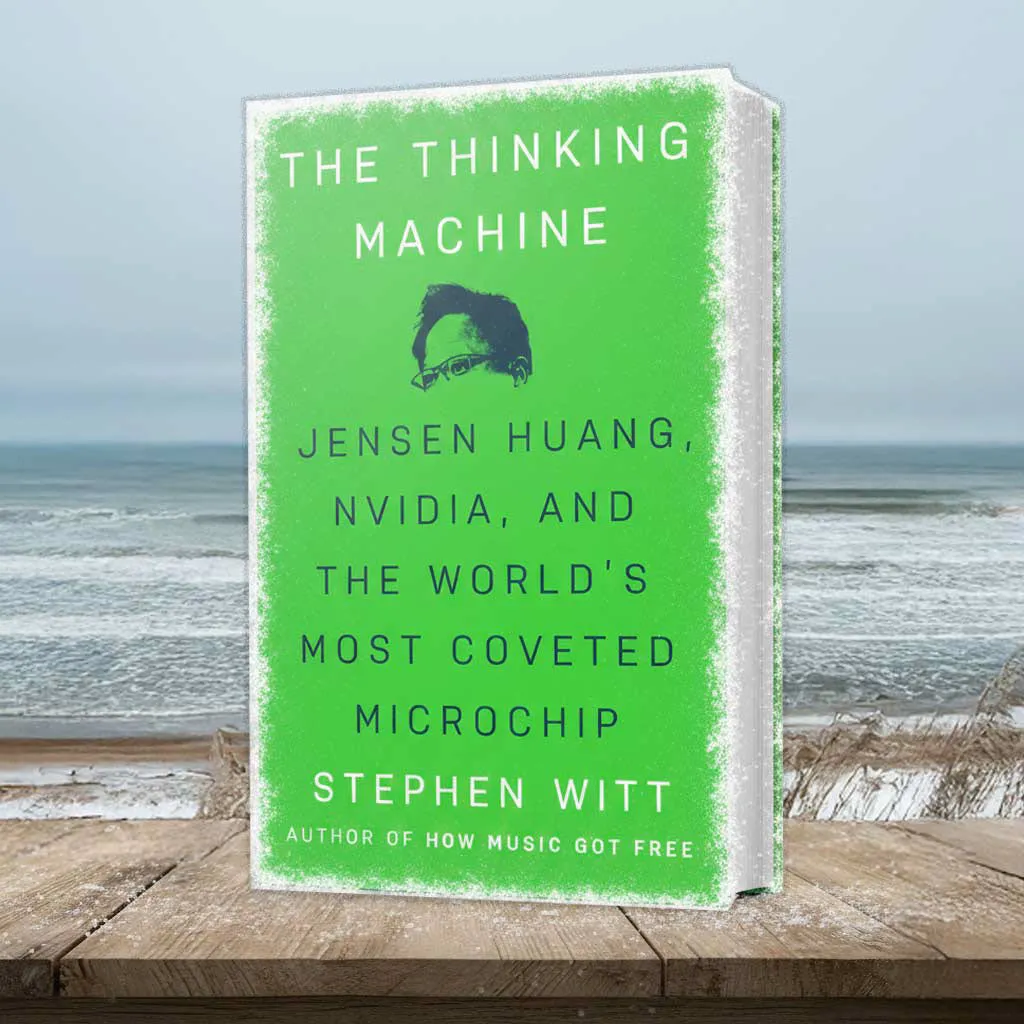
By Chris Gaffney, Managing Director, Georgia Tech Supply Chain and Logistics Institute | Supply Chain Advisor | Former Executive at Frito-Lay, AJC International, and Coca-Cola
People often ask me a simple question: “You always recommend a good book to read; what have you read lately?”
I usually give them my version of a money-back guarantee. I haven’t had to pay up yet!
The Thinking Machine, Stephen Witt’s book on Jensen Huang and NVIDIA, is one of those recommendations.
It’s a fast, engaging read that packs a lot of insight into a book you can finish in just a couple of days. It’s also one of the most interesting books I’ve read this past year out of a stack of twenty or thirty. Most importantly for my world, it’s a book from which supply chain students, young professionals, and senior leaders can all take something different.
What many supply chain readers may not realize is that NVIDIA’s story is, at its core, a case study in supply chain design, constraint management, and long-horizon system building played out on a global stage.
This book matters to me because it pulls back the curtain on the largest technology shift impacting supply chains this century. It shows it not just as a technology story, but as a supply chain, leadership, and ethics story hiding in plain sight.
More Than a Tech Book
On the surface, this is a story about GPUs, artificial intelligence, and one of the most important technology companies in the world. But underneath, it’s really a story about context: how ideas evolve, how industries form, and how long-term decisions compound over decades.
You don’t need to be an engineer to enjoy it. By the time you’re done, you’ll have a much better grasp of:
- why chips matter,
- why AI depends on physical infrastructure,
- and why supply chains quietly shape what’s possible.
That combination makes the book especially relevant for anyone building a career in supply chain, operations, or industrial leadership.
The Immigrant Story — Still Worth Protecting
One of the most powerful threads running through the book is Jensen Huang’s immigrant story.
His family worked hard to come to the United States. He grew up in modest circumstances, and through persistence, opportunity, and relentless effort, he helped build a company with global impact.
For many of our ancestors, this story feels familiar. For many who come to the U.S. today, it still represents hope. The book serves as a quiet reminder that this pathway from modest beginnings to meaningful contribution is not accidental; it is something that needs to be protected.
The United States is far from perfect, but it remains a remarkable place to innovate and to start businesses. Supply chains are both a driver of that innovation and a beneficiary of the new ideas that emerge.
A Startup Story With Real Twists and Turns
The founding of NVIDIA is not a clean, linear success story.
The original big idea wasn’t necessarily the one that ultimately “won,” and the initial target market wasn’t always the right one. The company faced near-death moments, pivots, resets, and more than a few reasons to walk away.
For students and young professionals considering startups, whether founding one or joining one, this book offers a realistic picture of what that path looks like. It reinforces a few hard truths:
- the probability of failure is high,
- the work ethic required is enormous,
- and the rewards, if they come, often come much later.
I often describe this as a “one scoop now, two scoops later” dynamic. Early effort is rarely rewarded proportionally; patience matters more than hype.
Innovation Is a Team Sport
While Jensen Huang is clearly the centerpiece of the book, one of its strengths is that it avoids treating innovation as a solo act.
Many other players, sometimes knowingly and sometimes unwittingly, contributed research, ideas, and decisions that ultimately shaped where we sit today. The book does a good job showing how progress builds through layers of contribution, often across institutions and generations.
This matters, especially for students and early-career professionals. Breakthroughs rarely come from a single moment or a single person; they come from systems that allow ideas to accumulate and translate into real-world application.
From Basic Engineering to Neural Networks
Several chapters walk through the literal evolution of the technology, and this is where the book is both accessible and impressive.
Even if you can only “just barely hang on” technically, the narrative is clear: today’s AI capabilities are the result of layered progress. Hardware advances built on earlier hardware, software abstractions built on earlier software, and research findings translated into application over time.
Many of the contributors moved fluidly between academia and industry, reinforcing a core lesson: foundational science and engineering still matter. For those of us who remember an analog world, it’s fascinating to see how decades of incremental progress led to the current state and potential of AI.
A Supply Chain Story Hiding in Plain Sight
From a supply chain perspective, The Thinking Machine reads like a case study hiding in plain sight.
NVIDIA is an American innovation success story that is, at the same time, deeply dependent on global supply chains. Its relationship with TSMC in Taiwan, the scarcity of advanced manufacturing capacity, the national security implications of certain chips, and the need to serve global markets all create a complex and fragile operating reality.
One of the quieter but most powerful lessons in the book is how much supply chain design matters. Product success here isn’t just about better ideas; it’s about how effectively those ideas are translated into scalable, resilient, global systems.
AI may feel digital, but its limits are profoundly physical.
Leadership Results — and a Real Paradox
The book also forces an uncomfortable but important leadership conversation.
Jensen Huang is demanding, intense, and uncompromising. While the results are undeniable, I don’t advocate for many aspects of his leadership style. I believe similar outcomes could be achieved without subjecting employees to public humiliation.
Results matter, but how we get them matters too.
Reading this book reminded me that some of the most valuable leadership lessons I’ve learned came from watching both how to lead and how not to lead. I’ve had bosses who modeled the kind of leader I wanted to become, and a few who taught me just as much by showing me what I wanted to avoid. Both experiences have been valuable.
That tension is worth sitting with, especially for those mentoring the next generation of leaders.
Computer Vision, GPUs, and Adaptability
Computer vision plays a supporting role in the story: not the headline act, but an important early driver. Graphics and vision workloads helped shape GPU architectures long before today’s generative AI boom.
Over time, those architectures generalized to support a wide range of parallel computation, including neural networks. It’s a reminder that technologies often succeed not because of a single application, but because they are flexible enough to evolve.
Ethics, Uncertainty, and Responsibility
Finally, the book leaves us with unresolved questions, and that may be its most honest contribution.
AI is resource-intensive, it will reshape work and livelihoods, and it raises real ethical concerns. Opinions vary widely on whether this moment resembles past industrial revolutions or represents something fundamentally different.
I teach and advocate for the application of AI, but I personally struggle with these ethical dilemmas. Rather than avoid them, I try to address them head-on by highlighting the risks and encouraging students to stay informed so they can be voices for responsible, positive use.
In today’s global and regulatory environment, it’s unrealistic to expect a pause in research or application. Education, not avoidance, may be the most practical form of governance we have.
We can’t guarantee how this plays out over the next decade, but we can prepare.
Why I Keep Recommending This Book
If you’re a supply chain student looking for context, a young professional navigating career choices, or a senior leader trying to understand how AI, supply chains, leadership, and ethics intersect, this is a book worth your time.
It’s engaging, timely, and surprisingly human.
And when someone asks me, “What are you reading?”
This is the book I’ll keep recommending.
The Thinking Machine succeeds because it reminds us that behind AI are people, supply chains, and long-term decisions, all operating under real constraints. That’s a lesson worth revisiting as we set the pace for the months ahead.
A Closing Question
This book highlights traditional supply chain constraints that NVIDIA faced in its growth journey, such as single source supply, perceived lead times, capacity at key suppliers, demand volatility, and talent gaps. Where have you seen or faced these, and how have you and your company navigated them?
Jan. 22, 2026

Students visited Lachung and Chungthang in Sikkim, India. Upstream in the Teesta Valley, students examined how steep terrain and river confinement amplify flood forces and how failures can cascade across an entire corridor of infrastructure.

Downstream in the town Dikchu in Sikkim, India, the class focused on community-scale consequences: damaged buildings, disrupted access, and long recovery timelines.

Rangpo in Sikkim, India offered a view of recovery in motion such as materials staged for rebuilding near bridges and roads that keep commerce and emergency response moving.

In Kathmandu Valley, Nepal, the course broadened from hazard impacts to cultural context, exploring how heritage, governance, and everyday use of public space shape resilience.
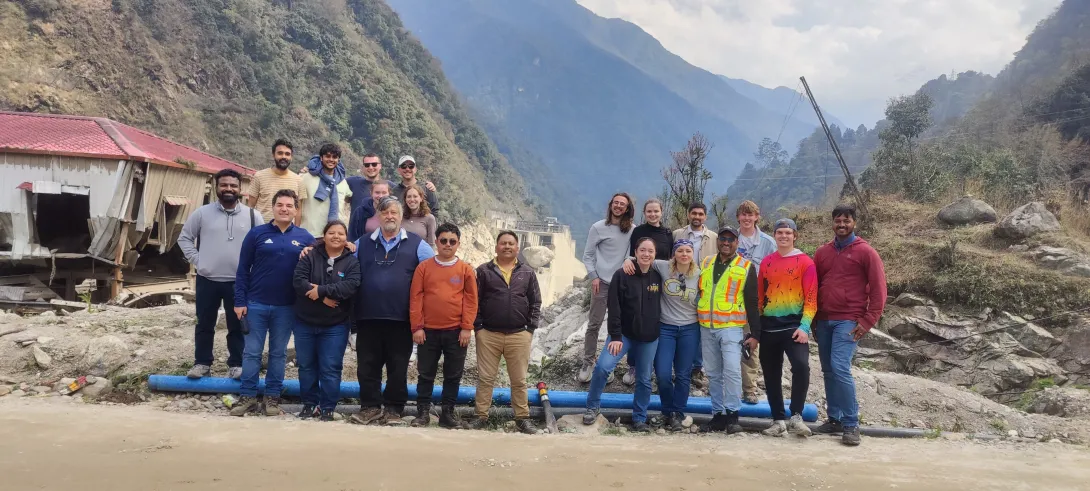
School of Civil and Environmental Engineering students captured 360 media, using Filio, to study disaster sites in India and Nepal. Photos provided by Roozbahani.
An AI-powered tool is changing how researchers study disasters and how students learn from them.
In the International Disaster Reconnaissance (IDR) course, students now use Filio, a platform built by School of Computing Instruction Senior Lecturer Max Mahdi Roozbahani, to capture immersive 360° media, photos, and video that transform real disaster sites in India and Nepal into living digital classrooms.
Offered by the School of Civil and Environmental Engineering and taught by IDR director and Regents’ Professor David Frost, the course pairs traditional fieldwork with Roozbahani’s expertise in immersive technology and data-driven learning, transforming on-the-ground observations into reusable, interactive educational resources.
How Computing Can Capture Data
Disasters are not only physical events; they are also information events, Roozbahani says. Effective response and long-term resilience depend on the ability to observe, record, and communicate critical data under pressure. Georgia Tech’s IDR course pairs structured on-campus preparation with international field experiences, enabling students to study the cascading effects of major disasters, including how local building practices, governance, and culture shape damage and recovery.
“When students step into a disaster zone, they learn quickly that resilience is a systems problem: physical, social, and informational. Our job in computing is to help them capture and reason about that system responsibly,” Roozbahani said.
Learning from the 2025 Himalayas Expedition
During spring break last year, the cohort traveled along the Teesta River corridor in Sikkim, India. The region is shaped by steep terrain, fast-moving water, and critical infrastructure in narrow valleys.
The visit followed the October 2023 glacial lake outburst flood from South Lhonak Lake, which destroyed the Teesta III hydropower dam and impacted downstream towns, including Dikchu and Rangpo. Field stops across India included Lachung, Chungthang, Dikchu, Rangpo, Gangtok, and New Delhi.
Students explored both upstream and downstream consequences.
Upstream, the team examined how steep terrain and river confinement amplify flood forces, creating cascading risks for infrastructure. Using Filio’s interactive 360° media, students captured conditions in Lachung and Chungthang, allowing viewers to explore the landscape through a 360° photo and 360° video that reveal how topography and river dynamics intensify disaster impacts.
They studied community-scale effects downstream, including damaged buildings, disrupted access, and prolonged recovery timelines.
Rangpo offered a glimpse of recovery in motion, with materials staged for rebuilding bridges and roads essential to commerce and emergency response.
Using Immersive Media as a Learning Tool
Students documented their field experience using Filio, an AI-powered visual reporting platform developed by Roozbahani through Georgia Tech’s CREATE-X ecosystem. Filio captures high-resolution photos, video, and 360° immersive media, preserving both the facts and the context of disaster sites; what the site felt like, what was lost, and what communities prioritized in recovery.
“A 360° capture lets students return months later and ask better questions. That second look is where learning accelerates,” Roozbahani said.
Supported by alumni and faculty mentors, including Tech alumnus Chris Klaus and Georgia Tech mentor Bill Higginbotham, the platform is evolving into a reusable educational library for future courses on immersive technology, responsible AI, and global resilience.
Kathmandu: The Context of Culture
The course concluded in Kathmandu, Nepal, where students examined how heritage, governance, and the everyday use of public space shape resilience.
Through Filio’s immersive documentation — including a 360° photo and 360° video from Kathmandu — the focus broadened from hazard impacts to cultural context, highlighting how recovery is not only about rebuilding structures, but also about preserving identity, memory, and community.
Looking Ahead: A Growing Resource for All Students
Frost and Roozbahani envision the IDR immersive media library as a reusable resource for students even when they cannot travel, supporting future courses on immersive technology, responsible AI, and global resilience. Spring 2026 cohorts will continue to build on this foundation by documenting, analyzing, and sharing insights that can improve education and real-world disaster response.
Jan. 15, 2026
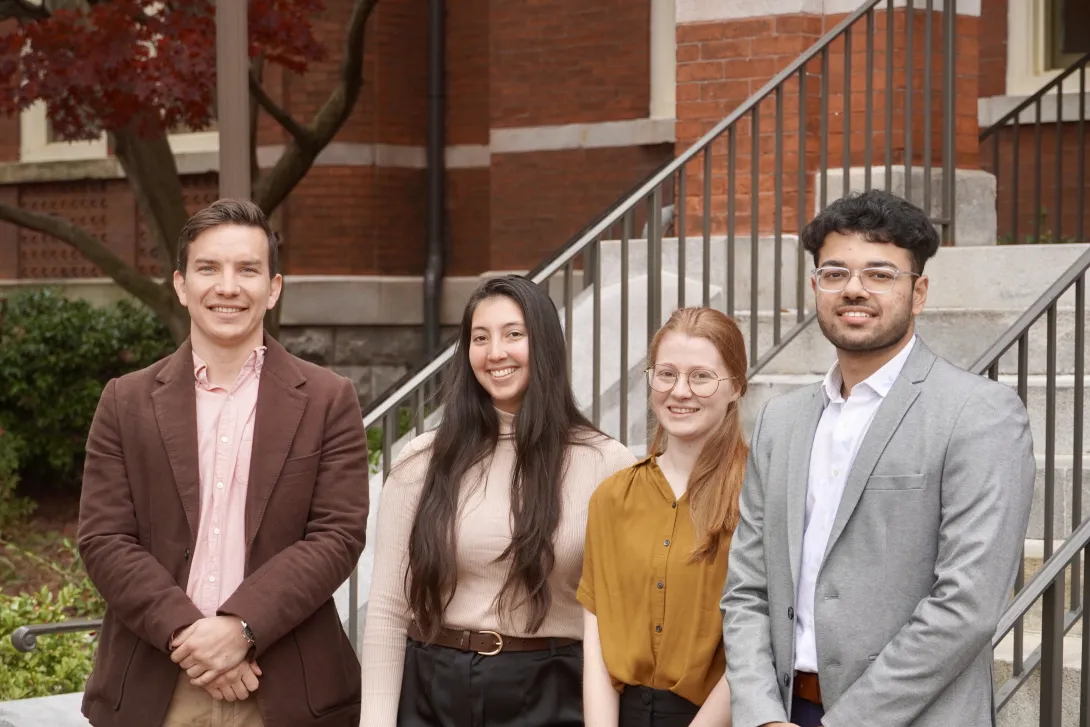
Four graduate students from the College of Sciences were selected for the new Community Engagement Graduate Fellowship, made possible through a gift from Google.
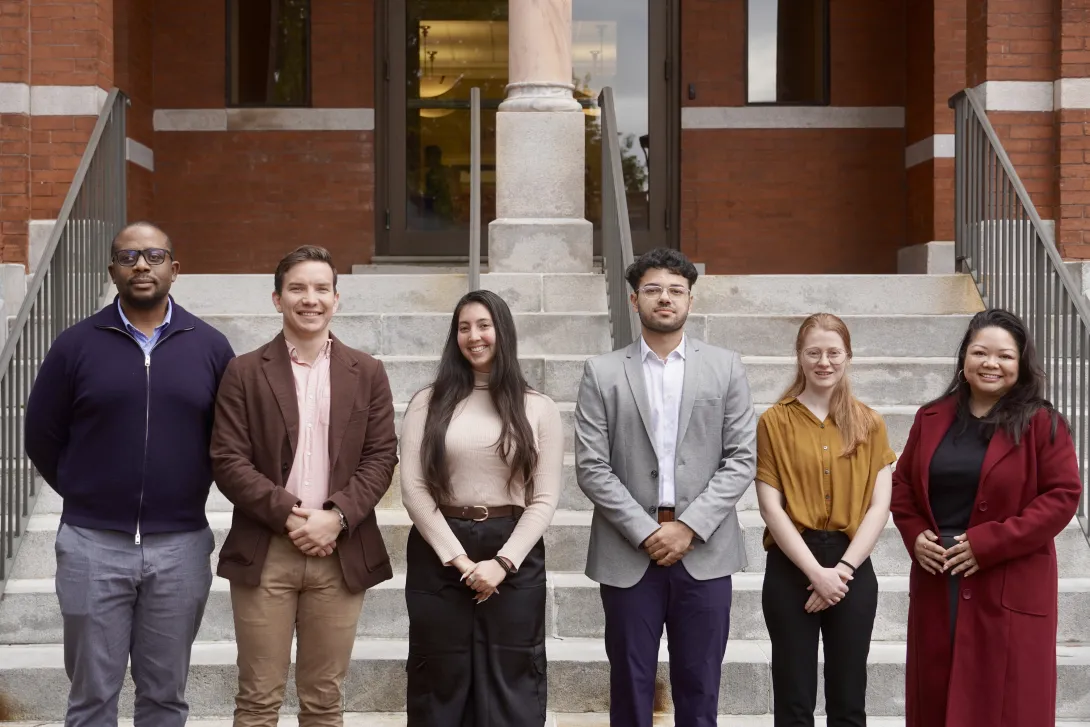
C-PIES Director Lewis A. Wheaton (far left) and Director of Programs Lea Marzo (far right) stand with the inaugural Community Engagement Graduate Fellows (left to right): Nikolai Simonov, Miriam Simma, Aniruddh Bakshi, and Katherine Slenker.
Four graduate students from the College of Sciences were recently selected for the new Community Engagement Graduate Fellowship, made possible through a gift from Google. This one-year research opportunity awards up to $5,000 for each fellow to develop a project with local partners that aims to build stronger communities.
“It has been a pleasure for the Center for Programs to Increase Engagement in the Sciences (C-PIES) to collaborate with Google and the College of Sciences Advisory Board to bring this fellowship, which will positively impact our community and highlight how science can align with public good,” says Lewis A. Wheaton, professor in the School of Biological Sciences and director of C-PIES.
In the year ahead, the fellows will work with C-PIES and community partners on campus and in the metro Atlanta area to develop projects in one of three priority areas: civic and policy engagement, community-engaged research, and K-12 research outreach.
The fellowship was open to all graduate students in the College of Sciences, and four inaugural fellows — Aniruddh Bakshi, Katherine Slenker, Miriam Simma, and Nikolai Simonov — were named based on their exciting, yet feasible applications.
Fellow Aniruddh Bakshi: Strengthening trust in science
Ph.D. student Aniruddh Bakshi studies the problem of drug delivery at the intersections of organic chemistry, biochemistry, and immunology. As mRNA vaccines are closely related to his area of research, he sees the need for a grassroots outreach movement from young academics to help bolster public confidence in rigorous scientific methodology.
In collaboration with local hospitals and nonprofits, his proposed project is to start a social media content series, titled “A Day in the Life of a Ph.D. Student,” to show the realities of graduate school for those interested in this career path while connecting his research to broader public issues.
“Science has the power to solve urgent problems, but only if people understand and trust it,” says Bakshi. “Through this fellowship, I will use my research and outreach efforts to help strengthen that trust — showing how discoveries in drug delivery and vaccine design can make a real difference in people’s lives.”
Fellow Katherine Slenker: Creating a biodiversity data network
Atlanta is often referred to as “the city in a forest,” but according to Ph.D. student Katherine Slenker, wildlife has a difficult time navigating across roads and housing developments, often resulting in human-wildlife conflict.
“Conservation ecologists have long recommended that the movement of wildlife could be eased through the creation of ‘ecological corridors,’ which connect greenspaces and wildlife populations,” she explains. “Determining the movement patterns of wildlife, and where such corridors may be best situated, requires that we first understand what species reside in the metro Atlanta area as well as how they are expected to disperse.”
As a fellow, Slenker plans to build a biodiversity data network by comparing wildlife monitoring at Davidson-Arabia Mountain Nature Preserve and Stone Mountain Park and increasing the coalition of metro Atlanta researchers. This data can be used in the development of ecological corridors to reduce clashing between humans and wildlife, notably animals struck by vehicles, and improve ecosystem health at these parks.
Fellow Miriam Simma: Making structural biology research more accessible
The study of crystallography is vital in academia, industry, and medicine because it enables researchers to decipher the atomic structures of proteins, but it is scarcely taught outside of graduate school. Ph.D. student Miriam Simma wants to change that.
Her proposed project is to introduce protein crystallography to K-12 students and teachers through hands-on activities in local high school classrooms and to the public during the Atlanta Science Festival at Georgia Tech.
“My vision is to make structural biology research accessible, so everyone can engage with cutting-edge scientific research — fostering curiosity and interest in STEM careers,” says Simma. “Long term, I will synthesize these activities into a chemical education article that introduces K-12 students to protein structure and function.”
Fellow Nikolai Simonov: Mentoring middle school scientists
Last year, Ph.D. student Nikolai Simonov became involved in the GoSTEM Club at Lilburn Middle School — leading student activities and recruiting other graduate student volunteers. In partnership with Georgia Tech’s Center for Education Integrating Science, Mathematics and Computing, the club is a weekly afterschool program for students, many of whom come from underserved backgrounds, to grow their scientific curiosity.
“I assembled a team of 10 Tech graduate students who could explain complex scientific concepts in approachable ways for middle school students. Through this fellowship, we are excited to enrich the GoSTEM Club with an ongoing mentorship program and materials for more ambitious science fair projects,” shares Simonov.
As part of the program, club members can meet one-on-one with Georgia Tech mentors to discuss their educational and career goals. “By sharing their stories and connecting scientific ideas to real-world applications, our mentors aim to show students that STEM is not only accessible but a path toward a fulfilling life,” he adds.
News Contact
Jess Hunt-Ralston
Director of Communications
College of Sciences at Georgia Tech
Writer: Annette Filliat
Dec. 23, 2025
By Chris Gaffney, Managing Director, Georgia Tech Supply Chain and Logistics Institute | Supply Chain Advisor | Former Executive at Frito-Lay, AJC International, and Coca-Cola
Introduction
The supply chain labor market has been through one of the most dramatic swings in modern history. During the COVID-19 era disruption, talent shortages were acute, and the pendulum swung decisively toward employees. Companies paid top dollar, offered unprecedented flexibility, and competed fiercely for planners, warehouse leaders, S&OP talent, logistics managers, strategic sourcing leaders, and procurement specialists.
But the pendulum swung back in the opposite direction, from whence it came: in favor of the employers.
The past 18–24 months have seen hiring across supply chain cooling. Many large companies are now signaling they intend to grow revenue without necessarily increasing headcount. At the same time, AI and automation have gotten to the point where employers can get more productivity from existing teams. The result is not necessarily indicative of a recessionary job market but a “Great Hiring Pause”: low hiring, low firing, and a clear tilt of bargaining power back toward employers.
The key question now is whether this moment represents a temporary pause or the new normal. Additionally, what does this mean for both hiring managers and early to mid-career supply chain professionals who want to stay competitive in the workplace?
We’ll explore what this means for all stakeholders as we wrap up the year, looking at how the supply chain job market evolved in 2025 and what we expect to see in 2026.
The Pendulum has Swung from Employee Power to Employer Advantage
If you had as little as 5 years of supply chain experience in late 2020–2022, you may have found yourself with competing job offers. Compensation packages offered were lucrative and filled with relocation fees or even 100% remote job offers.
Without a doubt, this shaped the next 2–3 years of the supply chain labor force. Office space sat empty. Employees moved out of the city into the suburbs. Work-life balance improved for everyone. Employers fretted over rents and mortgages on office space and whether their highly compensated employees were actually working. Threats of a pending recession loomed but never materialized. (fingers crossed, knock on wood). Employers ran a bit lean but then found themselves needing more people to keep up with demand.
In early 2025, we wrote about this swing and the influence AI and automation had on supply chain hiring. Companies seemed to be focusing more on how they could accelerate the performance of existing teams while navigating new cost influences and demand swings. Anxiety about the economy amid never-before-seen tariff whims made it increasingly difficult for employers to plan reliable growth strategies for 2026.
And now here we are. The prevailing mindset as we close out a volatile 2025, where AI and tariffs took center stage, is for growth without as much hiring. So what does that mean for 2026 for employers and employees, or aspiring employees?
Growth Without Hiring: Why Companies are Staying Lean Across Supply Chain and Logistics
Executives are treating hiring as a last resort and not a first resort. JP Morgan Chase’s CFO reportedly said the firm has a “strong bias” against reflexively hiring new people. Walmart, Inc. has signaled plans to grow revenue without increasing employee numbers, instead relying more on automation/AI and efficiency improvements.
As mentioned above, market indicators have become increasingly unreliable. Recent Black Friday consumer spending data indicate that people are financing their purchases on credit and using buy-now, pay-later plans. This means less cash injected into the economy in the short term, along with increased interest payments for 95% of the purchases made on Black Friday. Retailers rely heavily on consumer spending and demand, which dictate their growth or lack thereof.
Businesses have also decided to engage in what some are calling “The Great Freeze”, which is not to hire but also to not fire—holding steady on headcount until they can get a better feel for what 2026 will offer from a demand and affordability sense. High inflation affects everyone, which is why many employers are riding it out for a while.
The Risks of Going Too Lean: Burnout, Fragility, and a Shrinking Talent Pipeline
For supply chain organizations, running lean means pressure to improve throughput, reduce waste, and automate more tasks. While the rapid emergence of AI and automation has greatly improved efficiencies, you still need people to understand the best use cases for all of these tools. They can certainly be enhancements, but will backfire if they are seen to be wholesale replacements for full-time employees. This backlash is being felt and mentioned a lot more consistently. AI shouldn’t replace humans, but rather, make them superhuman.
Firms may invest in upskilling existing staff rather than hiring large numbers of junior or mid-level staff. This could help manage costs in a turbulent economy. This is a tricky game, though. Keeping headcount flat while demands increase can lead to burnout, skill gaps, or degraded service if not managed carefully. Productivity gains might be possible, but at what cost? Change management, culture shift, lack of future talent pipeline, and succession planning can place your supply chain at great risk. Think about it: What will you do about career progression, worker loyalty, and organizational capability in 5–10 years? Yes, AI and automation are force multipliers, but not force replacers.
The people who succeed are those who take a measured approach to talent decisions. It is a refrain that has been emphasized for years. Overly lean operations become fragile, just as banking talent balloons your costs. The goal is to strike a balance between the two.
Will the Pendulum Swing Again?
The short answer: not anytime soon. Today’s flat hiring environment is not just a reaction to inflation or a temporary post-COVID correction or regression to the mean. It is influenced by other structural forces like AI maturity, demographic shifts (including the aging of the workforce), productivity pressure, and a corporate mindset increasingly comfortable with “growth without headcount.”
So what now? Employees should pay attention to these moves and make themselves more valuable by staying proactive. Do not wait for a chance to improve your position. Seek it out.
Find collaborative opportunities with your peers outside of your specific silo. Cross-functional literacy takes center stage to increase one’s value. There has been career acceleration among mid-level supply chain professionals who can work across the organization and become proficient in a multitude of functions. Increase your functional knowledge base and increase your organizational value at the same time.
This is not the time to be complacent or average. Employers still need people with elite soft skills such as leadership, personnel management, communication, and initiative. Visible contributions are essential and will separate those who thrive from those who are content to endure.
There is also hope on the horizon. An elite supply chain institution recently reported that more than 85% of their spring graduates received high-level roles. Another hopeful metric is the rise in offers coming to every supply chain graduate. These numbers are all trending up, which means that the supply chain is strong and in need of a robust talent pipeline.
Employees must demonstrate they can become experienced—if not fluent—with AI tools that make individuals more productive. Use them to lift your value. Differentiation is the name of the game in a field where the top 10–15 percent of talent still commands a premium.
This was explored further in an article written for Georgia Tech this summer. AI is not the end, it is the beginning:
I firmly believe professionals—especially early in their careers—should spend 3 to 5 years in front-line roles. No AI tool can replicate the kind of intuition you build by seeing how things work, where they break, and how people respond in real time. That foundation lasts an entire career.
There will always be a place where the human edge is necessary. The goal is to find where you fit and how you can use AI to your advantage while honing and refining your soft skills. Do not be afraid to make mistakes, either. It is one of the best ways to learn.
Conclusion: Planning for Stability in an Unstable Market
The supply chain talent pendulum has clearly swung back toward employers, and the forces keeping it there are unlikely to fade any time soon. AI maturity, demographic stagnation, post-COVID overcorrections, and a corporate appetite for “growth without hiring” all point to a labor market that may remain employer-favored through 2027 or 2028. But the story does not end there. The pendulum can shift again, and it will if several conditions align: steady consumer demand, renewed business investment, lower interest rates, stable inflation, and a labor market that stays tight enough to force companies to compete for talent rather than squeeze more productivity out of smaller teams.
For employees, waiting for that moment is a recipe for disaster and is not a strategy for success. This is the time to skill up, stand out, and become visibly indispensable. Become more proficient with AI tools, expand your cross-functional range, and build the soft skills that technology cannot replace. Your competition now becomes yourself. There is no better time to be a “self-starter” than now.
For employers, running lean perpetually will not provide a bulletproof bottom line. There is risk to succession planning and employee morale through burnout and stagnation. Continue strategically building internal pipelines. The job market has plenty of talent at a premium right now, so find people who can help you maintain operations and grow into more senior roles as the economy rebounds. Workforce resilience cannot be built overnight, and organizations that fail to adequately invest now will struggle later.
“Steady-Eddie” remains the preferred path. Do not overhire or overfire. Aim for a sweet spot that maintains growth, protects margins, and creates a small cushion of resilience for the labor pool. The companies that invest smartly and the employees who stay adaptable, proactive, and highly visible have the chance to define the next era of supply chain leadership, no matter where the pendulum lands.
Call to Action: What This Means for You—and What to Do Next
If these dynamics feel familiar—or unsettling—you are not alone. Moments like this are precisely when intentional investment in skills, talent pipelines, and professional networks matters most.
For students and early-career professionals
This is the time to differentiate, not wait. Employers are hiring selectively, and they are looking for candidates who combine foundational supply chain experience with strong communication, cross-functional literacy, and practical fluency with analytics and AI-enabled tools. Georgia Tech’s Supply Chain and Logistics Institute (SCL) offers professional education courses designed to build exactly these capabilities—grounded in real-world application, not theory alone.
For working professionals
If you are navigating growth-without-hiring realities, reskilling and upskilling are no longer optional. SCL programs help professionals sharpen decision-making, leadership, and applied technical skills that increase both individual and organizational resilience—especially in environments where headcount is constrained but expectations are rising.
For hiring managers and employers
Even in a cautious hiring market, the competition for top-tier supply chain talent has not disappeared—it has become more targeted. Engaging early with Georgia Tech SCL allows you to connect with high-caliber students, support a durable talent pipeline, and partner on developing skills that align with where supply chains are headed, not where they have been.
Readers are also encouraged to explore SCM-focused podcasts and practitioner conversations—including leadership, career-path, and “day-in-the-life” perspectives—that help translate these labor market shifts into practical guidance. These voices complement formal education by offering lived experience and real-world context during periods of uncertainty.
For those wondering how to navigate what comes next, staying connected with Georgia Tech SCL can be valuable. In a January 2026 webinar, the team will preview an emerging trend expected to materially shape supply chain roles, workforce expectations, and talent strategies over the next 3–5 years—particularly at the intersection of AI enablement, front-line experience, and leadership readiness.
This moment favors those who engage early, build capability deliberately, and stay connected to credible institutions shaping the future of supply chain practice.
This content was developed in collaboration with SCM Talent Group, a supply chain recruiting and executive search firm.
Resources
- Associated Press — “US hiring stalls with employers reluctant to expand...” (reports just ~22,000 jobs in a month). AP News
- CBS News — Supporting story on same 22,000-job report / labor-market cooldown. CBS News
- PBS NewsHour — Analysis of U.S. hiring stall and its implications. PBS
- Business Insider — Coverage of weak August 2025 jobs report and growing caution in labor markets. Business Insider
- The Wall Street Journal — “Jobs Report Shows Hiring Slowed in August 2025” (subscription-gated). The Wall Street Journal
- Bloomberg — Reporting that job openings and hiring have decoupled despite rising corporate capital expenditures; signals firms are investing without matching headcount growth. Bloomberg
- Walmart / Newsweek — Recent article on Walmart celebrating automation and signaling flat headcount even as business grows. Newsweek
Dec. 16, 2025
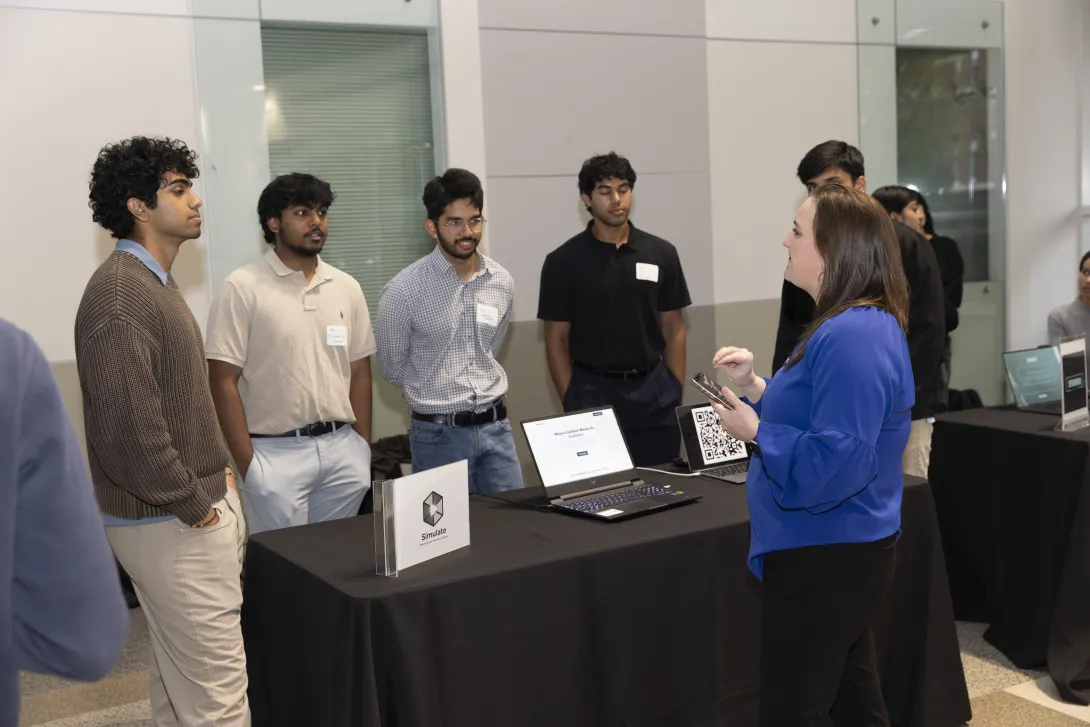
SCI's Jennifer Whitlow speaks with a team presenting at the new entrepreneur section of Junior Design Capstone. Photos by Terence Rushin/ College of Computing.
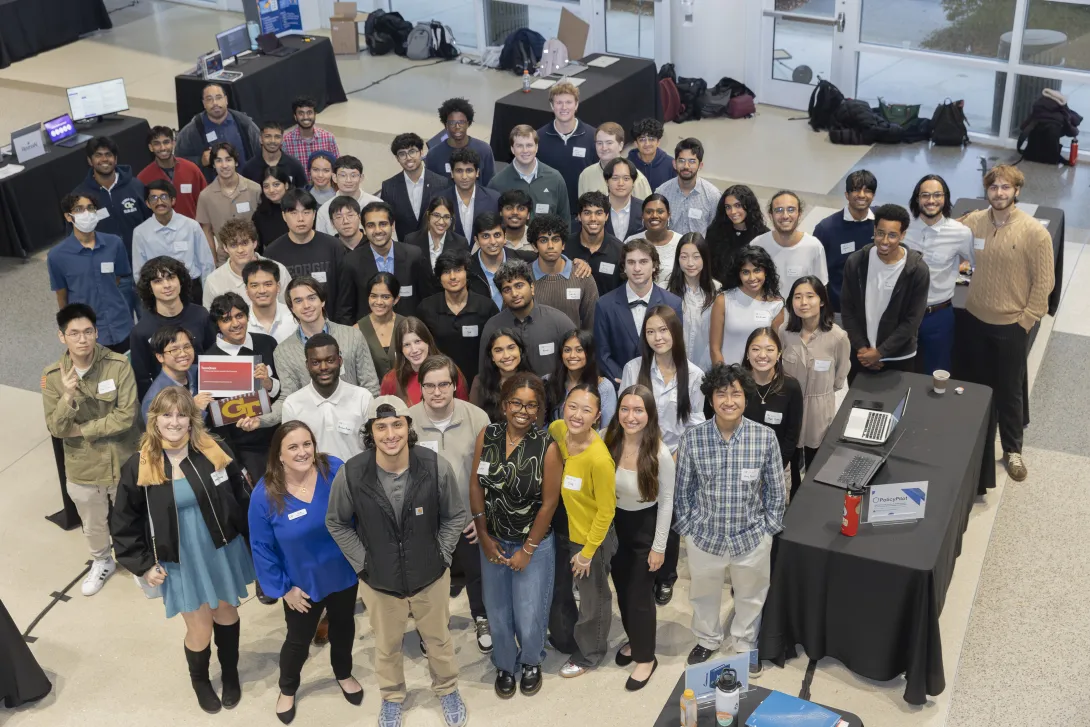
Students present at the expo
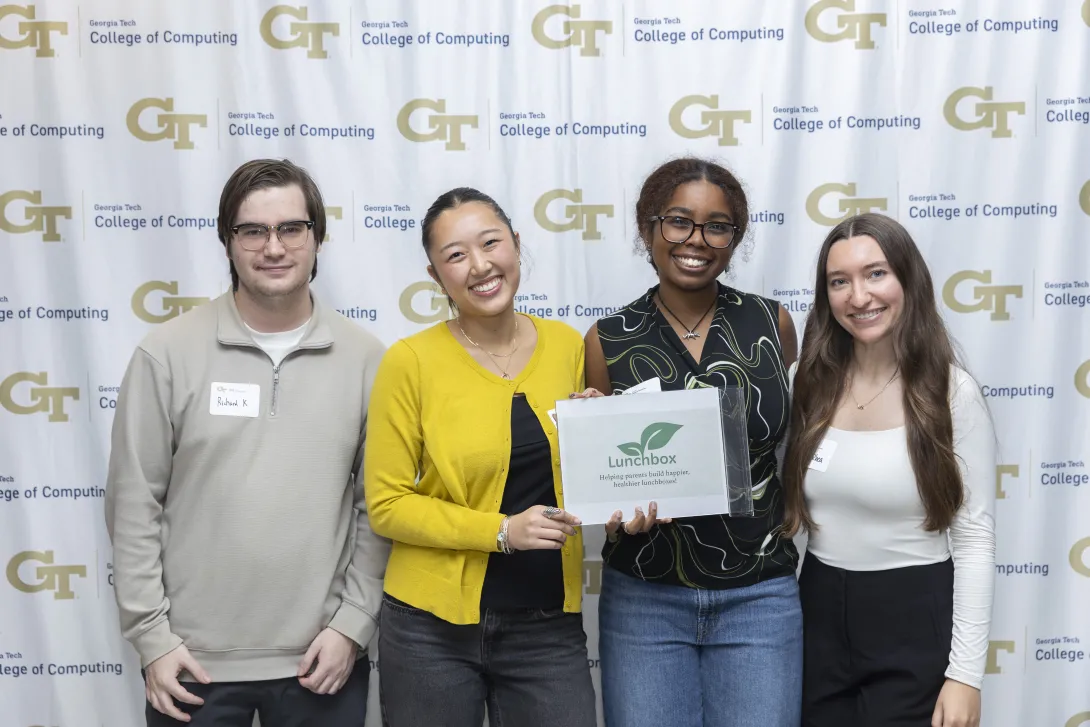
Team Lunchbox created a prototype to help parents of neurodivergent children with safe foods. Photo by Terence Rushin/ College of Computing.
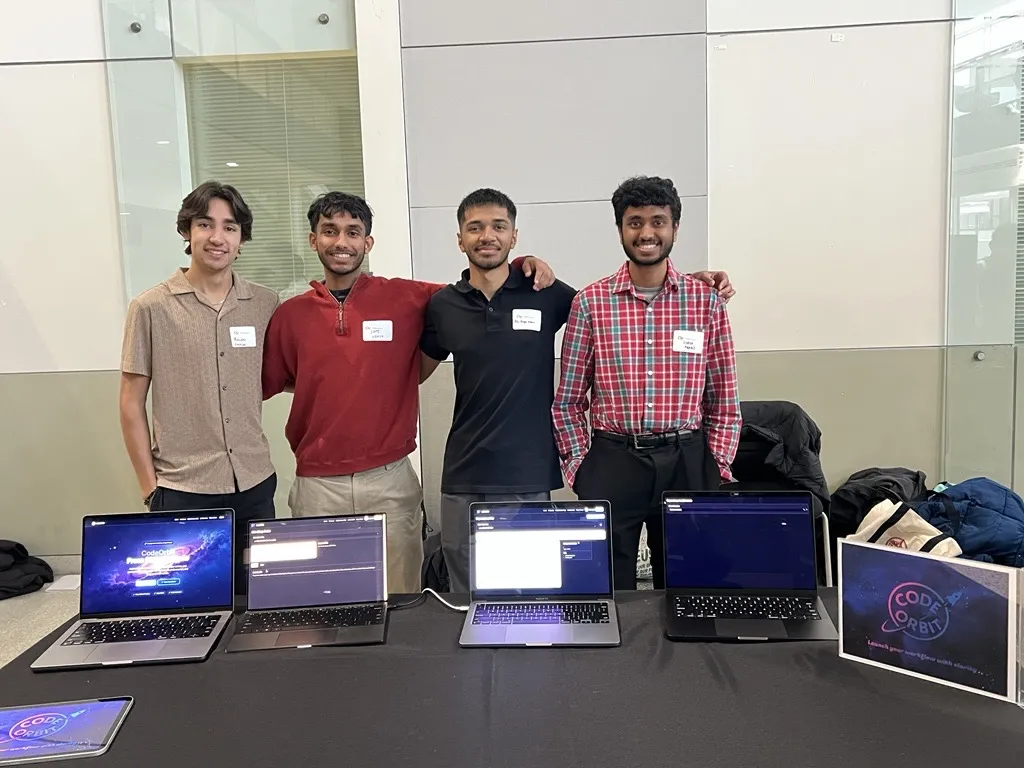
Team CodeOrbit took first place at the Expo. Photo by Jennifer Whitlow.
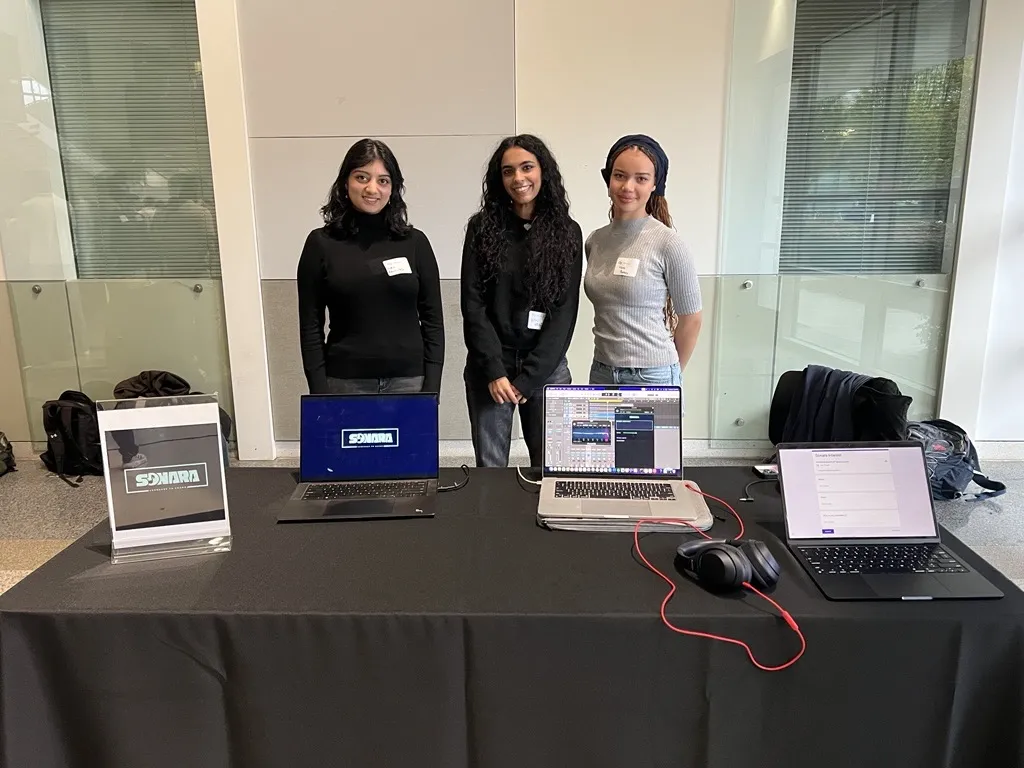
Team Sonara took second place at the Expo. Photo by Jennifer Whitlow.

Whitlow, who has years of experience working with startups, leads the new section of Junior Design Capstone. Photo by Kevin Beasley/ College of Computing.
From zero to working prototype in just four months, students in the College of Computing’s new entrepreneurial Junior Design Capstone tackle real-world problems with guidance from startup mentors.
Led by School of Computing Instruction faculty member and Georgia Tech alumna Jennifer Whitlow, the course gives students a founder’s perspective on building technology that meets real user needs.
A Startup Approach to Junior Design
Unlike the traditional CS Junior Design course where teams work with sponsors, students in the entrepreneurial track act as their own clients. They begin the semester with no predetermined problem and follow a structured process, which is anchored by deliverables that reflect professional expectations.
“Students come in with nothing,” Whitlow said. “They identify a problem, conduct customer discovery, realize which assumptions were wrong, refine their direction, figure out what to build and then build it. And they own it 100 percent.”
Customer-discovery interviews ensure every idea is grounded in real user needs, and the semester culminates in a fully functioning prototype paired with a written justification of the decisions behind it. This combination of development and reflection gives students a framework that mirrors startup practices.
Expert Alumni Coached and AI-Driven Development
To further simulate a startup environment, Whitlow recruited alumni coaches with startup or executive experience. Coaches were paired with teams based on their areas of expertise, advising anywhere from one to four groups. The roster includes a former chief technology officer and longtime startup advisor, along with alumni startup founders.
Students also incorporate AI tools into development, accelerating early prototype work while still making critical decisions themselves.
“AI can accelerate the early stages,” Whitlow said. “But students have to understand their design well enough to guide it. AI doesn’t replace their decision-making.”
Top Teams Earn CREATE-X Acceptance
Sixteen teams completed the entrepreneurial capstone this fall.
The top two scoring projects earned automatic acceptance into CREATE-X Launch, Georgia Tech’s startup accelerator:
- CodeOrbit
- Sonara
These teams showcase the program’s ability to quickly bring student ideas to a level that’s ready for real-world startup incubation.
Putting the Process into Action: Lunchbox
One team that exemplifies how the capstone’s structure supports innovation is LunchBox. Created by computational media major Abigail Rhea and her teammates, LunchBox helps parents and caregivers of neurodivergent children navigate limited safe-food options.
The idea evolved after early customer discovery revealed that the original concept had too much competition, so the team narrowed its focus.
“During research, one of our teammates came across a testimonial from the mother of an autistic child,” Rhea said. “It spoke to all of us and helped us shift toward a truly underserved demographic.”
The team conducted more than 20 interviews with caregivers and special education teachers, reshaping its approach. “We realized families didn’t need another daily task,” Rhea said. “They needed personalized guidance that runs in the background. Everything we built came directly from those conversations.”
The team's biggest technical challenge was engineering a dynamic, emotionally supportive roadmap for food-exposure therapy. While AI accelerated development of SwiftUI code, all core decisions remained human-driven.
At the Capstone Expo, attendees connected strongly with the project. “So many people told us how applicable LunchBox is to their lives,” Rhea said. “Most joined the waitlist. We couldn’t be more excited for what’s next.”
Looking Ahead
Whitlow sees the pilot already fulfilling its purpose: giving students the tools and confidence to turn ideas into real ventures. Teams can continue work by applying to CREATE-X programs or building on their prototypes after the semester.
“This course shows students they can create something real,” Whitlow said. “That’s the goal: empowering them to innovate.”
A Startup Approach to Junior DA Startup Approach to Junior DesiUnlike the traditional CS Junior Design course where teams work with sponsors, students in the entrepreneurial track act as their own clients. They begin the semester with no predetermined problem and follow a structured process, which is anchored by deliverables that reflect professional expectatio
Nov. 11, 2025

The Ray C. Anderson Center for Sustainable Business (Center), in partnership with Georgia Tech Scheller College of Business Executive Education and the Georgia Manufacturing Extension Partnership at Georgia Tech, is launching an Energy Management and Reporting course designed specifically for small and medium-sized enterprises (SMEs). The course has been developed in response to a growing challenge: Large corporations increasingly need their suppliers to track and report energy and emissions data, yet many SMEs lack the resources and expertise to do so.
News Contact
acsb@scheller.gatech.edu
Nov. 21, 2025
By Chris Gaffney, Managing Director, Georgia Tech Supply Chain and Logistics Institute | Supply Chain Advisor | Former Executive at Frito-Lay, AJC International, and Coca-Cola
In today's supply chain environment, the pace and scale of change are no longer episodic — they are constant. Network redesigns, automation investments, digital transformation, new product and business models, shifting customer expectations, cost pressure, and talent dynamics all converge at once.
Here is the most direct insight I can offer — and one I have come to believe deeply through experience:
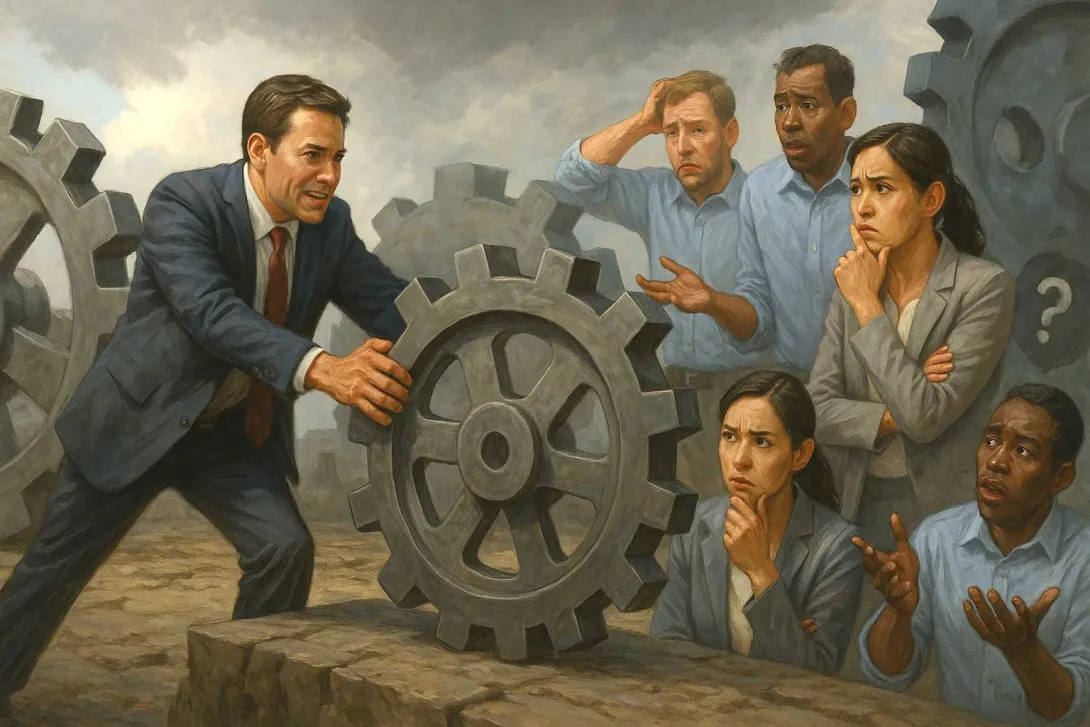
“If you want your organization, automation, or Digital/AI investments to pay off, change management is not optional. It is the highest-leverage point of failure or success.”
Despite decades of innovation, the uncomfortable truth is that most large-scale supply chain transformations still fall short. According to a recent Bain survey, 70% of major transformations fail to meet their objectives — a number that has remained stubbornly consistent over time. The reasons vary, but the most common root cause is not the technology — it’s the people side of the change.
This is why change management must be treated as a leadership discipline at the center of supply chain excellence. And it is why this topic continues to rise in conversations I have with industry partners, consulting clients, and the students entering the field.
Where I First Learned the Power of Change Leadership
This isn’t an abstract subject for me — it is something I experienced in my career. When I worked at The Coca-Cola Company, the business went through multiple waves of transformation over a 10–15 year period: acquisitions and integrations, major information-system deployments, shifts in the beverage portfolio, and cultural changes as carbonated soft drink growth slowed.
As the company diversified into new beverage categories, the economics shifted and productivity expectations rose. The technical challenges were significant, but what stood out to me was this:
“The difference between transformations that succeeded and those that stalled was how effectively people were brought into the change — how well they understood it, aligned with it, and adapted to it.”
Strong technical designs struggled if people weren’t aligned. But “good enough” solutions thrived when the organization invested in communication, role clarity, and capability-building.
Later in my career, during my time as President of Coca-Cola Supply, we made one of the most durable leadership investments I’ve ever seen: certifying the entire organization in the Coca-Cola change model. Many of those leaders still apply the same principles today — 15 to 20 years later — because the skills became part of how they led, not something they had to remember.
That experience shaped how I see change leadership today.
What Today’s Supply Chain Landscape Is Telling Us
Across industries — and especially across complex supply chains — the same patterns repeat.
WMS and automation vendors now budget change management into implementation plans. They’ve learned that even well-designed systems fail if associates fear job loss or can’t visualize the “after” state of their work.
Consulting firms see adoption challenges as the biggest barrier to client success. A firm we taught recently added change management to their executive education curriculum because their teams saw change gaps in almost every engagement. Months later, that module remains the highest-value part of the course.
Network design firms observe cultural resistance across geographies. Even optimized solutions don’t transfer cleanly from one region to another. Culture, norms, and expectations matter — often more than the math.
Robotics and automation projects fail for people reasons, not engineering reasons. At the recent RoboGeorgia Forum, the keynote emphasized that a surprising percentage of large automation investments fail because of unclear roles, resistance, weak communication, and fear — not limitations in the technology.
AI adoption mirrors these challenges. According to a recent McKinsey Global AI survey, only one-third say they are scaling AI enterprise-wide, and just 39% report measurable EBIT impact. The survey reinforces that even when technology works, the real barrier is organizational readiness — leadership alignment, redesigned processes, clear governance, and a reskilled workforce — not model performance.
There is also strong evidence showing that when change leadership is done well, project outcomes dramatically improve. In a benchmarking study of more than 2,600 initiatives, Prosci found that 88% of projects with excellent change management met or exceeded their objectives, compared with only 13% of those with poor change management. Projects with excellent change management were also 5 times more likely to stay on or ahead of schedule and 1.5 times more likely to stay on or under budget. These findings reinforce a simple truth: effective change leadership is directly correlated with higher performance, better adoption, and faster time to value.
Put simply:
“Technical innovation moves faster than organizational adoption — and the gap costs time, money, and credibility.”
Why We Still Struggle With Change, Even Though We “Know Better”
Here's where a critical-thinking lens helps:
- We have 50 years of research on how change works.
- We have widely used models.
- We have entire consulting practices devoted to change.
- And most leaders have lived through multiple transformations.
So why does the gap persist?
Leaders confuse technical readiness with organizational readiness. A strong design doesn’t guarantee strong adoption.
Self-interest is underestimated. Logic rarely moves people. Personal impact does.
Urgency pressures force shortcuts. Go-live dates push leaders to cut corners on communication, training, and role clarity — the exact things that prevent failure.
Leaders assume operations teams “will adjust.” This is the most common miscalculation. Operational excellence does not automatically translate to change readiness.
These points explain the paradox: even experienced leaders underestimate the work of leading people through change.
The Two Leading Change Management Models: Kotter and ADKAR
Dozens of frameworks exist, but two stand clearly above the rest in terms of use, validation, and practical effectiveness in modern supply chain and technology environments: Kotter’s 8-Step Process and the Prosci ADKAR model.
Frameworks like Kotter and ADKAR are powerful, but they don't replace judgment. Real change leadership requires applying these tools with situational awareness, not following them mechanically.
Kotter’s 8 Steps focus on organization-wide transformation:
- Create a sense of urgency: Show why change is necessary and the potential consequences of not changing.
- Build a guiding coalition: Assemble a team with enough power and influence to lead the change effort and encourage teamwork.
- Form a strategic vision: Develop a clear vision for the future and strategies to achieve it, making it clear how things will be different.
- Communicate the change vision: Widely and often communicate the vision to get buy-in and inspire action from others.
- Empower broad-based action: Remove obstacles and barriers, such as outdated processes or resistant individuals, to enable employees to act on the vision.
- Generate short-term wins: Plan for and celebrate early successes to build momentum and prove that progress is being made.
- Consolidate gains and build on the change: Use the credibility from initial wins to tackle larger, more complex changes, and don't declare victory too early.
- Anchor new approaches in the culture: Reinforce the new behaviors, processes, and practices until they become a permanent part of the organization's culture.
ADKAR focuses on individual adoption:
- Awareness – Of the need for change
- Desire – To Participate and support the change
- Knowledge – On how to change
- Ability – To implement required skills and behaviors
- Reinforcement – To sustain the change
The synthesis:
Kotter shows leaders how to orchestrate change.
ADKAR shows leaders how to scale it through people.
Supply chain leaders benefit from understanding both.
What Supply Chain Leaders Can Do on Monday
A practical call to action for building your own change leadership muscle:
1. Run a 15-minute clarity check with your team.
Ask:
- What change is coming?
- Why is it happening?
- Who will feel it most?
- What might they fear losing?
2. Identify the two individuals most affected by the change.
Ask:
- What will their new day actually look like?
- What one action can support them?
3. Choose one communication habit and make it consistent.
Options include:
- A Friday “What’s coming next” email
- A weekly dashboard
- A Monday 10-minute huddle
4. Map one current project against Kotter or ADKAR.
- Pick a project already underway.
- Identify the missing step.
- Strengthen it.
5. Model the behaviors you want to see.
- Be the first adopter.
- Be transparent.
- Be steady.
A Personal Reflection (Full Circle)
Looking back at my time at Coca-Cola Supply, the decision to certify the entire organization in change leadership stands out as one of the smartest investments we made. It gave us a shared language and a shared discipline for supporting people through transformation.
Fifteen to twenty years later, I still see those leaders applying those principles instinctively. That’s what happens when change management becomes part of a leadership culture — a natural reflex, not a task.
My hope is that every supply chain professional, whether student or senior leader, will build this capability. Because:
“Technology will keep evolving. People will remain the center of every transformation.”
Final Thought: “Says Easy, Does Hard” — But Always Worth It
Supply chains do not succeed because of perfect plans or flawless systems. They succeed because the people who operate them understand the change, believe in it, and are supported through it.
This is a muscle worth building. And it’s one that lasts.
If You Need Support — We’re Here to Help
If your organization is navigating a transformation and wants support building these capabilities, please reach out to us at the Georgia Tech Supply Chain and Logistics Institute (SCL). We are actively working with companies across Georgia and beyond, sharing what we’ve learned and offering short, practical workshops on change leadership for supply chain teams. We’re always happy to help organizations strengthen this essential muscle.