
Jun. 11, 2024

Ocean shipping, the backbone of international trade, is significantly more energy efficient than air or land transport. However, cutting down on ocean freight carbon emissions will require a great deal of collaboration and effort.

Valerie Thomas, the Anderson-Interface Chair of Natural Systems Professor in the H. Milton Stewart School of Industrial and Systems Engineering, and in the School of Public Policy. (Credit: Camille C. Henriquez)
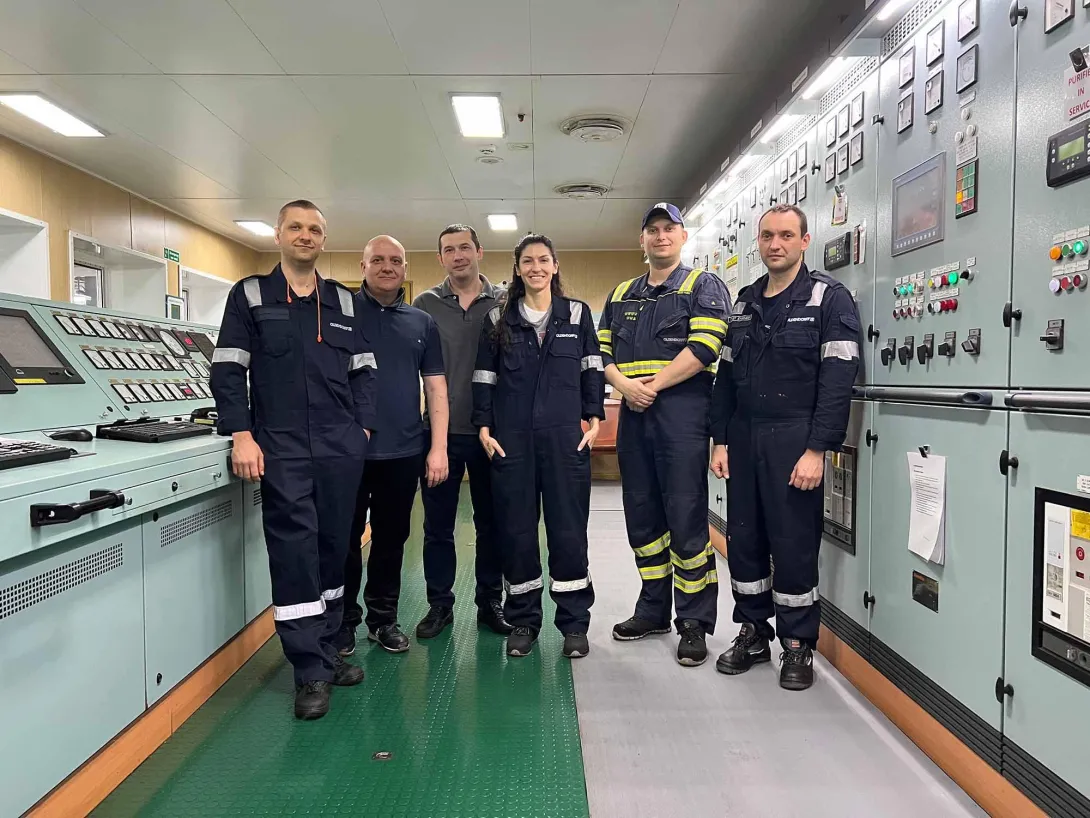
Patricia Stathatou (third from right), a researcher at the Renewable Bioproducts Institute, with the carrier vessel's crew members. (Credit: Patricia Stathatou)

Stathatou preserving water and washwater samples from the vessel's scrubber so they can be stored and analyzed later in the lab. (Credit: Patricia Stathatou)
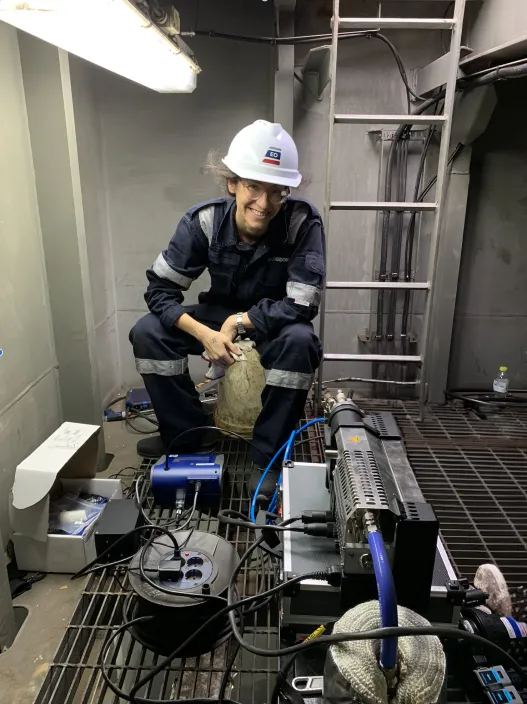
Stathatou prepares to measure particulate matter emissions in the vessel's funnel — a very windy area of the ship. (Credit: Patricia Stathatou)
When people think of greenhouse gas emissions from transportation, what often comes to mind are airplanes and land vehicles like cars or trucks. But as efforts to slow climate change are ramping up, the spotlight is on another form of transport: ships.
The U.N.’s International Maritime Organization (IMO) has set targets to reduce shipping greenhouse gas emissions by at least 40% by 2030 and 70% by 2040, aiming for net-zero by 2050. Shipping currently accounts for about 3% of global annual greenhouse gas emissions, and the pressure is on shipping companies to meet these ambitious goals.
Across Georgia Tech, researchers are working toward a sustainable future for ocean shipping. This includes Valerie Thomas, the Anderson-Interface Chair of Natural Systems Professor in the H. Milton Stewart School of Industrial and Systems Engineering, and in the School of Public Policy. She is scholar of energy systems, sustainability, assessment, and low-carbon transportation fuels, and her work touches many aspects of the maritime industry.
Finding Sustainable Solutions
“Today, we ship a lot of goods by ocean freight, and there is certainly an environmental impact with shipping,” Thomas said. “But the emissions from shipping a product from East Asia to the U.S. on a bulk carrier vessel are significantly lower than trucking a product across the U.S. When ships are filled to the brim with cargo and are moving slowly across oceans, this is energy efficient, fuel efficient, and even cost efficient per ton of ‘stuff’ transported.”
While ocean shipping is significantly more energy efficient than air or land transport and contributes far fewer emissions, Thomas says cutting down on ocean freight emissions will require a great deal more effort. One way is to find more eco-friendly fuels.
“I look at big systems, and one of those areas is investigating alternative fuels,” Thomas said. “I’m often trying to figure out how much greenhouse gas various fuels emit, what other types of emissions or matter are coming out, and how to compare different fuel options.”
Thomas is a leading expert in life-cycle assessment. It is a method used to evaluate a fuel or technology's environmental impact throughout its entire cycle — from raw materials extraction, processing, manufacturing, distribution, and ultimately, use. Right now, basically all ships use petroleum fuels, which emit carbon dioxide and particulate matter into the air.
Finding fuel alternatives is not a simple task: Just because a fuel might initially seem like a promising low-carbon option, that is not always the case in the end. Thomas’s expertise in life-cycle assessments helps her figure out whether these possible fuels are truly environmentally friendly.
“One such example is hydrogen: It doesn’t emit carbon dioxide when burned,” Thomas said. “But the manufacturing of hydrogen can emit carbon dioxide, and therefore, hydrogen is not always a low-carbon fuel on a lifecycle basis.”
Helping the Shipping Industry Cut Carbon
Patricia Stathatou, a researcher at Georgia Tech’s Renewable Bioproducts Institute, specializes in sustainability assessment of chemical engineering processes and products, which includes lifecycle assessments and techno-economic assessments, evaluating both the environmental impacts and the economic viability of products and processes. Stathatou, who will join the School of Chemical and Biomolecular Engineering as an assistant professor in January 2025, also conducts experiments to support these assessments and guide the development of new technologies.
“My contribution to the lifecycle assessment field is that I support assessments with in-field emission monitoring, taking samples, and performing chemical analyses,” Stathatou said. “This helps identify specific pollutants that might be emitted into the air or be present in water, wastewater, or solid waste streams.”
But as maritime shipping companies rise to the challenge of cutting emissions, they often do not know where to start. This is where Stathatou’s experience comes in.
During her postdoctoral research at MIT, a major shipping company reached out to Stathatou and her colleagues asking for help in cutting emissions. They wanted to increase the energy efficiency of their fleet and investigate different strategies and technologies to eventually reach the IMO’s emissions goals.
Because of Stathatou’s expertise in alternative fuels, biofuels, and sustainable energy sources, she investigated potential solutions for the company, which included a six-day research trip monitoring emissions aboard one of the company’s bulk carrier vessels in East Asia. Her work involves designing experiments, measuring emissions, and evaluating the environmental impact of different fuels onboard bulk carrier vessels.
“Ten years ago, there weren't rigorous goals or guidelines for reducing emissions in the shipping industry — and not much scientific collaboration in the process,” Stathatou said. “If we are to make a difference in the industry in regard to climate, we need partnerships with shipping companies to help guide their efforts.”
Stathatou plans to continue her collaborations with shipping companies and expects to carry out more on-ship evaluations soon.
The Big Picture
According to Thomas, a holistic approach is needed to make shipping more sustainable. "It's not just about the fuels we use; it's about optimizing supply chains, reducing empty freight, and leveraging multimodal transportation options," Thomas said. "By embracing net-zero freight initiatives and maximizing efficiency in logistics, we can achieve meaningful reductions in emissions while meeting the demands of global trade."
Encouraging shifts to ocean freight is another means of reducing emissions. For example, if a company wants to transport goods from Miami to Baltimore, they don’t need to go by road or rail. “You can ship your freight on the ocean along the coast, and that could be more environmentally efficient,” Thomas said.
The work Thomas and Stathatou do is part of a broad portfolio of shipping sustainability research at Georgia Tech, which also includes the Georgia Tech Supply Chain and Logistics Institute, the Panama Logistics and Innovation Research Center, and the Net Zero Freight Systems Program, which Thomas co-leads. These partnerships aim to enhance the efficiency and sustainability of global supply chains, leveraging innovative research and practical applications.
“The work of evaluating different fuels, technologies, and strategies is not trivial, and figuring out these new methods does not happen quickly,” Thomas said. “These are difficult technologies, and it takes a long time to put them in place. That is why we need to do this work now.”
Stathatou envisions that, with more shipping companies now looking to curb their emissions, there will be significant adoption of new fuels and technologies within the next decade.
“Ocean shipping is a transportation sector that we cannot go without, and so decarbonizing it is very important,” Stathatou said. “I believe the ability to perform these assessments and guide the development of future solutions will have a tremendous impact on humanity.”
May. 23, 2024

Yongsheng Chen, Bonnie W. and Charles W. Moorman IV Professor in Georgia Tech's School of Civil and Environmental Engineering, has been awarded a $300,000 National Science Foundation (NSF) grant to spearhead efforts to enhance sustainable agriculture practices using innovative AI solutions.
The collaborative project, named EAGER: AI4OPT-AG: Advancing Quad Collaboration via Digital Agriculture and Optimization, is a joint effort initiated by Georgia Tech in partnership with esteemed institutions in Japan, Australia, and India. The project aims to drive advancements in digital agriculture and optimization, ultimately supporting food security for future generations.
Chen, who also leads the Urban Sustainability and Resilience Thrust for the NSF Artificial Intelligence Research Institute for Advances in Optimization (AI4OPT), is excited about this new opportunity. "I am thrilled to lead this initiative, which marks a significant step forward in harnessing artificial intelligence (AI) to address pressing issues in sustainable agriculture," he said.
Highlighting the importance of AI in revolutionizing agriculture, Chen explained, "AI enables swift, accurate, and non-destructive assessments of plant productivity, optimizes nutritional content, and enhances fertilizer usage efficiency. These advancements are crucial for mitigating agriculture-related greenhouse gas emissions and solving climate change challenges."
To read the full agreement, click here.
News Contact
Breon Martin
AI Research Communications Manager
Georgia Tech
May. 16, 2024
Georgia Tech has earned a STARS Gold Rating in recognition of its sustainability achievements from the Association for the Advancement of Sustainability in Higher Education (AASHE). STARS, the Sustainability Tracking, Assessment & Rating System, measures and encourages sustainability in all aspects of higher education.
With more than 1,200 participating institutions in 52 countries, AASHE’s STARS program is the most widely recognized framework in the world for publicly reporting comprehensive information related to a college or university’s sustainability performance. Participants report achievements in five areas:
- Academics and research
- Engagement
- Operations
- Planning and administration
- Innovation and leadership
“STARS was developed by the campus sustainability community to provide high standards for recognizing campus sustainability efforts,” said AASHE Executive Director Meghan Fay Zahniser. “Georgia Tech has demonstrated a substantial commitment to sustainability by achieving a STARS Gold Rating.”
The STARS program is open to all institutions of higher education and allows for both internal comparisons as well as comparisons with similar institutions. "STARS is the cornerstone of sustainability reporting for colleges in the U.S. It is our most comprehensive process for collecting data and tracking our sustainability progress at Georgia Tech," said Jennifer Chirico, associate vice president of The Office of Sustainability at Georgia Tech.
The Office of Sustainability led the charge, reaching out to more than 200 individuals and dozens of offices collecting data for STARS. The information provides a deep understanding of how diverse campus areas work together to support sustainability. STARS data directly informed Georgia Tech’s recently published Climate Action Plan, whose goals advance Tech’s commitment to advancing the UN Sustainable Development Goals (SDGs).
“Achieving this rating is evidence of our commitment to sustainability and responsible stewardship,” said Shantay Bolton, executive vice president for Administration and Finance. “It reflects the collaborative efforts of our entire campus community — students, faculty, and staff — as we work together to create a more innovative, environmentally conscious, and socially responsible institution. Let this be an inspiration as we continue advancing sustainable practices and making a positive impact on our campus, in Atlanta, the state of Georgia, and the world.”
Emma Blandford serves as portfolio manager for Sustainability Next and project manager for the STARS report. She says, “This team is incredibly passionate, and they are all experts in their fields. This report truly showcases that amazing work, but the progress does not end there. As proud as we are of earning a Gold Rating, Georgia Tech will continue to improve our commitment to sustainability going forward.”
It is important to note that this report showcases data only from Summer 2021 through Summer 2023. Since the fall, Georgia Tech has:
- Launched Sustainability Next, a 10-year strategic plan to advance sustainability across research, education, operations, and commercialization.
- Launched the Georgia Tech Climate Action Plan, an actionable road map for halving Institute emissions by 2030 and reaching net-zero emissions by 2050. Led by the Office of Sustainability, it includes 30 climate-focused strategies.
- Distributed over $400,000 in seed grants for sustainability-related research in partnership with the Brook Byers Institute for Sustainable Systems, the Strategic Energy Institute, and the Renewable Biproducts Institute.
- Awarded over $150,000 in seed grants significantly expanding the reach of Georgia Tech’s sustainability-across-the-curriculum initiatives and launched a Community of Practice through the Center for Teaching and Learning in partnership with the Undergraduate Sustainability Education Committee.
The Gold Rating represents an improvement from Georgia Tech's 2021 submission, which received a Silver designation. From highest to lowest, STARS ratings include Platinum, Gold, Silver, Bronze, and Reporter. Blandford adds, “We have landed Gold status, but the path to Platinum is visible. We are excited to see how far we can go.”
Georgia Tech’s STARS report is publicly available on the STARS website.
News Contact
Emma Blandford
Program and Portfolio Manager
Sustainability Next
May. 14, 2024

When he was in college, Hong Yeo's father died in his sleep from a heart attack, and Yeo changed his academic and research efforts as a result. Now, he and his research collaborators have developed a device that monitors vital signs during sleep, and it's the type of thing that may have helped doctors intervene in his father's illness if it had been available. This Sleep Scan device is a type of mask you can easily take on and off, and it has now been tested with human subjects and is close to being available commercially.
Hong Yeo’s father, Yonghyun Yeo, with his mother in Korea.
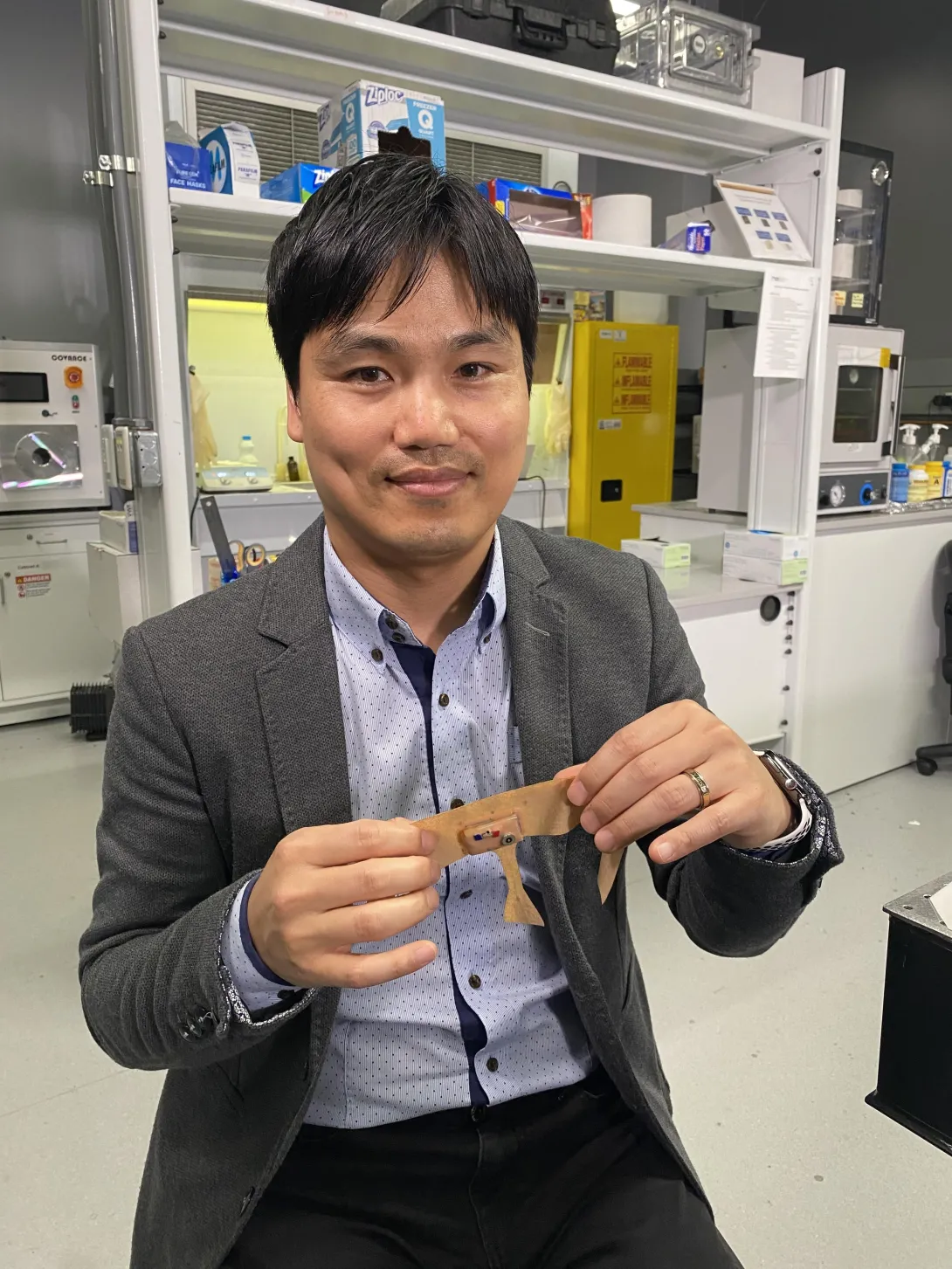
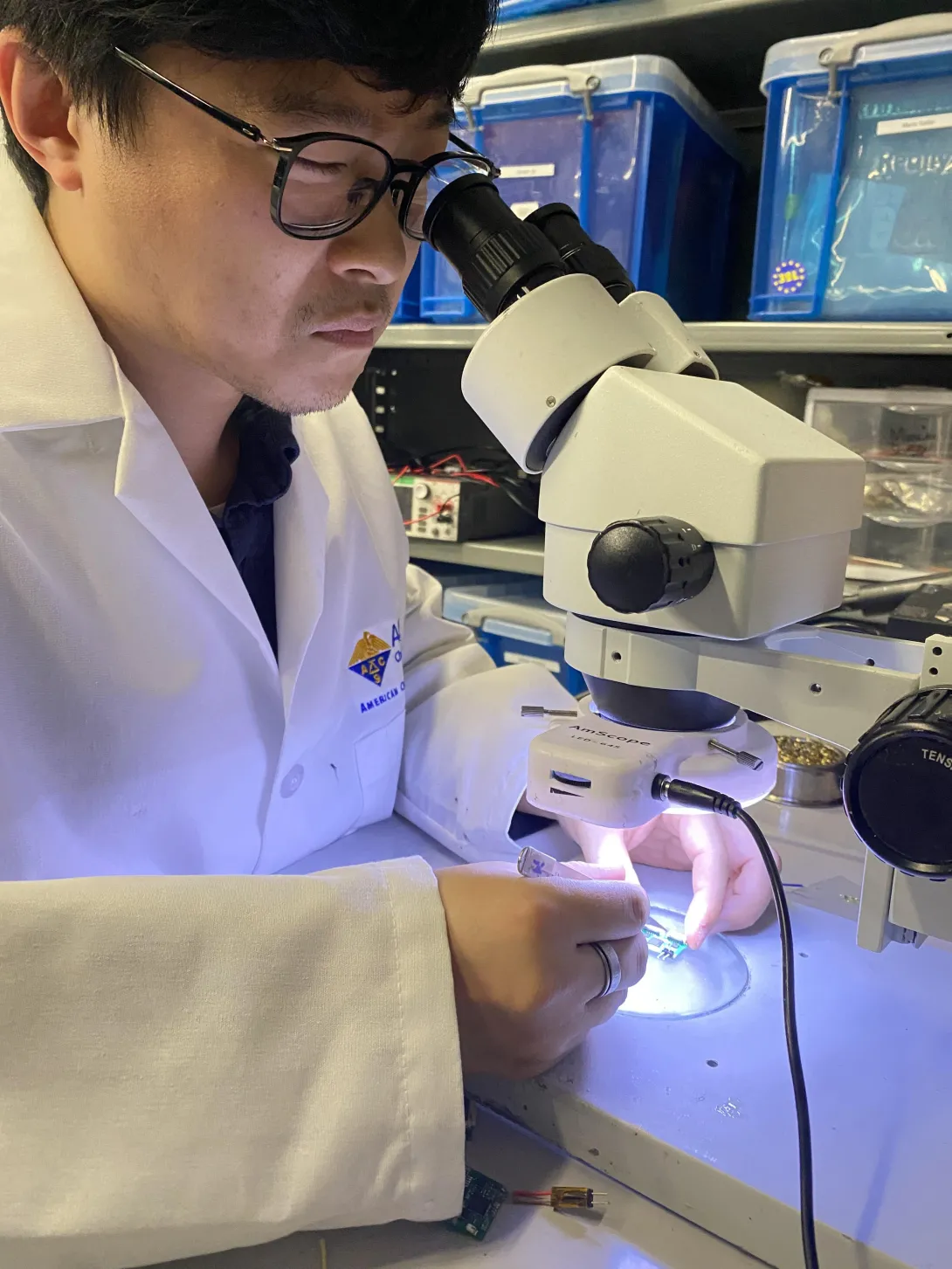
Taewoog Kang, a post-doctoral student in mechanical engineering, works to repair a tiny circuit in Hong Yeo’s lab on Georgia Tech’s campus.
The call from his mom is still vivid 20 years later. Moments this big and this devastating can define lives, and for Hong Yeo, today a Georgia Tech mechanical engineer, this call certainly did. Yeo was a 21-year-old in college studying car design when his mom called to tell him his father had died in his sleep. A heart attack claimed the life of the 49-year-old high school English teacher who had no history of heart trouble and no signs of his growing health threat. For the family, it was a crushing blow that altered each of their paths.
“It was an uncertain time for all of us,” said Yeo. “This loss changed my focus.”
For Yeo, thoughts and dreams of designing cars for Hyundai in Korea turned instead toward medicine. The shock of his father going from no signs of illness to gone forever developed into a quest for medical answers that might keep other families from experiencing the pain and loss his family did — or at least making it less likely to happen.
Yeo’s own research and schooling in college pointed out a big problem when it comes to issues with sleep and how our bodies’ systems perform — data. He became determined to invent a way to give medical doctors better information that would allow them to spot a problem like his father’s before it became life-threatening.
His answer: a type of wearable sleep data system. Now very close to being commercially available, Yeo’s device comes after years of working on the materials and electronics for an easy-to-wear, comfortable mask that can gather data about sleep over multiple days or even weeks, allowing doctors to catch sporadic heart problems or other issues. Different from some of the bulky devices with straps and cords currently available for at-home heart monitoring, it offers the bonuses of ease of use and comfort, ensuring little to no alteration to users’ bedtime routine or wear. This means researchers can collect data from sleep patterns that are as close to normal sleep as possible.
“Most of the time now, gathering sleep data means the patient must come to a lab or hospital for sleep monitoring. Of course, it’s less comfortable than home, and the devices patients must wear make it even less so. Also, the process is expensive, so it’s rare to get multiple nights of data,” says Audrey Duarte, University of Texas human memory researcher.
Duarte has been working with Yeo on this system for more than 10 years. She says there are so many mental and physical health outcomes tied to sleep that good, long-term data has the potential to have tremendous impact.
“The results we’ve seen are incredibly encouraging, related to many things —from heart issues to areas I study more closely like memory and Alzheimer’s,” said Duarte.
Yeo’s device may not have caught the arrhythmia that caused his father’s heart attack, but nights or weeks of data would have made effective medical intervention much more likely.
Inspired by his own family’s loss, Yeo’s life’s work has become a tool of hope for others.
Apr. 04, 2024

Continued growth will transform metro Atlanta, and the Atlanta Regional Commission (ARC) projects 1.8 million new residents across the 21-county region by 2050.
The increase would bring the regional population to 7.9 million, but to accommodate that growth, Georgia Tech experts say improvements in the housing, transportation, and labor markets must be made.
Housing
The five-county core around Atlanta — Fulton, Gwinnett, Cobb, DeKalb, and Clayton — will account for nearly half of the new residents and continues to grow. Gregory Randolph, an assistant professor in Georgia Tech’s School of City and Regional Planning, says the region must start by reexamining its approach to urbanism as new census data shows Atlanta has become the sixth most-populated metro area in the country.
"For the second half of the 20th century, little of the population growth in metro Atlanta was happening in the City of Atlanta, but that has changed over the past two decades. With the urban core growing, we have an opportunity. to pursue a different kind of urban form that is higher density and more walkable. A lot of the recent growth in Atlanta is adding density without necessarily improving the quality of urbanism.”
He explains that, especially in downtown Atlanta, retrofitting existing properties will play a key role in transforming neighborhoods through the replacement of "lower-value infrastructure," such as surface parking lots, with higher-density housing. In a post-pandemic environment, the conversion of office space to mixed-use properties is emerging as a strategy in urban areas like Atlanta.
A 2023 report identified the need for 391,878 housing units within the five-county core at the current population level. Mike Dobbins, professor of the practice in the School of City and Regional Planning, credits efforts made by the mayor's office and nonprofit organizations such as the Urban Land Institute to increase availability.
"We're living in a situation where housing values are too high because big money investors are bidding up real estate prices throughout the region. Even nationally, it's double the rate of wage increases. The biggest question is how can we bring down housing costs,” he said.
Randolph and Dobbins agree that addressing Atlanta’s housing needs is more complicated than simply adding supply.
“Our priority must be building housing that is affordable to low- and middle-income households, and in a way that promotes mixed-income, walkable neighborhoods with equitable, car-free access to amenities like parks, schools, and community-serving retail,” Randolph said.
Labor
Along with population growth, the region will add an estimated 856,000 jobs, with significant gains in healthcare, technology, and waste management. To maintain a labor force that can fill the jobs of the future, Dobbins stresses that continued investment in K-12 education, especially in traditionally underserved communities, is vital to accommodate new growth and overcome existing challenges of inequity.
Atlanta has the highest income inequality in the nation. According to the Atlanta Wealth Building Initiative, the average white family’s median income is $83,722 compared to $28,105 for Black families and $43,110 for Latino families. That gap widens when examining wealth, which for white households is 46 times higher than that of Black households in Atlanta.
The ARC study notes that "virtually all the net growth will come from racial and ethnic minority groups.” Randolph points to policy as a necessary tool in improving workforce development for current and future residents to support equitable and inclusive growth across the region. He adds that institutions like Georgia Tech can play a role in expanding access to the advanced degrees often needed to fill the jobs created by the city’s emerging status as a technology hub, with an emphasis on ensuring access to these degrees among historically disadvantaged groups in the city.
Transportation
The other 900,000 projected new residents will reside among the remaining 16 counties in the Atlanta region. The ARC predicts the most rapid growth in Forsyth, Barrow, Paulding, Cherokee, Walton, and Coweta, and the need for affordable housing will extend to the surrounding counties, as will the need to travel throughout the region.
Ryan Gravel, the Georgia Tech alumnus and mind behind the Atlanta BeltLine, says transit improvements are needed to ensure each county is connected to Atlanta’s city center.
“We haven't made a substantial new transit investment since 2000,” he said. “Meanwhile, the region has grown substantially since then. We haven't been laying the foundation for that future growth, which means it will come in ways that we don't want: more traffic, more congestion, and more inequities in communities of color.”
Gravel, founder of the consulting firm Sixpitch, rejects adding lanes to existing highways, saying that strategic improvements to MARTA — the rail system constructed in 1979 — will reduce traffic while allowing residents to live outside of the five-county core.
“As the saying goes, the best time to plant a tree is 20 years ago,” he said. “The second-best time is now. We didn’t do it 20 years ago, but we could start now.”
In his 2024 State of the City address, Dickens announced plans to construct a new MARTA rail station on the Southside at the Murphy Crossing redevelopment project site, connecting the system to Beltline for the first time. The mayor revealed preliminary plans to add three infill MARTA stations throughout the city, however, specific locations were not announced.
Plans to add a portion of the light-rail system around the BetlLine are currently under review, with construction on the Streetcar East expansion project — extending Atlanta Streetcar service from downtown Atlanta to Ponce de Leon Avenue — projected to begin construction in 2025 and begin service in 2029. In 2025, the MARTA Rapid Summerhill project will begin service from downtown to Capitol Gateway, Summerhill, Peoplestown, and the BeltLine through dedicated bus lanes with transit signal priority to bypass traffic.
A “Beloved Community”
The Atlanta region’s transformation will not happen overnight, but anchor institutions like Georgia Tech can contribute along the way. Randolph sees current plans to revitalize portions of the city’s Westside as an example of how neighborhoods can be revitalized for current residents while simultaneously building with future growth in mind.
“It’s important that we continue to play a positive role in not just physically developing the Westside but also thinking about how we can strengthen the economy of Westside neighborhoods through our own procurement and purchasing practices. It's an example of how Georgia Tech, as an engine of economic development, can play a positive role in propelling that growth while ensuring that the growth is inclusive.” Randolph said.
The solutions to the ARC’s projected growth will not be cheap or easily attained, but as Gravel points out, it’s an opportunity for Atlanta to honor its past as it marches toward its future, aspiring to Martin Luther King Jr.’s idea of the beloved community.
“The prosperity of the metropolitan region stands on the shoulders of the Civil Rights Movement,” he said. “If that's who we are when we're at our best, then we should use that as a model for how we move forward. How we accommodate that future change should be based on decisions to ensure that this place is a place for everyone.”
News Contact
Steven Gagliano - Institute Communications
Mar. 18, 2024
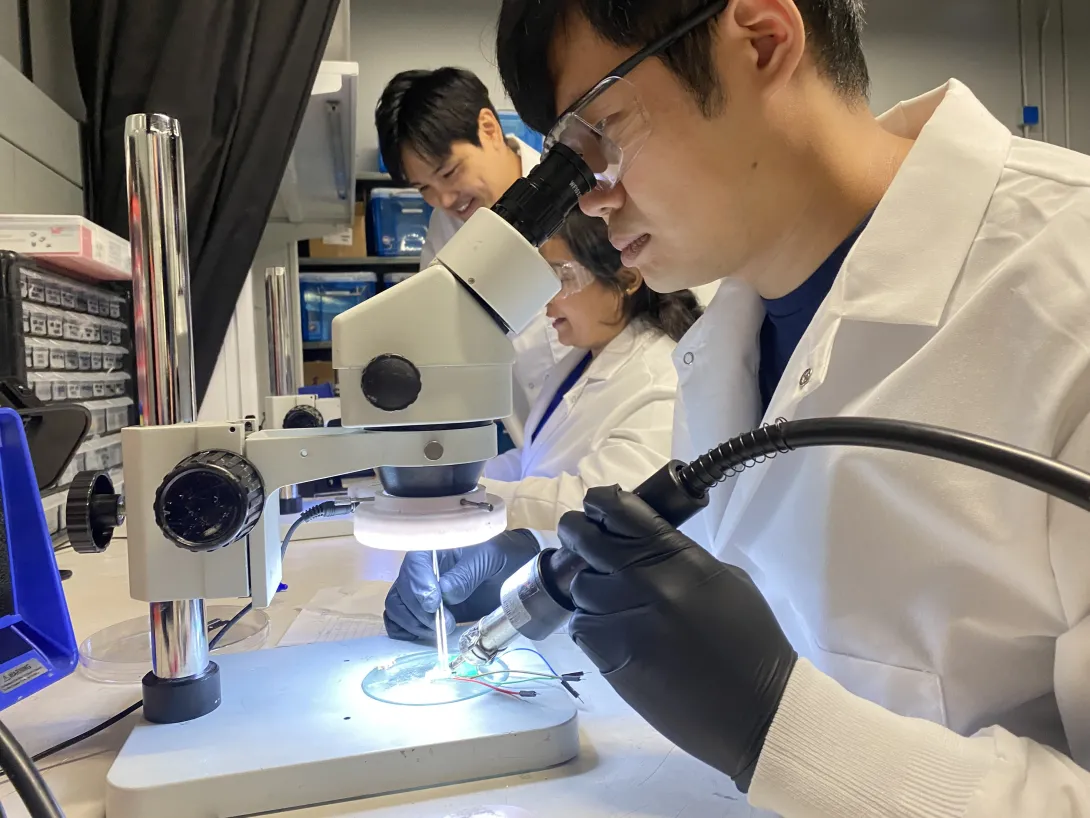
Emory University and Georgia Institute of Technology researchers are using a $2.46 million grant to test and continue developing a wearable BioPatch for farmworkers and others who work outside, funded by the National Institute of Environmental Health Sciences. This BioPatch will use multiple sensors to predict heat-related illnesses, dehydration, and acute kidney injury. By transmitting data to a smart phone or other device, artificial intelligence tools will provide real-time warnings to workers with the goal of reducing health risks associated with occupational heat exposure.
Researchers with Georgia Tech and Emory University are field testing a new device that could help protect people who work outside from heat related injury. It’s a skin patch you can wear while working that sends detailed information to a smartphone or other device about important health markers like skin hydration and body temperature. The device takes different measurements than health wearables on the market currently and will be paired with an artificial intelligence program to predict health hazards. The team is calling the device BioPatch, and it’s being put to the test with landscaping crews. Researchers hope use of the device can guide better decisions about working in the heat.
The project involves collaboration between principal investigators Vicki Hertzberg from Emory University, W. Hong Yeo from Georgia Tech, and Li Xiong from Emory University. Their expertise spans statistics, mechanical and biomedical engineering, and computer science, respectively. Roxana Chicas of the Emory School of Nursing and Jeff Sands of the Emory School of Medicine, along with members of the Farmworker Association of Florida, are also part of the team. This video shows the device and data collection during a key component of testing during the summer.
Mar. 12, 2024

Cicadas are the soundtrack of summer, but their pee is more special than their music. Rather than sprinkling droplets, they emit jets of urine from their small frames. For years, Georgia Tech researchers have wanted to understand the cicada’s unique urination.
Cicadas are the soundtrack of summer, but their pee is more special than their music. Rather than sprinkling droplets, they emit jets of urine from their small frames. For years, Georgia Tech researchers have wanted to understand the cicada’s unique urination.
Saad Bhamla, an assistant professor in the School of Chemical and Biochemical Engineering, and his research group hoped for an opportunity to study a cicada’s fluid excretion. However, while cicadas are easily heard, they hide in trees, making them hard to observe. As such, seeing a cicada pee is an event. Bhamla’s team had only watched the process on YouTube.
Then, while doing fieldwork in Peru, the team got lucky: They saw numerous cicadas in a tree, peeing.
Read more about what they discovered at Georgia Tech Research News.
News Contact
Tess Malone, Senior Research Writer/Editor
tess.malone@gatech.edu
Feb. 12, 2024
The University of Waterloo and the Board of Regents of the University System of Georgia, representing Georgia Institute of Technology (Georgia Tech), have officially entered a Memorandum of Understanding (MOU) to strengthen academic and research ties between the two institutions. The MOU signifies a commitment to fostering collaborative initiatives in research, education, and other areas of mutual interest. Both universities, recognized for their global impact and innovation, are eager to embark on this journey of cooperation.
Charmaine Dean, Vice-President of Research & International, shared, “The University of Waterloo is pleased to embark on a new collaboration with Georgia Tech, featuring faculty and student exchanges, joint research projects, dual degrees, and conferences. Strengthening ties between our institutions through this collaboration creates a dynamic environment for our faculty and students to foster innovation in many areas of mutual excellence.”
“Georgia Tech is excited to see its NSF AI Institute for Advances in Optimization (AI4OPT), under the leadership of Prof. Pascal Van Hentenryck, partner with experts from the Waterloo Artificial Intelligence Institute of the University of Waterloo. I am really looking forward to the impact that this partnership will have in advancing the fundamental knowledge of AI, in further expanding its applications, and in enabling its wider adoption,” noted Prof. Bernard Kippelen, Vice Provost for International Initiatives at Georgia Tech.
This collaboration is poised to elevate the academic and research landscape of both institutions, promoting global engagement and creating opportunities for students and faculty to thrive in an interconnected world.
News Contact
Breon Martin
Feb. 07, 2024
U.S. News & World Report has ranked the Georgia Institute of Technology as the top public university and No. 3 nationally in energy and fuels research. This is the first year the category has been included in the annual rankings, and Georgia Tech’s dominance reflects the dynamic research and expertise of the Institute.
“I’m thrilled to see Georgia Tech recognized for our leading-edge approach to creating sustainable energy solutions,” said Executive Vice President for Research Chaouki Abdallah. “This achievement reflects the unwavering commitment of our faculty and researchers to conducting groundbreaking research, transformative innovation, and our dedication and focus through our Strategic Energy Institute (SEI) to addressing the world's most pressing energy challenges.”
SEI integrates energy research across Georgia Tech and is one of 10 Interdisciplinary Research Institutes. Headed by Executive Director Tim Lieuwen, Regents’ Professor and David S. Lewis Jr. Chair, SEI helps connect and integrate the large Georgia Tech energy community for engagement with industry, government, communities, and nonprofits.
“Georgia Tech has over 1,000 researchers working on the clean energy transition across every school, college, and unit,” said Lieuwen. “I’m pleased to see the scale of our impact recognized by this ranking but also energized by the real-world impact that we are having on cleaner air, lower cost energy, and a healthier planet.”
U.S. News & World Report ranks 47 subject areas by tabulating academic research performance such as publications and citations, and indicators for regional and global reputation. Georgia Tech was evaluated out of 319 universities, and continues its strong standing in the rankings, claiming the No. 33 spot overall in the nation and No. 10 among public schools.
News Contact
Tess Malone, Senior Research Writer/Editor
tess.malone@gatech.edu
Jan. 11, 2024

In 1950, Alan Turing asked, “Can machines think?” More than 70 years later, advancements in artificial intelligence are creating exciting possibilities and questions about its potential pitfalls.
A recent executive order issued by President Joe Biden seeks to establish "new standards for AI safety and security" while addressing consumer privacy concerns and promoting innovation. Georgia Tech experts have examined the key elements of the order and offer their thoughts on its scope and what comes next.
A Precautionary Tale
The order calls for the development of standards, tools, and tests to ensure the safe use of AI. From voice scams and phishing campaigns to larger-scale threats, the technology’s potential dangers have been widely documented. But Margaret Kosal, associate professor in the Ivan Allen College of Liberal Arts, says that additional context is often needed to dispel hysteria.
"No one is going to be hooking up AI to launch nuclear weapons, but AI capabilities may enable targeting, or enable the command and control and the decision-making time to be compressed,” she said.
The order will create an AI Safety and Security Board tasked with addressing critical threats. Companies developing foundation models that "pose a serious risk to national security, national economic security, or national public health and safety” will be required to notify the federal government when training the model and required to share the results of all red-team safety tests — a simulated cyberattack to test a system's defenses.
Since the launch of ChatGPT in 2022, a CNBC report details a 1,267% rise in phishing emails. Srijan Kumar, assistant professor in the College of Computing, attributes the increase to the technology's availability and an inability to rein in "bad actors."
He says these scams will only continue to get more sophisticated and personalized. They “can be created by knowing what you might be willing to fall prey to versus what I might fall prey to,” said Kumar, whose systems have influenced misinformation detection on sites like X (formerly Twitter) and Wikipedia. “AI is not going to autonomously do all of those bad things, but this order can ensure there are consequences for people who misuse it.”
A Delicate Balance
Building an AI platform requires large amounts of data regardless of its intended application. Two primary goals of the executive order are protecting privacy and advancing equity.
To protect personal data, the order tasks Congress with evaluating how agencies collect and use commercially available information and address algorithmic discrimination.
Acknowledging that everyone should be allowed to have their voice represented in the outputs of AI data sets, Deven Desai, associate professor in the Scheller College of Business, noted, "There are people who don't want to be part of data sets, which is their right, but this means their voices won't be reflected in the outputs.”
The order also includes sections to address intellectual property concerns among inventors and creators, though legal challenges will likely set new precedents in the years ahead.
When that time comes, Kosal says that defining “theft” in the context of AI becomes the true challenge and that, ultimately, money will play a significant role. "If you spit out a Harry Potter book and read it yourself, nobody will care. It's when you start selling it to make money, and you don't share proceeds with the original people, then it becomes an issue," she said.
What Does AI-Generated Mean?
The order instructs the Department of Commerce to develop guidelines for content authentication and watermarking to label AI-generated content. Desai questions what it means for something to be truly created by AI.
An important distinction lies between using AI to assist a writer in organizing their thoughts and using the technology to generate content. He likens the trend to the music industry in the 1980s.
"Synthesizers really changed people's ability to generate music and, for a while, people thought that was horrible. They can just program the music. They're not. I am still the human responsible for that music, or that article in this case, so what is the point of the label?" he asks.
As AI assistance becomes commonplace in content creation, trusting the source of information is increasingly important. Recently, articles published on Sports Illustrated's website featured AI-generated content provided by a third-party company that had used a machine to write the content and create fake bylines. Sports Illustrated, which may not have known of the problem, ran the material without disclosure to readers. CEO Ross Levinsohn was ousted shortly after the story broke.
“Perhaps if the third party had disclosed its use of AI software, SI would have been able to assess how much AI was used and then chosen not to run the material, or to run it with a disclaimer that AI helped write the material,” Desai said. "Of course, even if they label the content as AI-generated, a reader still won't know exactly how much of the content came from AI or a human.”
AI and the Workforce
As AI systems and models become more sophisticated, workers may become more concerned about being replaced. To counteract these concerns, the order calls for a study to examine AI’s potential impact on labor markets and investments in workforce training efforts.
Kumar compares the rise of AI to similar technological innovations throughout history and sees it as an opportunity for workers and industries to adapt. "It's less a matter of AI replacing workers and more of reskilling people to use the new technology. It's no different from when assembly lines in the auto industry were created."
Promoting Innovation and Competition
The power to harness the full potential of AI has initiated a race to the top. Desai believes that part of the executive order providing resources to smaller developers can help level the playing field.
"There is a possibility here for markets to open up. Current players using models that weren't built with transparency in mind might struggle, but maybe that's OK."
The issue of reliability and transparency comes into focus for Desai, especially as it relates to government usage of AI. The order calls on agencies to "acquire specified AI products and services faster, more cheaply, and more effectively through more rapid and efficient contracting."
When taxpayer dollars are at stake, government can’t afford to trust a technology it doesn’t fully understand — a topic Desai has explored elsewhere. "You can’t just say, ‘We don’t know how it works, but we trust it.’ That’s not going to work. So that’s where there may be a slowdown in the government’s ability to use private sector software if they can’t explain how the thing works and to show that it doesn’t have discriminatory issues.”
What's Next
Promoting and policing the safe use of AI cannot be done independently. Georgia Tech experts agree that participation on a global scale is necessary. To that end, the European Union will unveil its comprehensive EU AI Act, which includes a similar framework to the president's executive order.
Due to the evolving nature of AI, the executive order or the EU's actions will not be all-encompassing. Law often lags behind technology, but Kosal points out that it's crucial to think beyond what currently exists when crafting policy.
Experts also agree that AI cannot be regulated or governed through a single document and that this order is likely the first in a series of policymaking moves. Kosal sees tremendous opportunity with the innovation surrounding AI but hopes the growing fear of its rise does not usher in another AI winter, in which interest and research funding fade.
News Contact
Steven Gagliano - Institute Communications