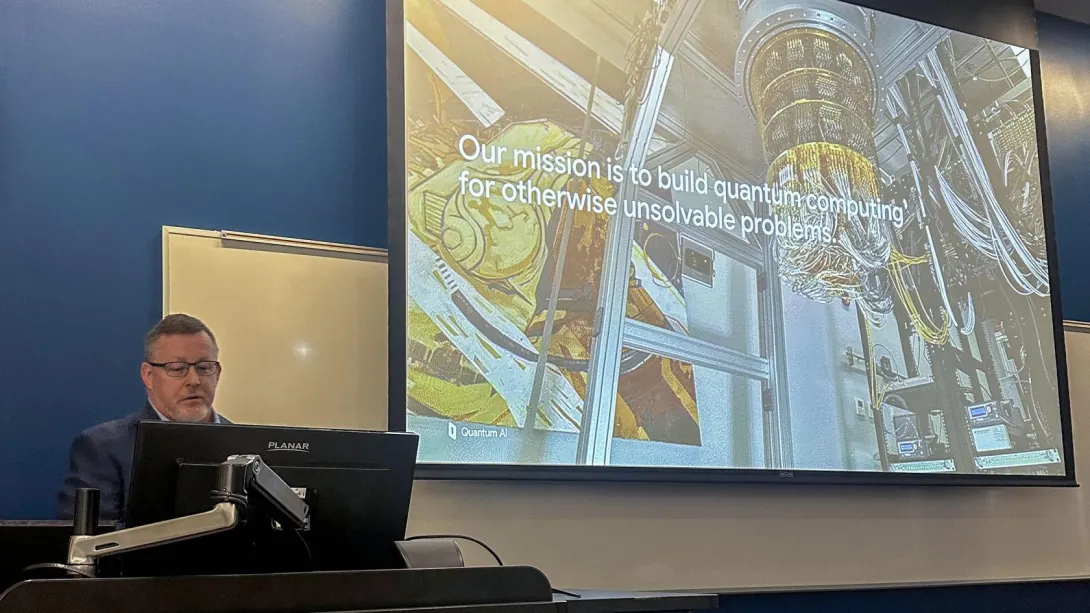
Michael Hamilton presents his talk "Quantum Computing at Google Quantum AI."
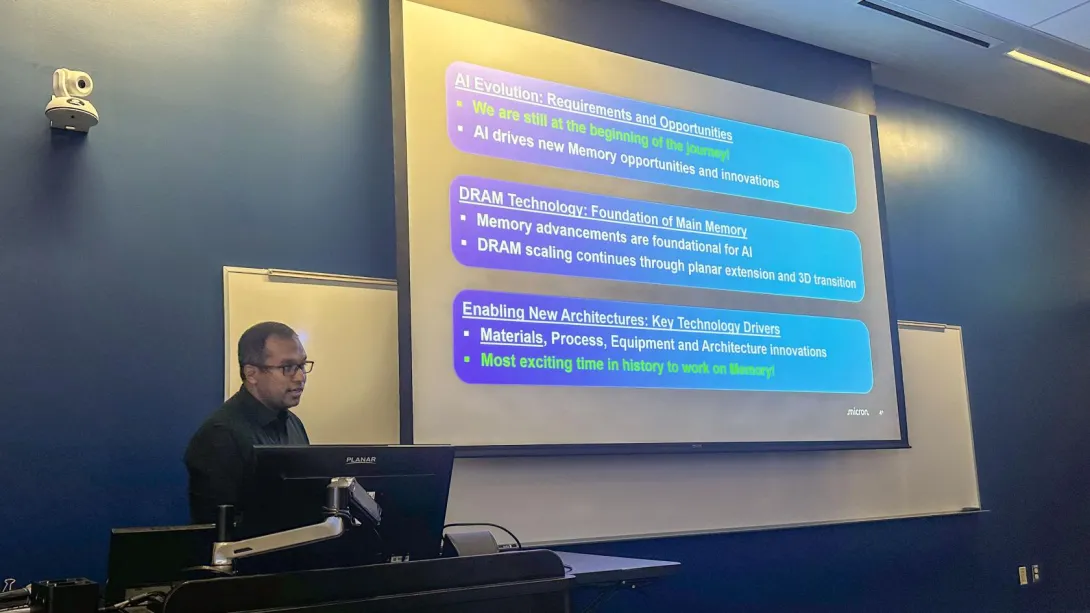
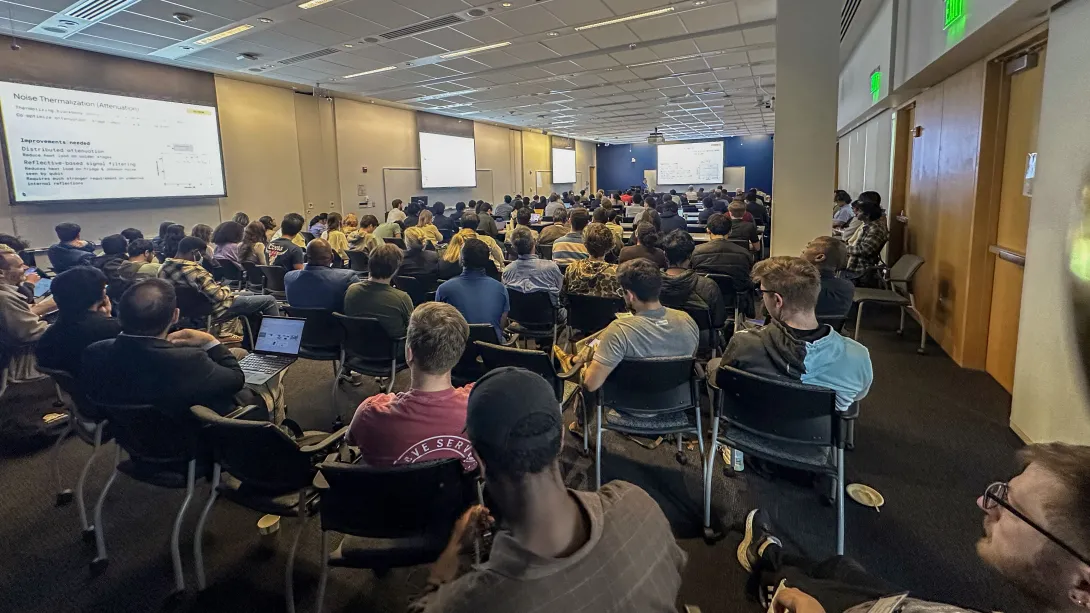
Adarsh Rajagopal presents his talk "The Future of Memory: Scaling DRAM and Enabling New Memory Architectures."
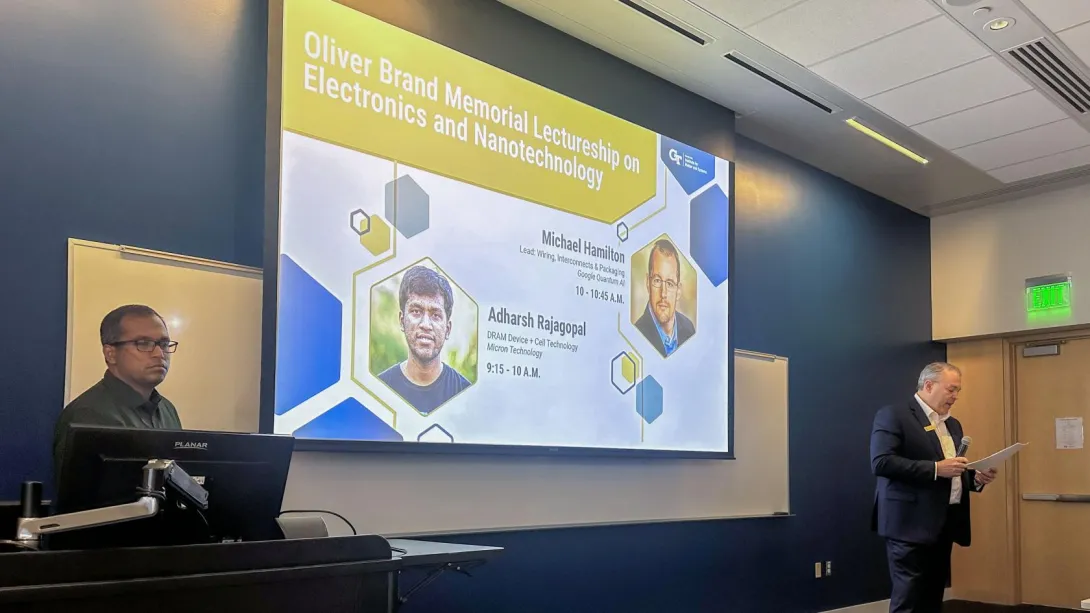
The Institute for Matter and Systems (IMS) at Georgia Tech hosted the fourth annual Oliver Brand Memorial Lectureship on Electronics and Nanotechnology, continuing a tradition of honoring Brand’s legacy by inviting experts to campus to explore electronics and nanotechnology research.
This year’s lecture, the first featuring two speakers, was presented by Adharsh Rajagopal of Micron Technology, and Michael Hamilton of Auburn University and Google Quantum AI. Their talks explored two rapidly evolving areas of computing: next-generation memory technologies and the engineering challenges of scaling quantum computers.
Established in Brand’s memory, the annual lectureship recognizes his lasting impact on Georgia Tech as a researcher, educator, mentor, and leader. During more than two decades at Georgia Tech, Brand helped strengthen connections across disciplines and advance the Institute’s research community in electronics and nanotechnology.
“Oliver Brand had a remarkable ability to bring people together, build bridges across disciplines, institutions, and perspectives,” said Eric Vogel, executive director of IMS. “He helped shape not only Georgia Tech’s research enterprise, but also the culture of collaboration that continues to define it today.”
Brand’s interdisciplinary spirit was reflected throughout both presentations.
Rajagopal focused on one of the challenges of rapid artificial intelligence growth: How can memory technology keep pace with computing systems?
“As AI increases the amount of compute, memory innovations need to take advantage of the increase in compute,” said Rajagopal.
Meeting computing demands requires more than simple hardware changes. Rajagopal discussed innovations in materials, devices, wafer bonding, advanced metrology, and three-dimensional dynamic random-access memory (DRAM) architectures. DRAM is a type of random-access memory that can provide higher density storage at a lower cost. As traditional scaling approaches become more difficult, moving into three dimensions could provide a pathway for increasing memory density, but it would require advances across the entire stack.
“Improvement and breakthrough in memory needs to be a co-optimization of material, device, process, equipment and architecture across the scale,” said Rajagopal. “This is what makes it very challenging, but it also makes working in memory one of the most exciting things at this point in time.”
Hamilton brought a similar interdisciplinary perspective to a different challenge: scaling quantum systems.
Quantum computers have the potential to address complex problems that are difficult to solve using classical computing systems, including questions in materials and chemistry. Turning that potential into large-scale systems, however, involves challenges that extend beyond quantum physics. Future computers could require millions of qubits, the basic units of information in quantum computing, operating at extremely low temperatures. Scaling these systems creates challenges involving electrical engineering, materials science, nanofabrication, packaging, interconnects, thermal management, and testing.
For Hamilton, one of the most important challenges is also the most familiar one: wiring.
“This whole thing is just wires, which is cool if you like wires,” said Hamilton while showing an image of Google’s quantum computing system. “But it doesn’t scale.”
Solving the scalability problem requires researchers to look beyond individual components and consider the entire system, an approach that creates opportunities for experts across numerous disciplines to contribute to the future of quantum computing.
“Some people probably look at this and say, ‘Wow, there’s no way I’ll be able to do that,’” said Hamilton. “I look at it as a challenge.”
Although the two lectures examined different technologies, they arrived at a similar conclusion. Whether the goal is building memory capable of supporting increasingly powerful AI systems or developing quantum computers that can operate at meaningful scale, innovation depends on expertise that crosses materials, devices, fabrication, packaging, and systems.
Brand, who passed away in 2023, left a legacy that lives on through interdisciplinary research at Georgia Tech. For more than 20 years, he served on the Institute’s faculty and led the Institute for Electronics and Nanotechnology, which later evolved into the Institute for Matter and Systems, for nine years. He was a professor in the School of Electrical and Computer Engineering, director of the Coordinating Office for the National Science Foundation-funded National Nanotechnology Coordinated Infrastructure (NNCI), and director of the Southeastern Nanotechnology Infrastructure Corridor, one of the 16 NNCI sites.
Brand united researchers in electronics and nanotechnology, fostering collaboration and expanding the Institute for Electronics and Nanotechnology to include more than 200 faculty members. In addition to his respected work in microelectromechanical systems, he is remembered for his kindness, dedication, and unwavering support for all who knew him.
News Contact
Amelia Neumeister | Communications Manager
The Institute for Matter and Systems