From left, Brett Klosterhoff (cofounder and chief business officer), Brennan Torstrick (cofounder and chief scientific officer), and Chris Lee (cofounder and CEO) of Huxley Medical. All three men are graduates of Georgia Tech and worked as trainees in the Parker H. Petit Institute for Bioengineering and Bioscience.
With a Ph.D. in biomedical engineering and as a former trainee in the Parker H. Petit Institute for Bioengineering and Bioscience (IBB), it’s no surprise that Georgia Tech alumnus and serial entrepreneur Chris Lee loves numbers. One in four. Eighty percent. Five times.
But for him, these numbers are more than just data — they’re people. One in four adults have sleep apnea. Up to eighty percent go undiagnosed. And those who are untreated are five times more likely to die of heart disease. Lee’s latest company, Huxley Medical, aims to change those numbers with one simple patch.
“When you look at sleep apnea, it's probably the highest diagnostic opportunity there is in healthcare that can lead to the most impactful outcome in terms of reducing heart disease,” Lee said.
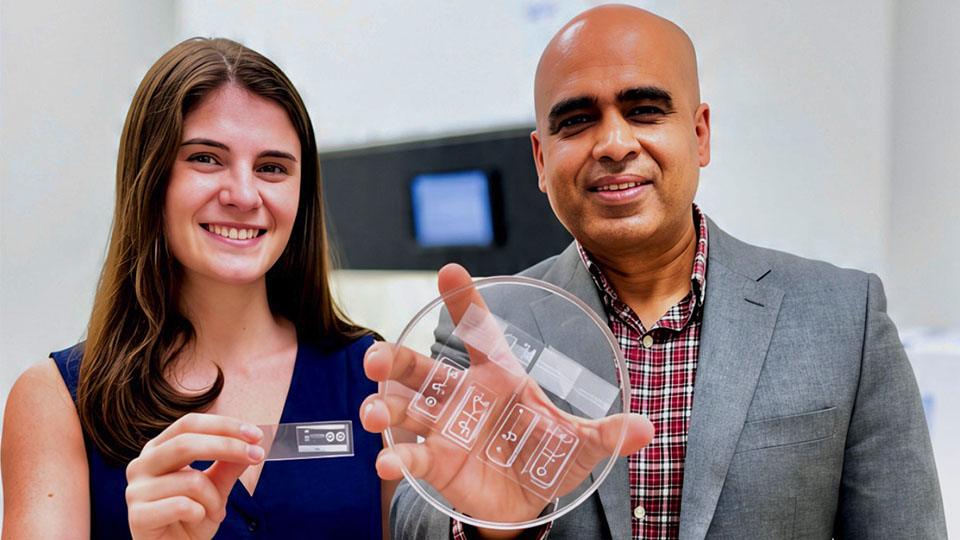
The company’s point-of-care device, called SANSA, measures nine physiological channels, enabling it to help doctors diagnose sleep apnea and related cardiovascular disease simultaneously. The device can be shipped directly to the patient’s home, adheres to the chest like a Band-aid, and uploads data to a cloud-based system automatically.
“We’re able to detect diseases faster in a very consumer-friendly manner,” Lee said. “More or less, you just wear it and you’re done.”
SANSA has already been tested by more than 30,000 patients, with plans to expand exponentially by the end of the year. For Lee, that growing number is the most important of all.
“I can’t think of a higher calling than coming up with innovations that can improve the health or extend the life of people around the world,” he said. “That's why it's important to understand how to bring what you're working on in the lab to the masses because, at least for me personally, there's no higher calling in life than to be able to do that.”
Turning Ideas into Innovation
Taking his research to market was always the goal for Lee, and something he learned how to do through the TI:GER program during his time at Georgia Tech. TI:GER, which stands for Technology Innovation: Generating Economic Results, is housed in the Scheller College of Business. It connects Ph.D. students from the colleges of Engineering, Computing, and Sciences with MBA students to form teams that turn entrepreneurial ideas into technological innovation.
Lee, who joined the program in 2010 while still a trainee in IBB, was drawn to TI:GER because of the safe space it provided to develop his skills.
“I would say TI:GER was a big part of why I chose this career path. I really enjoyed research, but the aspect I always liked was the potential for translation of that research,” Lee said. “TI:GER gives you direct insight, resources, mentorship, and a network to be able to do that.”
The network that Lee developed through the program has been a constant throughout his career. After earning his Ph.D., he joined his program mentor, Kurt Jacobus, working at Medshape, a startup that Jacobus founded. After that company was acquired, the two co-founded another medtech business together, Vertera, which was also later acquired.
Now, Jacobus sits on the board of Huxley Medical, and the connections don’t stop there. The company’s two co-founders — Brett Klosterhoff, Chief Business Officer; and Brennan Torstrick, Chief Scientific Officer — are also alumni of the TI:GER program and worked as trainees at IBB.
“I think it's the network that's probably the most surprising,” Lee said. “Someone that I met at TI:GER when I completed that program 16 years ago, he's still someone that I work with on a regular basis and he's still an advisor as we continue to scale our businesses together. I would say that is probably the most valuable thing for me about the program.”
For the business-minded researcher, all the data, numbers, and statistics boil down to the human connection. More important than technology and innovation are the problems that they solve for patients, and Lee encourages young researchers to meet those problems with creativity.
“There's never one set path to figuring out how to translate research or starting a business or making an impact toward healthcare,” he said. “But Georgia Tech can give you the tools that you can use to build your own path.”
News Contact
Ashlie Bowman | Communications Manager
Parker H. Petit Institute for Bioengineering and Bioscience