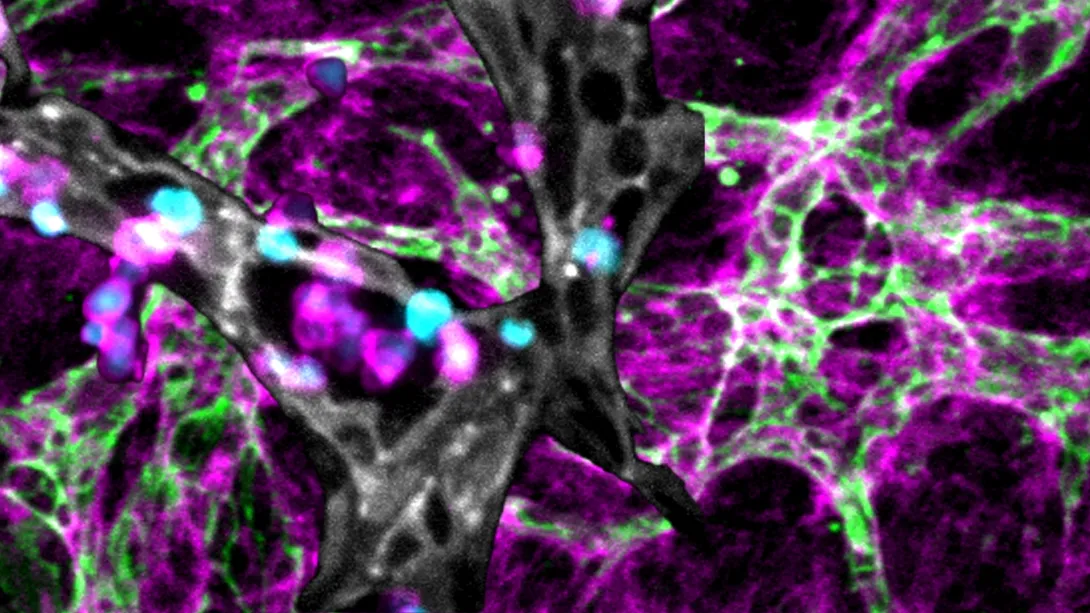
Inside this lab-grown bone marrow, blood vessels (green and grey) thread through a network of supportive cells and proteins (magenta). Antibody-producing cells (blue) move through this landscape, finding the signals they need to survive and keep making antibodies.
For decades, immunologists have known that the body's most durable defenses depend on plasma cells, the antibody-producing cells responsible for long-term immune memory. Long after an infection has passed or a vaccine has been administered, these cells continue releasing protective antibodies, sometimes for decades.
Yet one of immunology's enduring mysteries has remained unsolved: scientists understand what plasma cells do, but not how they interact with their environment.
The challenge is simple. Plasma cells reside deep within bone marrow, one of the most difficult tissues in the human body to study. Encased in bone and inaccessible to direct live imaging, it has largely remained a black box. As a result, much of what scientists know comes from mouse studies or simplified laboratory systems that capture only fragments of the human environment.
Now, researchers at Georgia Tech and Vanderbilt University have opened an unprecedented window into this hidden world.
In a study published in Science Advances, the team developed a human bone marrow-on-a-chip with channels of the size of human hair that allowed fluids to flow through it. This enabled them to directly observe human antibody-secreting cells as they migrated, interacted, and settled within a three-dimensional tissue environment.
The platform recreates not only the cellular complexity of bone marrow but also its vascular architecture and specialized microenvironments.
“What we found was far more dynamic than the textbook view of plasma cells simply taking up residence and staying put,” said study co-senior author Ankur Singh, Carl Ring Family professor in the George W. Woodruff School of Mechanical Engineering and the Wallace H. Coulter Department of Biomedical Engineering at Georgia Tech and Emory University. Singh is also Director of the Center for Immunoengineering at Georgia Tech, part of the Parker H. Petit Institute for Bioengineering and Bioscience.
Building a Human Bone Marrow Model
Rather than creating a conventional cell culture, the researchers engineered a living microenvironment containing two major bone marrow neighborhoods: areas surrounding blood vessels, known as the perivascular niche, and a bone-like region lining internal bone surfaces, known as the endosteal niche.
The team then introduced human antibody-secreting cells generated from engineered lymphoid organoids, which are miniature immune tissues capable of producing large numbers of cells that develop into plasma.
What happened next surprised them.
Instead of dispersing throughout the tissue, the cells traveled through the vascular network and accumulated around blood vessels.
“These cellular gatherings were not random traffic jams,” said co-senior author Krishnendu Roy, the Bruce and Bridgitt Evans Dean of Engineering University Distinguished Professor at Vanderbilt University. “The cells appeared to congregate in regions rich in survival signals, suggesting that specialized perivascular neighborhoods serve as safe harbors for long-term immune memory.”
The collaboration between Roy and Singh began while Roy was a faculty member at Georgia Tech, where much of the work was initially conceived and launched. The Roy lab pioneered the bone marrow chip while the Singh lab pioneered the lymphoid organoids. Their joint findings provide strong evidence that human plasma cells actively seek supportive environments rather than simply becoming trapped where they are, as previously believed.
Not as Stationary as Once Believed
Perhaps the most striking discovery emerged when researchers tracked individual cells over time.
Rather than remaining fixed in place, a subset displayed a distinctive "stop-and-go" migration pattern.
“Classic immunology has often viewed plasma cells as largely sedentary,” said Singh. “We found that many cells paused for extended periods, moved, stopped again, and continued exploring their surroundings.”
The behavior suggests that plasma cells actively sample their environment, searching for the combinations of signals and support needed for long-term survival.
A Tale of Two Niches
The study also revealed that bone marrow's two major compartments perform distinct but complementary functions.
The perivascular niche attracts cells and provides key survival signals, while the neighboring endosteal niche influences how they migrate, persist and are retained.
Together, these compartments form a cooperative ecosystem that shapes plasma cell fate, challenging the idea of bone marrow as a single, uniform environment.
Why It Matters
The implications extend far beyond understanding where plasma cells live.
Bone marrow niches support the cells responsible for long-term antibody protection, placing them at the center of vaccine durability, immune aging, autoimmune disease, chronic infection, blood cancers, and cancer metastasis.
The new platform allows researchers to systematically manipulate components of the human bone marrow environment and observe the consequences in real time. It may help explain why immunity wanes with age, why some vaccines provide longer-lasting protection than others, and how disease disrupts the biological foundations of immune memory.
Most importantly, it offers a rare glimpse into one of the immune system's most inaccessible habitats. Though there is still much more to learn, their secrets are no longer quite so hidden.
News Contact
Ashlie Bowman, Communications Manager
Parker H. Petit Institute for Bioengineering and Bioscience