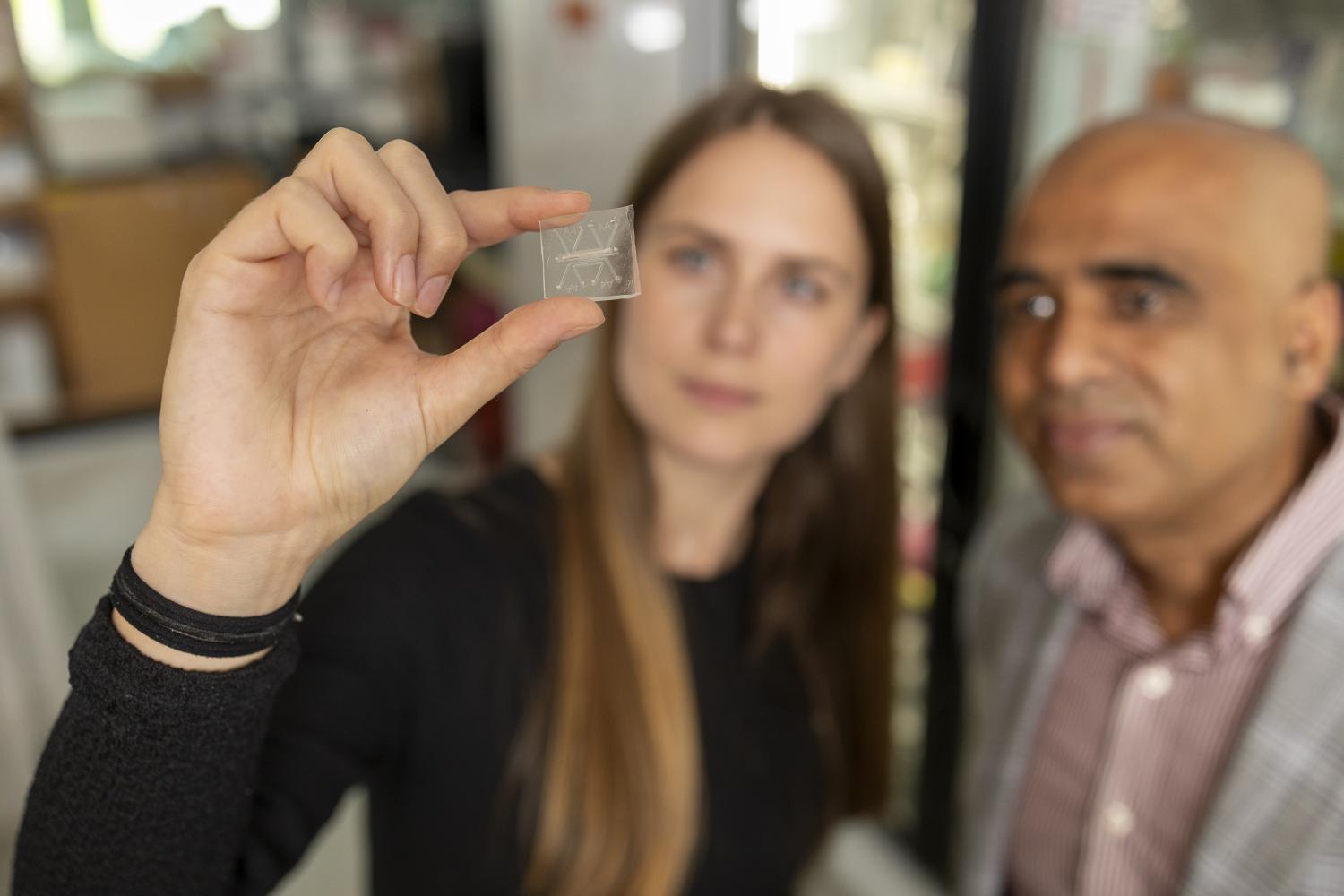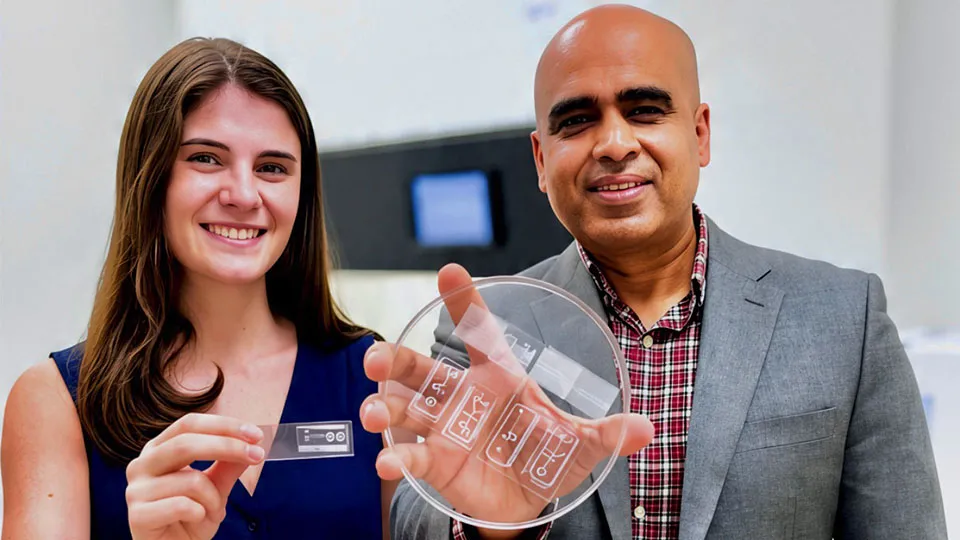
Ankur Singh will lead Georgia Tech’s new ETHOS initiative to advance New Approach Methodologies (NAMs) and transform drug discovery through human-relevant systems. Singh is pictured alongside Ph.D. student Olivia Jones, holding a human immune organ engineered on-a-chip, a breakthrough innovation developed at Georgia Tech to model complex immune responses outside the body.
Georgia Tech's ETHOS initiative brings together expertise from across the Institute to advance human-centered research models that could accelerate the development of safer, more effective therapies.
Before a promising new therapy can reach a patient, researchers need to answer a deceptively simple question: Will it work?
For decades, part of the answer has come from animal testing. Animal models have helped scientists make countless medical advances and understand how potential treatments behave in a living system. But they also present scientific and ethical challenges, including one unavoidable limitation: A mouse isn't a human. This limitation is one reason many promising drug candidates fail during human clinical trials.
Now, Georgia Tech is launching a new Institute-wide initiative focused on technologies that help researchers close that gap by studying human health and disease in ways that more closely reflect human biology. This interdisciplinary venture, called Emerging Technologies for Human-Oriented Systems (ETHOS), will advance human-centered research technologies, including new approach methodologies (NAMs) that improve prediction of human responses and support the development of safer, more effective therapies.
“ETHOS reflects Georgia Tech's commitment to advancing innovative approaches to some of society's most pressing health challenges,” said Executive Vice President for Research Tim Lieuwen. “By bringing together expertise from across the Institute and investing in technologies that more closely reflect human biology, we have an opportunity to accelerate discovery, strengthen translation, and help shape the future of biomedical research."
Unifying Research
Supported by the Office of the Executive Vice President for Research, ETHOS is built on an interdisciplinary framework that connects researchers across Georgia Tech and with clinical and translational partners. The initiative draws on expertise in bioengineering, materials science, device engineering, computing, and data science. It will be led jointly by the Parker H. Petit Institute for Bioengineering and Bioscience (IBB) and the Institute for Data Engineering and Science (IDEaS).
“What sets Georgia Tech apart is our ability to unify deep expertise in foundational life sciences, bioengineering, and materials science with artificial intelligence and data science,” said Vice President for Interdisciplinary Research Julia Kubanek. “ETHOS creates a framework for connecting those strengths, fostering new collaborations, and enabling researchers to tackle complex health challenges in ways that no single discipline could accomplish alone.”
Ankur Singh, Carl Ring Family Professor in the George W. Woodruff School of Mechanical Engineering and Wallace H. Coulter Department of Biomedical Engineering at Georgia Tech and Emory University (BME), will lead ETHOS in his new administrative role as deputy director of IBB. Although ETHOS is a new initiative, Georgia Tech researchers have already begun building a NAMs community through an institutional task force and other collaborative efforts. That momentum will continue with the 2027 Suddath Symposium, which will focus on NAMs and bring researchers together across disciplines.
“Georgia Tech has expertise across the full spectrum of these approaches, from AI and computational modeling to engineered tissues and experimental systems,” said JC Gumbart, Dunn Family Professor in the School of Physics. “ETHOS gives us a framework to connect those strengths and accelerate human-centered biomedical research.”
Gumbart co-led the NAMs task force and is co-organizing the symposium with Shuichi Takayama, a Georgia Research Alliance Eminent Scholar and chair of regenerative engineering medicine within BME.
Advancing Discovery
What are new approach methodologies, or NAMs, and how can they help researchers address human health challenges?
NAMs include both physical models, such as organoids and organ-on-chip technologies, and computational models that use artificial intelligence. Each approach has its own advantages and limitations.
Organoids and organ-on-chip are living tissue systems grown in the lab that mimic key features of human biology and help researchers study how the body may respond to new drugs or treatments. These models allow researchers to observe biological responses in human tissue systems, but they are limited by the steep cost of time and resources required to create them.
Computational models take advantage of AI and supercomputing technology to rapidly explore and predict thousands of possibilities. They use existing datasets to examine complex relationships at scale and simulate how potential changes might affect a system. Though these simulations can provide a large-scale prediction of what might happen, they can’t provide evidence of how cells actually respond.
ETHOS emphasizes a bidirectional approach that combines engineered biological systems with predictive computational models. For instance, a scientist who is testing a new drug on an organoid may use AI to predict how the drug could affect a larger population with differing demographics. Conversely, a researcher using a computational model may use an organ-on-chip experiment to validate (or disprove) the computer’s prediction.
“These human platforms allow us to look broad — exploring how therapies behave across populations — and look deep, engineering precise models that reflect an individual patient’s unique health profile,” Singh said.
Leading the Way
The adaptability of NAMs gives researchers a more human-centered way to study — and hopefully one day treat — some of humanity’s most pervasive health problems, such as cancer, cardiovascular disease, autoimmune diseases, neurological disorders, infection, and more. Therapies developed using NAMs could be broad-use solutions that impact entire populations or tailored treatments for personalized healthcare. By bringing together strengths in engineering, computing, data science, and the life sciences, ETHOS positions Georgia Tech to help shape the future of NAMs research and technology development.
“The next generation of medical research increasingly relies on models that are both more human and more intelligent. Georgia Tech's strength lies in connecting the physical and digital worlds of biology,” Singh said. “That closed loop between human biology and computation gives us a powerful advantage in developing the next generation of non-animal models for research and drug development.”
The initiative will also include the development of a platform designed to connect researchers across the Institute and help them identify complementary expertise, shared experimental systems, and collaborative funding opportunities. The digital matchmaking system, along with pilot research and technology development, AI integration, grant development, and community building, makes ETHOS a potentially groundbreaking program launching at an opportune time.
“ETHOS is an initiative of convergence. Few institutions combine strengths in advanced human tissue systems, engineering, AI, and data science at the scale of Georgia Tech. ETHOS provides a framework to unite those capabilities and accelerate biomedical discovery and translation,” Singh said.
ETHOS is designed to strengthen connections between fundamental research and real-world health applications. By developing research models that more closely reflect human biology, the initiative could help researchers identify promising therapies earlier and better understand how they may perform in people. ETHOS could also strengthen collaborations among Atlanta's academic, clinical, and industry partners, creating new opportunities for translational research and technology development.
News Contact
Ashlie Bowman | Communications Manager
Parker H. Petit Institute for Bioengineering and Bioscience