Researchers in the Jamali Lab have published a new study that sheds light on how nanoparticles move across liquid-solid interfaces, a discovery that could improve scientists’ ability to study materials and processes at the nanoscale.
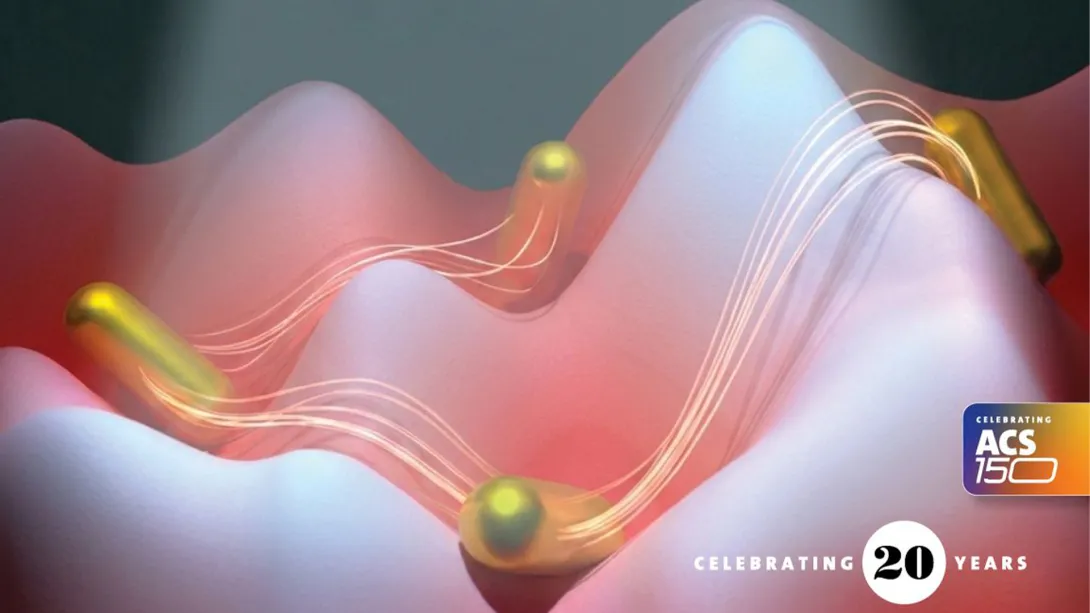
The paper, Solution-Tunable Interfacial Interaction Landscape Governs Anomalous Nanoparticle Diffusion in Liquid-Phase Electron Microscopy, was featured on the cover for the June issue of ACS Nano. Lead author Isabel Panicker, doctoral student in the School of Chemical and Biomolecular Engineering, created the cover artwork and highlights the complex interactions that influence nanoparticle motion at liquid-solid interfaces .
The team used liquid-phase transmission electron microscopy (LPTEM) to observe nanoparticles moving across a liquid-solid interface in real time. Their research shows that changing the ionic composition of the liquid alters the forces acting between nanoparticles and their surroundings. These modifications influence how the particles move, sometimes causing behavior that differs from the random motion typically expected in liquids.
By uncovering how the liquid environment shapes nanoparticle movement, the researchers gained new insight into the fundamental processes that govern movement at the nanoscale. Understanding these processes is important for applications ranging from advanced materials and energy technologies to biological systems.
The team also developed a new framework that uses nanoparticle motion to measure the mechanical properties of the liquid-solid interface. Rather than treating LPTEM solely as an imaging technique, the approach allows researchers to extract quantitative information about a material's behavior directly from the paths of particles observed under the microscope.
The study was co-authored by Zain Shabeeb and Vida Jamali. The Institute for Matter and Systems supported the research through the research program Compressed Super-Resolution TEM Using Nanoelectronic Coded Aperture Device, led by Jamali.
The findings expand the capabilities of liquid-phase electron microscopy and open new opportunities for studying complex materials and dynamic processes at the nanoscale.
DOI: http://doi.org/10.1021/acsnano.6c04149
News Contact
Amelia Neumeister | Communications Manager
The Institute for Matter and Systems