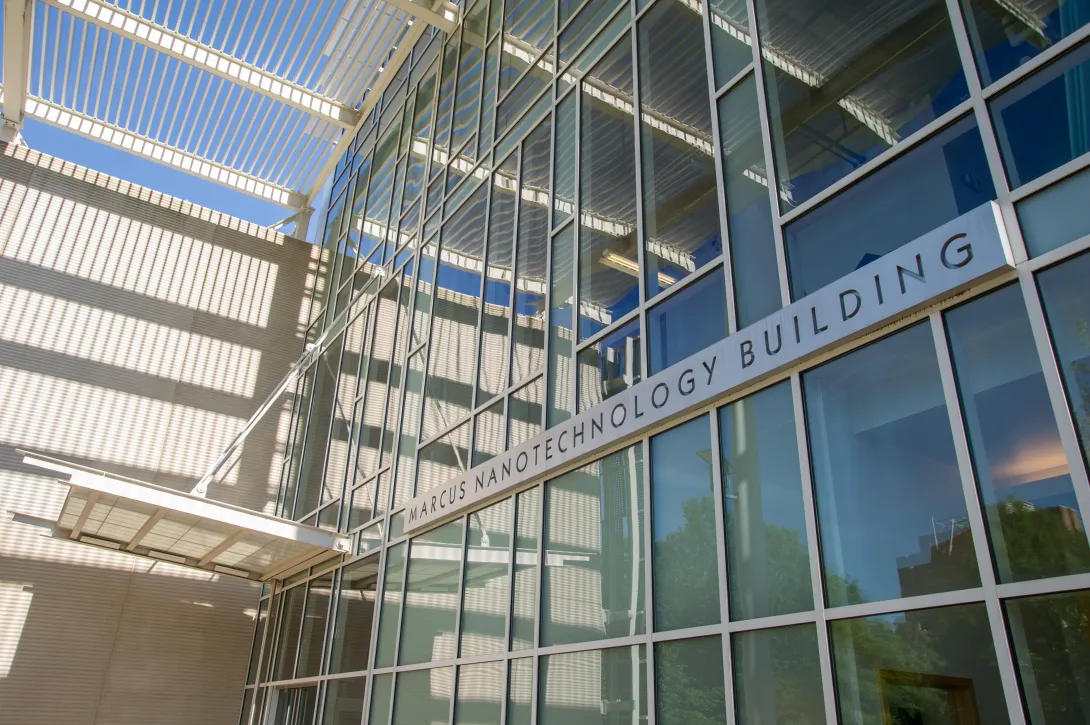
The Institute for Matter and Systems (IMS) at Georgia Tech has announced the Spring 2026 Core Facility Seed Grant recipients. The primary purpose of this program is to give graduate students in diverse disciplines working on original and unfunded research in micro- and nanoscale science and engineering the opportunity to access the most advanced academic cleanroom space in the Southeast. In addition to using the labs' state-of-the-art fabrication, lithography, and characterization tools, the awardees will have the opportunity to gain proficiency in cleanroom and tool methodology and access the consultation services provided by research staff members in IMS. Seed Grant awardees are also provided travel support to present their research at a scientific conference.
In addition to student research skill development, this biannual grant program gives faculty with novel research topics the ability to develop preliminary data to pursue follow-up funding sources. The Core Facility Seed Grant program is supported in part by the Southeastern Nanotechnology Infrastructure Corridor (SENIC), a member of the National Science Foundation’s National Nanotechnology Coordinated Infrastructure (NNCI).
The five winning projects were awarded IMS cleanroom and lab access time to be used over the next year.
The Spring 2026 IMS Core Facility Seed Grant recipients are:
Mineralogical and Microtextural Signatures of Lava-Water Interactions in a Paleo Lava Delta at Lake Tahoe: Implications for Volcanic-Hydrologic Processes on Mars
PI: Frances Rivera-Hernandez
Student: Tuhi Saumya
School of Earth and Atmospheric Sciences
Holistically Designing Robust 3D Mesoscale Networks of Organic Mixed Electronic and Ionic Conductors
PI: Erin Ratcliff
Student: Corey Roberts
School of Materials Science and Engineering, School of Chemistry and Biochemistry
Moisture-Based Energy Harvesting for Ingestible Electrical Stimulation Therapy
PI: Alex Abramson
Student: Julia Ding
The Wallace H. Coulter Department of Biomedical Engineering
Advanced Processing of Agro-waste and its Application in Building Construction
PIs: Kimberly Kurtis (CEE), Ebenezer Fanijo (BC), and Valerie Thomas (ISyE)
Student: Catelyn Chamblee
School of Civil and Environmental Engineering
Field-induced Second-order Nonlinearity in Silicon for Electro-optic Modulation
PI: Wenshan Cai
Student: Zeyu Pan
School of Electrical and Computer Engineering
News Contact
Amelia Neumeister | Communications Manager
The Institute for Matter and Systems