- by Seungho Lee
As data center development accelerates across Georgia and beyond, understanding the relationship between AI infrastructure and water systems is becoming increasingly urgent. The BBISS Demystifying Data Centers Insights Series on March 27 focused on this issue, bringing together perspectives from engineering, utilities, and infrastructure planning. Moderated by Ameet Pinto, BBISS faculty director for Interdisciplinary Research and Collaboration, the discussion highlighted the water impacts of data centers and the need for systems thinking and collaboration across disciplines.
Why Systems Thinking Matters
A recurring theme was the mismatch between AI infrastructure and water systems. AI services are ubiquitous and scalable, while water resources are local, physically constrained, and managed by regionally fragmented utility systems. Data centers can be deployed rapidly, but water infrastructure evolves slowly. These differences complicate how impacts are measured and managed.
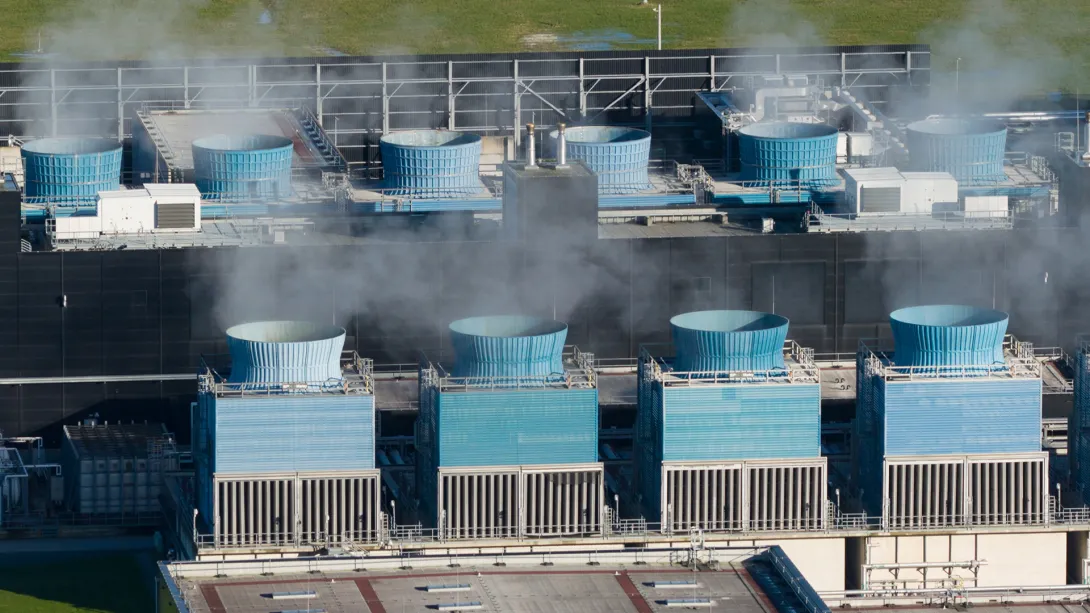
Water usage is more complex than it appears. While discussions often focus on water used directly for cooling, this represents only part of the total footprint. Significant water is used indirectly through electricity generation and the manufacturing of the computing hardware and cooling systems installed in data centers. As noted by Akanksha Menon, assistant professor in the George W. Woodruff School of Mechanical Engineering, distinguishing between direct, indirect, and embodied water use shows that impacts extend far beyond individual facilities.
These complexities make isolated solutions insufficient. Reducing water use in one location doesn’t necessarily reduce overall demand. For example, Douglas County’s collaboration with Google, as presented by Brian Keel, deputy director of Engineering for Douglasville-Douglas County Water and Sewer Authority, has invested in alternative water sources, such as treating wastewater from the Sweetwater Creek facility for non-potable cooling.
Yet the growing energy and water demands driven by accelerating AI use remain a major challenge. In particular, managing water as a finite resource becomes increasingly important because energy can be generated through different methods, but water cannot simply be created. Such complexity highlights the need for a systems approach to navigate overlapping and conflicting issues.
Why Collaboration Is Essential
The session also underscored that no single discipline or entity can fully address these challenges. Douglas County’s partnership with Google highlights not only collaboration between local agencies and industry, but also the need for coordination beyond individual jurisdictions, as water used for power generation or sourced outside the immediate region can create indirect pressures elsewhere.
John Ikeda, chief mission officer for the Water Environment Federation, discussed governance challenges associated with data center water use. Ikeda underlined the challenges in measurement and governance, noting that water impacts can be counterintuitive. While efforts that appear water-saving, such as avoiding on-site water use, can increase indirect water demand through additional electricity use, water-based cooling may reduce total systemwide demand. These complexities reveal the limits of single metrics and the need for frameworks that account for direct, indirect, and life-cycle impacts. Governance challenges can arise from complex practical issues, including rural communities’ limited experience working with industrial partners and broader social resistance to AI and AI infrastructure, which once again calls for large-scale collaboration.
The broader takeaway is that the challenges linking AI and water are deeply tied to structural mismatches between digital AI infrastructure and physical water systems: ubiquitous AI services versus physically constrained water resources; rapid data center growth versus the slower development of water infrastructure; and global digital demand versus regionally concentrated environmental impacts.
As these gaps complicate measurement, planning, and governance, the discussion highlighted the need for broader, systems-level perspectives and collaboration across disciplines and sectors, including engineering, computing, utilities, policy, and community stakeholders. Sustainable data center development depends on perspectives that consider water, energy, infrastructure, and community resilience together.
News Contact
Brent Verrill, Research Communications Program Manager, BBISS