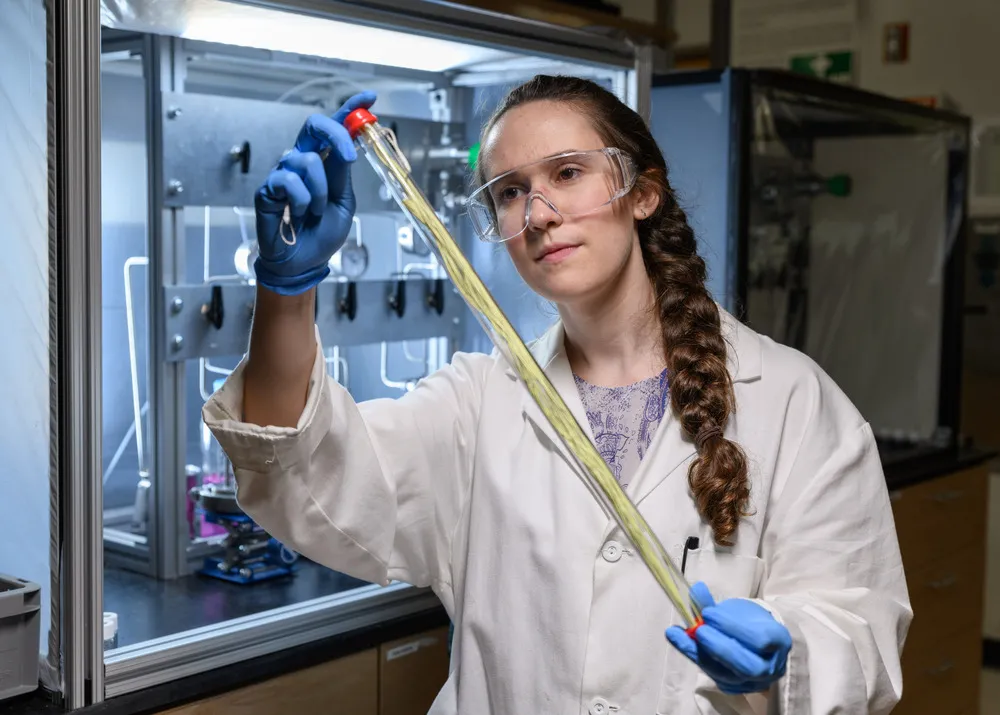
A Georgia Tech graduate student examines a hollow fiber membrane, used for low-energy chemical separation. New DOE Genesis Mission awards have bolstered innovative interdisciplinary work across the Institute, with Georgia Tech leading two projects and contributing to five more. (Photo: Rob Felt)
Georgia Tech will play a key role in the newly announced Genesis Mission, a national initiative harnessing artificial intelligence (AI) to propel scientific discovery and address challenges in health, energy, manufacturing, infrastructure, and national security. The White House announced the first Genesis Mission projects on July 22 as part of a more than $5 billion investment in AI-enabled science and technology.
Georgia Tech was chosen for multiple Genesis Mission awards. Faculty will lead two projects and collaborate on others with research partners across the country.
“Artificial intelligence is rapidly transforming how we conduct research and drive discovery,” said Tim Lieuwen, Georgia Tech’s executive vice president for Research. “These awards recognize Georgia Tech’s leadership in AI, advanced computing, engineering, and the sciences. By bringing together expertise from across our colleges and research units, we can help accelerate breakthroughs in areas that are crucial to the nation’s future — from energy and manufacturing to health and critical infrastructure.”
- Ameet Pinto, associate professor in the School of Civil and Environmental Engineering and faculty director for interdisciplinary research and collaboration for the Brook Byers Institute for Sustainable Systems, will lead “AI-Enabled Single Cell Phenotyping to Advance Biomanufacturing.” The project aims to advance AI-enabled approaches for understanding biological systems and strengthening next-generation biomanufacturing capabilities.
- Fan Zhang, assistant professor in the George W. Woodruff School of Mechanical Engineering, will lead the project, “AI Driven Workflow with Cyber Assured Digital Twin for Autonomous Operations in SMRs and Microreactors.” Her team will focus on developing AI-enabled digital twin technologies to support the safe, autonomous operation of advanced nuclear energy systems.
The additional Georgia Tech-supported awards span multiple disciplines and involve researchers from the Colleges of Engineering, Computing, and Sciences; the Ivan Allen College of Liberal Arts, the Brook Byers Institute for Sustainable Systems; the Institute for Robotics and Intelligent Machines; the Institute for Data Engineering and Science; and the Strategic Energy Institute.
- Marilyn Brown (Jimmy and Rosalynn Carter School of Public Policy) and Oak Ridge National Laboratory (ORNL) will build AI foundation models that predict and test water-for-energy conditions in the Tennessee Valley Authority region.
- Peng Chen (School of Computational Science and Engineering) will collaborate on two projects designed to improve predictions of both water availability and flood risks. He will partner with ORNL and the Argonne National Laboratory.
- Asif Khan (School of Electrical and Computer Engineering) will partner with the Lawrence Livermore National Laboratory to accelerate the discovery of new materials for a type of computer memory called Electro-Chemical RAM (ECRAM) to help create more energy-efficient AI systems.
- Fan Zhang’s second Genesis Mission project is a collaboration with ORNL to develop AI tools for the lifecycle of fusion plants, including robotics and maintenance.
- Samer Naif (School of Earth and Atmospheric Sciences) will collaborate with the University of Southern California on the project "AI-enabled Geobiological Critical Minerals Characterization and Recovery in Geothermal Systems."
- Shimeng Yu (School of Electrical and Computer Engineering) will partner with Duke University on the project, "Neuromorphic Circuit Primitives for Robotic Embodied Physical AI."
Georgia Tech’s role in the Genesis Mission highlights the Institute’s strong interdisciplinary research approach, which brings together experts across many fields to solve complex problems and rapidly advance innovation.
Note: Selection for award negotiations does not constitute a final funding award. According to the U.S. Department of Energy, awards remain subject to successful negotiations and the availability of funding. https://science.osti.gov/-/media/funding/pdf/Awards-Lists/2026/GM-RFA-Awards-List.pdf
News Contact
Angela Ayers
AVP of Research Communications