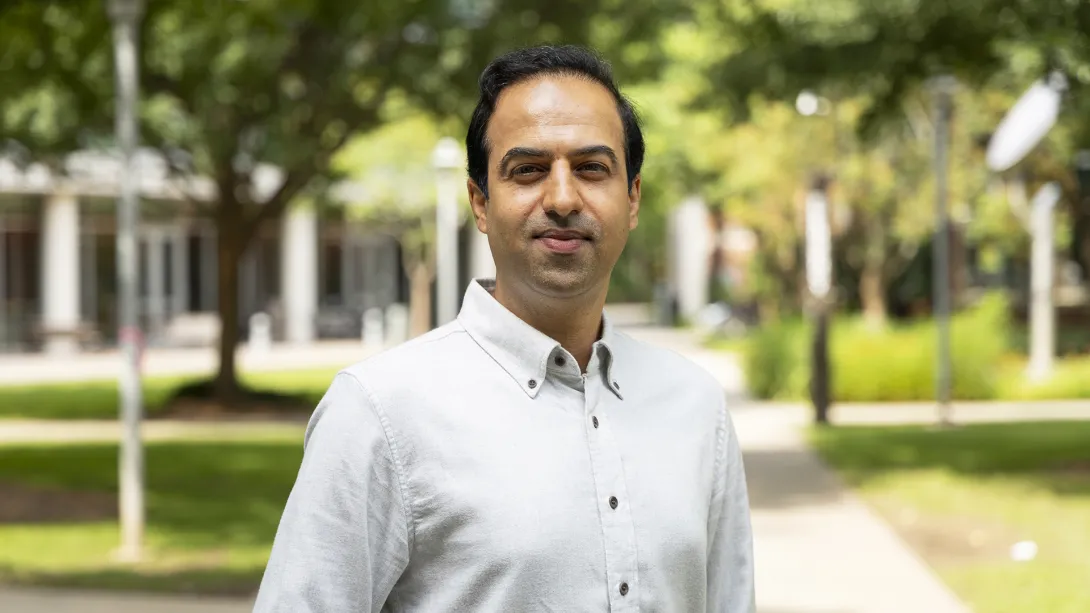
When most people think of hurricanes, they picture howling winds tearing off roofs and snapping trees. But for Ali Sarhadi, a Brook Byers Institute for Sustainable Systems (BBISS) Faculty Fellow, assistant professor in the School of Earth and Atmospheric Sciences, and director of the Climate Risk and Extreme Dynamics Lab, the real killer is often less visible. “People think that hurricanes are about wind, but sometimes that’s not the whole story,” he said. “The majority of fatalities are coming from the water, not the wind.”
Supported by two Sustainability Next Seed Grants, Sarhadi’s work draws on climate science, fluid physics, engineering, and artificial intelligence. He’s using AI-powered, physics-informed models to better anticipate water hazards that can cripple cities and power grids in both coastal and inland communities.
Rethinking Hurricane Risk
Sarhadi focuses on compound flooding, the dangerous interaction between storm surge, torrential rainfall, and river flooding that increasingly defines hurricanes. He points to Hurricane Mitch, which hit Central America in 1998, as a stark example, noting that more than 12,000 people died, “all from freshwater flooding — none from wind,” he said.
His work has shown how climate change and sea-level rise are reshaping flood risk from storms like Hurricane Sandy, which devastated New York and New Jersey in October 2012. In the current climate, a Sandy-level natural disaster has a recurrence period of roughly once every 150 years. But that is changing fast. “Because of climate change and sea-level rise, by the middle of this century, the same level of flooding is likely to occur once every 60 years. By the end of the century, that goes up to once every 30 years,” he says. “Hurricane Sandy caused about $70 billion in damage. Imagine experiencing that kind of destruction every 30 years.”
Since 1970, Sarhadi notes, damage from tropical cyclones has increased by about 380% globally, a trend driven by the combined effect of stronger storms and more people and infrastructure being located in harm’s way.
Physics-Informed AI: Street-Level Flood Warnings
While storm forecasting has improved dramatically in recent decades, Sarhadi argues, “We’re in good shape in terms of track forecasting, and we’re getting better at rapid intensification forecasting. But what is missing is the hazard part, and specifically the water part. That’s the number one killer.”
His lab is developing AI models tightly coupled with physics-based simulations to forecast hurricane-induced flooding at unprecedented resolution.
Using Hurricane Sandy as a test case, his team showed that by integrating physics-based surge and rainfall models with generative AI, they could forecast building-level flood depths three to five days before landfall. “We could predict that a storm was surge-dominant and estimate how much flooding could happen at the level of each building with an accuracy beyond 90%,” he says.
Those extra days, and that level of granularity, could give emergency managers and local leaders the information they need to order earlier evacuations, pre-stage resources, and protect critical infrastructure. “We hope by combining AI and physics-based models we can come up with faster, more accurate modeling, first, to save lives, and then to minimize the economic damage,” Sarhadi says.
Targeting Georgia’s Coastline
Although much of the public’s attention focuses on the Gulf Coast and megacities on the Eastern Seaboard, Georgia’s coastline is also highly vulnerable to surge and compound flooding. Sarhadi is collaborating with Georgia Tech for Georgia’s Tomorrow to model risk in places like Savannah and the surrounding coastal region. “We’re working to come up with good long-term solutions for protecting coastal communities and infrastructure,” he says.
Events like Hurricane Helene in 2024, which triggered extended blackouts in Georgia and lethal flooding in western North Carolina, underscore how far inland these risks can reach. “People think hurricanes are just a problem for coastal areas,” Sarhadi says. “But even if you are far from a coastline, you can be at risk when saturated soils, torrential rain, and river flooding combine.”
Building Climate-Resilient Power Grids and Cities
Sarhadi’s work doesn’t stop at forecasting. A central focus of his research is climate-resilient infrastructure, particularly the power grid. His team is exploring digital twin modeling — virtual replicas of energy and infrastructure systems. “When you have a digital twin of your grid, you can run that hurricane through it and identify which substations or power lines are more vulnerable,” he says, explaining that this knowledge could trigger utility crews to fix or reinforce power lines ahead of storms.
Looking decades ahead, these tools could help utilities and planners prioritize where to upgrade aging infrastructure as hurricanes intensify and water levels rise. “We know hurricanes are getting more intense, and our infrastructure is aging,” Sarhadi said. “By combining engineering, climate science, and AI, we’re trying to design better adaptation plans so our communities and power systems are more resilient in the future.”
News Contact
Brent Verrill, Research Communications Program Manager
Brook Byers Institute for Sustainable Systems
Georgia Tech
Written by Anne Wainscott-Sargent