
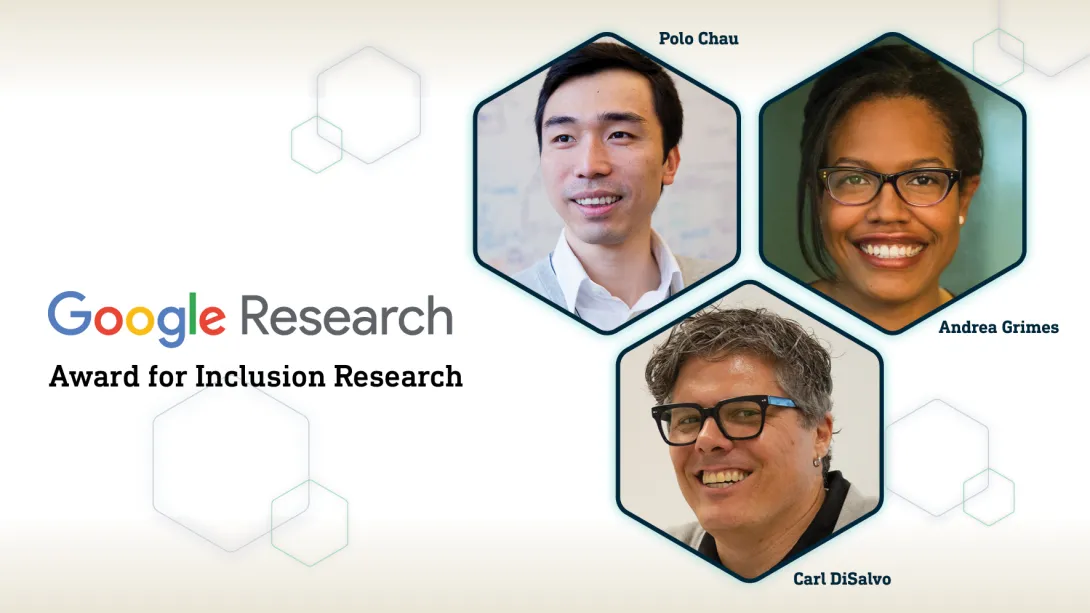
With inclusion at the center of their research, three College of Computing faculty members earned one of the top honors Google awards for academic researchers.
Professor Carl DiSalvo and Associate Professor Andrea Parker from the School of Interactive Computing and Associate Professor Polo Chau from the School of Computational Science and Engineering made the list of recipients for the 2023 Google Award for Inclusion Research (AIR).
Google AIR recognizes significant contributions in computing and technology that address the needs of historically marginalized groups. For 2023, Google sought to identify research that focused on accessibility, collaboration, collective- and society-centered AI, and the impact of AI on education. The award includes a $60,000 grant for each recipient.
Working alongside Ph.D. student Vanessa Oguamanam, Parker seeks to develop a mobile app that helps perinatal black women handle stress management. The award will help fund a mixed-method study to evaluate the app's efficacy.
"This award will enable me to establish new collaborations with two community partners doing vital work to address maternal health inequities within Georgia," Parker said. "Culturally relevant mental health resources are sorely lacking yet vitally needed to support a population that has disproportionately experienced social and structural stressors and mental health conditions."
Working with Ph.D. candidate Sara Espinosa-Milkes, DiSalvo collaborates with online resellers in co-designing speculative and applied tools and practices to enable better navigation of the algorithmic ecosystems of online second-hand economies.
DiSalvo said sites such as PoshMark, Depop, and ThredUp require resellers to navigate multiple platforms, applications, and algorithms. Their research helps resellers make sense of these technologies and construct tactics to move between these platforms.
"The Google AIR gift is an amazing contribution and opportunity," DiSalvo said. "It provides a pathway for collaborating with colleagues at Google and much-needed support for the critical and experimental work we are trying to accomplish. It enables us to share work with researchers at Google that is participatory, critical, and grounded in humanities theories and arts methods."
Chau received the Google AIR award for his work in AI and education, that led to the creation of a unique tool called VisGrader.
VisGrader helps instructors and students alike by automatically grading JavaScript data visualizations. The tool enhances student learning by providing immediate feedback on their designs, allowing them to improve their work iteratively.
Ph.D. student Matthew Hull leads the project comprised of current and former teaching staff members of Georgia Tech's Data and Visual Analytics course. So far, VisGrader has auto-graded over 72,000 submissions from 4,000 students spanning four semesters since 2021.
"I am very grateful for Google's recognition of the breakthrough research innovations at Georgia Tech and Georgia Tech's ongoing vision and efforts to broaden education access to learners around the world," Chau said.
"Next, we are exploring how we can extend the approach to data visualizations created in other languages and platforms and how generative AI may help provide even more informative feedback to our students."
School of Interactive Computing Communications Officer Nathan Deen and School of Computational Science and Engineering Communications Officer Bryant Wine contributed to this story. Contact Nathan Deen at ndeen6@gatech.edu. Contact Bryant Wine at bwine3@gatech.edu.
News Contact
School of Interactive Computing Communications Officer Nathan Deen and School of Computational Science and Engineering Communications Officer Bryant Wine contributed to this story. Contact Nathan Deen at ndeen6@gatech.edu. Contact Bryant Wine at bwine3@gatech.edu.

Georgia Tech researchers have created a machine learning (ML) visualization tool that must be seen to believe.
Ph.D. student Alec Helbling is the creator of ManimML, a tool that renders common ML concepts into animation. This development will enable new ML technologies by allowing designers to see and share their work in action.
Helbling presented ManimML at IEEE VIS, the world’s highest-rated conference for visualization research and second-highest rated for computer graphics. It received so much praise at the conference that it won the venue’s prize for best poster.
“I was quite surprised and honored to have received this award,” said Helbling, who is advised by School of Computational Science and Engineering Associate Professor Polo Chau.
“I didn't start ManimML with the intention of it becoming a research project, but because I felt like a tool for communicating ML architectures through animation needed to exist.”
ManimML uses animation to show ML developers how their algorithms work. Not only does the tool allow designers to watch their projects come to life, but they can also explain existing and new ML techniques to broad audiences, including non-experts.
ManimML is an extension of the Manim Community library, a Python tool for animating mathematical concepts. ManimML connects to the library to offer a new capability that animates ML algorithms and architectures.
Helbling chose familiar platforms like Python and Manim to make the tool accessible to large swaths of users varying in skill and experience. Enthusiasts and experts alike can find practical use in ManimML considering today’s widespread interest and application of ML.
“We know that animation is an effective means of instruction and learning,” Helbling said. “ManimML offers that ability for ML practitioners to easily communicate how their systems work, improving public trust and awareness of machine learning.”
ManimML overcomes what has been an elusive approach to visualizing ML algorithms. Current techniques require developers to create custom animations for every specific algorithm, often needing specialized software and experience.
ManimML streamlines this by producing animations of common ML architectures coded in Python, like neural networks.
A user only needs to specify a sequence of neural network layers and their respective hyperparameters. ManimML then constructs an animation of the entire network.
“To use ManimML, you simply need to specify an ML architecture in code, using a syntax familiar to most ML professionals,” Helbling said. “Then it will automatically generate an animation that communicates how the system works.”
ManimML ranked as the best poster from a field of 49 total presentations. IEEE VIS 2023 occurred Oct. 22-27 in Melbourne, Australia. This event marks the first time IEEE held the conference in the Southern Hemisphere.
ManimML has more than 23,000 downloads and a demonstration on social media has hundreds of thousands of views.
ManimML is open source and available at: https://github.com/helblazer811/ManimML
News Contact
Bryant Wine, Communications Officer
bryant.wine@cc.gatech.edu
In keeping with a strong strategic focus on AI for the 2023-2024 Academic Year, the Institute for Data Engineering and Science (IDEaS) has announced the winners of its 2023 Seed Grants for Thematic Events in AI and Cyberinfrastructure Resource Grants to support research in AI requiring secure, high-performance computing capabilities. Thematic event awards recipients will receive $8K to support their proposed workshop or series and Cyberinfrastructure winners will receive research support consisting of 600,000 CPU hours on the AMD Genoa Server as well as 36,000 hours of NVIDIA DGX H-100 GPU server usage and 172 TB of secure storage.
Congratulations to the award winners listed below!
Thematic Events in AI Awards
Proposed Workshop: “Foundation of scientific AI (Artificial Intelligence) for Optimization of Complex Systems”
Primary PI: Peng Chen, Assistant Professor, School of Computational Science and Engineering
Proposed Series: “Guest Lecture Seminar Series on Generative Art and Music”
Primary PI: Gil Weinberg, Professor, School of Music
Cyber-Infrastructure Resource Awards
Title: Human-in-the-Loop Musical Audio Source Separation
Topics: Music Informatics, Machine Learning
Primary PI: Alexander Lerch, Associate Professor, School of Music
Co-PIs: Karn Watcharasupat, Music Informatics Group | Yiwei Ding, Music Informatics Group | Pavan Seshadri, Music Informatics Group
Title: Towards A Multi-Species, Multi-Region Foundation Model for Neuroscience
Topics: Data-Centric AI, Neuroscience
Primary PI: Eva Dyer, Assistant Professor, Biomedical Engineering
Title: Multi-point Optimization for Building Sustainable Deep Learning Infrastructure
Topics: Energy Efficient Computing, Deep Learning, AI Systems OPtimization
Primary PI: Divya Mahajan, Assistant Professor, School of Electrical and Computer Engineering, School of Computer Science
Title: Neutrons for Precision Tests of the Standard Model
Topics: Nuclear/Particle Physics, Computational Physics
Primary PI: Aaron Jezghani - OIT-PACE
Title: Continual Pretraining for Egocentric Video
Primary PI: : Zsolt Kira, Assistant Professor, School of Interactive Computing
Co-PI: Shaunak Halbe, Ph.D. Student, Machine Learning
Title: Training More Trustworthy LLMs for Scientific Discovery via Debating and Tool Use
Topics: Trustworthy AI, Large-Language Models, Multi-Agent Systems, AI Optimization
Primary PIs: Chao Zhang, School of Computational Science and Engineering & Bo Dai, College of Computing
Title: Scaling up Foundation AI-based Protein Function Prediction with IDEaS Cyberinfrastructure
Topics: AI, Biology
Primary PI: Yunan Luo, Assistant Professor, School of Computational Science and Engineering
- Christa M. Ernst
News Contact
Christa M. Ernst - Research Communications Program Manager
Robotics | Data Engineering | Neuroengineering
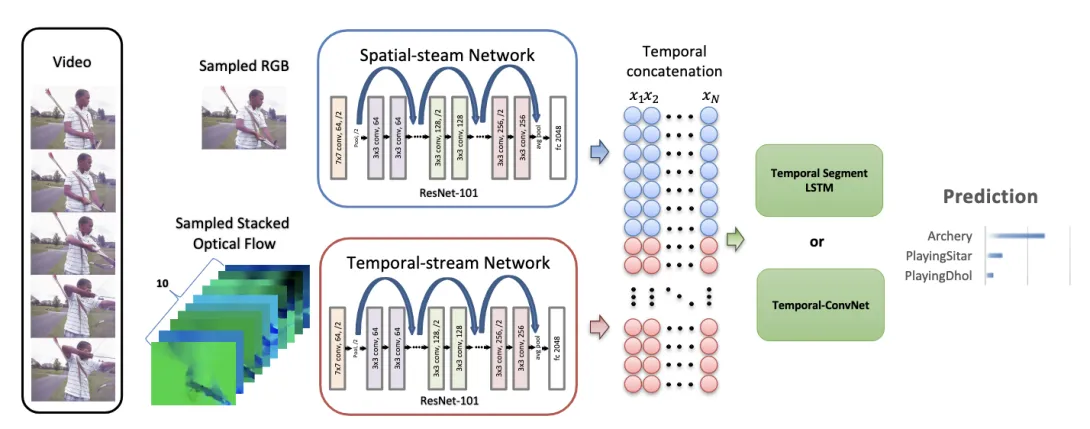
Overview of the proposed framework. Spatial and temporal features were extracted from a two-stream ConvNet using ResNet-101 pre-trained on ImageNet, and fine-tuned for single-frame activity prediction. Spatial and temporal features are concatenated and temporally-constructed into feature matrices. The constructed feature matrices are then used as input to both of our proposed methods: Temporal Segment LSTM (TS-LSTM) and Temporal-Inception.
A team of researchers, led by Professor Ghassan AlRegib in the School of Electrical and Computer Engineering, has been awarded the prestigious European Association For Signal Processing (EURASIP) 2023 Best Paper Award for their outstanding contribution to the Image Communication journal.
The award-winning paper, titled "TS-LSTM and temporal-inception: Exploiting spatiotemporal dynamics for activity recognition," was authored in 2019 by AlRegib and Assistant Professor Zsolt Kira in the College of Computing, as well as then-Ph.D. candidates Chih-Yao (Kevin) Ma (now a staff research scientist at Meta) and Min-Hung (Steve) Chen (now a senior research scientist at NVIDIA). the work was completed in AlRegib’s Omni Lab for Intelligent Visual Engineering and Science (OLIVES).
The research explores different methods to improve action recognition in videos using deep neural networks, specifically two-stream Convolutional Neural Networks (ConvNets). It investigates how to better capture the spatiotemporal dynamics within video sequences. The study proposes and evaluates two new network architectures: temporal segment RNN and Inception-style Temporal-ConvNet. These architectures aim to effectively integrate spatiotemporal information and enhance the overall performance of action recognition systems. The research also identifies specific limitations of each method, which could guide future work in this area.
The EURASIP Best Paper Award is bestowed upon exceptional papers published in journals sponsored by EURASIP within the past four years. This ensures that the most influential and vital ideas in the field are honored.
The Georgia Tech team will be honored at the European Signal Processing Conference (EUSIPCO) held in Helsinki, Finland, from September 4-8. EUSIPCO offers a comprehensive technical program addressing the latest developments in signal processing research and technology, along with its diverse applications.
EURASIP, founded in 1978, has been a crucial platform for researchers, providing an academic and professional forum to disseminate and discuss all aspects of signal processing, fostering growth and collaboration within the community.
Caption for photo header: Overview of the proposed framework. Spatial and temporal features were extracted from a two-stream ConvNet using ResNet-101 pre-trained on ImageNet, and fine-tuned for single-frame activity prediction. Spatial and temporal features are concatenated and temporally-constructed into feature matrices. The constructed feature matrices are then used as input to both of our proposed methods: Temporal Segment LSTM (TS-LSTM) and Temporal-Inception.
News Contact
Dan Watson
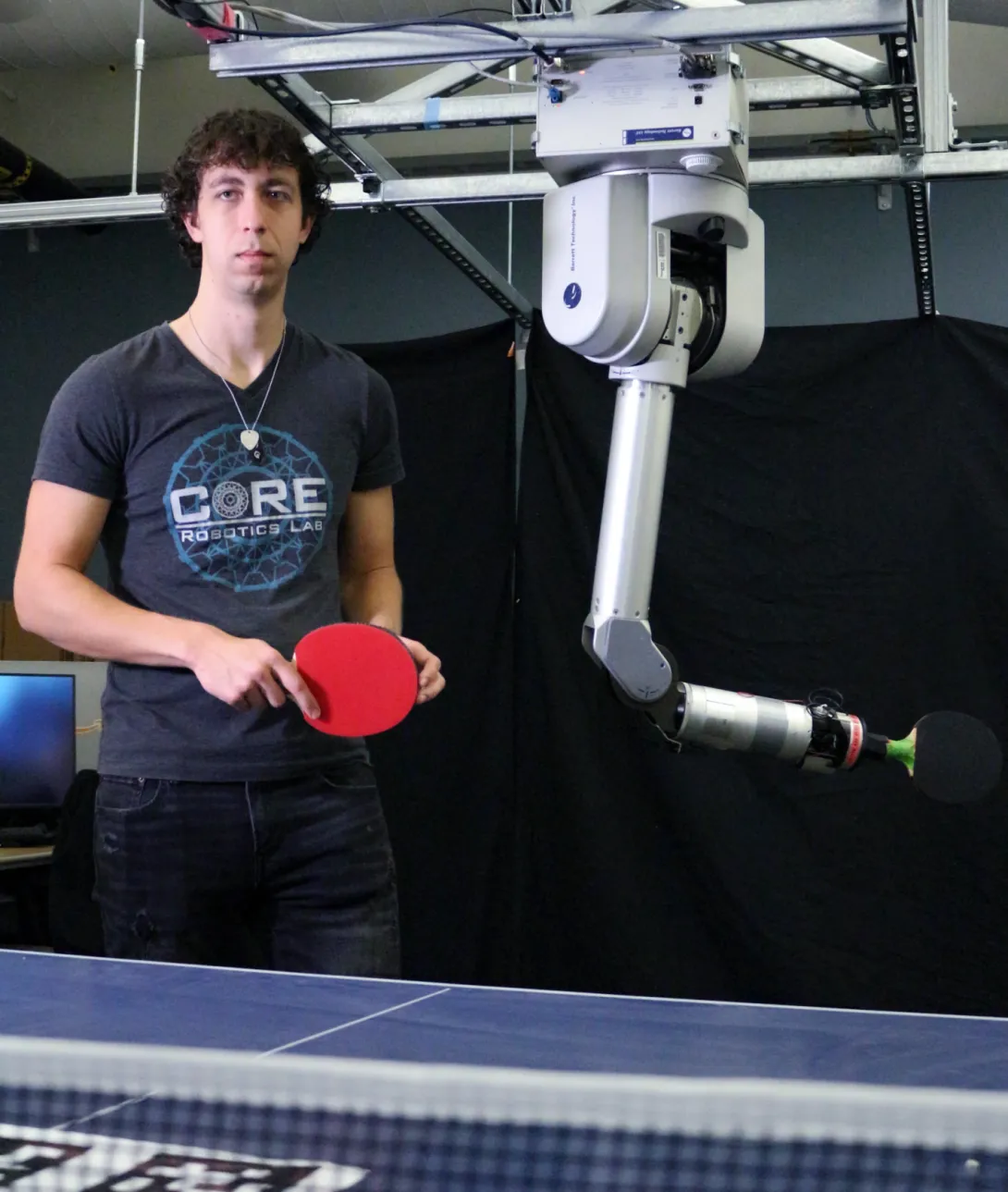
A team of researchers, led by Matthew Gombolay, an assistant professor in the School of Interactive Computing and director of the Cognitive Optimization and Relational (CORE) Robotics Lab at Georgia Tech, are using the sport of table tennis to showcase that humans may not always trust a robot's explanation of its intended action.
They have developed what is called a ‘cobot,’ which uses table tennis to demonstrate the potential areas a robot can work closely with human partners to complete tasks.
Robot Technology and Ability to Work With Humans
The robot, Barrett WAM arm equipped with a camera and paddle, was trained through a machine learning process called imitation learning. The researchers developed a system to give the robot positive reinforcement for successful volleys, and negative reinforcement for unsuccessful ones.
“We have also trained our robot to be a safe table tennis partner,” said Gombolay. “We leveraged prior work on table tennis and “learning from demonstration techniques” in which a human can teach a robot a skill such as, how to hit a table tennis shot or simply having the human demonstrate the task to the robot."
The project demonstrates the potential for robots to work closely with humans in physical and social capacities, a significant step forward for collaborative robotics, according to Gombolay. The development of intelligent systems that can work collaboratively with humans has numerous applications, from manufacturing, healthcare, to education.
The Work Towards Safe and Trustworthy Human-Robot Interaction
In some cases, researchers found the lack of trust of human participants from explanations given by the robot and were less likely to collaborate with it as a result. A potential reason being a lack of trust that the robot may not have the same goals or motivations as the human partner. Participants in the study were more likely to trust a robot's explanation when they felt that the robot shared their goals and motivations.
“If we can figure out how to safely enable humans and robots to work together in extreme cases, that should give us insights into how to support interaction in a broad variety of settings,” said Gombolay who’s co-study highlights the importance of developing robots that can communicate effectively with humans in a way that builds trust and confidence. This is particularly important in settings where the consequences of a mistake or miscommunication can be severe, such as in healthcare or emergency situations.
“While the choice to work with a robot is ultimately an objective behavior and may vary based upon context or how risky the interaction is, it is ultimately this trust factor that is a key driving force behind your decision-making and behavior,” said Gombolay. “In practice, we often find that people design and deploy impressive robotic solutions, but that robot was not designed to engender the appropriate level of trust from the human end-users.”
Outcome of the Research
The researchers suggest that a possible solution may be to design robots that are more transparent in their decision-making processes. By providing human partners with a clear understanding of how the robot arrived at a particular decision or action, it may be possible to build trust and confidence in the robot's abilities.
“The greater goal of the project is to understand how to design robots for fast-paced, proximate interactions in manufacturing, logistics warehouses, restaurant kitchens, and even in homes. We need to know how to design physically safe systems, of course, but we also need to know what users find intuitive and trustworthy – what makes users feel safe,” said Gombolay. “Otherwise, these robots will never make it out of the lab to coexist with people. I believe our work answers key questions in helping design robots for interaction with people, particularly involving how robots convey their intentions to their human counterparts. But, of course, the research opens even more exciting opportunities than existed before.”
An approach that could eventually be a wave in effective collaboration between humans and robots in a variety of settings.
-Breon Martin
Publication
You can find more information on this project in the recently published paper, “The Effect of Robot Skill Level and Communication in Rapid, Proximate Human-Robot Collaboration,” which include co-authors from the CORE Lab: Kin Man Lee, Arjun Krishna, Zulfiqar Zaidi, Rohan Paleja, Letian Chen, Erin Hedlund-Botti, and Mariah Schrum.
The paper will be featured in the 18th Annual ACM/IEEE International Conference on Human Robot Interaction (HRI), March 13-16, 2023, in Stockholm, SE.
About Matthew Gombolay
Matthew Gombolay is an assistant professor in the School of Interactive Computing at the Georgia Tech. Gombolay is also the director of the Cognitive Optimization and Relational (CORE) Robotics Lab, which seeks to place the power of robots in the hands of everyone by developing new computational methods and human factors insights that enable robots to learn from interaction with diverse, non-expert end-users.
In less than four years, Gombolay’s lab produced more than 50 peer-reviewed publications, including a best paper award at the 2022 ACM/IEEE International Conference on Human-Robot Interaction (HRI), a best paper finalist at the 2020 Conference on Robot Learning (CoRL), and a best student paper finalist at the 2020 American Controls Conference (ACC). Gombolay is a NASA Early Career Fellow and a DARPA Riser and has raised millions in research funding, including support from government agencies (i.e., NSF, NIH, NASA, ONR, and NRL) and industry partners (i.e., Lockheed Martin, Ford, Konica Minolta, and Google) alike. Gombolay has served on Organizing Committees of HRI’21, HRI’22, CoRL’23, and multiple workshops, and he is an Associate Editor of Autonomous Robots and the ACM Transactions on HRI.
News Contact
Breon Martin