
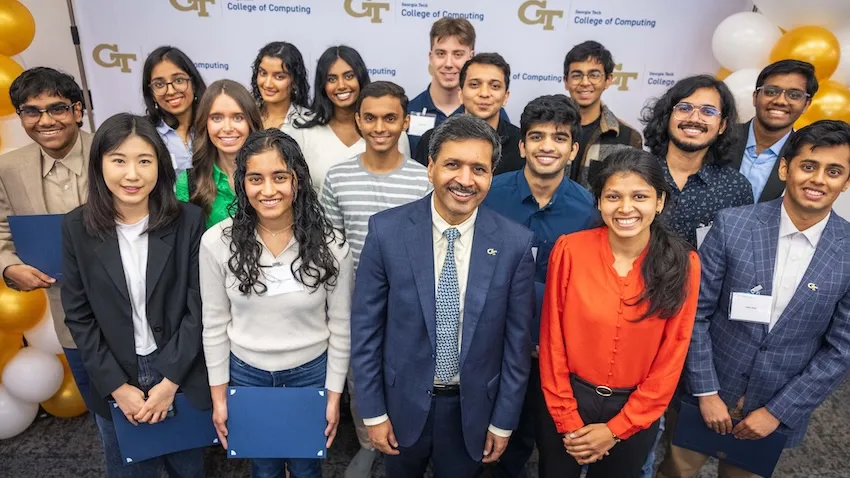
The dictionary is the only place where success comes before work. The College of Computing’s 34th Annual Awards Celebration on April 8 offered a venue to honor the hard work and ensuing success of students, faculty, staff, and alumni in 2024-2025.
“In this past year, my first as the dean of computing, I have seen exactly how much work it takes from everyone to keep this community going, not to mention excelling,” said Vivek Sarkar, dean and John P. Imlay Jr. Chair of the College of Computing.
“We are strong across the board, and that makes our winners all the more impressive.”
The School of Computational Science and Engineering (CSE) is one unit that reinforces the College’s emphasis on collaboration, problem solving, and excellence. By earning awards this year at the College, Institute, and levels beyond, the School of CSE continues to distinguish itself as a top-tier department for research and learning.
Select award winners from the School of CSE recognized at this year’s banquet were:
- Professor Polo Chau- Dean’s Award
- Pratham Mehta, M.S. CS student- The Donald V. Jackson Fellowship
- Parisa Babolhavaeji- The Marshall D. Williamson Fellowship
- Aeree Cho, Ph.D. student- Rising Star Doctoral Student Research Award
- Alumnus Zijie (Jay) Wang (Ph.D. ML-CSE 2024)- Outstanding Doctoral Dissertation Award
The College of Computing also recognized awardees with ties to the School of CSE. These included:
- Lecturer and alumnus Max Roozbahani (Ph.D. CSE 2019)- William A. "gus" Baird Faculty Teaching Award. Instructor of the online section of CSE6242: Data and Visual Analytics.
- Lecturer and alumnus Nimisha Roy (Ph.D. CSE 2021)- William D. "Bill" Leahy Jr. Outstanding Instructor Award
- Teaching Assistant Susanta Routray- Outstanding Instructional Associate Teaching Award. Co-head TA of the online section of CSE6242: Data and Visual Analytics.
Chau teaches the CSE6242 course, and advises Babolhavaeji, Cho, Mehta, and Wang. Along with the College of Computing awards, Chau received the Innovator’s Award at the M.S. Analytics Ten Year Anniversary. He has served as the program’s associate director since 2014 and over 1,000 students have taken his data and visual analytics course each semester in recent years.
Along with receiving the College of Computing’s dissertation, Wang received a 2025 Outstanding Dissertation Award from the Association for Computing Machinery Special Interest Group on Computer-Human Interaction (ACM SIGCHI).
SIGCHI is the world’s largest association of human-computer interaction professionals and practitioners. Wang is one of five recipients of the award this year.
Earlier in the year, Forbes recognized Wang by naming him to its 30 Under 30 in Science for 2025.
Wang’s dissertation earned him the 2025 Best Ph.D. Thesis Award from the Georgia Tech Sigma Chi chapter.
At the same ceremony, Sigma Chi presented Regents’ Professor Mark Borodovsky with the Best Faculty Paper Award for his work on GeneMark-ETP. Borodovsky holds joint appointments with the School of CSE and the Wallace H. Coulter Department of Biomedical Engineering.
Trailblazing work in biocomputing earned Regents’ Professor Srinivas Aluru the 2025 Charles Babbage Award. The Institute of Electrical and Electronics Engineers Computer Society (IEEE CS) presented the award for Aluru’s pioneering contributions intersecting parallel computing and computational biology.
News of Aluru’s Babbage Award arrived at the same time the College of Computing announced the appointments of associate deans. The College appointed Aluru as senior associate dean, and Associate Professor Elizabeth Cherry became associate dean for graduate education.
Aluru and Cherry’s appointments marked the first time in the School’s history that faculty represented the School as associate deans.
Aluru ended his role as executive director of Georgia Tech’s Institute for Data Engineering and Science (IDEaS) when he accepted the senior associate dean role. In his place, IDEaS appointed Regents’ Professor C. David Sherrill as interim executive director.
Sherrill holds joint appointments with CSE and the School of Chemistry and Biochemistry. He has served as associate director of IDEaS since its founding in 2016. His appointment as interim executive director comes after his election to the International Academy of Quantum Molecular Science (IAQMS).
Cherry's appointment as associate dean was one of many accolades she received in 2025. In March, the Society for Industrial and Applied Mathematics (SIAM) selected her as a Class of 2025 Fellow, recognizing her contributions to computational cardiology research and extensive service to the SIAM community. Cherry is the fifth faculty member from the School of CSE selected as a SIAM Fellow.
Cherry co-chaired the organizing committee for the SIAM Conference on Computational Science and Engineering (CSE25). She is also serving a second consecutive term as a SIAM council member-at-large.
Members of the SIAM Activity Group on Computational Science and Engineering (SIAG/CSE) elected School of CSE Professor and Associate Chair Edmond Chow as vice chair. Chow’s two-year term began in January after serving as the group’s program director.
Cherry previously served as the School of CSE’s associate chair for academic affairs. When she accepted her new associate dean role, the School appointed B. Aditya Prakash as associate chair.
Prakash was one of three School of CSE faculty members who received promotions that take effect in July. He was promoted to full professor. Assistant Professors Chao Zhang and Xiuwei Zhang earned tenure and promotions. Each has been promoted to associate professor.
Prakash advised Alexander Rodríguez (Ph.D. CS 2023), now an assistant professor at the University of Michigan. Rodríguez won an outstanding dissertation award runner-up at the International Conference on Knowledge Discovery and Data Mining (KDD 2024).
Rodríguez’s dissertation on Artificial Intelligence for Data-centric Surveillance and Forecasting of Epidemics earned him the College of Computing's Outstanding Dissertation Award in 2024.
Assistant Professor Florian Schäfer co-authored a paper selected for one of five best technical paper awards at the annual conference for ACM’s Special Interest Group on Computer Graphics and Interactive Techniques (SIGGRAPH 24).
Schäfer’s work in numerical computation and statistical inference led to his appointment as an initiative lead within Georgia Tech’s Institute for Matter and Systems (IMS). IMS selected Schäfer to lead the initiative on Matter and Information, looking to him to facilitate innovative approaches and impact in alignment with IMS’ mission.
Assistant Professor Spencer Bryngelson and his group received an ACCESS-CI Maximize allocation from the National Science Foundation. The award amounts to 225,000 GPU hours annually to run their multiphase fluid flow simulation algorithms on powerful supercomputers.
One of Bryngelson’s Ph.D. students, Ben Wilfong, received the 2024-2025 CRNCH Fellowship. Wilfong will use the fellowship to optimize superchip architectures, such as NVIDIA Grace Hopper and AMD MI300A.
Early in the year, Suzan Manasreh and Elizabeth Hong won President’s Undergraduate Research Awards (PURA) for Fall 2024. Manasreh studies in Bryngelson’s group, and Professor Rich Vuduc advises Hong.
M.S. CSE student Grace Driskill attained achievement in the classroom, on the track, and cross country courses. The first-ever School of CSE student-athlete earned a third selection to an All-ACC academic team.
Driskill made history by recording the fourth fastest 3000-meter time in history of the Georgia Tech Women’s Indoor Track program. She clocked a 9:22.21 on Feb. 15 at Boston University’s David Hemery Valentine Invitational.
Students praised Assistant Professor Raphaël Pestourie, who was selected for the Fall 2024 CIOS Honor Roll. The honor roll recognized Pestourie for outstanding teaching and educational impact through his CSE 8803: Scientific Machine Learning course.
In the waning weeks of the semester, CSE-AE Ph.D. student Atticus Rex received the NSF Graduate Research Fellowship Program (GRFP) award for computational and data-enabled science research. Rex is advised by Assistant Professor Elizabeth Qian, who holds joint appointments with the School of CSE and the Daniel Guggenheim School of Aerospace Engineering.
In March, the American Institute of Mining, Metallurgical and Petroleum Engineers (AIME) awarded honorary membership to Regents’ Professor Surya Kalidindi. Kalidindi is affiliated with the School of CSE, the George W. Woodruff School of Mechanical Engineering, and the School of Materials Science and Engineering.
News Contact
Bryant Wine, Communications Officer
bryant.wine@cc.gatech.edu

Instead of relying on traditional methods like cognitive tests and image scans, this new approach leverages data science and algorithms.
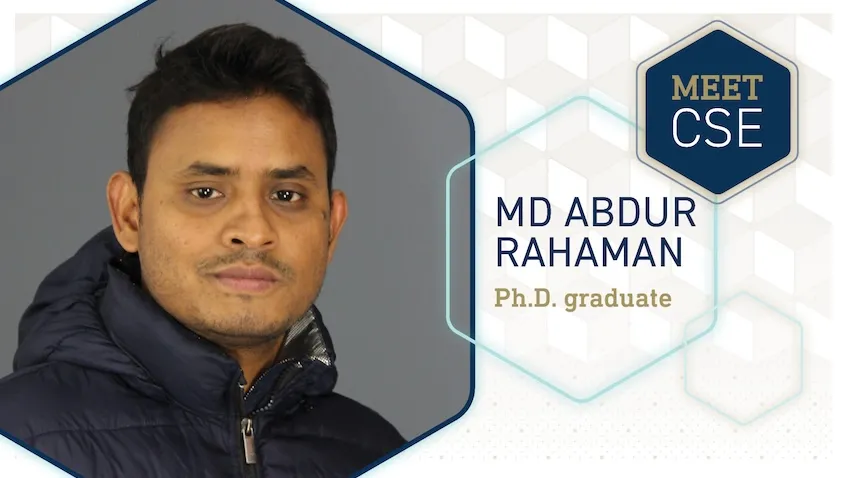
Ph.D. candidate Md Abdur Rahaman’s dissertation studies brain data to understand how changes in brain activity shape behavior.

A Georgia Tech doctoral student’s dissertation could help physicians diagnose neuropsychiatric disorders, including schizophrenia, autism, and Alzheimer’s disease. The new approach leverages data science and algorithms instead of relying on traditional methods like cognitive tests and image scans.
Ph.D. candidate Md Abdur Rahaman’s dissertation studies brain data to understand how changes in brain activity shape behavior.
Computational tools Rahaman developed for his dissertation look for informative patterns between the brain and behavior. Successful tests of his algorithms show promise to help doctors diagnose mental health disorders and design individualized treatment plans for patients.
“I've always been fascinated by the human brain and how it defines who we are,” Rahaman said.
“The fact that so many people silently suffer from neuropsychiatric disorders, while our understanding of the brain remains limited, inspired me to develop tools that bring greater clarity to this complexity and offer hope through more compassionate, data-driven care.”
Rahaman’s dissertation introduces a framework focusing on granular factoring. This computing technique stratifies brain data into smaller, localized subgroups, making it easier for computers and researchers to study data and find meaningful patterns.
Granular factoring overcomes the challenges of size and heterogeneity in neurological data science. Brain data is obtained from neuroimaging, genomics, behavioral datasets, and other sources. The large size of each source makes it a challenge to study them individually, let alone analyze them simultaneously, to find hidden inferences.
Rahaman’s research allows researchers and physicians to move past one-size-fits-all approaches. Instead of manually reviewing tests and scans, algorithms look for patterns and biomarkers in the subgroups that otherwise go undetected, especially ones that indicate neuropsychiatric disorders.
“My dissertation advances the frontiers of computational neuroscience by introducing scalable and interpretable models that navigate brain heterogeneity to reveal how neural dynamics shape behavior,” Rahaman said.
“By uncovering subgroup-specific patterns, this work opens new directions for understanding brain function and enables more precise, personalized approaches to mental health care.”
Rahaman defended his dissertation on April 14, the final step in completing his Ph.D. in computational science and engineering. He will graduate on May 1 at Georgia Tech’s Ph.D. Commencement.
After walking across the stage at McCamish Pavilion, Rahaman’s next step in his career is to go to Amazon, where he will work in the generative artificial intelligence (AI) field.
Graduating from Georgia Tech is the summit of an educational trek spanning over a decade. Rahaman hails from Bangladesh where he graduated from Chittagong University of Engineering and Technology in 2013. He attained his master’s from the University of New Mexico in 2019 before starting at Georgia Tech.
“Munna is an amazingly creative researcher,” said Vince Calhoun, Rahman’s advisor. Calhoun is the founding director of the Translational Research in Neuroimaging and Data Science Center (TReNDS).
TReNDS is a tri-institutional center spanning Georgia Tech, Georgia State University, and Emory University that develops analytic approaches and neuroinformatic tools. The center aims to translate the approaches into biomarkers that address areas of brain health and disease.
“His work is moving the needle in our ability to leverage multiple sources of complex biological data to improve understanding of neuropsychiatric disorders that have a huge impact on an individual’s livelihood,” said Calhoun.
News Contact
Bryant Wine, Communications Officer
bryant.wine@cc.gatech.edu
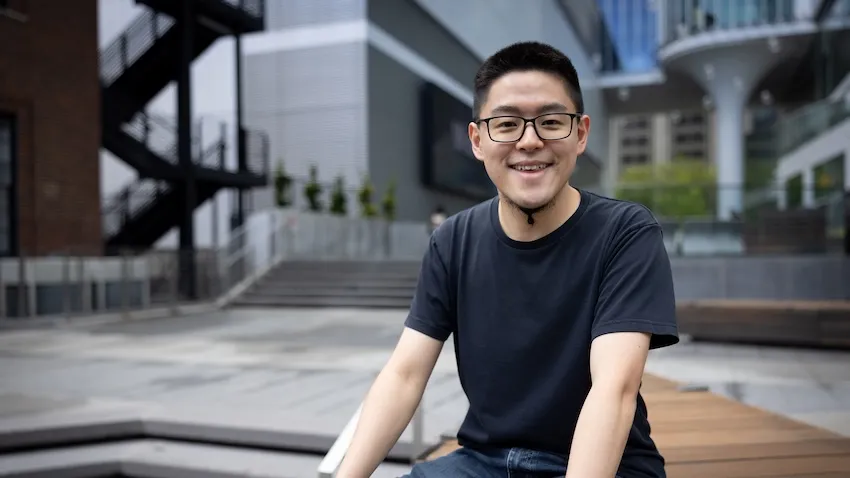
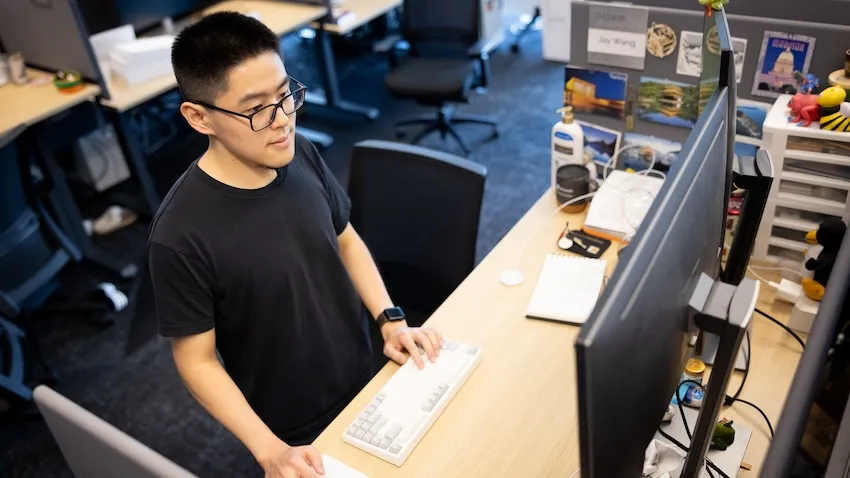
A Georgia Tech alum’s dissertation introduced ways to make artificial intelligence (AI) more accessible, interpretable, and accountable. Although it’s been a year since his doctoral defense, Zijie (Jay) Wang’s (Ph.D. ML-CSE 2024) work continues to resonate with researchers.
Wang is a recipient of the 2025 Outstanding Dissertation Award from the Association for Computing Machinery Special Interest Group on Computer-Human Interaction (ACM SIGCHI). The award recognizes Wang for his lifelong work on democratizing human-centered AI.
“Throughout my Ph.D. and industry internships, I observed a gap in existing research: there is a strong need for practical tools for applying human-centered approaches when designing AI systems,” said Wang, now a safety researcher at OpenAI.
“My work not only helps people understand AI and guide its behavior but also provides user-friendly tools that fit into existing workflows.”
[Related: Georgia Tech College of Computing Swarms to Yokohama, Japan, for CHI 2025]
Wang’s dissertation presented techniques in visual explanation and interactive guidance to align AI models with user knowledge and values. The work culminated from years of research, fellowship support, and internships.
Wang’s most influential projects formed the core of his dissertation. These included:
- CNN Explainer: an open-source tool developed for deep-learning beginners. Since its release in July 2020, more than 436,000 global visitors have used the tool.
- DiffusionDB: a first-of-its-kind large-scale dataset that lays a foundation to help people better understand generative AI. This work could lead to new research in detecting deepfakes and designing human-AI interaction tools to help people more easily use these models.
- GAM Changer: an interface that empowers users in healthcare, finance, or other domains to edit ML models to include knowledge and values specific to their domain, which improves reliability.
- GAM Coach: an interactive ML tool that could help people who have been rejected for a loan by automatically letting an applicant know what is needed for them to receive loan approval.
- Farsight: a tool that alerts developers when they write prompts in large language models that could be harmful and misused.
“I feel extremely honored and lucky to receive this award, and I am deeply grateful to many who have supported me along the way, including Polo, mentors, collaborators, and friends,” said Wang, who was advised by School of Computational Science and Engineering (CSE) Professor Polo Chau.
“This recognition also inspired me to continue striving to design and develop easy-to-use tools that help everyone to easily interact with AI systems.”
Like Wang, Chau advised Georgia Tech alumnus Fred Hohman (Ph.D. CSE 2020). Hohman won the ACM SIGCHI Outstanding Dissertation Award in 2022.
Chau’s group synthesizes machine learning (ML) and visualization techniques into scalable, interactive, and trustworthy tools. These tools increase understanding and interaction with large-scale data and ML models.
Chau is the associate director of corporate relations for the Machine Learning Center at Georgia Tech. Wang called the School of CSE his home unit while a student in the ML program under Chau.
Wang is one of five recipients of this year’s award to be presented at the 2025 Conference on Human Factors in Computing Systems (CHI 2025). The conference occurs April 25-May 1 in Yokohama, Japan.
SIGCHI is the world’s largest association of human-computer interaction professionals and practitioners. The group sponsors or co-sponsors 26 conferences, including CHI.
Wang’s outstanding dissertation award is the latest recognition of a career decorated with achievement.
Months after graduating from Georgia Tech, Forbes named Wang to its 30 Under 30 in Science for 2025 for his dissertation. Wang was one of 15 Yellow Jackets included in nine different 30 Under 30 lists and the only Georgia Tech-affiliated individual on the 30 Under 30 in Science list.
While a Georgia Tech student, Wang earned recognition from big names in business and technology. He received the Apple Scholars in AI/ML Ph.D. Fellowship in 2023 and was in the 2022 cohort of the J.P. Morgan AI Ph.D. Fellowships Program.
Along with the CHI award, Wang’s dissertation earned him awards this year at banquets across campus. The Georgia Tech chapter of Sigma Xi presented Wang with the Best Ph.D. Thesis Award. He also received the College of Computing’s Outstanding Dissertation Award.
“Georgia Tech attracts many great minds, and I’m glad that some, like Jay, chose to join our group,” Chau said. “It has been a joy to work alongside them and witness the many wonderful things they have accomplished, and with many more to come in their careers.”
News Contact
Bryant Wine, Communications Officer
bryant.wine@cc.gatech.edu
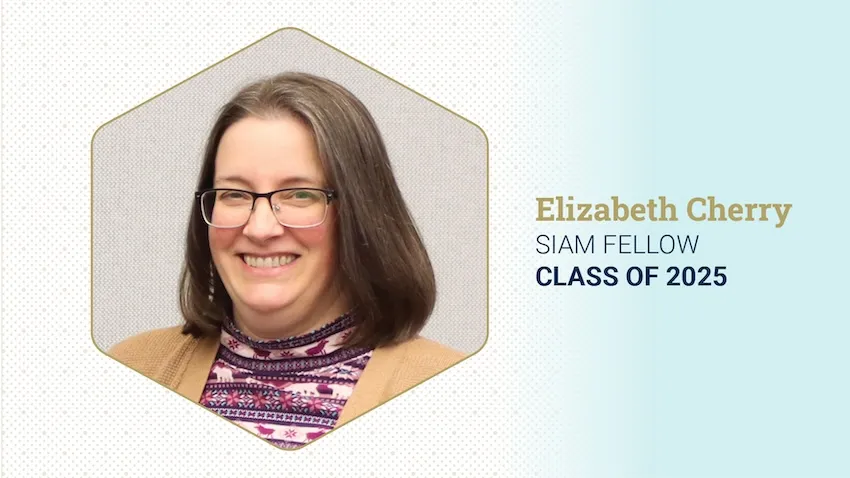
Two faculty members represented Georgia Tech as new fellows to the world’s leading organization dedicated to applied mathematics, computational science, and data science.
The Society for Industrial and Applied Mathematics (SIAM) selected Elizabeth Cherry and Katya Scheinberg as Class of 2025 fellows. The two Georgia Tech faculty join an illustrious class of 23 other researchers from around the globe in this year’s class.
SIAM selected Cherry to recognize her contributions to mathematical and computational modeling and extensive service to the SIAM community. She studies the electrical behavior of cardiac cells and tissue.
Cherry’s computer models and simulations improve understanding of cardiac dynamics in normal and diseased states. Using these tools, she designs advanced strategies for preventing and treating arrhythmias.
“SIAM has played a huge role in my professional development—the first conference I attended as a graduate student was a SIAM conference, and I’ve attended at least one SIAM conference almost every year since then,” Cherry said.
“Given this long history, it means a lot to me for SIAM to acknowledge my contributions in this way.”
Scheinberg, from Georgia Tech’s College of Engineering, was selected for her foundational contributions to derivative-free optimization and optimization applications in data science and her dedicated service to the optimization community.
[Related: Coca-Cola Foundation Chair Katya Scheinberg selected for 2025 Class of SIAM Fellows]
Cherry is the fifth faculty member from the School of Computational Science and Engineering (CSE) to be selected as a SIAM Fellow.
Cherry’s announcement as a SIAM Fellow comes weeks after serving in a leadership role at a SIAM conference. She co-chaired the organizing committee of the SIAM Conference on Computational Science and Engineering (CSE25).
In 2023, SIAM members reelected Cherry to a second term as a council member-at-large. She began her three-year term in January 2024.
"SIAM Fellows are selected for deep mathematical contributions. Receiving Fellow status is a high honor for any applied mathematician," said Regents’ Professor Srinivas Aluru, senior associate dean of the College of Computing and Class of 2020 SIAM Fellow.
"Not only are Elizabeth's contributions technically outstanding, but her work also provides deep insights into the functioning of the heart and its abnormalities."
Cherry’s leadership and service extends outside of SIAM, influencing students and faculty across Georgia Tech.
In December, the College of Computing appointed Cherry as associate dean for graduate education. Before this appointment, she served as associate chair for academic affairs of the School of CSE.
With her new role as associate dean, Cherry continues serving as director of CSE programs at Georgia Tech.
In March 2024, Cherry was among five Georgia Tech faculty members selected for the ACC Academic Leaders Network (ACC ALN) Fellows program. The ALN program fosters cross-institutional networking and collaboration between ACC schools, increasing each institution’s academic leadership capacity.
Cherry was part of a team of Georgia Tech and Emory University researchers who won a Georgia Clinical and Translational Science Alliance award in 2023. The group earned the Team Science Award of Distinction for Early Stage Research Teams award for work that captures high-resolution visualizations of spiral waves that create heart arrhythmias.
SIAM will recognize Cherry, Scheinberg, and Class of 2025 fellows during a reception at the SIAM/CAIMS Annual Meetings this July in Montréal.
“It is such an honor to be recognized as a SIAM Fellow,” Cherry said. “I’m thrilled to join my CSE colleagues who have also received this recognition.”
News Contact
Bryant Wine, Communications Officer
bryant.wine@cc.gatech.edu
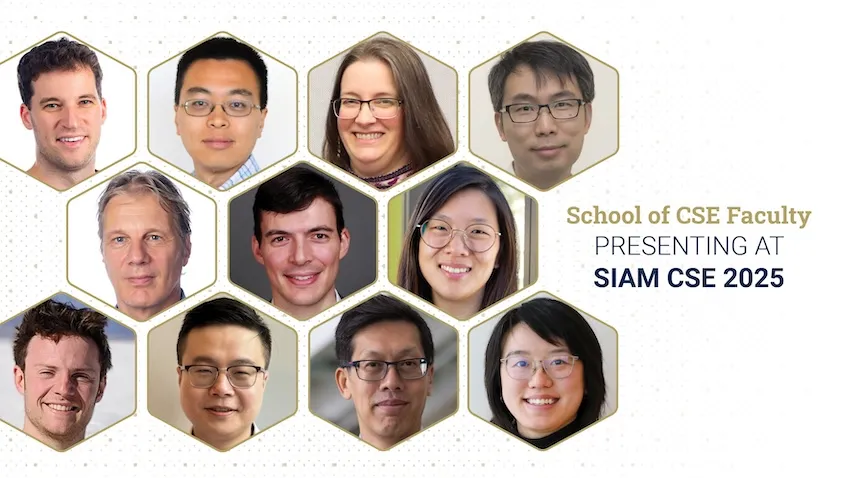
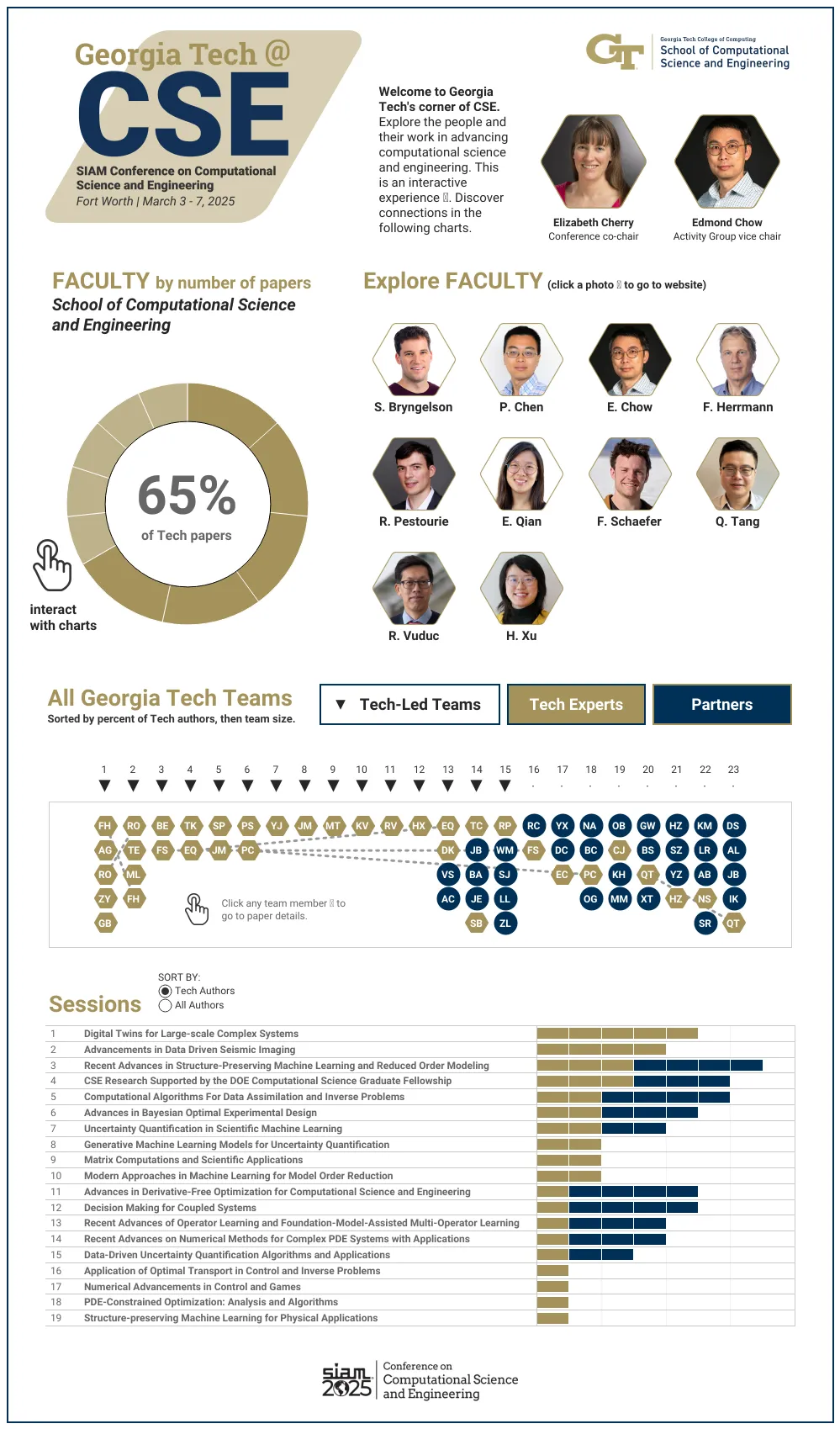
Many communities rely on insights from computer-based models and simulations. This week, a nest of Georgia Tech experts are swarming an international conference to present their latest advancements in these tools, which offer solutions to pressing challenges in science and engineering.
Students and faculty from the School of Computational Science and Engineering (CSE) are leading the Georgia Tech contingent at the SIAM Conference on Computational Science and Engineering (CSE25). The Society of Industrial and Applied Mathematics (SIAM) organizes CSE25, occurring March 3-7 in Fort Worth, Texas.
At CSE25, the School of CSE researchers are presenting papers that apply computing approaches to varying fields, including:
- Experiment designs to accelerate the discovery of material properties
- Machine learning approaches to model and predict weather forecasting and coastal flooding
- Virtual models that replicate subsurface geological formations used to store captured carbon dioxide
- Optimizing systems for imaging and optical chemistry
- Plasma physics during nuclear fusion reactions
[Related: GT CSE at SIAM CSE25 Interactive Graphic]
“In CSE, researchers from different disciplines work together to develop new computational methods that we could not have developed alone,” said School of CSE Professor Edmond Chow.
“These methods enable new science and engineering to be performed using computation.”
CSE is a discipline dedicated to advancing computational techniques to study and analyze scientific and engineering systems. CSE complements theory and experimentation as modes of scientific discovery.
Held every other year, CSE25 is the primary conference for the SIAM Activity Group on Computational Science and Engineering (SIAG CSE). School of CSE faculty serve in key roles in leading the group and preparing for the conference.
In December, SIAG CSE members elected Chow to a two-year term as the group’s vice chair. This election comes after Chow completed a term as the SIAG CSE program director.
School of CSE Associate Professor Elizabeth Cherry has co-chaired the CSE25 organizing committee since the last conference in 2023. Later that year, SIAM members reelected Cherry to a second, three-year term as a council member at large.
At Georgia Tech, Chow serves as the associate chair of the School of CSE. Cherry, who recently became the associate dean for graduate education of the College of Computing, continues as the director of CSE programs.
“With our strong emphasis on developing and applying computational tools and techniques to solve real-world problems, researchers in the School of CSE are well positioned to serve as leaders in computational science and engineering both within Georgia Tech and in the broader professional community,” Cherry said.
Georgia Tech’s School of CSE was first organized as a division in 2005, becoming one of the world’s first academic departments devoted to the discipline. The division reorganized as a school in 2010 after establishing the flagship CSE Ph.D. and M.S. programs, hiring nine faculty members, and attaining substantial research funding.
Ten School of CSE faculty members are presenting research at CSE25, representing one-third of the School’s faculty body. Of the 23 accepted papers written by Georgia Tech researchers, 15 originate from School of CSE authors.
The list of School of CSE researchers, paper titles, and abstracts includes:
Bayesian Optimal Design Accelerates Discovery of Material Properties from Bubble Dynamics
Postdoctoral Fellow Tianyi Chu, Joseph Beckett, Bachir Abeid, and Jonathan Estrada (University of Michigan), Assistant Professor Spencer Bryngelson
[Abstract]
Latent-EnSF: A Latent Ensemble Score Filter for High-Dimensional Data Assimilation with Sparse Observation Data
Ph.D. student Phillip Si, Assistant Professor Peng Chen
[Abstract]
A Goal-Oriented Quadratic Latent Dynamic Network Surrogate Model for Parameterized Systems
Yuhang Li, Stefan Henneking, Omar Ghattas (University of Texas at Austin), Assistant Professor Peng Chen
[Abstract]
Posterior Covariance Structures in Gaussian Processes
Yuanzhe Xi (Emory University), Difeng Cai (Southern Methodist University), Professor Edmond Chow
[Abstract]
Robust Digital Twin for Geological Carbon Storage
Professor Felix Herrmann, Ph.D. student Abhinav Gahlot, alumnus Rafael Orozco (Ph.D. CSE-CSE 2024), alumnus Ziyi (Francis) Yin (Ph.D. CSE-CSE 2024), and Ph.D. candidate Grant Bruer
[Abstract]
Industry-Scale Uncertainty-Aware Full Waveform Inference with Generative Models
Rafael Orozco, Ph.D. student Tuna Erdinc, alumnus Mathias Louboutin (Ph.D. CS-CSE 2020), and Professor Felix Herrmann
[Abstract]
Optimizing Coupled Systems: Insights from Co-Design Imaging and Optical Chemistry
Assistant Professor Raphaël Pestourie, Wenchao Ma and Steven Johnson (MIT), Lu Lu (Yale University), Zin Lin (Virginia Tech)
[Abstract]
Multifidelity Linear Regression for Scientific Machine Learning from Scarce Data
Assistant Professor Elizabeth Qian, Ph.D. student Dayoung Kang, Vignesh Sella, Anirban Chaudhuri and Anirban Chaudhuri (University of Texas at Austin)
[Abstract]
LyapInf: Data-Driven Estimation of Stability Guarantees for Nonlinear Dynamical Systems
Ph.D. candidate Tomoki Koike and Assistant Professor Elizabeth Qian
[Abstract]
The Information Geometric Regularization of the Euler Equation
Alumnus Ruijia Cao (B.S. CS 2024), Assistant Professor Florian Schäfer
[Abstract]
Maximum Likelihood Discretization of the Transport Equation
Ph.D. student Brook Eyob, Assistant Professor Florian Schäfer
[Abstract]
Intelligent Attractors for Singularly Perturbed Dynamical Systems
Daniel A. Serino (Los Alamos National Laboratory), Allen Alvarez Loya (University of Colorado Boulder), Joshua W. Burby, Ioannis G. Kevrekidis (Johns Hopkins University), Assistant Professor Qi Tang (Session Co-Organizer)
[Abstract]
Accurate Discretizations and Efficient AMG Solvers for Extremely Anisotropic Diffusion Via Hyperbolic Operators
Golo Wimmer, Ben Southworth, Xianzhu Tang (LANL), Assistant Professor Qi Tang
[Abstract]
Randomized Linear Algebra for Problems in Graph Analytics
Professor Rich Vuduc
[Abstract]
Improving Spgemm Performance Through Reordering and Cluster-Wise Computation
Assistant Professor Helen Xu
[Abstract]
News Contact
Bryant Wine, Communications Officer
bryant.wine@cc.gatech.edu
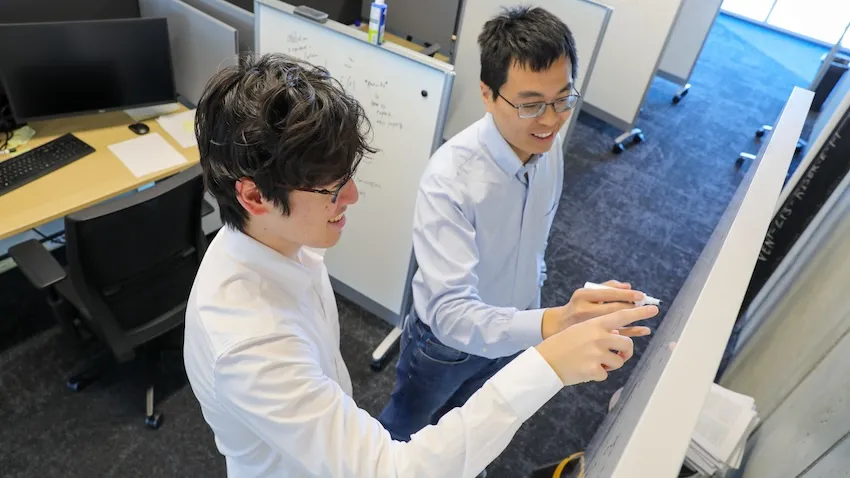
Successful test results of a new machine learning (ML) technique developed at Georgia Tech could help communities prepare for extreme weather and coastal flooding. The approach could also be applied to other models that predict how natural systems impact society.
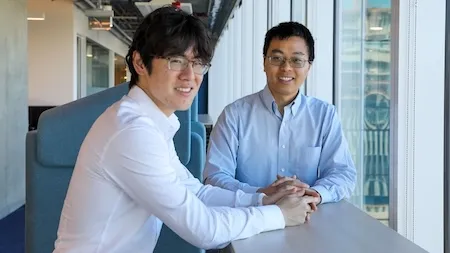
Ph.D. student Phillip Si and Assistant Professor Peng Chen developed Latent-EnSF, a technique that improves how ML models assimilate data to make predictions.
In experiments predicting medium-range weather forecasting and shallow water wave propagation, Latent-EnSF demonstrated higher accuracy, faster convergence, and greater efficiency than existing methods for sparse data assimilation.
“We are currently involved in an NSF-funded project aimed at providing real-time information on extreme flooding events in Pinellas County, Florida,” said Si, who studies computational science and engineering (CSE).
“We're actively working on integrating Latent-EnSF into the system, which will facilitate accurate and synchronized modeling of natural disasters. This initiative aims to enhance community preparedness and safety measures in response to flooding risks.”
Latent-EnSF outperformed three comparable models in assimilation speed, accuracy, and efficiency in shallow water wave propagation experiments. These tests show models can make better and faster predictions of coastal flood waves, tides, and tsunamis.
In experiments on medium-range weather forecasting, Latent-EnSF surpassed the same three control models in accuracy, convergence, and time. Additionally, this test demonstrated Latent-EnSF's scalability compared to other methods.
These promising results support using ML models to simulate climate, weather, and other complex systems.
Traditionally, such studies require employment of large, energy-intensive supercomputers. However, advances like Latent-EnSF are making smaller, more efficient ML models feasible for these purposes.
The Georgia Tech team mentioned this comparison in its paper. It takes hours for the European Center for Medium-Range Weather Forecasts computer to run its simulations. Conversely, the ML model FourCastNet calculated the same forecast in seconds.
“Resolution, complexity, and data-diversity will continue to increase into the future,” said Chen, an assistant professor in the School of CSE.
“To keep pace with this trend, we believe that ML models and ML-based data assimilation methods will become indispensable for studying large-scale complex systems.”
Data assimilation is the process by which models continuously ingest new, real-world data to update predictions. This data is often sparse, meaning it is limited, incomplete, or unevenly distributed over time.
Latent-EnSF builds on the Ensemble Filter Scores (EnSF) model developed by Florida State University and Oak Ridge National Laboratory researchers.
EnSF’s strength is that it assimilates data with many features and unpredictable relationships between data points. However, integrating sparse data leads to lost information and knowledge gaps in the model. Also, such large models may stop learning entirely from small amounts of sparse data.
The Georgia Tech researchers employ two variational autoencoders (VAEs) in Latent-EnSF to help ML models integrate and use real-world data. The VAEs encode sparse data and predictive models together in the same space to assimilate data more accurately and efficiently.
Integrating models with new methods, like Latent-EnSF, accelerates data assimilation. Producing accurate predictions more quickly during real-world crises could save lives and property for communities.
To share Latent-EnSF to the broader research community, Chen and Si presented their paper at the SIAM Conference on Computational Science and Engineering (CSE25). The Society of Industrial and Applied Mathematics (SIAM) organized CSE25, held March 3-7 in Fort Worth, Texas.
Chen was one of ten School of CSE faculty members who presented research at CSE25, representing one-third of the School’s faculty body. Latent-EnSF was one of 15 papers by School of CSE authors and one of 23 Georgia Tech papers presented at the conference.
The pair will also present Latent-EnSF at the upcoming International Conference on Learning Representations (ICLR 2025). Occurring April 24-28 in Singapore, ICLR is one of the world’s most prestigious conferences dedicated to artificial intelligence research.
“We hope to bring attention to experts and domain scientists the exciting area of ML-based data assimilation by presenting our paper,” Chen said. “Our work offers a new solution to address some of the key shortcomings in the area for broader applications.”
News Contact
Bryant Wine, Communications Officer
bryant.wine@cc.gatech.edu
Many communities rely on insights from computer-based models and simulations. This week, a nest of Georgia Tech experts are swarming an international conference to present their latest advancements in these tools, which offer solutions to pressing challenges in science and engineering.
Students and faculty from the School of Computational Science and Engineering (CSE) are leading the Georgia Tech contingent at the SIAM Conference on Computational Science and Engineering (CSE25). The Society of Industrial and Applied Mathematics (SIAM) organizes CSE25, occurring March 3-7 in Fort Worth, Texas.
At CSE25, the School of CSE researchers are presenting papers that apply computing approaches to varying fields, including:
- Experiment designs to accelerate the discovery of material properties
- Machine learning approaches to model and predict weather forecasting and coastal flooding
- Virtual models that replicate subsurface geological formations used to store captured carbon dioxide
- Optimizing systems for imaging and optical chemistry
- Plasma physics during nuclear fusion reactions
[Related: GT CSE at SIAM CSE25 Interactive Graphic]
“In CSE, researchers from different disciplines work together to develop new computational methods that we could not have developed alone,” said School of CSE Professor Edmond Chow.
“These methods enable new science and engineering to be performed using computation.”
CSE is a discipline dedicated to advancing computational techniques to study and analyze scientific and engineering systems. CSE complements theory and experimentation as modes of scientific discovery.
Held every other year, CSE25 is the primary conference for the SIAM Activity Group on Computational Science and Engineering (SIAG CSE). School of CSE faculty serve in key roles in leading the group and preparing for the conference.
In December, SIAG CSE members elected Chow to a two-year term as the group’s vice chair. This election comes after Chow completed a term as the SIAG CSE program director.
School of CSE Associate Professor Elizabeth Cherry has co-chaired the CSE25 organizing committee since the last conference in 2023. Later that year, SIAM members reelected Cherry to a second, three-year term as a council member at large.
At Georgia Tech, Chow serves as the associate chair of the School of CSE. Cherry, who recently became the associate dean for graduate education of the College of Computing, continues as the director of CSE programs.
“With our strong emphasis on developing and applying computational tools and techniques to solve real-world problems, researchers in the School of CSE are well positioned to serve as leaders in computational science and engineering both within Georgia Tech and in the broader professional community,” Cherry said.
Georgia Tech’s School of CSE was first organized as a division in 2005, becoming one of the world’s first academic departments devoted to the discipline. The division reorganized as a school in 2010 after establishing the flagship CSE Ph.D. and M.S. programs, hiring nine faculty members, and attaining substantial research funding.
Ten School of CSE faculty members are presenting research at CSE25, representing one-third of the School’s faculty body. Of the 23 accepted papers written by Georgia Tech researchers, 15 originate from School of CSE authors.
The list of School of CSE researchers, paper titles, and abstracts includes:
Bayesian Optimal Design Accelerates Discovery of Material Properties from Bubble Dynamics
Postdoctoral Fellow Tianyi Chu, Joseph Beckett, Bachir Abeid, and Jonathan Estrada (University of Michigan), Assistant Professor Spencer Bryngelson
[Abstract]
Latent-EnSF: A Latent Ensemble Score Filter for High-Dimensional Data Assimilation with Sparse Observation Data
Ph.D. student Phillip Si, Assistant Professor Peng Chen
[Abstract]
A Goal-Oriented Quadratic Latent Dynamic Network Surrogate Model for Parameterized Systems
Yuhang Li, Stefan Henneking, Omar Ghattas (University of Texas at Austin), Assistant Professor Peng Chen
[Abstract]
Posterior Covariance Structures in Gaussian Processes
Yuanzhe Xi (Emory University), Difeng Cai (Southern Methodist University), Professor Edmond Chow
[Abstract]
Robust Digital Twin for Geological Carbon Storage
Professor Felix Herrmann, Ph.D. student Abhinav Gahlot, alumnus Rafael Orozco (Ph.D. CSE-CSE 2024), alumnus Ziyi (Francis) Yin (Ph.D. CSE-CSE 2024), and Ph.D. candidate Grant Bruer
[Abstract]
Industry-Scale Uncertainty-Aware Full Waveform Inference with Generative Models
Rafael Orozco, Ph.D. student Tuna Erdinc, alumnus Mathias Louboutin (Ph.D. CS-CSE 2020), and Professor Felix Herrmann
[Abstract]
Optimizing Coupled Systems: Insights from Co-Design Imaging and Optical Chemistry
Assistant Professor Raphaël Pestourie, Wenchao Ma and Steven Johnson (MIT), Lu Lu (Yale University), Zin Lin (Virginia Tech)
[Abstract]
Multifidelity Linear Regression for Scientific Machine Learning from Scarce Data
Assistant Professor Elizabeth Qian, Ph.D. student Dayoung Kang, Vignesh Sella, Anirban Chaudhuri and Anirban Chaudhuri (University of Texas at Austin)
[Abstract]
LyapInf: Data-Driven Estimation of Stability Guarantees for Nonlinear Dynamical Systems
Ph.D. candidate Tomoki Koike and Assistant Professor Elizabeth Qian
[Abstract]
The Information Geometric Regularization of the Euler Equation
Alumnus Ruijia Cao (B.S. CS 2024), Assistant Professor Florian Schäfer
[Abstract]
Maximum Likelihood Discretization of the Transport Equation
Ph.D. student Brook Eyob, Assistant Professor Florian Schäfer
[Abstract]
Intelligent Attractors for Singularly Perturbed Dynamical Systems
Daniel A. Serino (Los Alamos National Laboratory), Allen Alvarez Loya (University of Colorado Boulder), Joshua W. Burby, Ioannis G. Kevrekidis (Johns Hopkins University), Assistant Professor Qi Tang (Session Co-Organizer)
[Abstract]
Accurate Discretizations and Efficient AMG Solvers for Extremely Anisotropic Diffusion Via Hyperbolic Operators
Golo Wimmer, Ben Southworth, Xianzhu Tang (LANL), Assistant Professor Qi Tang
[Abstract]
Randomized Linear Algebra for Problems in Graph Analytics
Professor Rich Vuduc
[Abstract]
Improving Spgemm Performance Through Reordering and Cluster-Wise Computation
Assistant Professor Helen Xu
[Abstract]
News Contact
Bryant Wine, Communications Officer
bryant.wine@cc.gatech.edu
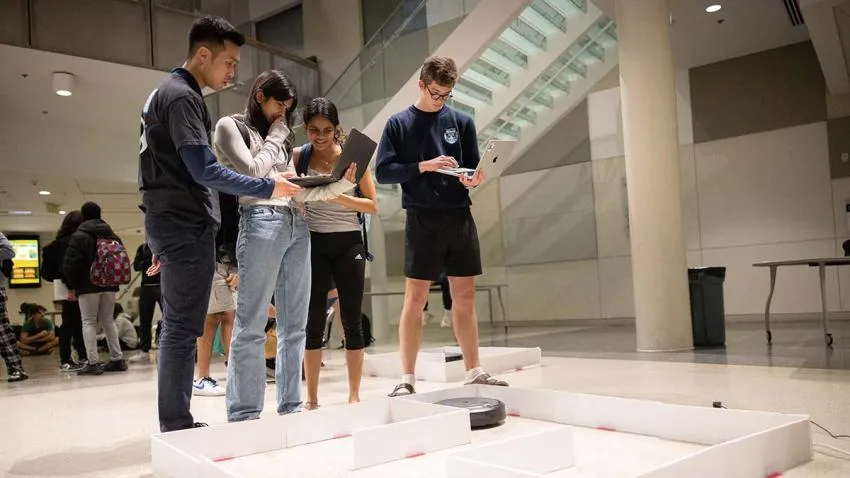
Students test their code using a robot. Photos by Kevin Beasley/College of Computing
As advancements in generative AI reshape the field and students face an increasingly competitive internship market, Georgia Tech’s introductory computer science (CS) courses are evolving to emphasize hands-on, real-world applications.
A new study examines the impact of integrating robotics into CS—a project led by School of Computing Instruction (SCI) faculty member Rodrigo Borela, with contributions from fellow faculty member Melinda McDaniel and head teaching assistant Zhixian "Chris" Liding.
Borela and his team will share their findings at the SIGCSE Technical Symposium 2025. They will present an accepted paper and accompanying talk on how robotics can enhance introductory CS education.
The study stems from Borela’s efforts to integrate robotics into CS1, an introductory CS course. With support from Georgia Tech’s Transformative Teaching and Learning Innovator Grant, Borela introduced robotics lab assignments into his course, focusing on experiential learning.
Over two semesters, more than 100 students participated, programming robots in Python to complete tasks like navigating mazes and avoiding obstacles using sensors. The goal is to foster teamwork, problem-solving skills, and confidence in applying coding techniques to real-world scenarios.
“Instead of just writing code in isolation, students programmed robots to navigate obstacles and simulate delivery routes, helping them develop systems-level thinking,” Borela said. “This hands-on approach goes beyond coding; it builds confidence, curiosity, and the ability to troubleshoot in complex, unpredictable scenarios.”
The study compared this robotics-based curriculum with traditional web development labs. Results showed that students in the robotics section demonstrated a twofold improvement in understanding course topics, as reflected in exam grades. They also reported heightened engagement and confidence in computational thinking and real-world applications.
“Compared to students doing traditional web development labs, those in the robotics group showed more confidence in their coding skills and a better understanding of systems thinking. Plus, they had fun—some even recorded their robots in action to share with friends,” he said.
The curriculum combined individual and team projects, significant engagement time, and reflective practices to promote deeper learning. Students built foundational coding skills and gained exposure to collaborative problem-solving, an essential skill in today’s tech-driven industries.
Beyond this robotics-focused research, SCI faculty and students are showcasing additional projects at SIGCSE 2025. Explore their full lineup of research here.
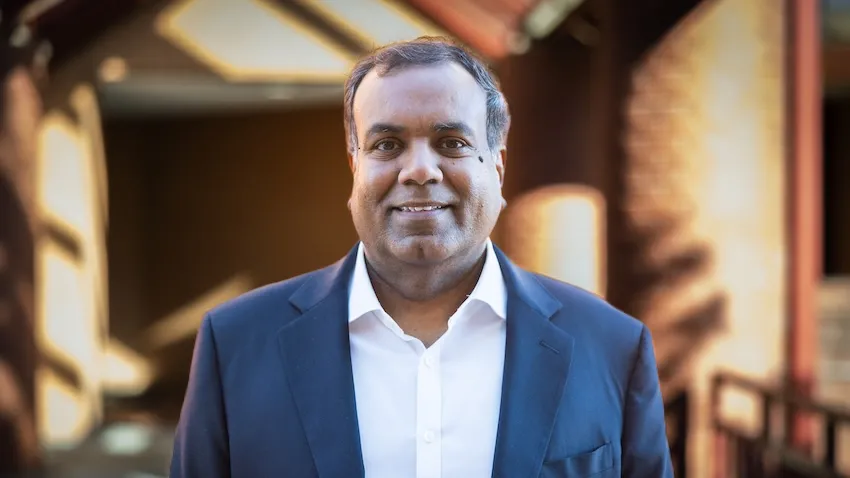
Georgia Tech Regents’ Professor Srinivas Aluru is the recipient of the Charles Babbage Award for 2025. Aluru was awarded for pioneering research contributions that intersect parallel computing and computational biology.
“This is a very well-deserved recognition for Srinivas as he joins the illustrious list of past recipients of the Charles Babbage Award,” said Vivek Sarkar, the John P. Imlay Jr. Dean of the College of Computing.
“Srinivas’ accomplishments reflect positively on himself and all of us at Georgia Tech. This is indeed an occasion to celebrate.”
The IEEE Computer Society presents the Babbage Award annually. The award recognizes significant contributions to parallel computation.
[Related: IEEE-CS interview with Aluru on his award-winning career]
The award is named after Charles Babbage, widely considered to be a “father of the computer.” Babbage and Ada Lovelace are credited with inventing the first mechanical computers in the 19th century, eventually leading to more complex designs.
Aluru is a pioneer in computational genomics, an area of biology that studies the order, structure, function, and evolution of genetic material. Throughout his career, his lab has developed software and algorithms to analyze the genomes of several species of plants, animals, and microorganisms.
Genome base pair sizes can number into the billions, which can be interpreted as massive datasets. Ever since the early years of his career, Aluru championed parallel computing as a practical approach to studying these challenging datasets.
Parallelism divides a large problem into smaller ones, allowing different processors on a computer to solve the simpler tasks simultaneously. This approach breaks a genome into smaller segments, allowing computers to efficiently transcribe genetic code and identify insightful patterns.
“Srinivas Aluru’s groundbreaking contributions have profoundly shaped the intersection of parallel processing and bioinformatics. His work is nothing short of extraordinary,” said Yves Robert, awards chair of the IEEE Computer Society Babbage Committee.
“It is a privilege to recognize a researcher whose work will undoubtedly have a lasting impact for generations to come.”
IEEE selected Aluru as a fellow in 2010, and he recently served as the editor-in-chief of the journal IEEE/ACM Transactions on Computational Biology and Bioinformatics.
Aluru has fellowships with the American Association for the Advancement of Science, the Association for Computing Machinery (ACM), and the Society of Industrial and Applied Mathematics. He is a past recipient of the NSF CAREER Award, IBM Faculty Award, and the Swarnajayanti Fellowship from the government of India.
Along with receiving the Babbage Award, Aluru’s leadership acumen earned him the recent appointment as senior associate dean of Georgia Tech’s College of Computing.
Aluru helped form the Institute for Data Engineering and Science (IDEaS) at Georgia Tech in 2016, serving as co-executive director. Later, he became the institute’s sole executive director from 2019 to 2025. Regents’ Professor C. David Sherrill became interim executive director of IDEaS when Aluru accepted his associate dean appointment.
Aluru started at Georgia Tech in 2013 to join the new School of Computational Science and Engineering, established in 2010. He served as the School’s interim chair from 2019 to 2020. In 2023, the University System of Georgia appointed Aluru as Regents’ Professor.
Aluru completed his Ph.D. at Iowa State University in 1994. He then worked at Ames National Laboratory, Syracuse University, and New Mexico State University before returning to his alma mater from 1999 to 2013.
“This award is a recognition of over two and a half decades of research efforts in my group, reflecting not only my work but that of numerous graduate students and collaborators,” said Aluru.
“I hope the award draws attention to the importance of parallel methods in computational biology and points key advancements to new entrants in the field.”
News Contact
Bryant Wine, Communications Officer
bryant.wine@cc.gatech.edu
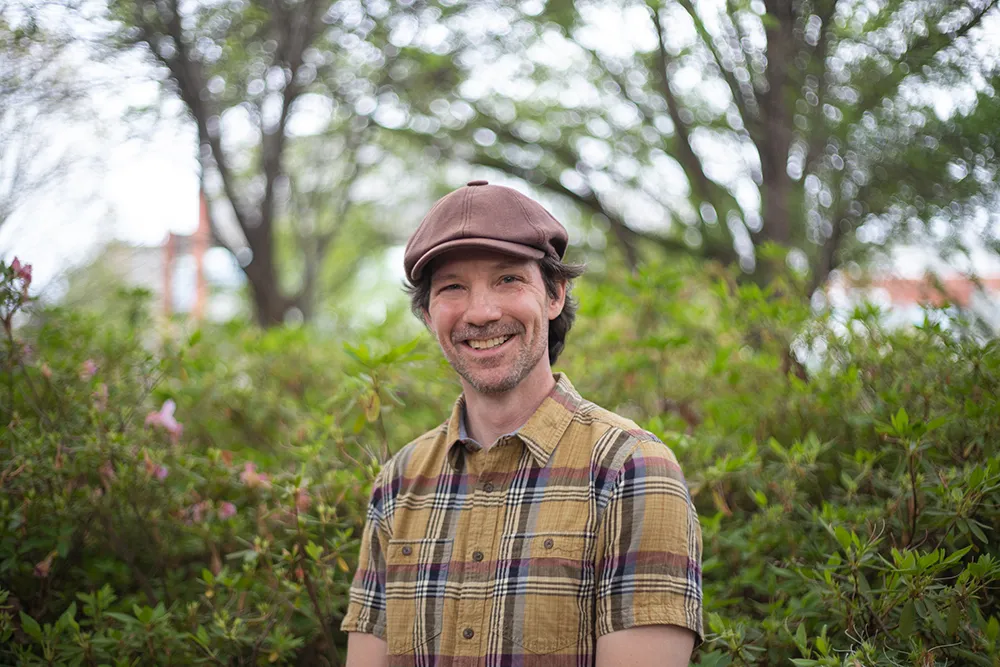
Gregory Sawicki to Serve as Interim Director of the Institute for Robotics and Intelligent Machines
Effective January 1st, Gregory Sawicki will serve as interim executive director of the Georgia Tech Institute for Robotics and Intelligent Machines (IRIM). Sawicki is a professor and the Joseph Anderer Faculty Fellow in the George W. Woodruff School of Mechanical Engineering with a joint appointment in the School of Biological Sciences.
“Professor Greg Sawicki will make a great interim executive director of IRIM. He brings experience with robotics and collaborative research to this role,” said Julia Kubanek, professor and vice president for interdisciplinary research at Georgia Tech. “He'll be a strong partner to faculty, students, and the EVPR team as we explore the future of IRIM and robotics over the next several months."
Sawicki succeeds Seth Hutchinson who will be taking a new position at Northeastern University in Boston. Hutchinson, professor and KUKA Chair for Robotics in Georgia Tech’s College of Computing, has served as executive director of IRIM for six years. During Hutchinson’s tenure as executive director, IRIM expanded its industry outreach activities, developed more consistent communications, and grew its faculty pool at Georgia Tech to include a diverse cohort from across the Colleges of Engineering and Computing and the Georgia Tech Research Institute.
"I am extremely excited to step into this leadership role for IRIM, maintain our research excellence in the foundational areas of robotics, and proactively leverage opportunities to grow across campus and beyond in novel, creative interdisciplinary directions,” said Sawicki. “This will involve new initiatives to incentivize connections with GTRI and other IRI's on campus, to build new industry partnerships, and continue to strengthen the M.S./Ph.D. program in Robotics by engaging with Schools beyond those with a traditional footprint in robotics education and research.”
Sawicki directs the Human Physiology of Wearable Robotics (PoWeR) Lab where he and his group seek to discover physiological principles underpinning locomotion performance and apply them to develop lower-limb robotic devices capable of improving both healthy and impaired human locomotion. By focusing on the human side of the human-machine interface, his team has begun to create a roadmap for the design of lower-limb robotic exoskeletons that are truly symbiotic – that is, wearable devices that work seamlessly in concert with the underlying physiological systems to facilitate the emergence of augmented human locomotion performance.
Sawicki earned a B.S. in mechanical and aerospace engineering from Cornell University in 1999, an M.S. in mechanical and aeronautical engineering from the University of California - Davis in 2001, and a Ph.D. in neuromechanics at the University of Michigan-Ann Arbor in 2007. Sawicki completed his postdoctoral studies in integrative biology at Brown University in 2009.
Sawicki has been recognized for his interdisciplinary research and teaching, recently receiving a $2.6 million Research Project Grant from the National Institutes of Health (NIH) to study optimization and artificial intelligence to personalize exoskeleton assistance for individuals with symptoms resulting from stroke. * Sawicki was also selected as a 2021 George W. Woodruff School Academic Leadership Fellow, and the 2022 College of Sciences Student Recognition of Excellence in Teaching and the 2023 American Society of Biomechanics Founders’ Award for excellence in research and mentoring. Sawicki has also been featured as an expert voice on exoskeletons and human neuromechanics in numerous print and television news releases.
--Christa M. Ernst
*Joint Award with Aaron Young, Assistant Professor in the Woodruff School of Mechanical Engineering