
May. 11, 2026
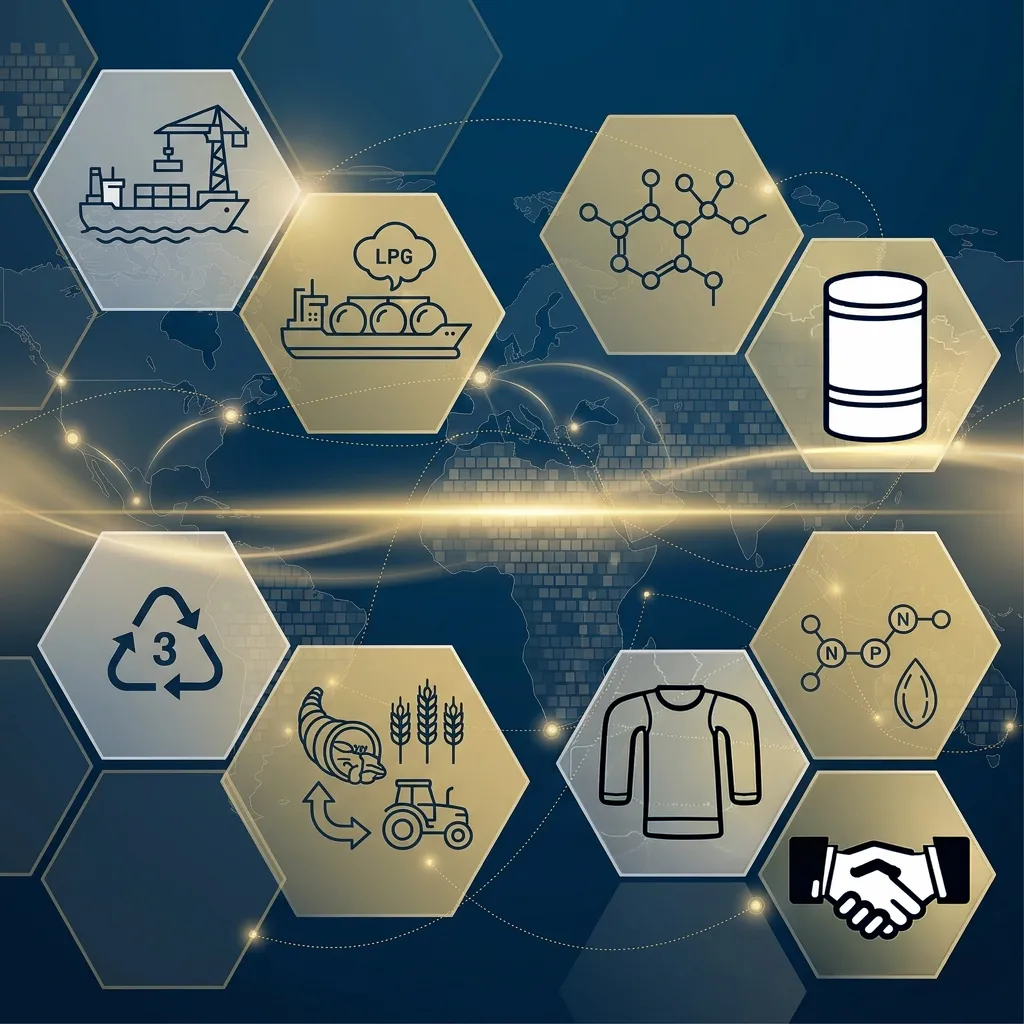
The energy shock is already widely understood. What is not yet widely understood is what comes after it — and why a diplomatic deal, when it comes, will not be the end of the story.
By Chris Gaffney, Managing Director of the Georgia Tech Supply Chain and Logistics Institute and a former Vice President of Global Strategic Supply Chain at The Coca-Cola Company.
Three weeks ago, I started hearing from contacts in my network. Senior supply chain executives, people who have managed through COVID and the Suez Canal blockage, were expressing concern. The kind of concern that doesn’t make it into earnings calls or press releases. The kind that shows up in private conversations between people who actually move goods around the world for a living.
Their worry wasn't about crude oil prices. Crude oil prices are now widely discussed. Their worry was about what happens after crude oil prices. About the plastic in your water bottle, the fertilizer going into this year's corn crop, the engine oil in your car, the polyester in your running shoes.
Those conversations sent me back to the data. The geopolitical crisis and the energy shock are now well-documented in mainstream reporting. What is less discussed and what my conversations with experienced practitioners suggested was being systematically underestimated is the operational cascade downstream of that energy shock. I wanted to answer a specific question: given that the Strait has been effectively closed since February 28, what aspects of the downstream impact are already locked in regardless of a diplomatic solution, and what is still unfolding? Could I use publicly available data, straightforward analytical tools, and accessible modeling to produce a defensible, quantified view of that question?
The answer, after several weeks of work, is yes. And what the analysis shows is more operationally significant than most of the public commentary has yet captured.
Start with what is already true.
The International Energy Agency (IEA) has characterized this as what it describes as one of the largest supply disruption in the history of the global oil market. Flows through the Strait fell from roughly 20 million barrels per day before the conflict to low single-digit levels in March and early April. Asian crude stocks dropped 31 million barrels in March alone, with further declines expected through April. Global refinery runs in Asia were cut by around 6 million barrels per day. Middle distillate prices in Singapore hit all-time highs.
But energy prices, as alarming as they are, are the visible part of this problem. The less visible part is what those commodities become.
Naphtha, a petroleum derivative most people have never heard of, is the feedstock for the polyester in your clothing, the polyethylene terephthalate (PET) in your water bottle, the polypropylene in your food packaging, the polyvinyl chloride (PVC) in your plumbing. Roughly 80 percent of the naphtha imported into Asia comes from the Middle East. South Korean petrochemical plants were running at 60 to 70 percent of capacity by late April. Japanese crackers at 65 to 75 percent. The IEA confirmed it in plain language: Asian petrochemical plants curtailed operating rates as feedstock supply dried up.
Liquefied petroleum gas (LPG) is the cooking gas that 60 percent of Indian households depend on for daily meals and was the first fuel to be rationed. Queues formed as deliveries were delayed. This reflected physical supply constraints alongside severe price pressure.
Fertilizer prices hit 49 percent above last year's levels by April, according to DTN data. Corn planting intentions dropped 3.5 percent. The math on that is straightforward: the food prices that result from this spring’s planting decisions will show up at the grocery store in 2027. The disruption has a long tail, and most of that tail is still ahead of us.
The question isn’t whether this will affect what you pay for everyday goods. It already is. The question is how far the cascade goes and how long it lasts.
Here is what the modeling shows.
Working from publicly available IEA, U.S. Energy Information Administration (EIA), and commodity price data, I built a scenario model that tracks 12 commodity-region pairs through a 300-day simulation horizon. I then ran that model over 1,500 times with slightly varying assumptions to produce a range of outcomes rather than a single point estimate. That range is more honest than a single number, because the genuine uncertainty in this situation deserves to be represented.
Three findings stand out.
First: a diplomatic deal today would be unlikely to quickly reverse what has already happened. This is the finding that surprised me most, and it held across almost every simulation. The high-import-dependency commodities have already depleted enough inventory that functional shortage is already embedded in the near-term outlook regardless of when the Strait reopens. The diplomatic question determines how long the pain lasts and how severe the recovery will be. For consumers, this means the effects may show up long after the headlines fade through higher prices, product shortages, and delays in everything from clothing and packaging to fertilizer-dependent food production.
Second: Europe's most visible supply chain story, airlines canceling flights, is a price story, not a physical shortage story. The IEA documents approximately six weeks of European jet fuel supply. Airlines are grounding aircraft because fuel has doubled in price, not because airports are running dry. Meanwhile, Asian petrochemical plants are curtailing because feedstock physically stopped arriving. These two situations look similar in the headlines. They require completely different responses. For consumers, the difference matters because one problem mainly makes travel and goods more expensive, while the other can interrupt the actual production of the products modern life depends on.
Third: the recovery will be harder and longer than most public commentary assumes. S&P Global estimates five weeks to seven months for full supply normalization after a reopening, depending on infrastructure damage. Mine clearance alone requires 60 to 90 days of sustained operations before commercial vessels can transit safely. Insurance premiums will not normalize until underwriters see months of safe transit. And when supply does restart, suppressed demand returns simultaneously with a supply base that is still rebuilding. The EIA's 2027 demand forecast of 1.6 million barrels per day growth (nearly three times the depressed 2026 rate) makes this concrete. We have seen this pattern before. COVID demonstrated it at scale. The bullwhip effect, applied to a supply-side energy shock, produces a second dislocation on the back side of the crisis.
What this means for your grocery bill, your gas tank, and your business.
The analysis maps 36 supply chain pathways from raw commodity to consumer shelf across 15 product categories. Here are three examples that are or will be visible to you.
Take construction materials. PVC pipe, insulation, and window profiles all begin with petrochemical feedstocks moving through the Gulf region. PVC resin prices in India rose nearly 80 percent in March. Since PVC pipe is largely PVC resin, the pass-through to construction costs is immediate and difficult to absorb. The result is likely to show up in higher prices for building materials, repairs, and infrastructure projects long before most consumers connect the cause.
The same pattern is unfolding in synthetic motor oil. Shell's Pearl Gas-to-Liquid facility in Qatar — one of the world's most important sources of premium Group III base oil — was taken offline by missile strikes. Producers in Bahrain and the UAE have declared force majeure. Roughly 40 percent of global Group III supply is now offline or unable to ship. For consumers, that eventually means higher oil-change costs, more expensive industrial lubricants, and added operating costs moving quietly through trucking, aviation, manufacturing, and delivery networks.
Food arrives later, but it arrives. Fertilizer prices are already sharply elevated, and planting decisions are being made right now under those conditions. The agricultural calendar creates a lag most consumers do not see. Disruptions this spring can become higher grocery prices many months from now. That is not speculation. It is simply how agricultural supply chains work.
We tend to underestimate the breadth and duration of these events while they are happening, and overestimate how quickly things return to normal after they appear to resolve.
What we did, and why it matters how we did it.
Every number in this analysis traces to a cited source. Where data was insufficient and judgment was required, those judgment calls are labeled as such. The model is not a black box. It is a documented, reproducible simulation that any researcher can run independently.
I also used AI — specifically Claude by Anthropic — as a partner to help analyze and build this work. While I provided the analytical framework, the practitioner judgments, and the validation of assumptions, the AI assisted with drafting, building models, computation, and data synthesis. This collaboration is fully detailed in the paper.
This represents a new way of performing analytical work. The results are significant: a quantified, sourced, and reproducible analysis of a complex disruption in the actual world. What usually takes a traditional research team months was completed in weeks. That speed is vital when a situation is still unfolding.
The larger point.
Sixty-seven days in, the global supply chain community is navigating a disruption that has no precise historical parallel. The 1973 OAPEC embargo lasted months and produced lasting structural change in how the world consumes energy. The 1990 Gulf War shock was brief enough that it produced relatively mild downstream consequences. The 2022 European energy crisis showed us what happens when industrial feedstock costs become uneconomic for months at a time: capacity comes offline, and some of it does not come back for a long time.
The 2026 Hormuz closure is now 72 days old. It has already lasted longer than the 1990 Gulf War shock. It is approaching the territory where the worse historical outcomes become the more relevant comparators. Every additional week of closure moves the probability distribution toward the scenarios that produced lasting structural damage.
Both public and private entities may be underestimating the magnitude of what recovery will require. Restoring normal supply chain function after an event of this scale and duration is not a matter of reopening a waterway. It is a matter of rebuilding inventory buffers, restarting industrial capacity, normalizing insurance markets, reestablishing commercial relationships, and managing the demand surge that hits simultaneously with the supply restart. The organizations that are planning for that recovery now will be materially better positioned than those that wait.
The people I talked to three weeks ago were right to be concerned. Their concern was based on experience and instinct and what they were seeing in their own business. Our work over the past weeks validates their perspective.
An enduring diplomatic solution is the essential precondition for any of this to improve. Without it, the cascade continues. With it, the hard work of recovery begins. Either way, the time to understand the full scope of what is in motion is now and not after the headlines move on.
Editor’s note:
View the related report: technical analysis, scenario modeling, Monte Carlo simulation methodology, consumer impact assessment.
May. 06, 2026

In recognition of her extraordinary teaching, outreach, and mentoring activities, Emily Weigel has been awarded the Eugene P. Odum Award for Excellence in Ecology Education by the Ecological Society of America (ESA). Each year, the award celebrates a singleone individual’s sustained, outstanding work in ecology education.
“I’m honored to receive the 2026 Odum Award,” says Weigel, who is a senior academic professional in the School of Biological Sciences. “Georgia Tech is widely recognized for its research excellence, but teaching is mission-critical to the ways we serve the public good. This award reflects the incredible work happening in our classes and communities that drives science, and science education, forward.”
Weigel is among 10 individuals selected nationwide for annual ESA awards. “This year’s award recipients have each contributed something important to ecology, often in very different ways,” says ESA President Peter Groffman. “These are ecologists whose efforts have shaped the field, supported colleagues and created opportunities for others. I’m glad to see that kind of work acknowledged.”
About Emily Weigel
Weigel’s work focuses on improving biology education by examining how student backgrounds, values, and instructional practices shape learning outcomes. Her impact spans K–12 students, undergraduates, graduates, and members of the Atlanta community.
Known for her teaching innovations, she has pioneered new courses in biology, ecology, and statistics, and is also a leader in the Vertically Integrated Projects program at Georgia Tech.
From studying the dynamics of flu, to using drone aerial footage to monitor Georgia Tech’s changing landscape, to a long-term project monitoring the trees of the Campus Arboretum, Weigel shares that “students thrive when they develop skills through real-world experiences."
Weigel has also creatively infused the traditional “nature” topics and fieldwork found in ecology curricula with modern technology and programming skills used in research. “Effectively introducing professional skills, like programming in the language R, is innovative nationally,” she says. By making R, an open-source programming language, more accessible, “we’re preparing undergraduates for success in graduate school and their careers, and empowering them to learn other programming languages in the future.”
In addition to teaching, Weigel plays a central role in mentoring and supporting students across the Institute. She serves as the undergraduate academic advisor for around one-sixth of Georgia Tech’s Biology majors, mentors graduate and undergraduate teaching assistants, and is an instructor for the “Tech to Teaching” capstone course in the Center for Teaching and Learning.
Apr. 30, 2026
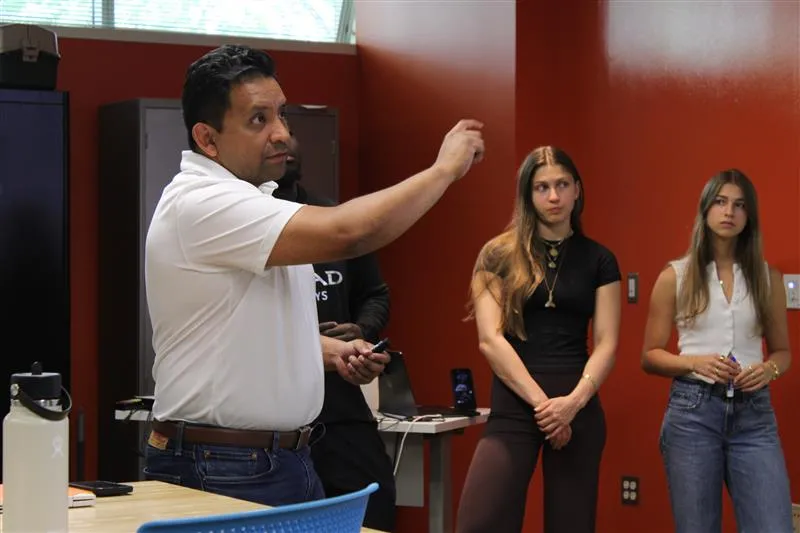
You don’t need an idea to begin. You don’t need a co‑founder, a pitch deck, or a perfect plan. What you need is curiosity, a willingness to talk to real people, and a place where it’s safe to learn by doing. That’s exactly what CREATE‑X Startup Lab delivers.
Omar Garcia Urdiales, CREATE‑X’s associate director of Learn, brings a global entrepreneurial experience to Georgia Tech: founder and CEO of a startup operating in the AWS Accelerator Loft, longtime startup coach in Europe’s major innovation hubs, lecturer across multiple universities, and an external doctoral researcher in entrepreneurship and digitalization. He brings this background to his teaching of Startup Lab’s latest iteration – a significant redesign developed by VentureLab’s Director Keith McGreggor. McGreggor created the course and has evolved it over many years, building on its initial success.
“This new iteration of Startup Lab allows us to meet students exactly where they are,” said McGreggor. “By doing this, we give them the strongest foundation possible, providing them with the tools to grapple with uncertainty and build their confidence.”
Startup Lab has long anchored the Institute’s entrepreneurial pathway with clearer structure, a unified language, and a deeper focus on reflective growth, so more Georgia Tech students can discover (and trust) their own entrepreneurial judgment.
Startup Lab is expanding responsibly, with six sections in Atlanta and additional global sections in France and Asia-Pacific taught by faculty trained in the curriculum. Students here benefit from a program that’s learning across borders and bringing that learning back to campus.
“Startup Lab is not about becoming an entrepreneur, but about engaging in the unknown and adopting entrepreneurial behavior, which can be applied to all career paths,” Urdiales said. “Students become better equipped to identify problem spaces and solve them through evidence-based building.”
Start Where You Are
Urdiales emphasized that Startup Lab is built for students who are still exploring, uncertain, or are simply curious.
“Many students tell us they’re curious about entrepreneurship but feel not ready,” he said. “They worry they’re too introverted for customer interviews or assume Startup Lab is only for people with fully formed ideas. In fact, those are the most common misconceptions.”
The course’s first few weeks focus on training students to see struggles and patterns in the world. Then, they apply those skills on a team, exploring, designing, and testing a concept with real people. The nonnegotiable outcome isn’t the best idea; it’s a more confident, evidence-driven version of you.
“Startup Lab is strengthening that self-awareness. All of us who are entrepreneurs, we don’t grow linearly. We have various iterations of how we see things,” Urdiales said. “This ability to see patterns or to see problems with customer discovery, it’s a learning process and a growth process.”
Building Muscle Memory
Urdiales said that students won’t have a passive experience in the lab.
“To become an entrepreneur, you need to do it. You need to engage with customers. You need to get out of the building,” he said. “It gives you the ability to incorporate theoretical frameworks into practical solutions and then understand these more practical outcomes.”
Aligning with CREATE-X’s culture of continuous iteration, Startup Lab is tightening the hands-on core of the course around four simple, repeatable tools so that entrepreneurial thinking becomes muscle memory, not a one-off assignment. The new iteration of the curriculum, developed by McGreggor, helps students learn to:
- Elicit grounded problem stories from real people (and separate observations from interpretations).
- Make explicit strategic decisions — who you serve, what you offer, how you deliver, how you get paid — and back them with discovery evidence.
- Externalize your logic with clear Business Model Canvas snapshots (hypotheses ≠ decisions ≠ open questions).
- Design minimum viable experiments (MVEs) that can falsify assumptions, not just confirm them.
“What we have is a frontier model in entrepreneurial education,” said McGreggor. “The result is a course that teaches sound decision making and builds entrepreneurial confidence that rewards authentic discovery and iteration over performative polish. It creates a more solid foundation for entrepreneurial thinking and sets students up to engage more deeply with everything that follows in their CREATE-X pathway.”
Reflection as a Feature
As a part of Startup Lab, instructors integrate reflection throughout the semester, which helps students notice patterns of work, make small experiments, and adjust based on what’s learned. Students often worry they’re not the founder type or that their introversion will hold them back; Startup Lab reframes those worries as raw material for growth, including communication skill building and one-on-one interactions you won’t always get in higher-level courses.
Startup Lab integrates HaradaLite — McGreggor's adaptation of the Japanese Harada Method — as a weekly reflection practice in which students keep a reflection log, helping them notice patterns of work, run small experiments, and adjust based on what's learned. With this approach, educators are able to measure the growth of entrepreneurial confidence by self-report, leading to a more quantitative approach to teaching.
A Common Language Across CREATE‑X
There’s no mandated order for CREATE-X courses. Startup Lab simply makes the next steps clearer by providing a shared language and milestone structure across sections and instructors, so whatever comes next (I2P, Capstone, Launch, or an internship), you can carry forward a coherent, evidence- aware story of your work.
“All CREATE‑X Learn sections will work with the same milestone objectives,” Urdiales said. “Students trained in Startup Lab are already trained in the muscles of entrepreneurship. They’re more equipped to go into Make and Launch or be a leader within their industry.”
Built To Be Inclusive Across Disciplines and Needs
Startup Lab is about becoming the kind of person who can see opportunities, reason from evidence, and make better decisions when the path isn’t obvious.
- You do not need an idea or a pre‑built team — curiosity is enough.
- You do not need special permits to enroll. Startup Lab is open to anyone ready to explore.
- You can benefit from the course before or after I2P or Capstone, since there’s no fixed order to the CREATE‑X pathway.
- Introverts are welcome. The course intentionally builds communication skills through structured, low-pressure interviews and guided interaction.
“Startup Lab helps students see the world’s problems and fill the gaps with fresh ideas, teaching them to see and understand the important difference between evidence and inference,” said McGreggor. “This lays the foundation that leads to good founders, and builds the entrepreneurial confidence needed to succeed.”
What You’ll Actually Do
Students in Startup Lab can expect a workshop-heavy, conversation-rich semester with weekly artifacts, scenario-based decision prompts, startup reports, and quizzes that keep you honest about what you’re learning. You’ll assemble a Continuity Pack near the end: a compact bundle of your best discovery evidence, decisions, MVEs, economics, and final story slides so your future self (or your I2P/Launch application) can pick up right where you left off.
The course also sets norms for modern tool use. AI is welcomed as a coach and organizer, after your own baseline thinking and research, and as an enhancement of the real conversations you have. That matters because Startup Lab’s promise is that you build solid judgment under the test of uncertainty, critical to the world of today and the future that is being built.
Jump Into Startup Lab
You don’t have to have it all figured out. If you’re a first-year student still exploring, a junior craving real-world projects, or a senior looking to stand out in interviews, Startup Lab is for you.
Seats fill quickly across all sections — and for good reason.
This course gives you the clearest, most supportive on‑ramp into CREATE‑X, with a global methodology, a unified curriculum, and instructors who believe deeply in your potential to grow. Learn how to think entrepreneurially. See the world differently. Build the confidence that will follow you long after the semester ends.
News Contact
Breanna Durham
Marketing Strategist
Apr. 30, 2026

By Chris Gaffney, Managing Director of the Georgia Tech Supply Chain and Logistics Institute, Supply Chain Advisor, and former executive at Frito‑Lay, AJC International, and Coca‑Cola.
In this issue:
- The real blind spot in analytics teams
- Three failures where the model was “right” and the decision was wrong
- A five-question checklist to run before anything goes to leadership.
A Subtle but Growing Concern
Over the past several months, I have had conversations with senior leaders at several large, well-established supply chain organizations with strong teams responsible for Integrated Business Planning (IBP) and supply chain network design and optimization.
These teams are technically strong. They know how to build models. They are comfortable with large data sets. Many are now incorporating AI tools into their workflows.
But the same concern keeps surfacing across those conversations:
The analytical capability is improving—but the decision-making discipline around it is not keeping pace.
Analysts move quickly to building models without fully defining the business problem. Assumptions are not always surfaced or challenged. Outputs are evaluated mathematically, not operationally. And recommendations are not always translated into real-world implications.
Leaders are concerned about this and are looking for ways to address. I share their concern because I have been in their shoes.
What the Experience Taught Us
Earlier in my career, across different roles at Coca-Cola, we did not formally teach critical thinking. We learned it through experience and often through mistakes. Three situations shaped how I think about this today.
Powerade: When the Model Works but the Thinking Doesn’t
While working with optimization groups at Coca-Cola North America, we overbuilt capacity for Powerade. The model did exactly what it was supposed to do. The problem was upstream of the model.
We took the demand forecast at face value. At the time, we deferred to the brand teams without interrogating their assumptions. We never asked what was driving the projected volume—whether the competitive dynamics supported it, whether the channel assumptions were realistic, whether pricing and distribution plans were grounded, whether overall market growth would materialize as projected.
The consequence was idle capacity, production lines that were purchased and never installed, write-offs, and a fundamental change to our process. Going forward, brand and supply chain teams were both required to sign off on future business cases. The model was technically correct. The thinking around the model had not been.
Little Rock: When Feasibility Isn’t Reality
Later, within Coca-Cola Supply, we made a network decision to close a plant in Little Rock. On paper, the remaining system had the capacity to absorb the volume. The model said so.
What the model assessed was production capacity based on rated line speeds. What it did not account for was dock and storage capacity at peak, or the practical limitations of standing up a new shift at the receiving plants. Those constraints were real. They were also invisible in the model.
In the short term, we had to source sub optimally from other plants—which directly undermined the business case we had built to justify the closure. The math was right. The operational validation was incomplete.
Mini Cans: When the Thinking Matches the Model
By the time I led the National Product Support Group, we had evolved. Decisions like the launch of mini cans required cross-functional alignment, scenario-based thinking, and a clear understanding of how demand would actually be generated across channels and routes to market.
We got that one right, not because the model was more sophisticated, but because the discipline around the model was stronger. We had learned, the hard way, to ask the questions the model could not ask for itself.
Most of the Work Is Outside the Model
There is a line I first heard from Chris Janke: "Most of the work is outside the model." He may have learned it from someone else; I don’t know the original source, but it is the framing that has stayed with me. With the advances in data and machine learning we have seen over the past decade, that proportion may be closer to 75 percent today.
We are better than ever at collecting and cleansing large data sets, processing high volumes of information, and identifying mathematical errors. But the most important work still happens outside the model: defining the right business question, building meaningful scenarios, interpreting outputs in real-world terms, and stress-testing the assumptions that drive the recommendation.
Janke captured this precisely in documenting his own experience with a modeling error that illustrated the point. An analyst had validated the math on a labor cost model—everything checked out numerically. But when the output was translated into real-world terms, it implied production workers earning roughly $300,000 per year while working approximately 60 hours total annually. The math was internally consistent. The result was operationally impossible. The question that should have been asked early: does this make sense in the context of how the business actually operates? It was not asked until after the analysis was complete.
The discipline to ask that question is not modeling skill. It is a critical thinking skill.
Where the Breakdown Happens
Before the Model: Skipping the Hard Questions
A common pattern today is that analysts move quickly to building the model. The harder and more important step of defining the business decision before the model is built gets compressed or skipped entirely. The questions that require that step are not complicated, but they take time and engagement to answer well:
- What business decision are we actually trying to make?
- What scenarios matter, and why?
- What does success look like—not mathematically, but operationally?
- What constraints are real versus assumed?
These questions are not as clean as coding a model. They require conversations with people who understand the constraints, not just the data. That is part of why they get skipped.
After the Model: Mistaking Mathematical Accuracy for Business Validity
This is where more serious errors occur. Model issues can usually be fixed with more time. Misinterpretation of output leads to bad decisions that are much harder to unwind.
The Powerade and Little Rock situations both illustrate this. In each case, the model was not wrong in any technical sense. What was missing was the translation layer— where someone asks, “what changes on a Tuesday night shift, at Plant B, when demand spikes 12 percent?”
That translation layer does not happen automatically. It has to be built into how teams work. And it is exactly the discipline that gets squeezed when organizations reward speed and analytical sophistication above everything else.
What Critical Thinking Actually Means in Supply Chain
Critical thinking in supply chain is not skepticism for its own sake, and it is not a soft skill that sits alongside the analytical work. It is a discipline applied to decisions and not just to models. The word itself points to what we mean: kritikos, the Greek root, means skilled in judging, able to discern*. That is the right definition for our purposes.
It means asking whether the right question is being answered before investing in answering it well. It means making the assumptions that drive a recommendation visible and testable. It means translating analytical output into operational consequence: what actually changes, for whom, at what cost, and under what conditions the answer flips.
That discipline shows up or breaks down at four specific moments:
- Before the model is built: Is the business question defined precisely enough to model?
- While the model is running: Are the assumptions embedded in the data realistic and challenged?
- When the output is ready: Does this result make sense in how the business actually operates?
- Before the recommendation goes forward: Have we planned for how this will be received, and by whom?
When these moments are skipped because of time pressure, overconfidence in tools, or a culture that rewards analytical speed over decision rigor the gap between analysis and action grows. The Powerade and Little Rock situations were both failures at these moments, not failures of the models themselves.
*DeCesare, M. (2009). Casting a critical glance at teaching “critical thinking.” Pedagogy and the Human Sciences, 1(1), 73–77.
A Five-Question Diagnostic
Before an analysis or recommendation moves forward, teams should be able to answer five questions clearly. If any of them cannot be answered, the analysis is not ready—regardless of how strong the model is.
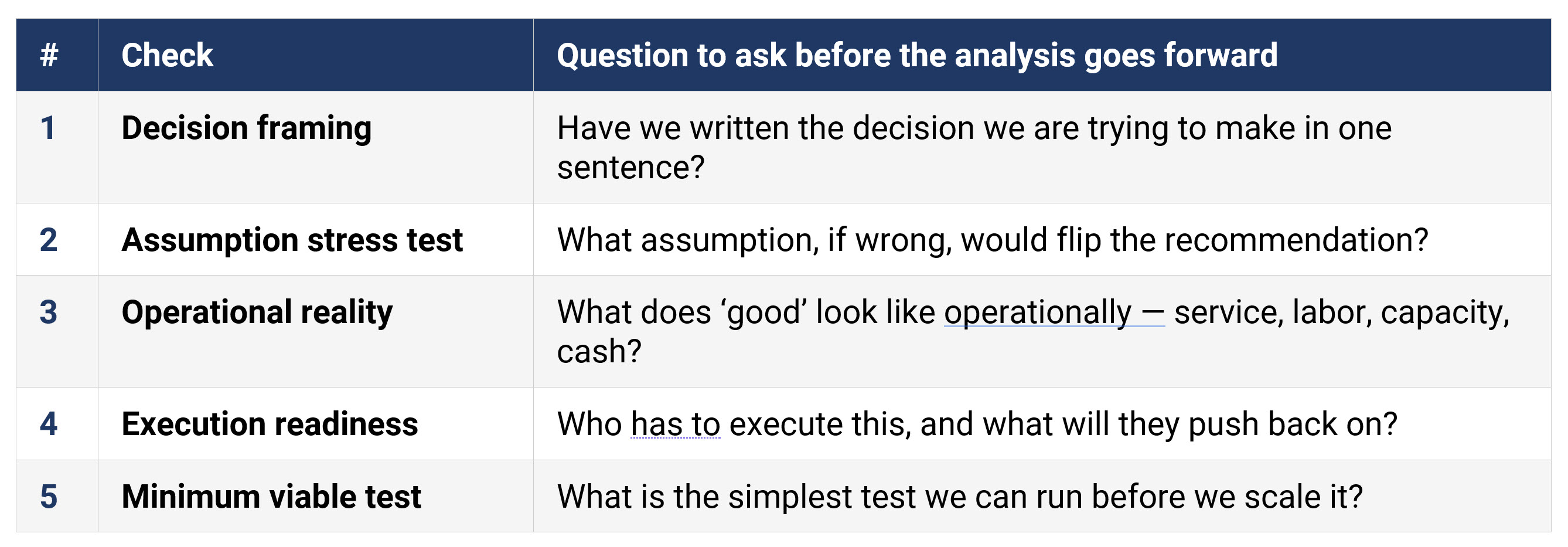
Figure 1: A Five-Question Diagnostic (accessible version)
These are questions that should have specific, grounded answers before a recommendation reaches leadership. If the team cannot answer question two (what assumption would flip the result) then the recommendation rests on unexamined ground. If question four cannot be answered, the change management work has not started yet.
In the Powerade situation, questions one and two were the misses. In Little Rock, it was question three. The models were not the problem. The diagnostic would have surfaced both gaps before the decisions were made.
This Gap Is Well Documented
What I am describing from my own experience is consistent with what the research shows.
A long-running finding in operations research is that many models are built and comparatively few actually drive decisions, and the breakdown is organizational, not technical. A widely cited review in the European Journal of Operational Research frames this as an implementation problem rooted in how models are connected (or not connected) to the people and processes that own the decision.
Professional credentialing bodies have recognized the same gap. The INFORMS Certified Analytics Professional blueprint explicitly lists business problem framing, stakeholder analysis, and business case development as core analytics competencies—not optional additions. The signal is clear: being analytically strong is necessary but not sufficient.
On the training side, a field study published in the European Journal of Operational Research tested the effects of structured decision training across roughly 1,000 decision makers and analysts. The results showed measurable improvement in proactive decision-making skills and decision satisfaction. The gap is real, and it is addressable. It is a training and design issue, not a talent issue.
The 4 C’s: A Decision-Focused Framework
At Georgia Tech SCL, we organize this thinking around what we call the 4 C’s. These soft skills play a key role in the decision process. Each one asks a specific question about whether the decision, not just the analysis, was made well.
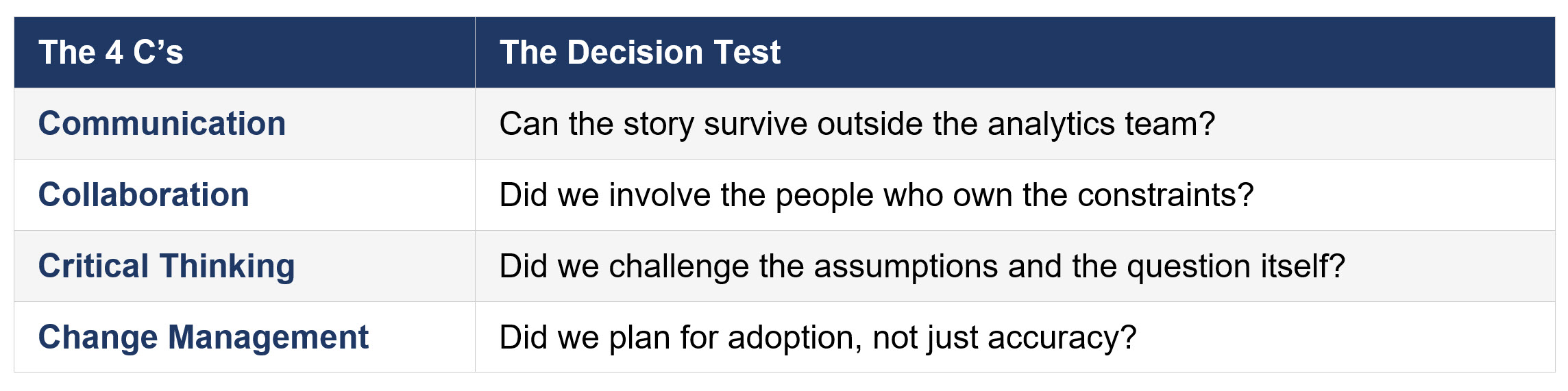
Figure 2: The 4 C’s: A Decision-Focused Framework (accessible version)
Notice what this framework does not include: model accuracy, data quality, or visualization quality. Those matter, and they are inputs to the decision. But a team can have a perfect model, a clean dataset, and a compelling dashboard and still fail all four of these tests.
The Powerade situation failed the Collaboration test The supply chain team did not sufficiently interrogate the brand team’s assumptions. Little Rock failed the Critical Thinking test: the right question was not asked about what the model was not capturing. In both cases, the Communication and Change Management failures followed directly from those upstream gaps.
When all four are present, analysis becomes a decision. When one or more is missing, the analysis and translation to a solid recommendation are at risk.
Where to Start
This topic keeps coming up in conversations with companies, in work with practitioners, and in what we hear from students as they move into industry roles.
The tools are not the problem. AI-assisted analytics, optimization models, and advanced forecasting are real assets. But tools amplify the thinking behind them. Weak decision discipline and better tools is a faster path to the wrong answer.
If this shows up in your org, try the five-question diagnostic on your next recommendation before it hits leadership. If it surfaces gaps you cannot close quickly, SCL can help. We are building workshops and courseware on decision-focused critical thinking, and we will cover this in our June Lunch and Learn.
Questions or comments? Reach out to SCL.
Apr. 13, 2026

Karen Rommelfanger recently joined Georgia Tech as a professor of the practice, where she will work with the Institute for Neuroscience, Neurotechnology, and Society to embed neuroethics into Georgia Tech’s research and technology development ecosystem. Photo via the Dana Foundation.
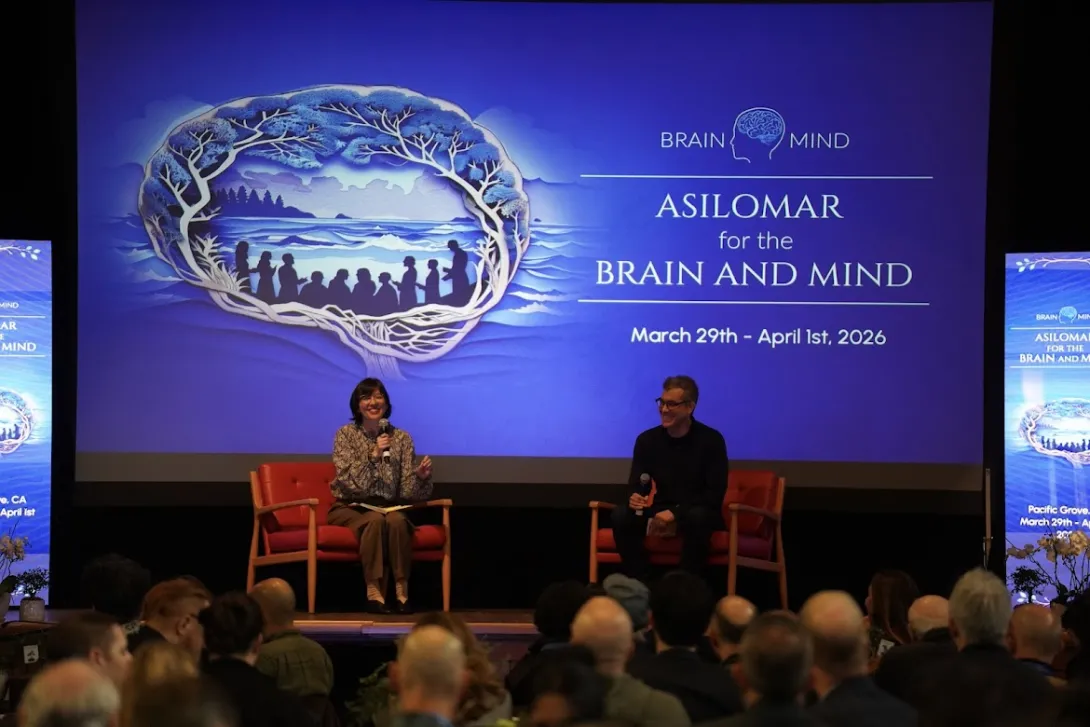
Karen Rommelfanger (left) is a leading voice in neuroethics, with years of experience bridging neuroscience, technology development, ethics, and public policy to address the societal impacts of emerging brain technologies.
Artificial intelligence has been touted as the most transformative technology of our time. With only a few years of mainstream use, it’s changed how we work and communicate, generated billions of dollars in investments, and sparked global debate. But according to leading neuroethics expert Karen Rommelfanger, the race isn’t over yet.
“Can you think of a more transformative technology than one that intervenes with the fundamental organ that drives your experience in the world?”
That fundamental organ is the brain.
Technologies interfacing directly with the brain have been reserved for treating severe injury or disease for decades. Now, neurotechnology is expanding into brain-responsive wearables meant to enhance, augment, and monitor everyday life. As these technologies accelerate and AI is incorporated, the question is no longer if neurotechnology will transform society, but how — and who will shape the boundaries.
These are some of the questions on which Karen Rommelfanger has built her career. Trained as a biomedical researcher and neuroscientist, Rommelfanger went on to found the Institute for Neuroethics, the world’s first think and do tank devoted entirely to neuroethics, public engagement, and policy implementation.
“The brain is special; it’s central to who we are,” says Rommelfanger, who was also an inaugural recipient of the Dana Foundation Neuroscience and Society Award. “And that means when you intervene with the brain, there are unique responsibilities. The field of neuroethics addresses things like: How do you ensure mental privacy? How do you protect free will? How do you ensure that people have the power to be narrators of their own lives and their cognitive experience?”
Now, Rommelfanger is joining Georgia Tech’s Institute for Neuroscience, Neurotechnology, and Society (INNS) as a professor of the practice, where she will work to further embed neuroethics into Georgia Tech’s research and technology development ecosystem.
“Georgia Tech is producing the next generation of neurotechnologists, and Karen’s expertise will help ensure we’re preparing them to think about societal impact as deeply as they think about the technical and scientific aspects of their work,” says Christopher Rozell, executive director of INNS. “Her leadership strengthens the Institute in exactly the way this moment in neurotechnology demands.”
“Georgia Tech has many, many ways that it leads in the technology ecosystem. But one of the powerful, unique ways it can lead is through neurotechnology,” says Rommelfanger. “I hope that the INNS, given its unique mandate for neuroscience, neurotechnology, and society, can be a lighthouse for these types of conversations.”
Neuroethics by Design
From institutional review boards to mandatory responsible research conduct training, ethics are a foundational part of scientific research. But designing neurotechnologies raises ethical challenges beyond the scope of typical training. What happens when discoveries leave the lab and enter people’s lives?
That question sits at the core of Rommelfanger’s work. She argues it’s a neurotechnologist’s responsibility to recognize and proactively address the need for unique safeguards for privacy, autonomy, and long-term responsibility. Her solution is to move neuroethics upstream, embedding it directly into the research, design, and deployment of neurotechnology through an approach she calls “neuroethics by design.”
“Neuroethics by design considers ethics as a core criterion where principles can drive innovation with more of a lens toward societal outcomes,” she says — an approach informed by years of advising national-level brain research initiatives and her experience at the intersection of clinical practice and ethics scholarship.
Rather than treating ethics as a compliance checklist or a post hoc review, neuroethics by design integrates ethical thinking throughout the entire innovation lifecycle, from early ideation and research questions to product requirements, governance strategies, and long-term sustainability. She has used the approach for years as an embedded partner for neurotechnology startups in her neuroethics consultancy, Ningen Co-Lab.
After decades as a traditional academic professor and then years advising companies and policymakers with this philosophy, Rommelfanger says Georgia Tech is the right place to scale this work. With its strength in neurotechnology and INNS’s rare focus on neuroscience and society, “I could not think of a better place to launch and pilot this neuroethics by design scaling effort.”
She will work with INNS to help equip researchers, students, and industry partners with practical tools for ethical decision-making. Her vision is not to create neuroethicists as a standalone profession, but to cultivate ethically engaged neurotechnologists and engineers.
Central to her plans at INNS are hands-on training programs that bring ethics out of the abstract and into practice. “I wanted to be a professor of the practice because, while the field does need more scholars, what it really needs most at this point are practitioners.”
Rommelfanger is exploring modular content that can be embedded into existing courses across disciplines, as well as immersive training — such as neuroethics boot camps and problem-solving hackathons — that bring together students, faculty, and professionals to tackle real-world challenges collaboratively.
“No one discipline can solve all the ethical challenges ahead,” says Rommelfanger. She is particularly interested in creating spaces where experts from across science and engineering, policy and law, design and the arts, and philosophy can work side by side with people with lived experience of neurological conditions. “The onus is not on scientists alone, but is a shared responsibility that benefits immensely from dialogue, accountability, and action across diverse communities.”
By situating neuroethics within Georgia Tech’s broader research ecosystem, Rommelfanger hopes INNS can help shift how the field evolves globally.
“It's really difficult to get your arms around something once it's out of the gate,” she says, citing the rapid adoption of AI without proper ethical or policy guidelines. “With neurotechnology, we still have a little bit of time, but not that much time. We are at that moment where we could change the course of global history.”
News Contact
Audra Davidson
Research Communications Program Manager
Institute for Neuroscience, Neurotechnology, and Society (INNS)
Apr. 09, 2026
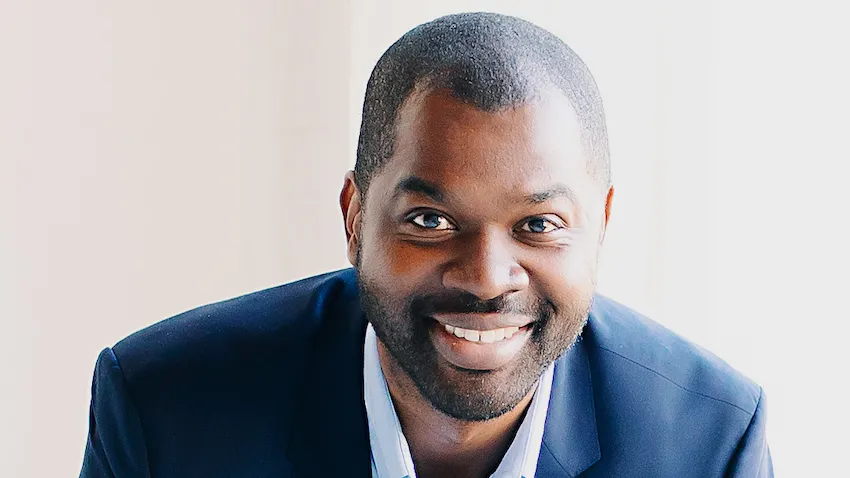
When Olufisayo “Fisayo” Omojokun joined Georgia Tech, his teaching followed a familiar cadence. His courses were highly structured and consistent. Lectures, exams, office hours, and semester breaks were always known months in advance. The goals were clear, the outcomes known, and the educational journey largely mapped. Then, he heard about CREATE-X.
A Spark of Curiosity
In 2017, faculty conversations began circulating about a new kind of capstone experience, one driven by student discovery and entrepreneurial thinking rather than predetermined client requirements. The idea intrigued Omojokun.
“I remember thinking, this is really different from anything I’ve ever taught,” he said.
In his previous courses, Omojokun took pride in providing the structured, rigorous framework students needed to master complex concepts. While those interactions were dynamic, the curriculum required a specific, focused trajectory. CREATE-X offered a different kind of challenge: the "X" of the program, representing undefined, endless potential.
“CREATE-X is full of unknowns. You don’t know what industry the students are diving into, what roadblocks they’ll run into and navigate out of, or what small- to large-scale successes they’ll achieve throughout the semester. It really had my blood pumping,” he said. As someone who loves the challenge of academia, it was an invigorating way to help the next generation apply what they’ve learned in a new context.
Omojokun co-taught the first CREATE-X Capstone section with College of Computing students in fall 2018 alongside Craig Forest, associate director of the Invention Studio. While the initial computer science cohort was small, the experience was immediately powerful.
“It was humble beginnings but deeply eye-opening,” he said.
In this new environment, students weren't just solving problems; they were seeking them and sometimes pivoting. Traditional client-driven capstones offer students invaluable experiences in delivering high-quality products, responding to clients’ often evolving needs, and adhering to professional standards. CREATE-X added a layer of venture-validation, requiring students to identify a gap in the market and build something with commercial viability.
As the semesters continued, CREATE-X grew from a program with an interesting capstone course Omojokun enthusiastically co-taught to a professional inflection point for him. He found himself talking about it frequently, with colleagues, with students, even with prospective undergraduates who may not see a capstone for years.
He began encouraging prospective and incoming students to take CREATE-X pathways.
“I would tell students, down to first-year students, when you get that opportunity to engage with CREATE-X, take it. You don’t even have to wait until capstone, as there are multiple pathways; in fact, Startup Lab has no prerequisites. Whatever path you take, you’ll remember it for years to come. Whether you officially take a problem solution to market or not, the entrepreneurial confidence gained is priceless.”
Spreading CREATE-X Into the College of Computing
By 2020, when the first Jim Pope Faculty Fellowship cohort opened, applying felt natural. He had already become an unofficial ambassador for CREATE-X, helping students navigate options, promoting programs in classes, and rallying colleagues to engage.
“It was an opportunity to become more connected to this thing that I felt was changing the game on campus,” he said. “It cemented my affiliation with CREATE-X.”
The fellowship gave name and weight to the work he was already doing, while also expanding what was possible.
The Jim Pope Faculty Fellowship provides faculty with $15,000 in discretionary funding, which can support a one-semester break from teaching, along with structured training in evidence‑based entrepreneurship, dedicated mentorship, and the opportunity to work closely with students launching startups.
The fellowship also equips faculty to become entrepreneurial instructors and mentors through the CREATE‑X ecosystem, giving them tools to integrate entrepreneurship into their coursework and curricula. Each cohort of fellows is trained to embed entrepreneurial methods, develop new innovation‑focused assignments, and serve as advisors within programs like Startup Lab, Idea‑to‑Prototype, and Startup Launch.
For faculty across Georgia Tech, the fellowship offers something rare: institutional backing, resources, and formal recognition for bringing entrepreneurship into their teaching and shaping how students learn to become problem‑solvers.
Omojokun said he sees CREATE-X as the apex of applying technical fundamentals.
As part of the fellowship, Omojokun brought the program’s ethos into his courses, even a foundational course like CS 1331: Introduction to Object Oriented Programming, where he created a CREATE-X–branded final project. Students built a “problem database” application as their final homework assignment, cataloging real issues they encountered in daily life, assessing their skills to solve them, evaluating markets and metrics, and then deciding potential pathways forward.
“It’s an innovation diary,” he said. “A tool that can get them closer to thinking like a founder.”
The response from students, including many non-computing majors who take his section each semester, has been overwhelmingly positive. While the project is challenging, the open-ended nature and real-world relevance motivate deeper engagement.
“When students believe their work will solve a meaningful problem for a meaningful population, they bring passion to it,” he said. “They start observing the world differently.”
The more Omojokun saw, the deeper his enthusiasm grew.
Shaping the College of Computing
Even as he stepped into the role of inaugural chair of the School of Computing Instruction in 2022, CREATE-X remained at the forefront of Omojokun’s conversations. Interest in the program continued to grow significantly. Students stopped him in the hallways to talk about their ideas. Faculty reached out to ask about mentorship opportunities. And he continued championing the program in the many settings he entered.
“It turns out that the most engaged group of students in CREATE-X is computing undergraduates,” Omojokun said. “I wanted to make sure that high involvement continued, no matter what size we are,” he said.
Over time, Omojokun strengthened the partnership between the College of Computing and CREATE-X, weaving entrepreneurship deeper into the College's curricular fabric.
Last January, Omojokun was appointed as the associate dean for Undergraduate Education in the College of Computing. One of his priorities was highlighting CREATE-X’s curricular impact. In coordination with key stakeholders — including Kelly Ann Fitzpatrick (computing), Craig Forest (mechanical engineering), and Raul Saxena (CREATE-X) — he nominated the program for the ABET Innovation Award. The award honors programs that challenge the status quo in technical education and demonstrate a measurable impact on student learning in ABET-accredited disciplines, such as natural sciences, computing, engineering, and engineering technology. CREATE-X won.
The CREATE-X Advantage With Faculty
When faculty are considering something like the Jim Pope Fellowship, Omojokun said the biggest barrier he hears about from them is time. With courses that can enroll 300 students per section and extensive responsibilities beyond the classroom, time is a scarce resource.
He could relate.
“There are always lots of things on my physical and virtual desktop. I always warn people before they enter my office,” he said.
However, Omojokun argued that participating in the fellowship program was time well spent because it helps them rediscover the most exciting parts of teaching.
“It’s worth the time. One of the goals of teaching is to see students passionate about what they’re learning, and CREATE-X makes that happen consistently,” he said.
The Future With Technology
As AI reshapes industries, Omojokun believes that CREATE-X equips students to navigate the unknown and forge new paths as existing ones shift, providing a versatile skill set that transfers to employment, potentially self-employment, and beyond.
“There’s a lot of uncertainty with AI in the workspace, but CREATE-X gives students the confidence and skills to succeed at whatever comes,” he said. “We are putting students through this process of finding a problem that’s meaningful and matters to the world; mastering that allows them to lead in any environment.”
Applications Now Open: Become a Jim Pope Faculty Fellow
The 2026 Jim Pope Faculty Fellowship is now accepting applications. For faculty who want to explore integrating entrepreneurship into their teaching, mentoring student founders, and helping shape a culture of innovation across campus, this fellowship offers resources and a supported pathway to begin. Faculty from all disciplines are encouraged to apply to the Jim Pope Fellowship. Priority deadline: July 1; final deadline: Aug. 11.
News Contact
Breanna Durham
Marketing Strategist
Georgia Tech
Apr. 02, 2026

As students increasingly turn to artificial intelligence (AI) to help with coursework, some worry that their learning could be compromised. Georgia Tech researchers are working to counter this potential decline with an AI tool they hope will promote learning rather than hinder it.
TokenSmith is a citation-supported large language model (LLM) tutor that can be hosted locally on a user’s personal computer. The tutor only provides answers based on course materials, such as the textbook or lecture slides.
Associate Professor Joy Arulraj began the project with support from the Bill Kent Family Foundation AI in Higher Education Faculty Fellowship last year. The fellowship, led by Georgia Tech’s Center for 21st Century Universities, supports faculty projects exploring innovative and ethical uses of AI in teaching.
Arulraj has enlisted assistant professors Kexin Rong and Steve Mussmann to help build TokenSmith.
Mussmann said TokenSmith is a synergistic blend of a database system and a machine learning system. The model stores textbooks, textbook annotations by course staff, common questions and answers, a learning state of the student, and student feedback in a structured database system. However, machine learning plays a key role in the answer generation as well as adapting the system to the student, course staff guidance, and user feedback.
"What excites me most is demonstrating how data-driven ML and principled database systems design can reinforce each other — one providing adaptability and flexibility, the other providing structure and traceability — in a way that benefits students," Mussmann said.
Keeping the model local has been an important focus of the project. The team wanted to create an AI tutor that helps students learn from their class resources rather than just giving answers. With each response, TokenSmith cites the origin of the answer in the provided documents.
“One problem with LLMs is that they can hallucinate and provide wrong answers, but in this controlled environment, we can add these guardrails to make sure it’s actually helpful in an educational setting,” Rong said.
Rong said she feels that students often undervalue textbooks, and she hopes TokenSmith can motivate students to make better use of them.
“Textbooks can sometimes be daunting, but maybe if we combine them with the model, students might be more willing to read a paragraph or page in the textbook, and that could help clarify something for them,” she said.
Running the model locally is more cost-effective and helps preserve the user’s privacy. But running the new tool locally comes with technical challenges.
One challenge with creating the model is speed. Since it is a locally based model, TokenSmith depends solely on the user’s computer memory. Tests have also shown that the tutor currently struggles to answer more complex questions.
“We are interested in pushing the boundaries of these local models so that they give students good answers and also run fast enough to keep students engaged,” Arulraj said.
News Contact
Morgan Usry, Communications Officer
Mar. 30, 2026
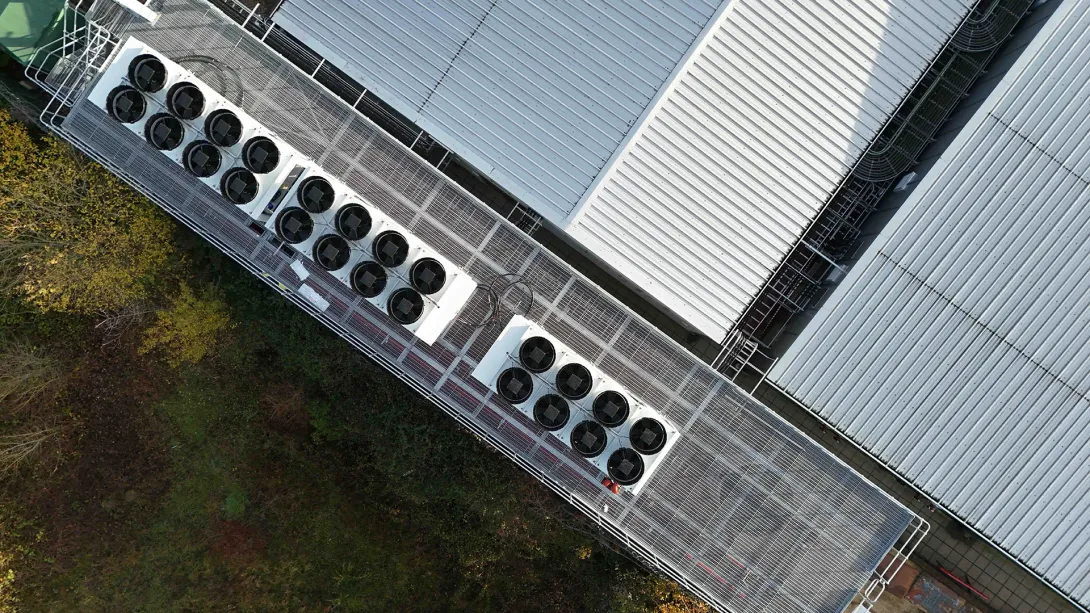
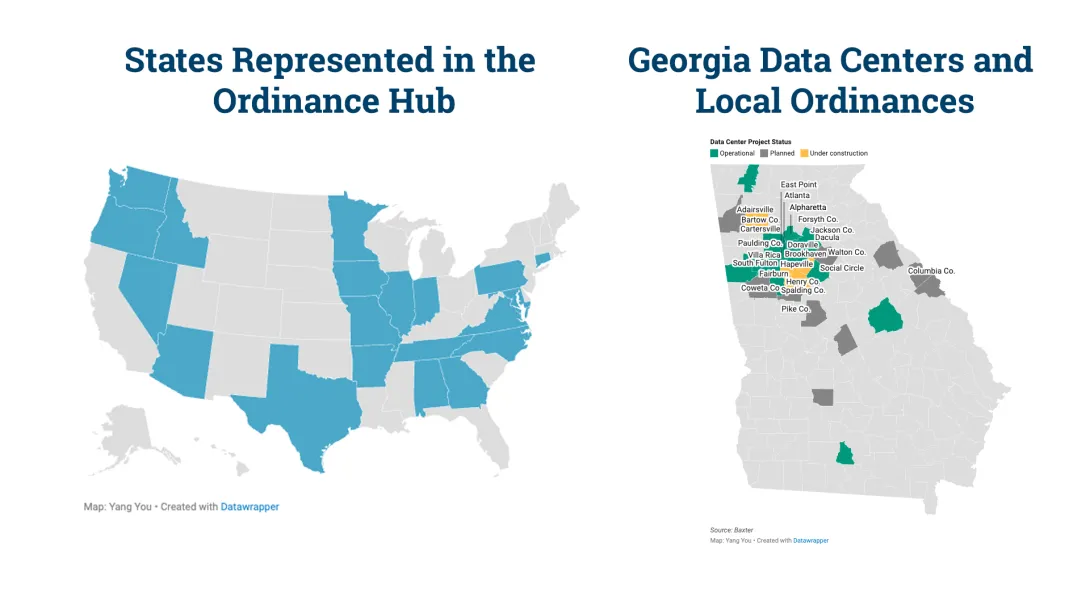
The Energy Policy and Innovation Center (EPIcenter) at Georgia Tech has launched an interactive tool to help communities navigate the dynamic land-use and policy landscape surrounding data center development: the Georgia Data Center Ordinance Hub.
As new data centers continue to be built and proposed in Georgia, counties and municipalities across the state are considering how to guide this growth. EPIcenter’s data center dashboard provides policymakers, planners, researchers, and community stakeholders with a centralized resource to better understand how data center regulations are being developed and applied across Georgia and the U.S.
“Our Data Center Hub provides Georgia communities with a one-stop shop to understand how their neighbors are managing land-use regulations for data centers,” said Laura Taylor, director of EPIcenter. “It brings together clear, accessible information to help jurisdictions plan when data center growth occurs in their area.”
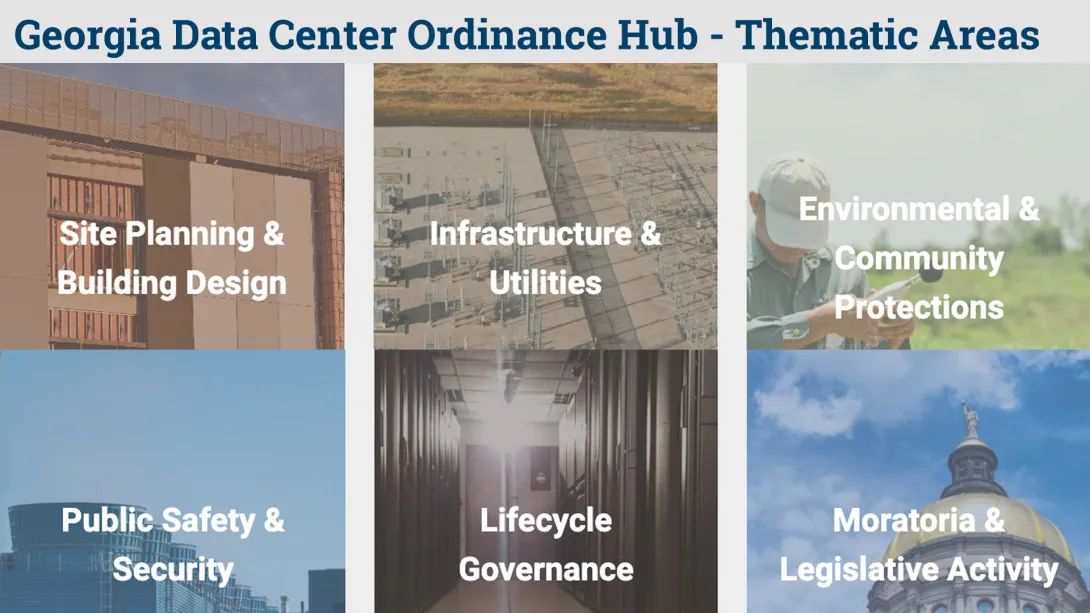
The dashboard is organized around five thematic areas commonly addressed in data center land-use regulations: Site Planning and Building Design, Infrastructure and Utilities, Environmental and Community Protections, Public Safety and Security, and Lifecycle Governance. Within each theme, users can explore specific regulatory topics and access the relevant ordinances enacted by Georgia communities.
To build the dashboard, EPIcenter researchers conducted a comprehensive review of municipal codes across the state.
“We reviewed municipal codes for about 180 cities and counties across Georgia and identified ordinances that specifically address data center development,” said Yang You, EPIcenter’s research associate who developed the project. “In total, we found 19 data center-specific topics that ordinances tend to cover. We analyzed ordinances across jurisdictions and organized their ordinance provisions into topics such as building placement, setbacks, infrastructure, and environmental considerations to make it easier to compare how different jurisdictions regulate data centers.”
You added that the dashboard also incorporates examples from outside of Georgia. By gathering ordinances from other states and pairing them with Georgia-specific examples, EPIcenter aims to provide a clear framework to help communities efficiently address data center land-use regulation.
The Georgia Data Center Ordinance Hub is available through the Energy Policy and Innovation Center website.
News Contact
Priya Devarajan || SEI Communications Program Manager
Mar. 25, 2026
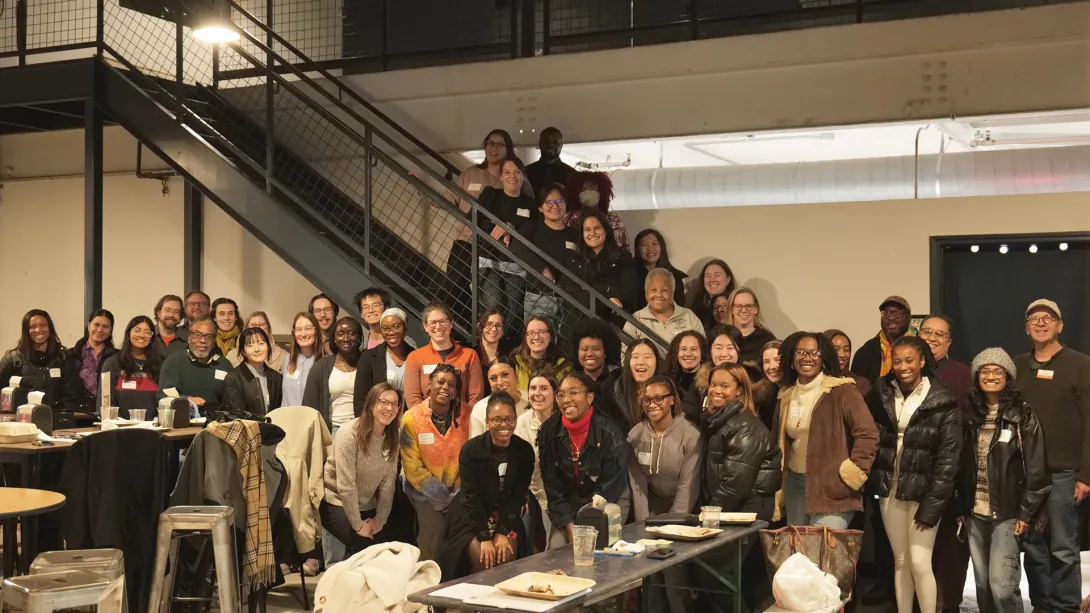
The Atlanta Community-Engaged Research Student Network launched this semester. The program is co-led by Nicole Kennard, assistant director for Community-Engaged Research with the Brook Byers Institute for Sustainable Systems (BBISS), along with Associate Professor Richard Milligan and Associate Professor Sarah Ledford from Georgia State University, Associate Professor Emily Burchfield and Associate Teaching Professor Carolyn Keogh from Emory University, and Iesha Baldwin from Spelman College. The program also partners with several community-based organizations to co-develop strategic direction and provide training. They are Science for Georgia, Historic Westside Gardens, HBCU Green Fund, South River Watershed Alliance, and Food Well Alliance.
The primary aim of the Atlanta Student Community-Engaged Research (CER) Network is to use a peer learning approach to train graduate students with the skills to co-lead community-engaged and locally focused research, while at the same time building relationships with local community organizations. This approach will help address local sustainability and societal challenges, lay the foundation for community-engaged research programs, and enable young researchers interested in this work to thrive in the Atlanta area. Initial funding for the pilot program was provided by the Atlanta Global Studies Center and the Georgia Tech Provost's Excellence in Graduate Studies fund.
The program received a total of 41 applications from graduate students from Georgia Tech, Georgia State University, and Emory University. Thirty-five master’s and Ph.D. students were accepted into the cohort, spanning a wide range of disciplines, from the humanities, sciences, design, public health, engineering, and computing. The program has additionally engaged eight senior-level undergraduates from Spelman College to learn about graduate school tracks with community-engaged research opportunities.
This program provides a unique opportunity to learn engagement and leadership skills not typically taught in graduate programs. Students are attending one training a month over the course of the Spring 2026 semester. Here, they learn about the diversity of sustainability-focused, community-based organizations in the area, develop skills to engage meaningfully with community partners in research projects, and improve the ways they communicate to the public about research.
The Georgia Tech Provost's Excellence in Graduate Studies fund will provide a $2,500 stipend to five Georgia Tech students who will work on a research project with a community partner organization. These projects will take place over the spring and summer semesters this year, providing opportunities for graduate students to apply their newly acquired community-engagement skills to on-the-ground research, while also opening a new pathway for Georgia Tech’s engagement with community partners.
Fellows and projects include:
- Irene Jacob, M.S., city and regional planning, will work with the Food Well Alliance to update the implementation strategy for their 10-year community garden survey.
- Ethan Zhao, M.S., human-computer interaction, will work with Historic Westside Gardens to integrate new technologies into their community garden spaces and assess the benefits to the communities they serve.
- Virginia Cason, M.S., sustainable energy and environmental management, will work with Science for Georgia to translate data gathering and analysis into community-centered narratives.
- Sharon Rachel, Ph.D., history and sociology of technology and science, will work with the HBCU Green Fund to examine the environmental and community impacts of data center projects in Atlanta.
- Ella Neumann, Ph.D., interactive computing, will work with the South River Watershed Alliance to document and communicate the history and impact of the City of Atlanta's combined sewer consent decree, and assess if the intended results of the decree have been met.
Applicants expressed their passion for community-engaged research projects and working directly with local community members and organizations:
“Lived experience is just as valuable as academic expertise, and meaningful change only occurs when both work together. I think that this takes approaching problems with a lot of humility, care, and a genuine desire to listen to communities and their needs.” -Virginia Cason, M.S., sustainable energy and environmental management
“I want to do research that stems from a theoretical question, but is feasible in reality and benefits the community. One of the most efficient ways to achieve this goal is through doing research WITH the community.” -Keke Li, M.S., analytics
“Community-engaged research is not only a methodology, but a commitment to partnership, humility, and shared power.” -Grace Fraser, M.S., city and regional planning
“To me, community-engaged research means working with people, not just for them. CER is not only a method but also a mindset. True impact comes when research and community experience grow together.” -Bingjie Lu, Ph.D., civil engineering
The community partners involved in the program are equally enthusiastic about community-engaged research. As Fred Conrad of Food Well Alliance put it, “Food Well has been intentional about engaging our constituents since we began, and this is not only a continuation of that effort, but a significant refinement of how we accomplish that. I think all of us have deepened our understanding of the CER process since we began this journey.”
News Contact
Brent Verrill, Research Communications Program Manager, BBISS
Mar. 24, 2026
By Chris Gaffney, Managing Director of the Georgia Tech Supply Chain and Logistics Institute, Supply Chain Advisor, and former executive at Frito‑Lay, AJC International, and Coca‑Cola
We recently wrapped our semi‑annual industry advisory board meeting, where a core element of the agenda is a set of "hot topics" sourced in advance from our member companies, curated, and facilitated to reflect what is most top of mind in the field. This cycle, one of those topics focused on the impact of AI on supply chain technology investment.
What began as a discussion on technology quickly surfaced a broader issue:
AI is not just changing supply chains—it is raising the standard for execution, and in doing so, redefining what it takes to sustain a brand.
When Capability Becomes Cheap
Within that discussion, a simple example sparked debate. Most of us would trust a platform like DocuSign without hesitation. It has earned that trust through reliability, security, and consistent performance.
But what if a new entrant—call it “FredSign”—offered similar functionality, powered by AI, at lower cost and with comparable features? Would you use it?
The room split. Some argued that established brands are durable because of the trust they have built over time. Others pushed back, suggesting that AI‑enabled challengers could close that gap faster than expected, making brand less relevant.
The discussion quickly moved beyond software to a broader question:
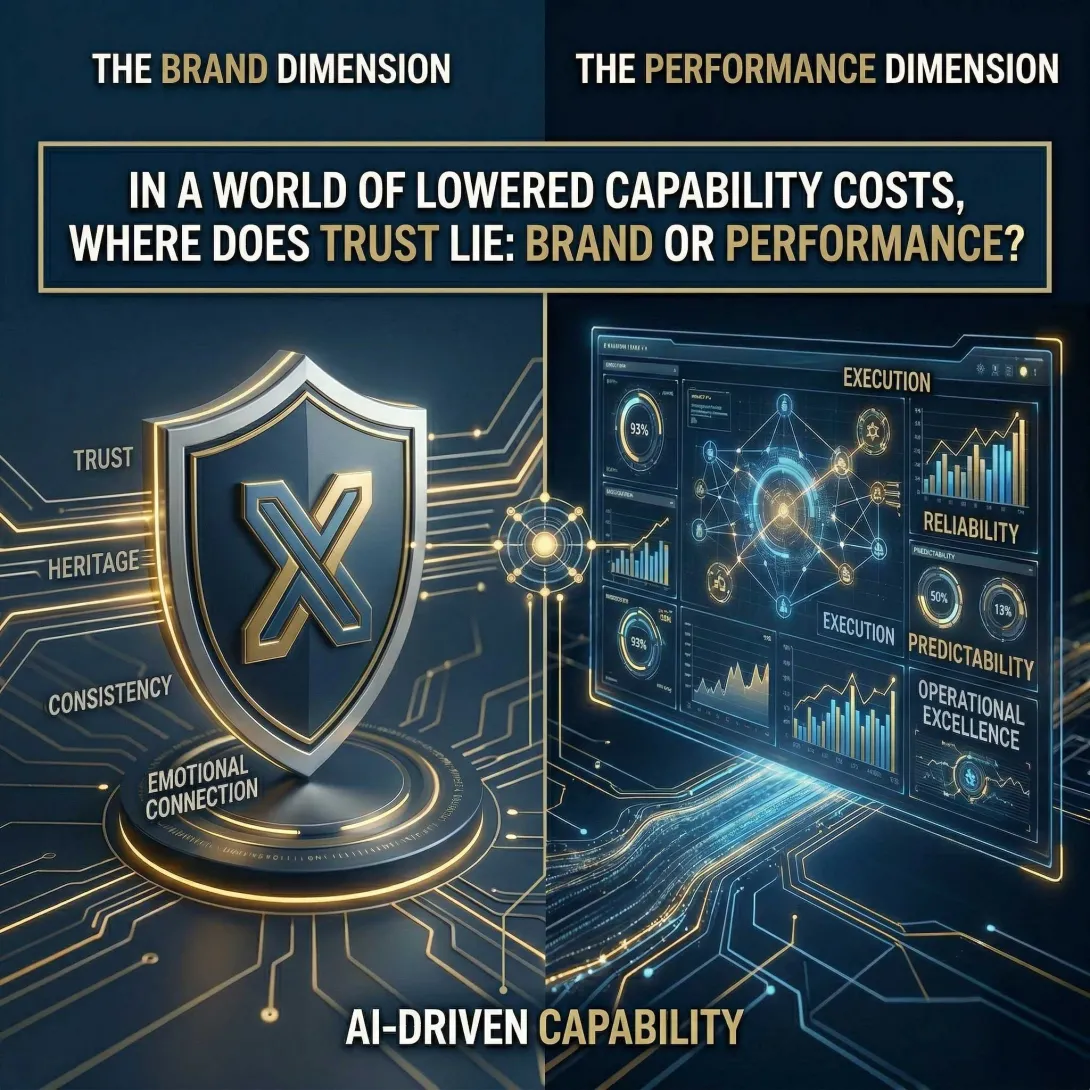
In a world where AI lowers the cost of building capability, does trust shift from brand to performance—or does brand become even more important?
Brand as a Promise
From a supply chain perspective, this is no longer theoretical. It is already happening.
At its core, a brand is a promise. For product companies, that promise is built on quality, consistency, and the experience of using the product over time. For supply chain technology and service providers, it is grounded in reliability, security, and confidence in execution.
Historically, brand has been reinforced by performance—but also protected by time, scale, and familiarity.
AI is changing that balance.
Lower Barriers, Higher Expectations
On one hand, AI lowers barriers to entry. New entrants can replicate functionality faster, improve user experiences, and target specific gaps in incumbent offerings.
In supply chain technology, this is particularly relevant. Many organizations have made significant, long‑term investments in systems that have not always delivered as expected. That creates an opening for AI‑enabled providers to enter through narrow use cases, solve specific problems better, and establish a foothold. Over time, they build credibility.
But there is a second dimension that is more immediate—and more consequential.
AI Raises the Execution Standard
One way to frame this is simple: data is a terrible thing to waste.
For years, supply chains have generated vast amounts of data across planning systems, transportation networks, warehouses, and customer interactions. Much of that data has been underutilized—captured, stored, but not fully leveraged to anticipate risk or improve outcomes.
That is changing.
The capability now exists—and is rapidly maturing—to sense, interpret, and act on that data in ways that were not previously practical. Risks can be identified earlier. Disruptions can be predicted. Corrective actions can be taken before the customer ever feels the impact.
From Disruption to Preventability
Over the past week, in the span of just six days and four unrelated conversations with members of my network, I heard a series of examples that all pointed to this shift.
- A global food company managing risk tied to a critical supplier whose quality issues could impact multiple major brands—raising the question of whether AI could have surfaced a near sole‑source dependency earlier.
- An e‑commerce retailer using machine learning to reduce theft and damage in its fulfillment network, improving the customer experience.
- An organization proactively shifting its fulfillment partner mix based on AI‑driven insights into which nodes can and cannot handle surge capacity.
- A high‑end clothing shipment arriving wet due to a fulfillment breakdown—where the loss was not just the product, but a time‑sensitive moment that could not be recovered.
- A consumer receiving an empty box after successfully purchasing a limited‑release product that could not be replaced.
These are not isolated anecdotes. The common thread is not disruption—it is preventability.
As AI enables earlier detection of risk, better prediction of disruptions, and faster response to exceptions, the tolerance for failure is declining. Companies are no longer judged simply on whether something went wrong. They are judged on whether it should have been avoided.
Brand Is the Delivered Experience
From a brand perspective, that is a fundamental shift.
A product brand may invest heavily in innovation and customer engagement. But if the product arrives damaged, late, or not at all, the customer does not distinguish between the brand owner and the supply chain behind it.
There is only one experience—and therefore only one brand.
In an AI‑enabled supply chain, failure is no longer just a risk—it is increasingly a choice.
The Weakest Node Defines the Brand
A brand is now only as strong as its weakest node.
That node may be a supplier, a logistics provider, a fulfillment partner, or a technology platform. Many sit outside the direct control of the brand owner, yet their performance is inseparable from the customer’s perception of the brand.
AI makes it possible to identify and address these weak points—but it also makes it more apparent when companies fail to do so.
Implications for the Supply Chain Ecosystem
This dynamic extends directly to platform and software providers. In an AI‑enabled environment, it is no longer sufficient for supply chain technology to be stable or functionally adequate. It must evolve—continuously—to sense risk earlier, enable better decisions, and improve execution outcomes. If it does not, its limitations will be exposed quickly, and alternatives will emerge.
Technology providers are not insulated by their brand; they are judged by the outcomes they enable. Their brand will strengthen if their platforms improve execution—and erode if they do not.
Product companies must use AI to protect the customer experience end‑to‑end. Logistics providers must adopt AI to remain credible partners. Technology providers must evolve their platforms to meet a higher execution standard.
If one part of the system advances while another does not, the gap will be visible—and acted upon quickly.
Winners and losers are being judged daily.
What This Means for Leaders
None of this suggests that brand is no longer important. In high‑trust, high‑risk environments—contracts, financial transactions, healthcare, and other sensitive use cases—brand remains critical.
Even in this environment, trust must be continuously reinforced through performance. Leaders must clearly understand what underpins their brand. Brand is not an asset to be protected; it is the result of consistently delivering on a promise. Any performance gaps must be addressed before others move in. AI‑enabled challengers will not challenge strengths—they will target weaknesses.
Finally, leaders must elevate their ecosystem. Brand performance is now inseparable from partner performance. That requires greater visibility, tighter integration, and higher expectations—not only internally, but across suppliers, logistics providers, and technology partners.
One Question to Answer Now
This execution dimension is only one part of how AI is reshaping brand—but it is already decisive.
A great product can still win. A strong brand can still endure. But in an AI‑driven world, where disruptions can be anticipated and failures mitigated, the margin for error is disappearing.
And in many cases—especially where the purchase is infrequent or the moment is critical—you only get one shot. At the conclusion of our discussion, one participant framed it simply:
What is our secret sauce—and what are we doing to build on it?
That is the question every supply chain leader should be answering now.
Because in an AI‑enabled world, your brand will be defined by what your system consistently delivers.