
Apr. 25, 2023
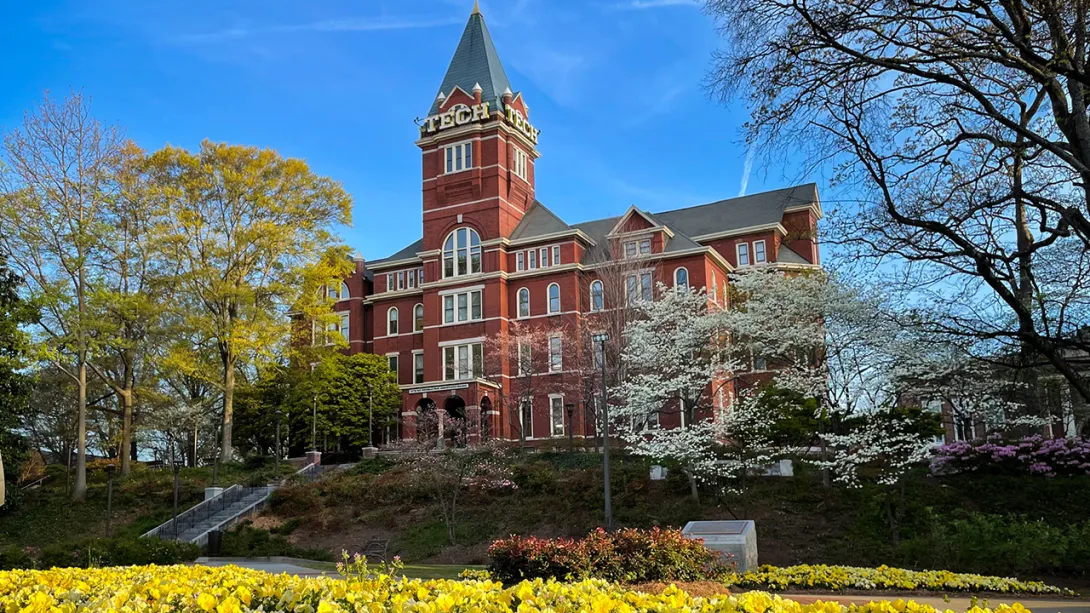
The 2022-23 Micro-Grants Community-Based Research awardees presented their findings at the second annual symposium, held on April 18, 2023, in the auditorium of the Kendeda Building for Innovative Sustainable Design, which is the region’s first Living Building. Ten teams presented to faculty, staff, students, and student family members. The topics were wide ranging, and dealt with both practical and theoretical issues. The work surpassed all expectations for quality and quantity.
Devised by the Kendeda Building Advisory Board and sponsored by the Brook Byers Institute for Sustainable Systems and the Kendeda Building, the Micro-Grants Research Program solicits proposals for very small scale ($50 to $500), short term, sustainability related, research studies to be conducted by members of the Georgia Tech community. Community investigators are encouraged to explore ways in which the Georgia Tech campus can continue to innovate, demonstrate, prove, and promote the adoption of best and next practices in regenerative design and operations. Researchers were also encouraged to use the United Nations Sustainable Development Goals as a framework for research design. All members of the Georgia Tech community were encouraged to apply. The program especially sought proposals from students and staff that had little or no prior research experience.
The program has four objectives:
- to expand scientific thinking and the understanding of the research process amongst those not (yet) directly involved in scientific research;
- to bolster the use of the campus as a living laboratory;
- to give voice to people and communities outside of research that have culturally novel perspectives on problems and their possible solutions, and to create new pathways for partnering with them; and
- to seed novel ideas and nurture nascent investigators.
The 2022-23 awardees and the titles of their projects are:
- Alex Lomis, Devi Patel, and Dr. Jung-Ho Lewe, "Design and Development of a Low-Cost and Highly-Scaleable Occupancy Counter to Optimize the Utilization of HVAC Resources"
- Kaitlyn Tran, Shivani Potdar, and Amanda Janusz, "Bird Safe Campus"
- Ricardo Martinez, "Chiropterans at Georgia Tech"
- Elizabeth Umanah, "Reimagining Eco-Friendly Parking Lot Design Through Simulations"
- Lujain Diab, Ally Kimpling, Jenna Sitta, Marcus Morris, Skylar Ryan, Dr. Jennifer Leavey, and Steve Place, "A Greener Grey: “Ironing” Out Issues in Greywater Systems"
- Jun Wang and Yilun Zha, "Kendeda’s Educational Role in Waste Management and Recycling"
- Siddharth Sivakumarun, "Investigating Capacity for Regenerative Energy through Foot Traffic"
- Alexandra Rodriguez Dalmau and John Fortner, "Recognition of Insect Species in the Georgia Tech campus with Machine Learning"
- Gray Simmons, Kevin Leach, and Dr. Jung-Ho Lewe, "IOT Climate Sensor Development for HVAC Efficiency Analysis"
- Kaylin Cross, Pranav Jothi, Maanas Kumar, Brian Wu, Savannah Howard, and Sheng Dai, "Prototyping Bio-inspired Geothermal Energy Recovery for Space Heating and Cooling"
More details and links to all the presentations are available at this web page.
News Contact
Brent Verrill, Research Communications Program Manager, BBISS
Apr. 20, 2023
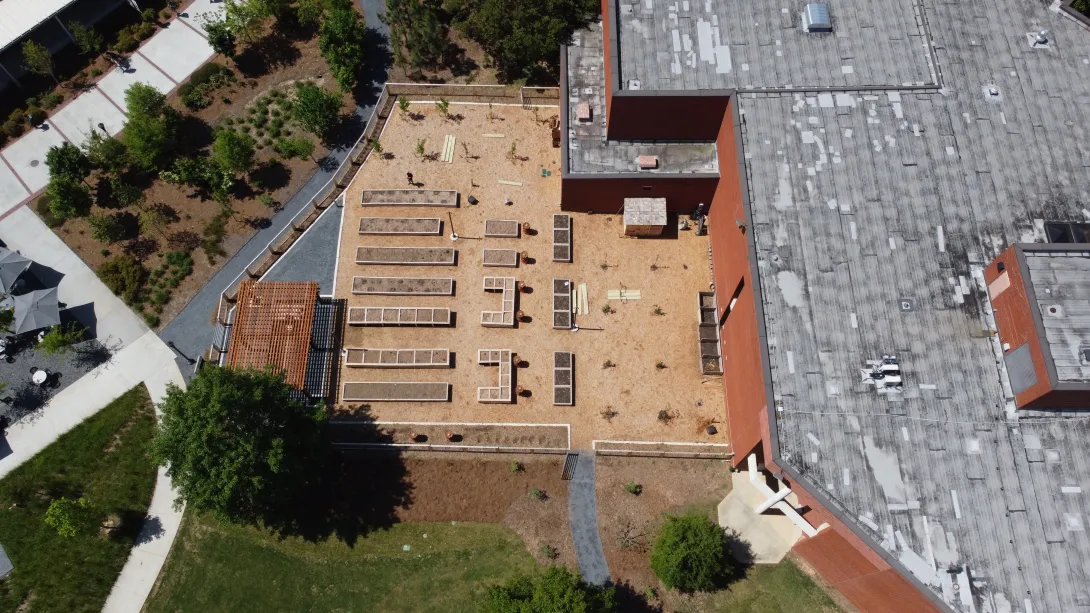
Bird's eye view of the expanded Community Garden
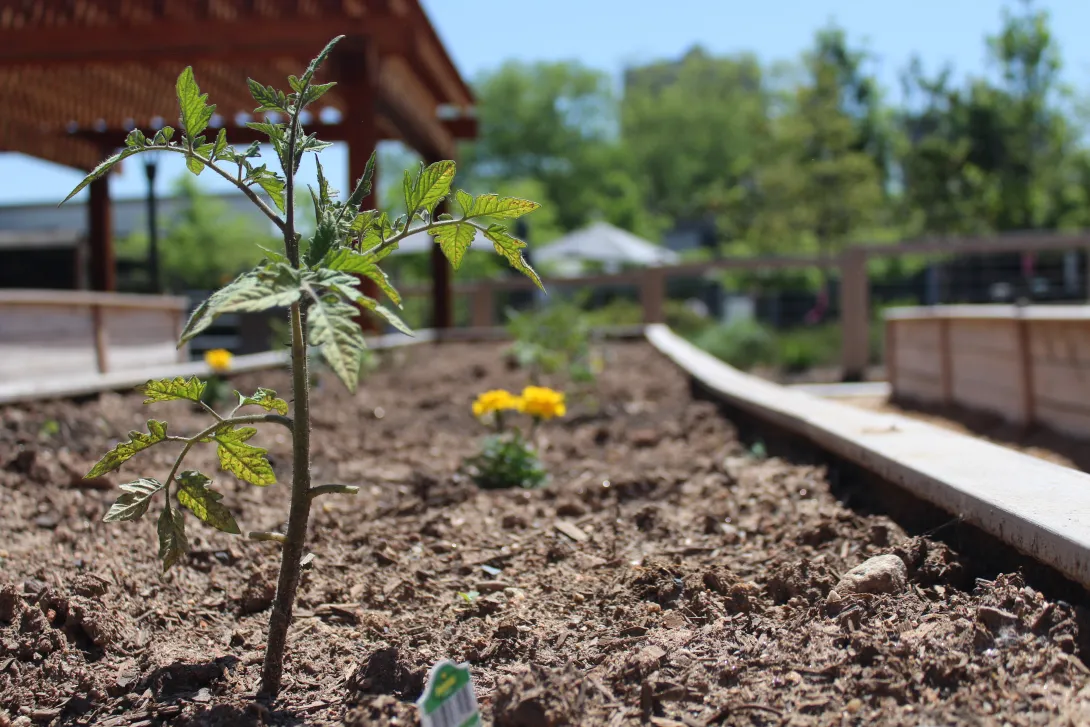
Tomato plants in the new community garden.
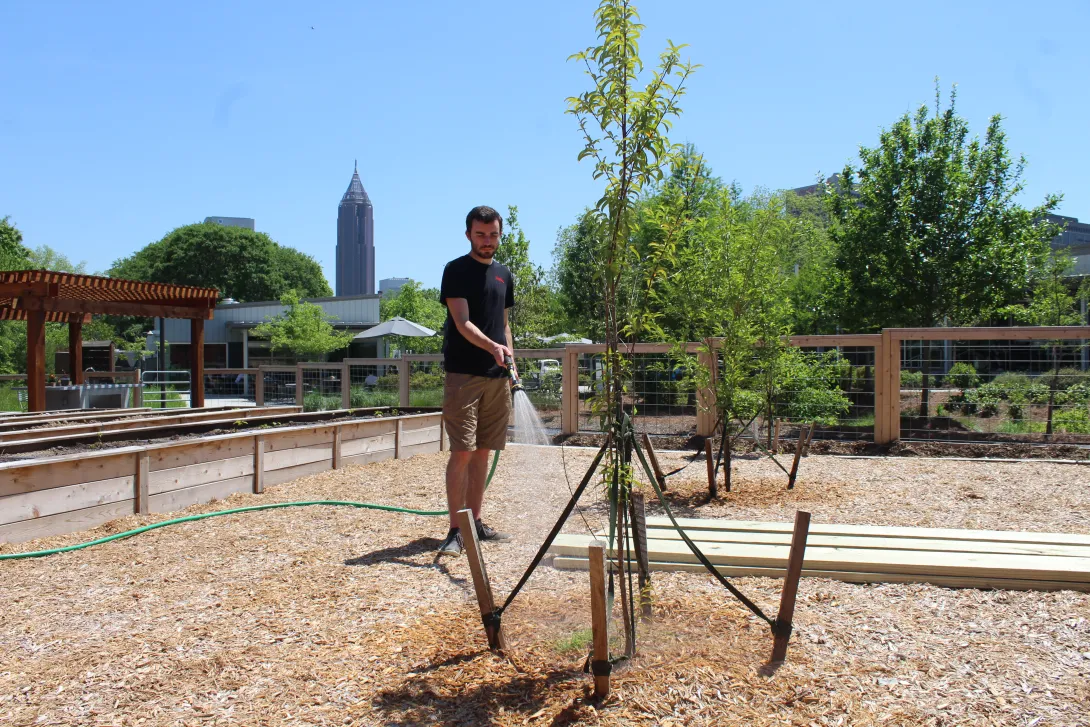
Elias Winterscheidt waters trees in the Community Garden
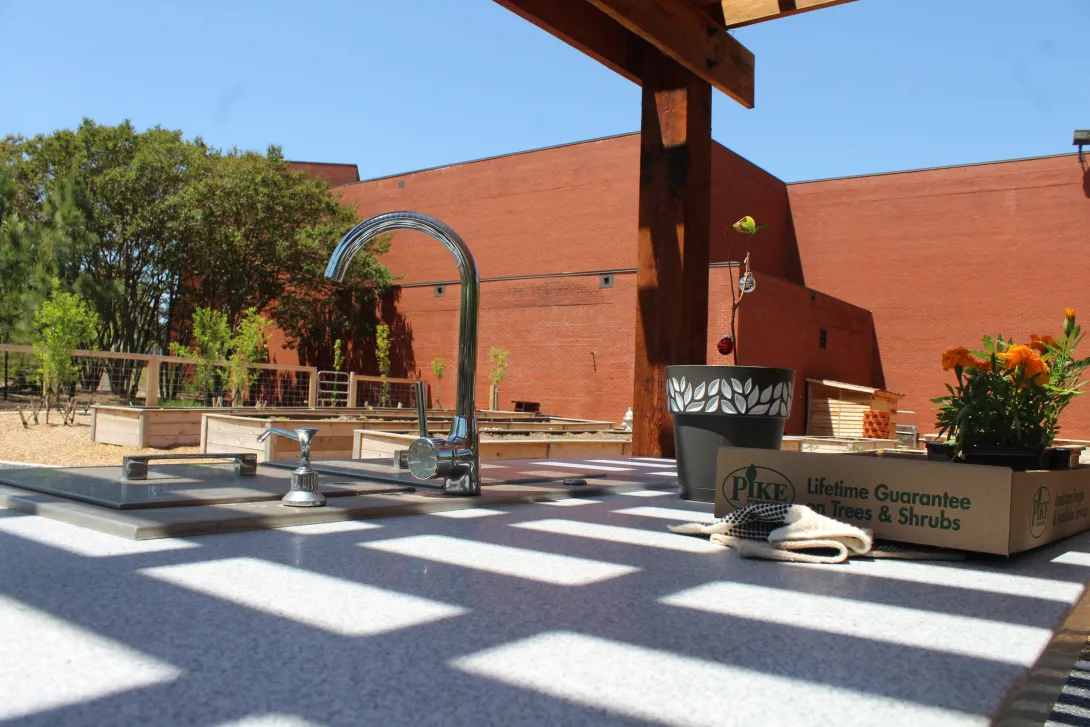
Demo kitchen inside the Community Garden
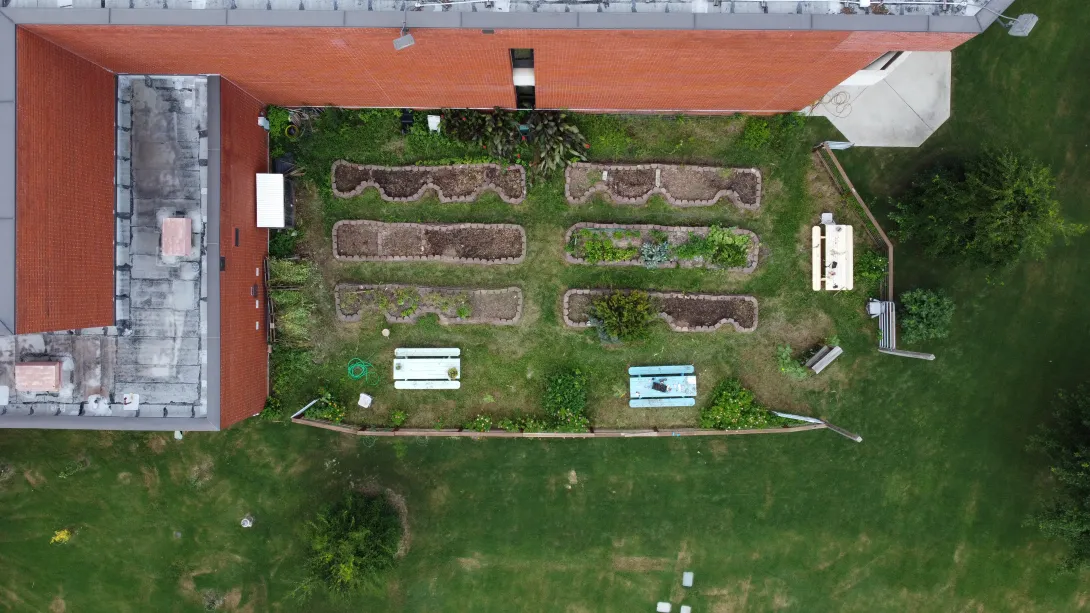
The Community Garden prior to its expansion.
As Georgia Tech continues to celebrate Earth Month, Friday's ribbon-cutting ceremony for the newly expanded Community Garden represents another step in the Institute's commitment to a sustainable future.
First opened in 2012 with six small planting beds, the garden has received a complete transformation over the past decade. With the latest project, which began in July 2022, essentially doubling its square footage, the garden now touts 21 fruit trees and nine large beds that are free and open to students. Two additional medium and nine small beds are available for lease for the Tech community. A new shed for gardening tools has been constructed alongside a brand-new demo kitchen to feature the garden's produce in healthy recipes. With the inclusion of slate-chip pathways and high-density mulch, the garden is now fully ADA accessible — a primary goal of the expansion effort.
Elias Winterscheidt was drawn to the garden while touring the Tech campus in 2019. With prior planting experience, he immediately got involved with Students Organizing for Sustainability (SOS), taking over as the Community Garden director in April 2021. Over the past three semesters before construction began, the garden donated 50 pounds of produce to Klemis Kitchen — Georgia Tech's on-campus food bank — in addition to the produce harvested by 500 volunteers during that time.
Winterscheidt anticipates the growth of the garden community continuing, with hopes of doubling both donations to Klemis Kitchen and the number of volunteers.
SOS got a head start on its goal at the outset of Earth Month, when Winterscheidt and a group of volunteers planted the first seeds in the expanded garden during a pair of community workdays. Sweet potatoes, tomatoes, strawberries, and various seeds are already in the ground, but plenty more fruits, vegetables, and herbs will be added soon.
In addition to a passion for gardening, Winterscheidt arrived at Tech at a time when many students were seeking ways to get outside during the pandemic. A lasting effect of the interruption has been an increase in the number of virtual events, but the garden provides the perfect opportunity to interact with nature and with other people.
"We're trying to get people to come outside. Our goal is to get Georgia Tech students away from their computers, away from their homework, and to de-stress and get their hands in the soil," he said, adding that the workdays give students a chance to interact with others from different majors and backgrounds. "Come for a few hours, chat with people, and after two hours, you feel refreshed. It's a kind of group therapy."
Community workdays in the garden are typically held on Saturday mornings, depending on the weather.
Beginning with summer programming, SOS will partner with the Wellness Empowerment Center to highlight the mental and physical health benefits of gardening. They will also be emphasizing sustainability. The Community Garden is entirely permaculture friendly, meaning it's a pesticide-free environment, and seeds are planted with purpose.
"We're mimicking nature in how we plant things," Winterscheidt explained. “Rather than spraying with pesticide, I can plant a basil plant that will deter hornworms from our tomatoes. Rather than spraying with herbicides, we can pluck all the weeds off individually. It takes a lot longer, but it's much better for our soil. Rather than growing for maximum output, we're growing in a way that benefits our soil the most."
While largely student-run, the garden does require constant upkeep, so in years past, the summer months could be challenging. However, with the expansion, Tamsin Leavy has been brought on as staff member to support the garden year-round.
"Like any garden or farm space, you don't want to lose all your hard work to the elements or other pests that can quickly annihilate a crop. We have put a lot of effort into this space and are looking forward to watching it grow. No pun intended," Leavy said. "It would be devastating to lose it to the harsh Georgia summer sun, so we will all be working together to keep our garden growing."
Volunteer opportunities remain plentiful over the summer, and in the absence of a large contingent of students, Malte Weiland, senior sustainability project manager for Campus Services, welcomes Tech faculty and staff to lend a hand. He encouraged all Tech employees to reach out to assist the team in maintaining the space and even urges entire departments to inquire about outings that can serve as wellness and team-building exercises.
For those looking to get involved with the garden or learn more about its expansion, Friday's ribbon-cutting ceremony will begin at 2 p.m.
“We all hope that the garden will continue to be a community gathering space where not just horticultural and agricultural education can happen, but anything adjacent to it — discussion on composting, urban gardens, or food justice issues. And day-to-day, for Tech students, I hope it can be a space where they are comfortable, where they can come to smell the flowers, put their hands in the dirt — even if it's just for a few minutes between classes to de-stress and reconnect to the earth," Leavy said.
The Community Market is another resource that brings sustainably sourced food to the Tech community every Wednesday from 10 a.m. to 2 p.m. along Tech Walkway. The Office of Sustainability will wrap up the spring semester market at the end of April, but selective summer dates will be announced soon. When the market returns in the fall, Weiland said that vendors and patrons can expect several updates, including a market map, and students will be able to make purchases using dining dollars on their BuzzCards.
Apr. 05, 2023
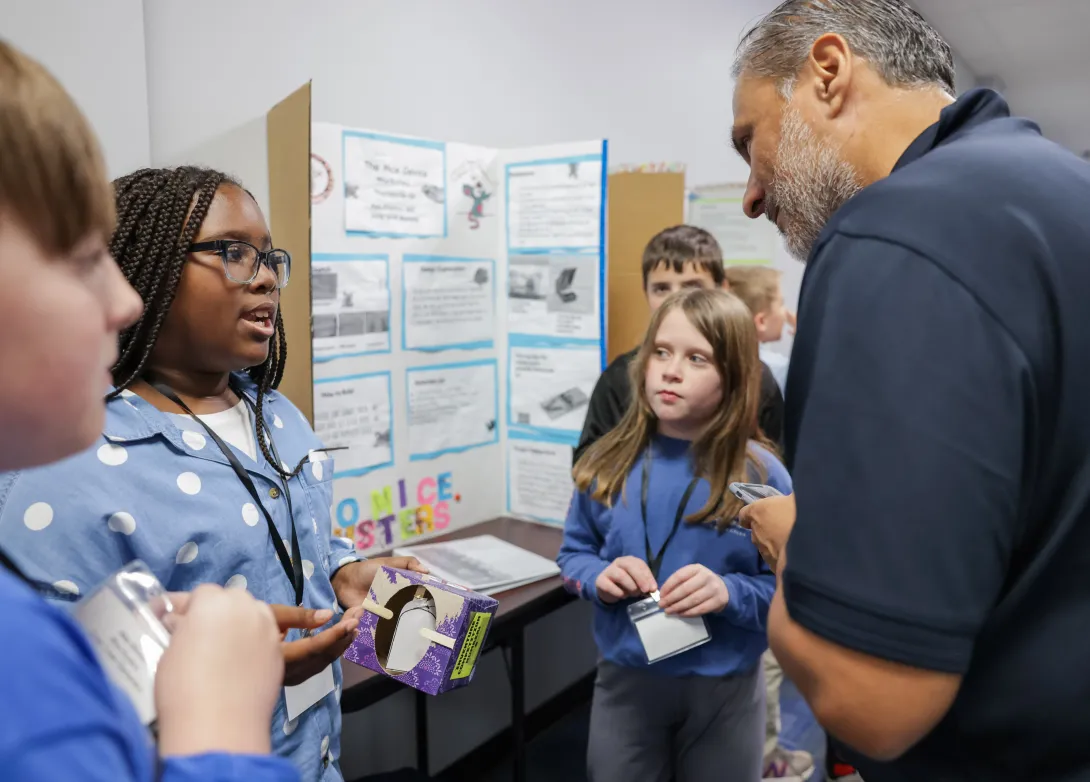
Students in Thomasville, Ga. explain their invention to a competition judge as a part of Georgia Tech’s expanding K-12 InVenture Prize program.
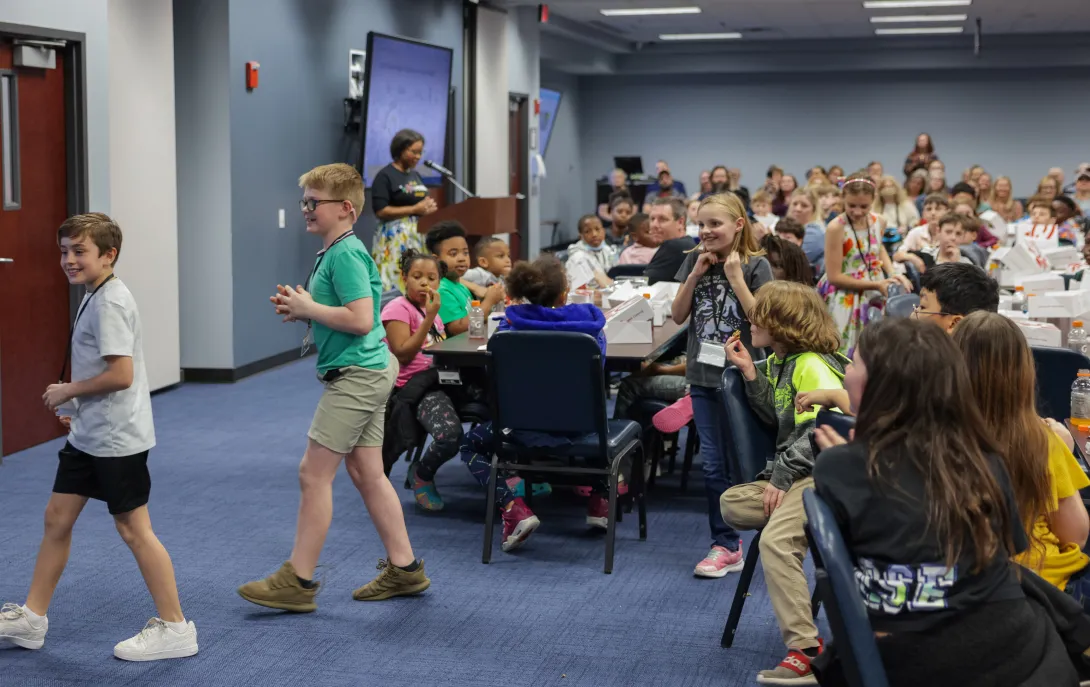
Students in Thomasville, Ga. present their own inventions as a part of Georgia Tech’s expanding K-12 InVenture Prize competition program.
Georgia Institute of Technology’s Center for Education Integrating Science, Mathematics, and Computing (CEISMC) is at the center of a new statewide initiative combining artificial intelligence and manufacturing innovations with transformational workforce development and K-12 outreach. The Georgia Artificial Intelligence Manufacturing Corridor project (Georgia AIM) is supported by a record-shattering $65 million grant Georgia Tech received in September 2022 from the U.S. Department of Commerce’s Economic Development Administration.
Georgia AIM will support a total of nine inter-related projects throughout the state and is designed to increase job and wage opportunities in distressed and rural communities and among historically underrepresented and underserved people. Georgia AIM targets rural residents, women, Black, Indigenous and People of Color (BIPOC), those living with disabilities, and veterans — groups historically underrepresented in manufacturing. Through innovation, collaboration, education, and participation, Georgia AIM will provide the tools and knowledge to empower these communities to participate fully in a diverse AI manufacturing workforce.
“Many people have preconceived notions about manufacturing and may not be able to see how they could possibly connect to it," said Roxanne Moore, Woodruff School of Mechanical Engineering’s senior research engineer and director of CEISMC’s K-12 InVenture Prize program. “What they may not realize is that manufacturing is what brings new ideas to life. AI is rapidly reshaping the manufacturing industry and changing the landscape for job opportunities. The work that we are doing will position Georgia to lead the nation into the future of AI and manufacturing.”
Moore explains that through Georgia AIM, CEISMC will expand its K-12 InVenture Prize invention and entrepreneurship program to collaborate with school districts and businesses in Southwest Georgia, Southeast Georgia and Northeast Georgia. The initiative will expand on existing partnerships Georgia Tech has established with technical colleges and minority-serving institutions.
The project will reach at least 1,000 K-12 students and 100 teachers from underserved areas, with a focus on rural communities via existing programs at Georgia Tech, other nonprofits, the Technical College System of Georgia, the Southwest Georgia Regional Commission, local manufacturers, and K-12 school leaders, Moore said.
“We need to illustrate the powerful relationships between innovation, entrepreneurship, and manufacturing so that students can see how ideas come to life and how they can improve their communities,” said Moore. “It is my hope that these regional ecosystems become a role model for how educational institutions can support each other in expanding access to high-quality STEM experiences for diverse students who typically are not empowered to create their futures.”
As part of Georgia AIM, CEISMC will also expand its offerings through partnerships with the institute’s GoSTEM program to better serve Latino populations. GoSTEM is a collaborative partnership at Georgia Tech between CEISMC and Institute Diversity, Equity and Inclusion (IDEI). Its mission is to promote STEM academic achievement and college attendance among Latino and other cultural and linguistic minority K-12 students. Plans include translating existing invention and entrepreneurship curriculum into Spanish, adding lessons to the curriculum on AI and manufacturing, assisting with the development of regionally focused curricula, and expanding training and events to make them more inclusive.
“Our goal is to make invention education accessible to everyone in the state, especially those who may have been previously left out of the conversation,” said Danyelle Larkin, educational outreach manager with CEISMC. “By going into more rural areas of the state and working to develop multi-lingual curricula that is focused on the needs of the region, we hope to serve as a national model for how to accelerate the transition to automation in manufacturing while diversifying the next generation of AI leadership.
Additional Georgia AIM expansion plans for CEISMC and K-12 InVenture Prize include supporting an existing high school entrepreneurship program in Fitzgerald and working with Albany State University to host teacher workshops, support local schools, and host regional competitions with a focus on inventiveness and the entrepreneurial mindset.
"The overall goal of Georgia AIM is to establish the United States as a leader in AI manufacturing while making sure that these systems complement rather than replace existing workers,” Larkin said. “The work that we are doing in CEISMC plays an integral role in Georgia AIM with our specific expertise in weaving invention education and entrepreneurship into K-12 classrooms and connecting with diverse communities. This huge grant gives us a chance to amplify our work and bring even more people into the AI conversation. It’s about building a better, more equitable future for the people of Georgia.”
—Randy Trammell, CEISMC Communications
Mar. 31, 2023
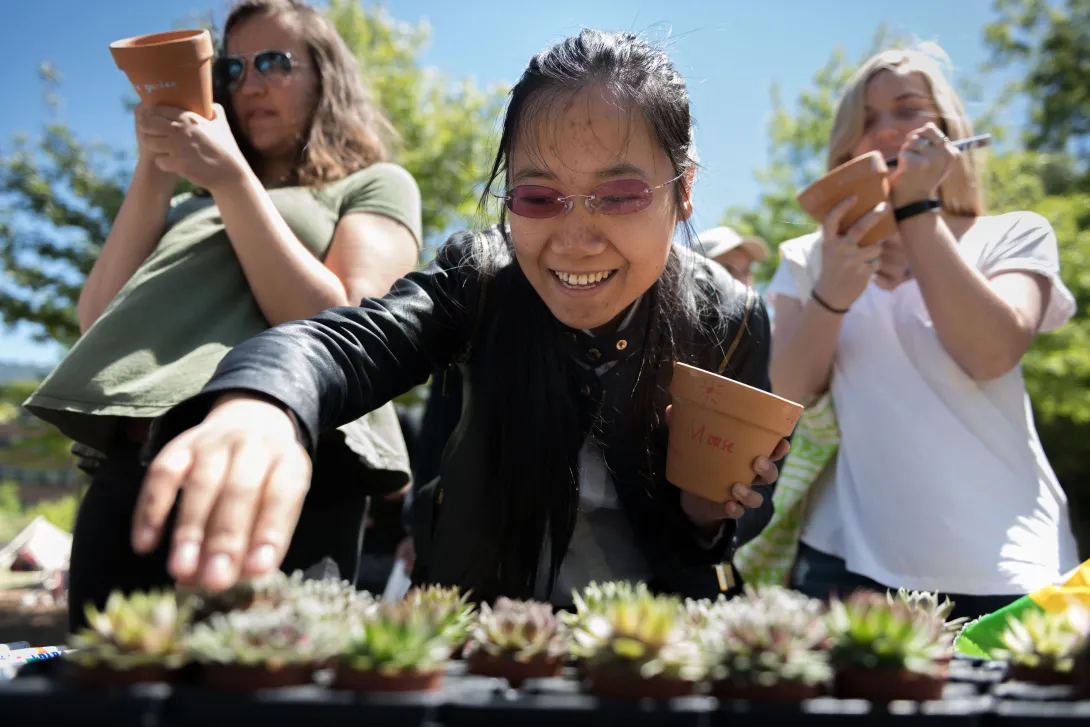
On April 22, communities across the U.S. and countries around the globe will come together in observance of Earth Day. Georgia Tech takes the opportunity to educate and celebrate the importance of protecting the environment a step further with Earth Month.
Events throughout the month allow students, faculty, and staff to familiarize themselves with sustainability efforts being put forward by the Institute and practices they can incorporate into their daily routines.
The global theme for Earth Day 2023 — the 53rd iteration of the event — and Tech’s month-long rendition is “invest in our planet.”
“The Earth Month lineup highlights the numerous ways that community members can embrace this theme,’” said Abby Bower, sustainability program support coordinator. “Today, the planet faces daunting challenges, but we all have the opportunity to pitch in to solve them. Georgia Tech has many great organizations, departments, and individuals dedicating their time and resources to making a better world, and we are excited to highlight them all month long.”
During Earth Month, you can participate in service opportunities, attend educational events, weigh in on ways Georgia Tech can meet our climate goals, and more.
Tech Beautification Day
April 1, 8:30 a.m. – 12:30 p.m., The Kendeda Building for Innovative Sustainable Design
The kickoff event for Earth Month, organized by the undergraduate Student Government Association and Georgia Tech Greek Week, will see hundreds of volunteers completing projects all over campus. After a welcome breakfast, groups of eight to 10 will be assigned a task with the goal of keeping the Georgia Tech campus as picturesque as ever. With assistance from Georgia Tech Landscaping, projects include planting flowers, trees, and shrubs; pulling weeds; and spreading pine straw. A primary goal of this year’s event is to plant 200 native azaleas.
For registration and additional information, click here.
Earth Day Clothing Swap at The Kendeda Revolving Closet
April 3 -7, 9 a.m. – 4 p.m., Basement of The Kendeda Building
Sustainable fashion is a pillar of this year’s global event. According to earthday.org, 87% of the 150 billion garments produced by the fashion industry each year eventually end up in landfills, and just 1% of discarded clothing is recycled. This weeklong event is a chance to donate gently used, clean clothes and recycle torn clothes and textiles.
Earth Day Bird Walk
April 5, 8:30 a.m. – 10 a.m., The Kendeda Building
The 400-acre Tech campus is home to diverse wildlife populations, including many species of birds. Learn more about the region’s birds from an expert guide during the Bird Walk organized by The Kendeda Building and Georgia Audubon Society. The reintroduction of native plants around Kendeda has created a habitat for birds, and the adjoining EcoCommons is part of a wildlife sanctuary certified by the Georgia Audubon, making Tech the first main campus in the state to receive the designation.
For registration and additional information, click here.
Southern Energy Conference
April 7, 9:30 a.m. – 2 p.m., Bill Moore Student Success Center
With the theme of “building blocks for a zero-carbon future,” the Energy Club will host the conference featuring keynote speakers, company demos, and panels discussing the technology and economics behind the future of the energy sector. Students are invited to compete in the Energy Research Poster Competition with cash prizes on the line.
For registration and additional information, click here.
EcoReps Earth Month Celebration
April 11, 1 – 3 p.m., West Village Dining Commons
Hosted by the 2022-23 EcoReps, this event is a celebration of all things sustainability in Housing and Residence Life, highlighting recent successes such as the Energy Competition, the ECGO app, and its growing composting program.
For additional information, click here.
Earth Month Bike Ride
April 11, 4:30 – 6 p.m., Meet on the Front Lawn of the Campus Recreation Center (CRC)
Hosted by the CRC, the leisurely 7-mile, no-drop ride promotes an alternate form of transportation and a healthy lifestyle. The ride will begin with a welcome from noted bike enthusiast President Ángel Cabrera and provide an overview of infrastructure projects that are making campus increasingly rider-friendly from Institute Landscape Architect Jason Gregory.
Registration and completion of a waiver are required. Riders are strongly encouraged to wear a helmet. Tech students, faculty, and staff can get a free helmet by completing the online Ride Smart Bike/Scooter Safety class.
For registration information, click here.
Propel ATL City Cycling Class - Georgia Tech Community
April 13, 4 – 5 p.m.
Propel Atlanta invites the Georgia Tech community to learn the rules of cycling during this instructional group ride. Participants will practice skills in a safe and supportive environment.
After getting the hang of the basics with a few drills, the 45-minute ride of 3 to 4 gentle miles will begin. Riders will experience Atlanta’s existing bicycle facilities, such as two-directional protected and single-directional bike lanes and sharrows, and learn to ride safely on streets without bike lanes by exercising their legal right to “take the lane.”
For registration information, click here.
Brook Byers Institute for Sustainable Systems Seminar Series: Anjali Thomas
April 13, 3 – 4 p.m., Economic Development Building (BBISS Suite 118)/Online
In the first of two seminars in this series, Anjali Thomas, associate professor and director of the Nunn School Program in Global Development, explores how “bureaucratic hurdles and identity politics shape water access in urban India.”
For additional information, click here.
Earth Day Org Fair and Celebration
April 18, 11 a.m. – 1 p.m., The Kendeda Building
Student organizations, academic departments, and groups around Atlanta will have tables set up in The Kendeda Building atrium and patio to promote a sustainable and environmentally conscious community. Enjoy free King of Pops, and bring a t-shirt, tote bag, or other item to be screen-printed with Earth Day designs. The Office of Sustainability will also have recovered shirts that can be used.
For additional information, click here.
Climate Action Plan Student Engagement Workshop
April 20, 5 – 6 p.m., Room 102, Clough Undergraduate Learning Commons
With a goal of reaching carbon neutrality by 2050, Georgia Tech is developing and implementing a comprehensive, cross-cutting Climate Action Plan. Students are invited to learn more about the plan and offer their thoughts on how the Institute can meet its climate goals during this engaging workshop hosted by the Office of Sustainability.
For additional information, click here.
Community Garden Ribbon Cutting
April 21, 2 – 3 p.m., Community Garden (Instructional Center Lawn)
Located along the Experiential Walkway, this event invites the Georgia Tech community to check out the newly renovated Community Garden and learn how to get involved.
For additional information, click here.
Film Screening: Making Pandemics at the Global Media Fest
April 23, 2 – 5 p.m., John Lewis Student Center
The French department in the School of Modern Languages will host a screening of Making Pandemics, a film that “seeks to understand the causes of this epidemic of pandemics” over the past four decades. The screening is free and open to the public.
Following the film, a panel of guest speakers will discuss its findings.
For more information, click here.
Sustainable-X Hangout
April 26, 3 – 4 p.m., Center for Sustainable Business Suite/Online
A partnership between the Ray C. Anderson Center for Sustainable Business and CREATE-X, Sustainable-X is a Sustainability Next Institute Strategic Plan project. With events occurring on the fourth Wednesday of every month, this session will examine social and environmental entrepreneurship and how to access resources for projects.
Brook Byers Institute for Sustainable Systems: Jenny McGuire
April 27, 3 – 4 p.m., Economic Development Building (BBISS Suite 118)/Online
Continuing the series hosted by the Brook Byers Institute for Sustainable Systems, Jenny McGuire, an associate professor in the School of Earth and Atmospheric Sciences, will host a seminar focused on “conserving the fabric of life given the complexities of global change.”
For additional information, click here.
Explore the Earth Month calendar for a comprehensive event lineup and updates. Campus groups, departments, and organizations interested in adding their sustainability-focused event to the Earth Month Calendar can submit this form or email Abby Bower.
Mar. 23, 2023
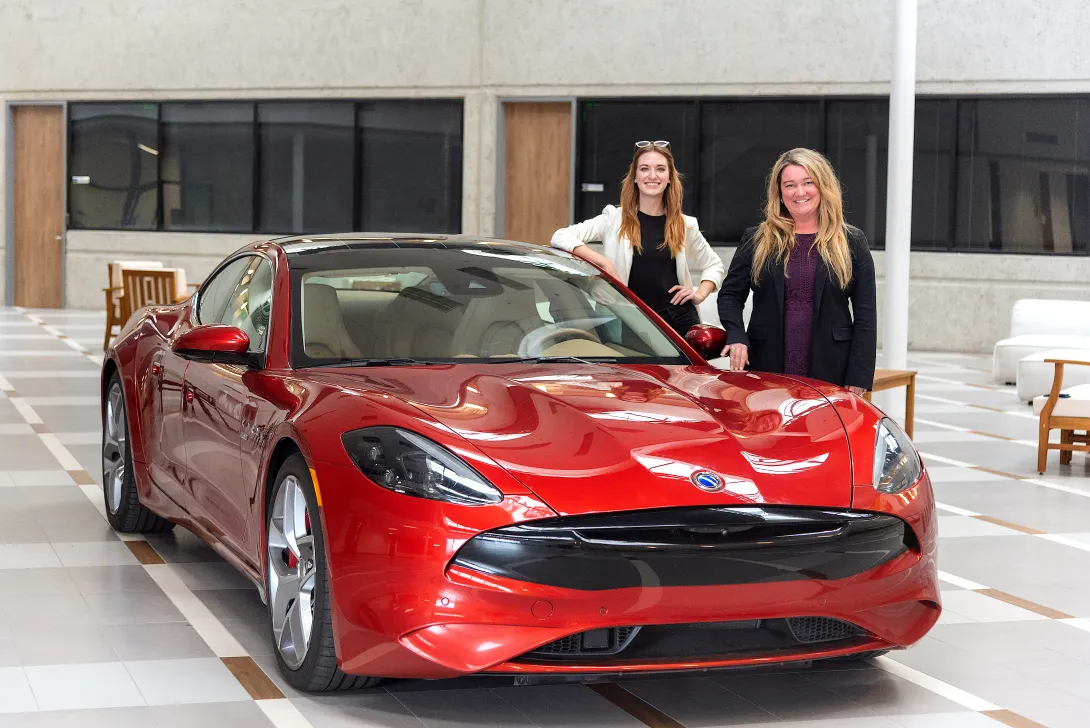
Jenn Voelker and Julia Vorpahl at the Karma Automotive headquarters in Irvine, California. Photo submitted.
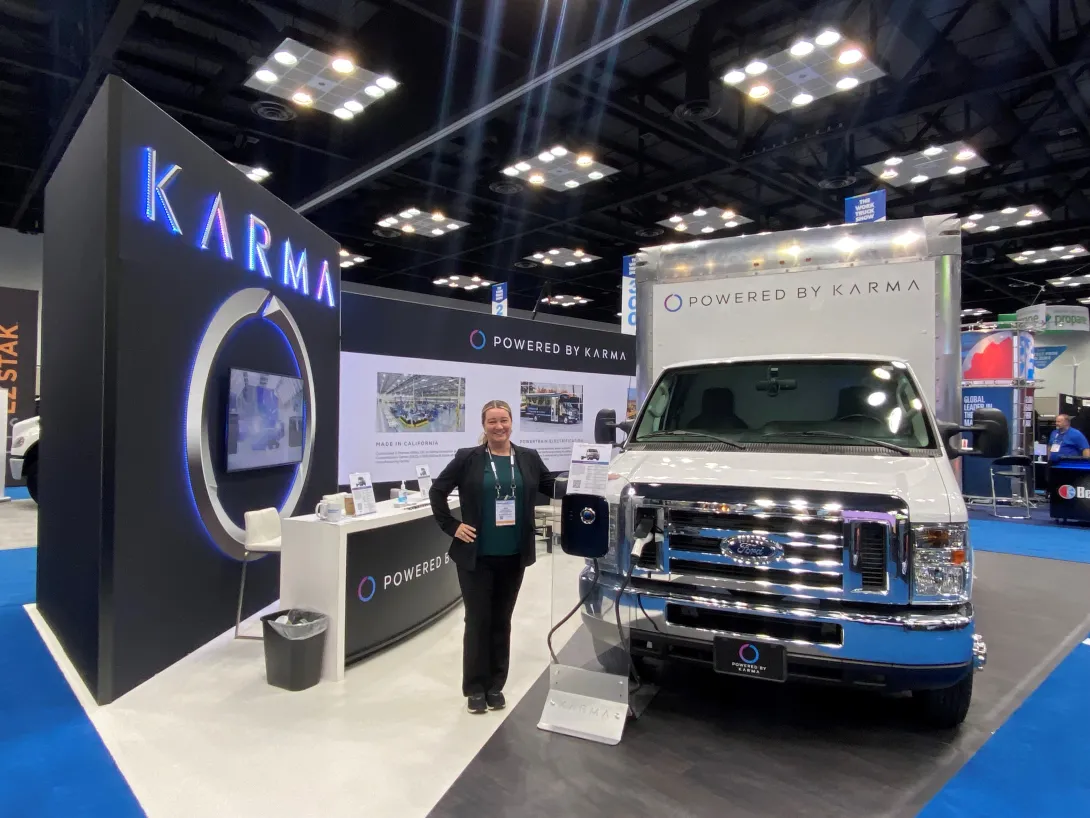
Jenn Voelker showcasing Karma's commercial product line at an auto show.
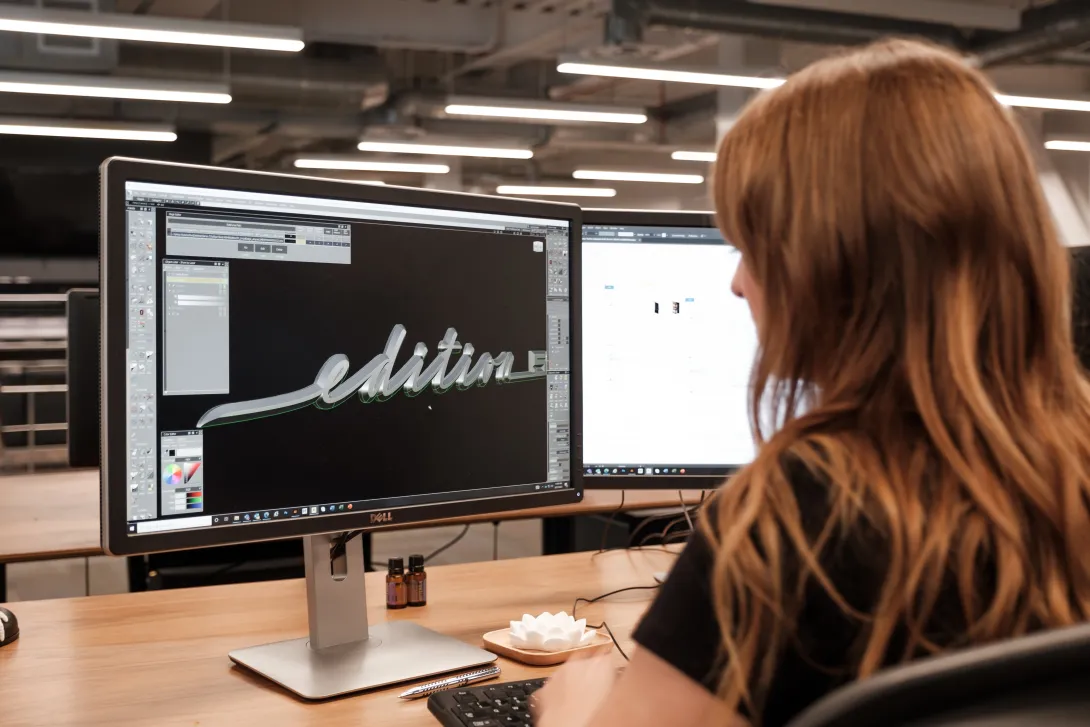
Julia Vorpahl working on a project in the Karma design studio.
Women make up just 24% of the automotive industry, but Georgia Tech graduates Jenn Voelker and Julia Vorpahl haven't let statistics stop them from paving their own way in a male-dominated field.
Both Voelker and Vorpahl work for Karma Automotive, a luxury electric vehicle manufacturer based in California. Beginning with their time at Tech, they've never let gender bias stop them from pursuing their passion.
"It's math," Vorpahl, a visualization and digital design modeler at Karma, said. "You either get the question right, or you get the question wrong. I think that attitude really helps when you get into a professional environment. It teaches you to have tougher skin where if you are the best for that job, you will get the job. That's what Georgia Tech instilled."
Vorpahl grew up in the industry watching her family operate what is now the oldest independently owned Mercedes-Benz dealer in metro Atlanta after her grandfather, an engine designer for the German automaker, came to America and opened the shop in 1967. She arrived at Georgia Tech unsure if she'd follow in her family's footsteps, but ultimately, she landed an internship at Daimler, the nation's largest commercial vehicle manufacturer.
While other interns came in with a background in automotive design, Vorpahl’s willingness to learn and tireless work ethic landed her a full-time job as the only woman in the company's design studio.
During her three years at Daimler before accepting her position at Karma in 2022, she'd occasionally make the drive from Portland, Oregon, back to Georgia. Along the way, she crossed paths with truckers, who often expressed surprise that Vorpahl was among those behind the scenes designing their rigs. She often heard questions like “Why do you work there?” or “How did you end up there?”
And her response was simple. "Women like cars, too.”
That rang true through Voelker's childhood as well. When the senior director of program management for Karma arrived in Atlanta for her first year at Georgia Tech, she knew she'd found a place that could help her turn an aptitude for math and science, and a fervor for cars, into a career.
"Best move I ever made," Voelker said on her decision to enroll at Tech, although it wasn't just the Institute's stellar reputation that lured her from her home state of New Hampshire. "I visited campus in February. There was 6 feet of snow on the ground and then I came to Atlanta, and the flowers were blooming."
After changing her major from mechanical engineering to industrial design, Voelker got her foot in the door through an internship with Masterack, a commercial cargo vehicle equipment manufacturer based in Atlanta. She attended Tech at a time when women made up around 27% of the undergraduate population, so when she entered the workforce, she wasn't fazed. "It never bothered me. I have always felt like I fit right in, especially when it's the right school, the right class, or the right company where everybody appreciates learning from each other and working together towards a common goal," she said.
In fact, her experience on North Avenue taught her to always keep learning and never give up, a piece of advice she now passes along to other women entering the industry.
"Don’t be afraid to give your opinion in meetings, speak up and use all of the knowledge that you've learned over the years toward whatever project you're working on," said Voelker, who worked her way up the ladder at Masterack for 18 years before seeking a new challenge at Karma. “That's one thing that I haven't backed down on. If I have a strong opinion about something, I have no fear of saying it.”
Vorpahl and Voelker each commended Karma for their dedication to promoting hard-working women and a culture that fosters diversity — a principle that Vorpahl especially values after completing two study abroad programs at the University of Singapore and the University of Strathclyde.
“One of the biggest advantages was seeing how people from different countries approach design and how different schools approach design. You don’t want a bunch of people who all think exactly the same way. Otherwise, we’d all be driving around in the exact same vehicle,” she said.
Leading Karma’s commercial vehicle product line, Voelker noted that she has continued to see more women in leadership positions and at industry conferences, and she hopes that momentum carries over to the next generation. Highlighting the importance of igniting both young girls’ and boys' interest in STEM, Voelker recently spoke to a local second grade class to share her experiences.
"I've been really fortunate to have had some great mentors over my career, so I love to pay it forward to the younger generation," she said. "They were so excited, and I hope that stays with them and excites them to learn more about engineering."
In addition to providing an example to young women of how to succeed in a competitive industry, Vorpahl also hopes to share the technical aspects of what she's learned in the field with her alma mater and offer future graduates a roadmap to a career in automotive design.
"The students would thrive in this industry because it is so nitpicky, and Tech minds would just love it," she said. "There's not really a direct path from the Georgia Tech studios into car studios, so I'm hoping that I can show them that path."
Voelker and Vorpahl are bonded by their employer and their alma mater, but it’s their shared passion for seeing their hard work hit the pavement that continues to drive them.
Apr. 17, 2017

Devyon wasn't having success landing interviews or getting call backs for job applications. A mentor at the National Urban League encouraged him to apply to Juma, an employment and job training program which helps youth overcome the hardships of poverty and aspire to career success. As part of its social enterprise operations in Atlanta, Juma offers year-round employment to over 140 Atlanta youth at SunTrust Park, Mercedes-Benz Stadium, and State Farm Arena—home of the Braves, Falcons, Hawks, and Dream—as well as the Georgia World Congress Convention Center.
Devyon applied and successfully enrolled in Juma, and found a path to earn money, build his resume, and pave his future. As part of the program, Devyon took Georgia Tech LEAP courses to learn more about supply and logistics and the career paths the field has to offer. His dedication to the job, his willingness to go above what was expected of him and his attention to detail were characteristics that made him stand out to Juma’s Enterprise Managers. After successfully completing Juma’s training program, Devyon secured a job at UPS, a Juma Atlanta job placement partner. Today, Devyon has stable employment and, after successfully passing UPS’ Supervisor Exam, became a Shift Manager.
Oct. 09, 2017
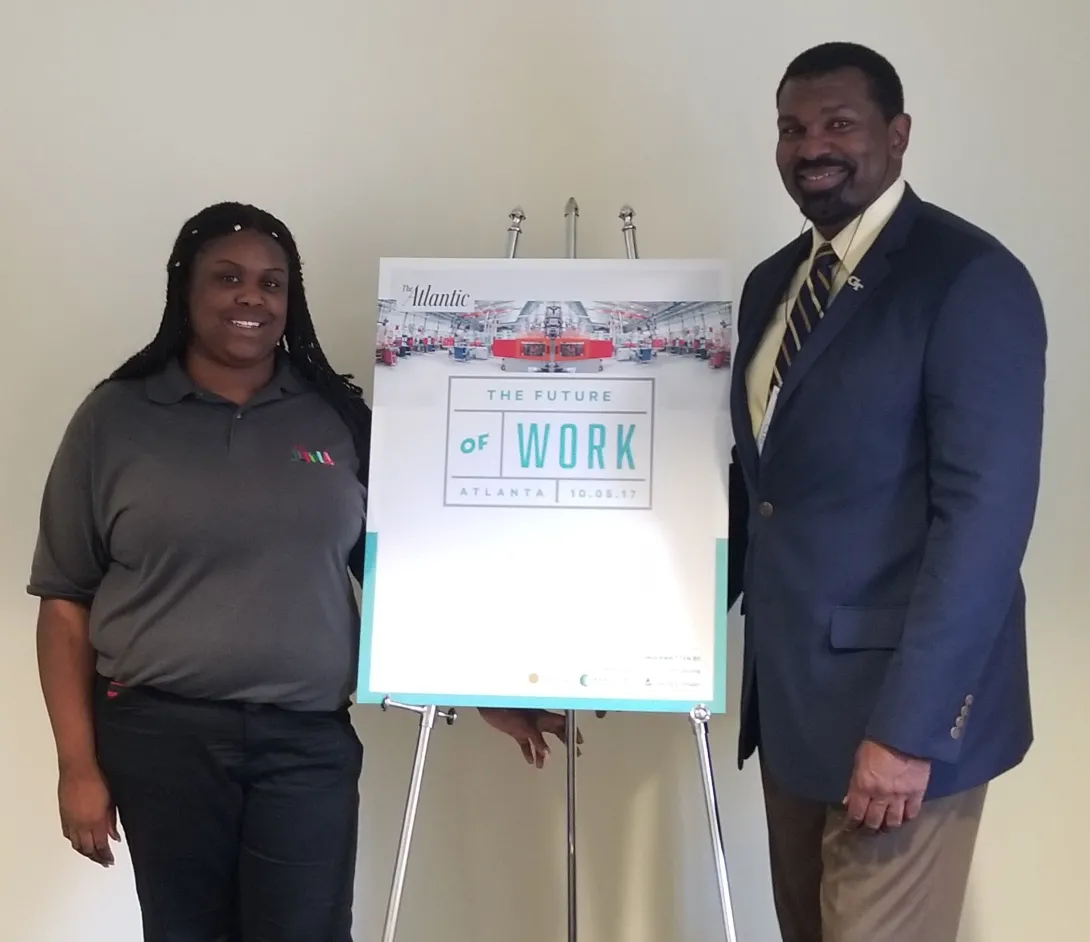

Zaria participated in Juma, an employment and job training program which helps youth overcome the hardships of poverty and aspire to career success. As part of its social enterprise operations in Atlanta, Juma offers year-round employment to over 140 Atlanta youth at SunTrust Park, Mercedes-Benz Stadium, and State Farm Arena—home of the Braves, Falcons, Hawks, and Dream—as well as the Georgia World Congress Convention Center.
Zuma promotes participants to earn while they learn, so while going to school during the week to pursue her GED, Zaria took GT LEAP courses at night and worked in the Juma Atlanta concessions operations group on the weekend. Through perseverance and her will to succeed, she later secured fulltime employment within the JUMA organization.
At the Future of Work 2017 summit sponsored by The Atlantic, Zaria was asked about her experience. She commented, “sometimes, people just need a second chance and an opportunity to take advantage of it.” The experience has opened her eyes to the possibilities and Ms. Walker has aspirations to be a crime scene investigator. Zaria plan to pursue further education and make that dream a reality some day.
Sep. 27, 2022
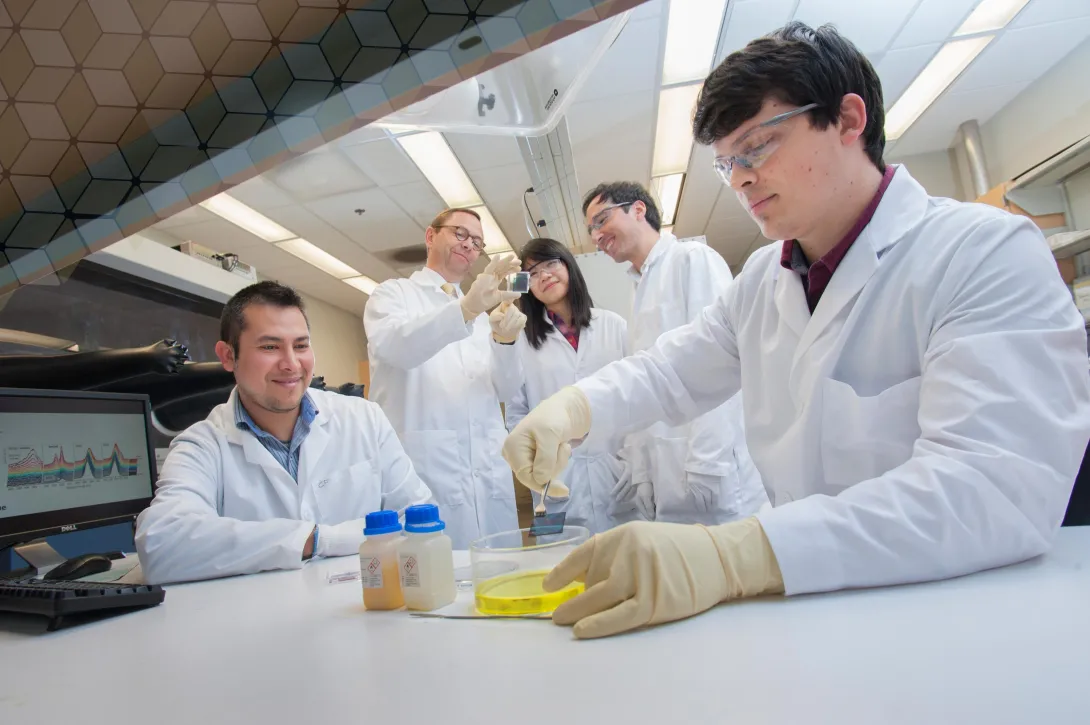
The Scalable Asymmetric Lifecycle Engagement Microelectronics Workforce Development program (SCALE) has announced the program will extend another five years and expand with $10.8 million additional Department of Defense (DoD) funding, with a ceiling of $99 million.
SCALE officials said this expansion of the nation’s preeminent program will further its goal to develop a next-generation workforce that can return the United States to prominence in global microelectronics manufacturing.
Georgia Tech participates in the partnership, which is led by Purdue University and managed by NSWC Crane. SCALE facilitates the training of highly skilled U.S. microelectronics engineers, hardware designers and manufacturing experts. SCALE brings together a public-private-academic partnership of 17 universities and 34 partners within the defense industry and government.
“This is an extremely exciting time in the country and at Tech for microchip design and manufacturing,” said Arijit Raychowdhury, the Steve W. Chaddick School Chair of Tech’s School of Electrical and Computer Engineering (ECE). “These newly announced funds for the SCALE program will help Georgia Tech recruit a new, diverse group of students ready to work in defense microelectronics. We’re thrilled to be a SCALE partner university and honored to be leading many of the project’s specialty areas.”
SCALE provides unique courses, mentoring, internship matching and targeted research projects for college students interested in five microelectronics specialty areas. Georgia Tech ECE faculty members will be the primary investigators for three of the areas:
- system on a chip will be led by Raychowdhury;
- radiation-hardening will be led by John Cressler;
- and heterogeneous integration/advanced packaging will be led by Madhavan Swaminathan.
The other two focus areas are embedded system security/trusted AI and supply chain awareness.
Industry and government partners regularly meet and update a list of knowledge, skills, and abilities important for new entrants to the workforce. The SCALE universities then update their curriculum to ensure the students are prepared for upcoming needs in the rapidly advancing microelectronics field.
Peter Bermel, SCALE director and the Elmore Associate Professor of Electrical and Computer Engineering at Purdue, said the United States will need 50,000 trained semiconductor engineers to meet overwhelming and rapidly growing demand.
“The United States is committed to expanding and strengthening its semiconductor industry and workforce rapidly over the next five years,” Bermel said. “SCALE takes a holistic approach to the microelectronics workforce gap by comprehensively addressing system challenges for workforce training and recruiting.”
Goals for the next five years include:
- Expanding student participation in SCALE fivefold to more than 1,000.
- Developing learning models for K-12 classrooms.
- Collaborating with community colleges nationwide to develop microelectronics classes.
The demand for microelectronics increased by 26.2% in 2021. But while the United States consumes about half of the chips produced worldwide, the country only manufactures about 12%, highlighting the pressing need for the U.S. to strengthen its domestic semiconductor supply chains and increase industrial capacity.
The funding announcement is the latest highlight in Georgia Tech’s leadership role in bolstering microelectronics and workforce development. Tech’s large engineering and science faculty bring a broad set of research expertise to strengthen the country’s semiconductor capacity. The Institute is uniquely positioned to train the microelectronics workforce, drive future microelectronics advances, and provide fabrication and packaging facilities for industry, academic and government partners to develop and test new solutions.
###
The Georgia Institute of Technology, or Georgia Tech, is a top 10 public research university developing leaders who advance technology and improve the human condition. The Institute offers business, computing, design, engineering, liberal arts, and sciences degrees. Its nearly 44,000 students, representing 50 states and 149 countries, study at the main campus in Atlanta, at campuses in France and China, and through distance and online learning. As a leading technological university, Georgia Tech is an engine of economic development for Georgia, the Southeast, and the nation, conducting more than $1 billion in research annually for government, industry, and society.
News Contact
Dan Watson
dwatson@ece.gatech.edu
Aug. 08, 2022
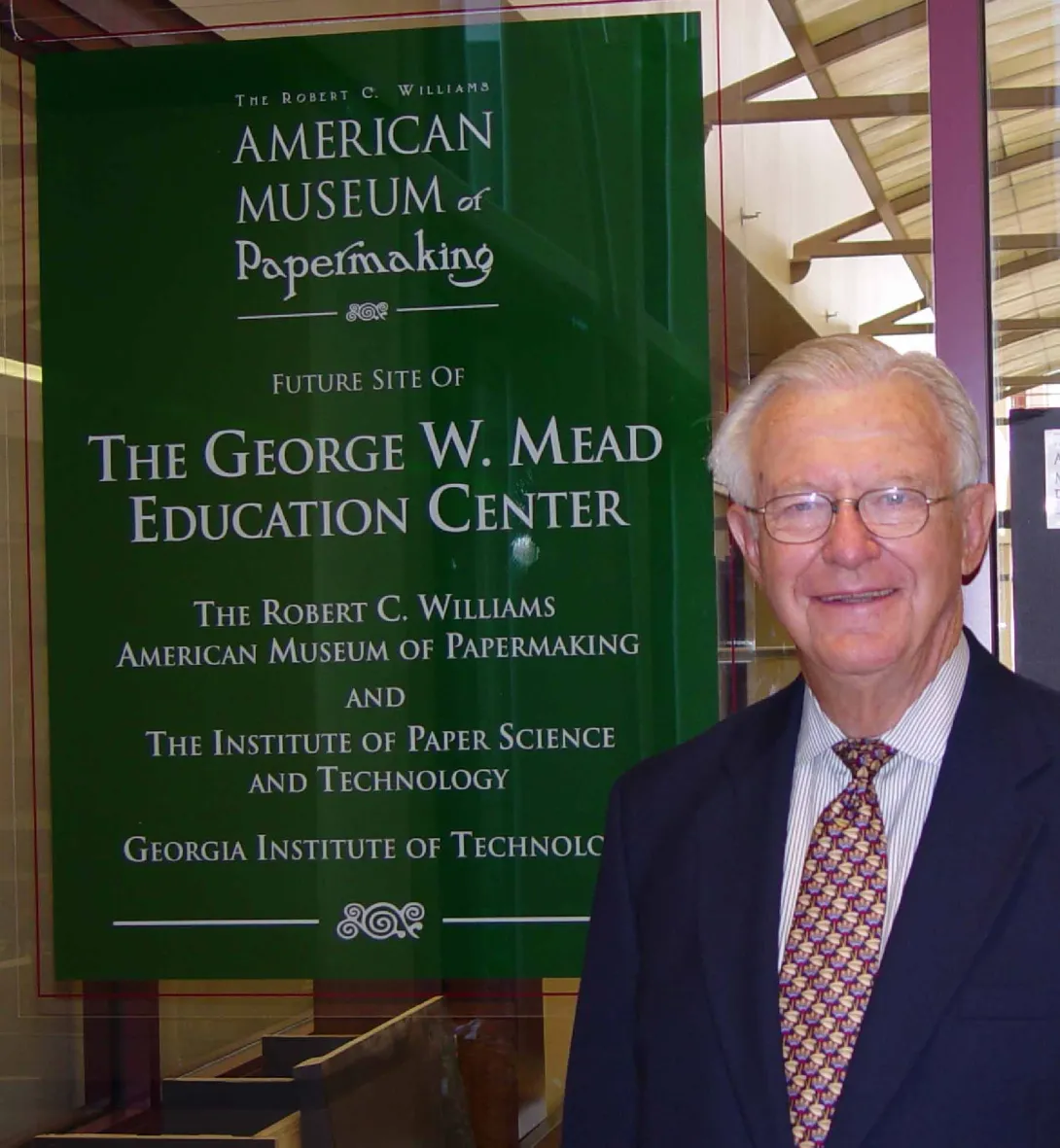

George W. Mead II passed away on July 29, 2022, at the age of 94. He was a long-time supporter of the Robert C. Williams Museum of Papermaking and the Institute of Paper Chemistry (now the Renewable Bioproducts Institute). He graduated from the Institute of Paper Chemistry in 1952, and supported the Institute as a board member and advocate for the paper industry. Through the Mead Witter Foundation, led by George Mead, the Paper Museum was able to establish classroom space in the early 2000s for hands-on experiences, and the George Mead Education Center, which serves as additional exhibition space focused on the industrialization of paper. This support enabled the museum to provide more in-depth experiences for school groups, and develop more intensive programs.
In an interview for the 75th Anniversary of the Institute, Mead said, “I’ve enjoyed my relationship with the Institute tremendously. I’m proud of it and I hope to see it continue to thrive in its own way. It’s been a huge contributor to the industry and a huge contributor to my own success and, as such, I feel obligated to continue my support.” He went on to say, “Our industry was pretty technologically inept when the Institute was first formed. While I don’t think the Institute or its graduates can take the credit for having created the technolical upsurge that has taken place since 1928 or so, the fact is that it couldn’t have taken place without the Institute graduates out there to implement it, to help put it into place. The Institute’s influence on the industry is probably as great as any institution could have possibly had.” He served as Board Chair of the Institute in 1989 – 1990, when the Institute moved to Atlanta from Appleton, Wisconsin. Mead received an honorary doctorate from the Institute of Paper Science and Technology in 2004.
Mead was born October 11, 1927 in Milwaukee, Wisconsin. His great-grandfather, J. D. Witter was a cofounder of Consolidated Water Power and Paper Co. His grandfather, George W. Mead I, and father, Stanton Mead, both served as president of the company. In 1966, George Mead II became president of the company. Mead was named Man of the Year in 1986 by the Paper Industry Management Association, and in 1998 he was inducted into the Papermakers International Hall of Fame. He served as the director of the American Forest and Paper Association, director and chairman for the National Council for Air and Stream Improvement, and was a director of the Technical Association of the Pulp and Paper Industry.
Mead’s philanthropy included the Mead Witter Foundation, which has given over $100 million in support of education, environmental causes, civic organizations, and local scholarships. He also supported the Mead Wildlife Area, a 33,000 acre preserve in Wisconsin. He was active in his community, from the library to the hospital association to the Rotary Club.
Mead is survived by his wife, Susan Feith, three children, two stepchildren, four grandchildren, four step-grandchildren, and four great-grandchildren.
The Robert C. Williams Museum of Papermaking extends condolences to the family and to his community on his passing.
News Contact
Virginia Howell
404-894-5726
virginia.howell@rbi.gatech.edu
Aug. 05, 2022
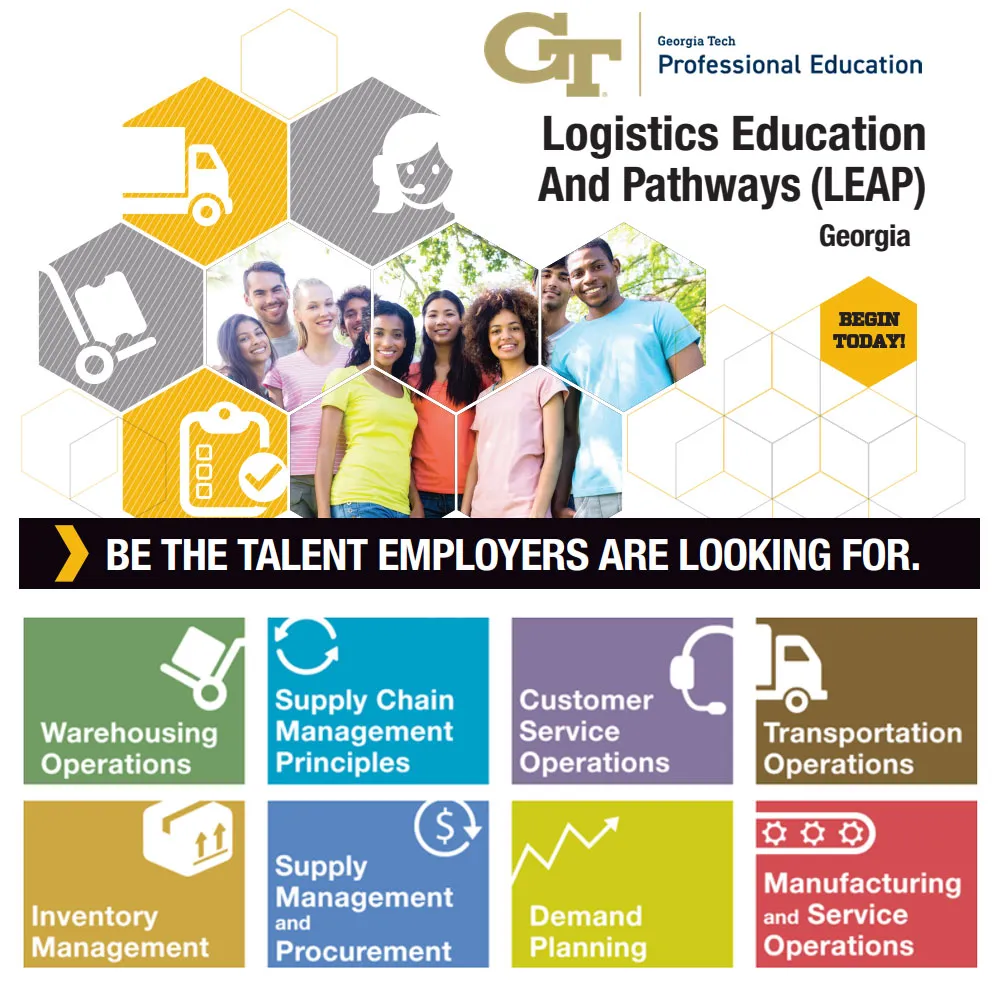
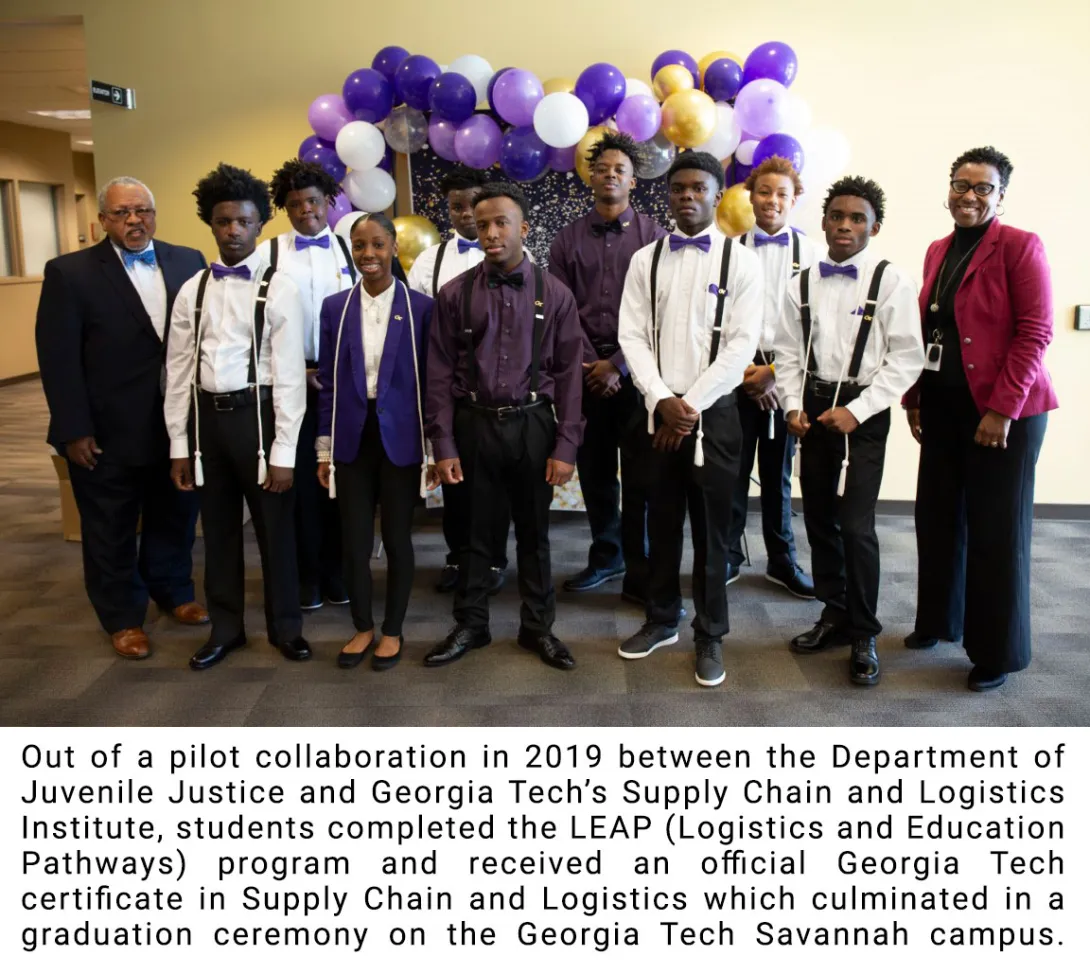
The Georgia Tech Supply Chain and Logistics Institute (GT-SCL) residing in and supported by the Stewart School of Industrial and Systems Engineering (ISyE), in coordination with Georgia Tech Professional Education (GTPE), is expanding its Logistics Education And Pathways (LEAP) program with the Georgia Department of Juvenile Justice (DJJ) Reentry Program to implement services for eligible participants in Chatham, Bibb, and Muscogee Education Transition Centers (ETC).
The goal of the ETCs is to reduce recidivisms and enable participants with the tools, training, and opportunities to move forward as a productive member of society with sustainable employment and a rewarding career. LEAP is a fast-paced certification program that prepares secondary education students to compete for successful high-growth jobs in the supply chain and logistics field, an outcome that is a natural component to the mission of the ETCs.
“I want to thank Georgia Tech for being a great corporate partner in rehabilitating our justice-involved youth,” said Tyrone Oliver, Commissioner of the Georgia Department of Juvenile Justice. “The LEAP program will help our youth gain valuable skills to aid them towards a brighter future.”
Initially, this partnership began with a pilot program in July of 2019, and culminated when the DJJ’s Chatham ETC hosted their Award Certification Ceremony on the Georgia Tech’s Savannah campus. Expanding this program in 2022 will equip students not only in Chatham County, but now in Bibb and Muscogee Counties with the knowledge, skills, and credentials for careers in the fast-growing Supply Chain and Logistics industry. All the funding for the LEAP program comes from industry partners like the GA Power Foundation, Schneider Foundation and JP Morgan Chase & Co. In addition, DJJ also contributed funding for this successful partnership with the ETCs.
The LEAP program initially covers understanding with the Supply Chain Management Principles course and then the various domains within the supply chain through three other optional courses (i.e., Customer Service, Warehousing Operations, and Transportation Operations). It also explores with students how the supply chain supports organizations’ strategic and financial goals, and current events through subject matter lectures and simulation exercises.
After completing the program, students receive an official GTPE Certificate of Completion for each completed pass/fail LEAP course (Supply Chain Management Principles, Customer Service Operations, Transportation Operations and Warehouse Operations), that are all sanctioned by the Board of Regents of the University System of Georgia. Typically, at their end-of-program, there is an Award ceremony where they receive their professional education certificate from Georgia Tech Professional Education (GTPE).
“While earning GT Professional Education credentials, attending fieldtrips to Gulfstream, GA Ports Authority, Amazon, or Dynacraft and improving their potential to secure employment in the exploding Savannah Supply Chain Industry, may have served as the initial motivation to attempt the program, the impact was immeasurable. Our students grew in areas that enhanced their self-confidence, work ethic, and intrinsic motivation. As a result, our students view themselves as productive citizens with credentials for quality jobs or careers in their future,” said ArtLisa Alston-Cone, Lead Teacher, DJJ Chatham ETC.
Students have a working knowledge of the fundamentals of Supply Chain and Logistics and will be immediately prepared for internships and job opportunities. Two students completed more than one course, indicating their interest and aptitude in this field. One student who was already working in a distribution operation actually completed four courses, earning a Logistics Fundamentals Program Certificate. After the program in December of 2019 with the DJJ’s Chatham ETC, seven of the eleven graduates received job offers, and another two were scheduled for interviews, making the program a great success. The students in the ETC’s have completed all requirements from the juvenile system. They are in transition to becoming productive members of society. At this point, many students are completing their High School Diploma requirements for graduation or getting their GED. They are typically living with family, a guardian or in a transition home.
“We’ve all had times in our lives when someone has discounted us, intentionally or unintentionally. There will always be that student in the corner who you think couldn’t care less, but given the proper attention and care, they can become a star. It’s easy to predetermine what someone is capable of doing; but when these students take this program, the lightbulb goes off, and they become interested and develop a passion and confidence because of this course,” said Charles Easley Jr., GT-SCL Project Director and Instructor.
The program is delivered in a cohort format so that the students always feel supported not only by the instructors but by their classmates as well. Students receive educational content but also learn how to integrate their training in the real world, so they are prepared to perform in the workplace. Students are taken on field trips with the support of community partners to learn how to apply their knowledge and see first-hand how the supply chain operates. In previous years, students were taken to Georgia Tech’s Atlanta campus to explore The Ferst Center for the Arts, The Supply Chain and Logistics Institute, and The H. Milton Stewart School of Industrial and Systems Engineering (ISyE) so they could see what options are open to them for their future working careers. During these visits they were able to participate in student information sessions, see the innovative technology in the ISyE Physical Internet Lab and interact with faculty like Benoit Montreuil, Tim Brown, GT-SCL, and role models like Gen. Ron Johnson, Professor of the Practice, and ISyE Student Ambassadors. Students were also taken to Gulfstream in Savannah and The Georgia Fair where they participated in a hands-on project to map out the supply chain process for food.
About the LEAP Program
GTSCL created LEAP in 2015 through a grant from JPMorgan Chase & Co. to further the financial services firm’s “New Skills at Work” initiative that promotes workforce development to bridge the gap between the talent employers need and the qualifications of the local talent pipeline. The curriculum and content were developed by The H. Milton Stewart School of Industrial and Systems Engineering (ISyE) at Georgia Tech. In August 2018, JPMorgan Chase & Co. continued once again committed to supporting LEAP with an additional grant. The Georgia Tech LEAP program has been delivered throughout Georgia to Schools, Cohorts, and Individual Students in 18 School Districts or Systems, at 46 different schools public and private, in 13 colleges and universities, and across several well-known organizations and employers. This includes schools like Maynard Jackson HS, Grady HS, North Atlanta HS, Effingham College Career and Career Academy, Fulton Schools College and Career Academy, Newton College and Career Academy, Social Circle HS, Griffin Region College & Career Academy, New Manchester HS; non-profit organizations like Goodwill, United Way(Career Rise), Scouts BSA(Crew 2421), The Latin American Association; and businesses like Sysco, and Mohawk Industries. The program has been continuously supported by generous donations from schools, civic organizations including Effingham College and Career Academy, Fulton Schools College and Career Academy, foundations including Home Depot Foundation, Fulton Education Foundation, Schneider Foundation, Georgia Power Foundation, Regions Foundation, and employers including companies like HMTX Industries, Inc.
News Contact
Kerry Jarvis
912-966-7913
kerry.jarvis@pe.gatech.edu