
Nov. 03, 2022

Banning scooters may reduce sidewalk congestion and keep would-be riders and pedestrians safer, but it comes at a cost, according to new research from Georgia Tech’s School of Public Policy.
In a study examining the impact of Atlanta's 2019 ban on e-scooters and e-bikes in the city, researchers found that average commute times increased by about 10%. Travel to stadium events such as soccer games increased by almost 12 minutes per trip or 37% increase in travel times while the ban was in effect.
For Atlantans, that adds up to 784,000 extra hours sitting in traffic each year — and that’s just between 9 p.m. and 4 a.m. when the ban was in effect. A moratorium during peak rush hour would cause even more congestion, the study’s principal investigator, Omar Asensio confirmed. Expanding the scope of their study, Asensio and his team in Georgia Tech’s Data Science and Policy Lab estimate that e-scooters, e-bikes, and other micro-mobility options can save an average of 17.4% in travel time for drivers nationally.
“These are fairly significant congestion effects that most travelers will feel and as an unintended consequence of the safety regulation,” said Asensio.
New data settle an old debate
The study, conducted in Georgia Tech’s Data Science and Policy Lab and published in Nature Energy, is the first to definitively show that investing in micro-mobility infrastructure such as e-bikes, e-scooters, and bike lanes can reduce traffic congestion and carbon emissions in cities. The research accounted for the rise in popularity of ride-sharing services and other sources of traffic.
Previous studies on micromobility were controversial and contradictory because they relied on travel surveys, which can be unreliable and are subject to biases resulting from self-reported data, Asensio said. This motivated his search for a more rigorous, data-driven approach to answering the question.
The opportunity arose when Atlanta banned scooters with a geo-fencing policy in 2019. The ban was done with a remote shutdown on all scooters within a certain perimeter, which ensured compliance across the city. Previous moratoriums in other places relied on people to choose to cooperate and follow the rules, so this 100% compliance rate was unique to Atlanta.
“I thought, okay, that's interesting because now we have near-perfect behavioral compliance in response to a policy intervention, which turns out to be extremely rare,” Asensio said. “All of a sudden, if you're without the use of the scooter, what do you do? This created a great natural experiment, to be able to precisely measure the traffic times before and after this policy intervention and in doing so, test behavioral theories of mode substitution.”
In addition, Asensio and his team received early access to the then-new Uber Movement Dataset, which gave them detailed information about commute times across the city that previously had to be collected by surveys as well. In short, the stars aligned in 2019 for the debate over the true impact of micro-mobility on city traffic to finally be settled.
Mary Feeney, program director for the Science of Science Program at the National Science Foundation, which supported the research, said “Asensio and his team are using newly available ‘big data’ sources to tackle practical questions with real policy implications. Bringing the appropriate data and analytical approaches to these problems helps empower decision-makers to enact evidence-based policy.”
Public safety vs. congestion and emissions
The regulation in Atlanta was one of many that U.S. cities put in place in response to increased accidents and hospitalizations from micro-mobility devices.
Reducing congestion also reduces emissions, noted Camila Apablaza, who worked on Asensio’s team along with Savannah Horner, Cade Lawson, and Edward Chen. “I thought this was an important question because the impact of certain modes of transportation, such as scooters, is sometimes overlooked,” she said. “We know that electric mobility will be the main contributor to decarbonizing the passenger transportation sector, therefore we need to understand the interactions between different modes of electric transportation.”
But, “the point of this paper is to present the idea that it’s not just as simple as ‘we should ban the scooters,’ right?” said Chen. “We have found that there are, in fact, trade-offs between banning them for public safety versus allowing them to relieve traffic congestion, and whether or not city governments make the decision does ultimately have an impact on people's daily lives.”
Economic impact
The researchers found that e-scooters and e-bikes do, in fact, reduce congestion on the road by substituting some personal vehicle or ridesharing use rather than only public transit or walking. When the estimated saved time for drivers nationwide is translated into monetary value, Asensio approximates that it adds up to $536 million a year.
“This is also just a personal thing,” Chen added. “I’ve lived around here my whole life. I start seeing these scooters around, and this kind of answers that fundamental question: are people actually using these, and are these actually replacing trips and inherently reducing all these carbon emissions?”
What’s Next?
The Data Science and Policy Lab partners with the private sector and city governments on data innovations in policy analysis and impact evaluation. Follow-up research to this project could dig deeper into the specific transit substitutions people choose and why, Asensio said.
“I think modeling the emissions impacts for those will continue to be an ongoing kind of investigation,” he said. “When it comes to electrification, micro-mobility is just one of many strategies that are aggressively being invested in by both the public and the private sector. It's a really exciting opportunity to meaningfully reduce emissions and to benefit from the public health co-benefit of reduced air pollution.”
The paper, “Impacts of Micromobility on Car Displacement With Evidence From a Natural Experiment and Geofencing Policy” was funded by Asensio’s 2020 NSF Faculty Early Career Development Program (CAREER) (Award No. 1945532). It is available at https://doi.org/10.1038/s41560-022-01135-1.
News Contact
Di Minardi, Communications Officer I - School of Economics, School of History & Sociology
Sep. 15, 2022
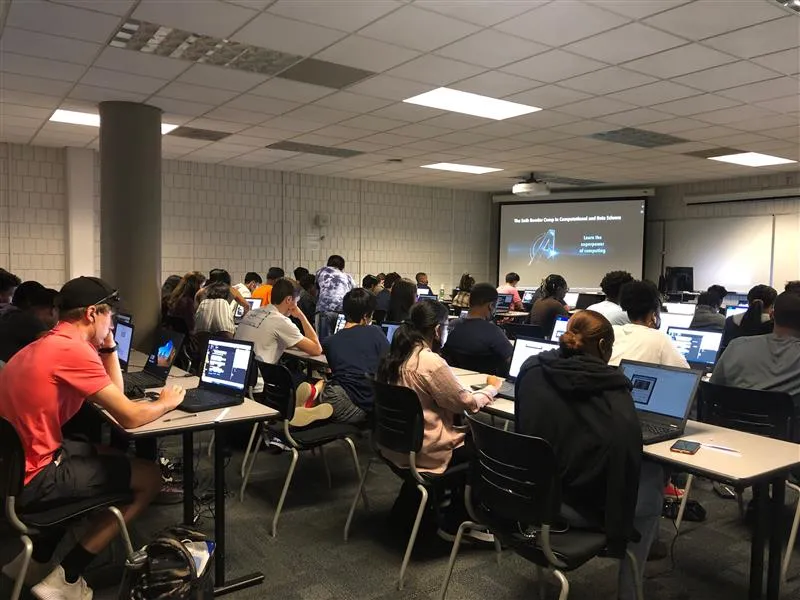
When Alexandria Sweeny, better known as Alex, considered what she wanted to accomplish before graduating from Drew Charter School, the then high school junior set two goals: complete her engineering internship and make a positive impact.
She did both while strengthening her coding knowledge during her time as a camper and mentor at the Seth Bonder Camp in Computational and Data Science for Engineering (SBC).
“I did it when it was fully virtual, and it was definitely an experience,” said Sweeny who spent a week being introduced to computing and data science where she performed virtual activities, last June.
The camp, which is offered either as an online course or on-campus summer camp at Georgia Tech, is designed to build students’ problem-solving and analytical skills while furthering their interest in computer science as a potential career. It is also part of AI4OPT’s mission to inspire young Georgians to pursue STEM (science, technology, engineering and mathematics).
AI4OPT hosted its first in-person summer camp at Georgia Tech in June. The camp brought together 60 students from schools across Georgia including Drew Charter, Banneker High School, and Westlake High School.
Sweeny was asked to return to this particular camp—but this time, as a mentor.
“Of course, I said yes, because it was something fun that I could do over the summer preparing for college without it being too hefty,” said Sweeny. “It was something that I felt prepared for from attending the camp.”
Responses like Sweeny’s motivates SBC Site Managers like Reem Khir to introduce more bright minds to the camp centered around computer programming logic, programming language for AI, and teamwork.
“We expose them [high school students] to certain types of education areas like Twitter analysis, how to solve a sudoku, and even computational biology, if they wanted to consider a career in biology,” said Khir, who joined the camp last year to help students with assignments. This year, she took on even bigger leadership role by maintaining and observing two camps and facilitating 50 students and seven teaching assistants (TAs). She worked under a ‘student to student and student to TA’ interactive structure so that each participant took away a useful skill in data science.
“It’s the time where high school students start forming opinions and decisions about the career path they want to pursue,” said Khir. “The steppingstone is their college education, and we can help students in that period.”
AI4OPT Will Acquire and Advance Seth Bonder Camp
AI4OPT is working to adopt a short-term system used to track students after the camp. The institute wants to build up the system to see majors, colleges, and career paths each student has vowed to pursue before they head off to college or the workforce.
“This is a critical period for students,” said Khir. “It’s a time where students start thinking about a major for college and later impacting the next 20 or 30 years of their life. Being a part of that is very unique in terms of creating a positive influence in the next generation.”
AI4OPT is taking the lead over the SBC to offer the initiative more organizational support as the program has seen tremendous growth and has become a much broader initiative. The Seth Bonder Foundation, which first introduced the camp to those ages 10-18, will continue to fund the camp now more targeted towards high school students interested in engineering, but do not have access to computer science and/or data science in their middle and high schools.
“A lot of the different communities are not exposed to this and may never see this opportunity. The Seth Bonder Camp exposes high school students to AI opportunities and gives them skills to successfully enter the field of STEM with confidence,” said Professor Pascal Van Hentenryck, who’s brought his data sciences skills and knowledge to Georgia Tech and leads both AI4OPT and the SBC.
AI4OPT is in transition to lead the SBC to offer more organizational support as the program sees tremendous growth. The research Institute will expand the longitudinal camps to engage middle and high school students in these topics, while also bringing AI education and research programs to HBCU’s and Hispanic-serving colleges throughout the nation, addressing the widening gap in job opportunities.
Though Sweeny has transitioned away from coding and transcended into research, she never stopped setting goals even now as a first-year biomedical engineering major at Georgia Tech.
“Do anything you can to take it [the SBC] even if you don't want to go into coding,” said Sweeny. “It is a good way to meet new people learn new skills, it is something that you don't necessarily have to have a love for coding to have to do it.”
To learn more about the Seth Bonder Camp in Computational and Data Science for Engineering and to partner with the camp, visit sethbondercamp.isye.gatech.edu.
(Writer’s note: This article is part of a series highlighting AI4OPT members, students, education programs and professional development testimonies.)
May. 27, 2022

A national shortage has parents and families across the country struggling to feed newborns as store shelves have been left bare of baby formula products – including many brands critical to young children with specific vulnerabilities. Retailers are having to ration their supplies, some parents have resorted to shipping in formula from overseas, and social media sites have been used to crowdsource goods to be shipped to parents nervous about where their children’s next meal might come from.
Georgia Tech economics expert Tibor Besedes says it has been a perfect storm of issues to create this stress-inducing situation.
“Like many other industries, the formula producers have faced supply chain issues with respect to ingredients and containers. Waves of Covid-19 infections have affected their workforce and how much formula they can produce,” explained Besedes.
The final straw that may have led to this nationwide shortage: an Abbott production shutdown in February 2022 after several babies were sickened and two died from bacterial infections connected to consuming baby formula from the Sturgis, Michigan facility. A recall followed, and that facility is believed to make at least 20% of all formula bought by consumers nationwide.
“It is one of a few plants in the U.S. producing formula,” said Besedes. “That fact itself is a bottleneck as those few plants operating in the U.S. produce 98% of all formula sold in the U.S.”
“The formula market has been highly concentrated for a long time,” explained Lindsay Rose Bullinger, Georgia Tech assistant professor of public policy. “Now we’re dealing with a crisis and it’s hard to be proactive.”
The overwhelming majority of those formula products are only made by four different companies, explains Wendy White, a nationally known food safety expert.
“Because infant formula is the sole source of nutrition and targeted at such a vulnerable population, it has extra regulations in the Infant Formula Act of 1980,” explains White.
This includes mandatory registration for any infant formula manufacturers and requirements for all formulation, processing details, and ingredient lists to be filed with the FDA.
The regulations are critical, according to Bullinger.
“We’re trying to make a product comparable to breast milk. Newborn children can’t digest many of the proteins in cow’s milk,” she explained.
Formula is developed by scientists in highly regulated environments for infants that are incredibly susceptible to sickness as their immune and digestive systems have just begun adapting to nourishment outside of the womb.
Diluted or homemade options do not provide the right balance of nutrients that infants need at the most critical time of their lives. Manufactured formulas are made in highly sterile environments to avoid harmful additions from getting into these mixtures.
“It’s incredibly hard to get that right in a home environment without introducing bacteria,” Bullinger said.
Those strict regulations also mean that possible scenarios to help alleviate this formula shortage have been complicated. Just shipping some in from another country? Not so fast.
“Foreign manufacturers need to obtain FDA approvals to begin exporting to the U.S. to make up the shortage,” said Besedes. “The FDA is now looking at manufacturers based in countries with similar regulations to expedite their approvals and increase shipments to the U.S.”
The first relief came from overseas within the past week – a shipment of about 70,000 pounds of formula. More foreign shipments are expected in the coming days, but the supply may only last for about a week as issues continue to compound.
“Once there was a recall and parents heard, they started stockpiling formula,” said White. The result is taking already short supplies and stretching them even thinner.
“The supply chain has to also deal with the unneeded bullwhip effect due to shortage gaming and hoarding behavior, making the situation even worse than what it should be,” says Operations Management Associate Professor Morvarid Rahmani.
White also says that 50% of the infant formula in America is purchased through government subsidies.
States who provide this assistance often sign exclusive contracts with one of these four formula manufacturers. Abbott carries the contract in nearly two-thirds of U.S. states – complicating the purchases for families with infants in those locations.
“Families in communities that are economically disenfranchised may be disproportionately affected,” explained Bullinger. “But even if you have the money, if you cannot buy formula how else are you supposed to feed an infant.”
Families who rely on Supplemental Nutrition Assistance Program (SNAP, also commonly known as food stamps) or Supplemental Nutrition for Women, Infants, and Children (WIC) may not be able to choose which brand of formula they can receive. They can only get the formula their state has a contract with. If it is out, they may just be out of luck.
Some of the most hard-to-find infant formulas are the specialized products developed for newborns with milk allergies or other digestive issues. There’s a special emphasis on sourcing those products for parents in need.
So how much longer could this shortage impact American consumers? At least a few weeks, Georgia Tech’s experts say.
“Abbott is estimating that it’ll take about two weeks to get production to resume but another 6-8 weeks to get formula back on supermarket shelves,” says White.
That means the closed facility should be open in late May with production back up to full speed sometime in August. Limited diversity in the market has left parents in a bind.
“A shortage could be alleviated by increasing output of other plants and manufacturers, which is being done, but it is difficult to replace an entire plant,” explained Besedes.
“Ramping up production has been difficult because of shortages in labor and ingredients as well as production scheduling challenges,” explained Rahmani.
Some desperate parents have had to resort to extreme measures. But pediatricians have said infants should only be fed formula or breast milk. Anything else is likely deficient. Using alternative feeding methods could lead to long-term problems.
“There is a risk that a shortage will mean babies will not be getting the nutrition they need to develop. That could lead to a range of health problems affecting their physical growth and brain development,” explained Senior Research Engineer Maureen Linden from Georgia Tech’s Center for Inclusive Design and Innovation.
“Consumers should listen to their pediatricians and other experts and follow their advice. Pediatricians may have available samples they can give out,” said Besedes.
They can also offer advice for alternative baby formula (to the one in shortage) which is available. Medical experts are strongly advising against diluting formula or trying to recreate it at home which could cause long-lasting damage.
“We may see a rise in the rate of developmental disabilities in the age group that is presently reliant on formula – those presently six months or less,” says Linden.
Nutrition is the most important thing in an infant’s life. It’s the number one priority – making sure we are feeding them and they are developing,” explained Bullinger.
That’s why infants often get so many checkups – to make sure they are growing and gaining weight. Proper nutrition is critical for that to happen.
In the meantime, consumers can take their own action. White says it’s worth trying to buy online or shopping around at different stores.
The federal government has relaxed regulations for SNAP and WIC recipients to be able to get products with increased flexibility.
The White House has also invoked the Defense Production Act which is aimed to help manufacturers ramp up output quickly.
“Those companies will have first dibs at materials and ingredients that are needed to make formula,” said Bullinger.
“This shortage should be temporary, as demand settles, and supply is replenished from the reopened Abbott plant and FDA-approved imports,” says White.
Regardless, Georgia Tech experts have said we should have seen this coming and could have been better prepared and quicker to act – particularly for the sake of the youngest among us.
“The FDA, Biden’s administration, and baby formula manufacturers have been slow in taking actions during the past few months to prevent that. This crisis could have been prevented by timely actions,” said Rahmani.
“Infants always get the short end of the stick. They can’t speak for themselves,” said Bullinger.
Experts in this story:
Tibor Besedes
Wendy White
Lindsay Rose Bullinger
Maureen Linden
Morvarid Rahmani, associate professor, Operations Management Scheller College of Business
News Contact
Steven Norris
Director, Media Relations and Social Media
Georgia Tech Institute Communications
Apr. 15, 2022
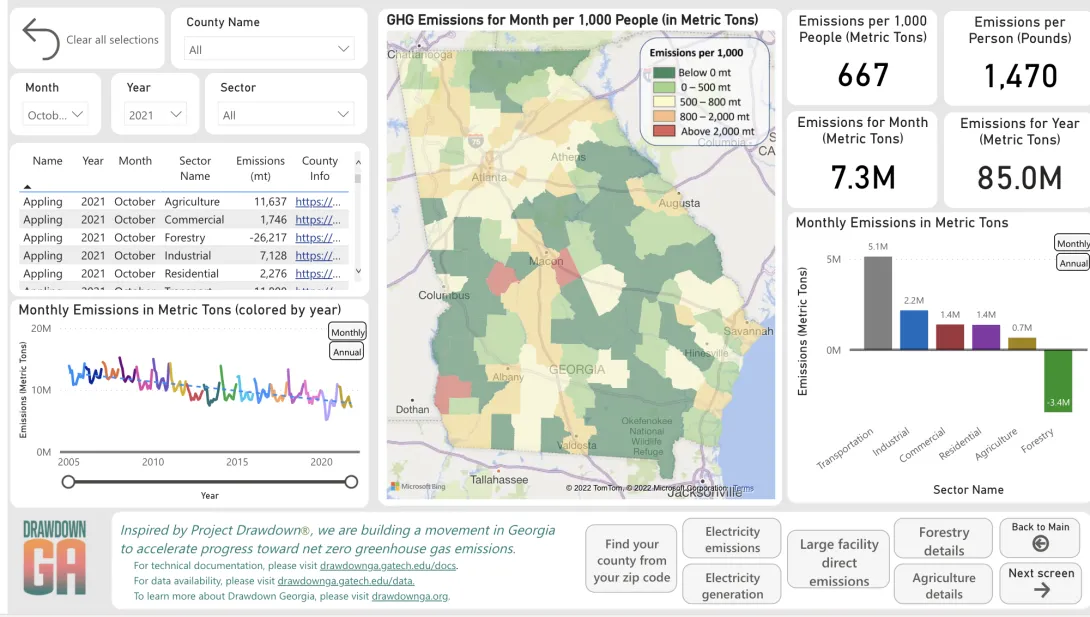
Georgians can now track where greenhouse gas emissions come from thanks to a tool that estimates those emissions at the state and county level.
Developed by Georgia Tech professors, the interactive map allows users to filter publicly available greenhouse gas estimates by county, month, year, and energy sector. Users can specify whether the emissions come from transportation, agriculture, commercial, forestry, residential, or industrial sources and counter with how much carbon is absorbed by trees and soils.
“The purpose of the tracker is to bring technology to bear on climate solutions,” said William Drummond, an associate professor in the School of City & Regional Planning and the lead behind the tracker. “This is the first time there has been effort to downscale emissions to the local level in a dynamic way we can update every month.”
The initiative is part of a trifold effort in Drawdown Georgia, a Ray C. Anderson Foundation–funded project across state universities to decrease reliance on carbon inspired by the national program Project Drawdown. As the first stage, the tracker enables Georgians to understand how the state contributes to emissions. Next, the Scheller College of Business will develop a business compact study to assess the economic impact of less carbon, and then the School of Public Policy will lead solutions activation. The tracker ties everything together by letting researchers measure how effective all the efforts are combined.
Ultimately, the researchers hope to inspire everyday Georgians to get involved in combatting climate change. With the public’s familiarity with Covid-19 case trackers, Drummond believes the tracker is accessible to most users, from regular citizens unsure how to help the environment to high school science students.
“This tracker is designed to be a catalyst for a climate movement across the state of Georgia, so it's important that we include ordinary citizens, advocacy groups, and businesses as partners in working toward climate solutions in Georgia,” Drummond said.
The researchers expect the carbon tracker will grow beyond Georgia. The tool is written in the common coding language R, so other states can replicate it. They also hope to track many other climate elements in the next few years.
“We'll progress as the technologies and markets evolve, and will soon turn to where the solutions are — not just where are the emissions are,” said Marilyn Brown, a Regents' and Brook Byers Professor of Sustainable Systems in the School of Public Policy. “We’re going to tie it all together, and it's all going to be facilitated by this geospatial tracking.”
News Contact
Tess Malone, Research Writer/Editor
Apr. 12, 2022
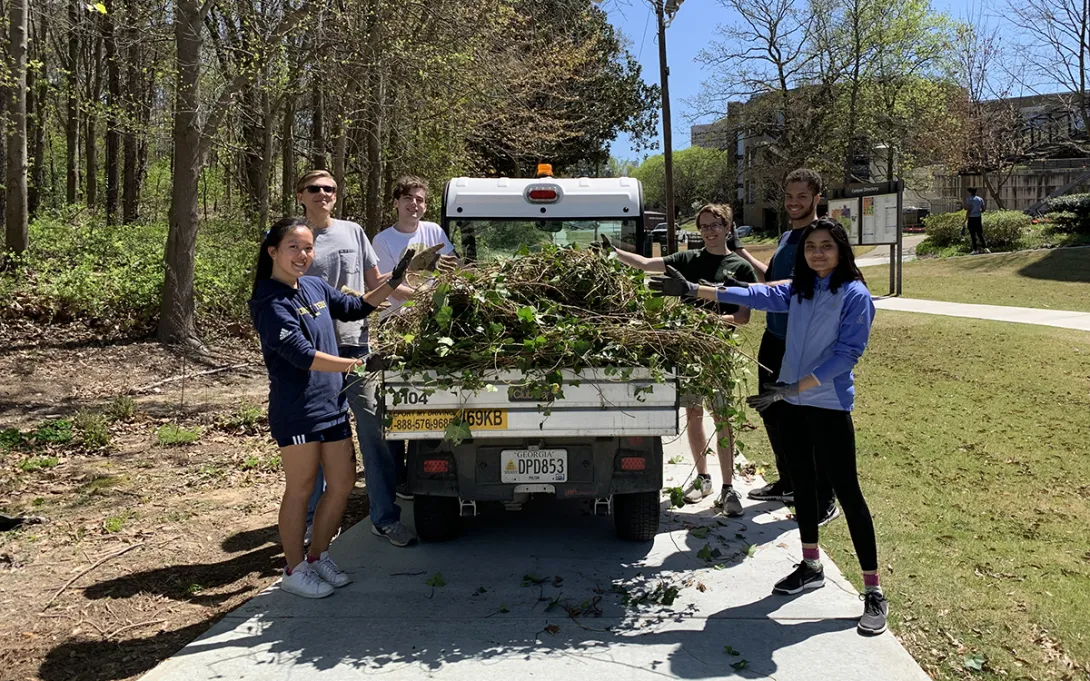
As Earth Day approaches, it’s a great time to look for new ways to get involved with sustainability efforts on campus. Tech students have a long history of being good stewards of the Earth’s resources and looking for ways to promote environmentally conscious practices.
Here are nine groups to look at if you want to get involved. To stay plugged in to all campus events, visit calendar.gatech.edu or engage.gatech.edu.
Students Organizing for Sustainability
This group has been active on campus for many years. One of its most visible initiatives is the Community Garden located on the Instructional Center Lawn. The group also hosts guest speakers and assists with invasive species removal on campus.
Association for Sustainable Investment
This group combines interest in sustainability and finance to promote investment in climate solutions and educate students about sustainable finance and fossil fuel divestment. The group hosts guest speakers, debates, and podcast discussions.
Trailblazers
The purpose of Trailblazers is to increase appreciation for the outdoors through trail adventure and exploration. The group coordinates trips that combine service, such as park cleanup or tree planting, with outdoor recreation. They also assist with on-campus projects such as invasive species removal. Trailblazers welcomes students, faculty, and staff to participate in its events.
Energy Club
The Energy Club’s premier event is its annual conference, which took place earlier this month. They also host weekly “energy chats” where an invited speaker will present on an area of their work in the energy landscape, focusing on topics that touch on technology, economics, and policy.
Solar Racing
Solar Racing designs and builds solar-powered race cars for track and cross-country competitions worldwide. The group recently built a vehicle that completed the American Solar Challenge last fall. Students of all experience levels and backgrounds are invited to participate and learn about solar vehicles — and have fun.
Engineers Without Borders (EWB)
The Tech student chapter, EWB-GT, is a chapter of EWB-USA, a nonprofit humanitarian organization. The goal of this group is to support community-driven development projects worldwide through partnerships that design and implement sustainable engineering projects. The Georgia Tech group has four ongoing projects in communities around the world.
IEEE PES
The IEEE Power and Energy Society is the oldest society of the Institute of Electrical and Electronics Engineers (IEEE), the world’s largest technical professional organization. IEEE PES at Georgia Tech is a student branch of the national organization. The group’s events are focused on the power and energy sectors and include group meetings, guest speakers, and networking opportunities.
Veggie Jackets
This group is designed for vegetarian and vegan students, offering many occasions to share meals together, including potlucks and other events. The group also hosts documentary viewings that focus on how eating habits can affect the Earth.
Effective Altruism
This group hopes to have its members maximize the positive impact they can have on the world and tackle some of the greatest challenges, including extreme climate change, mitigating the next pandemic, and human-compatible AI. The group focuses on making professional connections to work that addresses these global challenges.
Apr. 06, 2022
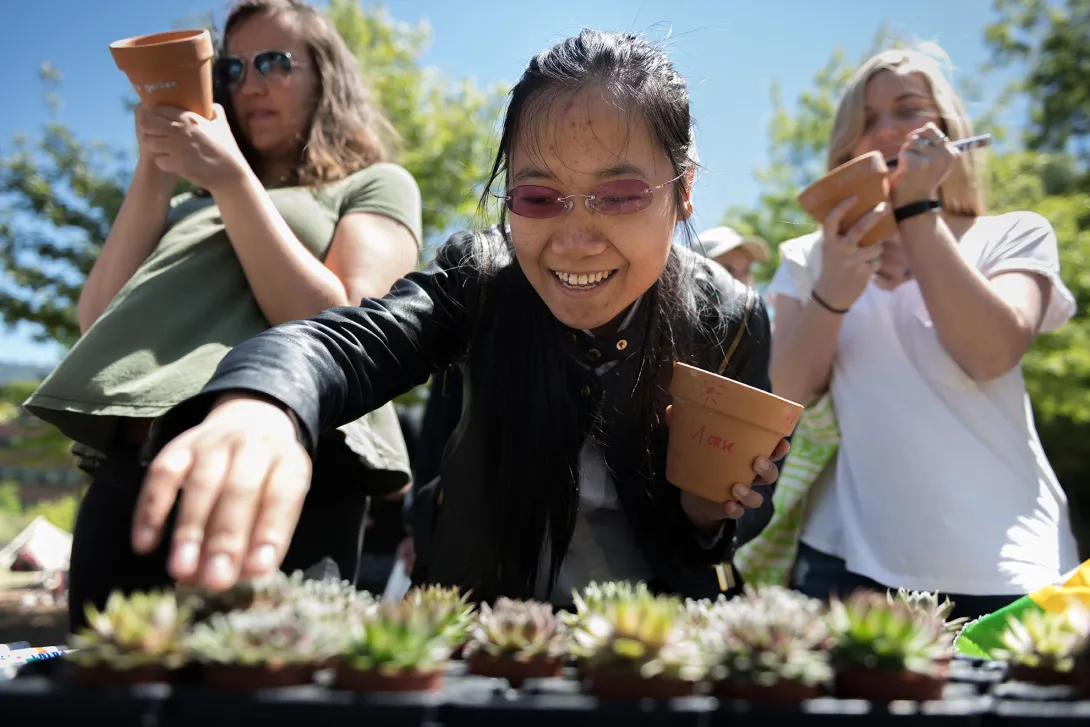
This year marks the 25th anniversary of celebrating Earth Day at Georgia Tech. A four-day schedule of events is planned for this campuswide program to celebrate nature, the preservation of our planet, and the Georgia Tech community’s contributions to campus sustainability. A few events are already collecting items or have opened registration — so get a head start on your Earth Day plans.
The keynote event on Monday, April 18, features Maria Cimilluca, vice president of Infrastructure and Sustainability, who will share the path forward for sustainability at Georgia Tech. The event will also feature the presentation of the Student Sustainability Champion Award. Register here.
If sustainable transportation is your thing, you can join a Group Bike Ride led by President Ángel Cabrera on Tuesday, April 19. The 4.75 mile ride requires registration and will begin in front of the Campus Recreation Center.
If you are more tuned in to understanding campus waste streams, join the Student Government Association’s Sustainability Committee and the Office of Solid Waste Management and Recycling on Tuesday, April 19, to assist with conducting a waste audit of the Clough Undergraduate Learning Commons. You will see firsthand how recycling and composting services support Georgia Tech’s goals to achieve zero waste.
If understanding and protecting nature fits more with your passions, register for a bird walk led by a subject matter expert and learn about which birds prefer to make their homes on campus. In partnership with Georgia Audubon and The Kendeda Building for Innovative Sustainable Design, the walk begins at 9 a.m. on Wednesday, April 20.
The week rounds out with the Sustainability Fair, which showcases student groups and campus departments such as Tech Dining, Landscape Services, and Building Services, highlighting the ways campus operations support sustainable initiatives. The Urban HoneyBee Project and the Georgia Tech Global Change Program will offer opportunities to get involved and be a part of the climate solution. Table registration for the Fair closes Friday, so register for a spot to showcase your organization's work supporting campus sustainability.
The Hard to Recycle Materials Dropoff and the Clothing Swap will take place on the lower level of The Kendeda Building from 10 a.m. to 4 p.m. each day. Clothing can be donated for the swap at Housing locations through Monday, April 11.
Most importantly, the Earth Day planning committee would love your help. Volunteer to help make this 25th anniversary event a success.
News Contact
Cathy Brim
Institute Communications
Feb. 21, 2022
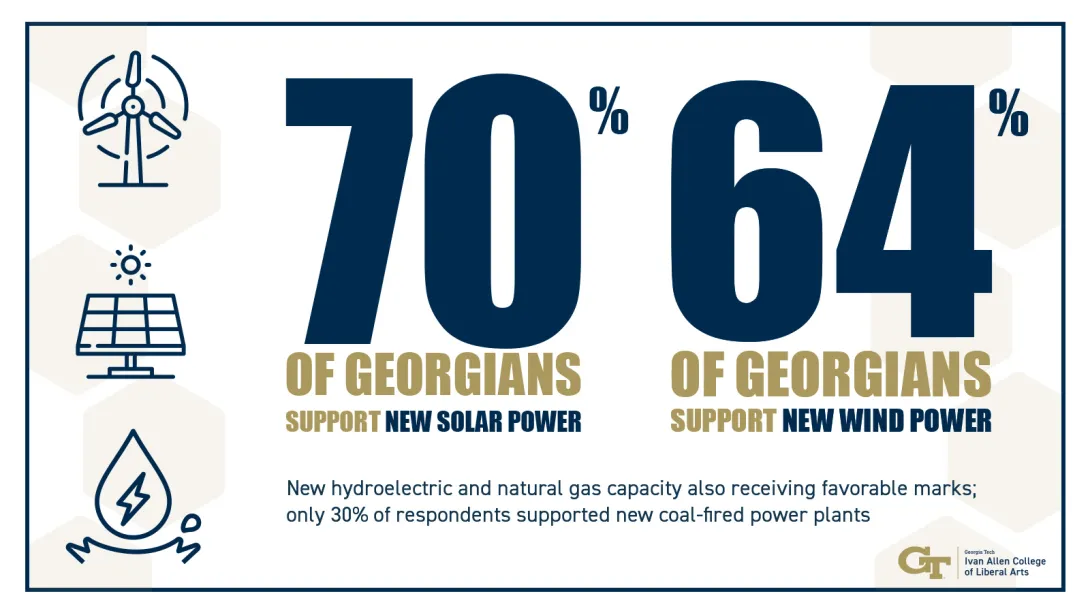
A majority of Georgia residents strongly support new solar and wind power capacity over new coal-fired plants and believe the state should set a carbon emissions reduction goal, according to a new survey conducted for researchers at Georgia Tech and the University of Georgia.
The survey, conducted by polling firm Dynata, found that 60% of Georgia residents back the creation of a state carbon emissions reduction goal. That includes 74% of Democrats and Democratic-leaning independents, 52% of independents, and 45% of Republicans and Republican-leaning independents.
The poll also found that 70% of Georgians support new solar power and 64% support new wind power, with new hydroelectric and natural gas capacity also receiving relatively favorable marks.
The survey found only 30% of respondents supported new coal-fired power plants.
“This survey demonstrates that many Georgians across the political spectrum are in favor of green energy solutions that will benefit the state’s environment, create new jobs, and support our economy,” said Marilyn Brown, Regents Professor and Brook Byers Professor of Sustainable Systems in Georgia Tech’s School of Public Policy.
Cory Struthers, assistant professor in the School of Public and International Affairs at the University of Georgia, and Brown designed the survey with help from graduate students in Georgia Tech’s Climate and Energy Policy Lab (CEPL).
Brown and Struthers are affiliated with Drawdown Georgia, a project of the Ray C. Anderson Foundation, which provided funding to universities and stakeholders across Georgia to identify promising climate solutions for the state. The Foundation provided support for this survey, in addition to other activities to translate research into action, including the Drawdown Business Compact.
“This survey provides important new information about how people in Georgia feel about climate solutions,” said Blair Beasley, the Foundation’s director of climate strategies. “We are pleased to see that the results validate Georgians' support of many high-impact solutions that Drawdown Georgia has identified for their potential to reduce emissions in our state this decade.”
The Busbee Endowment at the University of Georgia and Georgia Tech’s Brook Byers Institute for Sustainable Systems also provided support for the survey.
Support for a Range of Climate Solutions
The survey of 1,788 Georgia residents was conducted online from Aug. 20, 2021, to Sept. 5, 2021.
All survey participants answered a set of common questions about their demographics, energy bills, knowledge of climate solutions, values, and more. The respondents were then divided into three groups, with participants in each answering additional questions that focused on one of three transformational climate solutions: rooftop solar, retrofitting, or electric vehicles.
The survey’s margin of error is plus or minus 2 percentage points for questions in the larger, common, sample and plus or minus 4 percentage points for those in the smaller sample.
Overall, 75% of Democrats, 55% of independents, and 49% of Republicans supported development of a climate resiliency plan for Georgia to prepare for the impacts of climate change.
When asked about new energy infrastructure, new solar panels and wind farms received 70% and 64% support, respectively. In contrast, 36% of those surveyed showed support for new nuclear power plants, somewhat higher than for new coal plants. Seventy-one percent of respondents favored energy efficiency strategies and smart-meter infrastructure.
Climate technologies that individuals can adopt at home were also well-viewed. A majority of respondents either already had residential energy-saving technologies or were interested in adopting them. The highest combined level of interest and adoption was for using LED lights at 93%, followed by efficient HVAC systems (80%), rooftop solar (59%), community solar (59%), and electric vehicles (55%).
Many respondents were also willing to support government funding for financial incentives to go green: 50% said they would support $5,000 rebates for electric vehicles, 55% said they would look favorably on up-front financing for heat pumps, and 64% said they would support a similar strategy for rooftop solar projects.
“These high-impact solutions have the potential to both reduce emissions and increase energy efficiency in Georgia,” Struthers said. “A cleaner, more efficient Georgia means increased air and environmental quality, job creation, and gains in public health.”
Survey Also Reveals Details of Energy Poverty, Low Energy Literacy
The survey findings also shed light on the prevalence of “energy poverty” in Georgia. A household is energy-poor when it spends more than 6% of its income on energy. The survey found that while households with incomes greater than $150,000 spent about 2% of their income on energy bills each month, households with incomes less than $20,000 spent, on average, between 14% and 21% of their monthly earnings on energy.
The survey also found low levels of literacy in regard to climate solutions, energy technology, and policy among respondents. Fewer than 35% of respondents knew the correct answer to questions related to energy and climate, including what energy sources are fossil fuels and the relative cost of operating electric and gasoline-powered vehicles. Only 4% of those surveyed correctly answered that solar panels generate energy in full sunlight, in the shade, and on rainy days.
“We want to use this data to continue to answer questions about the diffusion of, and support for, clean and equitable energy technology transition in Georgia,” Brown said. “How can this data help us overcome ambivalence toward clean energy and design programs that make the energy transition work for all Georgians, especially the most vulnerable? How can it help us to raise knowledge and awareness about the promise of high-impact climate solutions?”
A PowerPoint of the full findings can be downloaded from the CEPL website.
About Georgia Tech
The Georgia Institute of Technology, or Georgia Tech, is a top-10 public research university developing leaders who advance technology and improve the human condition.
The Institute offers business, computing, design, engineering, liberal arts, and sciences degrees. Its nearly 44,000 students, representing 50 states and 149 countries, study at the main campus in Atlanta, at campuses in France and China, and through distance and online learning.
As a leading technological university, Georgia Tech is an engine of economic development for Georgia, the Southeast, and the nation, conducting more than $1 billion in research annually for government, industry, and society.
The Ivan Allen College of Liberal Arts, home of the School of Public Policy, provides innovative, human-centered perspectives at the intersections of humanities, social sciences, arts, and STEM, developing leaders who advance technology and improve the human condition. Nearly 350 tenured, tenure-track, non-tenure track, and permanent research faculty, prepare students to be leaders capable of balancing a richly defined base of expertise with a well-grounded sense of responsibility. Our programs encompass traditional fields as well as unique and professional disciplines. Many of our faculty members engage in ground-breaking, interdisciplinary research to solve complex issues of the world.
About the University of Georgia
Chartered by the state of Georgia in 1785, the University of Georgia is the birthplace of public higher education in America. What began as a commitment to inspire the next generation grows stronger today through global research, hands-on learning, and extensive outreach. A top value in public higher education and research, the University of Georgia tackles some of the world’s grand challenges, from combating infectious diseases and creating a dependable food supply to advancing economic growth and strengthening cyber and global security.
As Georgia’s flagship institution, the university is recognized for its commitment to student excellence through an emphasis on rigorous learning experiences both inside and outside the classroom, including hands-on research and leadership opportunities. These experiences contribute to the university’s exceptional rates in retention, graduation, and career placement. Among public universities, the University of Georgia has been one of the nation’s top three producers of Rhodes Scholars over the past two decades. The university is also home to the Peabody Awards, the most prestigious prize in electronic media.
Since 2001, the School of Public and International Affairs has been dedicated to enhancing civic engagement, public leadership, scholarship on political institutions and policy, and effective governance. Now, more than ever, the nation and the world require scholars and students to focus their attention on the pressing policy and governance issues of the day. Guided by an award-winning teaching faculty and innovative research, the School offers critical training to future public servants and a deep understanding of national and international politics.
News Contact
Michael Pearson
michael.pearson@iac.gatech.edu
Jan. 21, 2022
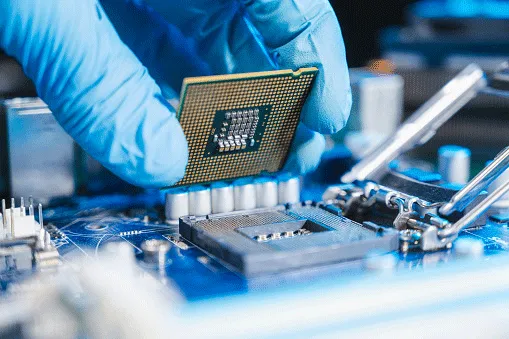
This country’s semiconductor chip shortage is likely to continue well into 2022, and a Georgia Tech expert predicts that the U.S. will need to make major changes to the manufacturing and supply chain of these all-important chips in the coming year to stave off further effects.
That includes making more of these chips here at home.
Madhavan Swaminathan is the John Pippin Chair in Electromagnetics in the School of Electrical and Computer Engineering. He also serves as director of the 3D Systems Packaging Research Center.
As an author of more than 450 technical publications who holds 29 patents, Swaminathan is one of the world’s leading experts on semiconductors and the semiconductor chips necessary for many of the devices we use every day to function.
“Almost any consumer device that is electronic tends to have at least one semiconductor chip in it,” Swaminathan explains. “The more complicated the functions any device performs, the more chips it is likely to have.”
Some of these semiconductor chips process information, some store data, and others provide sensing or communication functions.
In short, they are crucial in devices from video games and smart thermostats to cars and computers.
Our current shortage of these chips began with the Covid-19 pandemic. When consumers started staying at home and car purchases took a downward turn, chip manufacturers tried to shift to make more chips for other goods like smartphones and computers.
But Swaminathan explains that making that kind of switch is not simple. Entire production operations have to be changed. The chips are highly sensitive and can be damaged by static electricity, temperature variations, and even tiny specks of dust. The manufacturing environments must be highly regulated, and changes in the process can add months.
The pandemic highlighted another challenge with the semiconductor chip industry, according to Swaminathan.
“There’s a major shortage of companies making chips,” he says. “If you look worldwide, there are maybe four or five manufacturers making 80-90% of these chips and they are located outside of the United States.”
This creates supply chain hiccups with the raw supplies needed to make these chips as well. Add in the fact that many of these companies only design their chips – they don’t manufacture them directly.
“American consumers use 50% of the world’s chips,” Swaminathan says, which creates a serious challenge when the overwhelming majority of those chips are manufactured in other nations.
In the short term, the costs of the chip shortage is being passed on to the consumer. We see this directly with products like PlayStations and Xboxes that are more and more expensive and harder to purchase when the chips necessary for the consoles to function are in short supply.
Beyond 2022, Swaminathan says we need to work to revitalize the industry domestically.
“We need to bring more manufacturing back to the United States,” he says. “The U.S. government has recognized the importance of this semiconductor chip shortage and is trying to address the issue directly.”
That means investing in new plants to manufacture the chips, but America's journey toward chip self-sufficiency will continue to be a work in progress.
“This is a cycle,” Swaminathan explains. “But this is probably the first time where it has had such a major effect in so many different industries.”
But consumers can take direct action on their own in the coming year. “Reduce the number of times you purchase or upgrade electronic devices like phones and cars,” he says. “Then it becomes just a supply problem, not a demand and supply problem.”
Dec. 16, 2021
The global supply chain has been rocked by disruptions triggered largely by the coronavirus pandemic, resulting in a cascade of shortages on a host of products ranging from computer chips to medications.
But supply chain disruptions also highlight the potential vulnerabilities in the U.S. manufacturing sector’s critical segments like defense.
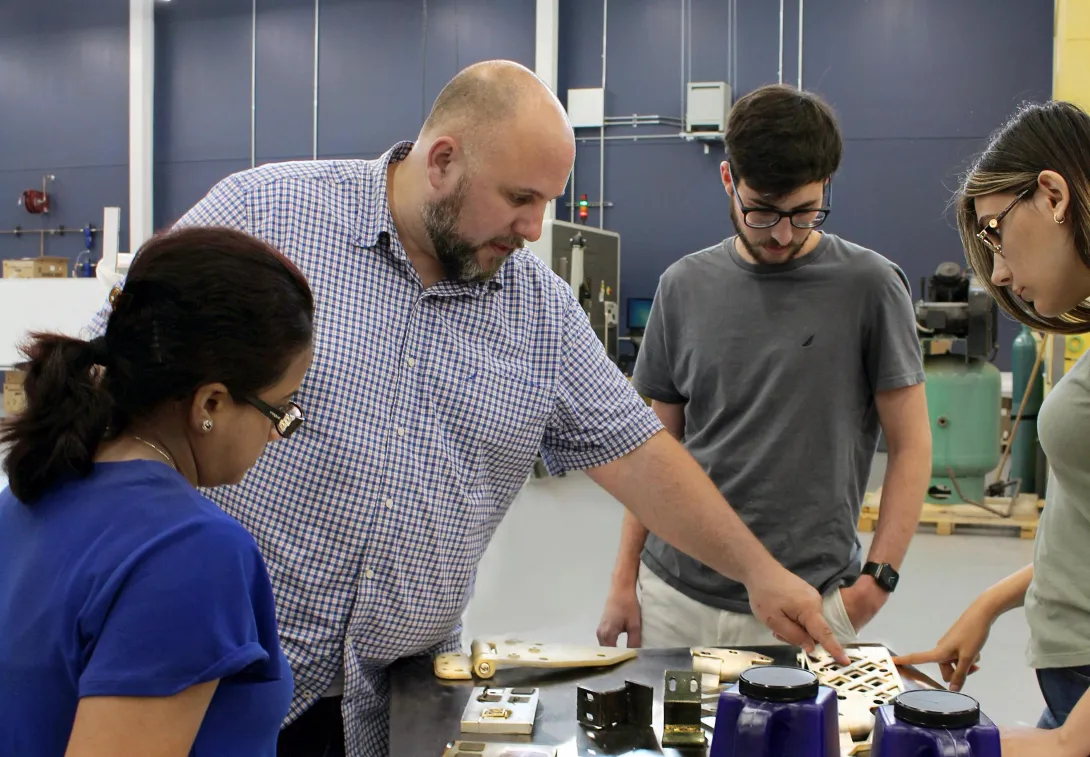
To help manufacturers across the state, the Georgia Institute of Technology has launched the Georgia Manufacturing 4.0 Consortium to work with those businesses in defense and related industries become more resilient and less susceptible to supply chain disruptions. The Consortium, which will begin accepting members in April 2022, will work with Georgia defense manufacturers to incorporate cybersecurity protocols, smart technologies such as sensor packs, machine learning, artificial intelligence, and other best practices under Industry 4.0 technology standards.
Led by Aaron Stebner, associate professor in the George W. Woodruff School of Mechanical Engineering and the School of Materials Science and Engineering, the Consortium is an 18-month pilot funded by a Department of Defense Office of Local Defense Community Cooperation (OLDCC) grant of nearly $1 million. Georgia Tech is working in partnership with Spelman College, the Technical College System of Georgia, and the Georgia Department of Economic Development, under the grant to develop workforce, training manuals, a curriculum, and to support businesses in adapting to economic and technological changes that emerge at a much more rapid pace today.
“It’s a cooperative effort that’s really focused on helping to get modern technologies to these Georgia manufacturers. This is about establishing a community of manufacturers who all want to move forward but don’t have the bandwidth or capabilities do it individually,” Stebner said.
The Consortium has three goals. The first is to increase the manufacturing defense supply chain’s resilience and diversification. That will allow those companies to pivot quickly in response to demand and let non-defense-related industries enter the supply chain at critical junctures. The second goal is to work with Georgia manufacturers in adopting new technologies and address challenges that put those businesses at risk.
Lastly, the Consortium is to be a conduit that helps small- and medium-sized manufacturers test out innovations using Georgia Tech resources such as the Advanced Manufacturing Pilot Facility, connect manufacturers with each other, and potentially unlock new markets and collaboration opportunities.
While the focus is on defense manufacturing, the Consortium is open to all manufacturers.
“We want to help as many manufacturers as we can, to grow a bigger pie that helps everybody, lowers risk, and allows companies to be part of building innovative solutions” Stebner said.
Manufacturing Supports Georgia Economy
National Association of Manufacturers data show that manufacturing accounts for $61.1 billion in economic activity, roughly 10% of Georgia’s total output. The industry includes more than 6,600 firms that employ nearly 400,000.
At $14 billion a year, Georgia is ranked 13th in federal defense spending. Roughly 1,200 manufacturers in the state are in defense or related industries. Those include information technology companies that support cybersecurity, wireless communications, and other innovations that are critically essential to Industry 4.0 in defense manufacturing.
University partners from the Technical College System of Georgia and Spelman College will look to take the Consortium findings and data from the work they do with member companies to create educational programming and workforce training.
Today, there is a need for more workers in machine learning and other aspects of advanced manufacturing, as well as a need to change perceptions of manufacturing, especially in rural parts of the state, Stebner explained.
To that end, the Technical College System of Georgia could develop programming for students within its two-year education curriculum. It also has a mobile manufacturing unit that could be taken to rural parts of the state and used as a tool to highlight opportunities in manufacturing and dispel misconceptions about the industry.
The all-women’s Spelman College, one of the nation’s premier historically black colleges and universities, launched an extended reality program in the fall of 2020. That program aims to integrate art, technology, and narrative on a gaming platform which is familiar and engaging for students. Those students will develop the technical skills to develop games, create immersive virtual experiences, and develop visual simulations for research, education, and training.
For Consortium members, Spelman’s extended reality program can be used to help turn research data gathered from them into workforce training and development modules.
“Spelman has a long history of graduating women in the natural sciences, and that history has recently led the Department of Defense to distinguish the College as a Center of Excellence for educating women in STEM,” said Jerry Volcy, a Spelman professor and co-director of the Spelman Innovation Lab.
The extended reality program furthers Spelman’s goal to increase the technological readiness of its graduates.
“Spelman has a long record of forging pathways for women of color into new spaces. Today, these spaces include extended reality, defense and, to some extent, manufacturing research,” Volcy said. “From the College’s perspective, participation in the Consortium has the dual potential of creating and discovering new pathways into these industries while immediately providing real-world applications laboratory for the developing extended reality program.”
Fulfilling Georgia Tech’s Mission
Within Georgia Tech, the Georgia Manufacturing Extension Partnership and the Georgia Tech Manufacturing Institute will support Consortium efforts.
The Consortium reflects Georgia Tech’s broader mission to further its Advanced Manufacturing Initiative, said George White, Georgia Tech’s interim vice president of Industry Collaboration.
“The anticipated research impact envisioned through the Defense Manufacturing Consortium will strengthen Georgia Tech’s positioning in enabling major public private collaborations,” White said. “The advent of the Consortium represents the opportunity to convene key stakeholders from government, academics, and industry to innovate and solve the most challenging problems in manufacturing.”
News Contact
Writer and media relations contact:
Péralte C. Paul
peralte.paul@comm.gatech.edu
404.316.1210
Dec. 14, 2021
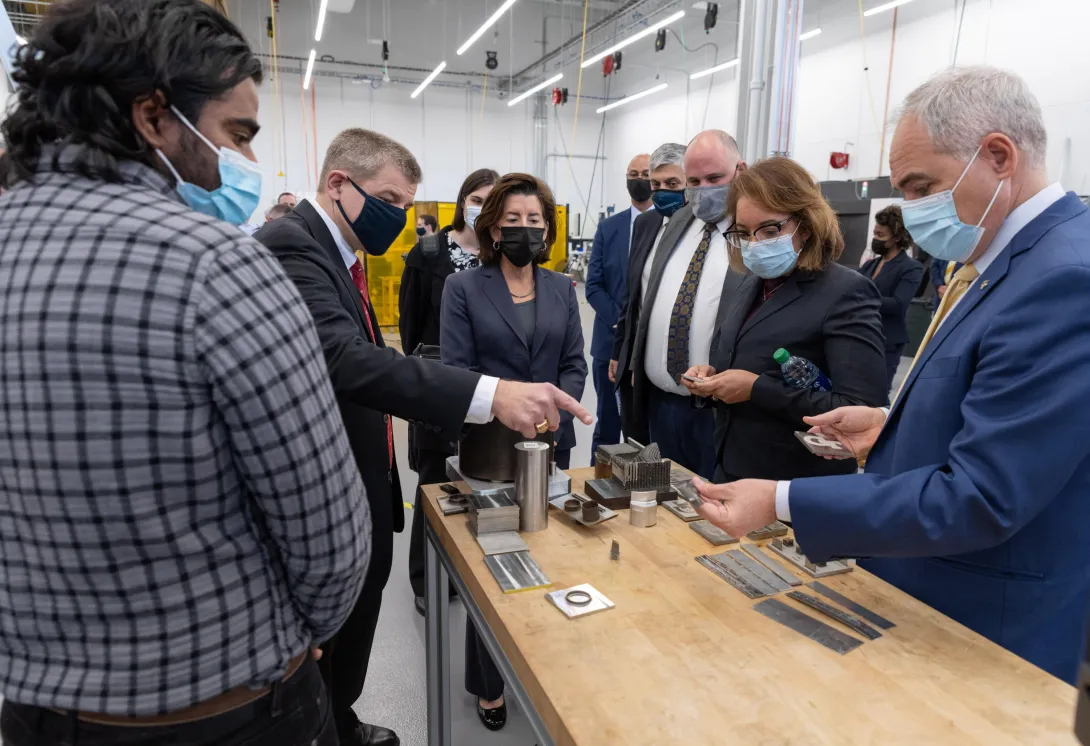
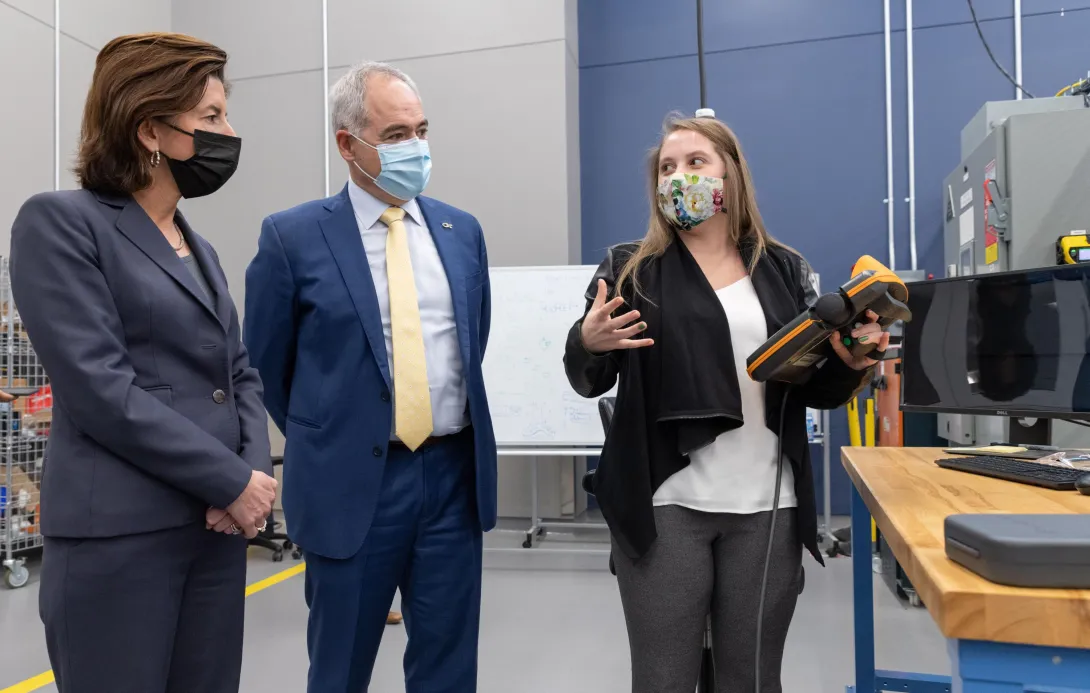
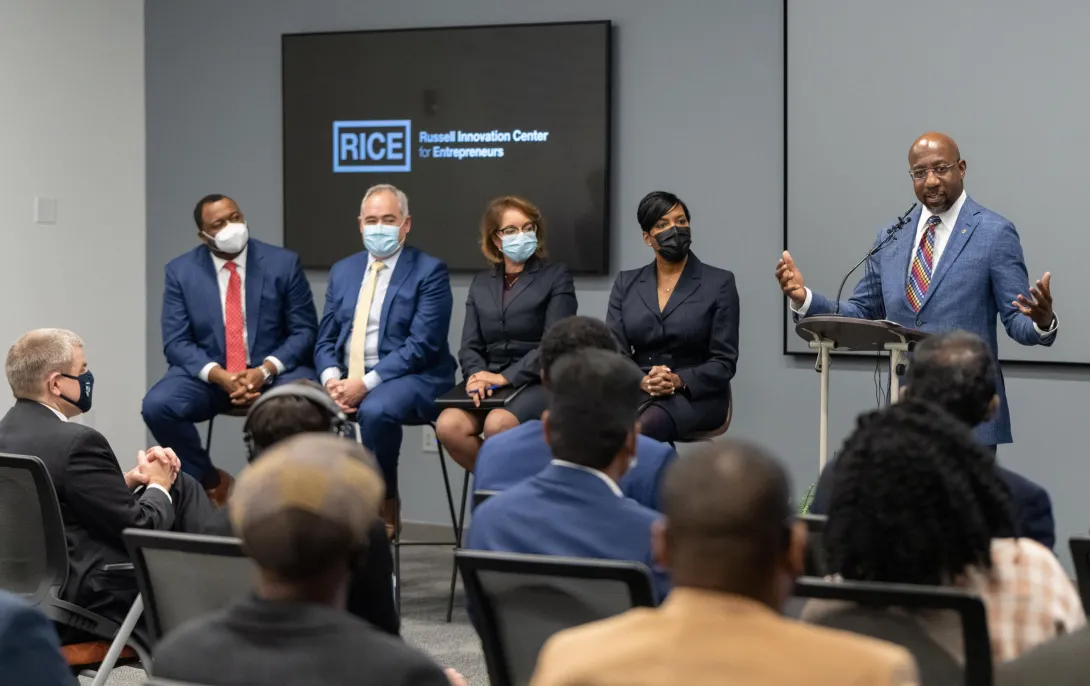
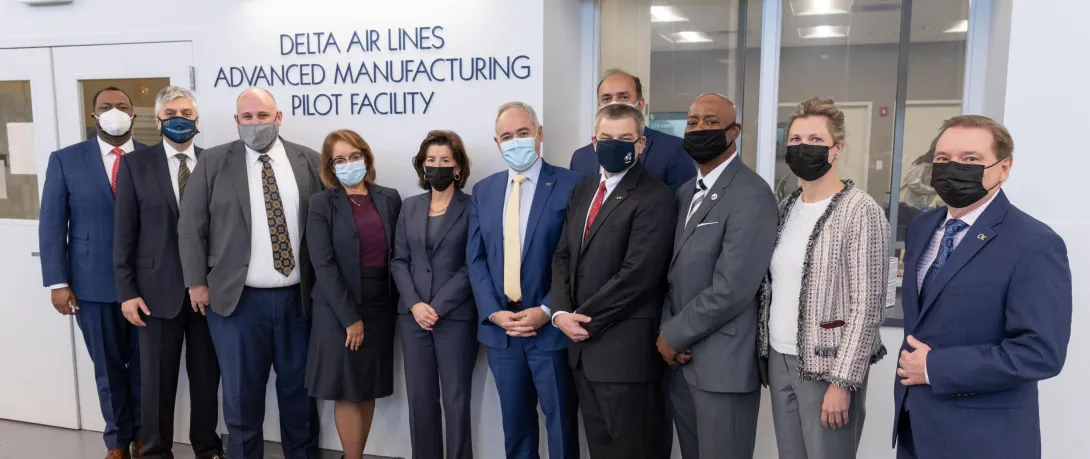
The Georgia Institute of Technology was awarded a grant from the U.S. Department of Commerce’s Economic Development Administration (EDA) as part of its $1 billion Build Back Better Regional Challenge. Georgia Tech is one of 60 entities to be awarded funding to assist communities nationwide in their efforts to accelerate the rebuilding of their economies in the wake of the pandemic.
As a leader in artificial intelligence, manufacturing research, and innovation-led economic development, Georgia Tech will utilize the grant for technical assistance to plan the Georgia Artificial Intelligence Manufacturing Corridor (GA-AIM). Led by Thomas Kurfess and Aaron Stebner in the George W. Woodruff School of Mechanical Engineering and in collaboration with local partners, GA-AIM will fill existing technology gaps, build a technological opportunity framework that includes underrepresented communities and rural Georgia counties, and better secure the state’s manufacturing infrastructure.
Georgia Tech’s partners in the effort include the Russell Innovation Center for Entrepreneurs, Spelman College, the Technical College System of Georgia, and the Georgia Department of Economic Development.
“We are truly honored to be awarded this grant to implement our vision for manufacturing excellence in Georgia with our partners in artificial intelligence research,” said Chaouki T. Abdallah, executive vice president for Research at Georgia Tech. “Alongside these important partners, the grant enables us to collaborate to include diverse backgrounds and perspectives in the process of learning, discovery, and creation, furthering Georgia Tech’s mission to expand access.”
Georgia Tech and its partners will pair artificial intelligence and manufacturing research innovation to better secure the manufacturing ecosystem, expand opportunity to distressed and rural communities and underrepresented groups, and support business growth across the state.
“We are thrilled to help communities work together — in coalitions of government, nonprofits, academia, the private sector, and others — to craft ambitious and regionally unique plans to rebuild their communities,” said Alejandra Y. Castillo, assistant secretary of commerce for the EDA. “These projects will help revitalize local economies and tackle our biggest challenges related to climate change, manufacturing, supply chains, and more. EDA is proud to ignite these plans and help communities nationwide build back better.”
GA-AIM’s partners have created a complementary network of resources that focus on each partner organization’s expertise and mission.
“We have an opportunity to create meaningful impact at the intersection of AI and manufacturing,” said Stebner, who wrote the grant proposal that resulted in the $500,000 grant from EDA.
Kurfess, who serves as the regional economic competitiveness officer for the grant, added, “Bringing together AI and manufacturing will ensure a strong manufacturing base for Georgia that will leverage our well-trained workforce and our strong educational institutions that are participating in this effort. What excites me the most is that AI will augment our workforce, making it more valuable and productive, ensuring job growth for Georgia and the U.S. well into the future.”
The GA-AIM effort takes a multifaceted approach to address its core goals:
Georgia Tech
- Formation of the AI Manufacturing Pilot Facility: Georgia Tech’s Advanced Manufacturing Pilot Facility will be transformed into the AI Manufacturing Pilot Facility. The new facility allows for government pilot trials, cybersecurity games, and workforce training to innovate, transition, and create a workforce for AI manufacturing technologies without exposing the region’s supply chains to risk.
- Center for AI Commercialization: Two of Georgia Tech’s commercialization programs — VentureLab and I-Corps South — will create a center for the commercialization of AI manufacturing technologies into local and regional startups. Those commercialization efforts will occur through a quarterly cohort-based entrepreneurial training program built on the National Science Foundation’s I-Corps curriculum. The center will also provide training for instructors to build a sustainable workforce and will secure investment funding for these startups.
- AI Manufacturing Community Engagement: The Enterprise Innovation Institute, Georgia Tech’s chief economic development arm, will engage in focused outreach and technical assistance to small and mid-sized manufacturers and minority business enterprises through its Georgia Manufacturing Extension Partnership and Georgia Minority Business Development Agency Business Center programs. A third Enterprise Innovation Institute program, the Economic Development Lab, will focus on outreach and engagement in distressed and underserved parts of the state, create workforce development programs and implementation strategies, and attract outside investment.
- AI Manufacturing Rural Supply Chain: The Supply Chain and Logistics Institute will study the impact of automation technologies, build automation solutions tailored for rural manufacturers, and create programs that lower the barrier for rural manufacturers’ access to use the AI Manufacturing Pilot Facility.
- AI InVenture K-12 Experiences: To ensure a technically capable workforce in the coming years, Georgia Tech’s InVenture Prize and the Center for Education Integrating Science, Mathematics, and Computing will expand their emphasis to rural and underserved areas of the state by piloting a rural regional event with a region-specific prize. They will also create supplemental lessons centered on AI and data science that will be part of a K-12 InVenture Prize curriculum website.
Spelman College
- Virtual Reality for AI Workforce Training Innovation: Spelman’s Innovation Lab will develop virtual reality technology for training or retraining the GA-AIM workforce to make workers comfortable with new technologies before deployment in real-world applications.
Russell Innovation Center for Entrepreneurs
- LaunchPad AI Innovation Studio: The Russell Innovation Center for Entrepreneurs will create the 5,000-square-foot LaunchPad AI Innovation Studio to provide prototyping and proof of concept development of physical products. Black entrepreneurs will be given access to equipment, training, and mentoring. LaunchPad AI will also be open to AI InVenture teams from Atlanta’s K-12 public schools, with special programs designed for startup mentoring and seed funding for K-12 entrepreneurs.
Technical College System of Georgia (TCSG)
- AI Manufacturing Technical Workforce Development: As Georgia’s technical college coordinating organization, the TCSG will design, develop, and implement curricula at community colleges that include apprenticeships at AI-MPF and virtual reality modules from Spelman. The TCSG will also provide regional entry points for dual enrollment and traditional students to AI manufacturing technical education at certificate and degree levels. Graduates will have exit points that lead directly to careers in the industry or provide for the continuation of education and higher degree attainment through articulation agreements among GA-AIM members.
With this grant, Tech becomes a finalist for significantly more funding to implement projects that support an industry sector and help communities withstand future economic shocks.
“GA-AIM is in strategic alignment with the EDA’s funding priorities, including manufacturing, workforce development, equity, and technology-based economic development,” said David Bridges, vice president of the Enterprise Innovation Institute at Georgia Tech and co-author of the grant proposal. “With manufacturing employing more than 400,000 people across the state and contributing more than $61 billion in economic activity, it’s critical that we leverage the best ideas and programs through our coalition of partners.”
###
About the Georgia Institute of Technology
The Georgia Institute of Technology, or Georgia Tech, is a top 10 public research university developing leaders who advance technology and improve the human condition. The Institute offers business, computing, design, engineering, liberal arts, and sciences degrees. Its nearly 44,000 students, representing 50 states and 149 countries, study at the main campus in Atlanta, at campuses in France and China, and through distance and online learning. As a leading technological university, Georgia Tech is an engine of economic development for Georgia, the Southeast, and the nation, conducting more than $1 billion in research annually for government, industry, and society.
About the U.S. Economic Development Administration
The mission of the U.S. Economic Development Administration (EDA) is to lead the federal economic development agenda by promoting competitiveness and preparing the nation's regions for growth and success in the worldwide economy. An agency within the U.S. Department of Commerce, EDA makes investments in economically distressed communities in order to create jobs for U.S. workers, promote American innovation, and accelerate long-term sustainable economic growth.
Writer: Péralte C. Paul I peralte.paul@comm.gatech.edu I 404.316.1210
Media contact: Steven Norris | stephen.norris@comm.gatech.edu| 404.281.3343
News Contact
Péralte C. Paul
404.316.1210