
The Georgia Tech Manufacturing Institute (GTMI), the Strategic Energy Institute (SEI), and the Supply Chain and Logistics Institute are racing to close the gap between what America invents and what it can build at scale.
When a key semiconductor plant in Japan went offline after the 2011 earthquake and tsunami, supply chain disruptions quickly spread far beyond the disaster zone, affecting manufacturers around the world.
Nearly all of the natural graphite the United States uses, and 70% to 80% of its rare earth elements, come from a supply chain the U.S. doesn't control.
Different vulnerabilities, same underlying problem: The U.S. invents faster than almost any country on Earth, but it doesn't always build, or secure the materials to build, fast enough, reliably enough, or close enough to home to matter when it counts.
That gap has become a national security problem, and Georgia Tech is tackling it within its own centers and with a wider network of universities, government agencies, and industry partners.
“You want to make sure you don't have a brittle supply chain,” says Tom Kurfess, executive director of GTMI and the former chief manufacturing officer at Oak Ridge National Laboratory. “One link breaks, and all of a sudden, you can't move forward.” For Kurfess, resiliency requires manufacturing networks that are digitally connected, built around qualified processes, and capable of shifting work across facilities without sacrificing quality, traceability, or performance.
A Brittle Supply Chain Is a National Security Risk
That single point of failure is the kind of fragility Kurfess worked to design out of American manufacturing during earlier stints at the White House Office of Science and Technology Policy, at Oak Ridge and now at GTMI. Concentrate too much capacity in one plant or supplier, he says, and a single disruption — a natural disaster, a fire, or a cyberattack — can freeze an entire industry. His fix is resiliency built through distributed, digitally connected manufacturing. As an example, Kurfess points to the opportunities created by the transition to electric vehicles, where production can be distributed across multiple motor manufacturing facilities located closer to assembly operations. With common designs, digital connectivity, and qualified processes, production can be redistributed more readily when disruptions occur.
GTMI applies the same logic to defense and energy supply chains, helping small manufacturers that build subassemblies for prime contractors connect to qualified digital manufacturing networks where production status, part traceability, and available capacity can be monitored in real time. Kurfess describes their role as “the Google Maps for manufacturing” — spotting the traffic jam and rerouting around it before a bottleneck stalls production.
The Raw-Material Chokepoint
Yuanzhi Tang, executive director of Georgia Tech's Strategic Energy Institute and founding director of its Center for Critical Mineral Solutions, has studied these supply chain vulnerabilities for years. Her focus on critical minerals and materials such as rare earths and gallium is only part of the picture, she says; battery materials carry similar risks. The U.S. relies heavily on imports for these important raw materials, with 70% to 80% for rare earths, nearly 100% for natural graphite, and 20% to 60% of the lithium, cobalt, and nickel used in batteries. “Critical minerals and materials are like vitamins,” she says. “Most of them we don't need in large quantities, but you can't replace them without compromising the performance.”
Tang is leading a Georgia Tech effort, backed by a $7.5 million Department of Energy (DOE) grant, to map critical mineral resources across the Atlantic coastal plain, from Puerto Rico to Maine, with Georgia and the Southeast as an unusually rich source. Her deep expertise in geochemistry and rare earth materials is reflected in more than 100 peer-reviewed papers and her role as co-editor-in-chief of the journal Chemical Geology. Georgia is the country's top kaolin clay producer, she notes, and rare earth-bearing waste from that mining could potentially supply materials the country currently imports.
Much of that work depends on physical space to test and scale new processes: GTMI's Advanced Manufacturing Pilot Facility (AMPF) serves as a shared facility where researchers from different disciplines can develop and scale manufacturing processes without building dedicated infrastructure for every technology. Tang's team hopes to co-locate a critical-mineral supply chain demonstration capability there, along with a Georgia Tech Advanced Battery Center pilot that SEI is standing up in the same space.
What makes the region distinctive isn't just geology. It's the chance to connect resource extraction, processing, manufacturing, and recycling within a few hours' drive, which Tang says is unique and hard to match. She compares the challenge of building critical mineral supply chains to building an airplane. “You can build a wing of the plane, you can build a wheel of the plane, but if you don't coordinate them, you can never build a full plane.”
Georgia Tech is coordinating the Resource Intelligence and Innovation Alliance with universities, national labs, and industry partners. Domestic mineral projects typically take close to three decades to move from discovery to market, Tang says. A coordinated regional supply chain, she believes, could bring the speed to market and significantly cut that time to years.
Designing Supply Chains for Scale, Not Just Invention
Turning a prototype into a fielded system also requires designing the manufacturing network itself, and that's where Chris Gaffney, managing director of Georgia Tech's Supply Chain and Logistics Institute, brings a different lens. Gaffney spent 25 years in supply chain leadership at The Coca-Cola Company, including as president of the group responsible for 95% of its North American volume, before joining Georgia Tech.
“The question of scale is a riddle in any supply chain,” Gaffney says. “People who get it right, they win.” He argues that, too often, companies optimize their own operations while overlooking their suppliers' suppliers, and that a real scale-up strategy extends responsibility across the entire chain, from raw material to end user.
Gaffney draws that lesson from his own experience at Coca-Cola. The company once assumed a can line running smoothly at one bottling plant would perform the same way in a second plant, using the same equipment and cans from the same supplier. It didn't; the tolerances and fits had to be revalidated at the second facility before the line would run reliably. “You can't make assumptions about those variables,” he says.
Gaffney's central design principle is to bring manufacturing partners into the technology design process as early as possible, rather than handing them a finished blueprint. Using a drone as an example, he describes designers, manufacturers, and end users working together from the start. “You go from the tabletop where you make one, to the line where you want to make a thousand, but then you have to make sure that when somebody's in a dirty, grimy combat environment, the thing is still going to work.”
He notes that while assembly can spread across smaller, harder-to-target sites — similar to how Ukrainian drone manufacturers dispersed production into basements to survive attacks — the most sensitive components still require concentrated, tightly controlled manufacturing. In his view, deciding where to centralize or distribute production is a core design choice with direct national security consequences.
Kurfess argues that timing is equally important. Manufacturers must preserve the ability to scale rapidly without carrying every tool and component in their inventory. They can preserve qualified digital designs, process plans, and tooling data so production can be restarted, redirected or expanded when needed.
Georgia's Regional Advantage
All three Georgia Tech experts point to the Southeast, and Georgia in particular, as one region well positioned to pull these pieces together, though careful to frame it as an example rather than the only answer. Gaffney credits the state's port access, calling it “the most progressive port in the U.S.,” along with its rail, road infrastructure, and growing technical talent. Similar pushes are underway elsewhere, he notes, from nuclear manufacturing partnerships with Oak Ridge to critical mineral and battery projects in other states. “Every region has its advantages. That’s the beauty of the country,” he said.
What distinguishes Georgia is how many of those advantages sit within a few hours of each other.
A Convener for the Next Decade
None of Georgia Tech’s experts argue the U.S. can, or should, build every critical supply chain onshore. Instead, they describe coordinated regional resiliency as sourcing more materials closer to home and designing manufacturing networks that can continue operating even when individual facilities, suppliers, or transportation nodes are disrupted.
Gaffney sees Georgia Tech’s role as setting an example other regions can follow. “We role model what good looks like and what good could be,” he said. “Being a convener, bringing different entities together to solve a problem, that's the kind of example I think we have an obligation to present.”
In Kurfess’ view, manufacturers increasingly need to think of capacity not as a single factory, but as a digitally connected network of qualified suppliers, manufacturing processes, and production assets that can respond rapidly when conditions change.
GTMI, SEI, and the Supply Chain and Logistics Institute are interconnected responses to the same national problem: that invention without a path to scale isn't security. Georgia’s combination of accessible raw materials, port infrastructure, a manufacturing base, and research depth allows Georgia Tech to demonstrate what a coordinated, regional approach within a national network can look like.
By Anne Wainscott-Sargent
News Contact
Media Contact: Jennifer Martin
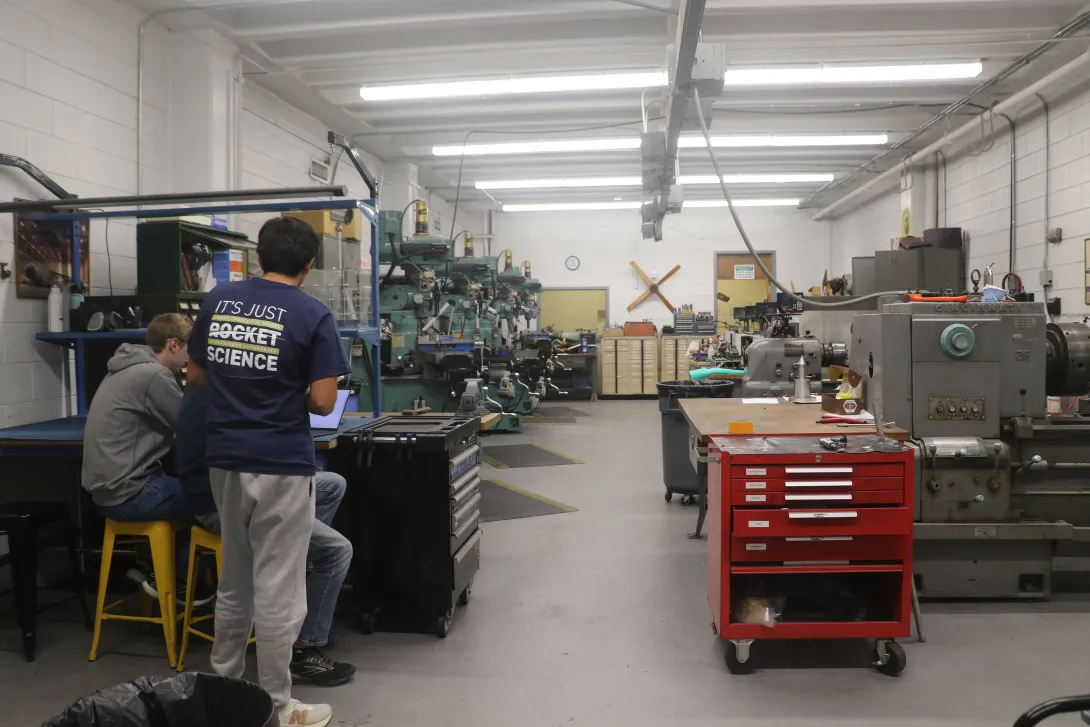
AE Machine Shop with students.
Georgia Tech is leading a new NASA-supported workforce development initiative designed to expand aerospace education and strengthen Georgia's pipeline of skilled technical talent needed for future space missions.
Through a Next Gen STEM (NGS) NASA Aerospace Skilled Technical Workforce Hubs (NAS_Hub) grant award, Georgia Tech will play a central role in addressing a critical labor shortage in the booming aerospace industry and enhance the state’s role as an aerospace industry leader in the global space economy.
Beginning this fall, the three-year, $1.5 million award will establish the Southeast Space Technology & Aerospace Readiness Skills (SE-STARS) Hub. The hub will expand opportunities for training and workforce readiness in high-demand technical careers in aerospace.
The SE-STARS Hub includes the Georgia Space Grant Consortium (GSGC), Georgia Tech’s Space Research Institute (SRI), the Georgia Tech Manufacturing Institute (GTMI), the Technical College System of Georgia (TCSG), Georgia Southern University, Georgia College and Career Academies, Georgia Aerospace & Defense Alliance (GADA), and select Georgia aerospace employers to support the growing aerospace industry and NASA missions.
Aerospace products are Georgia’s No. 1 export and the state has more than 800 companies supporting aviation, manufacturing, research, maintenance, repair, and operations. Many aerospace and engineering positions rely on skilled technical workers whose training pathways do not require a four-year, or advanced degree. There are significant gaps in technical roles such as machinists, electronics technicians, test operators, and systems integrators. These shortages are driven by an aging workforce and a projected national shortfall of at least one million skilled technical workers by 2030. (National Academics of Sciences, Engineering, Medicine, 2025). The gap also stems from the rapid pace of technological advancement, where even current skills can quickly become obsolete if not constantly renewed. All this combines to create an urgent need for training to support new and sustainable aerospace career pathways.
Stephen Ruffin, interim chair of the Daniel Guggenheim School of Aerospace Engineering and GSGC director will serve as the principal investigator (PI). Jud Ready, executive director of SRI; Lori Skillings, GSGC; Hossein Taheri, Georgia Southern University; and Steven Ferguson, GTMI, will serve as co-PIs. Jeffrey McNabb, a research engineer in Georgia Tech’s Aerospace Systems Design Lab (ASDL), will serve as the program manager, leading day-to-day operations and coordinating the project team.
"This initiative strengthens Georgia's position as a leader in aerospace innovation and manufacturing while providing new opportunities for students and industries across the state," said Ruffin.
Coordination between public education systems, industry, and workforce agencies can sometimes be limited. SE-STARS will act as a "hub" to bridge these gaps, connecting Georgia Tech and its specialized research institutes with TCSG’s 22 colleges and 88 campuses to provide statewide access to training.
“Another advantage of the program is the stronger network it creates,” said Ruffin. “Each organization in the SE-STARS team has unique capabilities but together we will strengthen the technical workforce pipeline across Georgia and the broader Southeast.”
The SE-STARS team will collaborate with industry partners to develop curriculum aligned with workforce needs. “The easily ported curricula we develop will be tailored for other institutions to adopt directly, creating a consistent foundation of skills and competencies that employers can universally expect from program graduates across Georgia,” Ready said.
Students will access training through a statewide network of technical colleges serving as regional instructional nodes, which offer flexible online options and hands-on paid apprenticeships to ensure broad geographic reach.
The program also reaches K-12 and adult learners through career academies and specialized STEM labs, creating a structured, sustainable transition from early education to high-demand aerospace credentials. GTMI will support this work through its Advanced Manufacturing Pathways Program, which connects industry-informed training with pathways into high-demand advanced manufacturing careers.
“Georgia's expanding aerospace and space sectors are creating high-paying jobs and driving economic growth,” said Ruffin. “This program will help develop the skilled workforce needed to support that growth and Georgia’s competitiveness in the space economy.”
News Contact
Monique Waddell
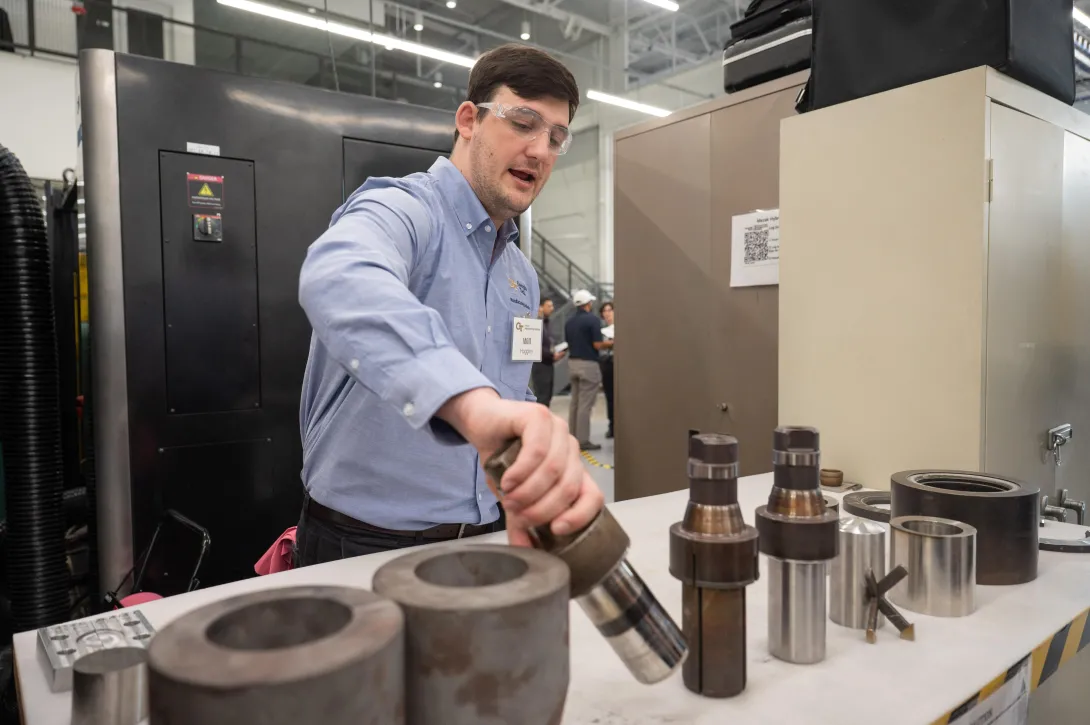
Georgia Tech doctoral candidate Will Huggins presents findings of an AMPF case study featuring the manufacture and repair of high-value parts used by the railway industry.
Counterfeit and out-of-spec components are entering U.S. defense supply chains through thousands of small and midsized suppliers that make up the lower tiers of the industrial base. Researchers at the Georgia Tech Manufacturing Institute (GTMI) say the fix isn't just better parts, but better proof: verified digital records, secured against tampering, that travel with each component from raw material to installation.
A landmark 2012 Senate Armed Services Committee investigation documented 1,800 cases involving more than 1 million suspect counterfeit electronic parts in the defense supply chain, traced to more than 650 companies relying on their own unvetted networks of distributors and brokers. In one case, parts changed hands five times before reaching a Raytheon subcontractor.
The Pentagon has separately estimated that up to 15% of the spare and replacement electronic parts it buys are counterfeit. Without verification built into the supply chain, officials warn, a single bad part, or a single exposed manufacturing controller, can compromise a weapons system or halt a production line. That risk hasn't eased: a 2025 Government Accountability Office report found that Department of Defense now depends on more than 200,000 suppliers, and a deeper look at the MQ-9 Reaper drone's supply chain found Chinese components at the lower tiers despite U.S.- and Europe-based top-tier suppliers.
Manufacturers are adopting a QR-coded digital record, sometimes called a digital passport, that documents a part's full production history and can be scanned at any point in the supply chain. According to GTMI Executive Director Tom Kurfess, a member of the National Academy of Engineering who previously oversaw federal manufacturing R&D policy at the White House, the core requirement of this digital infrastructure is straightforward: apart must prove it is what it claims to be.
"I am not a counterfeit part; I was made according to specifications, and you can insert me into that jet engine with high confidence that I'm going to perform as specified," Kurfess said, describing what the scan of a digital passport for a replacement jet engine turbine blade needs to confirm before it goes into an F-35.
How the Tracking Works
While a fighter jet represents the apex of tracking stakes, Kurfess notes that the underlying infrastructure is already proven on much more ordinary assembly lines. He points to a plumbing fixture plant near Hartsfield-Jackson Atlanta International Airport, where every unit carries a QR code that pulls up the humidity conditions during manufacturing, the processing steps, and who worked on the part. Defense components use the same method, where an untraced failure carries far higher stakes.
The technology itself is cost-effective. Shops have swapped standard calipers for Bluetooth-enabled versions that cost only a few dollars more, Kurfess said. Paired with a smartphone or tablet and a cloud account, those calipers automatically and securely feed measurements into a spreadsheet rather than a handwritten log, building a documentation record for every part in a batch.
"Before shipping it off, you essentially signal that you are ready. You click the print button, and a QR code prints out to go right on the shipping bin," Kurfess said. "Whoever receives that bin, whether a commercial OEM or a defense prime, scans the code and can pull up the part’s full record.” The same approach covers more complex components. Electric motors built for the automotive industry now upload test-stand performance data to the cloud before shipping; once installed, a vehicle's control system scans the motor's passport and calibrates accordingly, Kurfess said. On automotive assembly lines, cameras and scanners verify that every part in a kit is present before workers seal and code it, catching shortages before they halt the production line.
For defense suppliers, Kurfess said the documentation lets prime contractors, and the Department of Defense confirm that a part meets specifications and traces it through its full production history. "We know it's a good blade, and you can insert it into the F-35," he said. "We can track all of it."
The Cybersecurity Risk
That documentation only works if the underlying systems stay secure. Saman Zonouz, associate professor in the School of Cybersecurity and Privacy and Electrical and Computer Engineering, said manufacturing is one of 16 sectors the Department of Homeland Security, through the Cybersecurity and Infrastructure Security Agency (CISA) classifies as critical infrastructure, dependent on energy and water to operate while other sectors depend on it in turn.
His research shows adversaries can insert what his team calls "logic bombs" into design files: code that leaves a manufactured part looking normal until it fails on command, whether that part is a drone propeller or a power grid transformer. He also pointed to supply chain attacks, where imported machine tools arrive with vulnerable or deliberately compromised software already installed, the same pattern behind the SolarWinds breach that hit critical infrastructure nationwide.
Scanning the internet, Zonouz's team found manufacturing controllers exposed and reachable by outside actors. Manufacturing hasn't developed cybersecurity measures at the pace of sectors such as finance or energy, he said, in part because engineers built legacy equipment for reliability, not to resist a deliberate attack.
AI cuts both ways, according to Zonouz. It powers new attack-detection systems, including the Georgia AI in Manufacturing (Georgia AIM) technology corridor, a $65 million initiative that includes a pilot project at the Advanced Manufacturing Pilot Facility to enable shops to monitor for anomalies without constant human oversight. But AI systems also introduce new, often unknown vulnerabilities that attackers can exploit.
Zonouz encourages manufacturers to build cybersecurity into systems from the start, borrow lessons from more mature sectors already operating under frameworks such as North American Electric Reliability Corporation Critical Infrastructure Protection for the power grid, and prepare for manufacturing standards, including the Department of Defense's Cybersecurity Maturity Model Certification framework, to tighten over time.
Much of GTMI's work runs through the small and midsized manufacturers that supply nuts, bolts, and castings to prime contractors such as Lockheed Martin and General Motors, companies that typically lack the in-house IT resources of a major OEM. Kurfess said GTMI configures the same cloud tools that automate measurement tracking to meet Department of Defense documentation and cybersecurity requirements, working directly with smaller suppliers to build that capability instead of leaving them to develop it alone.
Tracking Choke Points Before They Become Failures
The same connectivity that verifies individual parts also shows manufacturers where a supply chain is vulnerable before a disruption hits. Kurfess cites the 2011 Fukushima disaster, which knocked out a single Japanese plant supplying a chip used in the machine tool industry worldwide, and the Covid-era shipping container shortage that forced companies to truck castings across the country when no containers were available at U.S. ports for shipping via rail. Mapping a supply chain in both directions, he said, reveals where a single supplier, region, or disruptive event such as inclement weather or a power outage could stop production.
Kurfess compares GTMI's approach to "being the Google Maps for manufacturing," using real-time connectivity to flag bottlenecks and reroute them in the best possible manner. That logic also drives GTMI's push for distributed manufacturing: spreading production of a component, such as electric vehicle motors, across many smaller regional plants instead of one large facility so a local disruption can't affect the whole chain. GTMI's Factory Information Systems Center builds the secure supply chain architectures and machine-to-cloud connectivity behind that work.
Chris Gaffney, managing director of Georgia Tech's Supply Chain and Logistics Institute, reached a similar conclusion in a June 2026 research brief, calling cyberattacks on physical supply chains "a defining executive risk" and trusted operational data possibly "the most valuable" asset a supply chain organization holds.
Verifying Quality Without Shipping Parts Across the Country
GTMI is applying AI directly to quality verification at its Advanced Manufacturing Pilot Facility (AMPF), where manufacturers can build and verify a part under one roof instead of shipping it elsewhere for testing. "Right now, in manufacturing, a piece of equipment, a turbine rotor blade, for example, is created in one place, then sent somewhere else for testing," said Aaron Stebner, an associate professor who leads AMPF's work under the Georgia AIM initiative. "Often it goes across the country to check its interior structure, then is shipped to a second location to test its chemical composition."
AMPF's connected machines "talk" to each other using AI and a knowledge management system, verifying a part’s material composition and durability as it's made rather than after the fact, so manufacturers can confirm they're building what they intend to build without shipping delays. "No other facility in the nation is built to do this autonomously," Stebner said. "Georgia Tech will be the first." GTMI is also opening AMPF to remote materials research through a new AI-driven cloud lab (see sidebar).
GTMI's Role
Kurfess and Zonouz both credited close collaboration between manufacturing and cybersecurity researchers at Georgia Tech, including a dedicated School of Cybersecurity and Privacy, as the basis for GTMI's work in this area. That collaboration drives research into cyber-secure manufacturing platforms designed with security built in from the outset, and AMPF gives those systems a place to run on production-scale equipment.
Kurfess said the next test is scale: whether digital passports, secure cloud tracking, and AI-verified quality checks can move from a handful of pilot programs and flagship facilities to the thousands of small shops that make up the defense industrial base. The technology, from Bluetooth calipers to readily available and cost-effective cloud accounts, is already cheap enough that cost isn't the barrier. What remains is installing, securing, and standardizing those tools across a supply chain that still runs largely on paper.
To learn more about how GTMI can help defense manufacturers build supply chain resilience, visit https://manufacturing.gatech.edu/engage
# # #
GTMI to Build AI-Driven Cloud Lab for Remote Materials Research
Georgia Tech is building a Programmable Cloud Laboratory that will let researchers across the country direct materials experiments at the Georgia Tech Manufacturing Institute's Advanced Manufacturing Pilot Facility (AMPF) without traveling on-site. The National Science Foundation is funding the project with $18.1 million as part of a planned national network of 20 AI-enabled cloud labs.
Researchers will submit a request, and AI agents will translate it into a detailed workflow, coordinating robots, equipment, and data collection across the facility. "Researchers can ask a question, have work recommended by AI agents, have experiments carried out at the facility using robotics, and get the results back," said Aaron Stebner, GTMI associate director, Eugene C. Gwaltney Jr. Chair, and James R. and Sarah R. Borders Faculty Fellow in the George W. Woodruff School of Mechanical Engineering. "They can use AMPF resources to advance their own research without having to be experts in each piece of equipment or send students to AMPF for weeks at a time."
AMPF is approaching autonomous workflow capability across about 38 of its 160 pieces of equipment. The cloud lab aims to push that past 100. Pascal Van Hentenryck, director of the NSF AI Institute for Advances in Optimization, said the system will rely on digital twins, virtual models of the facility, to plan and monitor experiments, and will improve its scheduling and machine tuning as it learns from each run.
The project also integrates Duke University's Automatic FLOW for Materials Discovery platform and a knowledge and data management platform from Contextualize to connect researchers, instruments, and IT systems across the network. Organizers expect more than 400 users from 150 academic, industry, and government institutions, with more than half participating remotely.
Tom Kurfess, GTMI's executive director, said the lab will let industry partners test new ideas before committing to large-scale deployment. "This initiative will shorten development cycles and make it easier to bring promising technologies into production, enabling our partners and us to innovate at the speed of thought," he said.
News Contact
Jennifer Martin
Assistant Director of Research Communications Services
Writer: Anne Wainscott-Sargent

As manufacturing systems become more connected, the cyberthreat grows with them. Saman Zonouz has spent years documenting how vulnerable smart manufacturing environments are. He’s an associate professor in the School of Cybersecurity and Privacy and the School of Electrical and Computer Engineering, where he co-leads the Cyber-Physical Security Lab with Raheem Beyah, Georgia Tech’s provost and executive vice president for Academic Affairs.
"Disrupting the manufacturing sector doesn't just shut down individual shops. It can directly impact national security and public safety," Zonouz said. Because manufacturing is one of 16 federally designated critical infrastructure sectors, it is deeply intertwined with energy, water, and defense, meaning disruptions can cascade far beyond the factory floor.
The threats Zonouz documents go beyond ransomware. His research has demonstrated how adversaries can insert logic bombs into design files, compromising Computer Numerical Control machines or 3D printers.
"We've shown how logic bombs can be inserted remotely into design files so that everything looks normal when the part is printed, but once it's in operation, the attacker can decide when it fails," Zonouz said, citing drone propellers, aircraft wings, and power grid transformer components as examples where invisible sabotage could have catastrophic consequences.
Internet-wide scans conducted by his team found that many shop-floor controllers are directly exposed to the internet, with no meaningful barrier between an adversary and the machines running a production line. Imported equipment compounds the risk, because controllers and firmware from unknown developers may carry unintentional vulnerabilities or deliberately planted backdoors. "In manufacturing, many controllers and machines can still be accessed easily from outside," Zonouz said, echoing the kind of supply chain exposure seen in high-profile attacks on widely used software platforms.
His prescription is straightforward but still largely unimplemented across the sector: Build security into the system design rather than adding it afterward. "The number one principle is to think about cybersecurity and risk when you design the system, not as an afterthought once everything is already built," Zonouz said.
His team has explored this through the $65 million Georgia AIM initiative, a collaboration with Aaron Stebner, Steven Ferguson, and Animesh Chhotaray, led by Ph.D. student Twisha Chattopadhyay. Using AI for automated anomaly detection allows complex production lines to be monitored continuously without requiring constant human oversight.
Georgia Tech's standing at the intersection of manufacturing and cybersecurity is, by most measures, singular. "Georgia Tech is the only top university with a dedicated School of Cybersecurity and Privacy, with about 30 professors focused solely on cybersecurity, and you rarely see this level of collaboration between cybersecurity and manufacturing faculty anywhere else," Zonouz said. That collaboration is already producing joint publications and a patent application for AI-driven attack detection systems developed through Georgia AIM.
Not every attacker wants a quick payoff. Zonouz also tracks advanced persistent threats, where a nation-state actor quietly compromises a controller and does nothing for months, waiting for the right geopolitical moment to act. "They get into the house and just sit there, because by sitting still nobody can detect them," Zonouz said. That patience turns an idle, exposed controller into tomorrow's leverage.
"Manufacturers do not need to solve every problem at once," Zonouz said. Finance and energy already operate under mandatory cybersecurity frameworks, while manufacturing's own standard, the Cybersecurity Maturity Model Certification, is still being phased in. "The security of these systems right now is so weak that basic, easy-to-deploy solutions would stop the majority of attacks that are succeeding simply because the door is wide open," he said. The hardest attacks will always be the patient, targeted ones, and closing the obvious gaps first is what buys manufacturers time.
News Contact
Jennifer Martin
Assistant Director of Research Communications Services
Writer: Anne Wainscott-Sargent
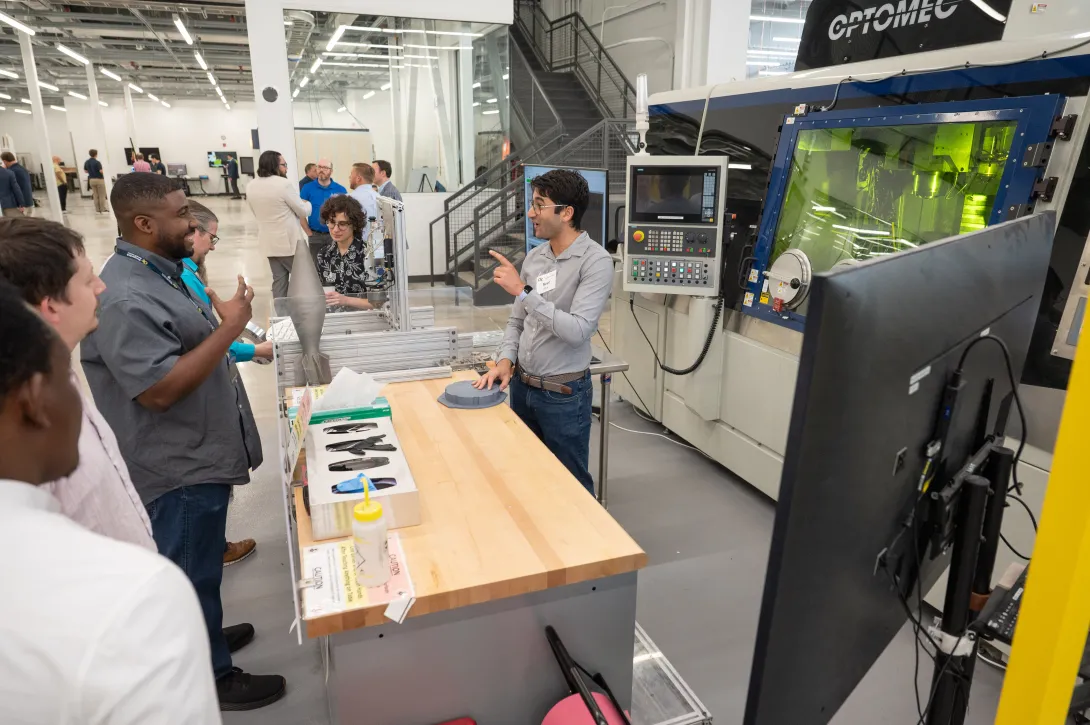
Georgia Tech doctoral candidates Neel Shah and Jamila Khanfri discuss how smart factories have the potential to autonomously incorporate domain expertise into additive manufacturing process development, saving industry partners time and money.
The U.S. has seen its printed circuit board market share plummet to 4% while becoming dangerously dependent on foreign rare earth processing. Now, with global supply chains fracturing, defense industrial capacity under pressure, and adversaries looking to dominate advanced production, the country is in a race to rebuild — and to rebuild smarter.
Two converging trends are shaping what that looks like on the factory floor. The first is the rise of the lighthouse factory, where AI-driven systems, autonomous mobile robots, and centralized digital control work with a skilled human workforce rather than replacing it. The second is physical AI, in which machine learning moves off the server rack and into the manufacturing process itself, making real-time decisions at the machine level that no human operator could match at scale. Together, these shifts are rewriting the economics and the security calculus of American production.
At the forefront of both is the Georgia Tech Manufacturing Institute (GTMI) and its Advanced Manufacturing Pilot Facility (AMPF), a first-of-its-kind, shared-use facility at a research university that is already doing what federal agencies are only beginning to fund. The AMPF is the proving ground where new manufacturing solutions are stress-tested before they reach the shop floor — where a scrap rate that plagued a major automobile supplier was cut in half in 45 days, and where capabilities are being realized faster than ever thought possible.
"The expectation was that building a capability like this would take decades," said Steven Ferguson, principal research scientist and GTMI deputy director. "Instead, we've compressed that timeline dramatically and are already applying these technologies to solve real manufacturing challenges."
The future Ferguson describes has already displaced the old “lights‑out” myth of fully dark, fully automated factories. What modern smart manufacturing demands is tighter integration between machines and the people who define what those machines should accomplish.
Georgia is well positioned to lead that charge. According to the Georgia Association of Manufacturing, the state supports more than 426,000 manufacturing jobs with average earnings of $86,372, contributing $77.1 billion to the state's gross regional product. Projected employment growth of 8% between 2024 and 2029 reflects not just expansion but transformation; the sector needs a different kind of worker, and a different kind of research partner than it did a generation ago.
GTMI and the AMPF have staked out a national leadership position in exactly those capabilities. The facility is pioneering the deployment of physical AI in a university R&D and demonstration environment, using machine learning to monitor and adjust manufacturing processes in real time. When printing a component from a $30,000 barrel of specialty powder or a newly developed superalloy, a process failure is not acceptable. AI-driven systems continuously analyze thousands of optical, thermal, acoustic, and process signals to identify patterns, optimize performance, and detect anomalies.
"In an R&D facility, you program it once, and it changes a million times," Ferguson said. "We're using AI and mobile robots to intelligently coordinate production scheduling, material movement, and manufacturing processes, all while humans define the experiments and interpret the results."
The facility also connects the full innovation chain from materials discovery through manufacturing process to quality assurance, demonstrating in one space what others are still planning.
Smart Manufacturing as a National Security Imperative
The stakes extend well beyond production efficiency. Ferguson points to pandemic-era chip shortages that left tens of thousands of finished vehicles waiting on a single component and to current constraints on the critical minerals and chips needed to build AI data centers and defense systems.
"Our ability to manufacture at scale underpins both our economic competitiveness and our national security," he said. "If we can't build what we need when we need it, we're at a strategic disadvantage."
From the Shop Floor: IAC Group
For Tom Boney, chief operating officer for the Americas at IAC Group, the question wasn’t whether to modernize; it was who could help the company move fast enough to keep plants competitive and workers employed. Georgia Tech, he said, offered something IAC couldn’t build on its own.
“Georgia Tech brings the brains and computing power we don’t have,” Boney said. “You’ve got some of the smartest people in the world on that campus, plugged into world-class infrastructure, and we put them side by side with our operators on the shop floor.”
An automotive interior components manufacturer with plants across the U.S., Mexico, and beyond, IAC is competing daily with facilities in lower-cost regions. “For us, smart manufacturing and AI are really about job and plant future security,” Boney said. “We’re competing every day with plants in China, Mexico, and the U.S., and we already have tons of production data, but we can’t analyze it fast enough on our own.”
IAC’s first project with GTMI focused on a complex adhesive manufacturing process at a plant in Vance, Alabama. The facility had rich production data but lacked computational power and AI modeling to act on it in real time. GTMI students and researchers connected Georgia Tech’s systems directly to the plant’s equipment, working with line operators. The result was a 50% reduction in scrap in roughly 45 days, with those gains then extended to other IAC locations.
The pace of the partnership was another sign that this wasn’t a typical university engagement. A framework agreement that usually takes 12 to 15 months was executed in 35 days, enabling the two organizations to move through new project cycles quickly. IAC now runs five active projects with GTMI, each advancing in turn or making way for the next initiative, a cadence Boney sees as essential to staying competitive on the factory floor.
Building the Workforce of Tomorrow
IAC’s success with GTMI underscores a hard truth: technology can unlock new performance, but only if there’s a workforce ready to run it. Technology alone cannot sustain a manufacturing renaissance. Ferguson is candid about the workforce challenge posed by automation, particularly the erosion of entry-level roles that once served as the first rung of a career ladder.
"The industry has an image problem. People still picture dark, dirty, and dangerous, when the reality is safer, cleaner, and far more interesting," Ferguson said. "Now we're trying to convince kids, 'You don't have to, you get to.' We don't need button pushers. We need thinkers and creators working alongside robots."
GTMI's response runs from K-12 engagement through technical college partnerships to university engineering programs at Georgia Tech, UGA, Georgia Southern, Kennesaw State, and others. For example, UGA partnered with the Russell Innovation Center for Entrepreneurs (RICE) to launch the Georgia AIM Mobile Studio. This traveling advanced-technology lab visits K-12 schools across the state to give students hands-on experience with interactive engineering vignettes and robotics. Teacher boot camps bring high school educators to campus for hands-on training in CAD design, CNC milling, and additive manufacturing, equipping them to return to their classrooms as informed advocates. Dual-enrollment pathways through Georgia's Technical College System give students an on-ramp well before they graduate from high school.
This workforce strategy extends beyond traditional education. Through programs such as Advanced Manufacturing Pathways, teacher professional development, dual-enrollment partnerships, undergraduate research experiences, graduate research opportunities, and industry-sponsored projects, GTMI is helping develop the technicians, engineers, researchers, and manufacturing leaders needed to support the nation's next generation of smart factories.
But the workforce pipeline is only one strand of a much larger web. The AMPF is also where partners pressure-test how AI, automation, and new materials behave under real-world constraints like cost, quality, uptime, safety, and security. At GTMI, AI-driven process control, autonomous material handling, critical-mineral research, and cyber-physical security work in concert to create trusted, resilient production capacity that can scale when it counts, whether that means building lightweight components for vehicles, accelerating drone production to meet national needs, or hardening the critical infrastructure that underpins defense and the economy.
In that context, smart manufacturing is no longer a niche technical initiative. It is the connective tissue between research labs, industry partners, and national readiness, and a platform for new kinds of careers. GTMI’s role is to ensure that those connections are real, tested, and ready to perform under pressure, while opening doors for students, teachers, and workers who will run the next generation of factories. In Georgia, that ecosystem is already taking shape on the ground.
News Contact
Jennifer Martin
Assistant Director of Research Communications Services
Writer: Anne Wainscott-Sargent
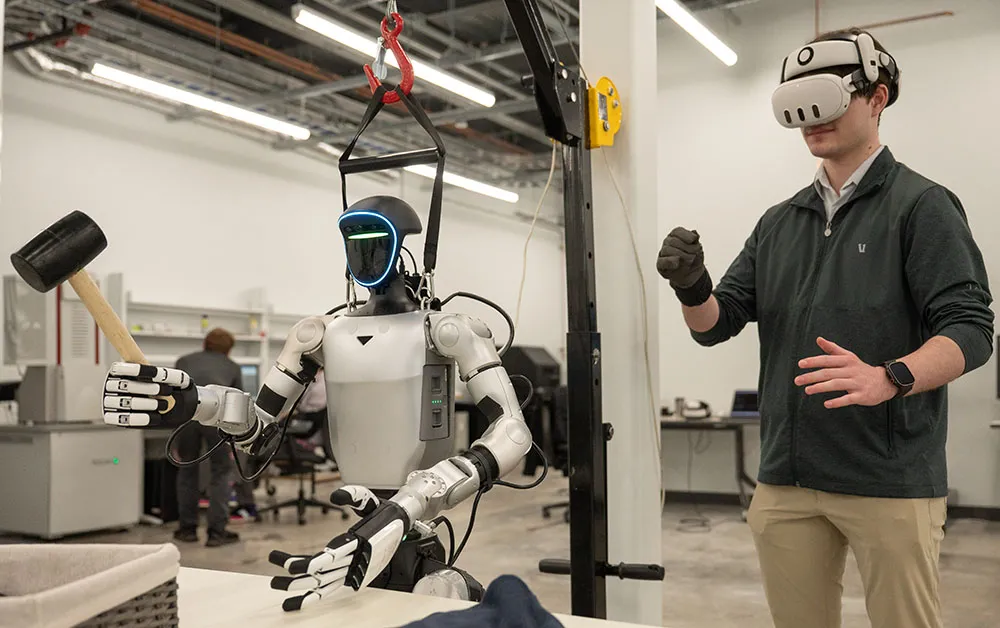
A student demonstrates human-robot interaction using virtual reality controls and collaborative robotics technology at the AMPF.
Moving a new idea from a research lab to production remains one of industry’s toughest challenges. But at the Georgia Tech Manufacturing Institute (GTMI), which leads the nation in translating research into technologies that shape the future of U.S. manufacturing, that gap is being closed by design. This effort was on full display during AMPF Week, a two-day celebration marking the official opening of the newly renovated Georgia Tech Advanced Manufacturing Pilot Facility (AMPF).

The Georgia Tech Manufacturing Institute (GTMI) has selected Aaron P. Stebner as its new associate director, expanding the institute’s leadership as it scales advanced manufacturing research, infrastructure, and industry engagement.
Stebner is the Eugene C. Gwaltney Jr. Chair in Manufacturing and a professor in the George W. Woodruff School of Mechanical Engineering, with a joint appointment in the School of Materials Science and Engineering. He also serves as a James R. and Sarah R. Borders Faculty Fellow, founding director of Georgia Artificial Intelligence Manufacturing (Georgia AIM), and executive director of Georgia Tech’s Professional Master’s in Manufacturing Leadership program.
In his role as associate director, Stebner will lead operations, engagement and continued growth of the Advanced Manufacturing Pilot Facility (AMPF), a cornerstone of Georgia Tech’s manufacturing ecosystem. The facility brings together artificial intelligence, automation, robotics, and digital manufacturing to accelerate materials discovery and manufacturing innovation at pilot scale.
The AMPF is evolving into what Georgia Tech leaders describe as a national first: a university-based, self-driving manufacturing facility that allows new technologies to be invented, tested and de-risked before they reach full-scale production. Backed by more than $80 million in federal, state, and private investment, the facility serves as a shared-use platform for industry, startups, researchers, and government partners.
“AMPF is a national user facility and a blended industry-academia, human-AI environment where new manufacturing discoveries are made ready for industry adoption,” Stebner said. “By integrating AI-enabled systems, real-time automation and pilot-scale validation, we’re helping shorten the timeline from discovery to deployment.”
Stebner’s research and leadership sit at the intersection of artificial intelligence, manufacturing, materials, and mechanics, with an emphasis on intelligent and adaptive manufacturing systems. His work spans advanced alloys, additive manufacturing, autonomous experimentation, and data-driven process design, with applications across aerospace, automotive, biomedical, energy and industrial sectors.
Under his leadership, the AMPF is expected to continue expanding as a national collaboration hub for academia, industry, and government. The facility supports pilot-scale testing of emerging technologies, workforce development and applied research aimed at strengthening U.S. manufacturing competitiveness and economic resilience.
Stebner’s appointment also strengthens the alignment between GTMI, Georgia AIM and Georgia Tech’s broader research enterprise, integrating AI-driven research, translational infrastructure, and industry partnerships into a cohesive model for manufacturing innovation.
“With Aaron’s experience building forward-looking manufacturing programs and leading large, interdisciplinary teams, GTMI is well positioned to accelerate the impact of the AMPF and related initiatives,” said Tom Kurfess, executive director of GTMI.
News Contact
Yanet Chernet
Communications Officer
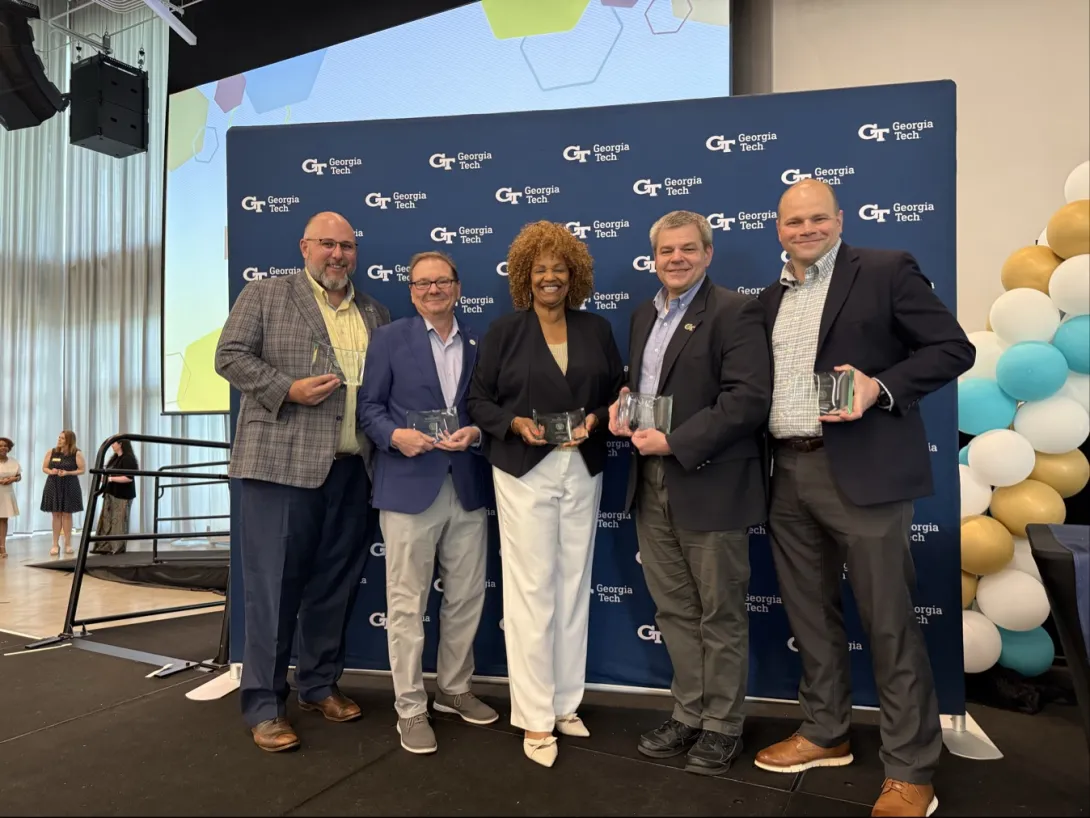
From left: Aaron Stebner, David Bridges, Donna Ennis, Thomas Kurfess, Steven Ferguson
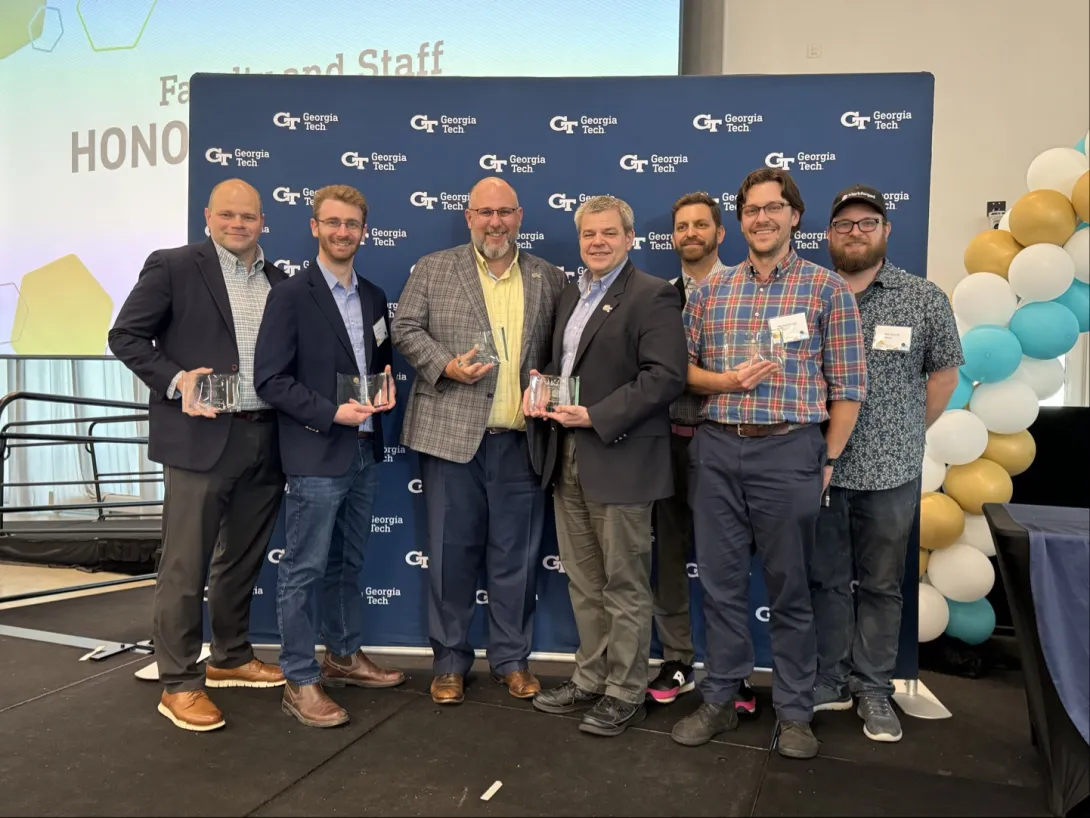
From left: Steven Ferguson, Kyle Saleeby, Aaron Stebner, Thomas Kurfess, Stephan Turano, Weston Straka and Matt Carrol
Georgia Artificial Intelligence in Manufacturing, or Georgia AIM, has received one of the highest research awards at the Georgia Institute of Technology, the Outstanding Achievement in Research Program Impact.
The award was announced March 25, 2026 and is one of six Institute Research Awards given by Georgia Tech’s Office of the Executive Vice President for Research. The portfolio of awards honors achievements in research engagement, innovation, faculty advising, and impact.
Georgia AIM is a statewide coalition led by the Georgia Tech Enterprise Innovation Institute (EI2) and the Georgia Tech Manufacturing Institute (GTMI) to develop and deploy AI talent and innovation in manufacturing. The Georgia AIM coalition includes dozens of universities, technical colleges, nonprofits, and economic development organizations.
“It is an incredible experience to collaborate with technology and economic development leaders around the state to lead the nation and the world in AI for manufacturing,” said Aaron Stebner, Georgia AIM co-director and the Eugene C. Gwaltney Jr. Chair in Manufacturing at Georgia Tech.
“We are truly honored to receive this recognition from our peers at Georgia Tech,” said Tom Kurfess, GTMI Executive Director and HUSCO/Ramirez Distinguished Chair in Fluid Power and Motion Control.
Georgia AIM was initiated in 2021 by Stebner, EI2 Vice President David Bridges, Kurfess, Georgia AIM managing director and GTMI deputy director Steven Ferguson, and Georgia Tech executive director for strategic partnerships George White. The coalition received an initial $500,000 planning grant from the U.S. Economic Development Administration (EDA), which was followed by $65 million in additional grants from EDA and with additional federal, state, and private sector support now totals more than $100 million to enact projects across the state.
The Georgia AIM coalition counts many achievements on and off campus, including:
- Supporting collaborations for more than thirty-five faculty, fifty research faculty and professionals, ten post docs, eighty graduate research assistants, one hundred and fifty undergraduate research assistants, and dozens of staff at Georgia Tech.
- Transforming the Georgia Tech Advanced Manufacturing Pilot Facility into a national user facility for research and development to invent, test, derisk, and mature AI manufacturing and materials technologies.
- Building a manufacturing commercialization pipeline that links faculty research, student innovation, startups, and corporate partners to introduce AI manufacturing innovations to regional and national economies.
- Launching workforce development programs that provide new opportunities and career paths thousands of students spanning K-12 engagement, technical apprenticeships and credentials, and professional education.
- Providing STEM experiences including AI coding camps, robotics competitions, and advanced manufacturing competitions to thousands of students across Georgia.
- 21 peer reviewed journal articles, 5 peer reviewed conference proceedings, 5 National Academies workshop presentations, 5 keynote/plenary presentations, more than 200 conference presentations and posters, 13 invention disclosures, 7 provisional patents, 2 full patents filed to date with dozens more in process.
“Georgia AIM proves that innovation scales when built alongside workforce,” said Ferguson. “We built a seamless pipeline from education to industry, ensuring talent is ready to deploy AI in real manufacturing environments on day one.”
“The impact of Georgia AIM is grounded in collaboration — universities, industry, nonprofits and communities working together to shape the future of advanced manufacturing in Georgia,” said Bridges. “This recognition underscores what a coordinated statewide effort can accomplish.”
Because research covers a range of activities — from research and development to commercialization and public impacts — the annual awards recognize the many facets of work in this area. The peer-driven nomination process emphasizes measurable contributions and leadership across disciplines.
“The strength of Georgia Tech’s research enterprise begins with the talented people who push discovery forward every day,” said Tim Lieuwen, executive vice president for Research. “Congratulations to this year’s honorees, who demonstrate what it means to turn bold ideas into real-world impact, advancing knowledge from fundamental science to commercial and community applications. With these awards, we celebrate their leadership, creativity, and dedication to serving the public good.”
Read more about this year’s Institute Research Award winners.
News Contact
Yanet Chernet
Communications Officer

More than 6,200 high school students across Georgia tuned in for Engineers Week 2026. Through a series of online talks, Georgia Tech researchers shared a glimpse of the technologies shaping the future.
A national initiative held February 23–27, the event highlighted research spanning cybersecurity, aerospace engineering, robotics, infrastructure, and advanced manufacturing. The program virtually brought engineers into classrooms statewide, who offered online learning experiences centered on inquiry, problem solving, and design.
“This is a great collaborative effort between the College of Engineering, the Georgia Tech Manufacturing Institute (GTMI), and the Georgia Tech Research Institute (GTRI),” said Sean Mulvanity, program lead at STEM@GTRI. “We provided students from across the state the opportunity to interact with leaders in a variety of engineering fields.”
Each day featured a different engineer discussing the real-world challenges driving their work. Cybersecurity professor Saman Zonouz began the week with a talk on protecting critical digital systems that power modern life. Aerospace engineer professor Adam Steinberg followed with insights into developing faster, cleaner engines for next-generation supersonic aircraft. Juergen Rauleder, also an aerospace engineer professor, then introduced students to aerodynamics research conducted in Georgia Tech's wind tunnel — one of the largest in the United States.
Later sessions expanded the conversation across disciplines. Civil and environmental engineering professor Lauren Stewart discussed designing buildings and infrastructure capable of withstanding extreme loads, while mechanical engineer professor Aaron Stebner closed the week with his talk, “3D Printing Titanium: Realizing the Superhero Powers of Ironman,” exploring advances in additive manufacturing.
“These talks show engineering isn’t just theory,” said Steven Ferguson, GTMI principal research scientist. “Students are hearing directly about the kinds of problems people are working on right now.”
One session featured Aparna Srinidhi Jagannathan, a third-year biomedical engineering student and undergraduate researcher at Georgia Tech, who spoke about her research in the Exoskeleton and Prosthetic Intelligent Controls (EPIC) Lab. Jagannathan is developing a wearable biofeedback system designed to help patients with gait disorders improve balance and coordination while walking.
“One of the things I value about being an engineer is the ability to turn abstract ideas and theories into tangible devices and technologies through research and design,” Jagannathan said. “Engineers Week empowers students with the knowledge that they, too, can meaningfully contribute to engineering. It reminds them that they can lead projects that benefit the communities around them.”
Engineers Week at Georgia Tech was presented by the College of Engineering, the Georgia Tech Manufacturing Institute, and the Georgia Tech Research Institute.
News Contact
Yanet Chernet
Communications Officer I
Georgia Tech
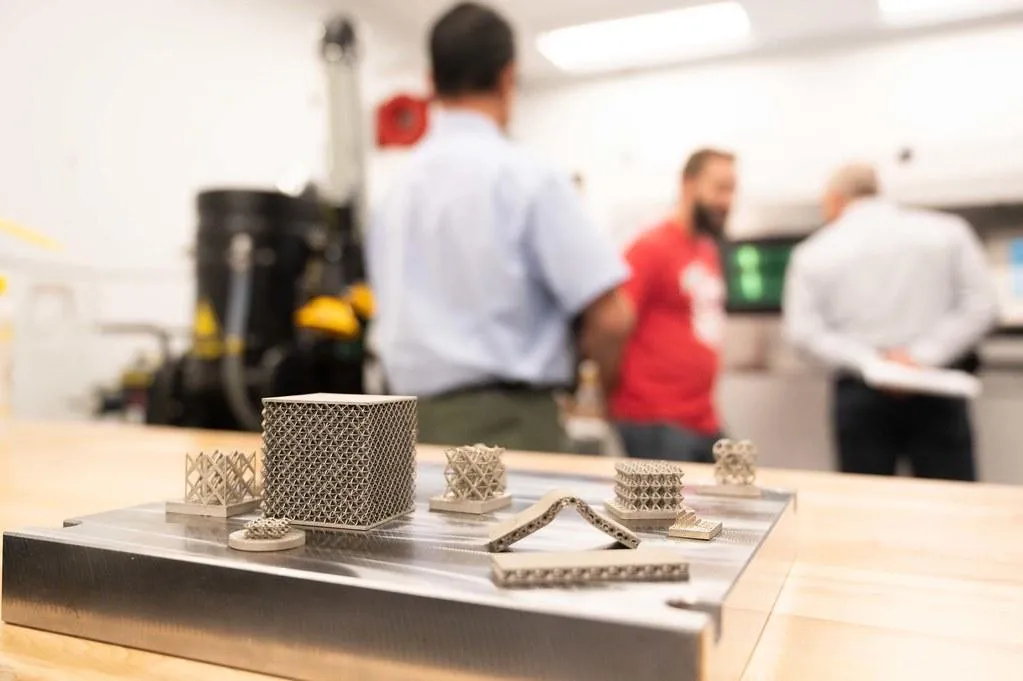
High-performance parts used in aerospace and defense systems need to be precise and durable, even with complex geometries. Advanced manufacturing methods enable the production of complicated parts that traditional machining can't achieve, like those seen here at GTMI's Advanced Manufacturing Pilot Facility. (Photo by Georgia Tech)

Collaborative research at the Georgia Tech Manufacturing Institute teamed is working to improve the finishing processes for hard to machine metals like tungsten. (Photo via Halocarbon)
From fighter jets to medical devices, today’s most advanced machines depend on parts as intricate as their missions. These components aren’t just geometrically complex — they’re made from specialized metals engineered to withstand extreme heat, friction, and wear. But that strength comes with a challenge. How do you shape metals tough enough to survive the heat of a jet engine?
One solution is to start with a more moldable form of these super-metals: powder. In a specialized form of additive manufacturing (like 3D printing), manufacturers start with fine metal powders and fuse them, layer by layer, using focused energy. Known as powder bed fusion (PBF), this method enables highly complex shapes and reduces the amount of finishing work needed. Still, when a micron of extra material can make or break the final product, even near-perfect parts require precise finishing touches.
“The introduction of new, exotic materials produced through additive manufacturing has brought unique challenges, especially for applications in space and missile systems,” says David Antonuccio, business development director at Halocarbon, a Georgia-based company producing advanced chemical solutions used in manufacturing and other fields. “While these materials offer distinct properties, they are notoriously difficult to machine.”
That’s where the Georgia Tech Manufacturing Institute (GTMI) comes in. Through its Manufacturing 4.0 Consortium, GTMI connects industry manufacturers like Halocarbon with researchers and innovators to tackle real production challenges like this. Membership includes access to GTMI’s Advanced Manufacturing Pilot Facility (AMPF), where companies can test ideas and collaborate on new solutions.
Halocarbon recently teamed up with Freemelt, a leader in producing PBF systems and a fellow consortium member, to address this bottleneck. Their goal: to determine whether Halocarbon’s specialized metalworking fluids could enhance the finishing process for PBF-manufactured parts made from tungsten and molybdenum, two high-temperature, hard-to-machine metals.
“The future of manufacturing depends on how well we integrate talent, technology, and collaboration,” says Steven Ferguson, interim director of Research Operations at GTMI and managing director of the consortium. “By bringing companies together around shared challenges, we’re closing critical gaps and strengthening the nation’s advanced manufacturing capability.”
Solving the Post-Processing Bottleneck
Even with advanced methods like electron beam powder bed fusion (E-PBF), which uses an electron beam to fuse metal powders inside a vacuum chamber, finishing remains a critical hurdle. “Surface finish in powder bed fusion is fundamentally tied to the particle size of the metal powder,” says Ian Crawford, a materials and application engineer at Freemelt. “Post-processing will almost always be part of the equation for high-performance components.”
In traditional machining, coolants and cutting fluids used in these finishing steps are often overlooked, and the methods haven’t changed much in decades. Halocarbon’s metalworking fluid aims to bring these fluids into a new era, using innovative polymer chemistry to extend tool life, improve surface quality, and boost efficiency when machining these challenging alloys.
The two companies initiated their joint project during their free AMPF equipment use time, which comes with the full level of consortium membership. From there, GTMI designed and executed controlled studies comparing the use of Halocarbon’s fluids to two standard finishing methods, dry machining and EDM-based finishing. The results showed a 6% improvement in side milling and a 26% improvement in end milling versus dry machining, with even greater gains over EDM. These improvements translate into higher-quality parts, tighter specifications, lower scrap rates, extended tool life, and reduced downstream costs — exactly what aerospace and defense suppliers need to meet stringent requirements.
The findings were shared at the 2025 National Space & Missile Materials Symposium, reinforcing the value of industry-academic collaboration.
“Industry keeps pushing materials to handle more heat and stress, but that makes post-processing harder,” says Matt Carroll, one of the GTMI researchers on the project. “By bringing equipment makers and chemistry innovators into the same experiment, we were able to prove where the gains really are and give manufacturers data they can act on.”
“No single manufacturing method solves every challenge,” says Crawford. “To achieve the performance and cost targets that aerospace and defense applications demand, we need to bring together the right combination of technologies, and collaborations like this show what's possible when we do.”
News Contact
Writer: Audra Davidson
Research Communications Program Manager
Georgia Tech Manufacturing Institute
Contact: Belinda Vogel
Research Engagement Manager
Georgia Tech Manufacturing Institute