
Sep. 12, 2025
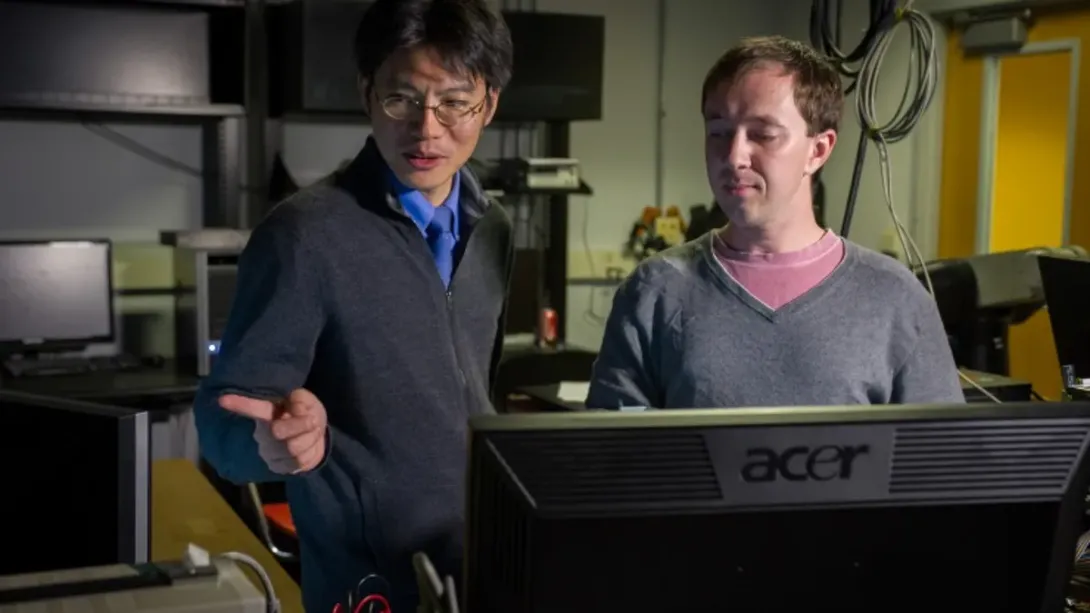
Robotic systems are currently deployed in sectors ranging from industrial manufacturing to healthcare to agriculture, adding benefits in production times, patient outcomes, and yields. This trend towards greater automation and human robot collaborative work environments, while providing great opportunities, also highlights a critical gap in cybersecurity research. These systems rely on network communication to coordinate movement, meaning that security breaches could result in the robot acting in ways that may endanger people and property.
Current cybersecurity approaches have been shown to be insufficient in blocking sophisticated attacks aimed at networked robotic motion-control systems.
To address this gap, Jun Ueda, Professor and ASME Fellow in the George W. Woodruff School of Mechanical Engineering at Georgia Tech, has been awarded approximately $700,000 by the National Science Foundation to establish methods to enhance cybersecurity for networked motion-control system. The research will focus on the unique geometric vulnerabilities in networked robotic systems and stealthy false data injection attacks that exploit geometric coordinate transformations to maintain mathematical consistency in robotic dynamics while altering physical world behavior.
Using an interdisciplinary approach that will combine research methodology from system dynamics, control, communication, differential geometry and cybersecurity engineering, Ueda hopes to establish new mathematical tools for analyzing robotic security and develop safer networked robotic systems that successfully repel system intrusion, manipulation attacks, and attacks that mislead operators.
This article refers to NSF Program Foundational Research in Robotics (FRR) Award # 2112793
A Geometric Approach for Generalized Encrypted Control of Networked Dynamical Systems
News Contact
Aug. 25, 2025
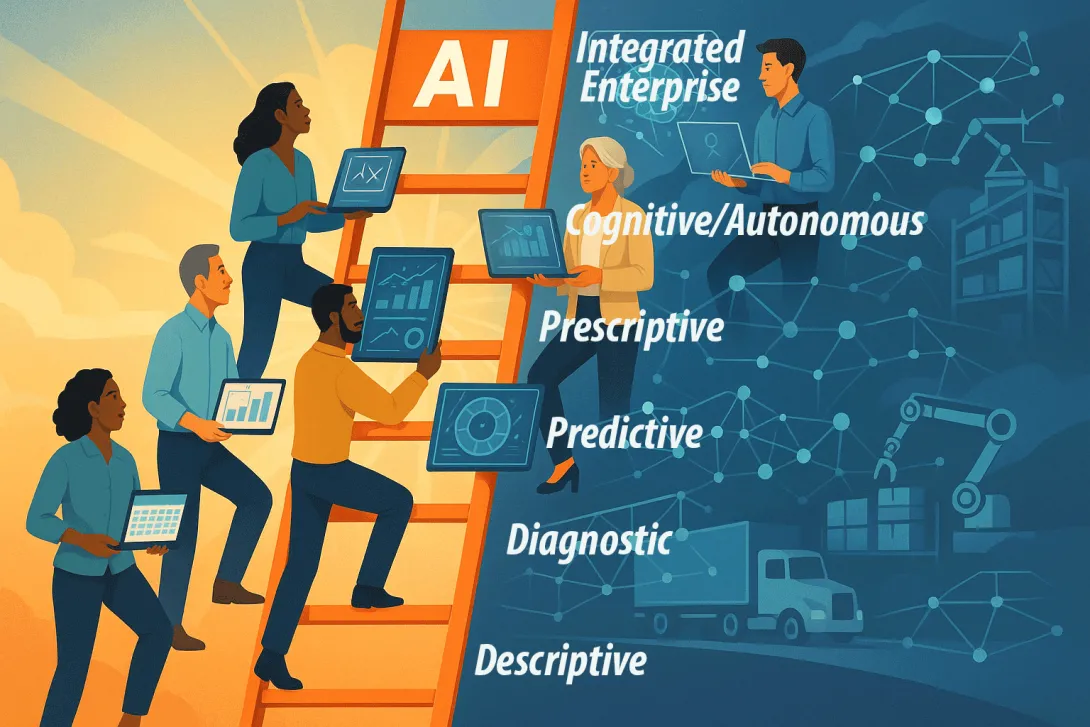
In this special episode, guest host Brian Kennedy sits down with Chris Gaffney to explore how supply chain professionals can take control of their careers by embracing artificial intelligence. Chris introduces the “AI Maturity Ladder,” a step-by-step roadmap that helps individuals and teams evolve from foundational tools like Excel to advanced capabilities like predictive analytics, machine learning, and AI agents.
By Chris Gaffney, Managing Director, Georgia Tech Supply Chain and Logistics Institute | Supply Chain Advisor | Former Executive at Frito-Lay, AJC International, and Coca-Cola
Introduction
Artificial intelligence has entrenched itself in almost every aspect of the professional world. From copywriting tools to search engine optimization and image generation, professionals and laypeople alike use this new technology to streamline daily activities. But, before AI, there was high-level analytics and machine learning in supply chain. Analysts across the supply chain used machine learning to interpret high volumes of data and turn it into predictive algorithms for inventory planning, demand planning, and more. Now, AI is generating these analytics at a much faster, real-time pace.
This shift raises important questions. What does this mean for technology professionals in the supply chain world who once made a living doing these jobs? And what can we expect for aspiring supply chain pros or mid-career professionals who want to increase their value to the team in an age of accelerated technological advances?
The fact of the matter is that AI is now everybody’s job. Standing still will ensure that you get left behind by your peers or the talent pipeline from colleges and universities. The question then becomes, how can I upskill and use what I already know to add value to my role and ensure that my AI competencies allow me to compete in today’s supply chain workforce?
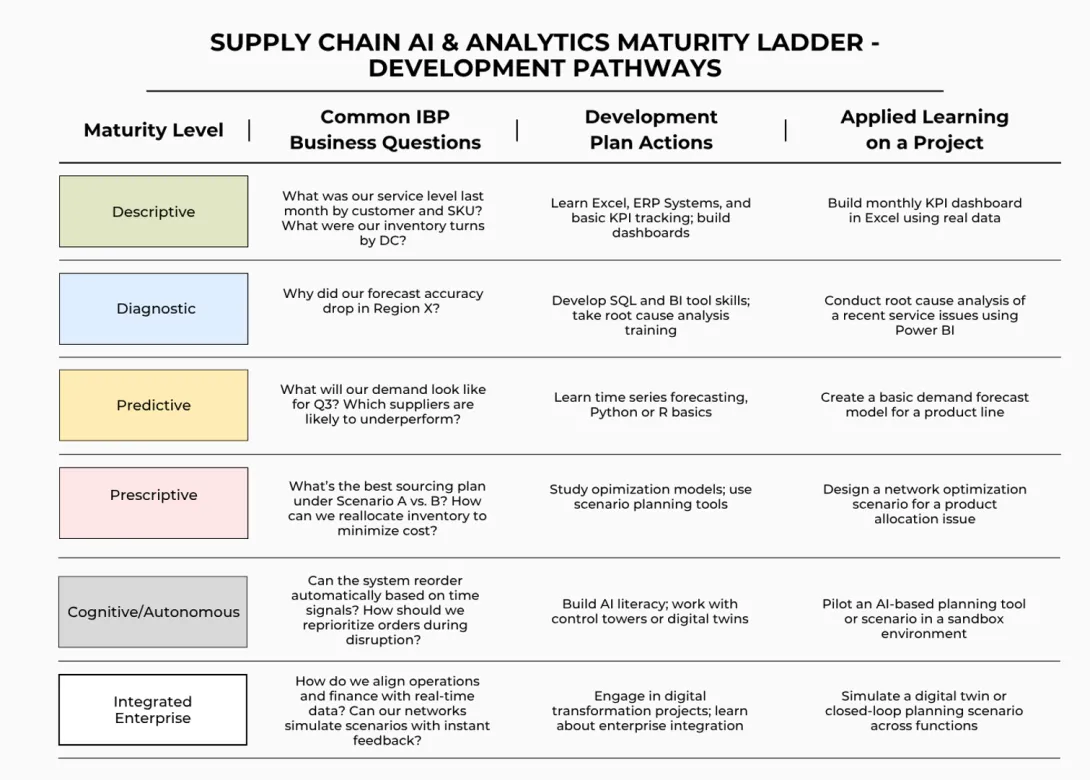
We’ll look at the ladder as a series of increasing levels of complexity and AI activity—what we’ll call ‘maturity levels’: descriptive, diagnostic, predictive, prescriptive, cognitive/autonomous, and integrated enterprise.
Some things to bear in mind as we progress through this topic:
- Everybody is somewhere on the ladder, so everyone has the opportunity to climb the ladder.
- Analytics are no longer just for specialists. AI allows analytics to be an access point to the ladder. You no longer have to rely on someone else higher up on the ladder, and it’s in your best interest to climb higher, regardless of your job description.
- There are lots of resources freely available to allow you to climb the ladder. But in most companies, you can find a mentor who is further along on a ladder, and perhaps they can help you up-skill your operational knowledge and help you advance your capabilities to ascend the ladder.
We’re here to discuss to what degree you should so you can optimize your career opportunities and not be left behind.
How Did We Get Here?
In the field of supply chain we’ve always been ahead of the curve when it comes to these types of innovations. Before AI, we were using machine learning and predictive analytics to enhance our understanding of real-time supply issues. We worked a lot on optimizations at Coke and started utilizing machine learning tactics almost 10 years ago. While I wasn’t the hands-on user of the technology, I took it upon myself to try and understand exactly what was happening and how it was working.
That was a large corporate machine–one of the biggest brands in the world–utilizing the latest in predictive analytics technology. And now we have a democratization of this technology being spread across industries. You no longer need to be part of such a high-powered team to make use of these tools.
We have now entered into an era where artificial intelligence has become omnipresent across almost every supply chain practice and industry, or any other career discipline. The key is understanding best practices is making use of AI in your field, and how you can add value and incorporate it into your everyday work-life.
Descriptive Level: From Rearview Mirror to Forward Thinking Decisions
“If you have some proficiency in Excel, then you’re on the ladder.” - Chris Gaffney
The lowest rung on the AI ladder is the descriptive level. Excel knowledge and experience resides here and can be the access point for most people. This level helps us describe what is happening with numbers and data. Reporting dashboards can be crafted here, and we can run trend analysis using basic inference to see what is happening and where to make adjustments, if necessary.
Excel tells us what did happen - not what could happen. These are important functions, to be sure. However, they only look behind us. They tell us what and why. Today’s supply chain landscape requires tools that allow us to make decisions based on what could happen in the future. We don’t have the power to make proactive decisions or to navigate uncertainty and factor in variables of change.
Our competitive edge is sharpened by having the capability to shape the future, not just explain the past. In order to do so, we need to move up into predictive and prescriptive AI territory.
Up until very recently, this descriptive capability was enough. Analysts, planners, and buyers were all able to produce data that helped others to understand what was happening. The data then required synthesis and analysis. The whys and so whats were human functions performed by different team members and used to measure the efficacy of various inputs and outputs throughout the supply chain. As one moves up the chain of command, so to speak, the ability to interpret the data and findings becomes even more important. However, the numbers crunching and analytics were more siloed.
And now, everyone has access to AI’s ability to synthesize and analyze raw data. But very few “off-the-shelf tools” can answer the why, let alone the ‘what should we do about it’ questions. Planners and managers need to upskill and ensure that they are up to speed on the capabilities and deficiencies of these platforms and insert themselves and their skillsets to close those gaps.
Roles at this level:
- Transportation analysts
- Warehouse supervisors reviewing daily throughput metrics
- Demand planners tracking forecast accuracy from the last quarter
Working in hindsight by monitoring and measuring data is important, albeit limiting. This looking backward in the world of supply chain decision making at a time when forward thinking is essential for future proofing your supply chain organization. Staying here too long limits your ability to prevent problems before they escalate.
What to do next?
- Learn Power BI or Tableau for interactive dashboards
- Get comfortable using large data sets from your ERP or WMS
- Start asking, “why” and “so what”
Diagnostic Level - Information into Insight
“This is where you start to become more valuable because now you can help the team avoid repeat issues.”
So you’ve now measured what happened. The next logical question is why? Here’s where many companies fall short by relying on only internal historical data. The real learning happens when you bring in external variables like weather, economy, labor, or competitive actions. Diagnostics help uncover root causes and patterns across time and systems. What does this mean for you and the AI ladder?
This could mean combining two different datasets using SQL to pull deeper reports or identifying correlations between variables. You need to be able to get inside of your supply chain to see what’s really going on, much like a physician will draw blood or perform various scans to get a more vivid and comprehensive picture of what’s happening.
Examples from the field:
- A demand planner diagnosing why forecasts were consistently off by adding external factors outside your control.
- A transportation analyst finding route disruptions correlated with labor strikes and weather trends - kinda like WAZE.
What you can do
- Add layers of internal and external factors
- Use Power BI or Excel to show the impacts of external events
- Start to track leading indicators, not just lagging ones.
Predictive - Seeing What’s Coming
“Most of the tools we have heavily leverage your own history. But your ability to sell a product next year is different because you don’t control everything.”
Predictive analytics enables supply chain professionals to see trends, forecast disruptions and plan proactively.
As we mentioned earlier, most forecasting tools rely too much on internal history. Predictive power comes from adding things like economic trends, labor availability, weather, etc., to your forecasting models.
My first exposure to the broader umbrella of machine learning, falling under AI, was while working at Coke. Every night, our machines processed enormous volumes of data to track how much of each type—across countless product combinations—was being used. This data was being used to predict when the fountain machines would fail so that we could prepare a replacement without losing time or operational capacity. Basically, this meant we could allocate maintenance resources proactively instead of reactively.
This machine learning doesn’t have to be intimidating. In fact, machine learning was the #1 skill in supply chain job postings in 2024. Python and machine learning are much more accessible tools than they once were, and many professionals are teaching themselves the basics using online resources that are much more prevalent than they once were. Again, the democratization of AI tools means everyone can level up a lot faster.
Roles Seeing This Shift
- Demand planners and sourcing managers are combining historical sales information with things like inflation, trade wars, and taste evolutions.
- Transportation teams are integrating weather trends and traffic data to reroute loads
What Can You Do:
- Learn the basics of Python’s forecasting libraries
- Pull in a single external variable, like weather or labor availability, into your demand forecast.
- Track model accuracy over time to see where it succeeds and, most importantly, fails.
Prescriptive: Deciding What to Do About It
"We don’t want analytics experts. We want people who are applied analytics or applied AI experts.”
It’s not just identifying the risk. The key is choosing a more effective path forward. And this requires modeling scenarios in a way that lets you take action rather than just be an observer.
A lot of companies stop at prediction. The ones that get ahead of the pack are those that are able to simulate outcomes and use this logic in daily decisions. Just remember that context is everything. Those with very impressive technical skills can sometimes miss the mark because they didn’t understand the business. There are also supply chain planners with moderate technical skills who can make major contributions because they knew what mattered and where to apply it.
The supply chain AI ladder is crucial, but only as effective as the depth of the supply chain knowledge base.
Cognitive and Integrated is When AI Starts to Work With You
This is the very top of the ladder or the tip of the AI ladder iceberg, if you will. This is the realm of AI agents that are learning and acting in an intelligent and sometimes autonomous manner. The cognitive tier blends into the integrated enterprise, where systems and data are connected. Warehouses talk to the forecast, which communicates with sourcing, which can adjust production. This is kind of futuristic, but based on how AI has evolved, it will likely be ubiquitous within a couple of years.
How to Apply Cognitive and Integrated AI:
- Learn how to build a basic GenAI or logic-based agent using online tutorials or sandbox tools
- Make sure the AI Agent’s work is sound before turning it loose on our business. The human element is still crucial in these cases.
Role of Leadership in Deploying the Supply Chain AI Ladder
“This can’t be a black box to you.”
Leaders need to know just enough about AI to advocate for it. If you’ve hired the right people, then you trust them to do the job that you hired them to do. If they’re telling you that AI tools will help them do their jobs better, then listen to them. Find out what your team needs and get them to explain to you how AI can unlock more benefits for your business.
Encourage them to pursue professional development courses and to experiment in a safe environment until they feel confident integrating the tools into regular operation.
Conclusion: Don’t Stand Still and Be Left Behind
The supply chain AI ladder is real, and it’s climbable. You are not too late to get on board and begin using AI to increase your personal value at your company. It doesn’t matter how old you are - whether you’re an entry-level professional with an MBA, a mid-career professional, or a seasoned C-suite executive. There is a place on the ladder for you.
The most valuable assets that employees can bring to bear right now in this tech immersion context. Those who have been in the workforce for a few years are able to mix their experiential knowledge with the tools and assets available through AI to translate technology into real-world wins for your supply chain teams. Your value increases significantly if you pair your knowledge with proactive learning tools.
Take the time to self-assess and figure out where you are on the ladder.
Don’t try to jump too high up on the level. Take it one rung at a time. Then reassess.
Commit to the 70/20/10 rule. 70% on-the-job learning, 20% learning from peers and mentors, and 10% formal training.
Apply what you’ve learned and stay curious. Just don’t get complacent. This is not the time to rest on your laurels because someone who is hungry for knowledge will be on your heels.
This content was developed in collaboration with SCM Talent Group, a supply chain recruiting and executive search firm.
Aug. 11, 2025



The Institute for Matter and Systems (IMS) has completed a major expansion of its cleanroom facilities, which now totals more than 23,000 square feet – solidifying its position as the largest academic cleanroom in the Southeast.
The expansion includes a newly constructed 2,000-square-foot ISO 6 cleanroom, designed to house an advanced packaging and 3D heterogeneous integration (3DHI) facility.
“As demand for cleanroom facilities continues to rise across academia and industry, this expansion strategically positions Georgia Tech to support national initiatives and advance global leadership in semiconductor packaging technologies,” said Gary Spinner, associate director of cleanroom and fabrication facilities at IMS.
This state-of-the-art space will be equipped with next-generation processing and inspection capabilities that represent the next generation of semiconductor manufacturing technology.
“The new facility, in conjunction with our existing Marcus facilities, will provide the campus community and our industry and government partners with the tools and capabilities to pursue revolutionary technologies in advanced packaging and 3D heterogeneous integration,” said Muhannad Bakir, Dan Fielder Professor in the School of Electrical and Computer Engineering and director of the 3D Systems Packaging Research Center (PRC). “These innovations will include developing radical advanced packaging and 3D stack architectures that seamlessly integrate electronics, photonics, power delivery, and thermal technologies.”
The PRC will use the new facility for advanced packaging research supported by multiple national programs and industry partnerships.
This robust infrastructure will support emerging applications in artificial intelligence, high-performance computing, and advanced mm-wave and photonic communications systems. By enabling the dense integration of multiple specialized chips within substrates and chip stacks, the pursued advanced packaging research will deliver more scalable, powerful and energy efficient systems at lower cost and shorter design cycles.
News Contact
Amelia Neumeister | Research Communications Program Manager
The Institute for Matter and Systems
Aug. 04, 2025
By Chris Gaffney, Managing Director, Georgia Tech Supply Chain and Logistics Institute | Supply Chain Advisor | Former Executive at Frito-Lay, AJC International, and Coca-Cola
A Personal Wake-Up Call
I’ve always considered myself a reasonably strong critical thinker—someone who asks good questions, challenges assumptions, and doesn’t adopt a viewpoint just because it’s popular. But a recent experience humbled me. I took an open-source critical thinking test and didn’t do nearly as well as I expected.
This led me down a deeper path of inquiry. I was already concerned about how two decades of social media have shaped the way we consume and respond to information—short, sensational content delivered by algorithm. And now, with the rapid rise of generative AI, I worry we may be trading our thinking for speed and scale.
I use AI tools daily, and I advocate for their use—especially in supply chain applications. But I’ve also come to believe this: if we’re not careful, we risk outsourcing the very thinking that makes us human and effective decision-makers.
Why Critical Thinking Matters More Than Ever—Especially in Supply Chain
Critical thinking isn’t just a defense mechanism—it’s a differentiator. In a world where AI can generate answers instantly, the professionals who ask the right questions will stand out.
Supply chain professionals operate in environments where second and third-order consequences matter. We are called on to make decisions under uncertainty, weigh risks, balance competing priorities, and understand interdependencies.
Judgment—tempered by experience, structured analysis, and humility—is the edge. Tools can help you scale, but they cannot replace the human responsibility to challenge, reflect, and adjust.
What Is Critical Thinking?
Critical thinking is the ability to think clearly and rationally about what to do or believe. It involves:
- Questioning assumptions
- Evaluating evidence
- Recognizing biases (ours and others’)
- Drawing reasoned conclusions
- Reflecting on one’s own thought process
Said simply, it’s self-awareness of your thinking style—how you form your views, test them, and revise them when new evidence emerges.
It requires effort. It requires slowing down. It requires, at times, being wrong.
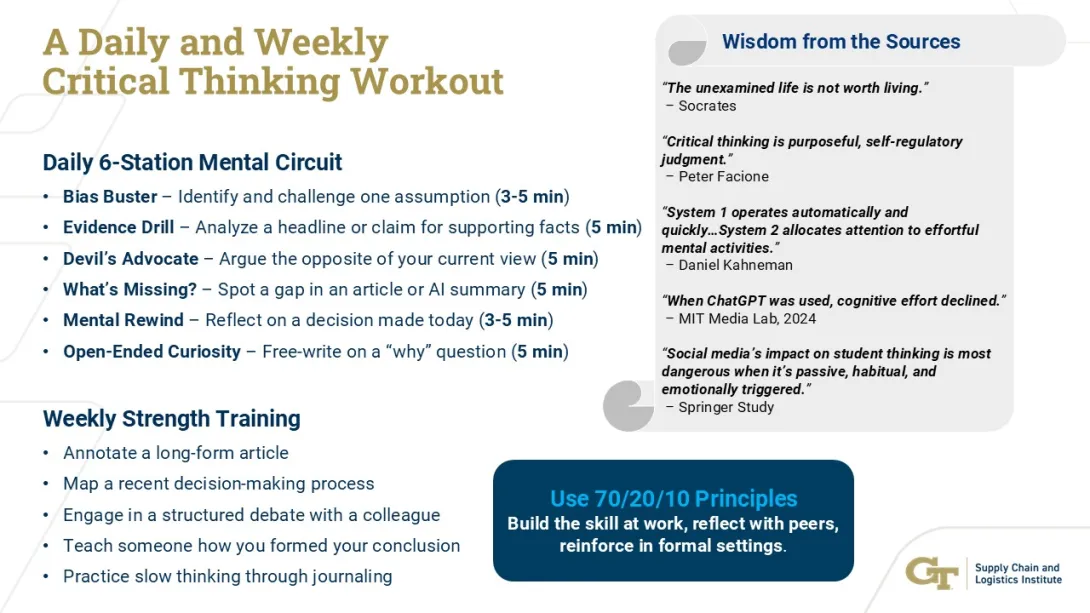
Facione, in his Delphi Report, defines it as "purposeful, self-regulatory judgment."
Kahneman reminds us that our brains are wired for shortcuts—“System 1” thinking is fast and efficient but often error-prone. True critical thinking requires “System 2” effort: slow, reflective, and disciplined.
Are We Losing It?
There’s growing evidence we are.
Social media echo chambers reduce exposure to opposing views. Short-form content conditions us to expect fast answers. And according to the MIT Media Lab (Kosmyna et al., 2024), students using ChatGPT retained less, showed reduced cognitive effort, and had lower originality.
“When ChatGPT was used, cognitive effort declined.”
And yet—this is not a moment for despair. It’s a call to discipline. Because critical thinking, practiced intentionally, can become a personal and professional superpower.
Applying Critical Thinking in Supply Chain Decisions
Supply chain professionals face complexity daily—inventory tradeoffs, supplier uncertainty, resource constraints, policy risk. Many of these decisions can’t be answered by tools alone—they require judgment. Critical thinking lives in that judgment.
Whether you're building a forecast, evaluating a supplier, responding to a disruption, or modeling risk exposure, structured thinking provides a path. The steps are familiar:
- Define the problem clearly
- Clarify what information is available—and what’s missing
- Analyze root causes or future implications
- Generate multiple options
- Establish decision criteria
- Choose a path—and test it before launch
- Monitor and adjust as feedback arrives
This process resembles A3 thinking or supply chain analytics. But what makes it powerful is doing it intentionally—even under pressure.
The best professionals I’ve worked with practice it on small decisions as well as large ones. They don’t confuse speed with clarity.
Practicing Critical Thinking When Using Generative AI
AI tools are powerful—but without deliberate use, they can dull our thinking. Here's how to make AI work with your brain—not instead of it:
- Document your assumptions before prompting
- Journal your intent: What are you trying to decide or explore?
- Ask AI to provide counterarguments or alternative views as well as sources for you to research and draw your own conclusions
- Look for what’s missing or oversimplified
- Summarize AI output in your own words
- Track and reflect on how AI influenced your decisions
Treat AI like a research assistant—not a strategist. Use it to extend your reach, not replace your reasoning.
Final Thought and Your Next Steps
Critical thinking is no longer optional. Not in business. Not in education. Not in leadership.
It is a skill. A discipline. And a mindset that pays dividends over a lifetime.
If you’ve read this far, take this challenge seriously:
- Write out how you form your opinions—on paper.
- Practice structured thinking on small problems weekly.
- Use AI with intention—never outsource your judgment.
- Teach someone else how you reached a conclusion.
- Be humble. Ask yourself: what if I’m wrong?
- Keep a thinking journal for 30 days.
The goal isn’t to be right all the time. It’s to be reflective, rigorous, open to challenge, and consistent over time. That’s what the world needs more of. That’s the edge AI can’t replicate.
So think before you automate.
And never stop questioning.