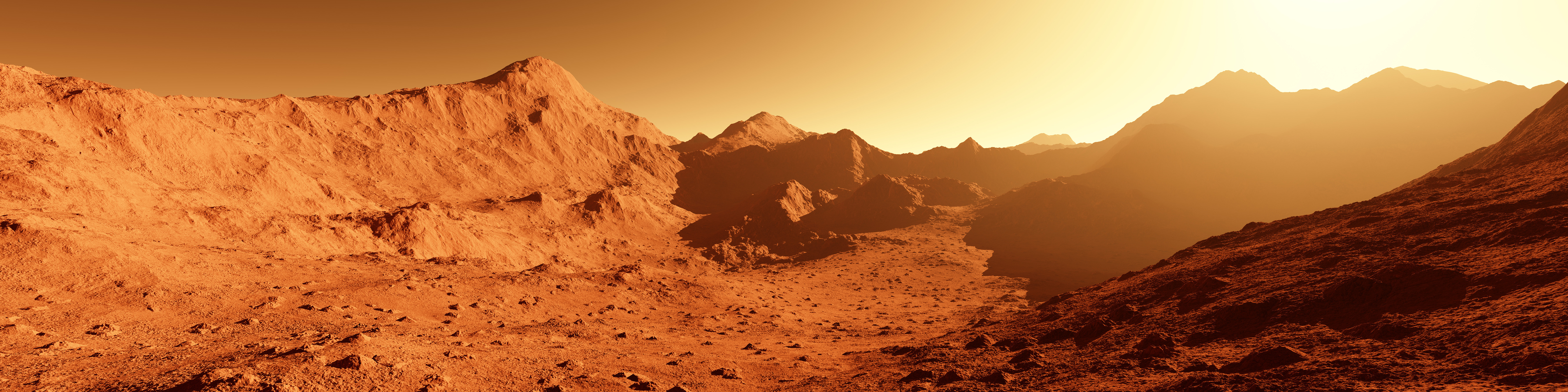
Six students have simulated a Mars mission, while dozens more operated a mission control center in Atlanta.
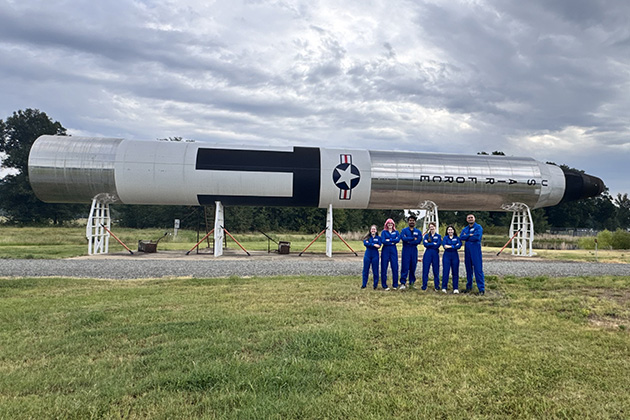
The SEA astronaut team gathered before the mission.
Earlier this month, six students went to Mars.
For 10 days, they conducted experiments, managed limited resources, and lived in isolation while learning what it’s like to be an astronaut.
They were at Titan Ranch in Arkansas, participating in the inaugural mission of Georgia Tech’s Southeast Analog (SEA), a completely student-led analog astronaut program.
Analog missions simulate long-duration spaceflight, helping researchers better understand how humans can live and work in extreme environments such as Mars and the moon. During the mission, students experienced many of the same challenges future astronauts may face, including communication delays, isolation, and teamwork under pressure.
But the six analog astronauts weren’t the only students involved. More than 30 Georgia Tech students staffed a full mission-control center on campus, where they monitored astronauts, tracked experiments, and practiced real-world flight operations procedures. To mimic the distance between Earth and Mars, communications between the astronauts and mission control were delayed by 20 minutes each way.
For the students involved, the mission offered a rare opportunity to gain hands-on experience in human spaceflight — without the financial and geographic barriers often associated with international analog astronaut programs.
By helping to develop SEA Flight Operations, we are hoping to provide students with the opportunity to develop skills in spaceflight operations. This exposure is often limited to highly selective research and internship opportunities."
– Alan Yeung
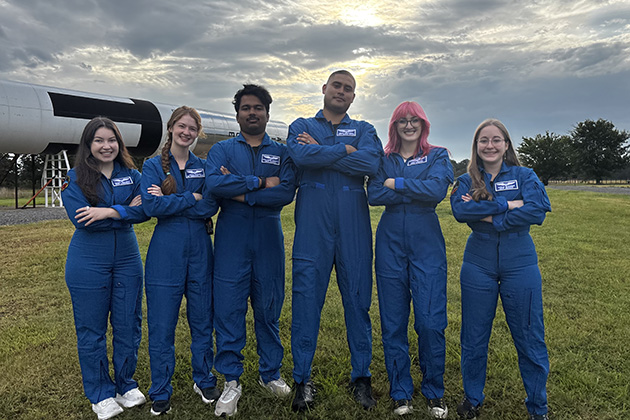
The astronaut team (from left to right): Amanda Galloway, Sophia Karako, Umesh Ponugupati, Emilio Larrazabal, Hailey Nelson, and Ariella Blackman.
Creating an Accessible Path to Space
The idea for SEA began with aerospace engineering Ph.D. student Vic Paulson, who previously participated in an analog astronaut program in Switzerland. After returning home, Paulson wanted to create a similar opportunity for U.S. students.
“I got to be in the position where I was both scientist and test subject simultaneously, even if I never went to space,” she said. “Georgia Tech is a premier institution for spaceflight, but it’s such a shame students are having to fly to different countries and spend thousands of dollars to get this opportunity.”
The project took shape after Paulson enrolled in Daniel Guggenheim School of Aerospace Engineering (AE) Associate Professor Christopher Carr’s bioastronautics course in 2024. In the class, Paulson met Sara Kapasi and Alan Yeung. The trio would become SEA’s executive team, with Kapasi leading research, Yeung heading mission control, and Paulson captaining the entire organization.
Together, they started SEA in 2025. With support from Carr, the team secured funding from the Space Research Institute (SRI), helping turn the concept into a full-scale mission. The project is also partially funded by the Georgia Tech Research Institute, Student Government Association, the Georgia Tech Student Foundation, Philadelphia Telangana Association, Epsilon3, and numerous individual donors.
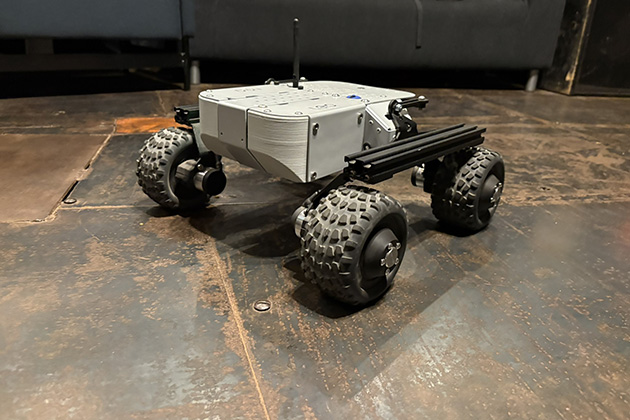
Umesh Ponugupati programmed this rover for a field test of coordinated sensing between rovers.
Conducting Research Beyond Earth
Beyond astronaut training, SEA serves as a platform for research designed to support future space exploration.
Kapasi, a first-year biomedical engineering Ph.D. student, found research projects that could continue for future analog missions. One experiment involved collaborating with a Bolivian university to remotely operate a rover on the country’s salt flats.
“Even if these research projects don’t work in Arkansas, as long as the astronauts have a good experience working on them and the principal investigators have a rewarding experience working with us, then the research is successful,” Kapasi said. “We can renew that relationship for future analog missions.”
The mission also provided students with experience in the growing field of spaceflight operations.
“By helping to develop SEA Flight Operations, we are hoping to provide students with the opportunity to develop skills in spaceflight operations,” said Yeung, a recent AE master’s graduate. “This exposure is often limited to highly selective research and internship opportunities.”
The 10-day mission was long but an incredible learning opportunity. Overall, the mission was a huge success, and I can’t wait to continue helping out SEA in the upcoming year for the following year’s mission."
– Umesh Ponugupati
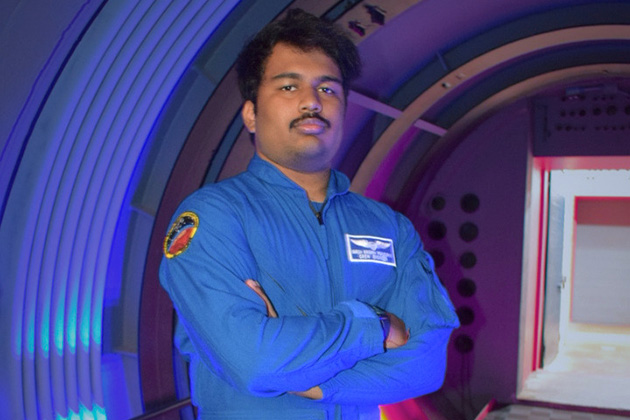
Umesh Ponugupati
Preparing for Future Careers
For student astronaut Umesh Ponugupati, a fourth-year aerospace student, SEA offered a chance to explore a long-held career goal.
“The 10-day mission was long but an incredible learning opportunity,” Ponugupati said. “Overall, the mission was a huge success, and I can’t wait to continue helping out SEA in the upcoming year for the following year’s mission.”
Students say the mission’s value extends beyond the possibility of one day reaching space.
“SEA has given me not only experiences that I never could have imagined, but also a wide support system of some of the most incredible science, engineering, and medical students in the country,” said Sophia Karako, a second-year AE student. “The impact Southeast Analog and this crew have had on my life in just six months has been extraordinary.”

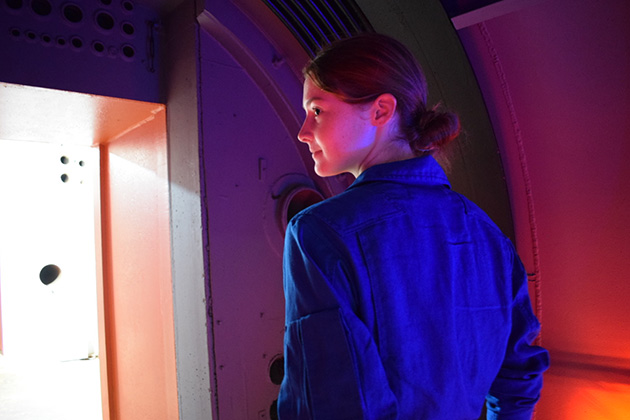
Sophia Karako
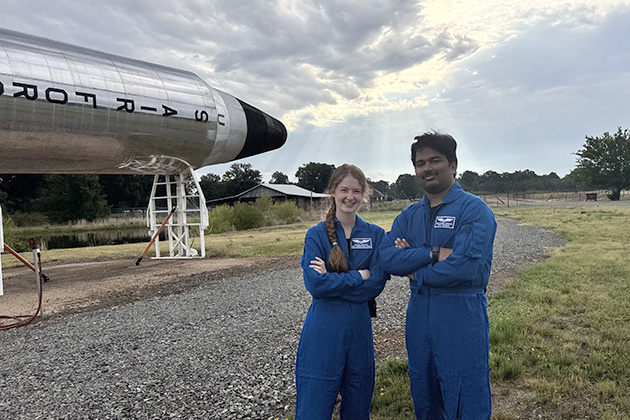
Karako and Ponugupati
Writer and Media Contact: Tess Malone | tess.malone@gatech.edu
Photos: Leslie Nava and Jacob Gillet
Copyediting: Stacy Braukman

Space Research Institute
The Space Research Institute (SRI) at Georgia Tech is an interdisciplinary hub for research, education, and collaboration in space science and technology. SRI brings together expertise across engineering, science, policy, and the humanities to advance work in areas such as astrophysics, aerospace systems, astrobiology, and space policy while building partnerships with academia, industry, and government.
Georgia Tech Research Institute
The Georgia Tech Research Institute (GTRI) is the nonprofit, applied research division of the Georgia Institute of Technology (Georgia Tech). Founded in 1934 as the Engineering Experiment Station, GTRI has grown to more than 3,000 employees, supporting eight laboratories in over 20 locations around the country and performing more than $1 billion of problem-solving research annually for government and industry. GTRI's renowned researchers combine science, engineering, economics, policy, and technical expertise to solve complex problems for the U.S. federal government, state, and industry.