Building a robot that can pick blueberries without damaging the fruit is a technical challenge. Turning that robot into something growers can afford and use in the field presents a different set of questions.
Georgia Tech researchers are addressing both through Fructus Robotics, a startup developing an autonomous blueberry-harvesting system. The team has tested the technology on farms in South Georgia, formed a company around its research, and secured funding to continue moving the system toward the agricultural market.
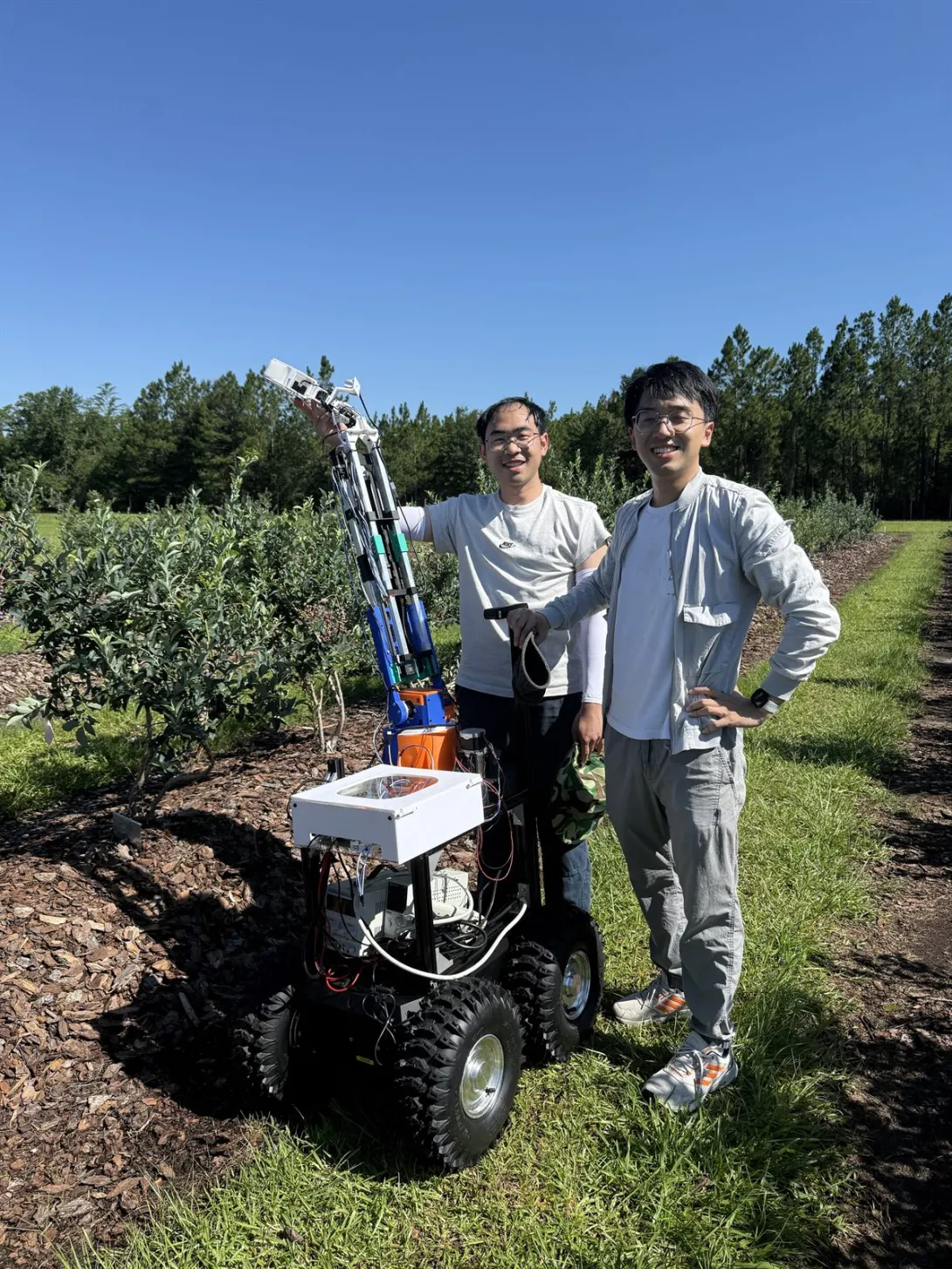
Led by Yue Chen, an associate professor in the Wallace H. Coulter Department of Biomedical Engineering, the Fructus team includes doctoral students Yixuan Xia, Yilin Cai, and Samuel Wilcox. Xia leads the team’s commercialization work, while Cai leads its technical development. They formed Fructus after conversations with growers revealed a need for new harvesting options.
Blueberries do not ripen all at once, requiring workers to return to the same bushes throughout the season and pick mature berries while leaving the rest to ripen. One commercial grower said that even with approximately 100 people working seven days a week, the farm still faces a labor shortage.
Mechanical harvesters offer another option, using vibration to selectively detach ripe berries. But the machines lack the precision to avoid bruising fruit, prematurely dislodging unripe berries, or damaging the bushes. This matters for fresh-market blueberries, where fruit quality is especially important.
Fructus is developing a system that combines the care of hand-picking with the efficiency of automation.
A Gentler Way to Harvest
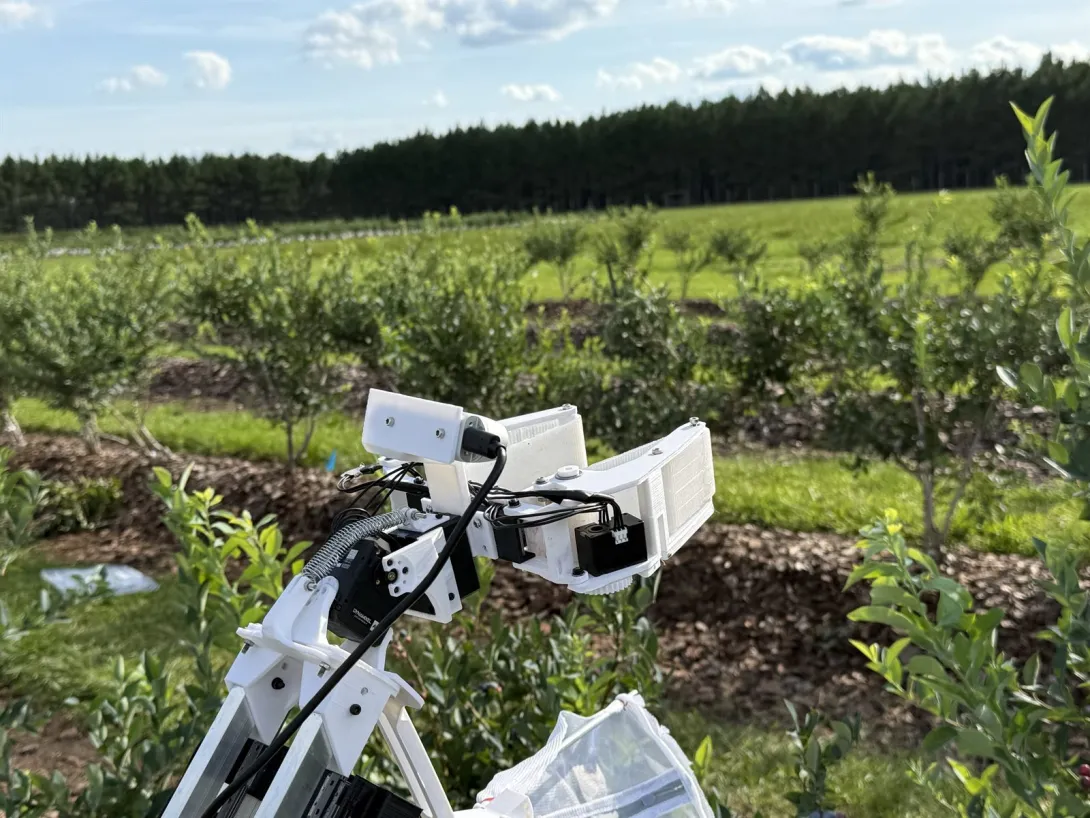
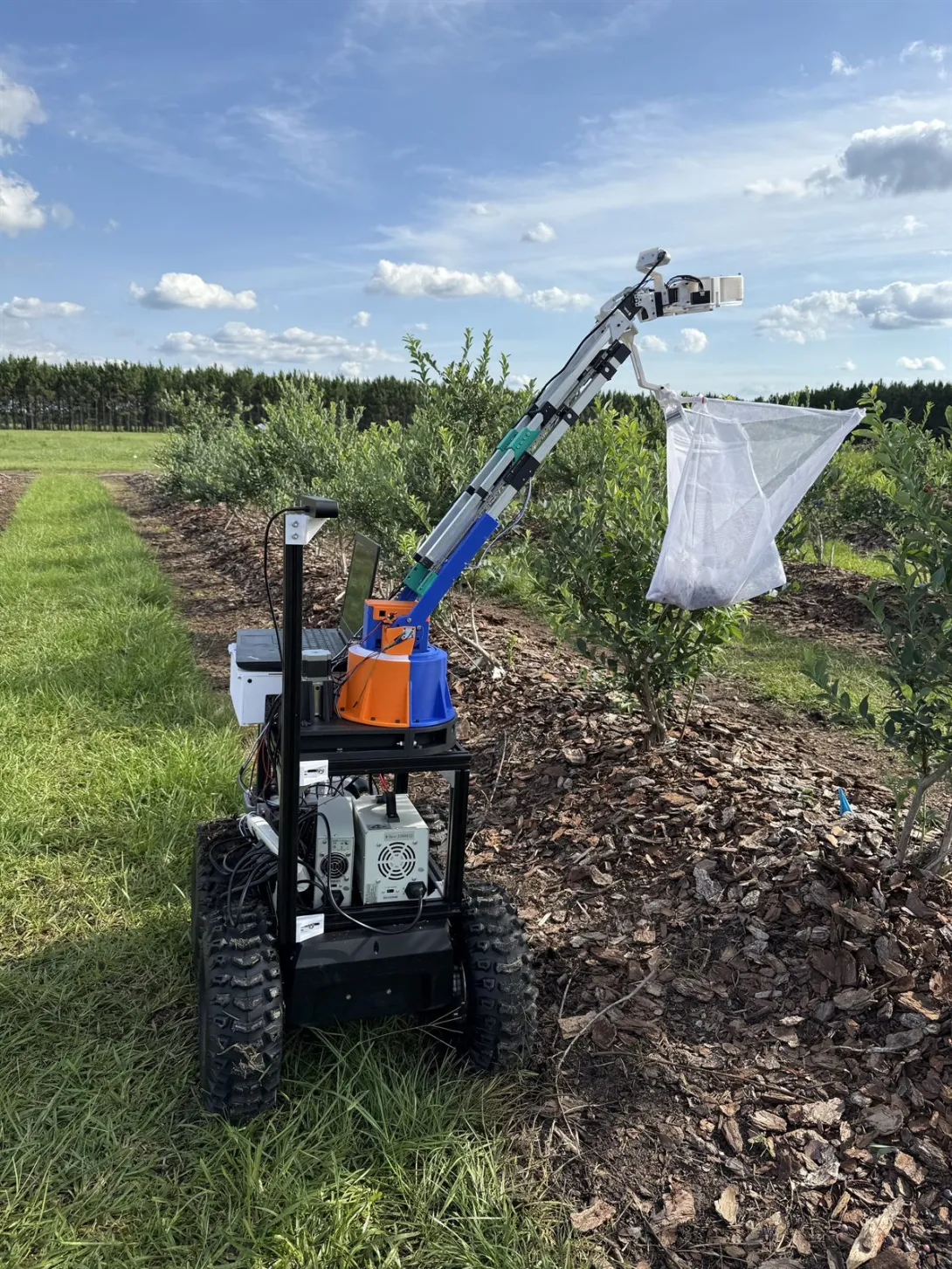
The team calls the system CLASP, short for Cluster-Level Autonomous Selective Picking. A camera first scans the bush and selects a blueberry cluster. The robotic arm then moves toward the fruit, where a second camera provides a closer view and helps align the gripper with the cluster.
Instead of grabbing or pulling each blueberry individually, the gripper opens around several berries at once. Two soft silicone bands gently roll against the fruit, using a motion similar to the way a person might use a thumb to remove ripe berries from a stem. The robot controls the amount of force it applies so that ripe berries detach while unripe berries remain on the plant.
That selectivity matters for fresh-market blueberries. Handpicking allows workers to choose ripe fruit without disturbing the rest of the cluster, but it requires significant labor. Traditional mechanical harvesters can move faster, but they may remove fruit before it is ready or leave it too damaged for the fresh market.
In recent field trials, CLASP autonomously grasped 23 of 25 blueberry clusters, a 92% success rate. The results provide early evidence that the system can perform outside of the lab. “Our goal is to validate it with growers in real-world farming environments,” said Chen.
Finding the Right Market
The technology did not begin with blueberries. It grew from a U.S. Department of Agriculture-funded research project using soft robotics to harvest blackberries, and was also supported by an Institute for Robotics and Intelligent Machines (IRIM) seed grant from Georgia Tech.
The researchers developed a robotic arm and soft gripper that could handle delicate fruit, but proving that the technology worked was only one step. They also needed to understand where it could make the greatest difference, what customers expected from it, and whether it could support a viable company.
Conversations with agricultural researchers at the University of Georgia, commercial growers, and other industry stakeholders pointed the team toward a larger opportunity in blueberries.
“Current mechanical harvesters still face challenges with fruit loss and bruising, and harvesting efficiency is critical for growers,” said Albert Wildes, a blueberry grower in South Georgia. “A new robotic harvesting system needs to do more than protect the fruit. It must also harvest efficiently.” During early testing at a commercial farm, the owner expressed interest in autonomous harvesting if the researchers could develop a system that performed reliably under real farming conditions.
Building for the Customer
To help close that gap, the team participated in Startup Launch through Quadrant-i. A unit within Georgia Tech’s Office of Commercialization, Quadrant-i supports faculty, researchers, and graduate students working to build startups around research-based technologies.
Through Startup Launch, the Fructus team received business coaching, conducted customer discovery, and began evaluating its technology as a potential product. That process required the researchers to leave the lab and listen to the growers who might eventually use the system.
In the lab, the team measured progress through technical benchmarks such as harvesting success, visual perception, and control accuracy. Growers introduced another measurement that would be critical to commercial adoption: harvesting cost per pound.
“As researchers, we usually focus on solving a research problem,” Cai said. “Through Startup Launch, we learned to see the problem from the customer’s perspective and think about what it really takes to build a product.”
Xia said those conversations also revealed needs beyond harvesting. Growers were interested in systems that could map fields, monitor when fruit was ready to be picked, and inspect berries for firmness or surface damage before packing.
“Turning research into a startup requires founders to look beyond the technology and understand the customer and the market, and find a business model,” said Harold Solomon, a principal at Quadrant-i who led the research-focused teams through Startup Launch.
Moving Closer to Market
Fructus was one of 15 research-based teams recently selected to receive an additional $10,000 through Quadrant-i. The funding will support the team’s next stage of technical development, prototyping, customer discovery, and market validation.
The researchers are currently pursuing additional funding and preparing for the next blueberry season, which begins around May and June. Because blueberries have a limited harvesting window, the months between seasons give the team time to improve the system before returning to the field. They are also exploring whether the soft-gripper technology could be adapted for other fruit, including peaches.
The commercialization process changed the direction of the technology. What began as a blackberry-harvesting research project became a blueberry startup after the team identified a larger market, tested the system in South Georgia, and began building to meet the needs of growers.
News Contact
Lacey Cameron
lacey.cameron@gatech.edu