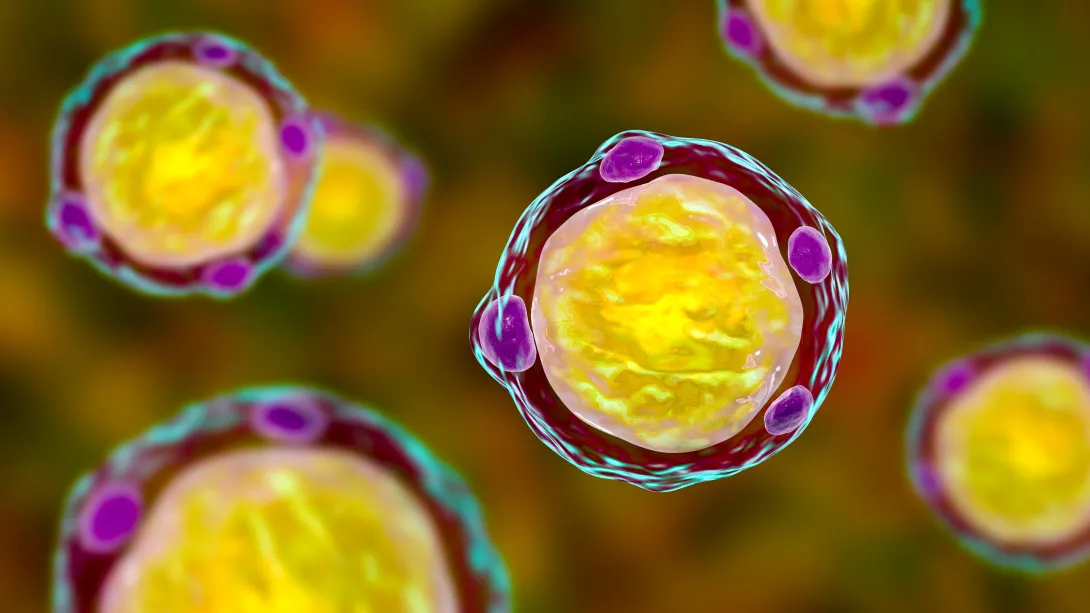
A illustration of Blastocystis. Lind hopes the project will provide answers about this protist while creating new tools to advance research more broadly. (Credit: Adobe Stock)

Abigail Lind
Trillions of microorganisms make their home in the human gastrointestinal tract, where they influence everything from digestion and vitamin synthesis to immune response. This microbial world is remarkably diverse — a complex ecosystem of bacteria, archaea, fungi, viruses, and single-celled organisms called protists. Yet research has largely focused on just one group: bacteria.
Now, new work from Georgia Tech School of Biological Sciences Assistant Professor Abigail Lind is looking beyond bacteria by investigating a common gut protist called Blastocystis.
In support of her research, Lind has received a prestigious Maximizing Investigators’ Research Award (MIRA) from the National Institutes of Health (NIH). The MIRA program provides investigators with five years of flexible funding, allowing them to pursue ambitious research in promising new directions.
Protists have long been understudied, Lind says, because until recently, these organisms were considered possible pathogens. “Recently, studies have found that they are actually correlated with many different positive health markers, like reduced inflammation and positive cardiovascular outcomes,” she explains. “But we still know very little about these organisms.”
“With this research, we want to lay a foundation to accelerate future work,” Lind adds. “We want to understand what these protists do, how they interact with microbial partners, and how that might ultimately impact their human hosts.”
Understanding the Microbiome Community
The protists are notoriously tricky to work with. They swell up and “pop” if they’re exposed to oxygen, and nobody is quite sure what they eat. “We’ve developed new techniques to work with them in the lab, which is why we’re able to do this research now,” Lind says.
While decades of work have gone into cultivating gut bacteria in the lab, cultivating Blastocystis is a different story. “Many of the techniques developed to cultivate bacteria kill this protist,” Lind says, “so we had to be creative.”
Postdoctoral scholar Fredrick Leon tested combinations of nutrients ranging from store-bought protein powders to boiled wheatgrass solutions, eventually settling on the formula they use today. But it still is unclear what exactly the organism is eating — and how.
“We know the strategies that bacteria use to break down and utilize food, but these protists don't have the same genes,” she says. “Do they eat something completely different? Do they eat the same things but with a different strategy? And how does that impact the microbial community and human host? These are the questions that we're answering.”
Building a Genetic Blueprint
Lind also aims to develop genetic tools for studying Blastocystis. Those tools could help researchers uncover which genes are responsible for specific functions, providing a clear map of what the protist does and how it does it.
By establishing new ways to grow, manipulate, and study Blastocystis, Lind hopes the project will provide answers about this organism while creating new tools to advance protist research more broadly.
“Our goal is to make Blastocystis a system that researchers can really begin to understand,” Lind says. “What we learn from this one organism could give us a foundation for studying many other protists and, ultimately, a more complete picture of the human gut microbiome.”
News Contact
Selena Langner
Writer / Editor
Georgia Tech College of Sciences