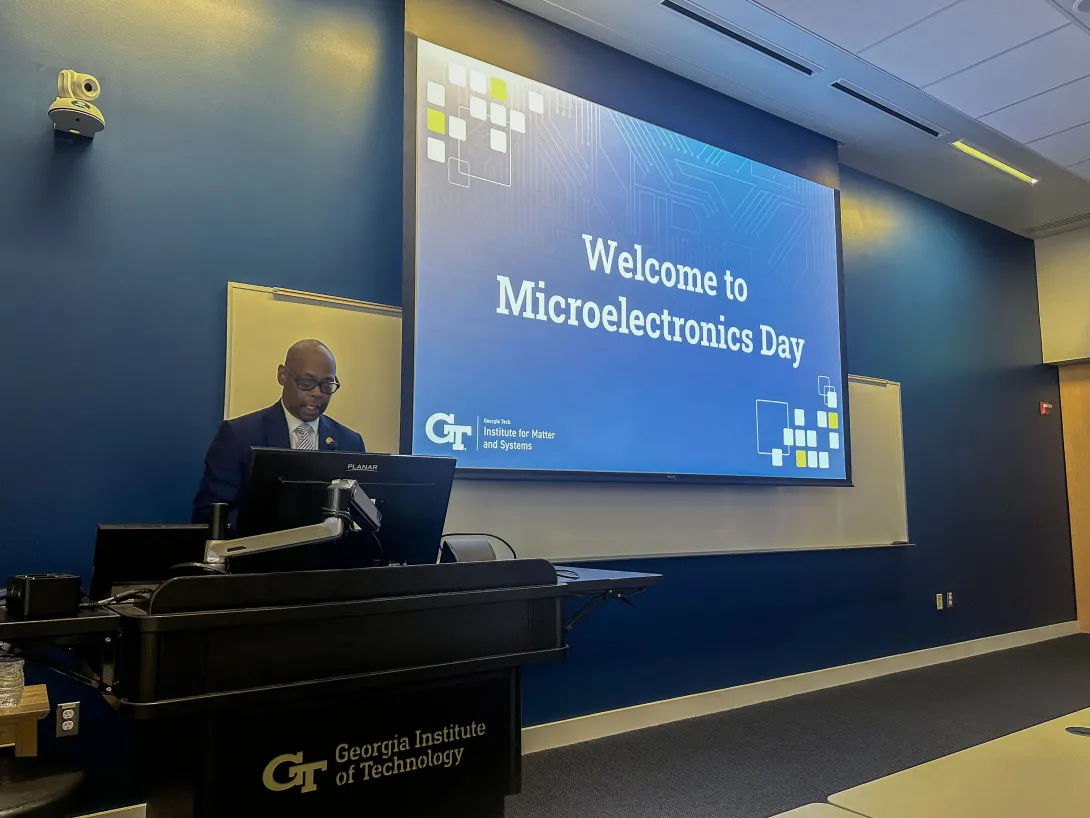
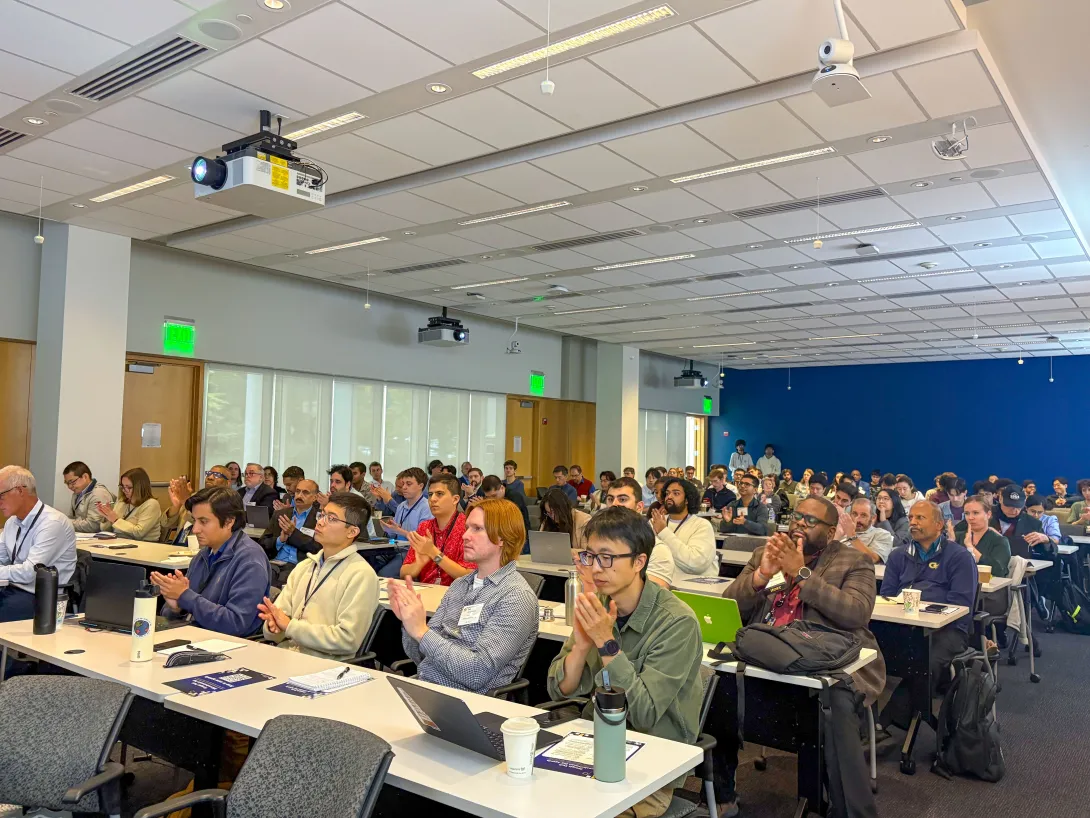
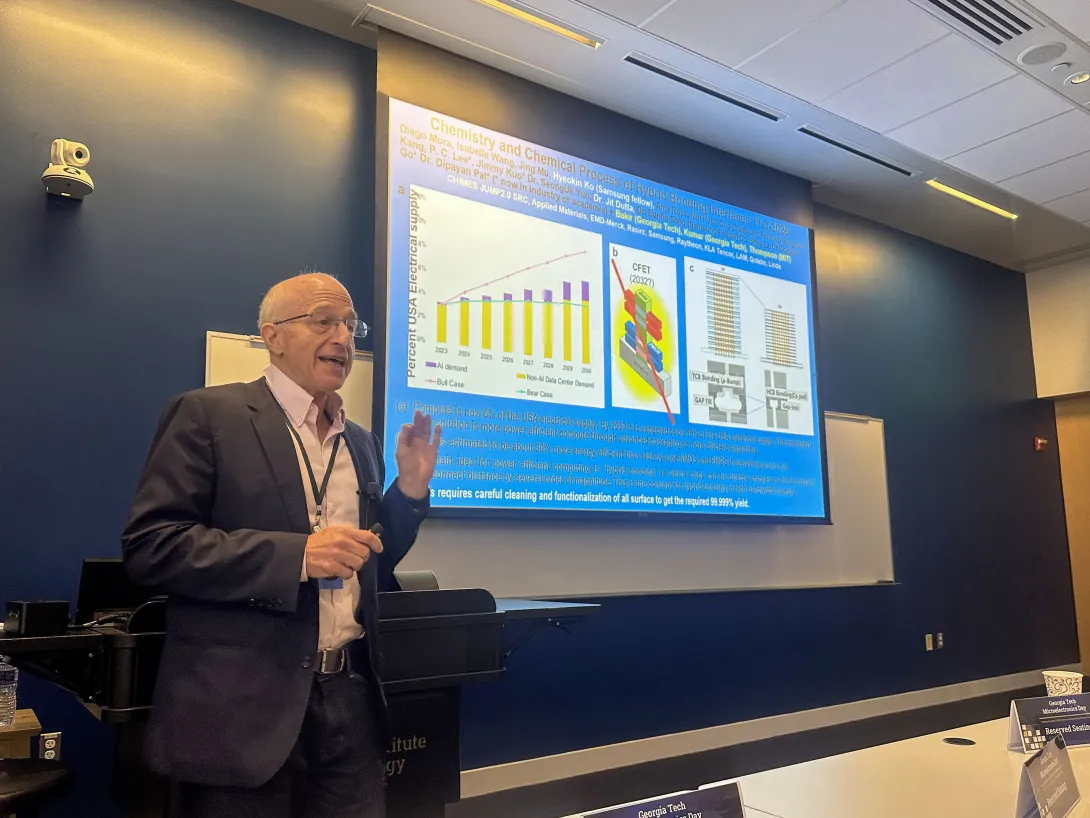
More than 200 people from academia, industry, and government gathered at Georgia Tech for the inaugural Microelectronics Day, exploring research that is pushing the boundaries of what is possible in semiconductors, computing, advanced packaging, wearable electronics, and other emerging technologies.
Held Nov. 2 and hosted by Georgia Tech’s Institute for Matter and Systems (IMS), the event brought together researchers working across the microelectronics field, from materials and fabrication to devices and integrated systems.
“The next major breakthrough in microelectronics may begin with research in a laboratory, but often it begins with an initial conversation,” said George White, Georgia Tech senior director for strategic partnerships. “This is what today is all about, bringing together people, bringing together ideas, capabilities and partnerships that will shape the future of microelectronics.”
Georgia Tech’s microelectronics research spans the full innovation chain, including materials and fabrication, devices, advanced packaging, integrated circuits and systems, with applications in computing, health, energy and quantum technologies.
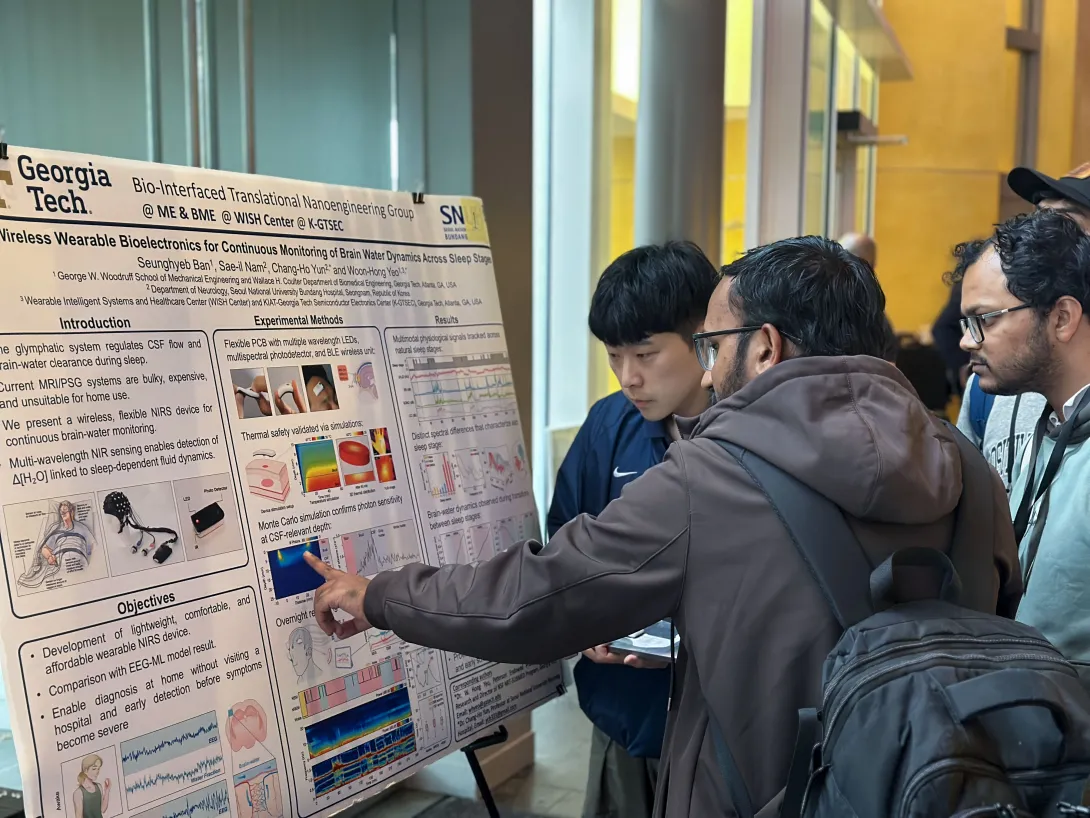
The day’s presentations reflected the breadth of microelectronics research, including next-generation memory, advanced packaging, quantum computing, microscopic robotics, wearable bioelectronics, thermal management, and energy-efficient sensing. Researchers shared work ranging from autonomous robots smaller than a millimeter and wearable systems designed to bring health monitoring into the home to new approaches for managing heat, engineering materials, and improving the performance of future electronic devices.
Eric Vogel, executive director of IMS, provided a broader look at the infrastructure supporting this work. IMS operates more than 300 shared research instruments with full-time staff across facilities supporting micro- and nanofabrication, materials characterization, and other research capabilities.
“IMS is really Georgia Tech’s interdisciplinary microelectronics engine,” Vogel said. “We provide world-class infrastructure, have a broad, integrated research portfolio bringing faculty together from across Georgia Tech, and help with talent, access and partnerships.”
The program also included the Oliver Brand Memorial Lectureship, which honors Oliver Brand, former executive director of the Institute for Electronics and Nanotechnology, a predecessor to IMS. The lectureship recognizes Brand’s contributions to research and education and his role in building interdisciplinary collaborations at Georgia Tech.
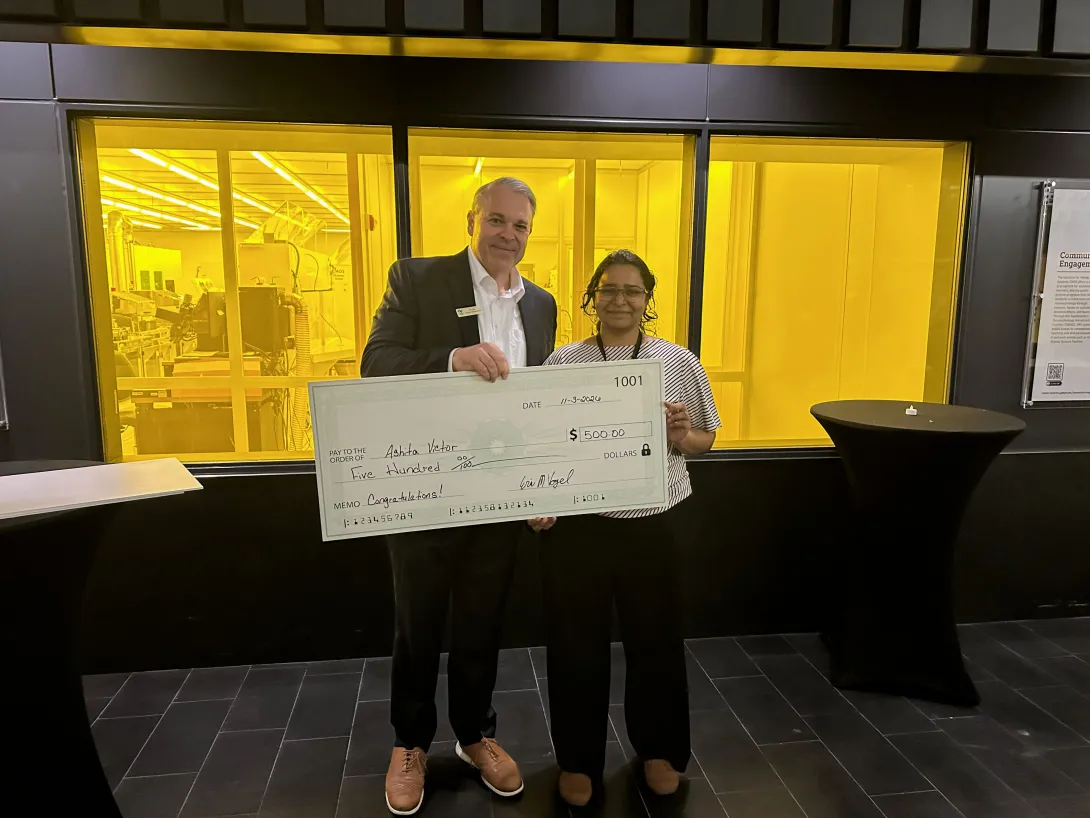
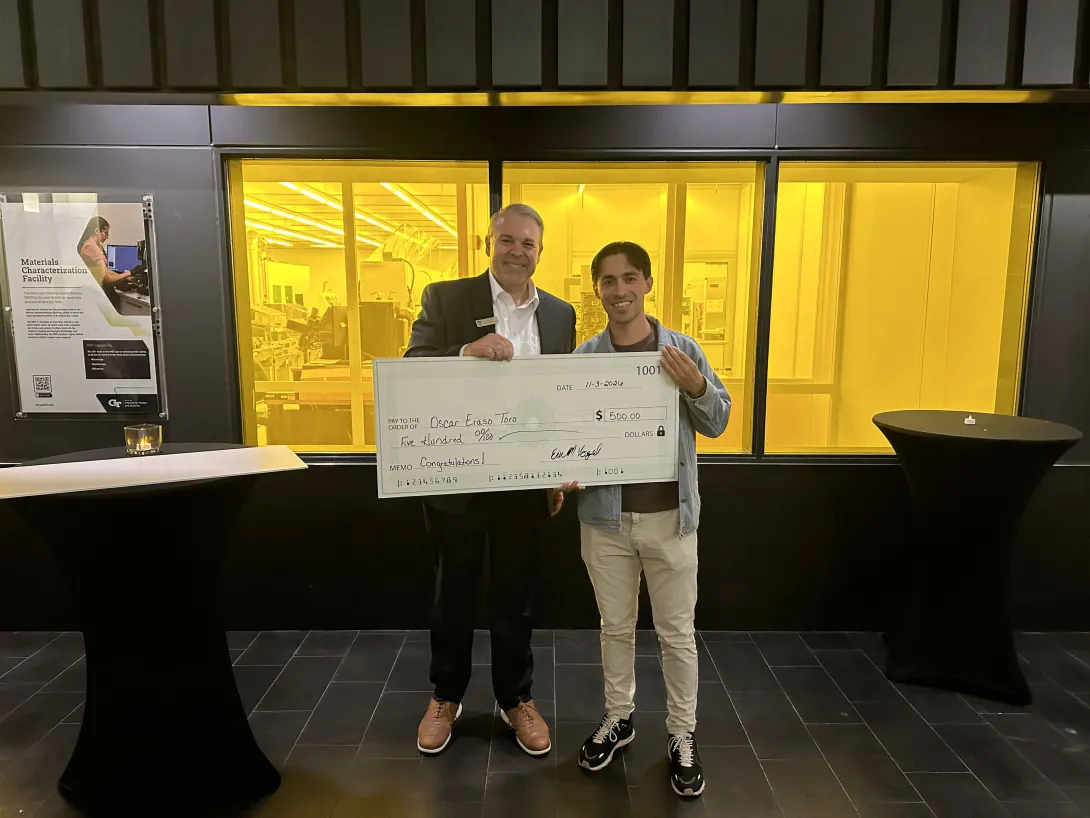
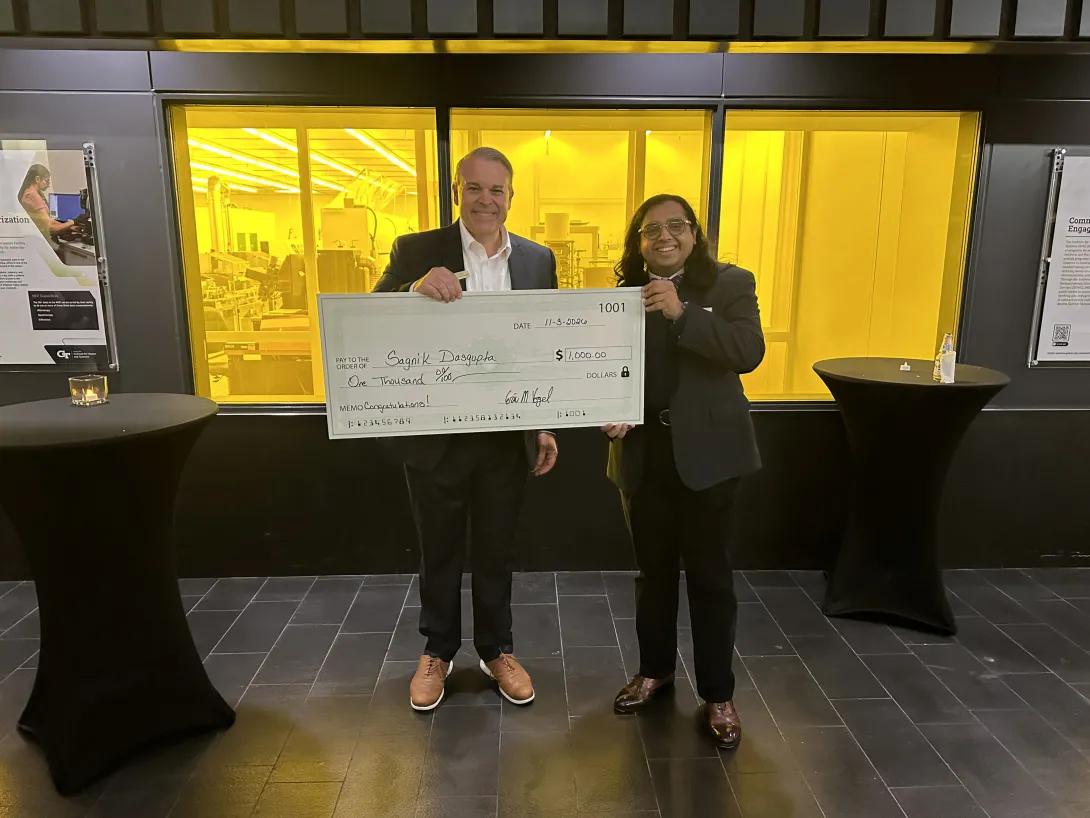
Microelectronics Day concluded with a student poster session featuring more than 20 research presentations and recognizing three students for excellence:
First place: Sagnik Dasgupta — “Microscopic Insights into the Formation of Copper Contact on n-TOPCon Solar Cells”
Finalist: Ashita Victor — “Chiplet Reconstitution Technology for High-density Heterogeneous Integration”
Finalist: Oscar Eraso Toro — “Infrared Photodetection Using Narrow Bandgap Conjugated Polymers”
News Contact
Amelia Neumeister | Communications Manager
The Institute for Matter and Systems