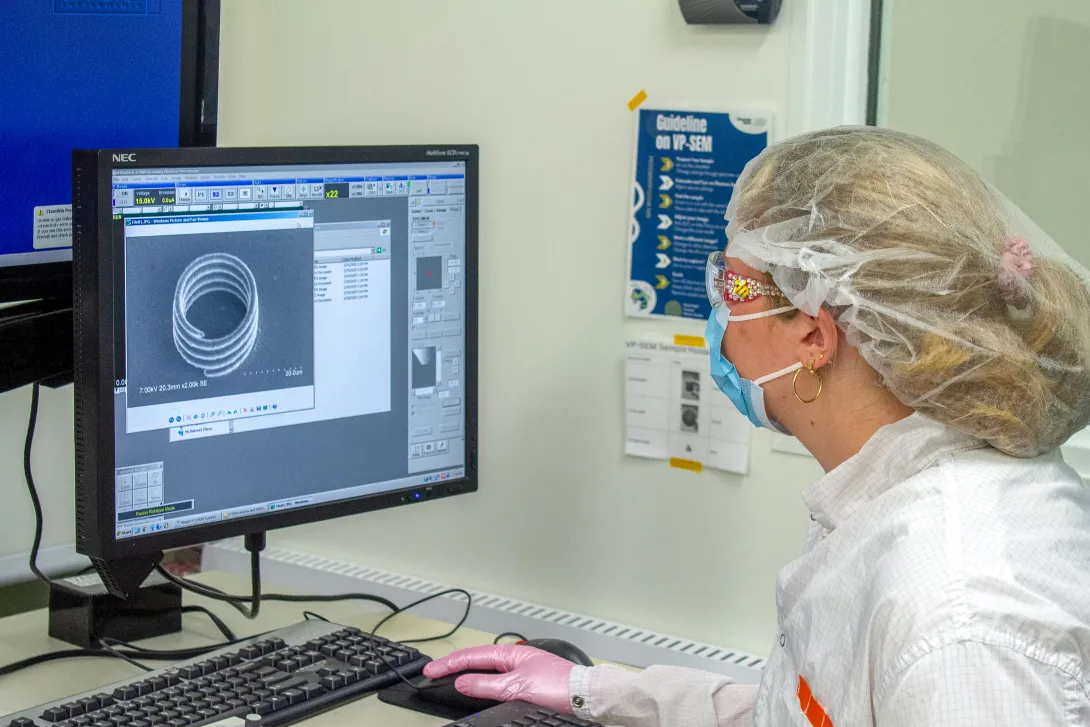
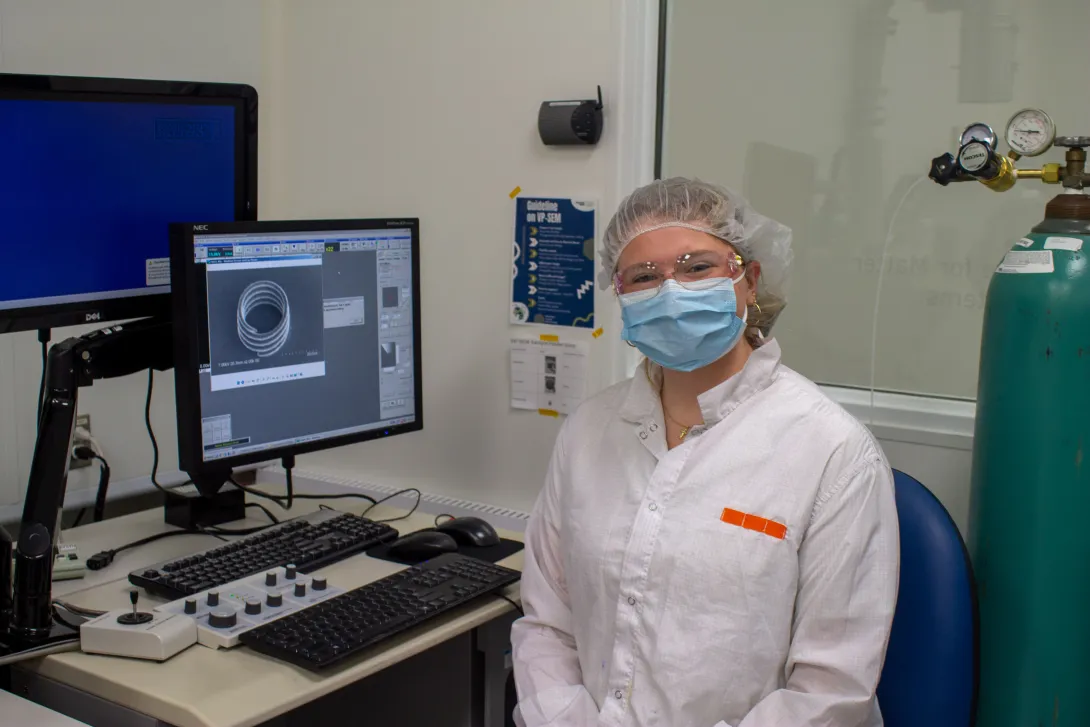
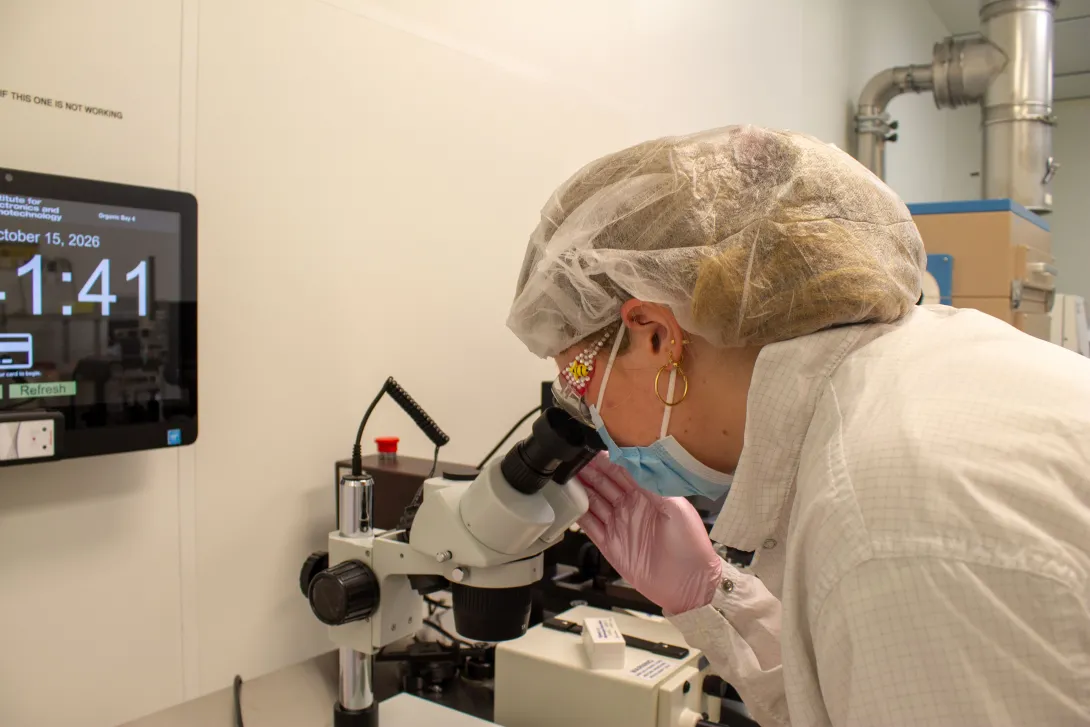
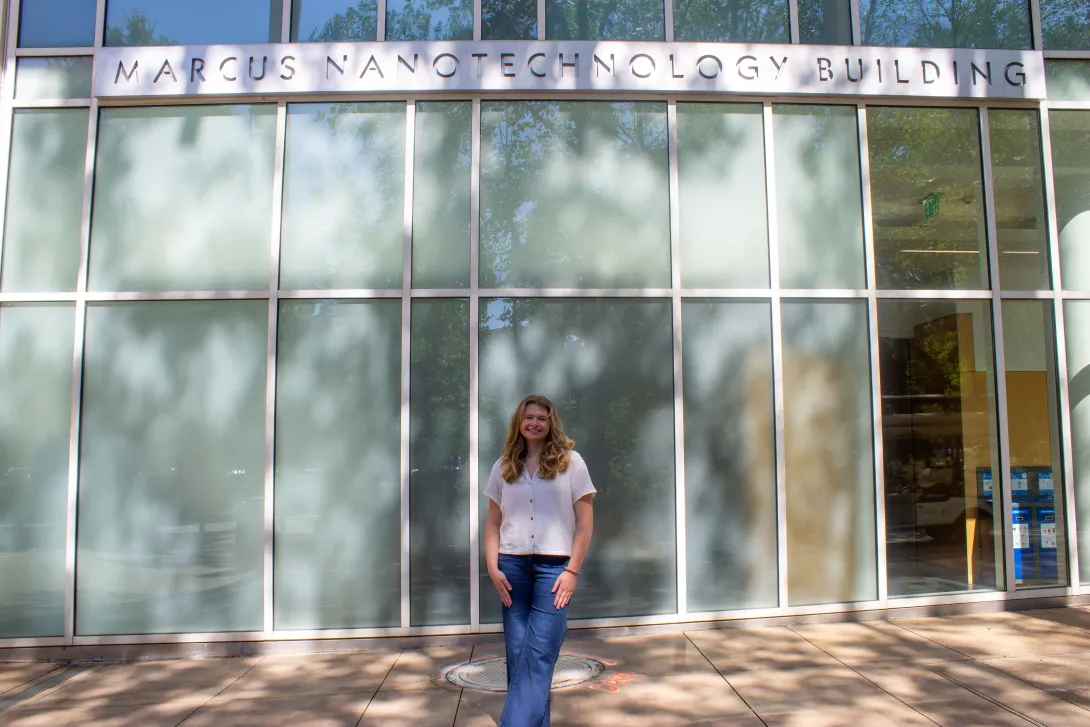
Many high school students spend summer break relaxing by the pool or reading a book. But in 2022, when Erin Taylor was a high school junior, she spent her summer in the Marcus Nanotechnology Building as an Institute for Matter and Systems (IMS) intern. Now, Taylor is wrapping up her undergraduate studies in electrical engineering while documenting her cleanroom experiences online.
Before developing an interest in nanotechnology, Taylor lived in New Hampshire. When she attended a Georgia Tech summer camp in 2021, she had never heard of the cleanrooms in Marcus, and did not know what a cleanroom was. However, when she peered in through the windows of the inorganic cleanroom during a camp tour, Taylor wanted to learn more.
“I remember having a lot of questions, like, what is this yellow room? What's going on in there? What is a bunny suit?” Taylor said. “And then I had the opportunity to answer a lot of those questions as a high school intern.”
As an intern, Taylor trained on a variety of tools and eventually learned to train others on those tools.
“There was a need for improvement on the training, so I was tasked with making around 14 YouTube videos on how to use different tools in the biocleanroom, as well as start guides next to the tools,” Taylor said. “The experience was really rewarding because it forced me to go deeper into the tools and learn how to use them, but also answer the question, ‘If I learn how to use them, how can I effectively communicate to have other people use them as well?’”
Her experience as an intern ultimately led her to choose Georgia Tech’s electrical engineering program. As she transitioned from an intern to a student researcher and employee, Taylor wanted to educate others on the critical research she once knew little about. Since then, she has worked to increase access to STEM knowledge and opportunities by making lab-centered social media content, working with Georgia Tech summer camps, and leading tours of the Marcus Nanotechnology Building.
“I started my social media account a few years ago, and I just really wanted to expand the reach of STEM,” Taylor said. “I wanted to give a general audience transparency on what research is, what happens in a cleanroom, and more of an inside look on the devices that they interact with every day.”
Through her content, Taylor shares what it’s like to work in a cleanroom, who some of the most historical scientists are, and how cleanroom technologies impact the world around us. Although Taylor has stepped back from content creation to focus on her research, she continues to educate people from K-12 students to industry professionals on the processes, technologies, and applications of the cleanroom through short courses.
Now a fourth-year electrical engineering student, Taylor reflects on how her experiences at IMS have shaped her approach to research.
“In addition to being involved in outreach, IMS has helped me develop a research mindset. Through working on process development and tool optimization, I've learned how to overcome challenges in research and find creative solutions,” Taylor said. “Fostering a research mindset at IMS has directly contributed to my success in undergraduate research and in a research internship.”
As she prepares for graduation, Taylor is applying to doctoral programs across the country so she can continue her research in microelectronic devices. She hopes to pursue a career in research and development for the advancement of sensing technology and betterment of humanity, where one day, nobody will have to wonder, “What really happens in a cleanroom?”
News Contact
Writer: Gabriel Buggi | Communications Student Assistant
Photographer: Savannah Robinson | Communications Student Assistant
Media Contact: Amelia Neumeister | Communications Manager
The Institute for Matter and Systems