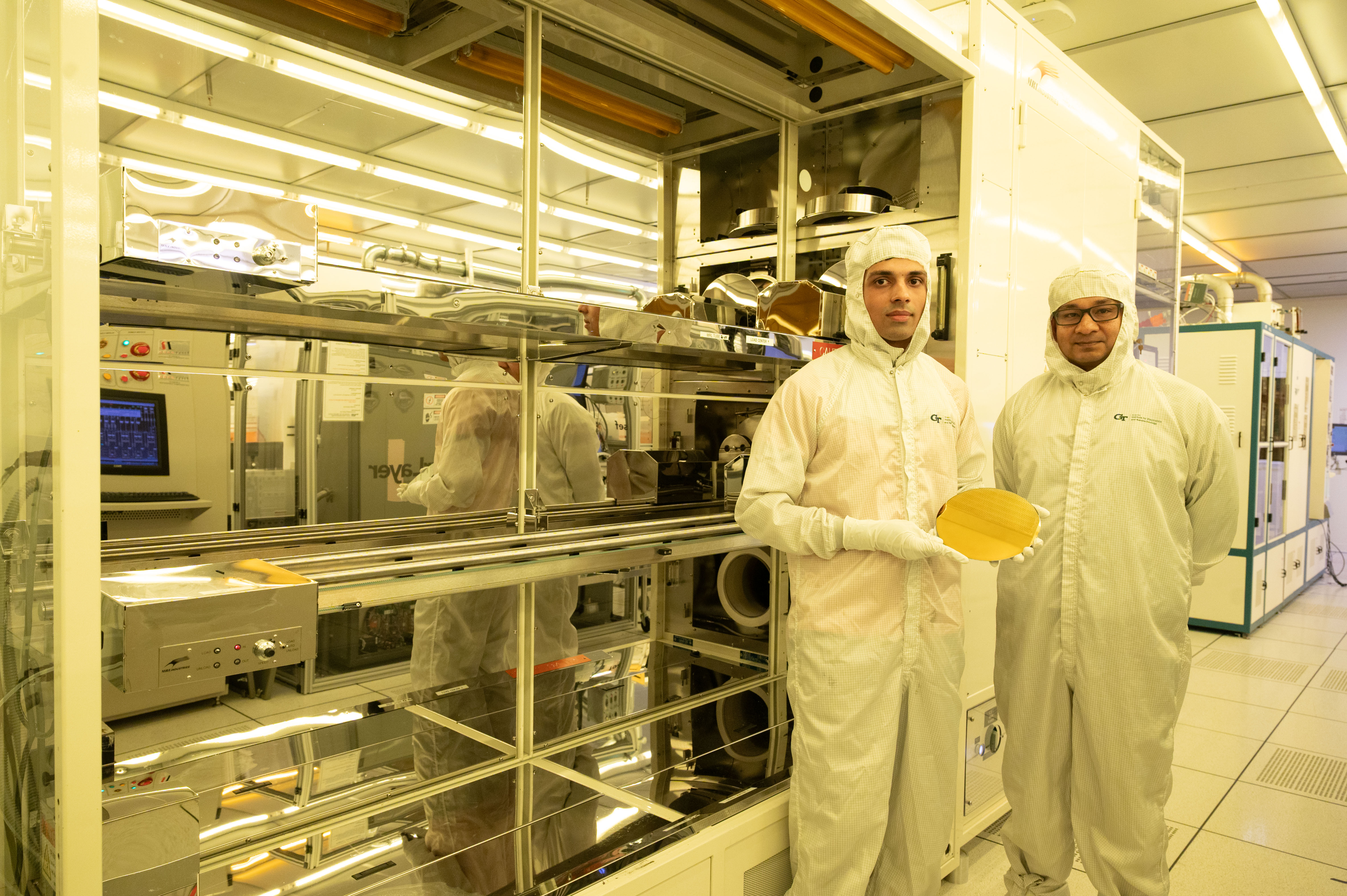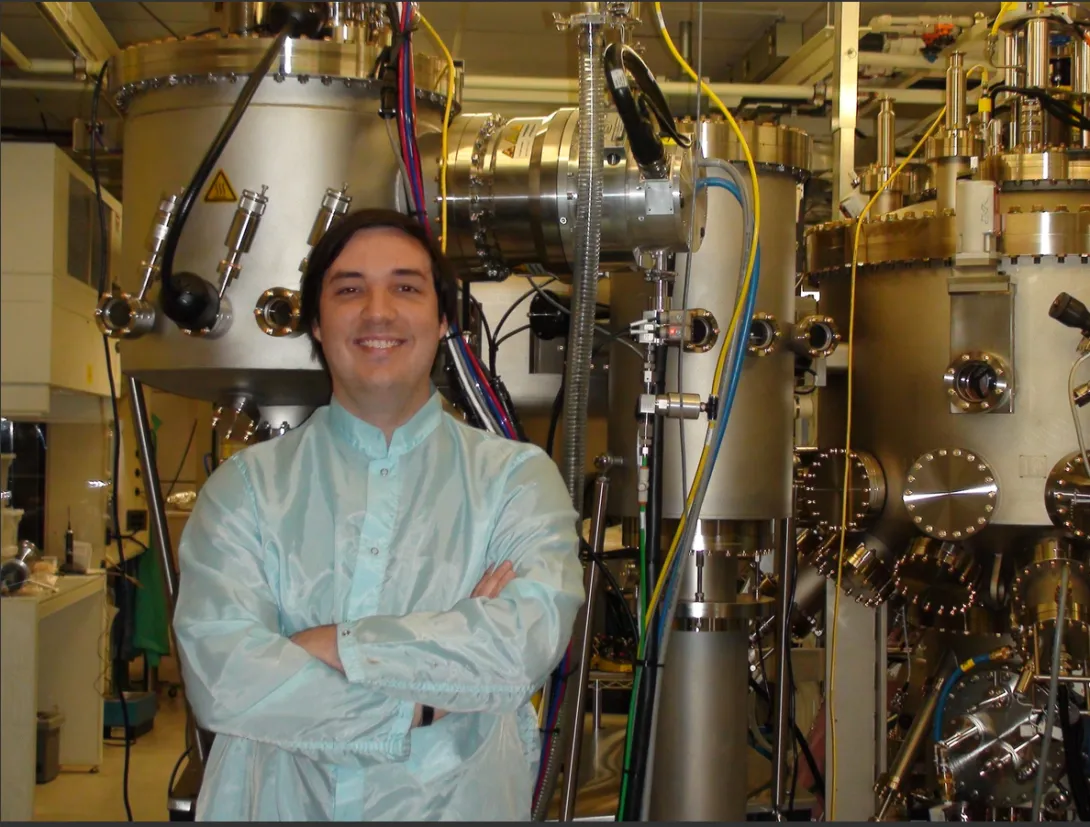
Carver stands in front of JPL’s brand new MBE device, 2009.
From implantable glucose monitors to smart thermostats, microelectronics are becoming more integrated into our everyday lives. The microelectronics Alexander Carver, B.S. E.E. 2001, M.S. E.E. 2004, Ph.D. E.E. 2009, develops at NASA’s Jet Propulsion Laboratory (JPL) are not yet part of our daily lives, but the technologies he works on could be the foundation of space exploration.
Shortly after Carver came to Georgia Tech in 1994, he began considering joining the co-op program at the Microelectronics Research Center (MiRC), now part of the Institute for Matter and Systems. Initially unsure if he could do the program, his considerations began to take shape when his residence hall advisor, a MiRC employee at the time, introduced him to Jerry Hill, then center’s associate director.
“I interviewed there and got the job,” Carver said. “It was kind of just an accident.”
What may have started as a simple interest soon evolved into a career path. From installing and repairing equipment, to developing the equipment control system now known as SUMS, Carver's experiences in the cleanroom helped him build skills that would become critical for his career. One of those experiences even helped lead him to graduate school.
“I lived on campus all through school, so I was usually on-call for after-hours emergencies,” Carver said. “Sometimes, a piece of equipment was not working correctly, and the users needed to complete a process to meet a deadline." One user happened to be Alan Doolittle, Joseph M. Pettit Professor. Carver remembers keeping a tool stable for Doolittle, since Doolittle's schedule meant lots of late-night work.
“The processes were long enough that we'd spend several hours in the lab talking about all sorts of topics. Those interactions eventually led him to offer me a spot in graduate school in his new research group.”
Throughout his time in the cleanroom, Carver was exposed to a wide variety of semiconductor processing equipment, but he had never worked with molecular beam epitaxy (MBE). Joining Doolittle’s research group changed that and helped shape the trajectory of his career.
“Joining Alan's group ended up giving me that last piece,” Carver said. “I had to rebuild an MBE machine as the starting job of my graduate career.
During the final year of his graduate studies, Carver had been constantly applying and interviewing for jobs while preparing to defend his Ph.D. thesis on MBE. Trudging through the middle of the Great Recession, very few companies made hard offers, not knowing whether they could afford to hire him. As graduation approached, nerves rose.
An interview with Intel at a Georgia Tech Career Fair, appeared to offer a path forward. As Carver moved through follow-up interviews with Intel, a previous meeting with representatives from JPL began to turn into something more.
“I distinctly remember one interviewer being Charles Norton who, upon learning of all the things I had done with MiRC and Doolittle's group, informed me that he knew of several people that would be interested in someone with my background,” Carver recalled. “I had several phone interviews shortly after the campus visit from several people at JPL.”
In January 2009, Intel was waiting for Carver to respond about a final interview while Carver was waiting for a call from JPL. With a leap of faith, Carver declined Intel’s final interview.
After a month of uncertainty, JPL invited Carver to an in-person interview and presentation at its Microdevices Laboratory (MDL).
After visiting Pasadena, California, Carver received an offer. On April 6, 2009, he defended his doctoral dissertation at Georgia Tech. Three days later, he began his new job at JPL’s Microdevices Laboratory.
Building on his experience in Doolittle’s lab, Carver was tasked with overseeing the installation and development of a new multi-million dollar MBE system. Because of the scale of the investment, the project drew the attention of JPL leadership, including then-director, Charles Elachi.
A few years after completing work on the MBE system, Carver got the opportunity to work on a new Mars mission. He joined a team of engineers and scientists designing and building instruments for a new rover.
“I was part of the team that made the engineering cameras, and I wrote some of the software to test them,” Carver said. “So I got to help put hardware on another planet, which is really cool.”
The Perseverance rover landed on Mars on Feb. 18, 2021. Carver’s work on its engineering cameras connected a career that began in a Georgia Tech cleanroom with an exploration mission millions of miles from Earth.
Today, Carver works on challenges ranging from new optical space instruments to the effects of space radiation on microelectronics. His path from Georgia Tech’s cleanroom to JPL illustrates how skills developed through hands-on research and experimentation can contribute to exploration far beyond campus.
News Contact
Writer: Gabriel Buggi | Communications Student Assistant
Media Contact: Amelia Neumeister | Communications Manager
The Institute for Matter and Systems