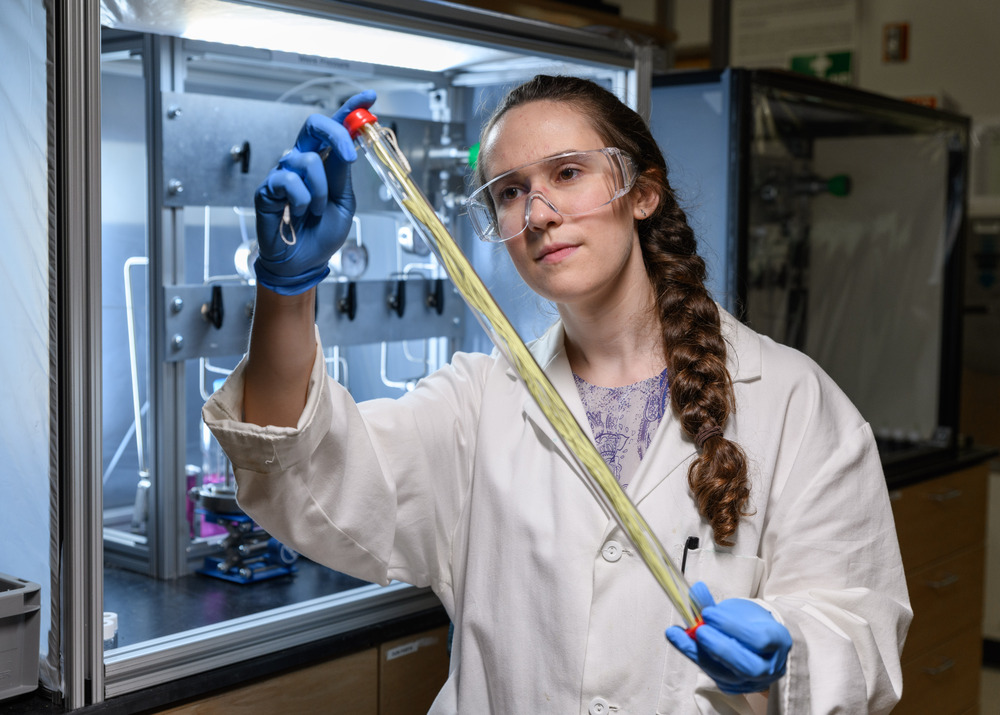
Refining crude oil into gasoline, jet fuel, and other everyday products requires enormous amounts of energy. The atmospheric and vacuum distillation processes used in refineries worldwide consume more than 1,100 terawatt-hours of energy annually — roughly enough to power 100 million U.S. homes for a year — while generating millions of tons of carbon dioxide emissions.
Five years after helping demonstrate that membranes could separate crude oil at the molecular level, Georgia Tech researcher Ryan Lively is part of an international team that has taken the concept a significant step further.
The team, including investigators at the Korea Advanced Institute of Science and Technology (KAIST), discovered that a membrane material widely believed to be non-selective for molecules as small as those found in crude can in fact selectively separate crude oil into lighter and heavier fractions in a way researchers did not expect.
Published in Nature, their findings suggest that using membranes to separate crude oil before distillation could significantly reduce the energy, water, and carbon footprint of petroleum refining.
Lively, the Thomas C. DeLoach Jr. Endowed Professor in Georgia Tech's School of Chemical and Biomolecular Engineering, served as an advisor and corresponding author on the study. Dong-Yeun Koh, an associate professor at KAIST and a former postdoc in the Lively Lab at Georgia Tech, led the study.
Building on Earlier Research
In the 2020 Science paper, Lively and collaborators demonstrated that specially designed membranes could separate crude oil into valuable fractions without relying solely on traditional heat-driven distillation. The work helped establish membrane-based crude oil fractionation as a promising alternative for reducing energy use in refining.
"This work grew directly out of the challenges we identified in our original findings in the 2020 article," Lively said. "One of the key challenges that the KAIST team set out to tackle was the very low oil productivities of the membrane units, which has limited the ability of this concept to leave the lab. Along the way, we not only increased the productivities, but we also uncovered a surprising new mechanism that could make membrane-based crude oil separations even more practical.”
The new study built on that foundation. The researchers investigated polyacrylonitrile (PAN) membranes, a material commonly used as a non-selective support layer in filtration systems. Because the material is porous, the team generally did not expect it to perform precise molecular separations on its own.
But what they found surprised them, Lively said. As crude oil flowed through the membrane, heavier hydrocarbon molecules accumulated within the membrane's pores. Instead of clogging the membrane, the buildup created a stable internal layer that gradually narrowed the pathways through which molecules could travel. Surprisingly, the molecules that caused the buildup in the first place were eventually excluded from entering the membrane, resulting in a steady production of higher quality oil through the narrow pathways that remained.
In effect, the membrane created its own molecular-scale filter. The result was a process that allowed lighter hydrocarbons to pass through while holding back heavier components.
The membrane enriched lighter fractions such as naphtha and kerosene while achieving crude oil flow rates more than 23 times higher those reported in the 2020 paper for whole crude oils
When Buildup Becomes an Asset
In most filtration systems, buildup inside a membrane (or fouling) is considered a problem because it reduces performance.
But according to the researchers, this study demonstrates that something different can happen under the right conditions.
Using a range of analytical techniques, the researchers found that long-chain hydrocarbon molecules accumulated inside the membrane and became an essential part of the separation process. The deposits effectively transformed larger pores into stable transport pathways measuring less than two nanometers across, they deduced based on available experimental evidence.
The membrane maintained consistent separation performance during four weeks of continuous operation, suggesting the filtration pathways remained stable over time.
“The findings challenge traditional assumptions about membrane fouling and may offer new opportunities for designing industrial separation systems that take advantage of similar behavior,” Lively said.
Potential Impact on Refining
Today's refineries heat entire streams of crude oil to separate them into useful products. By using membranes to remove a substantial portion of the lighter hydrocarbons before distillation, refineries could reduce the amount of material that must undergo energy-intensive heating. Alternatively, the refinery can use the membranes to incrementally increase refinery capacity, which is currently not possible using large-scale distillation equipment.
To evaluate the potential impacts of the membrane system, the researchers modeled a refinery process that incorporated a membrane separation step before conventional distillation.
“This study reveals a new scientific principle in which a membrane interacts with a complex mixture and spontaneously forms its own separation channels," Koh said. "Working with real crude oil supplied by HD Hyundai Oilbank allowed us to validate the technology under conditions relevant to industrial operation.”
The team's technoeconomic analysis showed that incorporating the membrane process could reduce distillation energy use by 30%, carbon dioxide emissions by 35%, and water consumption by 20%.
Applied across U.S. atmospheric crude distillation capacity — about 18 million barrels per day — those savings would be equivalent to powering roughly 2.2 million homes, removing about 3 million passenger vehicles from the road, and supplying enough water for approximately 660,000 people each year.
"Turning crude oil into useful products has relied on essentially the same basic approach for more than a century," Lively said. "Membranes offer a path toward achieving those separations with dramatically lower energy requirements and emissions."
The study's findings also suggest that the phenomenon may not be limited to a single membrane chemistry. Researchers observed similar behavior in a second membrane material, raising the possibility that the approach could be extended to other membrane systems.
"This is a terrific piece of research that rewards curiosity," said Andrew LIvington, vice president of research and innovation and professor at Queen Mary University of London, who was not involved with the study. "This work adds significantly to the field of membrane separations of crude oil streams as it tackles the first, hard to achieve separation of heavy hydrocarbons – most work to date has focused on lighter oils – and, it uses a simple and readily available membrane.
CITATION:
Jihoon Choi, Hyeokjun Seo, Minyong Lee, Woong-Chul Shin, Jaemin Choi, Keonwoo Choi, Min-Jun Jang, Sung Gap Im, Jae W. Lee, Ryan P. Lively, and Dong-Yeun Koh, "Crude oil fractionation by means of mesoporous polyacrylonitrile membranes," Nature, 2026.
News Contact
Brad Dixon, braddixon@gatech.edu