
Jun. 27, 2011

Mark Styczynski, anassistant professor in the School of Chemical and Biomolecular Engineering atGeorgia Tech, has received a 2011 Defense Advanced Research Projects AgencyYoung Faculty Award for his research on metabolites, the small moleculebuilding blocks necessary for all cellular functions.
DARPA presents the YoungFaculty Award to outstanding junior faculty whose research will enablerevolutionary advances in the areas of the physical sciences, engineering, andmathematics. The Young Faculty Award program will fund Styczynski’s researchthrough 2013.
Styczynski’s work involvesidentifying millions of allosteric metabolite and protein interactions bothefficiently and accurately.
“Metabolites are one of themost direct, real-time readouts of cellular state that researchers can assay,” Styczynskisaid. “But they also play a significant regulatory role, which is only beginning to be understood on a large scale.”
Potential applications of Styczynski’sresearch fall into the division of DARPA known as the Defense Sciences Office, whichfocuses on developing technologies that will radically transform battlefieldmedical care. By cataloging the infinite number of metabolite-proteininteractions, his research may lead to the development of a self-regulatingdrug for soldiers in the field that shuts itself down when no longer needed.
Styczynski received hisPh.D. from Massachusetts Institute of Technology in 2007. He joined the facultyat Georgia Tech in 2009 after a postdoctoral appointment at the BroadInstitute, a world-renowned genomic medicine research center located inCambridge, Mass.
News Contact
Georgia Tech Media Relations
Laura Diamond
laura.diamond@comm.gatech.edu
404-894-6016
Jason Maderer
maderer@gatech.edu
404-660-2926
Jun. 08, 2011

Hang Lu, associate professor in Georgia Tech’sSchool of Chemical and Biomolecular Engineering, has been selected to receivethe CSB2 Prize in Systems Biology, which is sponsored by MerrimackPharmaceuticals and by the Council for Systems Biology in Boston.
The CSB2 Prize in Systems Biology is awardedannually to a young scientist for exceptional contributions to the developmentand implementation of new methods in biomedical research. Lu was selected fordevelopment of microfluidic and lab-on-a-chip instruments for manipulating andstudying living embryos and nematodes.
Lu, who is part of Georgia Tech’s Parker H. PetitInstitute of Bioengineering and Bioscience, received her Ph.D. from theMassachusetts Institute of Technology in 2003 and served as a postdoc atthe Howard Hughes Medical Institute at the University of California andthe Rockefeller University before coming to Georgia Tech.
She has received other awards including the DARPA Young Faculty Award,the DuPont Young Professor Award and the National Institutes ofHealth Mentored Quantitative Research CAREER Development Award. Her researchlies at the interface of engineering and biology. Lu's lab engineersmicrofluidic devices and BioMEMS (Bio Micro-Electro-Mechanical Systems) tostudy neuroscience, genetics, cancer biology, systems biology, andbiotechnology.
The Council for Systems Biology in Bostonbuilds local, regional, and national links between academic and industriallaboratories active in the areas of systems and computational biology. CSB2 isdedicated to promoting quantitative, systems and synthetic biology in theBoston area and beyond by promoting interactions among academic andpharmaceutical laboratories, organizing international symposia and recognizingthe achievements of promising young scientists and engineers.
News Contact
Georgia Tech Media Relations
Laura Diamond
laura.diamond@comm.gatech.edu
404-894-6016
Jason Maderer
maderer@gatech.edu
404-660-2926
Mar. 09, 2011
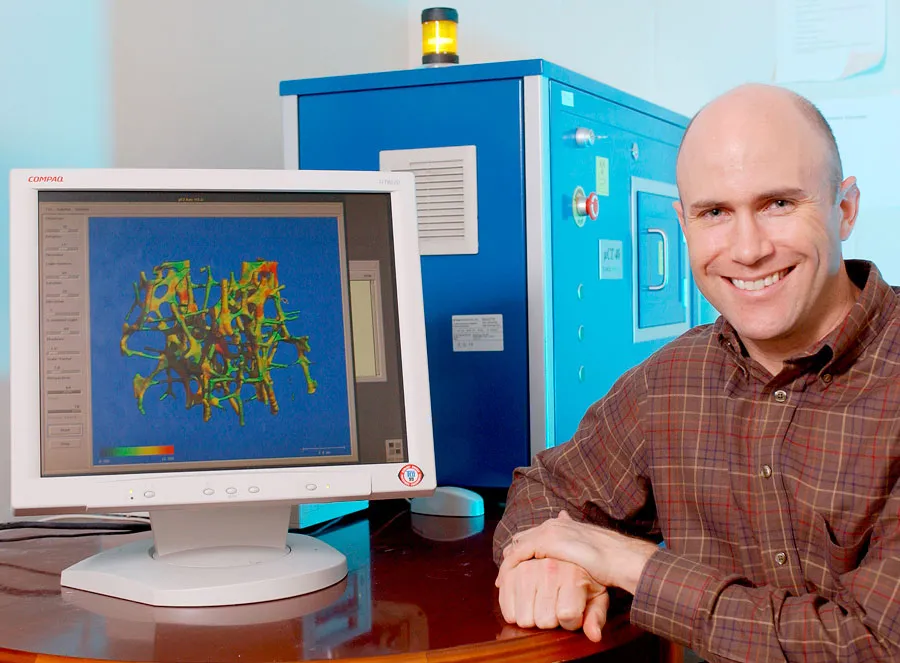
Robert E. Guldberg, director of Georgia Tech’sParker H. Petit Institute for Bioengineering and Bioscience (IBB), has beenappointed chairperson of the Musculoskeletal Tissue Engineering Study Sectionin the Center for Scientific Review – part of the National Institutes ofHealth.
Guldberg will serve as chairperson of the study section fromJuly 1, 2011, to June 30, 2013. The study section will contribute to thenational biomedical research effort and assure the quality of the NIH peerreview process.
Guldberg's research interests focus on musculoskeletalgrowth and development, functional regeneration following traumatic injury anddegenerative diseases, including skeletal fragility and arthritis
According to Dr. Toni Scarpa, director of the Center forScientific Review in NIH’s Department of Health and Human Services, Guldbergwas selected for the chair position because of his demonstrated achievement inhis scientific discipline, quality of research accomplishments, publications inscientific journals and overall judgment and objectivity.
At Georgia Tech, Guldberg studies cell-based therapies, bonebiomechanics, musculoskeletal injury, joint degeneration, biomaterials anddelivery, and micro-CT imaging. His laboratory creates strategies and enables technologiesfor the functional restoration of damaged or degenerated musculoskeletaltissues, with a focus on bone and cartilage.
In 1996, Guldberg joined Georgia Tech, serving both in IBBand the George W. Woodruff School of Mechanical Engineering. He was appointeddirector of IBB in November 2009.
Guldberg holds an undergraduate degree in mechanicalengineering, a master’s degree in bioengineering and mechanical engineering,and a Ph.D. in mechanical engineering from the University of Michigan.
News Contact
Georgia Tech Media Relations
Laura Diamond
laura.diamond@comm.gatech.edu
404-894-6016
Jason Maderer
maderer@gatech.edu
404-660-2926