
Apr. 30, 2026
The Bill Kent Family Foundation AI in Higher Education Fellowship invites Georgia Tech educators to explore how emerging tools can elevate teaching, learning, and student development through hands-on experimentation grounded in real classroom practice.
Offered through the College of Lifetime Learning, the fellowship provides dedicated time and space to test ideas, evaluate outcomes, and help shape how the Institute advances thoughtful, responsible innovation in teaching and learning.
“The Bill Kent Family Foundation’s philanthropic support enables us to turn new ideas about teaching and learning into action. Their investment empowers our fellows to explore—both in theory and in practice—how AI is changing long-standing academic practices and equipping educators with new tools,” Dean Bill Gaudelli said.
During the 2025–26 academic year, fellows Professor Ying Zhang, Patrick Danahy, Joy Arulraj, and Professor Flavio Fenton moved from concept to classroom — piloting AI‑supported tutoring in large engineering courses, integrating AI and robotics into design studios, developing privacy-conscious AI tools for computing courses, and reimagining scientific writing and physics instruction. Their work is sparking interdisciplinary collaboration and informing broader conversations about the future of teaching at Tech.
We encourage Georgia Tech academic professionals, lecturers, professors of practice, and tenure-track faculty who are excited to advance their understanding and application of AI in higher education to apply for the BKFF AI Fellowship.
Please visit the call-for-proposals webpage for more information. The submission period runs from May 1 to June 1, 2026.
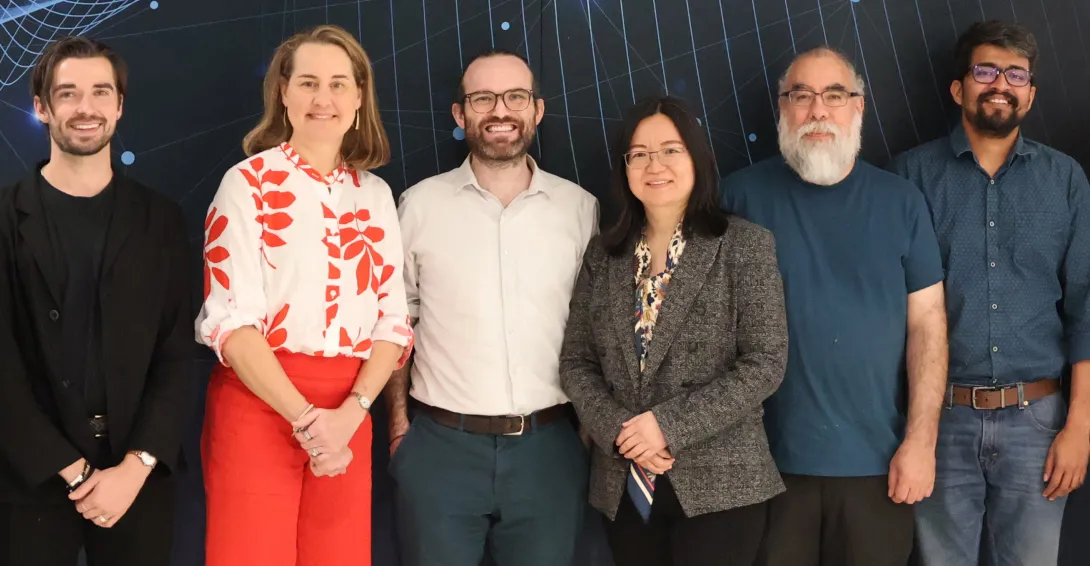
Pictured from left to right: Patrick Danahy, Lesley Baradel (BKFF), Eric Sembrat (College of Lifetime Learning), Ying Zhang, Flavio Fenton, and Joy Arulraj.
News Contact
Communications Program Manager
C21U, College of Lifetime Learning
Feb. 24, 2026
Two research teams within the College of Lifetime Learning are piloting new approaches to online education that integrate artificial intelligence and immersive virtual reality with thoughtful instructional design. More than technology experiments, these projects show how the College refines learning innovations before scaling them across programs.
Research Scientists Eunhye Grace Flavin, Abeera Rehmat, and Jeonghyun (Jonna) Lee are developing an AI-assisted course titled Design of Learning Environments. The course is being piloted within the College to gather feedback and data before broader implementation.
“We want to study how AI can meaningfully support learning,” Flavin said, “and how it can deepen engagement and enhance instructional design rather than distract from it.”
Faculty and staff are contributing in two ways: some are enrolling in the course and participating in AI-supported activities and surveys, while others are reviewing instructional models and providing feedback. Insights from both groups will guide refinements before future rollout.
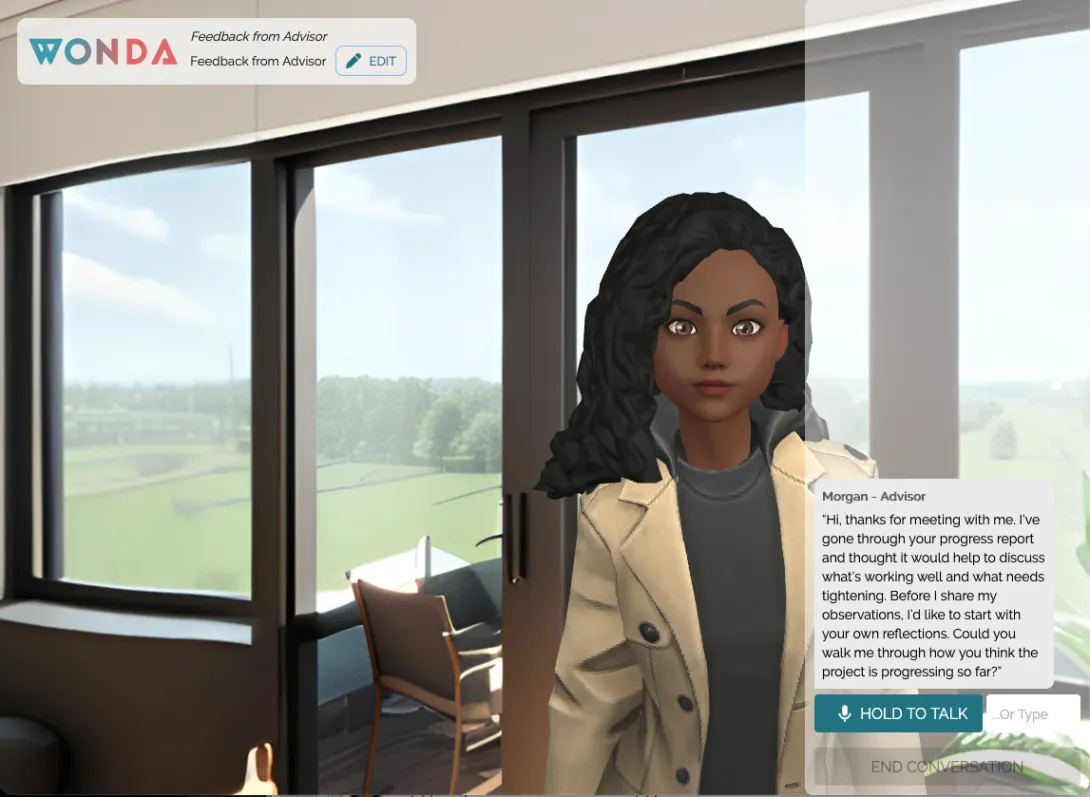
Meanwhile, Research Scientists Meryem Yılmaz Soylu and Jeonghyun (Jonna) Lee, along with Research Associate Eric Sembrat, are piloting an immersive VR module within the Online Master of Science in Analytics (OMSA) program. The module features case-based scenarios with a virtual agent, enabling students to practice leadership and workplace decision-making in realistic environments.
“Technical expertise alone is no longer enough. Our students need opportunities to practice leadership, navigate conflict, and communicate across stakeholders in realistic settings. Virtual reality allows us to create emotionally resonant, high-stakes scenarios in a safe environment where students can experiment, reflect, and grow,” Yılmaz Soylu said.
The VR experience uses branching 360° scenarios in which students’ communication choices and strategic decisions influence virtual stakeholders’ responses in real time. Insights from the pilot will inform refinements to strengthen usability, instructional alignment, and scalability before broader implementation.
“In many ways, we are building the future of online learning. We’re asking what works and what supports learning. It’s incredibly exciting to be part of a college that embraces this sort of thoughtful experimentation. Innovation like this can help us responsibly design courses for the individuals we serve,” Flavin said.
The VR module is being developed in collaboration with Lifetime Learning colleagues in instructional design, media production, and technology, as well as partners across Georgia Tech, including OMSA leadership and faculty collaborators.
Together, these initiatives reflect the College’s approach to innovation: integrating research, technology, and delivery to improve learning systems. By piloting and refining new models before scaling, the College strengthens its capacity to expand access while preserving quality and meaningful outcomes for learners across career stages.
News Contact
Yelena M. Rivera-Vale (she/her(s)/ella)
Communications Program Manager
C21U, College of Lifetime Learning
Sep. 25, 2025

The question raises a sense of caution and thrill for most of us: how is Artificial Intelligence (AI) changing your workplace, and how can you harness this potential? Nowhere is this more real than in the field of logistics and supply chain management. At Georgia Tech’s Savannah campus, a component of the College of Lifetime Learning, the September 4 seminar “Unlocking GenAI in the Supply Chain: From Curiosity to Capability” brought together industry leaders and other community members to address these issues.
“Saving 10 hours a week with GenAI tools and techniques? That attracts leaders in this field,” said Chris Gaffney, Managing Director of the Supply Chain and Logistics Institute (SCL) and presenter of the seminar. “But they also seek deeper expertise that addresses what leaders need to know now about AI, including prompting as a strategic skill, AI policy implications for both students and companies, and real examples of how GenAI can move the needle on decision speed and quality.”
Gaffney is also the Edenfield Executive-in-Residence and a Professor of the Practice in Georgia Tech’s H. Milton Stewart School of Industrial and Systems Engineering.
The free seminar was part of a regular “Learners and Leaders” series, which usually meets before work over breakfast. The interactive session began by defining confusing terms in AI and the significance of its rapid development, then focused on use cases and strategies. It presented emerging trends and a new Advanced Analytics Learning Ladder, an actionable guide to training teams in AI.
Georgia Tech-Savannah, an educational outreach arm of Georgia Tech to the Coastal Empire of Georgia and beyond provides a range of learning experiences, including education for veterans, K12 STEAM enrichment and outreach, leadership training, OSHA training, and more.
It is also home to the region's Enterprise Innovation Institute's office for the Advanced Technology Development Center (ATDC), the Georgia Tech Manufacturing Extension Partnership (GaMEP), and Georgia Tech’s regional presence for Apex Accelerator.
In a recent applied research partnership, the Georgia Ports Authority along with Georgia Tech experts from the GT Supply Chain and Logistics Institute (led by Gaffney) showed through research that routing Asia cargo through the Port of Savannah delivers lower costs, greater reliability, and comparable transit times versus West Coast ports.
This Learners and Leaders seminar series responds to regional needs and offers practical strategies and solutions to workplace or educational challenges. This includes the supply and logistics sector, predominant in the Savannah region, but also extends to other topics like K-12 education, safety and health, workforce demands, etc. Among more than 110 attendees in September (face-to-face and online) were representatives of the largest regional companies, the Georgia Ports Authority, local universities, and local economic development authorities.
Georgia Tech-Savannah plays a vital role in the College of Lifetime Learning efforts to address the needs of learners in timely and meaningful ways that help the workforce remain agile, capable, and engaged.
News Contact
Kerry Jarvis