
Feb. 07, 2023

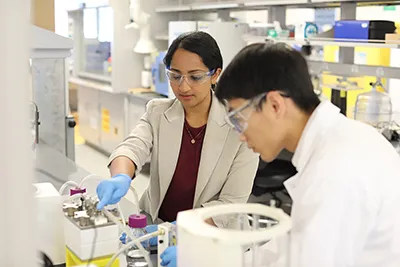
Akanksha Menon, assistant professor in the George W. Woodruff School of Mechanical Engineering, has been awarded a prestigious Faculty Early Career Development (CAREER) Award from the National Science Foundation’s (NSF) Division of Chemical, Bioengineering, Environmental and Transport Systems (CBET).
Menon directs the Water–Energy Research Lab (WERL) at Georgia Tech, which focuses on applying thermal science and functional materials to develop sustainable energy and water technologies.
"I am incredibly honored to receive an NSF CAREER award," said Menon. "I remember attending the College of Engineering panel on writing a successful NSF proposal wondering if I would be able to do this, and here I am with a CAREER award on my first try!"
Menon’s NSF CAREER project, “Nonequilibrium effects in thermochemical energy storage: linking microstructure to thermal transport,” aims to bridge our understanding of structure-property relationships in thermochemical materials across different lengths and timescales.
Currently, thermal loads (e.g., space conditioning and hot water) account for 50% of the energy consumption in buildings. To match energy demand with supply especially from renewables, a thermal battery can be used that stores and releases energy as heat. Among the different storage materials, thermochemical salt hydrates are promising as they have a higher energy density compared to phase change or sensible storage materials. However, these salt hydrates experience mechanical stress and hygrothermal instabilities that reduce their energy density as the thermal battery is cycled (charge-discharge).
Menon aims to provide a mechanistic understanding of the key factors governing thermochemical phase transitions and their impact on coupled heat-and-mass transport, which will eventually enable the development of reversible thermal batteries with long-term stability to decarbonize buildings.
Menon's research will be complemented by two education and outreach efforts. She will provide interdisciplinary and experiential learning opportunities for traditionally underrepresented students in Science, Technology, Engineering, and Mathematics (STEM) from the high school to graduate levels, as well as curriculum development for teachers to increase knowledge about energy storage broadly.
Menon’s award of $607,000 over five years will provide support for both her research and education and outreach efforts.
"The funding allows me to bring on a Ph.D. student to grow our efforts in decarbonizing heat, and it also supports my educational and outreach goals – all of which is what motivated me to become a faculty member," she said.
The CAREER Program offers the NSF’s most prestigious awards in support of early-career faculty who have the potential to serve as academic role models in research and education and to lead advances in the mission of their department or organization.
Menon joined Georgia Tech as an assistant professor in 2021. Prior, she was a Rosenfeld Postdoctoral Fellow at Lawrence Berkeley National Laboratory, where she worked on hybrid membrane-thermal desalination processes using solar energy. She also contributed to the development of thermal energy storage materials for high-temperature industrial process heat. Menon completed her Ph.D. at Georgia Tech, where she developed semiconducting polymers and new device architectures for thermoelectric energy harvesting. She holds a bachelor's degree from Texas A&M University at Qatar and a master’s degree in mechanical engineering from Georgia Tech.
Jan. 09, 2023
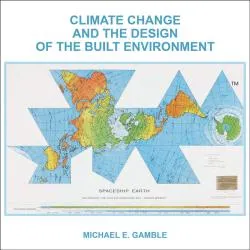
A new eBook, "Climate Change and the Design of the Built Environment," written by Michael Gamble, Academic and Research Council Chair at the Kendeda Building for Innovative Sustainable Design and associate professor in the College of Design at Georgia Tech is now available!
Written as a series of dialogues with leaders from various disciplines, the book positions design as an essential component of entrepreneurial approaches which explore the sociocultural and eco-political dimensions of climate change. Economist, Architects, Planners, Sociologist, Lawyers, Policy Makers, Landscape Architects, and MBA’s contribute to a spirited discussion around climate change and design.
Global climate change has already resulted in a wide range of impacts across every region of the country. Many sectors of the economy are expected to grow related to climate and health in the coming decades. The design and retrofit of buildings, infrastructure and cities will be a major part of future efforts.
All interviews are Kendeda Building based on Georgia Tech’s Atlanta campus with experts participating from around the world.
Jul. 12, 2022
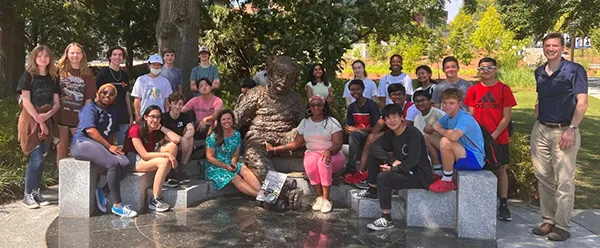
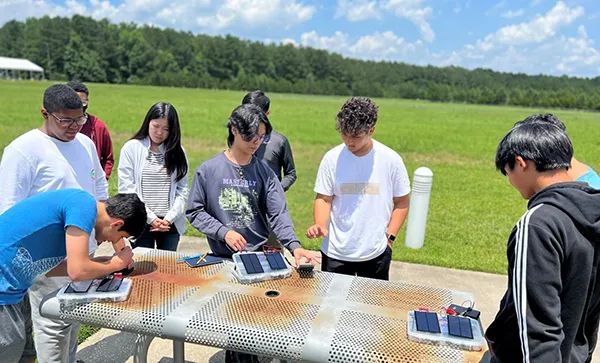
The Summer of 2022 is off to an energetic start! The Energy, Policy, and Innovation Center (EPICenter) hosted two week-long cohorts of "Energy Unplugged," an energy-themed STEAM camp for 35 high school students. Dr. Rich Simmons and Strategic Energy Institute fellow Azell Francis engaged with collaborators from around the state, and led the campers in hands-on interactive demonstrations and experiments involving solar panels, batteries, catapults, water rockets, and remote-control cars. The first camp was held on the Georgia Tech Savannah campus, and the second on the Georgia Tech main campus in Atlanta. Both camps covered both renewable and non-renewable energy sources, energy production and delivery, environmental impacts, and global electricity access. Campers gained insights into how a STEAM-oriented education can be a path that leads to an exciting and successful career in energy.
During the week of June 13 - 17, 2022, GT Savannah was host to a very engaged group of campers. Launching right into activities, the students built and tested catapults, integrating important physics and math concepts into hands-on fun. Next up was the water rocket design challenge, where they showcased their creativity to achieve maximum height and distance. The City of Savannah’s Office of Sustainability displayed their electric vehicle, and shared perspectives on local sustainability initiatives. A highlight of both summer camps was field trip day! The campers visited Georgia Power’s Plant McIntosh, which is a combined cycle gas turbine plant, and the Gulfstream Aerospace Corporation, where the G6 and G7 aircraft are assembled. The week ended too soon, but not before the camp students raced to the finish line driving a re-engineered remote-control electric car, and in true Georgia Tech fashion, hearing the steam engine whistle blow.
Simmons and Francis brought the Energy Unplugged fun to GT Atlanta during the week of June 21 – 24, 2022. The Kendeda Building for Innovative Sustainable Design served as an ideal instructional backdrop for the camp. The Living Building, as it is often called, is certified to generate more energy than it consumes, collect, capture, and process more water than it consumes, and, to the greatest extent possible, be regenerative, rather than consumptive. Hands-on learning remained a key pillar of the camp, conducting experiments with micro-grids and solar panels. The group also had the opportunity to visit Georgia Power’s Morgan Falls Hydroelectric Plant which began commercial operations in 1904, and GE Power’s Monitoring and Diagnostics Center, where more than 500 GW of gas turbine power plants are monitored. The week wrapped up with “shark-tank” style team presentations where campers took an entrepreneurial approach to delivering basic energy services to off-grid communities in the developing world.
Energy Unplugged is administered by Georgia Tech Summer P.E.A.K.S. (Program for Enrichment and Accelerated Knowledge in STEAM) at CEISMC (the Center for Education Integrating Science, Mathematics, and Computing). CEISMC serves as the primary connection point between Georgia Tech faculty and students and the preK-12 STEAM education community, reducing the barriers between kids and higher education. Annually, CEISMC programs impact more than 39,000 students, 1,700 teachers, 200 schools in over 75 school districts throughout the state of Georgia.
News Contact
Brent Verrill, Research Communications Program Manager, SEI
May. 26, 2022
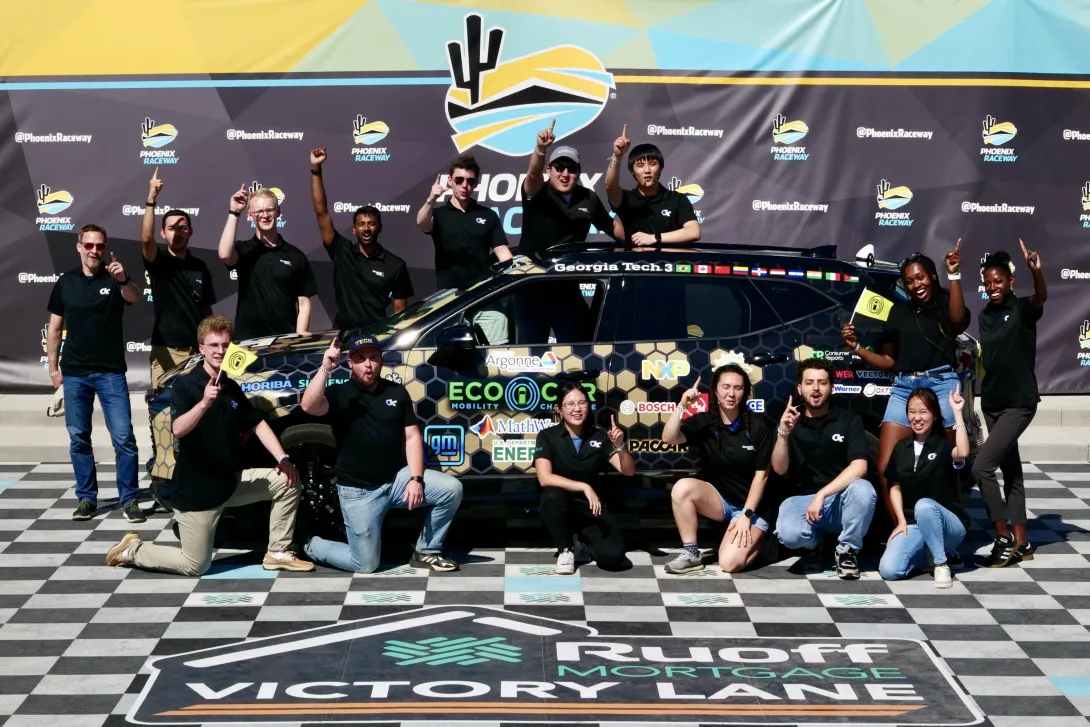
A team of Georgia Tech students and faculty members has won the U.S. Department of Energy’s (DOE) EcoCAR Mobility Challenge. The four-year competition tasked 11 universities with transforming a 2019 Chevrolet Blazer by adding advanced propulsion systems and automated vehicle technology. The goal was to improve the car’s energy efficiency while balancing emissions, safety, and consumer acceptability factors.
Originally a six-cylinder, the Georgia Tech team converted its Blazer to a four-cylinder hybrid vehicle with adaptive cruise control. Its vehicle-to infrastructure communication technology allows it to “talk” to stoplights and adjust its speed for optimization.
The team of approximately 60 graduate and undergraduate students represent six of the College of Engineering’s eight schools. The group also includes students from the College of Computing, Scheller College of Business, and Georgia State University.
Read the entire story on the College of Engineering website.
News Contact
Jason Maderer
College of Engineering
maderer@gatech.edu