
Jul. 29, 2022

The Renewable Bioproducts Institute (RBI) at Georgia Tech is excited to welcome three additions to its membership-based industrial advisory board: Pactiv Evergreen, Rayonier Advanced Materials, and Grasim Industries.
According to associate director Chris Luettgen, “these companies add to our board by providing expanded industrial expertise in laminated food packaging and dissolving pulp manufacturing.”
One of the companies joining recently is Pactiv Evergreen, a leading manufacturer of fresh food and beverage packaging in North America. Luettgen also facilitated the entry of RYAM (Rayonier Advanced Materials), who joined the advisory board in early spring semester 2022. RYAM produces high purity fluff and dissolving pulps for personal care and other products.
Finally, we welcome Grasim Industries, part of the India-based Aditya Birla Group of companies that also includes Novelis. Grasim is a leading producer of market and dissolving pulps as well as viscose and rayon. Grasim is joining the advisory board under a new trial membership program, which allows companies a 1-year period to experience the benefits of membership prior to making a longer-term commitment.
According to executive director Carson Meredith, “through this trial member program we hope to expand the range and breadth of participating companies.” RBI is excited to include these companies in guiding our research vision and programming. The full list of participating companies and member benefits can be found here: https://research.gatech.edu/rbi/members.
News Contact
Jul. 22, 2022
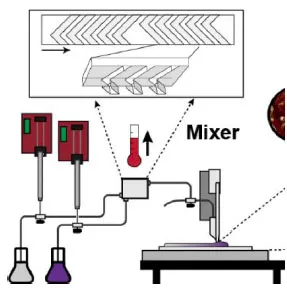
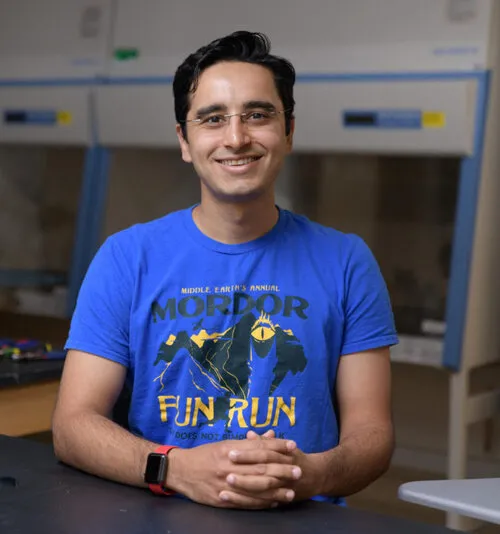
A team under Martha Grover, Elsa Reichmanis, and Carson Meredith recently published a paper in Chemistry of Materials titled "Composition Gradient High-Throughput Polymer Libraries Enabled by Passive Mixing and Elevated Temperature Operability." Grad student Aaron Liu (pictured) and Ezgi Dogan-Guner (Ph.D. 2021) are co-first authors, while RahulVenkatesh, Miguel Gonzalez, and Mike McBride (Ph.D. 2019) are also listed as co-authors.
ABSTRACT: The development of high-throughput experimentation (HTE) methods to efficiently screen multiparameter spaces is key to accelerating the discovery of high-performance multicomponent materials (e.g., polymer blends, colloids, etc.) for sensors, separations, energy, coatings, and other thin-film applications relevant to society. Although the generation and characterization of gradient thin-film library samples is a common approach to enable materials HTE, the ability to study many systems is impeded by the need to overcome unfavorable solubilities and viscosities among other processing challenges under ambient conditions. In this protocol, a solution coating system capable of operating temperatures over 110 degrees C is designed and demonstrated for the deposition of composition gradient polymer libraries. The system is equipped with a custom, solvent-resistant passive mixer module suitable for high-temperature mixing of polymer solutions at ambient pressure. Residence time distribution modeling was employed to predict the coating conditions necessary to generate composition gradient films using a poly(3-hexylthiophene) and poly(styrene) model system. Poly(propylene) and poly(styrene) blends were selected as a first demonstration of high-temperature gradient film coating: the blend represents a polymer system where gradient films are traditionally difficult to generate via existing coating approaches due to solubility constraints under ambient conditions. The methodology developed here is expected to widen the range of solution processed materials that can be explored via high-throughput laboratory sampling and provides an avenue for efficiently screening multiparameter materials spaces and/or populating the large data sets required to enable data-driven materials science.
The full paper can be found in July 14, 2022, Chemistry of Materials.
News Contact
Jun. 30, 2022

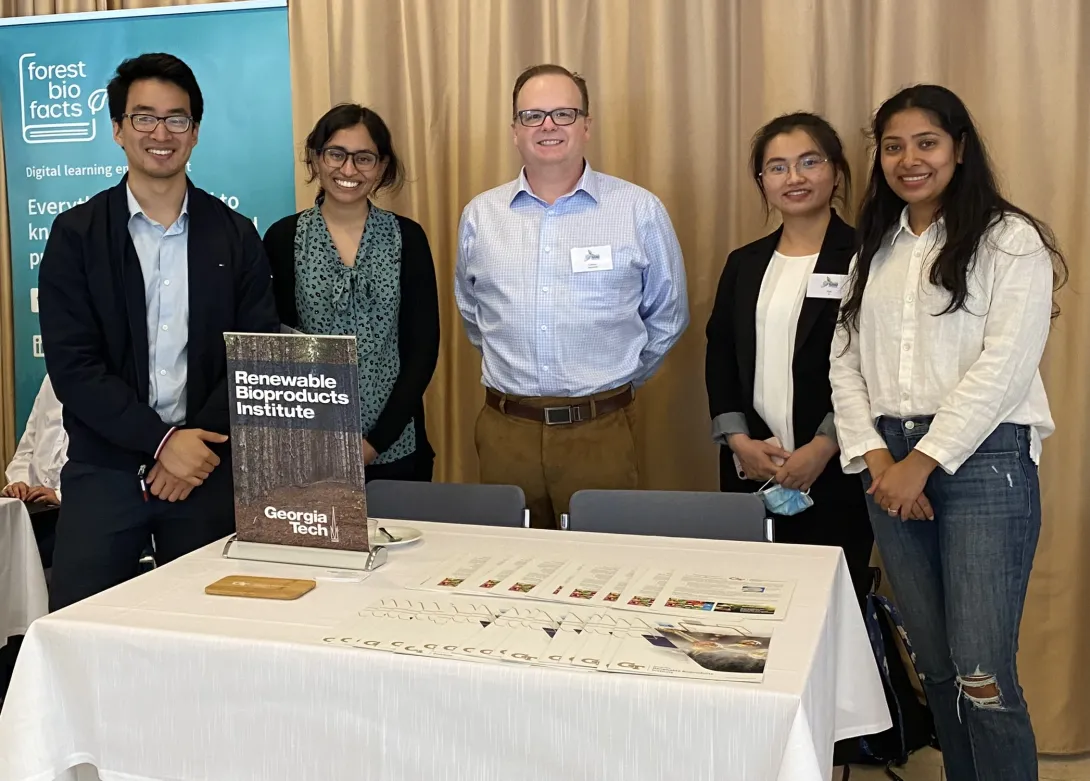
This summer, a faculty and student group from the Renewable Bioproducts Institute (RBI) at Georgia Tech attended TAPPI’s International Conference on Nanotechnology for Renewable Materials (TAPPI Nano) in Helsinki, Finland from June 13-17. This is a leading conference that attracts professionals, researchers, and corporations conducting research or using nanotechnology focused on renewable materials.
On average, the event draws more than 400 academics, industry leaders, and researchers from more than 25 countries around the world. This year's event featured more than 100 technical presentations, four keynote speakers, end-user panels, and poster presentations. The conference is designed to help attendees gain insights into the latest advancements in research and actual application in today’s newest renewable material products.
“Nanotechnologies are now being used commercially in renewable products in the paper and pulp industries,” said Carson Meredith, executive director of RBI. “In that industry, nanomaterials are being used mainly as an additive—such as for corrugated packaging. They are finding that small amounts of these additives can reduce the amount of fiber needed. New additives can also be used to acquire unique combinations of properties such as higher strength with less weight or help to color paper white with more environmentally friendly methods..”
Nanotechnology in the renewable bioproducts industry is enabling large-scale financial savings and helping to conserve resources when making paper products according to Meredith who is also a professor and the James Harris Faculty Fellow in the School of Chemical and Biomolecular Engineering.
Georgia Tech faculty and student presenters listed in the conference agenda included:
Talks at TAPPI Nano2022
- Session 12. Nanocellulose for Stronger or Lighter Glass Fiber Polyester Composites - Kyriaki Kalaitzidou
- Session 23. Consumer Gatekeeping in Sustainable Materials Streams - Nasreen Khan
- Session 25. Dewatering of Cellulose Nanofibrils Using Ultrasound - Udita Ringania
- Session 32. Minimizing Oxygen Permeability of Cellulose/Chitin Nanomaterials as Multilayer Coatings by Tuning Chitin Deacetylation - Yue Ji
Posters at TAPPI Nano2022
- Zero-angle Depolarized Dynamic Light Scattering for Characterization of Cellulose Nanomaterials - Li Zhang
- The Influence of Polyelectrolyte Complex Phase Behavior on Water Retention Values of Cellulose Nanofibers - Nasreen Khan
- Dewatering of Cellulose Nanofibrils Using Ultrasound - Udita Ringania
Kyriaki Kalaitzidou is an assistant professor in the Woodruff School of Mechanical Engineering and strategic coordinator for circular materials for RBI. The four doctoral students presenting included Yue Ji, Nasreen Khan, and Udita Ringania from the School of Chemical and Biomolecular Engineering; and Li Zhang from the School of Materials Science and Engineering.
TAPPI, formed in 1915, is the leading association for the worldwide pulp, paper, packaging, tissue, and converting industries.
News Contact
Walter Rich
May. 25, 2022
Abstract: Although cellulose nanomaterials have promising properties and performance in a wide application space, one hinderance to their wide scale industrial application has been associated with their economics of dewatering and drying and the ability to redisperse them back into suspension without introducing agglomerates or lose of yield. The present work investigates the dewatering of aqueous suspensions of cellulose nanofibrils (CNFs) using ultrasound as a potentially low-cost, non-thermal, and scalable alternative to traditional heat-based drying methods such as spray drying. Specifically, we use vibrating mesh transducers to develop a direct-contact mode ultrasonic dewatering platform to remove water from CNF suspensions in a continuous manner. We demonstrate that the degree of dewatering is modulated by the number of transducers, their spatial configuration, and the flow rate of the CNF suspension. Water removal of up to 72 wt.% is achieved, corresponding to a final CNF concentration of 11 wt.% in 30 min using a two-transducer configuration. To evaluate the redispersibility of the dewatered CNF material, we use a microscopic analysis to quantify the morphology of the redispersed CNF suspension. By developing a custom software pipeline to automate image analysis, we compare the histograms of the dimensions of the redispersed dewatered fibrils with the original CNF samples and observe no significant difference, suggesting that no agglomeration is induced due to ultrasonic dewatering. We also perform SEM analysis to evaluate the nanoscale morphology of these fibrils showing a width range of 20 nm–4 um. We estimate that this ultrasound dewatering technique is also energy-efficient, consuming up to 36% less energy than the enthalpy of evaporation per kilogram of water. Together with the inexpensive cost of transducers ( $1), the potential for scaling up in parallel flow configurations, and excellent redispersion of the dewatered CNFs, our work offers a proof-of-concept of a sustainable CNF dewatering system, that addresses the shortcomings of existing techniques.
The complete published paper can be found in the May 24 issue of Cellulose.
News Contact
Walter Rich
May. 02, 2022

Georgia Tech inventors (Carson Meredith, Sven Holger Behrens, and Yi Zhang) have identified a method that utilizes surfactant-free, oil-tolerant capillary foams consisting of a combination of colloidal particles, oil, water, and gas. This method allows the recovery of off-shore oil spills that allows the subsequent recovery of the oil.
A collection device allows the infusion of air and the addition of colloidal particles. As the oil and water is processed through the device, a capillary foam gel is formed. The foam cells are stabilized synergistically by oil and (readily available, inexpensive) solid particles of appropriate wettability, without the need for any surfactants. Networks of oil-bridged solid particles inside the aqueous lamella of capillary foams confer upon the foam a tunable viscosity. The accumulated foam can be mechanically removed from the water surface (either by skimming, scooping, or pumping), and transported to another location where a de-foaming agent can be added to “decompose” the capillary foam into its component parts (water, recovered oil, and stabilizing particles).
Read Full Feature
News Contact
Walter Rich
Apr. 25, 2022

Five faculty members in Georgia Tech’s School of Chemical and Biomolecular Engineering (ChBE) shared the 2022 Curriculum Innovation Award presented by Tech’s Center for Teaching and Learning for the development of the Online Graduate Certificate in Data Science for the Chemical Industry (DSCI).
The winning faculty team included ChBE Professors Fani Boukouvala, Martha Grover, Andrew J. Medford, Carson Meredith, and David Sholl. This award includes a prize of $3,000, which they will share.
Launched in Fall 2020, the Online Graduate Certificate in DSCI is the only credential of its kind, preparing chemical engineers with the skills and expertise they need for the future of work.
As chemical, energy, and manufacturing companies worldwide race to take advantage of big data trends in what has become known as Industry 4.0, a key need for that sector is strong domain knowledge in chemical engineering coupled with skills in data science.
Zak Kuiper, data scientist for the Mosaic Company, said that the DSCI program is “the first to the table in answering a need which most of the chemical industry is just now realizing they have. It has allowed me to develop as a professional significantly quicker than I would have otherwise and has shaped how our organization has focused on the area of Data Science.”
Designed to be completed in one-to-two years, the certificate (offered in partnership with Georgia Tech Professional Education) consists of six hours of core courses (Data Analytics for Chemical Engineers and Data-driven Process Systems Engineering) on foundational data science methods, with a strong emphasis on applications in the chemical process industry. An additional six hours of electives provide the opportunity to focus on a specific area of interest and can be selected from within Georgia Tech’s prestigious online master's degree in analytics.
Companies including 3M and Dow Chemical have partnered with Georgia Tech to enroll their employees in the DSCI program to provide skills in the emerging field of data science and data analytics. At the same time, the courses are also available to resident Georgia Tech graduate students, as well as senior undergraduate students, who take the courses for credit toward their degrees.
Writing in support of DSCI's nomination for the Curriculum Innovation Award, 3M officials Cristina Thomas and Chris Jacobs, said, "We value this program so highly that 3M Corporate R&D has granted full ‘internal’ scholarships to 11 employees to date and plan to award more for the coming school year with full support from their managers."
The certificate is built upon two core courses (Data Analytics for Chemical Engineers, and Data-driven Process Systems Engineering)
Christopher Jones, the John F. Brock III School Chair of ChBE, said the certificate program is “not only a fabulous educational innovation, it is also a crucial thought-leadership platform, one where we are far ahead of the curve, offering programmatic innovations that other institutions are just starting to imagine. I am tremendously proud of our DSCI team – we are fortunate to have them as members of our community.”
Jackson Dean, BS ChBE 2021, a data science associate (pharmaceutical supply chain) for GlaxoSmithKline, said, “I found success in these courses due to the thoughtful design of each course, which fostered a high level of engagement….The combination of lecture videos and instructor-created code demo notebooks to act as the primary course material meant that I had multiple ways of learning the material.”
Dean added: “The curriculum of this certificate program directly addresses this need of creating data-fluent chemical engineers – teaching skills such as data management/cleaning, building machine learning models, and data visualization.”
The application deadline for Fall 2022 is May 1, 2022. Learn more.
News Contact
Walter Rich
Feb. 22, 2021
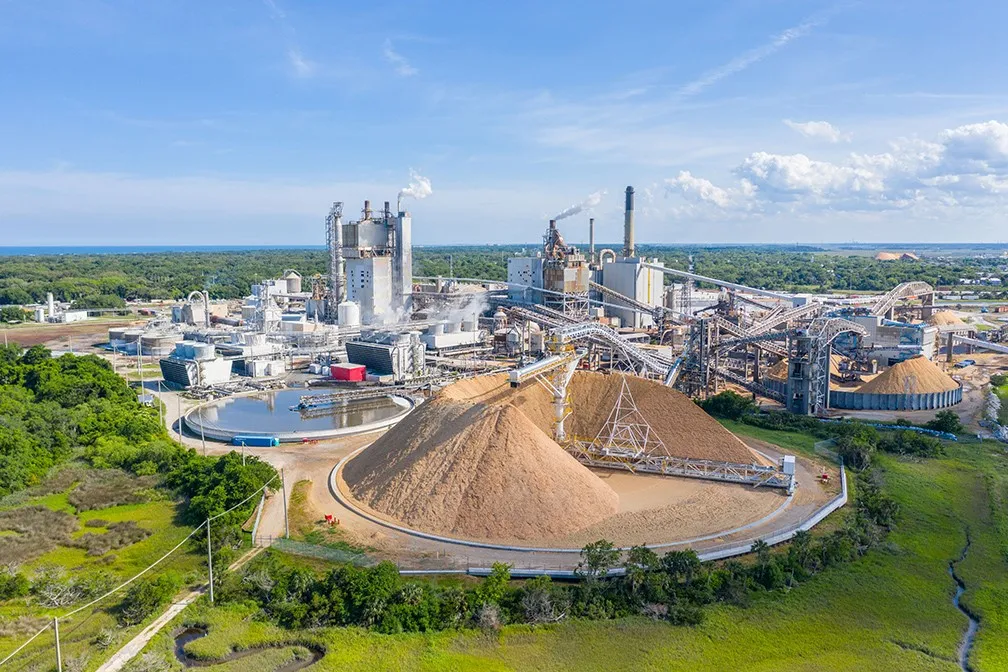
The U.S. pulp and paper industry uses large quantities of water to produce cellulose pulp from trees. The water leaving the pulping process contains a number of organic byproducts and inorganic chemicals. To reuse the water and the chemicals, paper mills rely on steam-fed evaporators that boil up the water and separate it from the chemicals.
Water separation by evaporators is effective but uses large amounts of energy. That’s significant given that the United States currently is the world’s second-largest producer of paper and paperboard. The country’s approximately 100 paper mills are estimated to use about 0.2 quads (a quad is a quadrillion BTUs) of energy per year for water recycling, making it one of the most energy-intensive chemical processes. All industrial energy consumption in the United States in 2019 totaled 26.4 quads, according to Lawrence Livermore National Laboratory.

An alternative is to deploy energy-efficient filtration membranes to recycle pulping wastewater. But conventional polymer membranes — commercially available for the past several decades — cannot withstand operation in the harsh conditions and high chemical concentrations found in pulping wastewater and many other industrial applications.
Georgia Institute of Technology researchers have found a method to engineer membranes made from graphene oxide (GO), a chemically resistant material based on carbon, so they can work effectively in industrial applications.
“GO has remarkable characteristics that allow water to get through it much faster than through conventional membranes,” said Sankar Nair, professor, Simmons Faculty Fellow, and associate chair for Industry Outreach in the Georgia Tech School of Chemical and Biomolecular Engineering. “But a longstanding question has been how to make GO membranes work in realistic conditions with high chemical concentrations so that they could become industrially relevant.”
Using new fabrication techniques, the researchers can control the microstructure of GO membranes in a way that allows them to continue filtering out water effectively even at higher chemical concentrations.
The research, supported by the U.S. Department of Energy-RAPID Institute, an industrial consortium of forest product companies, and Georgia Tech’s Renewable Bioproducts Institute, was reported recently in the journal Nature Sustainability. Many industries that use large amounts of water in their production processes may stand to benefit from using these GO nanofiltration membranes.
Nair, his colleagues Meisha Shofner and Scott Sinquefield, and their research team began this work five years ago. They knew that GO membranes had long been recognized for their great potential in desalination, but only in a lab setting. “No one had credibly demonstrated that these membranes can perform in realistic industrial water streams and operating conditions,” Nair said. “New types of GO structures were needed that displayed high filtration performance and mechanical stability while retaining the excellent chemical stability associated with GO materials.”
To create such new structures, the team conceived the idea of sandwiching large aromatic dye molecules in between GO sheets. Researchers Zhongzhen Wang, Chen Ma, and Chunyan Xu found that these molecules strongly bound themselves to the GO sheets in multiple ways, including stacking one molecule on another. The result was the creation of “gallery” spaces between the GO sheets, with the dye molecules acting as “pillars.” Water molecules easily filter through the narrow spaces between the pillars, while chemicals present in the water are selectively blocked based on their size and shape. The researchers could tune the membrane microstructure vertically and laterally, allowing them to control both the height of the gallery and the amount of space between the pillars.
The team then tested the GO nanofiltration membranes with multiple water streams containing dissolved chemicals and showed the capability of the membranes to reject chemicals by size and shape, even at high concentrations. Ultimately, they scaled up their new GO membranes to sheets that are up to 4 feet in length and demonstrated their operation for more than 750 hours in a real feed stream derived from a paper mill.
Nair expressed excitement for the potential of GO membrane nanofiltration to generate cost savings in paper mill energy usage, which could improve the industry’s sustainability. “These membranes can save the paper industry more than 30% in energy costs of water separation,” he said.
Georgia Tech continues to work with its industrial partners to apply the GO membrane technology for pulp and paper applications.
This work is supported by the U.S. Department of Energy (DOE) Rapid Advancement in Process Intensification Deployment (RAPID) Institute (#DE-EE007888-5-5), an industrial consortium comprising Georgia-Pacific, International Paper, SAPPI, and WestRock, and the Georgia Tech Renewable Bioproducts Institute. Any opinions, findings, and conclusions or recommendations expressed in this material are those of the authors and do not necessarily reflect the views of the sponsoring organizations.
CITATION: Zhongzhen Wang, et al., “Graphene Oxide Nanofiltration Membranes for Desalination under Realistic Conditions.” (Nature Sustainability, 2021) https://doi.org/10.1038/s41893-020-00674-3.
News Contact
Anne Wainscott-Sargent
Research News
(404-435-5784)