
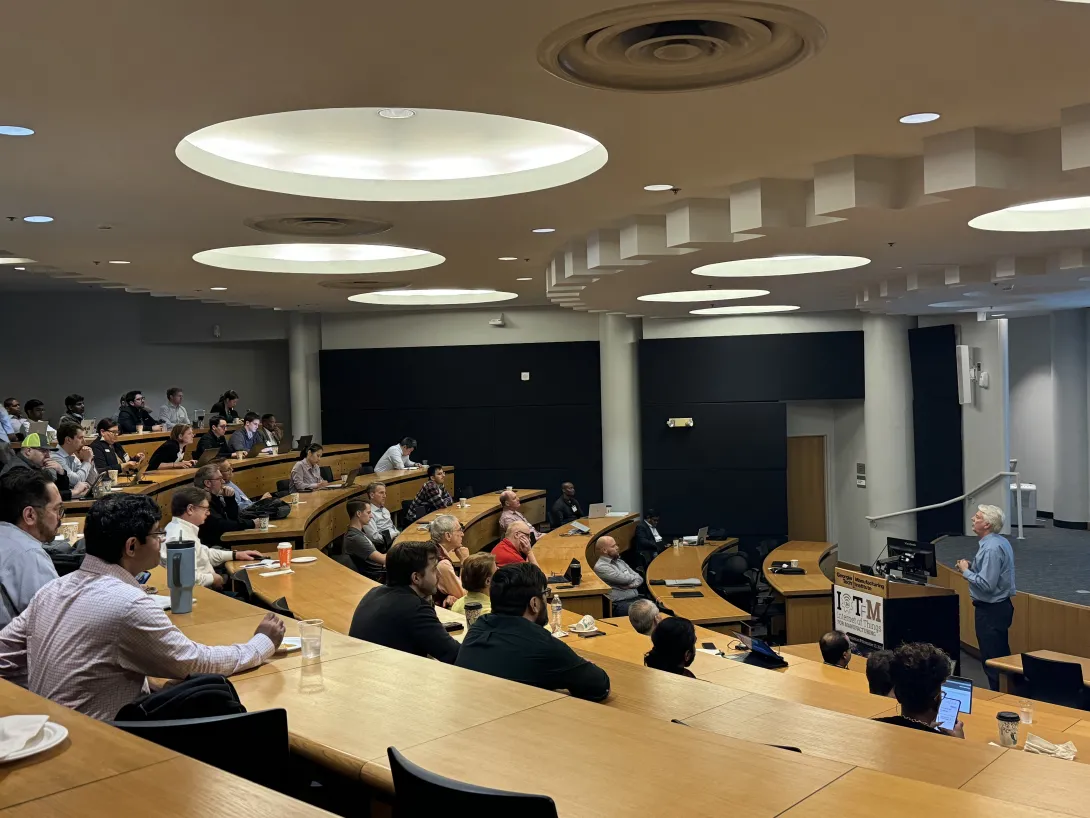
Andrew Dugenske, a principal research engineer at GTMI and symposium organizer, delivering a talk at the symposium's tenth annual gathering.
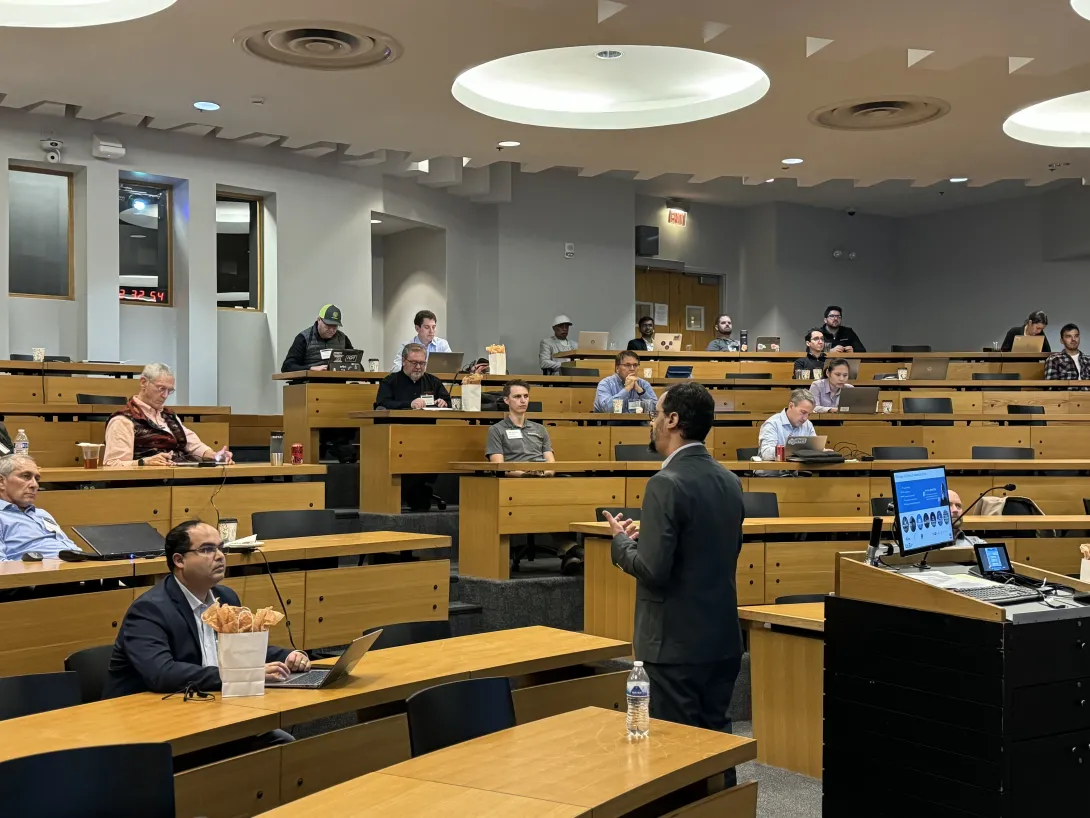
Dago Mata, regional director of business development at Tata Consultancy Services (TCS) and one of the event’s speakers.
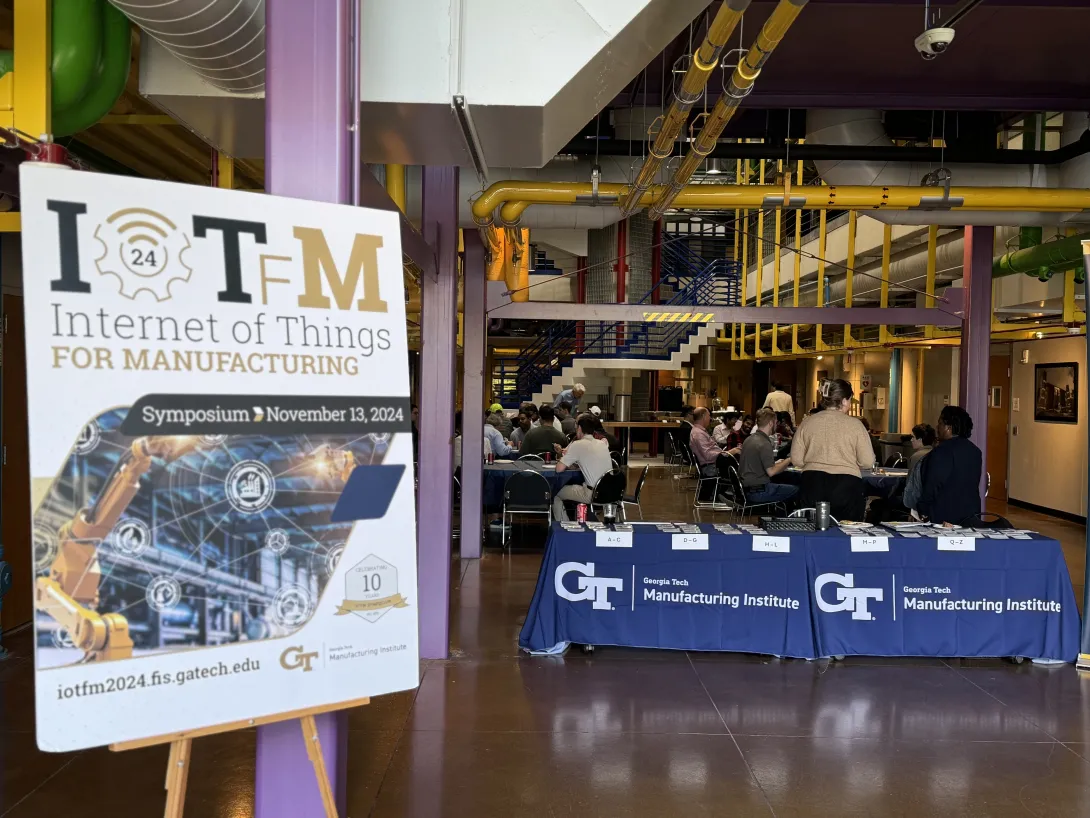
The event was held in the Callaway Research Building on November 13, 2024.
In the rapidly evolving world of manufacturing, embracing digital connectivity and artificial intelligence is crucial for optimizing operations, improving efficiency, and driving innovation. Internet of Things (IoT) is a key pillar of that process, enabling seamless communication and data exchange across the manufacturing process by connecting sensors, equipment, and applications through internet protocols.
The Georgia Tech Manufacturing Institute (GTMI) recently hosted the 10th annual Internet of Things for Manufacturing (IoTfM) Symposium, a flagship event that continues to set the standard for innovation and collaboration in the manufacturing sector. Held on Nov. 13, the symposium brought together industry leaders, researchers, and practitioners to explore the latest advancements and applications of IoT in manufacturing.
"The purpose is to bring the voice of manufacturers directly to the university community," explained Andrew Dugenske, a principal research engineer and director of the Factory Information Systems Center at GTMI. "It's about learning from industry to guide our research, education, and knowledge base, which is inherent to Georgia Tech."
Initiated over a decade ago, the IoTfM Symposium has grown into a premier event that highlights Georgia Tech's commitment to advancing manufacturing technologies.
"This symposium provides a unique platform to share and learn from cutting-edge advancements in IoT and now AI for manufacturing,” said Dago Mata, regional director of business development at Tata Consultancy Services (TCS) and one of the event’s speakers. “The opportunity to engage with industry leaders and showcase practical, real-world implementations was highly motivating."
This year’s symposium welcomed over 100 attendees from across the country. Speakers from TCS, Amazon Web Services, Southwire, and more shared insights on the latest advancements, use cases, current challenges, and future directions for IoT in manufacturing processes.
“My favorite aspect was the case studies presented by major manufacturers, highlighting successful IoT and AI implementations," said Mata, who has attended the symposium since 2018. "These provided actionable takeaways and inspiration for driving similar innovation in my projects — the blend of exclusive learning from real-world applications and the presence of diverse experts made it a truly practical and inspiring event."
A distinctive feature of the IoTfM Symposium is its commitment to providing a platform for industry partners to voice their perspectives on powerful manufacturing research, says Dugenske. "We ask our industry partners to tell us about their experiences, challenges, and future predictions. This way, we can guide our research with the real-world needs of the manufacturing sector to form stronger collaborations and better prepare our students."
This unique format not only enhances the relevance of the symposium but also fosters a collaborative environment where industry leaders can learn from each other and from Georgia Tech's academic community.
As GTMI looks to the future, the symposium will continue to evolve, incorporating new elements and expanding its reach. Dugenske envisions even greater integration with other GTMI initiatives and broader industry engagement.
"Our goal is to create an event that highlights our capabilities and builds deeper connections within the manufacturing community.”
News Contact
Audra Davidson
Research Communications Program Manager
Georgia Tech Manufacturing Institute
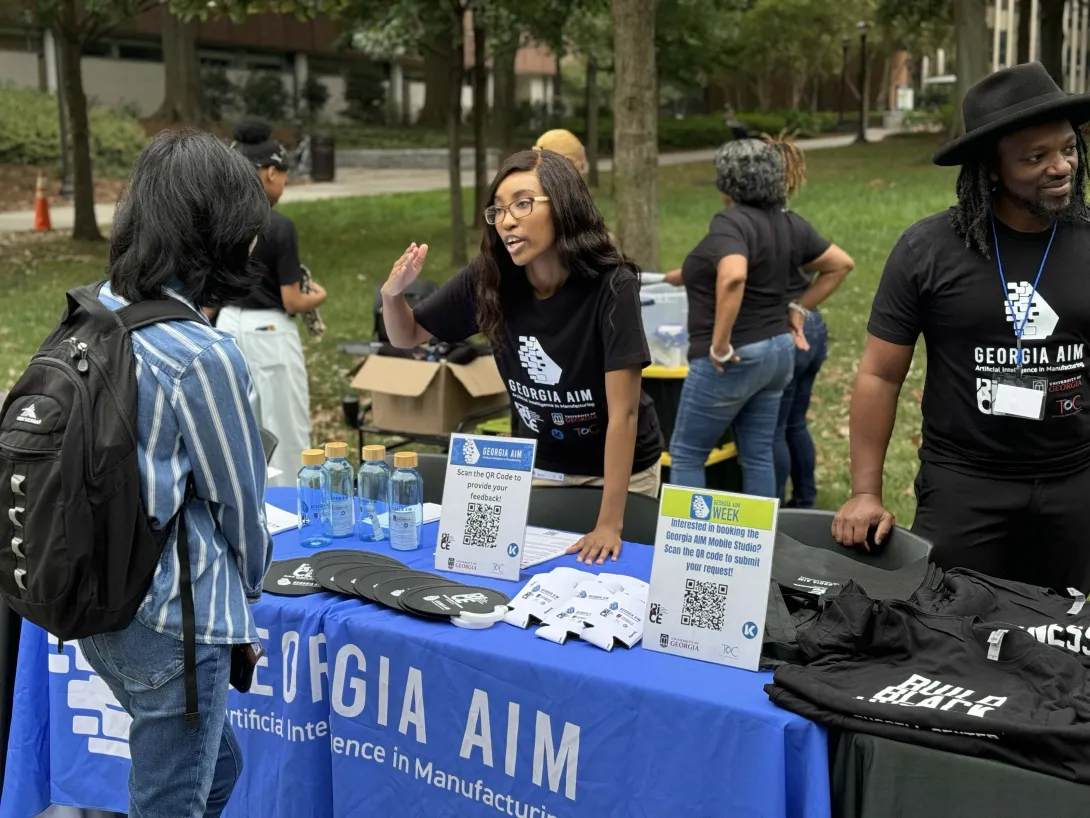
Georgia AIM representatives talk with students on Georgia Tech's campus during the launch event for their new mobile labs.
Gold and white pompoms fluttered while Buzz, the official mascot of the Georgia Institute of Technology, danced to marching band music. But the celebration wasn’t before a football or basketball game — instead, the cheers marked the official launch of Georgia AIM Week, a series of events and a new mobile lab designed to bring technology to all parts of Georgia
Organized by Georgia Artificial Intelligence in Manufacturing (Georgia AIM), Georgia AIM Week kicked off September 30 with a celebration on the Georgia Institute of Technology campus and culminated with another celebration on Friday at the University of Georgia in Athens and aligned with National Manufacturing Day.
In between, the Georgia AIM Mobile Studio made stops at schools and community organizations to showcase a range of technology rooted in AI and smart technology.
“Georgia AIM Week was a statewide opportunity for us to celebrate Manufacturing Day and to launch our Georgia AIM Mobile Studio,” said Donna Ennis, associate vice president, community-based engagement, for Georgia Tech’s Enterprise Innovation Institute and Georgia AIM co-director. “Georgia AIM projects planned events in cities around the state, starting here in Atlanta. Then we headed to Warner Robins, Southwest Georgia, and Athens. We’re excited about the opportunity to bring this technology to our communities and increase access and ideas related to smart technology.”
Georgia AIM is a collaboration across the state to provide the tools and knowledge to empower all communities, particularly those that have been underserved and overlooked in manufacturing. This includes rural communities, women, people of color, and veterans. Georgia AIM projects are located across the state and work within communities to create a diverse AI manufacturing workforce. The federally funded program is a collaborative project administered through Georgia Tech’s Enterprise Innovation Institute and the Georgia Tech Manufacturing Institute.
A cornerstone of Georgia AIM Week was the debut of the Georgia AIM Mobile Studio, a 53-foot custom trailer outfitted with technology that can be used in manufacturing — but also by anyone with an interest in learning about AI and smart technology. Visitors to the mobile studio can experience virtual reality, 3-D printing, drones, robots, sensors, computer vision, and circuits essential to running this new tech.
There’s even a dog — albeit a robotic one — named Nova.
The studio was designed to introduce students to the possibilities of careers in manufacturing and show small businesses some of the cost-effective ways they can incorporate 21st century technology into their manufacturing operations.
“We were awarded about $7.5 million to build this wonderful studio here,” said Kenya Asbill, who works at the Russell Innovation Center for Entrepreneurs (RICE) as the Economic Development Administration project manager for Georgia AIM. “We will be traveling around the state of Georgia to introduce artificial intelligence in manufacturing to our targeted communities, including underserved rural and urban residents.”
Some technology on the Georgia AIM Mobile Studio was designed in consultation with project partners Kitt Labs and Technologists of Color. An additional suite of “technology vignettes” were developed by students at the University of Georgia College of Engineering. RICE and UGA served as project leads for the mobile studio development, and RICE will oversee its deployment across the state in the coming months.
To request a mobile studio visit, please visit the Georgia AIM website.
During Monday’s kickoff, the Georgia Tech cheerleaders and Buzz fired up the crowd before an event that featured remarks by Acting Assistant Secretary of the U.S. EDA Christina Killingsworth; Jay Bailey, president and CEO of RICE; Beshoy Morkos, associate professor of mechanical engineering at the University of Georgia; Aaron Stebner, co-director of Georgia AIM; David Bridges, vice president of Georgia Tech’s Enterprise Innovation Institute; and lightning presentations by Georgia AIM project leads from around the state.
Following the presentations, mobile studio tours were led by Jon Exume, president and executive director, and Mark Lawson, director of technology, for Technologists of Color. The organization works to create a cohesive and thriving community of African Americans in tech.
“I’m particularly excited to witness the launch of the Georgia AIM Mobile Studio. It really will help demystify AI and bring its promise to underserved rural areas across the state,” Killingsworth said. “AI is the defining technology of our generation. It’s transforming the global economy, and it will continue to have tremendous impact on the global workforce. And while AI has the potential to democratize access to information, enhance efficiency, and allow humans to focus on the more complex, creative, and meaningful aspects of work, it also has the power to exacerbate economic disparity. As such, we must work together to embrace the promise of AI while mitigating its risks.”
Other events during Georgia AIM week included the Middle Georgia Innovation Corridor Manufacturing Expo in Warner Robins, West Georgia Manufacturing Day – Student Career Expo in LaGrange, and a visit to Colquitt County High School in Moultrie. The week wrapped on Friday, Oct. 4, at the University of Georgia in Athens with a National Manufacturing Day celebration.
“We’re focused on growing our manufacturing economy,” Ennis said. “We’re also focused on the development and deployment of innovation and talent in the manufacturing industry as it relates to AI and other technologies. Manufacturing is cool. It is a changing industry. We want our students and younger people to understand that this is a career.”
News Contact

U.S. Secretary of the Navy Carlos Del Toro during his remarks at the John Lewis Student Center.
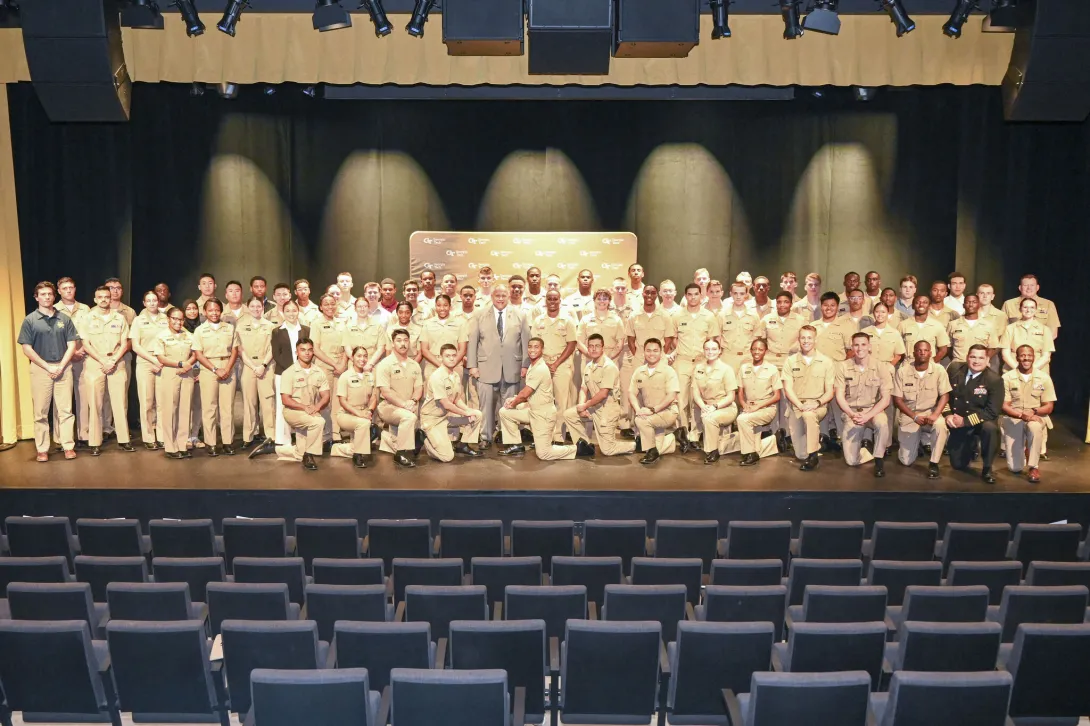
The Secretary provided an update on science and technology research to the Atlanta Region Naval Reserve Officer Training Corps unit, comprised of midshipmen from Georgia Tech, Georgia State University, Kennesaw State University, Morehouse College, Spelman College, and Clark Atlanta University.
The Georgia Tech Research Institute (GTRI) proudly hosted U.S. Secretary of the Navy Carlos Del Toro during his recent campus visit. Del Toro's visit underscored the critical role of innovation and technology in national security and highlighted Georgia Tech's significant contributions to this effort.
“Our Navy-Marine Corps Team remains at the center of global and national security — maintaining freedom of the seas, international security, and global stability,” he explained in his remarks at the John Lewis Student Center. “To win the fight of the future, we must embrace and implement emerging technologies.”
The Secretary provided an update on science and technology research to the Atlanta Region Naval Reserve Officer Training Corps unit, comprised of midshipmen from Georgia Tech, Georgia State University, Kennesaw State University, Morehouse College, Spelman College, and Clark Atlanta University. Del Toro has worked to establish a new Naval Science and Technology Strategy to address current and future challenges faced by the Navy and Marine Corps. The strategy serves as a global call to service and innovation for stakeholders in academia, industry, and government.
“The Georgia Tech Research Institute has answered this call,” he said.
A key pillar of the new strategy, says Del Toro, was the establishment of the Department of the Navy’s Science and Technology Board in 2023, “with the intent that the board provide independent advice and counsel to the department on matters and policies relating to scientific, technical, manufacturing, acquisition, logistics, medicine, and business management functions.”
The board, which includes Georgia Tech Manufacturing Institute (GTMI) Executive Director Thomas Kurfess, has conducted six studies in its inaugural year to identify new technologies for rapid adoption and provide near-term, practical recommendations for quick implementation by the Navy.
“I recently led the team for developing a strategy for integrating additive manufacturing into the Navy’s overall shipbuilding and repair strategy,” says Kurfess. “We just had final approval of our recommendations — we are making a significant impact on the Navy with respect to additive manufacturing.”
Del Toro's visit to Georgia Tech reaffirms the Institute's role as a leader in research and innovation, particularly in areas critical to national security. The collaboration between Georgia Tech and the Department of the Navy continues to drive advancements that ensure the safety and effectiveness of the nation's naval forces.
“Innovation is at the heart of our efforts at Georgia Tech and GTMI,” says Kurfess. “It is an honor to put that effort toward ensuring our country’s safety and national security in partnership with the U.S. Navy.”
“As our department continues to reimagine and refocus our innovation efforts,” said Del Toro, “I encourage all of you — our nation’s scientists, engineers, researchers, and inventors — to join us.”
News Contact
Audra Davidson
Research Communications Program Manager
Georgia Tech Manufacturing Institute
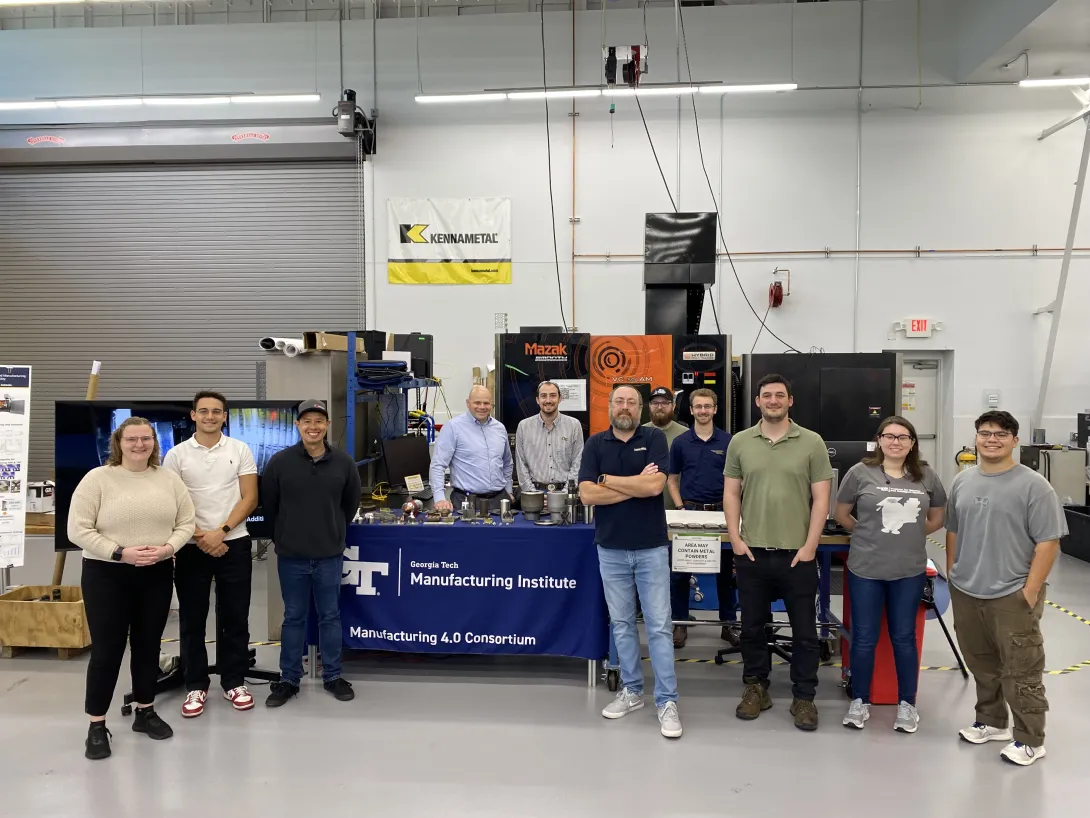
Georgia Tech students and staff members gathered at the Advanced Manufacturing Pilot Facility with members of OPEN MIND for the training.
As automation and AI continue to transform the manufacturing industry, the need for seamless integration across all production stages has reached an all-time high. By digitally designing products, controlling the machinery that builds them, and collecting precise data at each step, digital integration streamlines the entire manufacturing process — cutting down on waste materials, cost, and production time.
Recently, the Georgia Tech Manufacturing Institute (GTMI) teamed up with OPEN MIND Technologies to host an immersive, weeklong training session on hyperMILL, an advanced manufacturing software enabling this digital integration.
OPEN MIND, the developer of hyperMILL, has been a longtime supporter of research operations in Georgia Tech’s Advanced Manufacturing Pilot Facility (AMPF). “Our adoption of their software solutions has allowed us to explore the full potential of machines and to make sure we keep forging new paths,” said Steven Ferguson, a principal research scientist at GTMI.
Software like hyperMILL helps plan the most efficient and accurate way to cut, shape, or 3D print materials on different machines, making the process faster and easier. Hosted at the AMPF, the immersive training offered 10 staff members and students a hands-on platform to use the software while practicing machining and additive manufacturing techniques.
“The number of new features and tricks that the software has every year makes it advantageous to stay current and get a refresher course,” said Alan Burl, a Ph.D. student in the George W. Woodruff School of Mechanical Engineering who attended the training session. “More advanced users can learn new tips and tricks while simultaneously exposing new users to the power of a fully featured, computer-aided manufacturing software.”
OPEN MIND Technologies has partnered with Georgia Tech for over five years to support digital manufacturing research, offering biannual training in their latest software to faculty and students.
“Meeting the new graduate students each fall is something that I look forward to,” said Brad Rooks, an application engineer at OPEN MIND and one of the co-leaders of the training session. “This particular group posed questions that were intuitive and challenging to me as a trainer — their inquisitive nature drove me to look at our software from fresh perspectives.”
The company is also a member of GTMI’s Manufacturing 4.0 Consortium, a membership-based group that unites industry, academia, and government to develop and implement advanced manufacturing technologies and train the workforce for the market.
“The strong reputation of GTMI in the manufacturing industry, and more importantly, the reputation of the students, faculty, and researchers who support research within our facilities, enables us to forge strategic partnerships with companies like OPEN MIND,” says Ferguson, who also serves as executive director of the consortium. “These relationships are what makes working with and within GTMI so special.”
News Contact
Audra Davidson
Research Communications Program Manager
Georgia Tech Manufacturing Institute
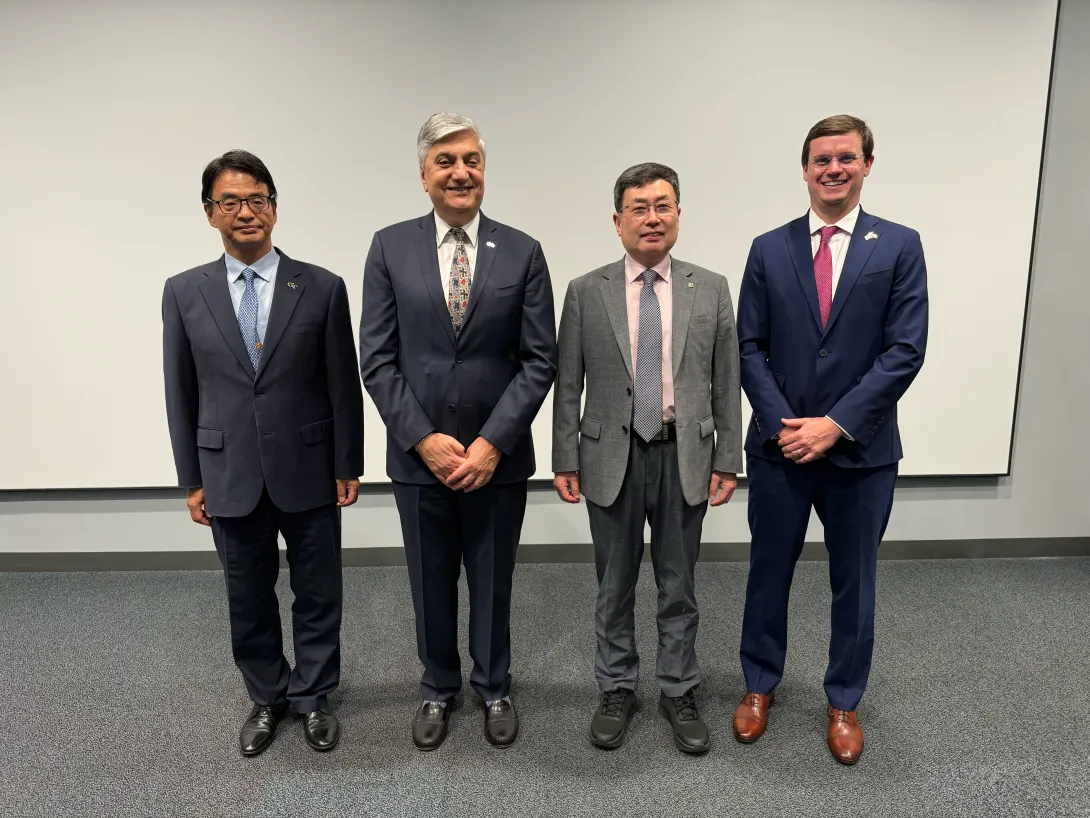
Leadership at the Memorandum of Understanding signing with the Korea Institute of Industrial Technology (KITECH). From left to right: Sangpyo Suh, Consulate General of Korea in Atlanta; Chaouki Abdallah, former executive vice president of Research at Georgia Tech; Sang Mok Lee, president of KITECH; and Barton Lowrey, director of the Georgia Department of Economic Development.
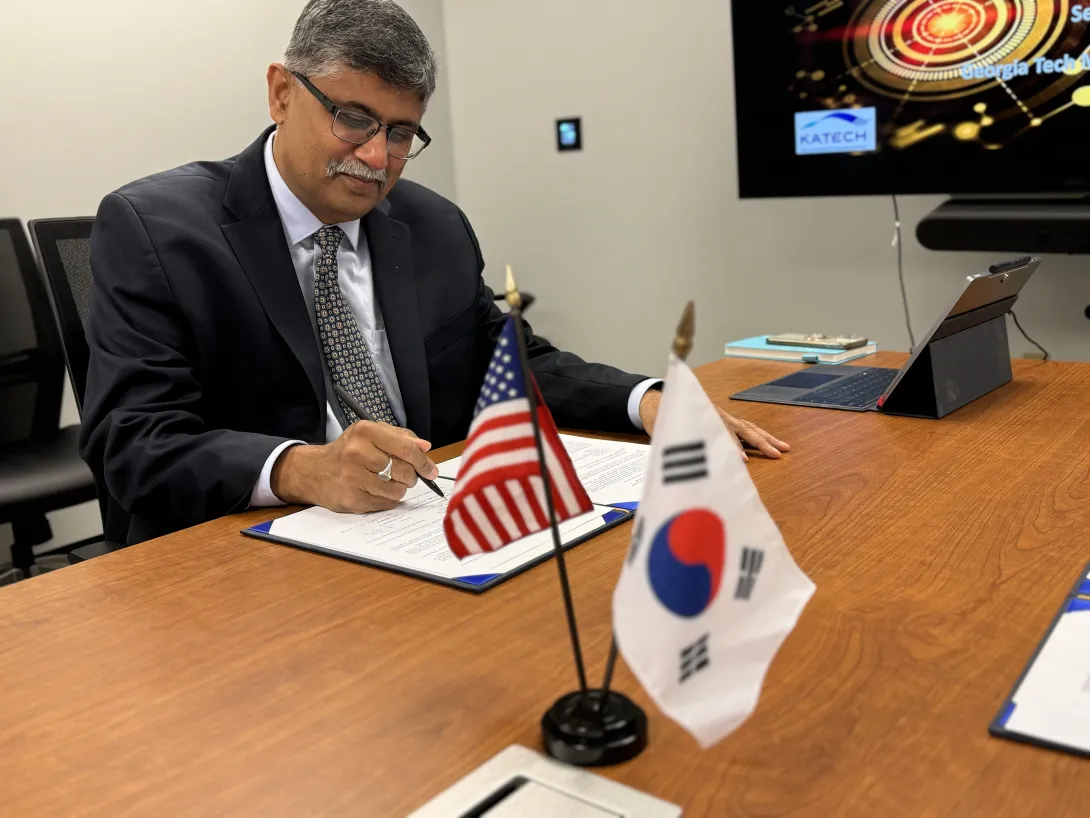
Shreyes Melkote, associate director of the Georgia Tech Manufacturing Institute, signing the Memorandum of Understanding with the Korea Automotive Technology Institute.
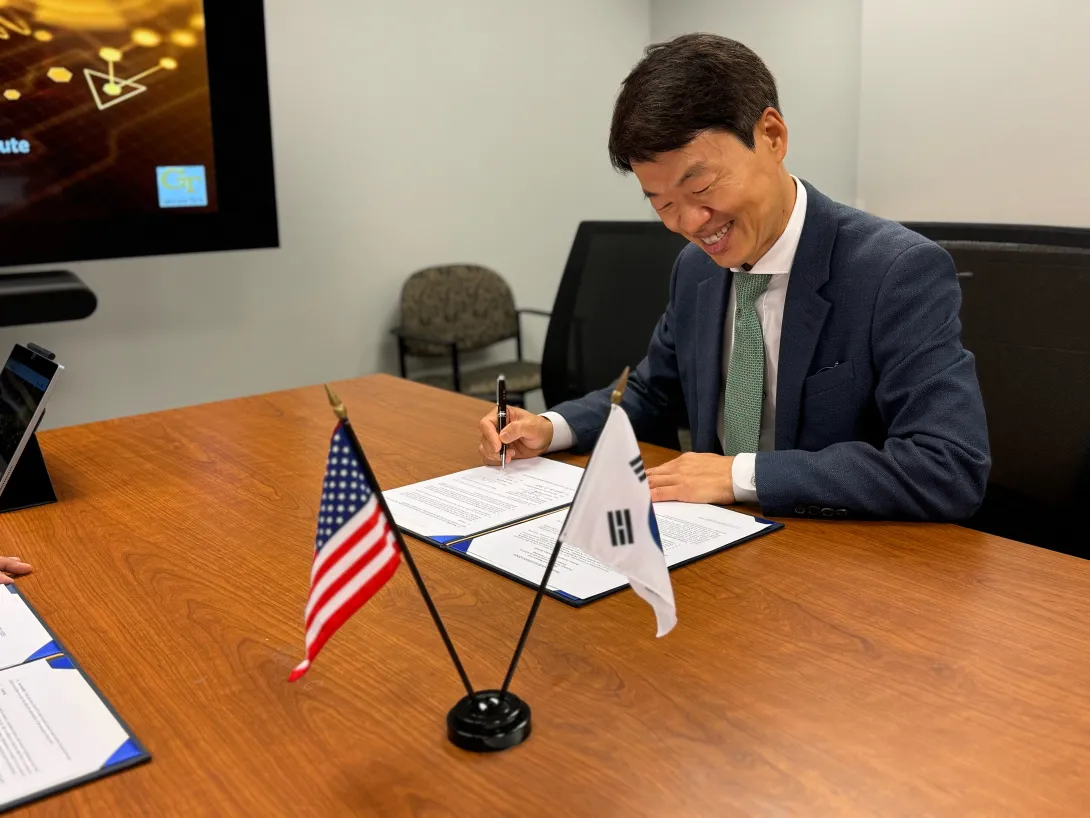
Na-Seung Sik, president of the Korea Automotive Technology Institute, signing the Memorandum of Understanding with Georgia Tech at the Georgia Tech Manufacturing Institute.
In a significant step towards fostering international collaboration and advancing cutting-edge technologies in manufacturing, Georgia Tech recently signed Memorandums of Understanding (MoUs) with the Korea Institute of Industrial Technology (KITECH) and the Korea Automotive Technology Institute (KATECH). Facilitated by the Georgia Tech Manufacturing Institute (GTMI), this landmark event underscores Georgia Tech’s commitment to global partnerships and innovation in manufacturing and automotive technologies.
“This is a great fit for the institute, the state of Georgia, and the United States, enhancing international cooperation,” said Thomas Kurfess, GTMI executive director and Regents’ Professor in the George W. Woodruff School of Mechanical Engineering (ME). “An MoU like this really gives us an opportunity to bring together a larger team to tackle international problems.”
“An MoU signing between Georgia Tech and entities like KITECH and KATECH signifies a formal agreement to pursue shared goals and explore collaborative opportunities, including joint research projects, academic exchanges, and technological advancements,” said Seung-Kyum Choi, an associate professor in ME and a major contributor in facilitating both partnerships. “Partnering with these influential institutions positions Georgia Tech to expand its global footprint and enhance its impact, particularly in areas like AI-driven manufacturing and automotive technologies.”
The state of Georgia has seen significant growth in investments from Korean companies. Over the past decade, approximately 140 Korean companies have committed around $23 billion to various projects in Georgia, creating over 12,000 new jobs in 2023 alone. This influx of investment underscores the strong economic ties between Georgia and South Korea, further bolstered by partnerships like those with KITECH and KATECH.
“These partnerships not only provide access to new resources and advanced technologies,” says Choi, “but create opportunities for joint innovation, furthering GTMI’s mission to drive transformative breakthroughs in manufacturing on a global scale.”
The MoUs with KITECH and KATECH are expected to facilitate a wide range of collaborative activities, including joint research projects that leverage the strengths of both institutions, academic exchanges that enrich the educational experiences of students and faculty, and technological advancements that push the boundaries of current manufacturing and automotive technologies.
“My hopes for the future of Georgia Tech’s partnerships with KITECH and KATECH are centered on fostering long-term, impactful collaborations that drive innovation in manufacturing and automotive technologies,” Choi noted. “These partnerships do not just expand our reach; they solidify our leadership in shaping the future of manufacturing, keeping Georgia Tech at the forefront of industry breakthroughs worldwide.”
Georgia Tech has a history of successful collaborations with Korean companies, including a multidecade partnership with Hyundai. Recently, the Institute joined forces with the Korea Institute for Advancement of Technology (KIAT) to establish the KIAT-Georgia Tech Semiconductor Electronics Center to advance semiconductor research, fostering sustainable partnerships between Korean companies and Georgia Tech researchers.
“Partnering with KATECH and KITECH goes beyond just technological innovation,” said Kurfess, “it really enhances international cooperation, strengthens local industry, drives job creation, and boosts Georgia’s economy.”
News Contact
Audra Davidson
Research Communications Program Manager
Georgia Tech Manufacturing Institute
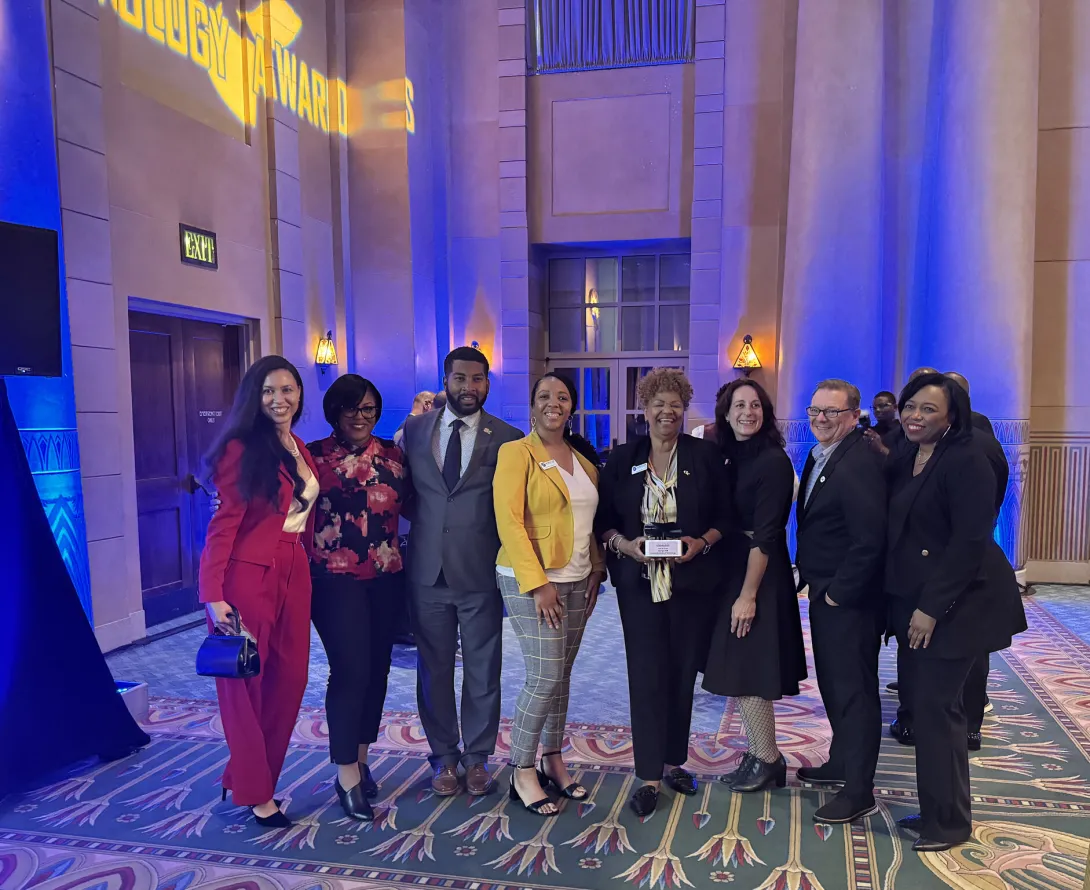
Members of Georgia AIM’s governance team stand for a photo with Cassia Baker, a cybersecurity expert with the Georgia Manufacturing Extension Partnership (left), and David Bridges, executive vice president of Georgia Tech’s Enterprise Innovation Institute (second from right), which oversees the projects.
Georgia AIM (Artificial Intelligence in Manufacturing) was recently awarded the 'Tech for Good' award from the Technology Association of Georgia (TAG), the state’s largest tech organization.
The accolade was presented at the annual TAG Technology Awards ceremony on Nov. 6 at Atlanta’s Fox Theatre. The TAG Technology Awards promote inclusive technology throughout Georgia, and any state company, organization, or leader is eligible to apply.
Tech for Good, one of TAG’s five award categories, honors a program or project that uses technology to promote inclusiveness and equity by serving Georgia communities and individuals who are underrepresented in the tech space.
Georgia AIM is comprised of 16 projects across the state that connect smart technology to manufacturing through K-12 education, workforce development, and manufacturer outreach. The federally funded program is a collaborative project administered through Georgia Tech’s Enterprise Innovation Institute and the Georgia Tech Manufacturing Institute.
TAG is a Georgia AIM partner and provides workforce development programs that train people and assist them in making successful transitions into tech careers.
Donna Ennis, Georgia AIM’s co-director, accepted the award on behalf of the organization.
“Georgia AIM’s mission is to equitably develop and deploy talent and innovation for AI in manufacturing, and the Tech for Good Award reinforces our focus on revolutionizing the manufacturing economy for Georgia and the entire country,” Ennis said in her acceptance speech.
She cited the organization’s many coalition members across the state: the Technical College System of Georgia; Spelman College; the Georgia AIM Mobile Studio team at the Russell Innovation Center for Entrepreneurs and the University of Georgia; the Southwest Georgia Regional Commission; the Georgia Cyber Innovation & Training Center; and TAG and Georgia AIM’s partners in the Middle Georgia Innovation corridor, including 21st Century Partnership and the Houston Development Authority.
Ennis also acknowledged the U.S. Economic Development Administration for funding the project and helping to bring it to fruition. “But most of all,” she said, “I want to thank our manufacturers and communities across Georgia who are at the forefront of creating a new economy through AI in manufacturing. It is a privilege to assist you on this journey of technology and discovery.”
News Contact
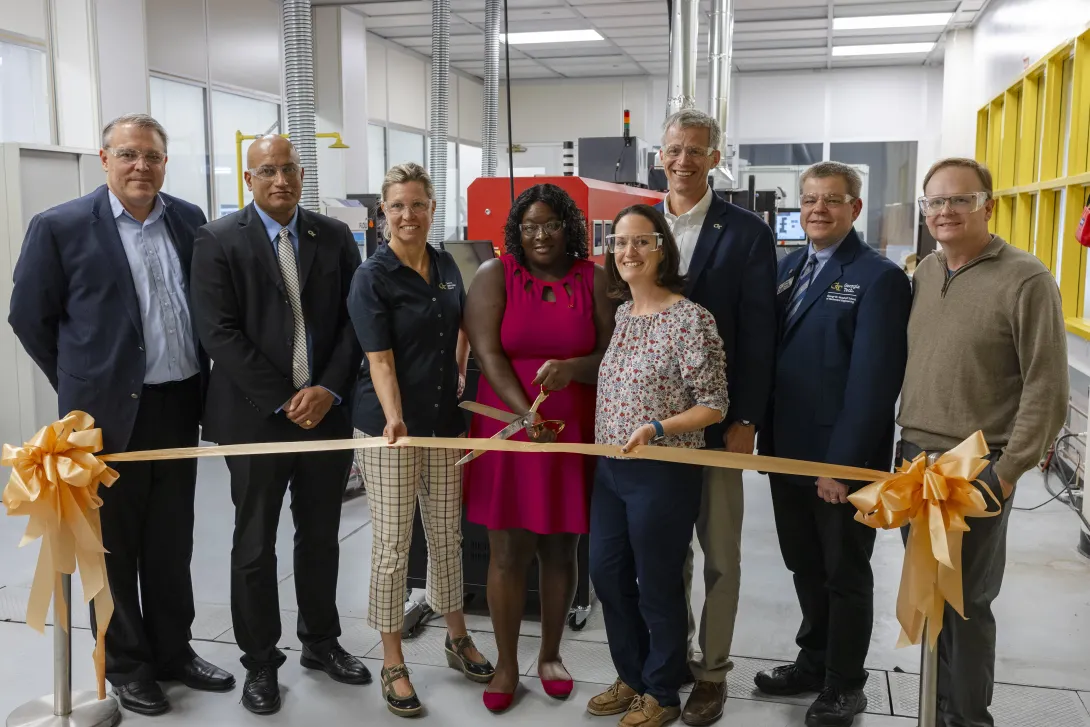
Partners of the facility gathered for an official ribbon cutting ceremony. From left to right: Eric Vogel, Hightower Professor in MSE, and executive director for the Institute for Matter and Systems; Devesh Ranjan, Eugene C. Gwaltney, Jr. school chair and professor in the George W. Woodruff School of Mechanical Engineering; Julia Kubanek, Vice President of Interdisciplinary Research; Tequila Harris, professor in the Woodruff School and facility leader; Christine Conwell, interim executive director for the Strategic Energy Institute; Tim Liewen, interim executive vice president for Research; Thomas Kurfess, Regent's Professor in the Woodruff School and executive director of the Georgia Tech Manufacturing Institute; J. Carson Meredith, professor and James Preston Harris Faculty Fellow in the School of Chemical and Biomolecular Engineering, executive director of the Renewable Bioproducts Institute. Photo: Christopher McKenney.
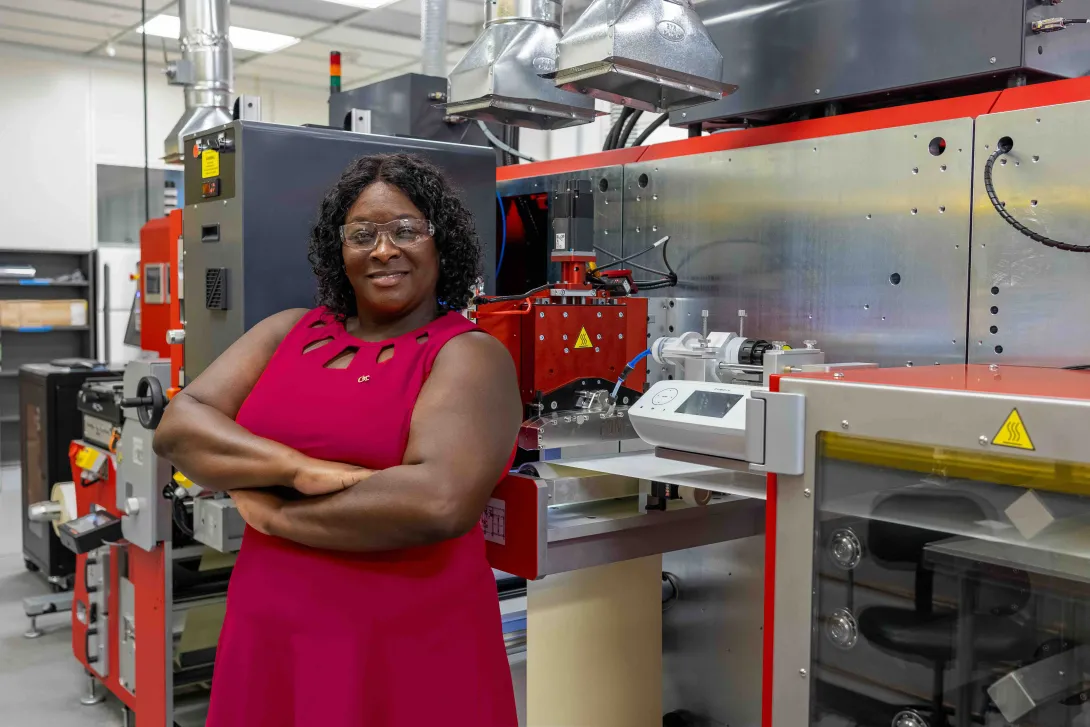
Tequila Harris, professor in the George W. Woodruff School of Mechanical Engineering, next to the modular R2R equipment. Photo: Christopher McKenney.
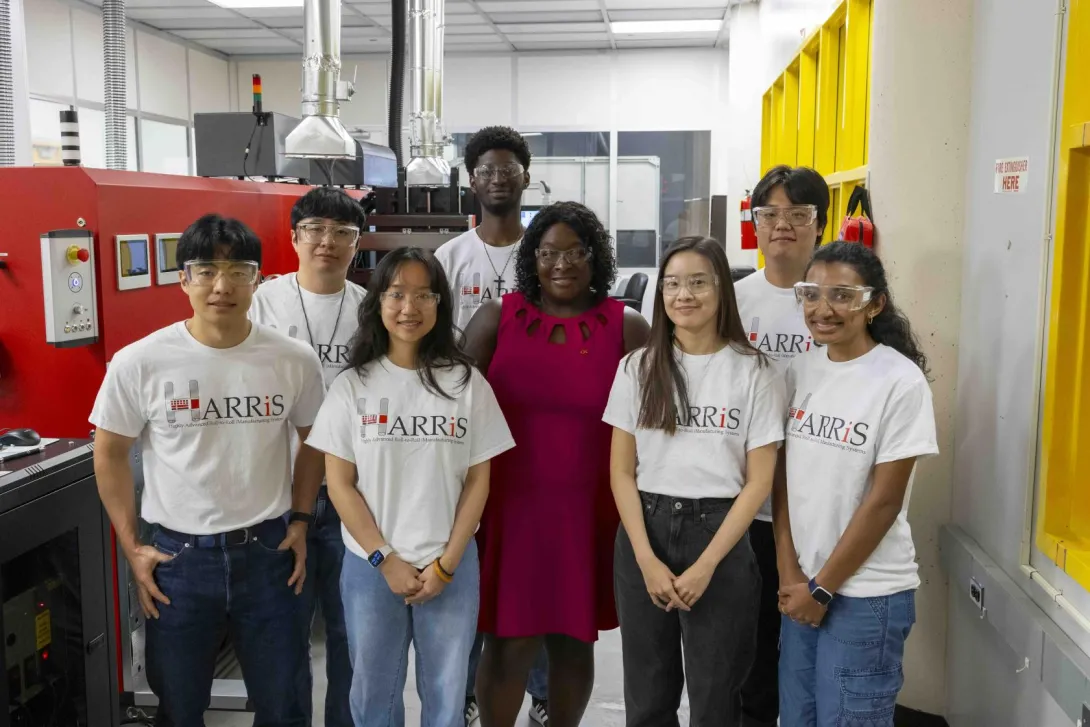
The Highly Advanced Roll-to-Roll iManufacturing Systems (HARRiS) research group in the new R2R facility. Photo: Christopher McKenney.
Whether it’s developing new products, reducing costs, or increasing accessibility, innovations in manufacturing stand to improve the lives of companies and consumers alike. Georgia Tech recently took another step toward ensuring those innovations make it from lab to market with the launch of a Modular Pilot Scale Roll-to-Roll Manufacturing Facility.
“As researchers develop new materials, one of the key aspects we’re missing is how to make them at scale. This is a major oversight because if we can’t make them at scale, we can’t transition from basic research to commercialization,” said Tequila Harris, a professor in the George W. Woodruff School of Mechanical Engineering. “With this new facility, we can prove our discoveries beyond lab-scale studies — and can go from materials innovation to product development at scale.”
Led by Harris, the new facility is the result of a partnership between the Georgia Tech Manufacturing Institute(GTMI), the Strategic Energy Institute, and the Woodruff School. As a pilot facility, it will serve as a testbed for scaling up manufacturing research open for Georgia Tech researchers as well as academic, government, and industry partners around the world.
“The larger vision I see at Georgia Tech involves innovation in manufacturing for large-scale industries,” said Georgia Tech’s Interim Executive Vice President for Research Tim Lieuwen at the facility’s unveiling event on Sept. 19. “It’s crucial that we’re innovating in basic science and technology, but we also need to be innovating in large-scale manufacturing.”
Roll-to-roll (R2R) manufacturing transforms flexible rolls of substrate materials, such as paper, metal foils, and plastics, into more complex, transportable rolls upon coating the surface with one or more fluids, such as inks, suspensions, and solutions, which are subsequently dried or cured on the base substrate. Its high yield and efficiency make R2R an ideal method for the sustainable, large-scale production of components for solar cells, batteries, flexible electronics, and separations — all industries that have expanded in Georgia in recent years.
“As a state institution, we’re ultimately here to serve our state,” said Lieuwen, who is also Regents’ Professor and David S. Lewis Jr. Chair in the Daniel Guggenheim School of Aerospace Engineering. “We’re seeing Georgia emerge as the national leader in terms of recruiting corporate investments in this space and in industries that will be served by this facility.”
Roll-to-Roll Innovations
The R2R process is similar to the production of newspapers, where a large roll of blank paper goes through a series of rollers printing text and photos. “The roll-to-roll aspect is the process of using a specialized tool to force fluid onto a moving surface,” says Harris. It’s one of the fastest-growing methods for producing thin film materials — photovoltaics used in solar cells, transistors in flexible electronics, and micro-batteries, for example — at a large scale.
Harris’s group works to develop novel manufacturing tools, with a particular focus on understanding and improving the dynamics of thin film manufacturing to increase efficiency and minimize waste. Her group is particularly interested in slot die coating, an R2R technique where a liquid material is precisely deposited onto a substrate through a narrow slot. With the new pilot facility, researchers like Harris will be able to take their work to the next level.
“Slot die coating on a roll-to-roll can handle the broadest viscosity range of most coating methods. Therefore, you can process a lot of different materials very quickly and easily,” says Harris. “It’s one of the fastest-growing technologies in the U.S. — and currently, this is the most advanced modular pilot scale facility at an academic university in the United States.”
“Georgia Tech is way ahead of the curve in terms of our facilities,” says GTMI Executive Director and Regents’ Professor Thomas Kurfess. “This will grow our capability in the battery area, membranes, flexible electronics, and more to allow us to support the development of new technologies.”
“As technologies around cleantech continue to advance at an unprecedented pace, pilot manufacturing facilities provide a critical bridge between innovative benchtop research and commercial-scale production and manufacturing,” says Christine Conwell, interim executive director of the Strategic Energy Institute. “We are excited about the opportunities this R2R facility will provide to the Georgia Tech energy community and our industry partners.”
News Contact
Audra Davidson
Research Communications Program Manager
Georgia Tech Manufacturing Institute
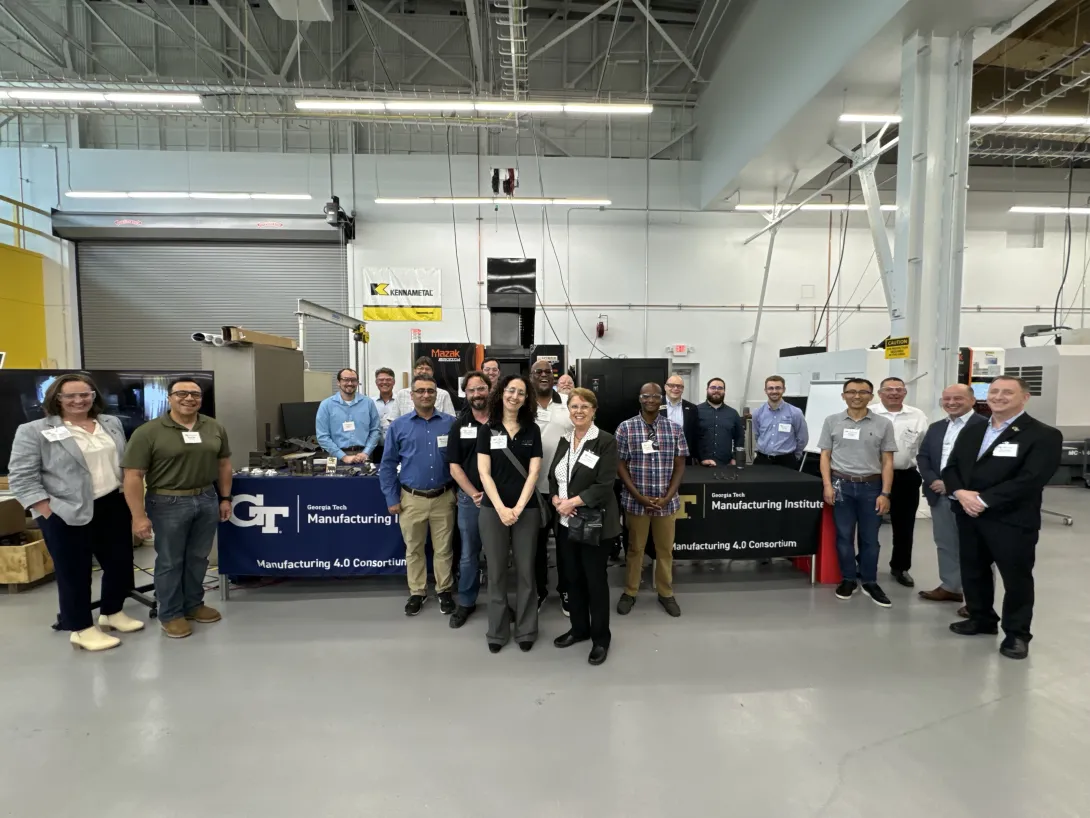
Manufacturing 4.0 Consortium members gathered at the June quarterly meeting. Photo: Audra Davidson.
Between revitalized investments in America’s manufacturing infrastructure and an increased focus on AI and automation, the U.S. is experiencing a manufacturing renaissance. A key focus of this resurgence lies in improving the resiliency of supply chains in the U.S., particularly in crucial sectors like defense.
“If we were to suddenly have a seismic shift in defense manufacturing needs,” asks Aaron Stebner, professor and Eugene C. Gwaltney Jr. Chair in Manufacturing in the George W. Woodruff School of Mechanical Engineering, “do we have the supply chain and manufacturers who could meet that sudden increase in demand? How do we do that in a way that’s sustainable for long periods of time as a nation if that need arises?”
The Georgia Tech Manufacturing Institute (GTMI) officially launched the Manufacturing 4.0 Consortium in 2023 to address that need. Designed to form a network of engaged manufacturers from across the country, the Consortium serves as a key connection point between Georgia Tech and industry partners — and as fertile ground for collaborative innovation.
“By bringing us all together,” says Stebner, who serves on the board of the Consortium, “we can do bigger, more meaningful things and find unique ways and opportunities to get money flowing back to the companies and Georgia Tech.”
With over 25 founding company members, the Consortium celebrated its first official year of operation in August.
Creating a Resilient Network
The Manufacturing 4.0 Consortium originally grew out of an 18-month pilot project funded by the Department of Defense Office of Local Community Cooperation aiming to increase defense supply chain resilience, assist Georgia manufacturers in adopting new technologies, and foster collaboration by connecting manufacturers across Georgia.
Those goals and more are tackled by the Consortium’s focus on “networking, engagement, and collaboration,” says Stebner. “It's not just a consortium for Georgia Tech to take money from industry and do stuff with their money — the goal is to create new resources that enable us to collaborate in bigger ways than we could otherwise.”
To join the Consortium, industry members pay up to $10,000 annually to access its network, intellectual property, and facilities. With a 10% membership discount for Georgia businesses and a 75% discount for small businesses, the Consortium especially aims to promote growth for small Georgia manufacturers.
“Memberships come with time at the Advanced Manufacturing Pilot Facility, which we’re expanding to be this test bed for autonomous maturation of research and development,” says Stebner. “The fact that we have what’s going to be an almost $60 million facility behind us as a mechanism and a playground for all these companies is unique.”
“Having a shared use facility that is fully equipped to solve manufacturing’s most interesting challenges is not only a perk of Consortium memberships,” said Executive Director Steven Ferguson, “but it also serves as a hub for innovation in manufacturing.”
Industry Innovation
Many consortiums founded by academic institutions are primarily focused on academic research.
“The Manufacturing 4.0 consortium has an industry focus,” said Branden Kappes, founder and president of Consortium member company Contextualize LLC. “It's more about how we take this capability that, at the moment, is trapped in a lab and transition from a wonderful concept into a wonderful product.”
The Consortium achieves that translation through shared intellectual property agreements, collaborative research initiatives, and an emphasis on creating an engaged and open network of members.
“I see camaraderie inside the Manufacturing 4.0 Consortium,” says Kappes. “I see companies that overlap and compete in some areas, are complementary in others, and are willing to build a bridge to advance the capabilities of both sides and the community as a whole. That type of mentality is very exciting.”
“This is one of the most highly engaged groups I have interacted with in a professional setting,” said John Flynn, vice president of Sales at Consortium member company Endeavor 3D. “It is an incredibly dynamic melting pot of all the different facets of industry 4.0 and digital manufacturing, bringing everyone together from that part of the supply chain to create what I know will be important and value-added projects, ultimately resulting in intellectual property.”
“We are able to connect Consortium members with subject matter experts at Georgia Tech and within the Consortium who have ‘been there and done that,’” said Ferguson. “At the same time, we are working with manufacturers to create novel solutions to complex problems through research engagements. Blending all of those activities into one organization is part of the magic that is the Consortium.”
News Contact
Audra Davidson
Communications Manager
Georgia Tech Manufacturing Institute

GTRI is leading the development of an integrated artificial intelligence response hub for Southwest Georgia to help communities streamline disaster management and logistics.
As artificial intelligence continues to transform countless areas of society, the Georgia Tech Research Institute (GTRI) is applying it to another critical area: disaster management.
GTRI is leading the development of an integrated artificial intelligence response hub for Southwest Georgia to help communities streamline disaster management and logistics. The hub aims to enhance resilience and response efficiency of these communities, potentially saving lives and reducing economic losses. GTRI is collaborating in this effort with the Southwest Georgia Regional Commission (SWGRC), a regional planning agency that serves 14 counties and 44 cities in Southwest Georgia. The SWGRC focuses on ecosystem building in the areas of manufacturing in food production, manufacturing start-ups, supply chain logistics and workforce development.
“This will be a centralized platform that key stakeholders in Southwest Georgia can use to manage various disruption scenarios,” said GTRI Senior Research Engineer Francisco Valdes, who is leading this project.
This project is one of several initiatives undertaken by Georgia Artificial Intelligence in Manufacturing (Georgia AIM), a $65 million federal grant awarded to Georgia Tech and a coalition of partners across the state, including the Georgia Tech Manufacturing Institute.
Read the full story on the GTRI website >>>
News Contact
Writer: Anna Akins
Photos: Sean McNeil
Media Inquiries: michelle.gowdy@gtri.gatech.edu
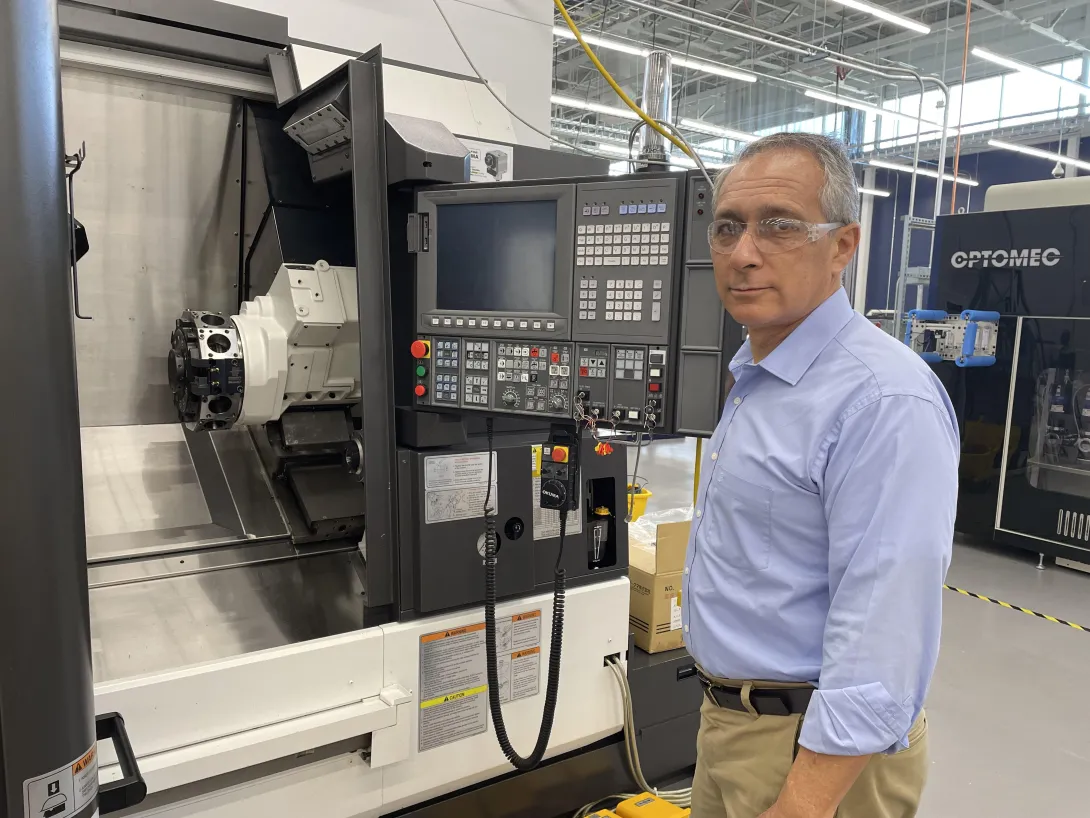
Professor Horacio Ahuett Garza from the Tecnológico de Monterrey
Professor Horacio Ahuett Garza from the Tecnológico de Monterrey recently settled into the Georgia Tech Manufacturing Institute (GTMI) community as a visiting scholar. Ahuett is a leading faculty member in the Mechanical Engineering and Advanced Materials Department at Tecnológico de Monterrey located in Monterrey, Mexico. He earned his mechanical engineering masters and doctorate from Ohio State University more than 25 years ago. Ahuett will be interacting with Georgia Tech faculty to explore research areas in Smart Manufacturing and Industry 4.0.
“My home university has 30 campuses across Mexico with the main campus being in Monterrey—where I was born. I’ve known professor Tom Kurfess, executive director of GTMI, for more than 20 years. He has a faculty appointment at Tecnológico de Monterrey similar to a distinguished professor due to an agreement with Georgia Tech,” said Ahuett. “We’re both involved with advanced manufacturing but in different countries with similar processes. However, the facilities at Georgia Tech are far more advanced, such as the Advanced Manufacturing Pilot Facility (AMPF) operated by GTMI. Some of our graduate students periodically come to participate in research at Georgia Tech.”
Ahuett, who has ample manufacturing research experience, was extended an invitation to visit Georgia Tech this spring. He is using this visit as a sabbatical to further his understandings and learn more about new advanced manufacturing topic areas.
He recently attended The Hershey Company lecture at GTMI presented by Will Bonifant, vice president of the US and Canada supply chain, and Chris Myers, vice president of engineering at Hershey. The topic was modernizing a century-old, iconic snacks company leveraging Industry 4.0 digital and technology solutions.
“Today, Hershey provided a good understanding of smart manufacturing and how Hershey uses its fast access to data to make quick decisions that are implemented inside the factory and its processes,” said Ahuett. “They deployed smart manufacturing processes to use fewer resources, reduce waste, yet make factory equipment changes in a timely manner and safe manner to deliver targeted product quantities based on customer demand.”
Ahuett indicated that the proliferation of sensor technology and corresponding data can be used to benefit manufacturing by reducing waste, saving energy, and generally making companies more agile with better use of resources in factory settings. One example would be understanding performance parameters for tooling where you generally know the life cycle of a cutting tool and are able to measure the tool’s degradation in real time so that you can make plans to replace the tool at the best time to minimize your downtime of that tool versus waiting for it to break unexpectedly and shut down the process.
His strongest research interest during his GTMI visit is the topic of digital twins.
“The topic of digital twins is not new -- it has been around for at least 40 years. A good example is that during the Apollo moon missions NASA had digital twins. They had instruments on earth that replicated the instruments sent on the moon missions so they could simulate actions [using data] on earth that would occur on the actual spaceships,” said Ahuett.
“The concept of digital twins generates confusion. The first impulse is to think of a digital image as the twin of a physical entity. In principle, the digital twin simulates the behavior of the physical twin to model and make predictions. Not all processes can be modelled in real time, but some can which provides beneficial information in a timely manner given how fast computer processors are today. Today, we have more and better tools that use data to give us greater insights.”
Ahuett will be working with robots and co-robots in collaboration with Kyle Saleeby, research engineer at GTMI, to help automate accurate measuring during a manufacturing process. A piece of their research project will be building models so a part’s characteristic data can be tracked and stored in a digital twin that represents a specific instance of each part manufactured and which will also include external data associated with the manufacturing of the part.
“I’m hoping my sabbatical at Georgia Tech will help me develop new competencies, new skills, and new knowledge on critical topics. I want to move research further in some areas and part of being here is to figure out some things that I didn’t know before with the help of GTMI,” said Ahuett.
News Contact
Walter Rich