
Mar. 03, 2025
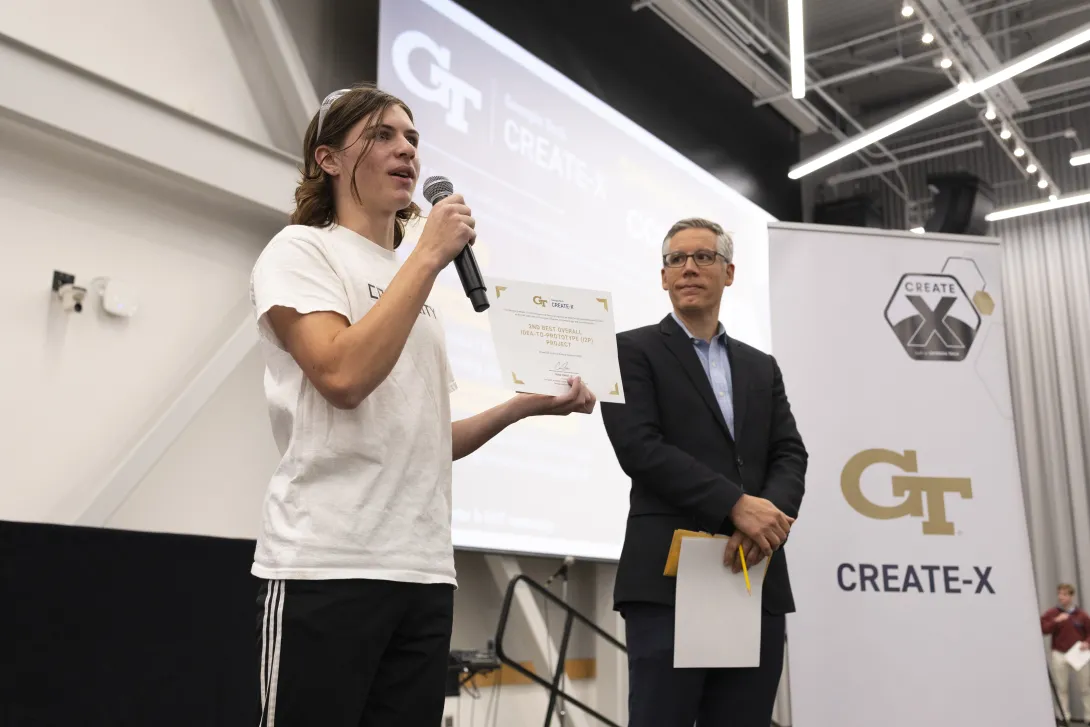
Calla Scotch, Sophomore, Mechanical Engineering and Materials Science and Engineering, speaks about their win with Team Convexity at the Fall 2024 I2P Showcase.
On April 21 at 5 p.m. in the Marcus Nanotechnology Building Atrium, dozens of teams will present prototypes at the Spring 2025 Idea to Prototype (I2P) Showcase. They will be vying for a chance to get a golden ticket in CREATE-X’s Startup Launch program, which gives participants $5,000 in optional seed funding and $150,000 in in-kind services like accounting and legal services, mentorship, and entrepreneurial education, among other benefits.
The I2P course, where these students develop their prototypes, offers research credit for undergraduate students up to $500 in reimbursement for physical material expenses and faculty mentorship. It’s open three times a year, in the spring, summer, and fall. Both undergraduate and graduate students can take the course, and students can take it up two times.
Convexity Electronics finished in second place at the Fall 2024 I2P Showcase. The company delivers smaller, faster, and more cost-effective circuit boards compared to traditional lithography-based methods. We delved into the team’s journey, challenges, and aspirations in this exclusive Q&A with one of its founders, Calla Scotch.
Q&A with Team Convexity's Calla Scotch
Team Members:
Calla Scotch, Sophomore, Mechanical Engineering and Materials Science and Engineering
Atharva Lele, Sophomore, Engineering
Anuj Pandey, Junior, Mechanical Engineering
Why did you pursue your startup?
It’s so complex. There are so many routes, and it's so new in terms of how many people are working on it. One day I woke up and couldn't stop thinking about it, then I couldn't sleep about it, and then I couldn't stop working on it. It was one of those things where I couldn't stop.
Traditionally, circuit boards — the stuff that's in your phones, computers, cameras, cars, everything — are made entirely subtractively. You have your block of material and cut away the stuff you don't want. It's a well-thought-out manufacturing process, but it's mostly very expensive and very slow. The materials and electronics manufacturing industry hasn't changed in about 30 years because it's been optimized as much as it can be.
What is your goal with Convexity?
To take that subtractive process and, instead of doing that, build the same circuits additively. I'm working on 3D printing the insulative base material, then 3D printing the conductive material, then using an electrical process to take those conductive materials and convert them into copper. And then doing layer after layer after layer to make the same circuits that someone in a subtractive process would do.
If you have traditional manufacturing, it takes about two weeks to ship from China, and it takes about a week to make a lab. My goal would be to make them in about five hours and then courier them over the same day. You don't need a big serial manufacturing facility if someone needs 6,000 boards. You don't have 6,000 printers in one room; all your printers are connected to the cloud. You could even go from 2D electronics to three-dimensional electronics. We just want to make more, smaller, faster, and cheaper than traditional manufacturing.
What surprised you about I2P?
How much time it took out of my day and how much I didn't want to do as much homework anymore. It made me want to focus all of my time on this and on how many different avenues there were to do what I wanted to do. I probably went through 30 different iterations of completely different scientific topics. I think because of how many options there were and how crazy scientifically advanced each of them was, it is what keeps me going.
What was your favorite part about I2P?
I did I2P for two semesters, and the best thing about it is getting to work on your own project and your own research for class credit.
What was challenging about building your prototype over the semester?
Sifting through all the research and development that has gone into this field. Electronics manufacturing has been around for a long time, and there's a lot of research and patents to work through and build on. I feel like I spent half my time coming up with ideas and the other half building the physical printer.
What would you say to students who are interested in entrepreneurship?
I can't tell you how much I've learned just by doing. Outside of that, talk to people. Just go out and talk to people. Ask people questions. Have your problem and get their input and insight on it, because how we make smart decisions and make startups that people want is by asking people what they want.
Cheer on Convexity as they pitch their prototype at the final round of the InVenture Prize, on March 12, at 7:30p.m., in the Ferst Theater of Arts. During this competition, the largest of its kind in the nation, a panel of celebrity judges and experts in science, technology, and venture capital will judge undergraduate teams competing for $35,000, including $5,000 for the People’s Choice award. Through audience voting, you get to advance the projects you support. Request your free InVenture Prize tickets today.
Want to be part of the next wave of technological advancements? Register for the Spring 2025 I2P Showcase to see our latest cohort of I2P inventors and their prototypes. Consider joining I2P for Summer or Fall 2025. For more information, visit the I2P program website.
News Contact
Breanna Durham
Marketing Strategist
Mar. 03, 2025

Forbes 30 Under 30 list featured eight CREATE-X founders. Pictured are Sohan Choudhury of Flint, Garrett Smiley of Sora Schools, Sarah Hamer of RetailReady, and Bruno Geoly of Lumindt.
CREATE-X is celebrating the eight CREATE-X entrepreneurs included on the recent Forbes 30 Under 30 list. They include founders Sohan Choudhury of Flint, Garrett Smiley of Sora Schools, Sarah Hamer of RetailReady, Bruno Geoly and Mia Rath of Lumindt, Rishabh Kewalramani of BackBar, Safir Monroe of UnDelay, and Tamara Zubatiy of Barometer.
Forbes 30 Under 30 is a yearly list of notable young people in art, entertainment, healthcare, science, and more. CREATE-X has had founders on this list 11 times since 2017. Read about how some of the 2025 honorees got their start — and their advice for other aspiring entrepreneurs.
Sohan Choudhury: Flint
The Beginning
“I decided to start Flint because I was passionate about education as a space, and I felt that there's a lot more that could be done with AI in education. When we started the company in May 2023, the perspective of a lot of schools and teachers on AI was very negative because they were looking at how students were using it to cheat. As technologists, my co-founder and I asked, ‘Is there something more we can do to change this narrative and perspective?’ We started building tools for teachers and students and partnering with schools.”
The CREATE-X Experience
“CREATE-X gave me the first avenue to work on my own thing. When I was a first-year or sophomore in college, I didn't know that was possible. I thought once I graduate I'll maybe get an engineering job and just do that. But CREATE-X changed that story for me by giving me another path. As I went down that path with my first company, the advisors we had through CREATE-X were incredibly helpful to us.”
The Outlook
“Day to day, a lot of the work we do is pretty unglamorous. We’re dealing with bugs that our customers are facing, or we’re cold emailing people. It's easy to get lost in the weeds. The Forbes announcement was a great way for us to reflect on what we've done so far. It's such a team effort, so it was validating to get recognition on a broader level for the work we're doing.”
Advice for Success
“If you can code or are interested in coding, pull on that thread. If you can build your own prototypes, which is becoming easy to do nowadays with AI, it will help you get further with your ideas. The second piece of advice is to take your idea and try to convince someone to pay for it. Even if you have a tool that will save your peers time with studying, build something basic for it, but then ask them to pay you five bucks. People speak with their money. There were times at Flint where we had a lot of positive feedback, and then we asked people to pay, and all of the constructive feedback came out.”
Garrett Smiley: Sora Schools
The Beginning
“I was a military brat, so I moved around to a lot of different schools and experienced a bunch of different styles of learning. I went to school in the early 2010s, right when laptops were entering the classroom. We had YouTube, Khan Academy, Coursera, and all these things hit the mainstream. Because of my background, education was a very active question in my life. I saw how these tools completely supercharged my learning and changed the relationship between student and teacher and the dynamics of the classroom.”
The CREATE-X Experience
“CREATE-X asked us to think about large systemic problems we were passionate about. That pushed me to think seriously about how I could help solve a problem in this space. It was helpful to put into practice many of the startup lessons that I'd been studying forever, and it was great to have a community of founders before anyone believed in us.”
The Outlook
“I'm inspired by Forbes’ emphasis on education, so to be recognized in that context was extra special. We’re in 46 states and 16 countries, so it's great to see the breadth that Sora has accomplished. We're bringing this style of education to different communities that, in many cases, have never considered something like this before. Seeing our students accepted into places like Harvard, Georgia Tech, and other elite institutions shows families that you can have a transformative education like Sora and still go to those schools if it makes sense.“
Advice for Success
“Use your free time in school to try the things you're thinking about. Sora was an idea I thought I would circle back to when I was 30 or 40 and had money and credibility. But I was shocked by how open people were to listening to a young person with a few resonating ideas. There's no qualification or age requirement to provide value and improve people's lives.”
Sarah Hamer: RetailReady
The Beginning
“I met my co-founder, Elle, while we were working at a company called Stord, which is also an Atlanta-based startup. Elle and I were put on a project going to a warehouse every week for six months. We saw some gaps in supply chain software and decided to solve them since nothing was on the market. So I applied to Y Combinator and got in, and now we’re here.”
The CREATE-X Experience
“CREATE-X was my first foray into starting a business. It gave me confidence, and I learned a lot of lessons with my first business. I think I would've made a lot of mistakes starting a business now if I hadn't had that experience in college. For example, knowing how important user interviews are, how you’ll probably fail here and there, start small, then scale — the principles you take for granted that CREATE-X taught.”
The Outlook
“I started at Microsoft right out of Georgia Tech and was there for a year and a half. It was a very stable, well-paying job. I followed my gut to leave and join a startup called Stord and then followed it again to leave and start RetailReady. Quitting your stable day-to-day job takes a lot, and I’m proud I took the chance. We’ve grown fast, and it’s a huge honor to be included on the Forbes 30 Under 30 list in the first year of being in business. We’re really happy about it.”
Advice for Success
“When you can, take the chance and do it. Even if you’re not sure, always believe you’ll win. A lot of it is mental fitness, believing what your gut is telling you. There will be times when you’ll say, ‘This probably isn’t the right move to make.’ Listen to that.”
Bruno Geoly: Lumindt
The Beginning
“An inflection point for me was the summer of 2021. I was working at SpaceX, and at the same time, my friends and I had started this Web3 crypto company dealing with NFTs. And I was like, I can mix these two things together to do something cool, something important. The idea of what Lumindt is wasn't even a sparkle in my eye at that time. But I knew I wanted something of my own, doing these two things I enjoy — entrepreneurship and high-level engineering. And that's what I did.”
The CREATE-X Experience
“CREATE X was a way for me and my co-founder to stay accountable for our work. When you have an idea you want to turn into a business, it’s hard to stay on yourself to do that. CREATE-X was a good way for us to always have a thing to go to and ideate what we’re working on. And there was a little bit of competition. You see all of these other people making progress, and it’s good inspiration and a motivator to continue working.”
The Outlook
“My co-founder and I were very appreciative of being included on the Forbes 30 Under 30 list. Looking back on what I wanted to do in college, I just loved building stuff. And to have this small team of people, and we’re able to build what we want, and there's cohesion and camaraderie, I'm very happy with that. It's fun to go to work every day and work with the people I do. And not only that, we now have a business that impacts the world.”
Advice for Success
“If you want to be an entrepreneur, that's a skill set like anything else. If you want to get better at karate, you practice karate. If you want to be a better entrepreneur, you have to practice entrepreneurship. You'll learn a lot about yourself — what problems you like to solve and what problems you need help solving.”
Want to Build Your Own Startup?
Georgia Tech students, faculty, researchers, and alumni interested in developing their own startups are encouraged to apply to CREATE-X's Startup Launch, which provides $5,000 in optional seed funding and $150,000 in in-kind services, mentorship, entrepreneurial workshops, networking events, and resources to help build and scale startups. The program culminates in Demo Day, where teams present their startups to potential investors. The deadline to apply for Startup Launch is Monday, March 17. Spots are limited. Apply now.
News Contact
Article by Alyson Key
CREATE-X Contact:
Breanna Durham
Marketing Strategist
Mar. 04, 2025
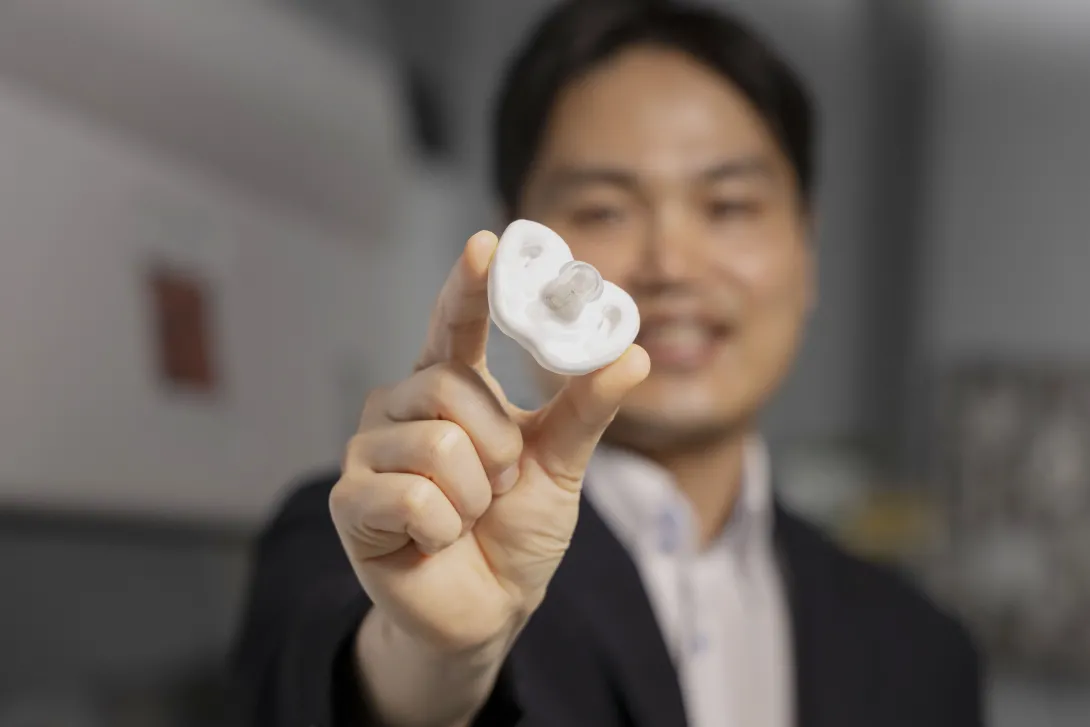
Hong Yeo, associate professor and Harris Saunders Jr. Endowed Professor in the George W. Woodruff School of Mechanical Engineering, came up with the pacifier idea at a pediatric technology conference.
Georgia Tech researchers have developed a pacifier that can constantly monitor a baby’s electrolyte levels in real time, eliminating the need for repeated invasive blood draws.
Feb. 26, 2025
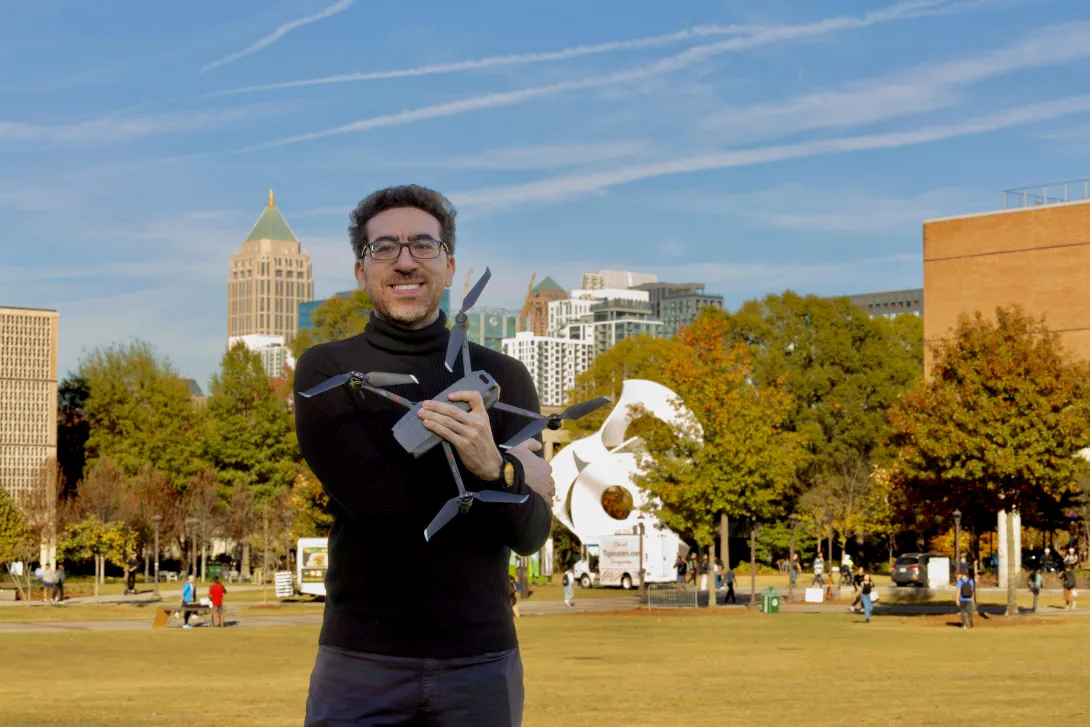
Lamarr.AI leverages AI and drones to autonomously diagnose building energy inefficiencies, reducing carbon emissions. The startup, a collaboration between Georgia Tech, MIT, and Syracuse University, raised $1.1 million in pre-seed funding. Their technology provides detailed diagnostics of building exteriors, helping owners save on energy costs and improve indoor air quality.
Feb. 24, 2025

Bradford “Brad” Greer (bottom) and Kevin Ge (top), both 2023 graduates from the George W. Woodruff School of Mechanical Engineering, and founders of CADMUS Health Analytics. Left, Greer loading a stretcher after dropping a patient off.
Bradford “Brad” Greer (bottom) and Kevin Ge (top), both 2023 graduates from the George W. Woodruff School of Mechanical Engineering, have taken their startup, CADMUS Health Analytics, from a classroom project to a promising health tech company. In 2023, CADMUS was accepted into the CREATE-X Startup Launch program. Over the 12-week accelerator, CADMUS made significant strides, and program mentors provided expert guidance, helping the team focus their direction based on real-world needs. Their partnership with Northeast Georgia Health System (NGHS) was a direct result of connections made at Startup Launch’s Demo Day.
How did you first hear about CREATE-X?
We did the CREATE-X Capstone with an initial team of seven people, later transitioning to Startup Launch in the summer. Capstone required a hardware product, but for several reasons, we pivoted to software. By that point, we already had a grasp on the problem that we were working on but didn't have the resources to start working on a large hardware product.
Why did you decide to pursue your startup?
One of our close buddies was an emergency medical technician (EMT), and we also had family connections to EMTs. When we were doing our customer interviews, we found out that Emergency Medical Services (EMS) had multiple problems that we thought we'd like to work on and that were more accessible than the broader medical technology industry.
What was Startup Launch like for you?
Startup Launch seemed to transition pretty seamlessly from the Capstone course. We came to understand our customer base and technical development better, and the program also led us through the process of starting and running a company. I found it very interesting and learned a whole lot.
What was the most difficult challenge in Startup Launch?
Definitely customer interviews. We spent a lot of time on that in the Startup Launch classes. It's a difficult thing to have a good takeaway from a customer interview without getting the conversation confused and being misled. We didn't mention the product, or we tried to wait as long as possible before mentioning the product, so as to not bias or elicit general, positive messaging from interviewees.
We're working in EMS, and the products we are building affect healthcare. EMS is a little informal and a little rough around the edges. Many times, people don't want to admit how bad their practices are, which can easily lead to us collecting bad data.
What affected you the most from Startup Launch?
The resources at our fingertips. When we were running around, it was nice to be able to consult with our mentor. It's great having someone around with the know-how and who's been through it themselves. I revisit concepts a lot.
How did the partnership with NGHS come about?
During Demo Day, we met a Georgia state representative. He put us in touch with NGHS. They were looking for companies to work with through their venture arm, Northeast Georgia Health Ventures(NGHV), so we pitched our product to them. They liked it, and then we spent a long time banging out the details. We worked with John Lanza, who's a friend of CREATE-X. He helped us find a corporate lawyer to read over the stuff we were signing. It took a little back and forth to get everything in place, but in September of last year, we finally kicked it off.
What’s the partnership like?
We provide them a license to our product, have weekly meetings where experts give feedback on the performance of the system, and then we make incremental changes to align the product with customer needs.
While we're in this developmental phase, we're kind of keeping it under wraps until we make sure it’s fully ready. Our focus is primarily on emergent capabilities that NGHS and other EMS agencies are really looking for. Right now, the pilot is set to be a year long, so we're aiming to be ready for a full rollout by the end of the year.
How did you pivot into this other avenue for your product?
EMS does not have many resources. That makes it not a popular space as far as applying emerging technologies. There's only competition in this very one specific vein, which is this central type of software that we plug into, so we're not competing directly with anyone.
EMS agencies, EMTs, and paramedics - the care that they give has to be enabled by a medical doctor. There has to be a doctor linked to the practices that they engage in and the procedures that they do. With the product that we're making now, we want to provide a low-cost, plug-and-play product that'll do everything they need it to do to enable the improvement of patient care.
How are you supporting yourself during this period?
I was paying myself last year, but we're out of money for that, so we're not currently paying for any labor. It's all equity now, but our burn rate outside of that is very low. The revenue we have now easily covers the cost of operating our system. I'm also working part-time as an EMT now. This helps cover my own costs while also deepening my understanding of the problems we are working on.
How are you balancing your work?
It's hard to balance. There's always stuff to do. I just do what I can, and the pace of development is good enough for the pilot. Every week, and then every month, Kevin and I sit down and analyze the rate at which we're working and developing. Then we project out. We're confident that we're developing at a rate that'll have us in a good spot by September when the pilot ends.
What’s a short-term goal for your startup?
Kevin and I are trying to reach back out and see if there's anyone interested in joining and playing a major role. The timing would be such that they start working a little bit after the spring semester ends. I think most Georgia Tech students would meet the role requirements, but generally, JavaScript and Node experience as well as a diverse background would be good.
Where do you want your startup to be in the next five years?
I want to have a very well-designed system. Despite all the vectors I’m talking about for our products, everything should be part of the same system in place at EMS agencies anywhere. I just want it to be a resource that EMS can use broadly.
Another issue in EMS is standards. Even the standards that are in place now aren’t broadly accessible. I think that these new AI tools can do a lot to bridge the lack of understanding of documentation, measures, and standards and make all of that more accessible for the layperson.
What advice would you give students interested in entrepreneurship?
Make sure the idea that you're working on, and the business model, is something you enjoy outside of its immediate viability. I think that's really what's helped me persevere. It's my enjoyment of the project that's allowed me to continue and be motivated. So, start there and then work your way forward.
Are there any books, podcasts, or resources you would recommend to budding entrepreneurs?
I’d recommend Influence to prepare for marketing. I have no background in marketing at all. Influence is a nice science-based primer for marketing.
I reread How to Win Friends and Influence People. I am not sure how well I'm implementing the concepts day-to-day, but I think most of the main points of that book are solid.
I also read The Mom Test. It's a good reference, a short text on customer interviews.
Want to build your own startup?
Georgia Tech students, faculty, researchers, and alumni interested in developing their own startups are encouraged to apply to CREATE-X's Startup Launch, which provides $5,000 in optional seed funding and $150,000 in in-kind services, mentorship, entrepreneurial workshops, networking events, and resources to help build and scale startups. The program culminates in Demo Day, where teams present their startups to potential investors. The deadline to apply for Startup Launch is Monday, March 17. Spots are limited. Apply now.
News Contact
Breanna Durham
Marketing Strategist
Feb. 21, 2025
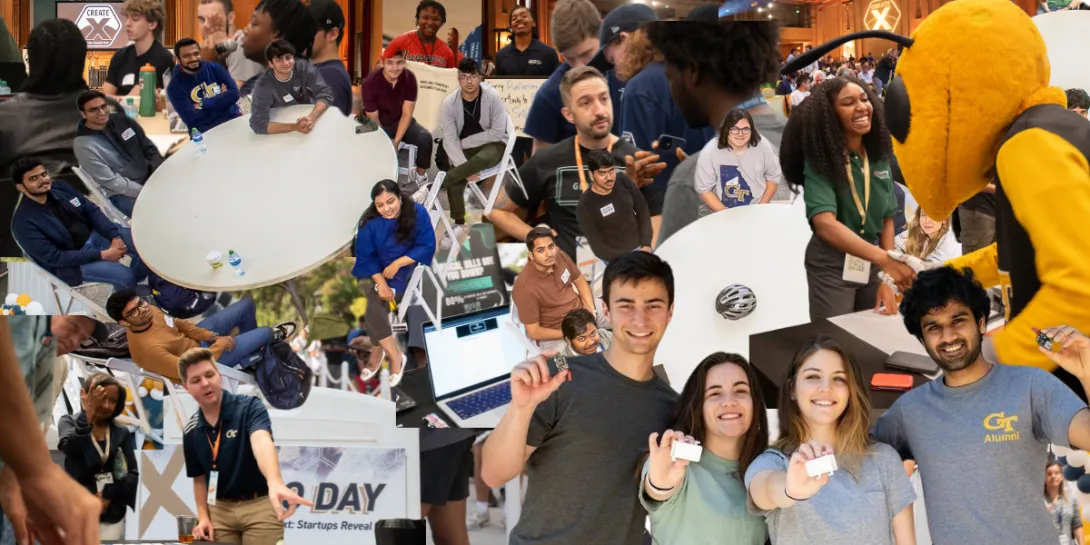
Image of CREATE-X Founders in the Startup Launch program, showing their products, meeting guests of Demo Day, and networking
As CREATE-X enters 2025, the program is more committed than ever to helping students build the future they envision. Through workshops, courses, mentorship, and support, CREATE-X provides a low-risk environment where students can tackle real-world problems and develop solutions.
So far, we have helped launch more than 650 startups by founders from over 38 majors, seen eight founders featured in the Forbes 30 Under 30 Atlanta listing this year, and generated a total portfolio valuation of over $2.4 billion.
Startup Launch, our 12-week summer startup accelerator, continues to be a cornerstone of student entrepreneurship at Georgia Tech, and the program is expanding to accommodate additional teams. Students are encouraged to apply and can even use course projects for their startups. Teams can be in any stage of development and must have at least one Georgia Tech faculty member, alumnus, or current student. Solopreneurs are also accepted. Apply to this summer’s Startup Launch by Monday, March 17.
Benefits of Startup Launch
- Education and Mentorship: Learn from experienced entrepreneurs and business experts.
- Financial Support: Receive $5,000 in optional seed funding and $150,000 of in-kind services like legal counsel and accounting.
- Networking Opportunities: Access a rich entrepreneurial network that will last a lifetime.
- Time in Front of Investors: Participate in Demo Day, Tech’s premier startup showcase, which attracts over 1,500 attendees annually, including investors, business and government leaders, field experts, and potential customers.
- Hands-On Experience: Fully immerse yourself in the startup process and intern for yourself.
- Skill Development: Build skills and confidence that will benefit you in any career path.
Rahul Saxena, director of CREATE-X, encouraged students not to feel like they have to be 100% ready before applying.
“We have seen classroom projects and hackathon teams move on to build very successful startups, even though they weren't originally thinking about it,” he said. “Students should apply for Launch to explore the possibility of it with whatever project they are doing now. You never know what could come of it.”
CREATE-X uses rolling admissions, so apply to Startup Launch today to increase your chances of acceptance. CREATE-X believes in producing quickly, failing fast, and iterating again. The team offers feedback to all applicants and encourages them to submit, even if they’re not entirely sure about their application. A previous info session on Startup Launch and a Startup Launch sample application are available to help students prepare. Attend CREATE-X events to get insights into entrepreneurship, workshop business ideas, find teammates, and prepare your Startup Launch applications. For additional questions, email create-x@groups.gatech.edu.
News Contact
Breanna Durham
Marketing Strategist
Feb. 24, 2025
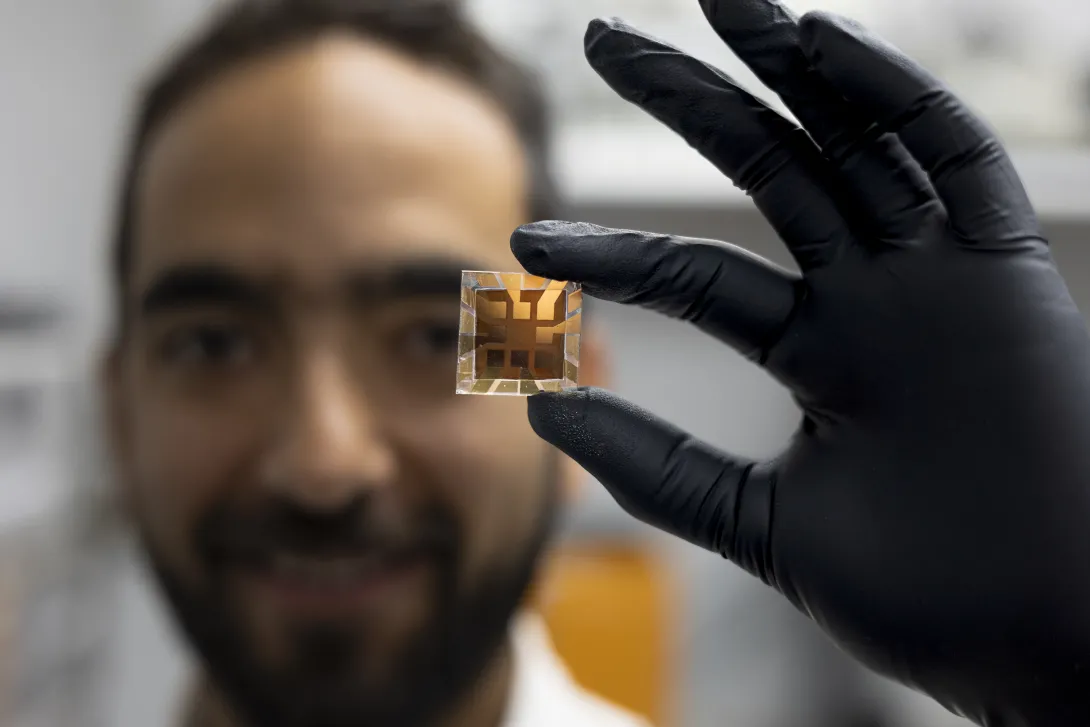
For years, Juan-Pablo Correa-Baena’s research group has explored using perovskite crystals as an alternative to silicon. A promising and prevalent replacement, perovskite is made of iodine atoms, lead, and organic elements. It is also as efficient as silicon.
Solar power as an electricity source is growing in the United States, with 7% of Americans using it to run their homes. But scientists are still trying to make the solar panel production process more efficient.
Feb. 18, 2025
When Air Force veteran Michael Trigger began looking for a new career in 2022, he became fascinated by artificial intelligence (AI). Trigger, who left the military in 1989 and then worked in telecommunications, corrections, and professional trucking, learned about an AI-enhanced robotics manufacturing program at the VECTR Center. This training facility in Warner Robins, Georgia, helps veterans transition into new careers. In 2024, he enrolled and learned how to program and operate robots.
As part of the class, Trigger made several trips to the Georgia Tech Manufacturing Institute (GTMI). When the faculty asked if anyone wanted an internship, Trigger raised his hand.
“Coming to Georgia Tech allowed me to clarify what I wanted to do,” he said. “I’ve always been in service-based jobs, but I was interested in additive manufacturing,” or 3D printing.
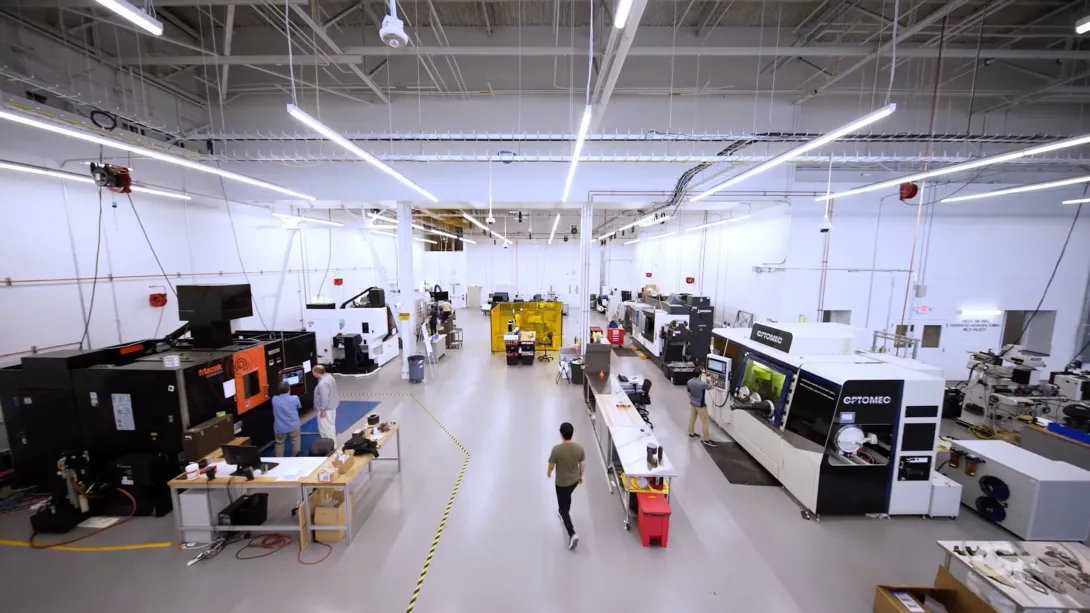
For five months every weekday, Trigger drove from his home in Macon to Georgia Tech’s campus for his internship. The paid internship took place at Tech’s Advanced Manufacturing Pilot Facility (AMPF). This 20,000-square-foot, reconfigurable facility serves as the research and development arm of GTMI, functioning as a teaching laboratory, technology test bed, and workforce development space for manufacturing innovations.
During his time there, Trigger focused on computer-aided manufacturing and met with faculty and students to learn about their research. The internship wasn’t convenient, but it was worth it.
“From our campus visits, I understood the mission of AMPF, so the fact they offered me this opportunity was huge for me,” he said. “The internship had a big impact on my life in terms of the technical and soft skills I gained.”
Building the Workforce
Launching new careers is just one of AMPF’s goals in testing new manufacturing and growing the future U.S. workforce. Since 2022, AMPF has improved the manufacturing process at all parts of the talent pipeline — from giving corporate researchers space to test and adopt AI automation technologies to training and upskilling their employees. Collectively, GTMI and AMPF’s efforts have led to a stronger, bigger network of manufacturers that other companies and the U.S. government can rely on.
“We are going to need to manufacture more in the U.S. — from computer chips to cars — so we want to create jobs and fill them,” said Tom Kurfess, GTMI’s executive director. “We need more people working in the manufacturing sector, and we've got to make these jobs better and make people more efficient in them.”
AI is one way to boost efficiency, but artificial intelligence won’t cut humans out of the process entirely. Rather, people will be integral to monitoring the systems and advancing them. As AI becomes more widely adopted, a college degree won’t necessarily be required to work in the AI field.
“Our workforce is going to need the next generation of employees to be amenable to retraining as the technology updates,” said Aaron Stebner, a co-director of the Georgia Artificial Intelligence Manufacturing program (AIM). A statewide program, Georgia AIM helps fund AMPF and sponsored Trigger’s internship. “Education is going to be more of a lifelong learning process, and Georgia Tech can be at the forefront of that.”
While GTMI already integrates AI into many processes, it remains committed to staying ahead of the curve with the latest technologies that could boost manufacturing. The facility is in the process of an expansion that will nearly triple its size and make AMPF the leading facility for demonstrating what a hyperconnected and AI-driven manufacturing enterprise looks like. This will enable GTMI to build and sustain these educational pipelines, which is key to its work.
“We’re developing the workforce for the future, not of the future,” explained Donna Ennis, a co-director of Georgia AIM. “It’s AI today, but it could be something else five years from now. We are focused on creating a highly skilled, resilient workforce.”
Part of Georgia AIM’s role is creating the pipelines that people like Trigger can follow. From bringing a mobile lab to technical colleges to hosting robotics competitions at schools, these efforts span the state of Georgia and touch populations from “K to gray.”
“Kids don’t say they want to be a manufacturer when they grow up, but that’s because they don’t know it’s a viable career path,” Ennis said. “We’re making manufacturing cool again.”
Creating Corporate Connection
To create these job opportunities, GTMI is also partnering with corporations. Companies can join a consortium to access the AMPF research facilities and collaborate with researchers. Any size or type of company can take advantage of AMPF facilities — from corporations including AT&T and Siemens to small startups like Alegna, which licenses and commercializes Navy research.
“The ability to manufacture domestically is critical, not only for national security purposes, but also to keep the U.S. economically competitive,” said Steven Ferguson, a principal research scientist and executive director for the GT Manufacturing 4.0 Consortium. “Having the AMPF puts Georgia Tech within the innovation epicenter for these areas and will help us reshore manufacturing.”
The benefit of such an arrangement is twofold. Companies can work with the newest manufacturing technologies and make their own advances, and Georgia Tech builds a network of manufacturers across the state and world that students can work with. For example, AT&T uses the AMPF to test sensors for expanding personal 5G networks, and George W. Woodruff School of Mechanical Engineering Professor Carolyn Seepersad has Ph.D. students funded by a Siemens partnership through AMPF.
Trigger was able to connect and collaborate with some of these corporations and researchers during his internship. “I told them about my interest in machine learning because I wanted to see how they were integrating machine learning into their research projects,” he said. “All of them invited me to come by to observe and be part of the research.”
Starting a New Path
Because of his research collaborations during his AMPF internship, Trigger now has a new focus. “The internship clarified for me that AI is where everybody is going,” he explained. He wants to be at the forefront of AI manufacturing and hopes to pursue a certificate in machine learning next.
While he knows he still has much to learn, AMPF gave Trigger a foot in the door and confidence about the future. He — and other veterans like him — will help build the workforce that propels America forward in manufacturing.
News Contact
Tess Malone, Senior Research Writer/Editor
tess.malone@gatech.edu
Feb. 11, 2025
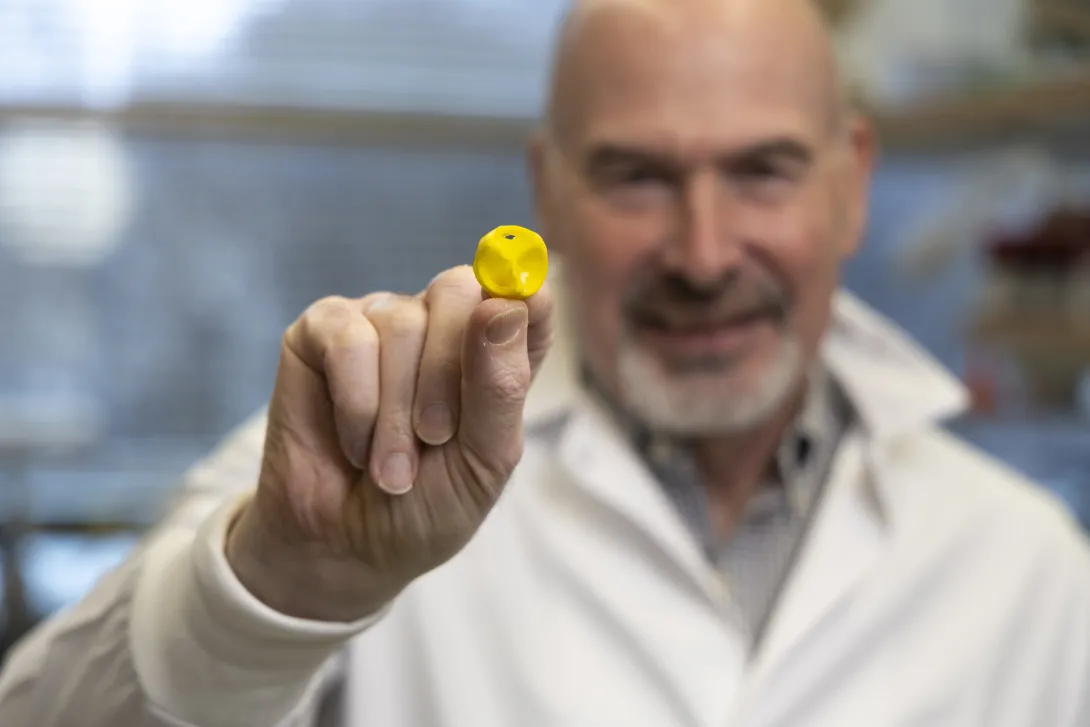
Georgia Tech researchers have developed a groundbreaking 3D-printed, bioresorbable heart valve that promotes tissue regeneration, potentially eliminating the need for repeated surgeries and offering a transformative solution for both adult and pediatric heart patients.
Feb. 03, 2025

Pursuing entrepreneurship is an exciting and rewarding experience. You have the power to solve real-world problems and make an impact. Here are six things you can do to begin your entrepreneurial journey.
1. Identify a Problem You’re Interested in Solving
We often gravitate toward familiar problems, but it's crucial to explore beyond our immediate surroundings. Take the time to venture off campus and learn about problems faced by small businesses, corporations, and communities. Engaging with diverse groups will help you uncover unique challenges that you might not have considered. We accept startups in a variety of industries, from fashion to healthcare.
2. Understand the Problem Before Creating a Solution
It's tempting to rush into building a solution once you've identified a problem. However, it's essential to thoroughly understand the problem first. Before you start building, conduct at least 10 – 20 customer discovery interviews. This will give you valuable insights into the problem you're solving and help you validate your business thesis.
3. Start With Your Business Thesis
Formulate a clear business thesis: "X will buy Y because of Z." Here, X represents your target customer, Y is your product, and Z is the reason they will purchase it. As you engage with potential customers, refine your hypothesis based on their feedback. This iterative process will help you develop a product that meets real needs.
4. Build a Version 1 of Your Product
This is easier than it sounds and can be very low-tech to start. Concentrate on developing the core functionality of your product that addresses the primary pain point for your users. This unlocks user insights that can help you know if and where to pivot your solution.
5. Think About Your Business Model
While you don't need to have a concrete business model from the start, it's beneficial to brainstorm potential models. Consider how your product could generate revenue and sustain itself. Your business model can evolve as you gain more insights and experience.
6. Put in the Time
Launching a startup requires a significant time commitment and focus. You can create real momentum when you can dedicate consistent time.
Looking for more support on your entrepreneurial journey? Be sure to check out Startup Launch, a 12-week accelerator that helps you move from idea/prototype to your first customer. You have access to expert mentors, exclusive founder-focused workshops, vendor discounts, and $5,000 in seed funding.
The application deadline is Monday, March 17, for the summer cohort.
A previous info session on Startup Launch and a Startup Launch sample application are available to help students prepare. Attend CREATE-X events to get insights into entrepreneurship, workshop business ideas, find teammates, and prepare your Startup Launch applications. For additional questions, email create-x@groups.gatech.edu.
News Contact
Breanna Durham
Marketing Strategist