
Sep. 30, 2025
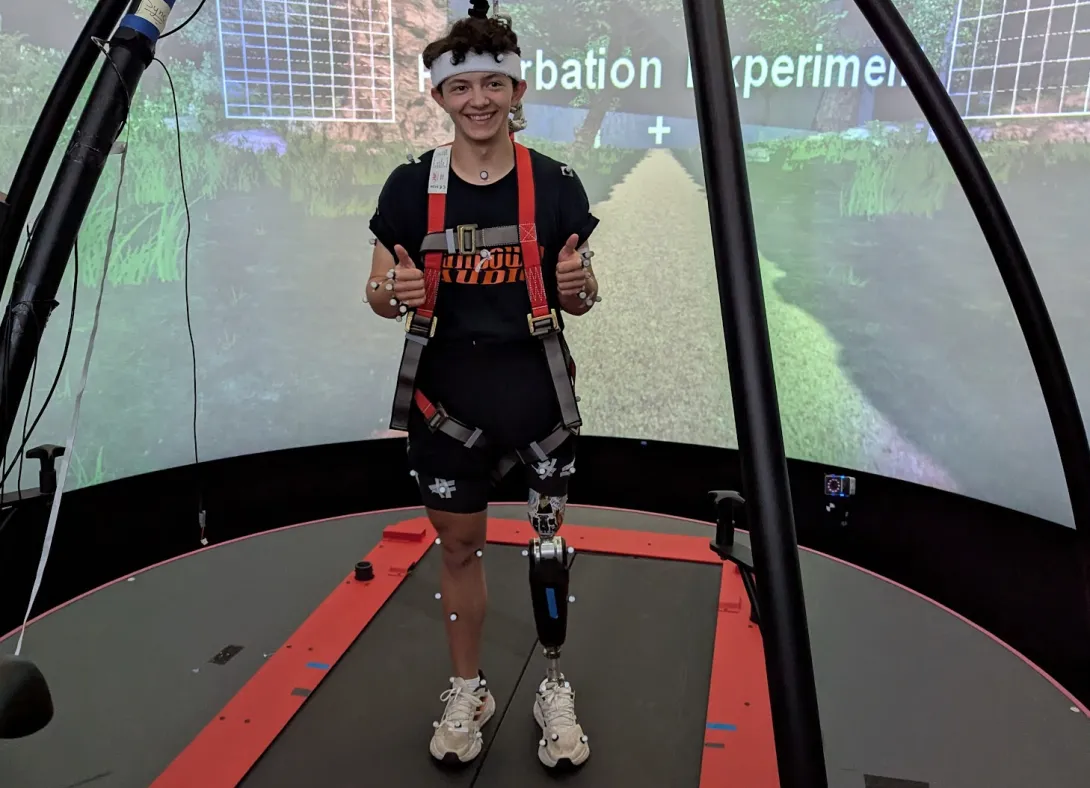
Nathan Wallace testing the microprocessor-powered leg in the Exoskeleton and Prosthetic Intelligent Controls (EPIC) Lab at Georgia Tech. Submitted photo.
Nathan Wallace was born with proximal femoral focal deficiency, a congenital limb disorder, which led to the amputation of his left foot at 8 months old. He was fitted for his first prosthetic at 13 months.
Now, the third-year biomedical engineering student is using his life experience to develop advanced prostheses as a member of the Exoskeleton and Prosthetic Intelligent Controls (EPIC) Lab. Wallace is part of the development and machine learning teams on an ongoing vertically integrated project led by Associate Professor Aaron Young and senior research scientist Kinsey Herrin. The teams are engineering a microprocessor-powered leg and ankle capable of mimicking gait and providing stability in walking patterns across various surfaces.
Traditional prosthetics, like the one Wallace uses, don’t provide ankle flexion, but the current iteration of the lab’s leg offers something that he views as an evolution of products on the market today. The latest tests allowed Wallace, while wearing the leg, to walk up a ramp with the ankle and knee adapting to the slope.
“A lot of our power comes from the ankle, and our version of the leg better recreates a complete gait cycle, which includes the knee and ankle flexion and everything in between. With my current prosthetic, I don’t have that same gait control, so I’m swinging my foot around and overcompensating on my right leg. With our leg, I’m walking up the ramp normally, and it’s creating a movement that I've never felt before,” he said.
Along with the improved performance of the leg, Wallace and the team intend to use machine learning to assist in fitting patients with prosthetics that meet their unique needs.
“We're trying to get away from patients having to spend hours in an office tuning a prosthetic to their preferences. Instead, it allows the machine learning model to learn as the person walks on it. This can help reduce costs related to both time and personnel,” he said.
Growing up, Wallace was an active child at recess and eventually became a high school wrestler. While there were times he felt he couldn’t keep up with his classmates, he found ways to adapt. He credits his condition for helping him develop a strong work ethic and a desire to help others find the same confidence he has found as he’s gotten older.
“Learning to embrace who I am has made me the person I am today. It’s given me perspective and a capacity for empathy and sympathy for others in the disabled community,” he said. “My past and my condition have driven me to where I am today, and I feel privileged to be at Georgia Tech. It touches a special place in my heart to know that this kind of work is going on, and that I can be a part of it.”
Outside of the lab, Wallace is a member of the student organization Tikkun Olam Makers, which develops open-source solutions for members of disabled communities. He also creates props for DramaTech, and, continuing to push himself beyond his comfort zone, he recently starred in the student-run theater’s production of Eurydice.
News Contact
Steven Gagliano – Institute Communications
Aug. 28, 2024

Since it began in 2019, Georgia Tech and Emory University’s Computational Neural-Engineering Training Program has funded and trained doctoral students at the intersection of neuroscience, engineering, computation, and clinical experience.
“We saw that there was a new kind of neuroscience that was happening, to both understand the mysteries of the brain and nervous system and to treat related diseases and disorders,” says Garrett Stanley, program co-director, professor, and McCamish Foundation Distinguished Chair in the Walter H. Coulter Department of Biomedical Engineering (BME). “The program was created to fill this gap in training, and to provide a community for like-minded scientists and engineers across these disciplines.”
Combined with support from Georgia Tech and Emory, that community is set to grow with recently renewed and increased funding from the National Institutes of Health (NIH).
“We’re excited to expand the number of students funded and continue to grow our programs,” says Lena Ting, program co-director, professor, and McCamish Foundation Distinguished Chair in BME. “With this funding, we’ll continue to attract the best and brightest students.”
Expanding Access
Through courses, research, professional development, and community outreach, the two-year program provides unprecedented training and community for doctoral students in BME, electrical and computational engineering, neuroscience, machine learning, and beyond.
“Our program is unique in that it combines computation — both how the brain computes and how we can use computational tools to better understand the brain — and engineering of technologies for interfacing with the brain and nervous system,” says Stanley, who also co-directs the Neural Engineering Center with Ting.
Students are also exposed to neurology, rehabilitation, and other related fields through clinical course requirements.
“We teach our students alongside physical therapy and occupational therapy students to solve clinically relevant problems,” explains Ting, who teaches several of the courses. “We think early exposure to such clinical problems can accelerate the translation of basic research to the clinic.”
Originally slated to last five years, funding for the program comes from the T32 program of institutional training grants by the NIH and the National Institute of Biomedical Imaging and Bioengineering. Michael Borich, associate professor in the Emory University School of Medicine, and Chris Rozell, professor and Julian T. Hightower Chair in Georgia Tech’s School of Electrical and Computer Engineering, also serve as directors of the program.
“The NIH T32 funding mechanism is great because it enables universities to create training programs that span different traditional disciplines,” says Stanley. Without the need to create entirely new academic units, training programs like these provide funding for students conducting interdisciplinary research. Since the funding isn’t tied to a specific research group, it also gives students the flexibility to rotate through multiple labs to find the best fit. “In other words, it’s a game changer.”
With NIH funding renewed and expanded by 50%, the program will now have the capacity to fund more trainees.
“I love to see the program grow so more of our students and faculty can benefit,” said Ting. “Thanks to generous funding from Georgia Tech, we will also be able to support international students now, something we couldn’t do in the past.”
In addition to support from the NIH, Emory University School of Medicine, and the joint Georgia Tech-Emory BME Department, the program is further bolstered by support from Georgia Tech’s College of Engineering and the Office of the Executive Vice President for Research.
“While the NIH funding enables us to support the salary and tuition for students,” said Stanley, “local support from Georgia Tech and Emory enables us to not only manage the growing program and provide reporting back to the NIH, but also to provide student-initiated training workshops in emerging technical areas, career development activities, training in neuroethics, and social events that help to bring the community together.”
The community, he said, is the “most exciting and significant part of this. The network of talented people brought together through this program will be valuable and influential for years to come.”
News Contact
Audra Davidson
Communications Manager
Neuro Next Initiative
Feb. 23, 2012

Younan Xia, an internationally recognized leader in the field of nanotechnology, recently joined the Georgia Institute of Technology as the first Georgia Research Alliance (GRA) Eminent Scholar in Nanomedicine.
Xia is the Brock Family Chair and GRA Eminent Scholar in Nanomedicine in the Wallace H. Coulter Department of Biomedical Engineering at Georgia Tech and Emory University, with a joint appointment in the School of Chemistry and Biochemistry. His research focuses on nanocrystals -- a novel class of materials with features smaller than 100 nm -- as well as the development of innovative technologies enabled by nanocrystals. These technologies span the fields of molecular imaging, early cancer diagnosis, targeted drug delivery, biomaterials, regenerative medicine and catalysis.
“The possible applications of nanotechnology in medicine have only begun to be explored, said Michael Cassidy, President and CEO of the Georgia Research Alliance. “Dr. Xia’s expertise and collaborative vision will lead to vital new scientific discoveries that can be transformed into new tools to help people live healthier lives.”
Xia received his Ph.D. in physical chemistry from Harvard University in 1996, his M.S. in inorganic chemistry from University of Pennsylvania (with the late Professor Alan G. MacDiarmid, a Nobel Laureate in Chemistry, 2000) in 1993. He has received a number of prestigious awards, including AIMBE Fellow (2011), MRS Fellow (2009), NIH Director's Pioneer Award (2006), Leo Hendrik Baekeland Award (2005), Camille Dreyfus Teacher Scholar (2002), David and Lucile Packard Fellowship in Science and Engineering (2000), Alfred P. Sloan Research Fellow (2000), NSF Early Career Development Award (2000) and the ACS Victor K. LaMer Award (1999).
“Dr. Xia is a world-renowned teacher and leader at the forefront of nanomedicine and materials science,” said Larry McIntire, the Wallace H. Coulter Chair of Biomedical Engineering. “His reputation and innovative research in these areas will clearly strengthen our expanding efforts in nanomedicine and biomaterials. We are honored to welcome him to the department and to the Institute.”
News Contact
Adrianne Proeller
Wallace H. Coulter Department of Biomedical Engineering at Georgia Tech and Emory University
404-894-2357

Sep. 23, 2010

Phillip Santangelo, assistant professor in the Coulter Department, has received an R01 NIH/National Institute for General Medicine Sciences award to develop single molecule sensitive probes for the study of virus replication, assembly and budding. The $1.48 million project will focus on the human respiratory syncytial (hRSV) virus. hRSV is recognized as the most important viral agent of serious pediatric respiratory tract disease. Worldwide, acute respiratory tract disease is the leading cause of mortality due to infectious disease, and hRSV remains one of the pathogens deemed most important for vaccine and antiviral development. He will collaborate with James E. Crowe, Jr., MD, The Departments of Microbiology and Immunology, and Pediatrics and The Vanderbilt Vaccine Center; Vanderbilt University Medical Center for the 5-year study.
News Contact
Adrianne ProellerWallace H. Coulter Dept. of Biomedical Engineering
Contact Adrianne Proeller
Aug. 18, 2010
Researchers have developed an improved coating technique that could strengthen the connection between titanium joint-replacement implants and a patient's own bone. The stronger connection - created by manipulating signals the body's own cells use to encourage growth - could allow the implants to last longer.
Implants coated with "flower bouquet" clusters of an engineered protein that mimics the body's own cell-adhesion material fibronectin made 50 percent more contact with the surrounding bone than implants coated with protein pairs or individual strands. The cluster-coated implants were fixed in place more than twice as securely as plugs made from bare titanium - which is how joints are currently attached.
Researchers believe the biologically-inspired material improves bone growth around the implant and strengthens the attachment and integration of the implant to the bone. This work also shows for the first time that biomaterials presenting biological sequences clustered together at the nanoscale enhance cell adhesion signals. These enhanced signals result in higher levels of bone cell differentiation in human stem cells and promote better integration of biomaterial implants into bone.
"By clustering the engineered fibronectin pieces together, we were able to create an amplified signal for attracting integrins, receptors that attached to the fibronectin and directed and enhanced bone formation around the implant," said Andres Garcia, professor in Georgia Tech's Woodruff School of Mechanical Engineering and the Petit Institute for Bioengineering and Bioscience.
Details of the new coating were reported in the August 18 issue of the journal Science Translational Medicine. The research was supported by the National Institutes of Health, the Arthritis Foundation, and the Atlanta Clinical and Translational Science Institute through the Georgia Tech/Emory Center for the Engineering of Living Tissues.
Total knee and hip replacements typically last about 15 years until the components wear down or loosen. For many younger patients, this means a second surgery to replace the first artificial joint. With approximately 40 percent of the 712,000 total hip and knee replacements in the United States in 2004 performed on younger patients 45-64 years old, improving the lifetime of the titanium joints and creating a better connection with the bone becomes extremely important.
In this study, Georgia Tech School of Chemistry and Biochemistry professor David Collard and his students coated clinical-grade titanium with a high density of polymer strands - akin to the bristles on a toothbrush. Then, Garcia and Tim Petrie - formerly a graduate student at Georgia Tech and currently a postdoctoral fellow at the University of Washington - modified the polymer to create three or five self-assembled tethered clusters of the engineered fibronectin, which contained the arginine-glycine-aspartic acid (RGD)sequence to which integrins binds.
To evaluate the in vivo performance of the coated titanium in bone healing, the researchers drilled two-millimeter circular holes into a rat's tibia bone and pressed tiny clinical-grade titanium cylinders into the holes. The research team tested coatings that included individual strands, pairs, three-strand clusters and five-strand clusters of the engineered fibronectin protein.
"To investigate the function of these surfaces in promoting bone growth, we quantified osseointegration, or the growth of bone around the implant and strength of the attachment of the implant to the bone," explained Garcia, who is also a Woodruff Faculty Fellow at Georgia Tech.
Analysis of the bone-implant interface four weeks later revealed a 50 percent enhancement in the amount of contact between the bone and implants coated with three- or five-strand tethered clusters compared to implants coated with single strands. The experiments also revealed a 75 percent increase in the contact of the three- and five-strand clusters compared to the current clinical standard for replacement-joint implants, which is uncoated titanium.
The researchers also tested the fixation of the implants by measuring the amount of force required to pull the implants out of the bone. Implants coated with three- and five-strand tethered clusters of the engineered fibronectin fragment displayed 250 percent higher mechanical fixation over the individual strand and pairs coatings and a 400 percent improvement compared to the unmodified polymer coating. The three- and five-cluster coatings also exhibited a twofold enhancement in pullout strength compared to uncoated titanium.
Georgia Tech bioengineering graduate students Ted Lee and David Dumbauld, chemistry graduate students Subodh Jagtap and Jenny Raynor, and research technician Kellie Templeman also contributed to this study.
This work was partly funded by Grant No. R01 EB004496-01 from the National Institutes of Health (NIH) and PHS Grant UL1 RR025008 from the Clinical and Translational Science Award program, NIH, National Center for Research Resources. The content is solely the responsibility of the principal investigator and does not necessarily represent the official view of the NIH.
News Contact
Abby Vogel RobinsonResearch News and Publications
Contact Abby Vogel Robinson
404-385-3364
Aug. 16, 2010

The National Science Foundation (NSF) has awarded $3 million to the Georgia Institute of Technology to fund a unique research program on stem cell bio-manufacturing. The program is specifically focused on developing engineering methods for stem cell production, in order to meet the anticipated demand for stem cells. The award comes through the NSF's Integrative Graduate Education and Research Traineeship (IGERT) Program, which supports innovation in graduate education in fields that cross academic disciplines and have broad societal impact.
While stem cell research is on the verge of broadly impacting many elements of the medical field - regenerative medicine, drug discovery and development, cell-based diagnostics and cancer - the bio-process engineering that will be required to manufacture sufficient quantities of functional stem cells for these diagnostic and therapeutic purposes has not been rigorously explored.
"Successfully integrating knowledge of stem cell biology with bioprocess engineering and process development into single individuals is the challenging goal of this program," said Todd McDevitt, an associate professor in the Wallace H. Coulter Department of Biomedical Engineering at Georgia Tech and Emory University and a Petit Faculty Fellow in the Parker H. Petit Institute for Bioengineering and Biosciences at Georgia Tech.
McDevitt is leading the IGERT with Robert M. Nerem, professor emeritus of the George W. Woodruff School of Mechanical Engineering at Georgia Tech. Nerem is also director of the Georgia Tech/Emory Center (GTEC) for Regenerative Medicine, which will administer this award.
Ph.D. students funded by Georgia Tech's stem cell bio-manufacturing IGERT will receive interdisciplinary educational training in the biology, engineering, enabling technologies, commercialization and public policy related to stem cells. Their research efforts will focus on developing innovative engineering approaches to bridge the gap between basic discoveries made in stem cell biology and therapeutic stem cell-based technologies.
"This program provides a unique opportunity for engineers to generate standardized and quantitative methods for stem cell isolation, characterization, propagation and differentiation," said Nerem. "These techniques must be developed in a scalable manner to efficiently produce sufficient numbers of stem cells and derivatives in accessible formats in order to yield a spectrum of novel therapeutic and diagnostic applications of stem cells."
The Georgia Tech program is centered around three main research thrusts, which focus on several critical technologies that must be developed to enable the application and use of stem cell-based products:
* Creating reproducible, controlled and scalable methods to expand and differentiate stem cells with defined phenotypes and epigenetic states.
* Developing reliable, rapid and quantifiable methods to characterize the composition and function of stem cells to be generated.
* Designing low-cost systems capable of producing large populations of defined stem cells and derivatives.
Students in the program will be able to take advantage of the core facilities provided by the new Stem Cell Engineering Center at Georgia Tech, which is directed by McDevitt. Technologies developed by the students supported through this IGERT will be rapidly integrated into academic and industrial stem cell practices and cell-based products.
The award will support 30 new Ph.D. students over the next five years and brings together more than two dozen faculty members from Georgia Tech, Emory University, the University of Georgia and the Morehouse School of Medicine. In addition, plans are being made for students to participate in international research collaborations with the National University of Ireland at Galway, Imperial College London, the University of Cambridge and the University of Toronto.
"We anticipate this program will produce the future leaders and innovators in the field of stem cell bio-manufacturing who will contribute significantly at the interface of stem cell engineering, biology and therapy," added McDevitt.
News Contact
Abby Vogel RobinsonResearch News and Publications
Contact Abby Vogel Robinson
404-385-3364
Jul. 26, 2010
Ravi Bellamkonda, a professor in the Wallace H. Coulter Department of Biomedical Engineering, has been named an associate vice president within the Office of the Executive Vice President for Research (EVPR). The three-year appointment, which begins on August 1, enables Bellamkonda to divide his time evenly between his own research and the administrative responsibilities of this new position.
In announcing the appointment, Executive Vice President for Research Steve Cross said, "I worked closely with Ravi during the strategic planning process of the past year and was pleased to learn of his continued interest in supporting Georgia Tech research on an institutional level. Ravi is a first-rate scientist with excellent intellectual curiosity and temperament, and I am excited about his joining our leadership team."
A Georgia Cancer Coalition Distinguished Scholar, Bellamkonda directs the Neurological Biomaterials and Cancer Therapeutics Laboratory and a National Institutes of Health (NIH) T32 training program in the Rational Design of Biomaterials. He also served as deputy director for research at the Georgia Tech & Emory Center for Regenerative Medicine (GTEC).
Visit URL below to view full article:
http://www.ibb.gatech.edu/hg_news/60222
News Contact
Floyd Wood
IBB
Contact Floyd Wood