
Apr. 05, 2024
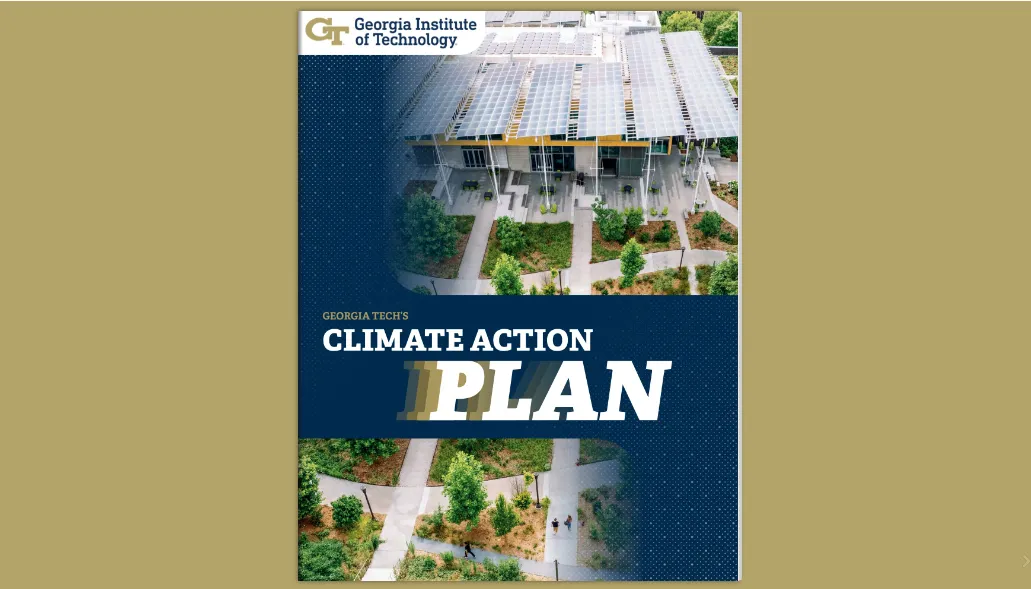
Georgia Tech unveiled its first Climate Action Plan (CAP), an actionable road map for halving Institute emissions by 2030 and reaching net-zero emissions by 2050. It provides strategies for mitigation, adaptation, climate education, and research, while finding ethical, cost-effective solutions.
The CAP is a deliverable of Sustainability Next, Georgia Tech’s 10-year strategic sustainability plan, and it is aligned with the United Nations Sustainable Development Goals, the Institute’s strategic plan, and the Comprehensive Campus Plan.
“As one of the world’s leading research universities, Georgia Tech has the opportunity, and the obligation, to create and share solutions that can help curb climate change and mitigate its harmful impact on our planet and our lives,” said President Ángel Cabrera. “Our Climate Action Plan is bold and ambitious, aiming for 100% clean ground transportation by 2030 and 100% clean energy by 2050. These goals are not easy, but they reflect the seriousness of the challenges before us.”
The CAP was led by Georgia Tech’s Office of Sustainability, with engagement across the campus community. The CAP Advisory Task Force, comprising experts and Institute leadership, helped guide the effort. Nine working groups in key focus areas developed climate action strategies, and additional stakeholder outreach with students, staff, faculty, and the Atlanta community took place at workshops, events, town halls, and webinars.
The plan’s nine focus areas and guiding principles are:
- Community, Ethics, and Accessibility: We seek to ensure that fair and just climate policies and strategies are in place at Georgia Tech and that they prioritize affordable climate change solutions that support our internal and external community.
- Building Energy: We are committed to reaching net-zero emissions by 2050.
- Renewable Energy and Offsets: We prioritize clean energy technologies to eliminate emissions.
- Mobility: We optimize campus mobility through a variety of transportation modes that are accessible, affordable, and low- to no-emissions, considering environmental and human health impacts when determining and implementing transit and land use actions.
- Materials Management: We support a thriving circular economy that focuses on upstream systems for achieving zero waste, ensures sustainable procurement, and supports our local community.
- Water Management: We adapt our water infrastructure to be resilient to the impacts of climate change.
- Education: We prepare all students, regardless of discipline, to address climate-related challenges in their personal and professional lives.
- Research: We expand support for faculty, staff, and students to advance innovative research and projects to address climate-related issues.
- Carbon Sequestration: We leverage the natural and physical resources of our campus to sequester and store carbon dioxide from the atmosphere.
The plan has 30 strategies for reaching net-zero emissions by 2050 and advancing climate research and education. The most ambitious strategies include:
- Transition to electrification of combustion-based heating systems.
- Increase energy efficiency in building operations.
- Increase on-site renewable energy production, and procure energy generated from renewable and zero-emissions sources.
- Transition the campus vehicle fleet to zero-emissions vehicles and increase sustainable and affordable commuting options.
- Implement blackwater reuse systems and increase water efficiency and conversation.
- Become a Zero Waste campus.
- Prioritize climate education across Georgia Tech’s curriculum.
- Identify and shape future climate research opportunities in which Georgia Tech aspires to lead.
“Georgia Tech is committed to sustainability and the environmental stewardship of our campus community,” said Jennifer Chirico, associate vice president of Sustainability and chair of the CAP Advisory Task Force. “The CAP was developed in partnership with leadership and with our own experts from within Georgia Tech. As we move toward implementation, it will require a whole-community approach, and we will continue to work together to reach our goal of net-zero emissions by 2050.”
To read or download the full plan, visit the Office of Sustainability’s webpage here. If you are interested in participating in an implementation committee, please fill out the form on the CAP website.
News Contact
Program and Portfolio Manager
Office of Sustainability
Infrastructure and Sustainability
Sep. 28, 2023

October is Campus Sustainability Month, an international celebration of sustainability on college and university campuses. Georgia Tech will host sustainability-focused events all month. With the recent release of the Institute’s Sustainability Next plan, these campus opportunities underscore our commitment to the objectives outlined in the plan. There are numerous options centered on climate and social sustainability topics in addition to trips to explore nature around Atlanta. The programming is hosted by diverse campus groups and offers a glimpse into the wide-ranging commitment to sustainability at Tech.
Event Lineup
Climate Action Plan Student Engagement Workshop
Monday, Oct. 2
5 – 6 p.m.
The Kendeda Building for Innovative Sustainable Design, Room 210
As a deliverable of the Sustainability Next Plan, the Georgia Tech Climate Action Plan is a roadmap for integrating climate action strategies across operations, research, and education focusing on climate justice and reducing emissions. Students are invited to join the Office of Sustainability for an interactive, in-person event to learn about the climate action strategies in the plan, share input, and enjoy free pizza.
For registration and additional information, click here. RSVP required.
Climate Action Plan Campus Town Hall (Virtual)
Wednesday, Oct. 4
11 a.m. – noon
Virtual via Zoom (RSVP Required)
The entire Georgia Tech community can learn more about the Georgia Tech Climate Action Plan and share input during a virtual campus town hall hosted by the Office of Sustainability.
For registration and additional information, click here.
Approaching the Limits of Climate Viability: Urban Heat Vulnerability in Atlanta and How to Adapt
Wednesday, Oct. 4
Noon – 1:30 p.m.
Scholar’s Event Theater, First Floor, Price Gilbert Library
As part of Georgia Tech Library’s initiative to highlight research that makes data accessible and meaningful to the public, Brian Stone Jr., a professor in the School of City and Regional Planning, will present a lecture on the urban heat island effect and its context for Atlanta.
Find more details and registration information here.
Brook Byers Institute for Sustainable Systems Seminar Series, Baabak Ashuri — Valuation of Investment in Sustainable Buildings and Renewable Energy Infrastructure
Thursday, Oct. 5
3 – 4 p.m.
Hybrid Event: BBISS Offices, 760 Spring St., Suite 118, and on Teams
Baabak Ashuri, a professor in the School of Building Construction and the School of Civil and Environmental Engineering, and a Brook Byers Institute for Sustainable Systems Fellow, will speak about how a new set of tools for the valuation and appraisal of renewable energy projects can enhance investment decision-making.
Liam's Legacy Symposium 2023: Humanitarian Engineering with Juan Lucena
Thursday, Oct. 5
4 – 6 p.m.
Coda Building, Ninth Floor Atrium
Juan Lucena, director of the Humanitarian Engineering Undergraduate Program and professor of engineering, design, and society at the Colorado School of Mines will visit Georgia Tech for the annual Liam’s Legacy Symposium. Lucena will explore the relationship between engineers, engineering, and the well-being of communities, social justice, and sustainability.
This event is presented by the Center for Sustainable Communities Research and Education in partnership with the School of History and Sociology, through a grant from the Gertrude and William C. Wardlaw Fund in support of the Conference on Human Rights, Changes, and Challenges.
Sustainable Careers and Shared Value Panel
Thursday, Oct. 12
2 – 3:15 p.m.
Scheller College of Business, Room 221
Join the Ray C. Anderson Center for Sustainable Business to hear from three panelists at various stages in their careers and diverse types of corporations about how sustainability is incorporated and how it has shaped their roles.
More information and registration here.
Lullwater Preserve (Emory) Bird Walk
Friday, Oct. 13
7 a.m. – 12:30 p.m.
Meet at Cherry Emerson
Ride the GT/Emory bus with Birdwatchers @ GT to Lullwater Preserve, a beautiful, forested park on Emory’s Druid Hills campus. Open to beginner and expert birders alike — make sure to RSVP if you need binoculars.
For more information and registration, click here.
Campus Energy Challenge
Oct. 16 – 22
Residence Halls Across Campus
Housing and Residence Life’s annual Energy Competition takes place the week of Oct. 16. The competition will give all campus residents a chance to see the daily energy use of their residence halls, along with tips on how to reduce their individual use. The residence hall that reduces its use the most will win a prize.
Contact Malte Weiland, senior sustainability project manager, Auxiliary Services, for more information.
A Conversation With Victor Luckerson, Author of ‘Built From the Fire’
Tuesday, Oct. 17
7 – 8:30 p.m.
Scheller College of Business, Room 100
A panel discussion with Victor Luckerson, author of Built From the Fire, moderated by Todd Michney, associate professor in the School of History and Sociology. The book follows a multigenerational saga of a family and a community in Tulsa’s Greenwood district, known as “Black Wall Street,” that in one century survived the 1921 Tulsa Race Massacre, urban renewal, and gentrification.
Staff Council Drive-Thru Recycling Event
Wednesday, Oct. 18
2 – 4 p.m.
O’Keefe Building Parking Lot, 151 Sixth St. NW
The Georgia Tech Staff Council and CPEC subcommittee are hosting a recycling collection event for faculty and staff. Drop off items such as plastic bottles, mixed paper, household batteries, electronics, and glass.
Brook Byers Institute for Sustainable Systems Seminar Series – Dylan Brewer: Who Heeds the Call in an Energy Emergency? Evidence from Smart Thermostat Data
Thursday, Oct. 19
3 – 4 p.m.
Hybrid Event: BBISS Offices, 760 Spring St., Suite 118, and on Teams
Dylan Brewer, an assistant professor in the School of Economics and BBISS Fellow, will present research exploring the relationship between compliance with calls to conserve energy during a shortage situation and in an environment of political polarization.
Climate and Innovation Business Forum
Friday, Oct. 20
1 – 5:30 p.m.
Global Learning Center
The Climate and Innovation Business Forum will convene stakeholders from various sectors to explore strategies for driving innovative climate solutions. Attendees are invited to participate in discussions on harnessing the potential of climate technology, forging innovative collaborations, and mobilizing capital for environmental and social impact.
Administration and Finance Virtual Town Hall
Friday, Oct. 20
2 – 3 p.m.
Virtual via Zoom gatech.zoom.us/j/95142941085
Celebrate Sustainability Month at the A&F virtual town hall and learn about activities designed to promote sustainability across the Institute. We will share highlights from the recently published Sustainability Next plan, developing strategies from the Climate Action Plan, and how Georgia Tech is harnessing the power of data throughout our utility management efforts to foster a living campus for all.
Georgia Tech Undergraduate Sustainability Education Panel
Tuesday, Oct. 24
11 a.m. – noon
The Kendeda Building for Innovative Sustainable Design, Room 210
Learn more about sustainability-focused campus educational opportunities at this panel discussion and hear from affiliated faculty, staff, and students. Snacks will be provided.
Surviving the “Zombie Apocalypse” at Kendeda 2023
Friday, Oct. 27
4 – 7:30 p.m.
The Kendeda Building for Innovative Sustainable Design
The Kendeda Building is an example of resilient infrastructure, with its potable water storage, solar power system, composting toilets, and ability to grow food on its rooftop garden. This Office of Sustainability event will focus on the lessons that The Kendeda Building has taught us about sustainability, regenerative design, and the benefits of being more self-sufficient. Join us for a spooky Kendeda Building tour, snacks, and lessons in sewing and food pickling.
Get tickets here.
Extension of Community: What It Means to Be Sustainable in a Digital World
Throughout October
Locations include The Kendeda Building, the Library, and the Georgia Tech Media Bridge
Experience an interactive art exhibit at the intersection of science and technology addressing sustainability and the climate crisis.
How have our technological and digital developments helped and harmed us?
How can we be more digitally sustainable?
What are the limits of technology and how can we shift our behaviors to help heal the planet?
Fourteen artists and scientists reflect on community and sustainability within their practice and question the impact of technology on the environment and society. The exhibit, curated by Birney Robert, addresses themes of plastics and waste, social and environmental justice, and imagined futures.
For more information, click here.
Explore the Campus Sustainability Month 2023 Calendar for a comprehensive list of events and updates. Campus groups, departments, and organizations interested in adding their sustainability-focused event to the calendar can email sustain.gatech.edu.
News Contact
Abby Bower
Program Support Coordinator
Office of Sustainability
Sep. 20, 2023
On the one-year anniversary of the launch of Sustainability Next, a publicly available version of the plan is being released and several plan initiatives are coming to life.
Following the creation of Georgia Tech’s 2020 – 2030 strategic plan, the Institute’s executive leadership team launched a task force to create a strategic sustainability roadmap — the Sustainability Next Plan — to help advance some of its most important goals.
“Sustainability Next is central to Georgia Tech’s commitment to developing leaders who advance technology and improve the human condition,” said President Ángel Cabrera. “As one of the largest technological universities in the world, we have the opportunity and responsibility to help find solutions to the biggest problems we face, achieve the United Nations Sustainable Development Goals, and support a human population that will soon rise to 10 billion while reducing the stress we’re causing on our planet.”
The plan calls on Georgia Tech to:
Be a global sustainability thought leader.
Catalyze innovation through education and research.
Lead by example in the practice and culture of sustainability.
Since the fall of 2022, Sustainability Next has begun to implement projects, including:
The Climate Action Plan to develop a roadmap for integrating climate action strategies across operations, research, and education focusing on climate justice and reducing emissions.
Sustainable X, which supports students interested in and passionate about developing climate tech, sustainability, and social impact startups.
Sustainability Education Innovation Grants for faculty to expand Sustainable Development Goals concept and skill integration across the undergraduate curriculum.
Research Seed Grants to support interdisciplinary climate and sustainability research initiatives.
Living Campus connecting Georgia Tech’s built environment and surrounding landscape to serve as opportunities for collaborations between academics, research, industry, operations, and community partnerships.
These initiatives alone have created collaborations between several sustainability-focused departments on campus, including the Office of Sustainability, the Brook Byers Institute for Sustainable Systems, the Ray C. Anderson Center for Sustainable Business, and the Center for Teaching and Learning.
Creating the Foundation for Successful Implementation
As an outcome of the strategic plan to more intentionally integrate sustainability and lead by example with campus operations, Georgia Tech restructured its facilities management into Infrastructure and Sustainability (I&S) in 2021. The following year, the Office of Campus Sustainability was restructured into the Office of Sustainability within I&S to bridge sustainability efforts across research, education, and operations. It was later expanded to integrate the departments of utilities, sustainable building operations, and The Kendeda Building for Innovative Sustainable Design.
Additionally, Sustainability Next has supported the Brook Byers Institute in becoming a transformative unit focused on climate and sustainability that integrates research and education. It has also strengthened ties in the sustainability cluster of the Vice President for Institutional Research, comprising the Byers Institute, the Renewable Bioproducts Institute, and the Strategic Energy Institute — including the permanent integration of Serve-Learn-Sustain into the newly established Center for Sustainable Communities Research and Education.
Looking Ahead
In the next few months, the Sustainability Next Plan will be supported by a refreshed website, a schedule of sustainability-related events, and calls to action, reinvigorating the sustainability charge set forth in the Institute’s strategic plan.
The Sustainability Next co-chairs invite every member and unit of the Georgia Tech community to join in bringing the Sustainability Next Plan to life and expanding its ambitions over time so that we can build a just, equitable, and sustainable future — together.
For continuous updates and to find out how you can get involved, visit the new Sustainability Next webpage.