
Oct. 07, 2025
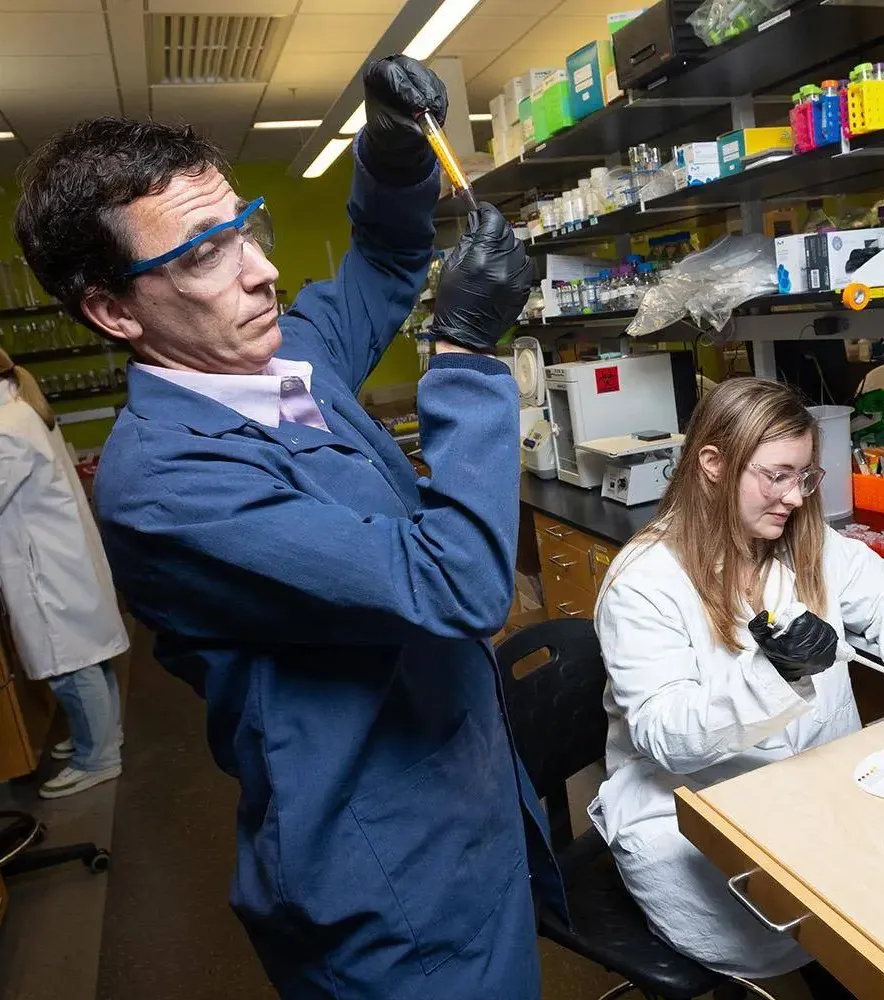
Imagine if building new medicines or sustainable materials were as straightforward as snapping together LEGO® bricks. That’s the goal of a new project led by the Georgia Institute of Technology that could help transform the future of biomanufacturing.
The project, headed by Professor Mark Styczynski in Georgia Tech’s School of Chemical and Biomolecular Engineering (ChBE@GT), recently received a $9.2 million grant from the National Science Foundation Directorate for Technology, Innovation and Partnerships (NSF TIP) to accelerate the adoption of cell-free systems in biomanufacturing.
Promising Technology
Biotechnology has largely relied on living cells for production of products such as medicines, fragrances, or renewable fuels. But working with living cells can be complex and expensive.
Cell-free systems, by contrast, strip biology down to its essential parts, the enzymes and molecules that carry out life’s chemical reactions. This can simplify and speed up biomanufacturing, making it easier to scale.
The challenge, Styczynski explained, is that most cell-free projects still require custom-built setups. “Right now, engineering biology is like reinventing the wheel for every application,” he said. “You have to figure out how all the parts fit together each time. We want to change that by making ready-to-use modules that work right out of the box.”
Styczynski’s project, called Meta-PURE (PUrified Recombinant Elements), will create eight standardized modules, each designed for a key function in cell-free systems, such as generating energy, producing proteins, or assembling complex molecules.
“Like interchangeable puzzle pieces, these modules can be mixed and matched to support different applications,” Styczynski said.
Demonstrating Uses
His team will demonstrate the system’s versatility by producing santalene (a plant-derived fragrance used widely in consumer products), GamS protein (a tool that can improve cell-free processes), and a bacteriophage (a virus that can be safely used in research and the development of new therapeutic treatments).
These examples highlight the technology’s potential across industries ranging from pharmaceuticals and agriculture to chemicals and sustainable materials.
“We want to make these tools so that someone in industry can create their molecule or product more quickly and efficiently, and get it out the door,” Styczynski said.
“Right now, cell-free systems are mostly limited to high-value products because the cost is too high. The goal is to drive costs down and productivity up, so we can move closer to commodity chemicals like biofuels or monomers for polymers, not just niche applications. One of our partners recently developed a butanol process that shows where this can go,” he said.
NSF Initiative
Styczynski’s team is one of four recently awarded an inaugural investment of $32.4 million to help grow the U.S. bioeconomy. The initiative is called the NSF Advancing Cell-Free Systems Toward Increased Range of Use-Inspired Applications (NSF CFIRE).
“NSF is resolute in our commitment to advancing breakthroughs in biotechnology, advanced manufacturing, and other key technologies of significance to the U.S. economy,” said Erwin Gianchandani, assistant director for NSF TIP. “The novel approaches from these four CFIRE teams will speed up and expand the adoption of cell-free systems across a variety of industries and ensure America’s competitive position in the global bioeconomy.”
Collaborative Effort
While ChBE@GT is the lead, Meta-PURE is a broad collaboration with partners across academia, industry, and government. Co-principal investigators include Paul Opgenorth, co-founder and vice president of development at the biotech firm eXoZymes; Nicholas R. Sandoval, associate professor of Tulane University’s Department of Chemical and Biomolecular Engineering; and Anton Jackson-Smith, founder of the biotech startup b.next.
Meta-PURE will also train graduate students and postdocs in partnership with industry, government, and other universities, helping prepare trainees to be the future of a highly interdisciplinary U.S. bioeconomy. The team will also engage the scientific community on the implementation of metrics and standards in cell-free biotechnology to better facilitate broad adoption and interoperability of not just the results of the Meta-PURE project, but of cell-free efforts more broadly.
News Contact
Brad Dixon, braddixon@gatech.edu
Oct. 24, 2011
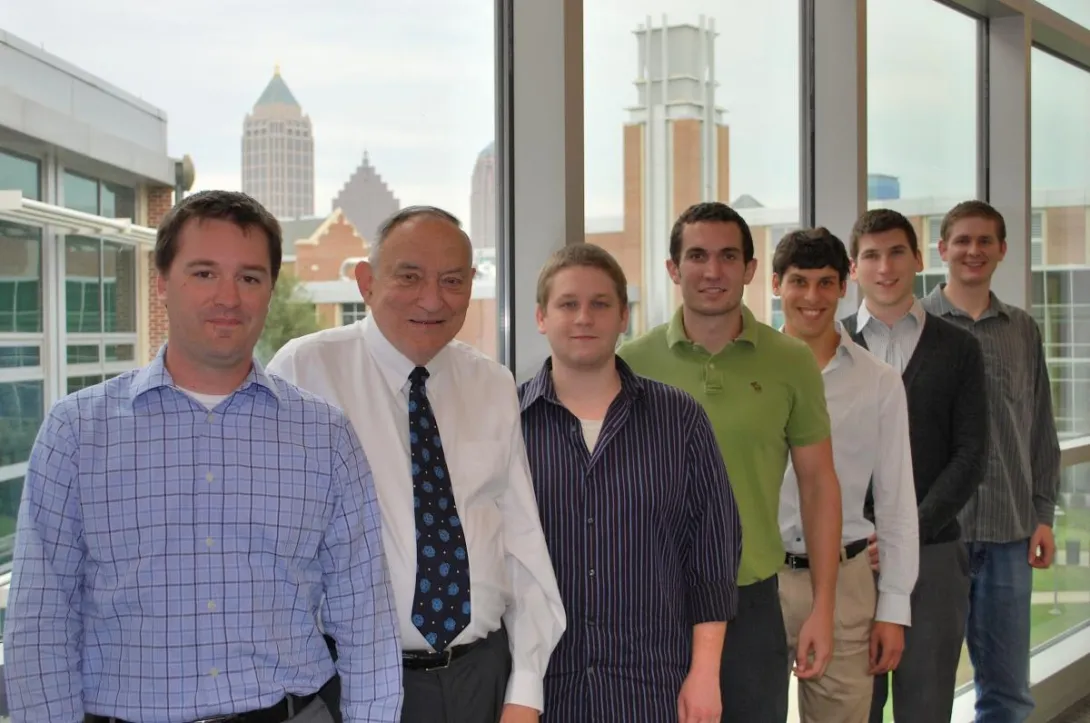


Georgia Tech’s Stem Cell Biomanufacturing Integrated Graduate Education Research Training (IGERT) program, recently identified by Nature magazine as one of the “out of the box” manufacturing educational programs in the country, announced its second class of graduate students today. The seven new trainees come from a wide variety of disciplines including the school of chemical and biomolecular engineering, biomedical engineering, mechanical engineering and material science and engineering.
The $3 million NSF-funded IGERT was awarded to Georgia Tech in 2010 to educate and train the first generation of PhD students in the translation and commercialization of stem cell technologies for diagnostic and therapeutic applications. The current state of the field of stem cell research offers a unique opportunity for engineers to contribute significantly to the generation of robust, reproducible and scalable methods for phenotypic characterization, propagation, differentiation and bioprocessing of stem cells.
Directed by Co-Principal investigators, Todd C. McDevitt, PhD, associate professor in the Wallace H. Coulter Department of Biomedical Engineering, and Robert M. Nerem, PhD, professor emeritus in the George W. Woodruff School of Mechanical Engineering, this grant provides a unique training opportunity to top engineering graduate students looking to understand how to scale and control stem cells into clinically relevant numbers. The goal, to train the next generation of experts in this new field of stem cell biomanufacturing for the development of stem cell technologies, diagnostics, and therapies.
Catalyzed by a surge of activity in the late 1990s, advances in stem cell biology over the past decade have continued to accelerate at a rapid pace. The manufacturing industry is expanding with commercial development of stem cell products projected to be $10 billion within the next 6-8 years. Moreover, the transformation from discoveries in stem cell biology to viable cellular technologies has enormous promise to revolutionize a range of applications for many aspects of society. As a result, stem cell biomanufacturing is on the verge of broadly impacting regenerative medicine, drug discovery and development, cell-based diagnostics and cancer.
Earlier this year, United States President Barack Obama asked Georgia Tech’s President G.P. “Bud” Peterson to join the Advanced Manufacturing Partnership steering committee to revolutionize manufacturing in the United States. Along with other industry and university representatives, the purpose of this committee is to identify and invest in the key emerging technologies, such as information technology, biotechnology and nanotechnology to help U.S. manufacturers improve cost, quality and speed of production in order to remain globally competitive. The stem cell biomanufacturing industry need look no further than President Peterson’s backyard for future experts in stem cell biomanufacturing.
“I have received dozens of calls and emails from industry looking for graduates of this program because of the uniqueness of the training and the need for manufacturing expertise,” stated McDevitt. “Georgia Tech has a real opportunity to become a leader in this emerging field and begin to answer questions about down-stream processes so that when the first clinical therapies are discovered, scientists are prepared to be able to respond with cells in the quantity and quality that will be needed for treatment.”
The Stem Cell Biomanufacturing IGERT is further catalyzed by the Stem Cell Engineering Center, which was also established in 2010 and brings together research laboratories from all over the state of Georgia to discuss and develop collaborative opportunities for research labs engineering novel stem cell based technologies, therapies, and diagnostics.
Georgia Tech's Stem Cell Biomanufacturing IGERT award will train over 30 graduate students in the first 5 years of the program. The IGERT offers a core curriculum in stem cell engineering and analytical design processes coupled with elective tracks in advanced technologies, public policy, ethics or entrepreneurship.
2011 Trainees
Tom Bongiorno – George W. Woodruff School of Mechanical Engineering, Advisor – Todd Sulchek
Rob Dromms – School of Chemical and Biomolecular Engineering, Advisor – Mark Styczynski
Devon Headen – Wallace H. Coulter Department of Biomedical Engineering, Advisor – Andres Garcia
Greg Holst – George W. Woodruff School of Mechanical Engineering, Advisor – Craig Forest
Torri Rinker – Wallace H. Coulter Department of Biomedical Engineering, Advisor – Johnna Temenoff
Shalini Saxena – School of Material Science & Engineering, Advisor – Andrew Lyon
Josh Zimmerman – Wallace H. Coulter Department of Biomedical Engineering, Advisor – Todd McDevitt
2010 Trainees
Amy Cheng – George W. Woodruff School of Mechanical Engineering, Advisor – Andrés García
Alison Douglas – Wallace H. Coulter Department of Biomedical Engineering, Advisor – Thomas Barker
Jennifer Lei – George W. Woodruff School of Mechanical Engineering, Advisor – Johnna Temenoff
Douglas White – Wallace H. Coulter Department of Biomedical Engineering, Advisors – Melissa Kemp & Todd McDevitt
Jenna Wilson – Wallace H. Coulter Department of Biomedical Engineering, Advisor – Todd McDevitt
News Contact
Megan Richards
Program Coordinator
Stem Cell Biomanufacturing IGERT
Georgia Institute of Technology
404-385-0783