
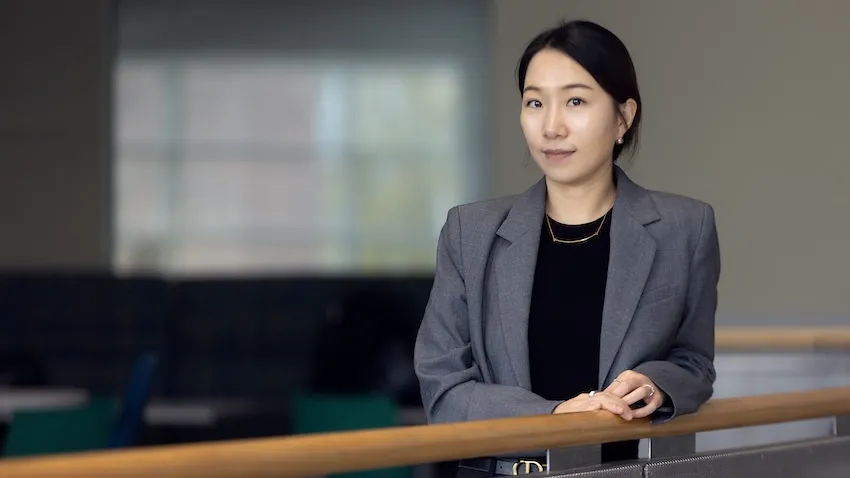
People with autism seeking employment may soon have access to a new AI-based job-coaching tool thanks to a six-figure grant from the National Science Foundation (NSF).
Jennifer Kim and Mark Riedl recently received a $500,000 NSF grant to develop large language models (LLMs) that provide strength-based job coaching for autistic job seekers.
The two Georgia Tech researchers work with Heather Dicks, a career development advisor in Georgia Tech’s EXCEL program, and other nonprofit organizations to provide job-seeking resources to autistic people.
Dicks said the average job search for people with autism can take three to six months in a good economy. It can take up to 18 months in a bad one. However, the new LLMs from Georgia Tech could help to reduce stress and fast-track these job seekers into employment.
Kim is an assistant professor who specializes in human-computer interaction technology that benefits neurodivergent people. Riedl is a professor and an expert in the development of artificial intelligence (AI) and machine learning technologies.
The team’s goal is to identify job-search pain points and understand how job coaches create better employment prospects for their autistic clients.
“Large-language models have an opportunity to support this kind of work if we can have more data about each different individual strength,” Kim said.
“We want to know what worked for them in specific settings at work, what didn’t work, and what kind of accommodations can better help them. That includes how they should prepare for interviews, how they can better represent their skills, how they can address accommodations they need, and how to write a cover letter. It’s a broad range.”
Dicks has advocated for neurodivergent people and helped them find employment for 20 years. She worked at the Center for the Visually Impaired in Atlanta before coming to Georgia Tech in 2017.
She said most nonprofits that support neurodivergent people offer career development programs and many contract job coaches, but limited coach availability often leads to long waitlists. However, LLMs could fill this availability gap to address the immediate needs of job seekers who may not have access to a job coach.
“These organizations often run at a slow pace, and there’s high turnover,” Dicks said. “An AI tool could get the job seeker quicker support. Maybe they don’t even need to wait on the government system.
“If they’re on a waitlist, it can help the user put together a resume and practice general interview questions. When the job coach is ready to work with them, they’re able to hit the ground running.”
Nailing the Interview
Dicks said the job interview is one of the biggest challenges for people with autism.
“They have trouble picking up on visual and nonverbal cues — the tone of the interview, figuring out the nuances that a question is hinting at,” she said. “They’re not giving the warm and fuzzy vibes that allow them to connect on a personal level.”
That’s why Kim wants the models to reflect a strength-based coaching approach. Strength-based coaching is particularly effective for individuals with autism. Many possess traits that employers value. These include:
- Close attention to detail
- Strong technical proficiency
- Unique problem-solving perspectives
“The issue is that they don’t know how these strengths can be applied in the workplace,” Kim said. “Once they understand this, they can communicate with employers about their strengths and the accommodations employers should provide to the job seeker so they can successfully apply their skills at work.”
Handling Rejection
Still, Kim understands that candidates will need to handle rejection to make it through the search process. She envisions LLMs that help them refocus their energy and regain their confidence after being turned down.
“When you get a lot of rejection emails, it’s easy to feel you’re not good enough,” she said. “Being constantly reminded about your strengths and their prior successes can get them through the stressful job-seeking process.”
Dicks said the models should also be able to provide feedback so that candidates don’t repeat mistakes.
“It can tell them what would’ve been a better answer or a better way to say it,” Dicks said. “It can also encourage them with reminders that you get 100 noes before you get a yes.”
You’re Hired, Now What?
Dicks said the role of a job coach doesn’t end the moment a client is hired. Government-contracted job coaches may work with their clients for up to 90 days after they start a new job to support their transition.
However, she said, sometimes that isn’t enough. Many companies have probationary periods exceeding three months. Autistic individuals may struggle with on-the-job training or communicating what accommodations they need from their new employer.
These are just a few gaps an AI tool can fill for these individuals after they’re hired.
“I could see these models evolving to being supportive at those critical junctures of the probationary period being over or the one-year job review or the annual evaluation that everyone dreads,” she said.
Dicks has an average caseload of 15 students, whom she assists in landing jobs and internships through the EXCEL program.
EXCEL provides a mentorship program for students with intellectual and developmental disabilities from the time they set foot on campus through graduation and beyond.
For more information and to apply, visit EXCEL’s website.
Chris Gaffney
By Chris Gaffney, Managing Director, Georgia Tech Supply Chain and Logistics Institute | Supply Chain Advisor | Former Executive at Frito-Lay, AJC International, and Coca-Cola
Introduction
The supply chain labor market has been through one of the most dramatic swings in modern history. During the COVID-19 era disruption, talent shortages were acute, and the pendulum swung decisively toward employees. Companies paid top dollar, offered unprecedented flexibility, and competed fiercely for planners, warehouse leaders, S&OP talent, logistics managers, strategic sourcing leaders, and procurement specialists.
But the pendulum swung back in the opposite direction, from whence it came: in favor of the employers.
The past 18–24 months have seen hiring across supply chain cooling. Many large companies are now signaling they intend to grow revenue without necessarily increasing headcount. At the same time, AI and automation have gotten to the point where employers can get more productivity from existing teams. The result is not necessarily indicative of a recessionary job market but a “Great Hiring Pause”: low hiring, low firing, and a clear tilt of bargaining power back toward employers.
The key question now is whether this moment represents a temporary pause or the new normal. Additionally, what does this mean for both hiring managers and early to mid-career supply chain professionals who want to stay competitive in the workplace?
We’ll explore what this means for all stakeholders as we wrap up the year, looking at how the supply chain job market evolved in 2025 and what we expect to see in 2026.
The Pendulum has Swung from Employee Power to Employer Advantage
If you had as little as 5 years of supply chain experience in late 2020–2022, you may have found yourself with competing job offers. Compensation packages offered were lucrative and filled with relocation fees or even 100% remote job offers.
Without a doubt, this shaped the next 2–3 years of the supply chain labor force. Office space sat empty. Employees moved out of the city into the suburbs. Work-life balance improved for everyone. Employers fretted over rents and mortgages on office space and whether their highly compensated employees were actually working. Threats of a pending recession loomed but never materialized. (fingers crossed, knock on wood). Employers ran a bit lean but then found themselves needing more people to keep up with demand.
In early 2025, we wrote about this swing and the influence AI and automation had on supply chain hiring. Companies seemed to be focusing more on how they could accelerate the performance of existing teams while navigating new cost influences and demand swings. Anxiety about the economy amid never-before-seen tariff whims made it increasingly difficult for employers to plan reliable growth strategies for 2026.
And now here we are. The prevailing mindset as we close out a volatile 2025, where AI and tariffs took center stage, is for growth without as much hiring. So what does that mean for 2026 for employers and employees, or aspiring employees?
Growth Without Hiring: Why Companies are Staying Lean Across Supply Chain and Logistics
Executives are treating hiring as a last resort and not a first resort. JP Morgan Chase’s CFO reportedly said the firm has a “strong bias” against reflexively hiring new people. Walmart, Inc. has signaled plans to grow revenue without increasing employee numbers, instead relying more on automation/AI and efficiency improvements.
As mentioned above, market indicators have become increasingly unreliable. Recent Black Friday consumer spending data indicate that people are financing their purchases on credit and using buy-now, pay-later plans. This means less cash injected into the economy in the short term, along with increased interest payments for 95% of the purchases made on Black Friday. Retailers rely heavily on consumer spending and demand, which dictate their growth or lack thereof.
Businesses have also decided to engage in what some are calling “The Great Freeze”, which is not to hire but also to not fire—holding steady on headcount until they can get a better feel for what 2026 will offer from a demand and affordability sense. High inflation affects everyone, which is why many employers are riding it out for a while.
The Risks of Going Too Lean: Burnout, Fragility, and a Shrinking Talent Pipeline
For supply chain organizations, running lean means pressure to improve throughput, reduce waste, and automate more tasks. While the rapid emergence of AI and automation has greatly improved efficiencies, you still need people to understand the best use cases for all of these tools. They can certainly be enhancements, but will backfire if they are seen to be wholesale replacements for full-time employees. This backlash is being felt and mentioned a lot more consistently. AI shouldn’t replace humans, but rather, make them superhuman.
Firms may invest in upskilling existing staff rather than hiring large numbers of junior or mid-level staff. This could help manage costs in a turbulent economy. This is a tricky game, though. Keeping headcount flat while demands increase can lead to burnout, skill gaps, or degraded service if not managed carefully. Productivity gains might be possible, but at what cost? Change management, culture shift, lack of future talent pipeline, and succession planning can place your supply chain at great risk. Think about it: What will you do about career progression, worker loyalty, and organizational capability in 5–10 years? Yes, AI and automation are force multipliers, but not force replacers.
The people who succeed are those who take a measured approach to talent decisions. It is a refrain that has been emphasized for years. Overly lean operations become fragile, just as banking talent balloons your costs. The goal is to strike a balance between the two.
Will the Pendulum Swing Again?
The short answer: not anytime soon. Today’s flat hiring environment is not just a reaction to inflation or a temporary post-COVID correction or regression to the mean. It is influenced by other structural forces like AI maturity, demographic shifts (including the aging of the workforce), productivity pressure, and a corporate mindset increasingly comfortable with “growth without headcount.”
So what now? Employees should pay attention to these moves and make themselves more valuable by staying proactive. Do not wait for a chance to improve your position. Seek it out.
Find collaborative opportunities with your peers outside of your specific silo. Cross-functional literacy takes center stage to increase one’s value. There has been career acceleration among mid-level supply chain professionals who can work across the organization and become proficient in a multitude of functions. Increase your functional knowledge base and increase your organizational value at the same time.
This is not the time to be complacent or average. Employers still need people with elite soft skills such as leadership, personnel management, communication, and initiative. Visible contributions are essential and will separate those who thrive from those who are content to endure.
There is also hope on the horizon. An elite supply chain institution recently reported that more than 85% of their spring graduates received high-level roles. Another hopeful metric is the rise in offers coming to every supply chain graduate. These numbers are all trending up, which means that the supply chain is strong and in need of a robust talent pipeline.
Employees must demonstrate they can become experienced—if not fluent—with AI tools that make individuals more productive. Use them to lift your value. Differentiation is the name of the game in a field where the top 10–15 percent of talent still commands a premium.
This was explored further in an article written for Georgia Tech this summer. AI is not the end, it is the beginning:
I firmly believe professionals—especially early in their careers—should spend 3 to 5 years in front-line roles. No AI tool can replicate the kind of intuition you build by seeing how things work, where they break, and how people respond in real time. That foundation lasts an entire career.
There will always be a place where the human edge is necessary. The goal is to find where you fit and how you can use AI to your advantage while honing and refining your soft skills. Do not be afraid to make mistakes, either. It is one of the best ways to learn.
Conclusion: Planning for Stability in an Unstable Market
The supply chain talent pendulum has clearly swung back toward employers, and the forces keeping it there are unlikely to fade any time soon. AI maturity, demographic stagnation, post-COVID overcorrections, and a corporate appetite for “growth without hiring” all point to a labor market that may remain employer-favored through 2027 or 2028. But the story does not end there. The pendulum can shift again, and it will if several conditions align: steady consumer demand, renewed business investment, lower interest rates, stable inflation, and a labor market that stays tight enough to force companies to compete for talent rather than squeeze more productivity out of smaller teams.
For employees, waiting for that moment is a recipe for disaster and is not a strategy for success. This is the time to skill up, stand out, and become visibly indispensable. Become more proficient with AI tools, expand your cross-functional range, and build the soft skills that technology cannot replace. Your competition now becomes yourself. There is no better time to be a “self-starter” than now.
For employers, running lean perpetually will not provide a bulletproof bottom line. There is risk to succession planning and employee morale through burnout and stagnation. Continue strategically building internal pipelines. The job market has plenty of talent at a premium right now, so find people who can help you maintain operations and grow into more senior roles as the economy rebounds. Workforce resilience cannot be built overnight, and organizations that fail to adequately invest now will struggle later.
“Steady-Eddie” remains the preferred path. Do not overhire or overfire. Aim for a sweet spot that maintains growth, protects margins, and creates a small cushion of resilience for the labor pool. The companies that invest smartly and the employees who stay adaptable, proactive, and highly visible have the chance to define the next era of supply chain leadership, no matter where the pendulum lands.
Call to Action: What This Means for You—and What to Do Next
If these dynamics feel familiar—or unsettling—you are not alone. Moments like this are precisely when intentional investment in skills, talent pipelines, and professional networks matters most.
For students and early-career professionals
This is the time to differentiate, not wait. Employers are hiring selectively, and they are looking for candidates who combine foundational supply chain experience with strong communication, cross-functional literacy, and practical fluency with analytics and AI-enabled tools. Georgia Tech’s Supply Chain and Logistics Institute (SCL) offers professional education courses designed to build exactly these capabilities—grounded in real-world application, not theory alone.
For working professionals
If you are navigating growth-without-hiring realities, reskilling and upskilling are no longer optional. SCL programs help professionals sharpen decision-making, leadership, and applied technical skills that increase both individual and organizational resilience—especially in environments where headcount is constrained but expectations are rising.
For hiring managers and employers
Even in a cautious hiring market, the competition for top-tier supply chain talent has not disappeared—it has become more targeted. Engaging early with Georgia Tech SCL allows you to connect with high-caliber students, support a durable talent pipeline, and partner on developing skills that align with where supply chains are headed, not where they have been.
Readers are also encouraged to explore SCM-focused podcasts and practitioner conversations—including leadership, career-path, and “day-in-the-life” perspectives—that help translate these labor market shifts into practical guidance. These voices complement formal education by offering lived experience and real-world context during periods of uncertainty.
For those wondering how to navigate what comes next, staying connected with Georgia Tech SCL can be valuable. In a January 2026 webinar, the team will preview an emerging trend expected to materially shape supply chain roles, workforce expectations, and talent strategies over the next 3–5 years—particularly at the intersection of AI enablement, front-line experience, and leadership readiness.
This moment favors those who engage early, build capability deliberately, and stay connected to credible institutions shaping the future of supply chain practice.
This content was developed in collaboration with SCM Talent Group, a supply chain recruiting and executive search firm.
Resources
- Associated Press — “US hiring stalls with employers reluctant to expand...” (reports just ~22,000 jobs in a month). AP News
- CBS News — Supporting story on same 22,000-job report / labor-market cooldown. CBS News
- PBS NewsHour — Analysis of U.S. hiring stall and its implications. PBS
- Business Insider — Coverage of weak August 2025 jobs report and growing caution in labor markets. Business Insider
- The Wall Street Journal — “Jobs Report Shows Hiring Slowed in August 2025” (subscription-gated). The Wall Street Journal
- Bloomberg — Reporting that job openings and hiring have decoupled despite rising corporate capital expenditures; signals firms are investing without matching headcount growth. Bloomberg
- Walmart / Newsweek — Recent article on Walmart celebrating automation and signaling flat headcount even as business grows. Newsweek
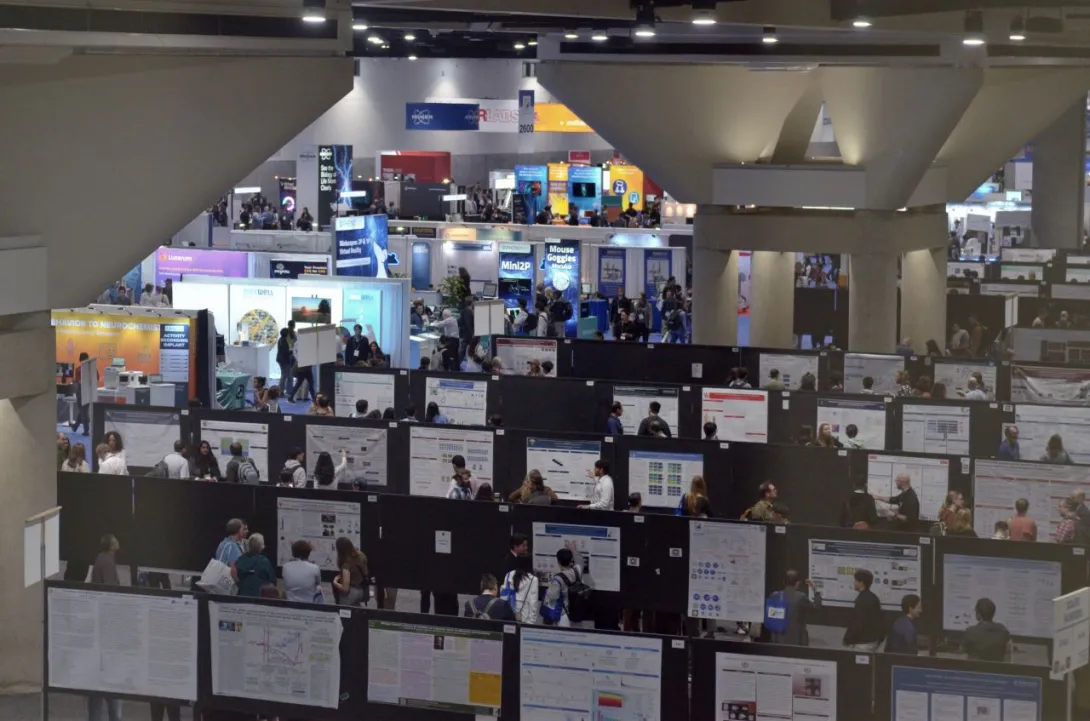
Affectionally called "DragonCon for neuroscience," the annual Society for Neuroscience meeting is one of the largest academic conferences in the world.
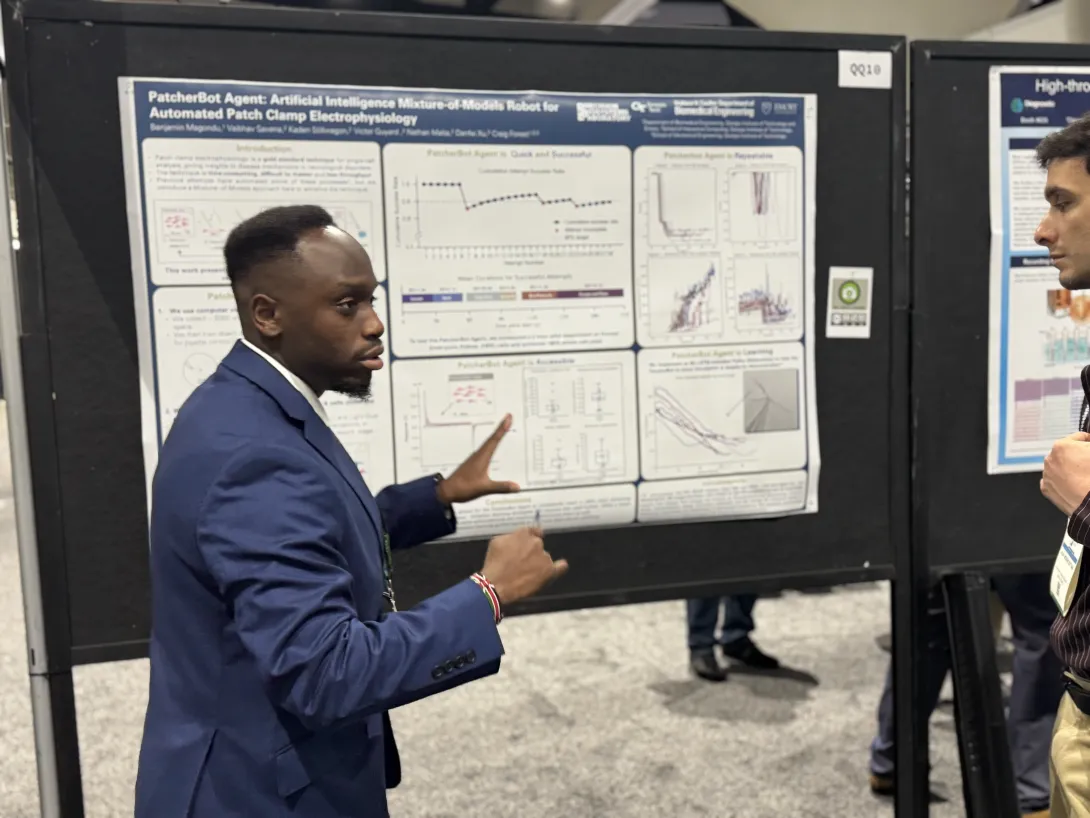
Benjamin Magondu, a graduate student in biomedical engineering, presented at SfN for the first time this year.
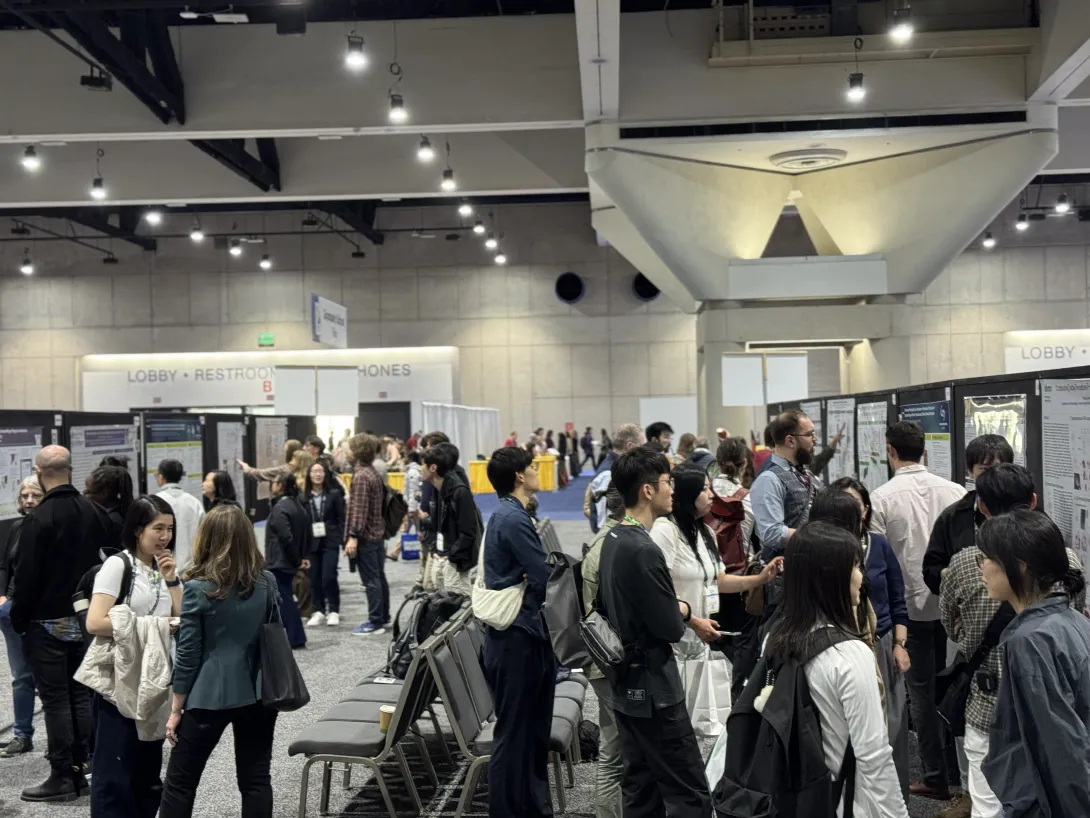
With hundreds of presentations happening simultaneously, the poster floor can be overwhelming at SfN — but for many, that's part of the draw.
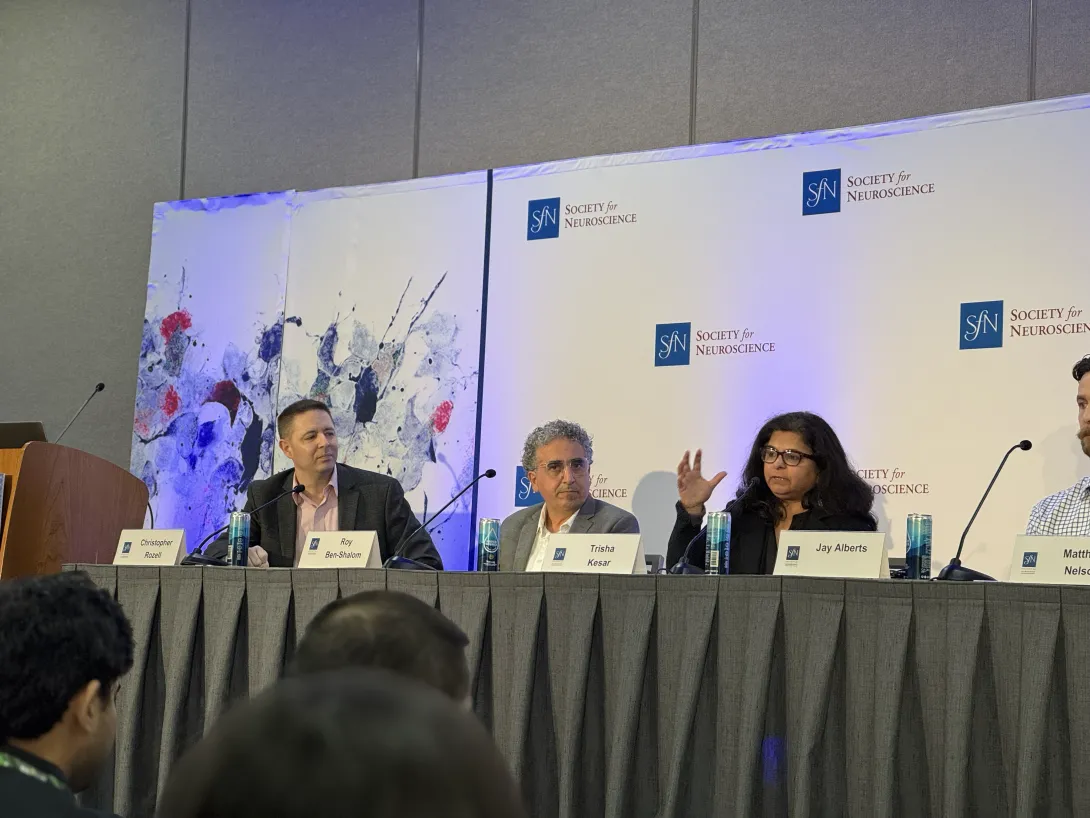
Trisha Kesar answers a question during the SfN press conference on AI in neuroscience, moderated by Chris Rozell.
Imagine stepping into a space the size of multiple football fields — only instead of turf and goalposts, it’s filled with science. Every inch is alive with posters, equipment demos, and researchers sharing the latest breakthroughs.
Welcome to the Society for Neuroscience (SfN) Conference, one of the largest scientific gatherings in the world, drawing more than 30,000 attendees to San Diego in November. According to Annabelle Singer, it is the place to be for neuroscientists. “If you want to know what is going on now in neuroscience, it is being talked about at SfN.”
Singer is a McCamish Foundation Early Career Professor in the Wallace H. Coulter Department of Biomedical Engineering (BME) at Georgia Tech and Emory University. A frequent SfN attendee, she describes the meeting as “Dragon Con for neuroscience, with thousands of talks and posters going on simultaneously.”
This year, Georgia Tech didn’t just show up — it made a statement with more than 60 presentations, a major outreach award, and a spotlight press conference.
“Seeing Georgia Tech and INNS represented so strongly at SfN is exciting,” says Chris Rozell, executive director of Tech’s Institute for Neuroscience, Neurotechnology, and Society (INNS). “It reflects the incredible breadth of neuroscience and neurotechnology research happening across our campus and how our work is shaping conversations at the highest level.”
Inside ‘Neuroscience Dragon Con’
Many conferences center around structured lectures, but at SfN, posters are the heart. You might find a senior researcher presenting groundbreaking findings right next to a first-time attendee sharing early results. This diversity is what makes the experience so valuable, says Singer. “Trainees get to talk directly with the scientist doing the work to get their questions answered, from wondering about future implications to clarifying technical details.”
The scale of SfN can feel overwhelming, but for many, that’s part of the excitement. “There are so many different posters from so many different fields. It’s a lot to absorb, but it’s all very interesting,” said Benjamin Magondu, a biomedical engineering Ph.D. student presenting for the first time. “I’ve definitely learned at least 47 things by just walking 10 feet.”
For students like Magondu, the experience is critical, says Biological Sciences Assistant Professor Farzaneh Najafi. “SfN has such a big scope, all the way from molecular to cognitive and computational systems. Especially for those deciding which direction of neuroscience they want to go into, it’s invaluable.”
That breadth also fosters connections across disciplines. “Conferences are usually pretty niche,” noted Tina Franklin, a research scientist in BME. “You have your own field that you’re really good at, but it’s difficult to venture out and find new people who can help you figure out what comes next. This conference brings people from all different fields together with the common interest of neuroscience and brain research.”
Leading the Charge
Georgia Tech’s impact went beyond the conference floor. Ming-fai Fong, an assistant professor in BME, received the prestigious Next Generation Award, one of SfN’s education and outreach awards. The honor recognizes members who make outstanding contributions to public communication and education about neuroscience.
“I’m certainly very grateful to the Society for Neuroscience for recognizing these types of contributions,” says Fong, who was recognized for her work supporting blind and visually impaired youth in Atlanta. “Rewarding outreach efforts reinforces my core belief that scientists and engineers can make an immediate impact on communities we care about through outreach. It’s a great parallel avenue to making a positive impact through research.”
Building on this recognition, Georgia Tech was in the spotlight during one of SfN’s selective press conferences — a session on artificial intelligence in neuroscience moderated by Rozell, who is also the Julian T. Hightower Chair in the School of Electrical and Computer Engineering.
During the SfN press event, Trisha Kesar, an associate professor in BME and adjunct faculty in the School of Biological Sciences, presented her research using AI to improve gait rehabilitation. Her work was among just 40 abstracts selected from more than 10,000 submissions for this honor, and one of five abstracts selected for the AI in neuroscience press conference. The project is a collaboration with Hyeok Kwon, a Georgia Tech computer science alumnus and an assistant professor in BME.
“It’s exciting to see Georgia Tech and Atlanta emerging as hubs for neuroscience innovation,” said Kesar. “Being part of a press conference on AI in neuroscience shows how much our community is contributing to the future of brain research, and how collaboration across institutions can accelerate progress.”
News Contact
Writer and media contact:
Audra Davidson
Research Communications Manager
Institute for Neuroscience, Neurotechnology, and Society (INNS)
Presenter Dashboard:
Created by Joshua Preston, Communications Manager, College of Computing
Data collection by Audra Davidson, Hunter Ashcraft

The AI4Science Center has announced the first recipients of its semiannual seed grant competition. Supported by the Schools of Chemistry and Biochemistry, Physics, and Psychology, the seed grant aims to support the development of research projects centered on innovation and collaboration.
“The selection committee received more than a dozen proposals that push the boundaries of AI-enabled science and encourage collaboration across units. I look forward to seeing the great science, strong results, and successful future external funding enabled by these seed grants,” says Dimitrios Psaltis, professor in the School of Physics and director of the AI4Science Center.
Launched earlier this semester, the center promotes cross-disciplinary research on AI tools that address scientific challenges. The following three proposals were selected by the center based on their scientific goals, extent of interdisciplinary collaboration, and potential for outside funding:
Spring 2026 AI4Science Center Seed Grant Recipients
Graph Foundation Models for Protein Conformational Dynamics | School of Chemistry and Biochemistry
- PIs: Professor Peter Kasson, School of Chemistry and Biochemistry; Professor JC Gumbard, School of Physics; Assistant Professor Amirali Aghazadeh, School of Electrical and Computer Engineering
- Graduate student: Jeffy Jeffy
- Team statement: “The AI4Science Center’s seed funding will allow us to complete and test a prototype of our new deep learning architecture for protein dynamics. We're super excited about the project and happy that this gives us support to pursue our new idea.”
Combinations of Verified AI and Domain Knowledge for New Insights in Theoretical Physics | School of Physics
- PIs: Assistant Professor Aishik Ghosh, School of Physics; Professor Vijay Ganesh, School of Computer Science
- Graduate student: Piyush Jha
- Team statement: “This seed funding gives us an opportunity to connect two fields in a way that could transform our approach to certain problems in theoretical physics.”
Harnessing the Manifold Geometry of Neural Representations for Robust LLM Safety | School of Psychology
- PIs: Assistant Professor Audrey Sederberg, School of Psychology; Assistant Professor Pan Li, School of Electrical and Computer Engineering
- Graduate student: Ruixuan Deng
- Team statement: “Our project injects insights from human neuroscience directly into AI safety algorithm design, allowing us to move beyond black-box approaches toward more interpretable and principled safety mechanisms. By closing the loop, these computational models will also provide new feedback and insights for neuroscience.”
News Contact
Writer: Lindsay C. Vidal
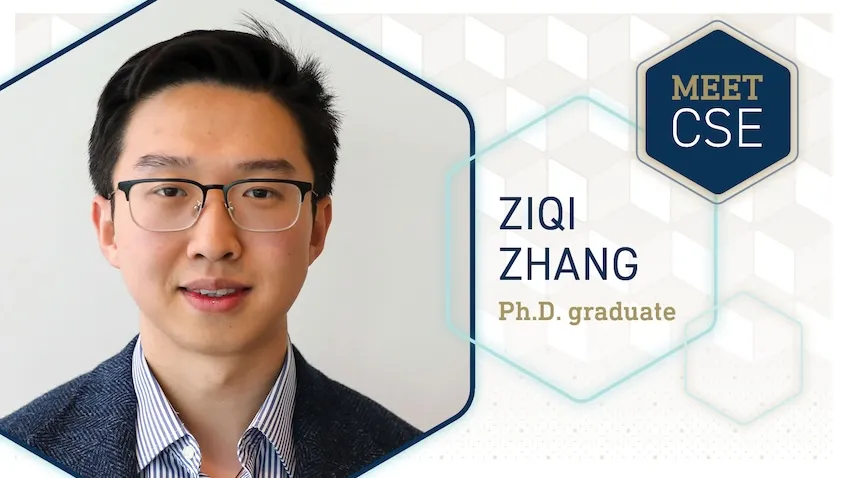
Ph.D. student Ziqi Zhang has built a career blending machine learning with single-cell biology. His work helps scientists study cellular mechanisms that advance disease research and drug development.
Though decorated with awards and appearances in leading journals, Zhang will achieve his greatest accomplishment tonight at McCamish Pavilion. He will join the Class of 2025 in walking across the stage, receiving diplomas, and graduating from Georgia Tech.
Before he “gets out” of Georgia Tech, we interviewed Zhang to learn more about his Ph.D. journey and where his degree will take him next.
Graduate: Ziqi Zhang
Research Interests: Machine learning, foundational models, cellular mechanisms, single-cell gene sequencing, gene regulatory networks
Education: Ph.D. in Computational Science and Engineering
Faculty Advisor: School of CSE J.Z. Liang Early-Career Associate Professor Xiuwei Zhang
What persuaded you to study at Georgia Tech?
I chose Georgia Tech because it is one of the top engineering institutions in the United States, known for its strength in machine learning and data science. The university offers exceptional research resources and the opportunity to work with leading scholars in my field. Georgia Tech also has very good research infrastructure. The Coda Building is one of the most well-designed and productive research environments I have experienced. Having access to such a space has been a genuine privilege.
How has working on your CSE degree helped you so far in your career?
Working toward my CSE degree has been instrumental in my career development. As an interdisciplinary program, CSE has equipped me with strong computational skills while also deepening my understanding of key application domains. This breadth of training has opened more opportunities during my job and internship searches. In addition, CSE community events, such as HotCSE, the weekly coffee hour, and faculty recruiting activities, have helped me strengthen my scientific communication skills, which are essential for my long-term career growth.
What research project from Georgia Tech are you most proud of?
My favorite research project was scMoMaT, a matrix tri-factorization algorithm for single-cell data integration. I invested a significant amount of time and effort into this work, iterating on the model many times. I’m very proud that it ultimately evolved into a clean, robust, and elegant algorithm.
What advice would you give someone interested in graduate school?
It is important to find an advisor who is supportive and genuinely invested in your career development. A Ph.D. is not an easy journey, and you will inevitably encounter challenges along the way. Having an advisor who can provide thoughtful guidance and dedicated mentorship is one of the most crucial factors in helping you navigate those difficulties.
What is your most favorite memory from Georgia Tech?
CSE’s new student campus visit day every year was one of my favorite times of the year. It was always fun to meet new people, have good food, and enjoy the beautiful view from the Coda rooftop.
What are your plans after graduation?
I plan to keep working in academia after graduation. I’m on the job hunt, currently applying for positions and preparing for interviews.
News Contact
Bryant Wine, Communications Officer
bryant.wine@cc.gatech.edu

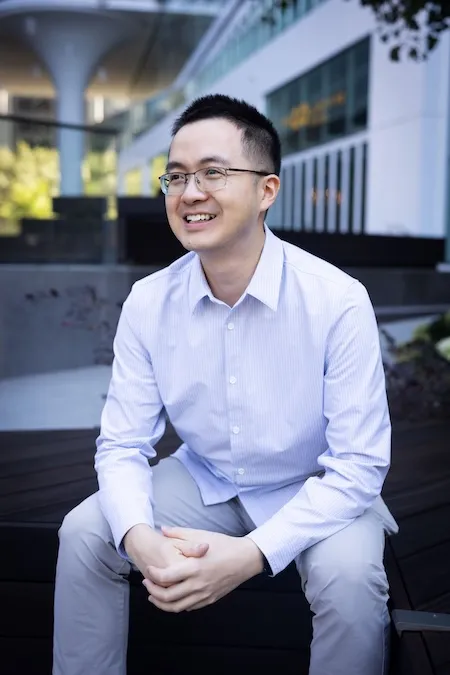
Proteins, including antibodies, hemoglobin, and insulin, power nearly every vital aspect of life. Breakthroughs in protein research are producing vaccines, resilient crops, bioenergy sources, and other innovative technologies.
Despite their importance, most of what scientists know about proteins only comes from a small sample size. This stands in the way of fully understanding how most proteins work and unlocking their full potential.
Georgia Tech’s Yunan Luo believes artificial intelligence (AI) could fill this knowledge gap. The National Science Foundation agrees. Luo is the recipient of an NSF Faculty Early Career Development (CAREER) award.
“So much of biology depends on knowing what proteins do, but decades of research have concentrated on a relatively small set of well-studied proteins. This imbalance in scientific attention leads to a distorted view of the biological landscape that quietly shapes our data and our algorithms,” Luo said.
“My group’s goal is to build machine learning (ML) models that actively close this gap by generating trustworthy function predictions for the many proteins that remain understudied.”
[Related: Yunan Luo to use AI for Protein Design and Discovery with Support of $1.8 Million NIH Grant]
In his proposal to NSF, Luo coined this rich-get-richer effect “annotation inequality.”
One problem of annotation inequality is that it slows progress in disease prognosis, drug discovery, and other critical biomedical areas. It is challenging to innovate the few proteins that scientists already know so much about.
A cascading effect of annotation inequality is that it diminishes the effectiveness of studying proteins with AI.
AI methods learn from existing experimental data. Datasets skewed toward well-known proteins propagate and become entrenched in models. Over time, this makes it harder for computers to research understudied proteins.
“Protein annotation inequality creates an effect analogous to a vast library where 95% of patrons only read the top 5% popular books, leaving the rest of the collection to gather dust,” Luo said.
“This has resulted in knowledge disparities across proteins in current literature and databases, biasing our understanding of protein functions.”
The NSF CAREER award will fund Luo with over $770,000 for the next five years to tackle head-on the problem of protein annotation inequality.
Luo will use the grant to build an accurate, unbiased protein function prediction framework at scale. His project aims to:
- Reveal how annotation inequality affects protein function prediction systems
- Create ML techniques suited for biological data, which is often noisy, incomplete, and imbalanced
- Integrate data and ML models into a scalable framework to accelerate discoveries involving understudied proteins
More enduring than the ML framework, Luo will leverage the NSF award to support educational and outreach programs. His goal is to groom the next generation of researchers to study other challenges in computational biology, not just the annotation inequality problem.
Luo teaches graduate and undergraduate courses focused on computational biology and ML. Problems and methods developed through the CAREER project can be used as course material in his classes.
Luo also championed collaboration with Georgia Tech’s Center for Education Integrating Science, Mathematics, and Computing (CEISMC) in his proposal.
Through this partnership, local high school teachers and students would gain access to his data and models. This promotes deeper learning of biology and data science through hands-on experience with real-world tools.
Luo sees reaching students and the community as a way of paying forward the support he received from Georgia Tech colleagues.
“I am incredibly grateful for this recognition from the NSF,” said Luo, an assistant professor in the School of Computational Science and Engineering (CSE).
“This would not have been possible without my students and collaborators, whose hard work laid the groundwork for this proposal.”
Luo praised CSE faculty members B. Aditya Prakash, Xiuwei Zhang, and Chao Zhang for their guidance. All three study machine learning and computational bioscience, two of CSE’s five core research areas.
Luo also thanked Haesun Park for her support and recommendation for the CAREER award. Park is a Regents’ Professor and the chair of the School of CSE.
News Contact
Bryant Wine, Communications Officer
bryant.wine@cc.gatech.edu
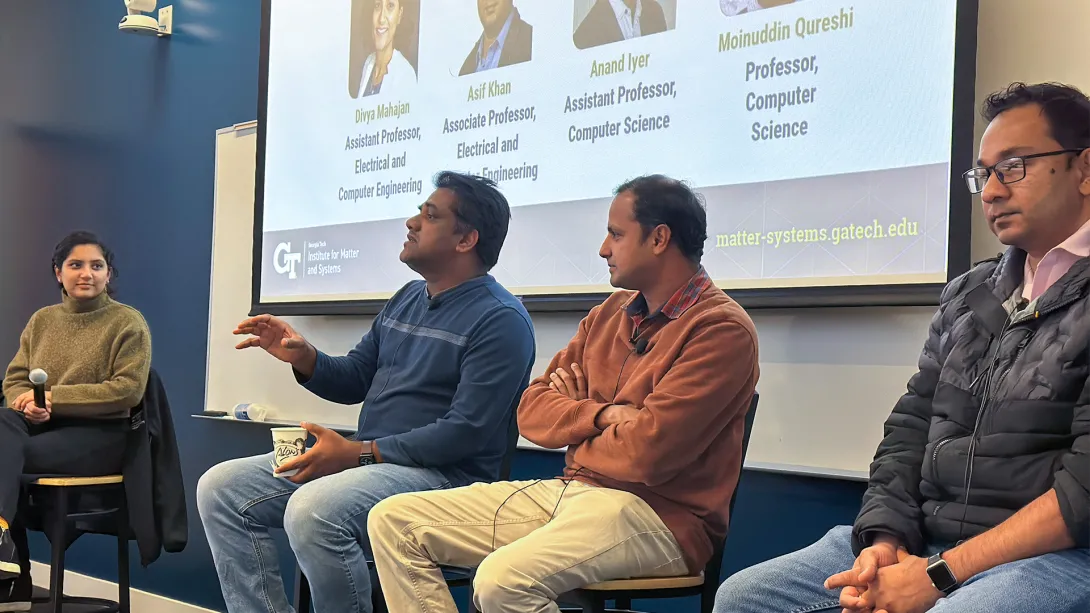
The Institute for Matter and Systems (IMS) hosted the inaugural Boundaries and Breakthroughs panel on Nov. 11, setting the stage for a new era of interdisciplinary dialogue at Georgia Tech. The event, held in the Marcus Nanotechnology building, brought together experts in electrical engineering, computer architecture, and computer systems design to tackle one of today’s pressing challenges: artificial intelligence (AI) scalability and sustainable high-performance computing.
As one of Georgia Tech’s 11 interdisciplinary research institutes, IMS is designed to break down silos between traditional academic units. By operating core user facilities and fostering collaborative research, IMS creates a unique ecosystem where device-level innovation meets systems-level design. This event personified that mission by connecting researchers who typically work on different ends of the stack.
“We’re looking for opportunities to bring people together to have discussions that are both informative and potentially create a little bit of friction in the best possible way around trending topics in science and engineering,” said Mike Filler, IMS deputy director, during opening remarks.
The panel was moderated by Divya Mahajan, assistant professor in the School of Electrical and Computer Engineering, and featured Moinuddin Qureshi, professor of computer science; Anand Iyer, assistant professor of computer science; and Asif Khan, associate professor in electrical and computer engineering.
The discussion explored the dynamics between compute abundance and energy constraints. As AI models scale up, power consumption has become a societal issue, driving up energy demands and even influencing political conversations. The panelists agreed that the bottleneck isn’t compute — a computer’s ability to process and execute tasks — but data movement. Moving data uses 100 to 1,000 times more energy than computation, making memory systems the critical frontier.
The conversation highlighted how breakthroughs in compute must occur at every layer — from individual devices to full computer systems. At the device level, Khan mentioned emerging memory technologies and “beyond CMOS” approaches such as embedding compute within memory and exploring bio-inspired architectures.
From a computer architecture level, Qureshi advocated rethinking interfaces and creating designs optimized for the future of computing. AI needs regular patterns to work optimally, and current patterns are not set up for that.
“If you want efficiency, design systems that make sense for AI,” Qureshi said. “Develop new interfaces, develop new modules, architectures, and organization that make for a specific pattern.”
At the systems level, Iyer stressed practical strategies like near-memory compute and energy-aware scheduling while acknowledging the need for co-design between hardware and software.
“Now in terms of brains or bio-inspired computing, my conjecture is that there is currently no hardware that is capable of doing it,” Khan said. He also noted that right now, there is no computer or algorithm that has the scale of computing comparable to human brain power.
The panelists didn’t shy away from provocative ideas — such as whether graphic processing units are the final solution for AI and whether matrix multiplication alone can lead to artificial general intelligence. While opinions varied, all agreed that organizations like IMS are key to bringing together diverse expertise to tackle these questions collaboratively.
The Boundaries and Breakthroughs series continues in January with a panel on bioelectronics and medical technologies, reinforcing IMS’s commitment to fostering dialogue that spans the full spectrum of innovation.
News Contact
Amelia Neumeister | Research Communications Program Manager
The Institute for Matter and Systems
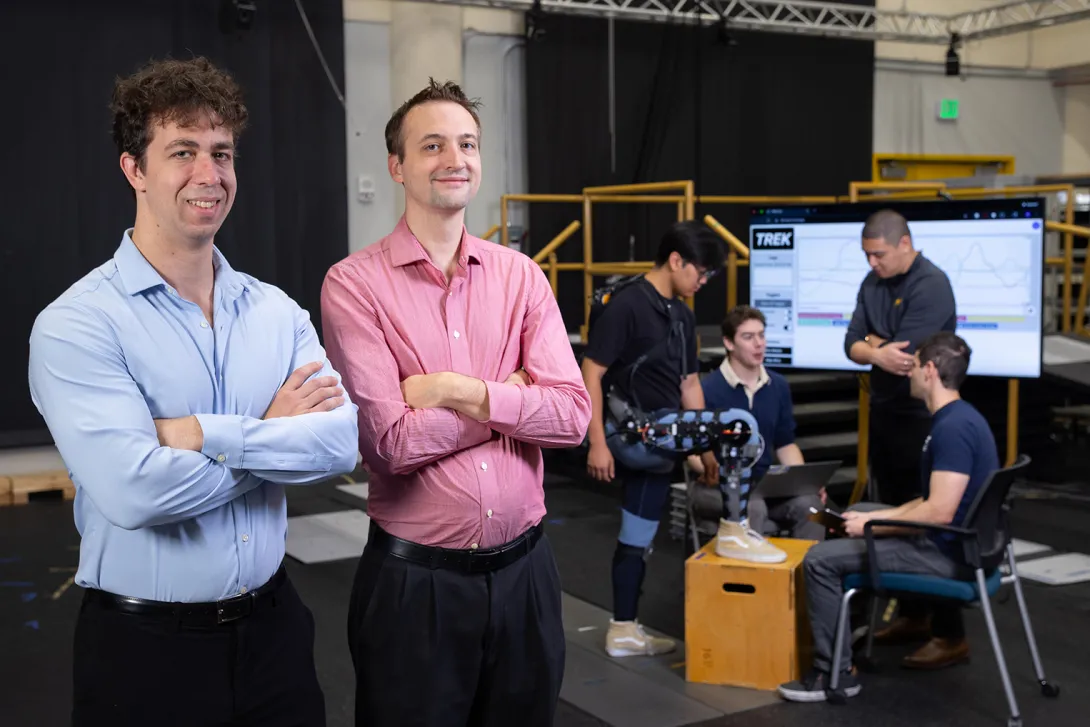
Researchers Matthew Gombolay, left, and Aaron Young used the lower-limb exoskeleton demonstrated in the background to test their new approach to creating exoskeleton controllers. They use huge amounts of existing data on how people move to create functional controllers able to provide meaningful assistance. And unlike earlier controllers, they do not require hours and hours of additional training and data collection with each specific exoskeleton device.
To make useful wearable robotic devices that can help stroke patients or people with amputated limbs, the computer brains driving the systems must be trained. That takes time and money — lots of time and money. And researchers need specially equipped labs to collect mountains of human data for training.
Even when engineers have a working device and brain, called a controller, changes and improvements to the exoskeleton system typically mean data collection and training start all over again. The process is expensive and makes bringing fully functional exoskeletons or robotic limbs into the real world largely impractical.
Not anymore, thanks to Georgia Tech engineers and computer scientists.
They’ve created an artificial intelligence tool that can turn huge amounts of existing data on how people move into functional exoskeleton controllers. No data collection, retraining, and hours upon hours of additional lab time required for each specific device.
Their approach has produced an exoskeleton brain capable of offering meaningful assistance across a huge range of hip and knee movements that works as well as the best controllers currently available. Their worked was published Nov. 19 in Science Robotics.
News Contact
Joshua Stewart
College of Engineering
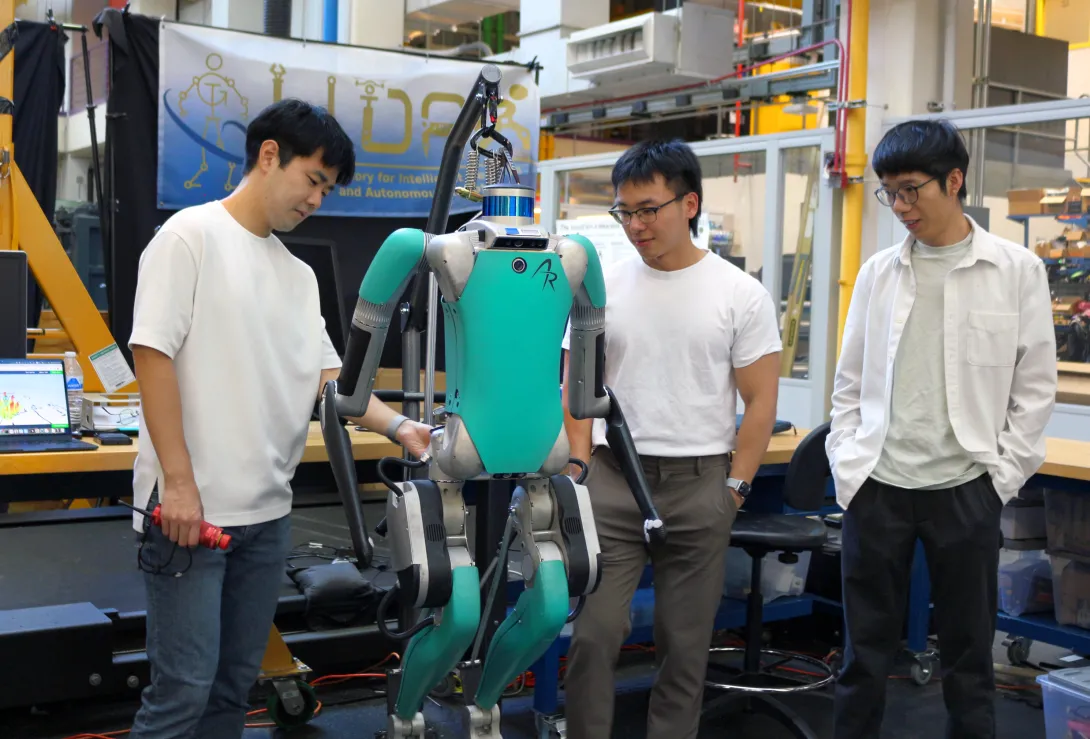
Members of the LIDAR Lab involved with the research with the DIGIT robot used in the trainings.
Viral videos abound with humanoid robots performing amazing feats of acrobatics and dance but finding videos of a humanoid robot performing a common household task or traversing a new multi-terrain environment easily, and without human control, are much rarer. This is because training humanoid robots to perform these seemingly simple functions involves the need for simulation training data that lack the complex dynamics and degrees of freedom of motion that are inherent in humanoid robots.
To achieve better training outcomes with faster deployment results, Fukang Liu and Feiyang Wu, graduate students under Professor Ye Zhao from the Woodruff School of Mechanical Engineering and faculty member of the Institute for Robotics and Intelligent Machines, have published a duo of papers in IEEE Robotics and Automation Letters. This is a collaborative work with three other IRIM affiliated faculties, Profs. Danfei Xu, Yue Chen, and Sehoon Ha, as well as Prof. Anqi Wu from School of Computational Science and Engineering.
To develop more reliable motion learning for humanoid robots and enable humanoid robots to perform complex whole-body movements in the real world, Fukang led a team and developed Opt2Skill, a hybrid robot learning framework that combines model-based trajectory optimization with reinforcement learning. Their framework integrates dynamics and contacts into the trajectory planning process and generates high-quality, dynamically feasible datasets, which result in more reliable motion learning for humanoid robots and improved position tracking and task success rates. This approach shows a promising way to augment the performance and generalization of humanoid RL policies using dynamically feasible motion datasets. Incorporating torque data also improved motion stability and force tracking in contact-rich scenarios, demonstrating that torque information plays a key role in learning physically consistent and contact-rich humanoid behaviors.
While other datasets, such as inverse kinematics or human demonstrations, are valuable, they don’t always capture the dynamics needed for reliable whole-body humanoid control.” said by Fukang Liu. “With our Opt2Skill framework, we combine trajectory optimization with reinforcement learning to generate and leverage high-quality, dynamically feasible motion data. This integrated approach gives robots a richer and more physically grounded training process, enabling them to learn these complex tasks more reliably and safely for real-world deployment. - Fukang Liu
In another line of humanoid research, Feiyang established a one-stage training framework that allows humanoid robots to learn locomotion more efficiently and with greater environmental adaptability. Their framework, Learn-to-Teach (L2T), unlike traditional two-stage “teacher-student” approaches, which first train an expert in simulation and then retrain a limited-perception student, teaches both simultaneously, sharing knowledge and experiences in real time. The result of this two-way training is a 50% reduction in training data and time, while maintaining or surpassing state-of-the-art performance in humanoid locomotion. The lightweight policy learned through this process enables the lab’s humanoid robot to traverse more than a dozen real-world terrains—grass, gravel, sand, stairs, and slopes—without retraining or depth sensors.
By training an expert and a deployable controller together, we can turn rich simulation feedback into a lightweight policy that runs on real hardware, letting our humanoid adapt to uneven, unstructured terrain with far less data and hand-tuning than traditional methods. - Feiyang Wu
By the application of these training processes, the team hopes to speed the development of deployable humanoid robots for home use, manufacturing, defense, and search and rescue assistance in dangerous environments. These methods also support advances in embodied intelligence, enabling robots to learn richer, more context-aware behaviors.Additionally, the training data process can be applied to research to improve the functionality and adaptability of human assistive devices for medical and therapeutic uses.
As humanoid robots move from controlled labs into messy, unpredictable real-world environments, the key is developing embodied intelligence—the ability for robots to sense, adapt, and act through their physical bodies,” said Professor Ye Zhao. “The innovations from our students push us closer to robots that can learn robust skills, navigate diverse terrains, and ultimately operate safely and reliably alongside people. - Prof. Ye Zhao
Author - Christa M. Ernst
Citations
Liu F, Gu Z, Cai Y, Zhou Z, Jung H, Jang J, Zhao S, Ha S, Chen Y, Xu D, Zhao Y. Opt2skill: Imitating dynamically-feasible whole-body trajectories for versatile humanoid loco-manipulation. IEEE Robotics and Automation Letters. 2025 Oct 13.
Wu F, Nal X, Jang J, Zhu W, Gu Z, Wu A, Zhao Y. Learn to teach: Sample-efficient privileged learning for humanoid locomotion over real-world uneven terrain. IEEE Robotics and Automation Letters. 2025 Jul 23.
News Contact

The Georgia Tech Library is proud to show a new piece from Hyojin Kwon and Nix Liu Xin on the Media Bridge, Synthetic Ecologies: AI-Translated Matter in Architectural Media.
The four-minute piece, which went live in November, is playing every hour at the ten-minute mark on Media Bridge, located between Price Gilbert and Crosland Tower.
About Synthetic Ecologies: AI-Translated Matter in Architectural Media
Rather than accelerating images, Synthetic Ecologies asks “how matter thinks.” New Materialism treats matter as an active partner; design emerges where human intention intra-acts with things, datasets, models, and light. Authorship becomes orchestration, and every dataset a canon—a politics of selection. Method, therefore, is ethics.
The project authors a white model first, fixing space, camera, light, and motion as temporal logic. AI then enters as a translator, moving on rails of depth/normal/segmentation with flow consistency. The surface reveals signs of behavior—gloss, scattering, porosity, accretion—rather than mere style. We publish provenance—sources and biases, node graphs and parameters, timelines and versions—so choices are traceable and contestable, transferable to learning, practice, and public decision.
From plastic toward a synthetic ecology, the work declares architecture thinking with media. AI is not authority but a transparent amplifier; authorship is not surrendered.
Spanning the Library, the Media Bridge is a civic threshold of study and routine, a common ceiling shared day and night. Installed overhead, the flow of plastics becomes a sky that prompts daily audiences to reflect on circulation, responsibility, and bias. Open provenance turns the piece into a public manifesto, linking campus AI literacy and circularity agendas to civic practice. The work does more than show images; it proposes a public curriculum where data and decisions, materials and culture, negotiate in view of the community.
Artist Bios
Hyojin Kwon is an Assistant Professor in the School of Architecture at the Georgia Institute of Technology and cofounder of Pre- and Post-, a research-driven design practice based in Atlanta and Boston. Her work explores how digital media — including animation, simulation, and AI-assisted image workflows — can function as both generative and critical tools within architectural design. Situated within a post digital framework, her recent projects investigate material agency and synthetic ecologies, often translating computational processes into civic installations and experimental representations. Her work has been exhibited internationally, including at the Museum of Brisbane, Tokyo Designers Week, Seoul Foundation for Arts and Culture, and Atlanta Contemporary, and supported by institutions such as MacDowell, Art Omi, and Autodesk.
Nix Liu Xin is a spatial computing artist and director, Harvard graduate, and the founder & CEO of OI (Onceness Intelligence), an experiential-AI startup. He envisions a future where 4D–AI interfaces enable everyone to record life moments, relive memories, and design immersive spatial experiences through intelligent 4D media.
He was named to the AACYF 30 Under 30 and has received accolades such as the Harvard Design Studies Domain Award, the CGarchitect 3D Awards, and the MIT AI Film Hack Award for Best Picture.
Additionally, Nix was featured as an artist at the Lianzhou Photography Biennale. He also co-founded the HarvardXR Conference and the Creative.Tech Community.