
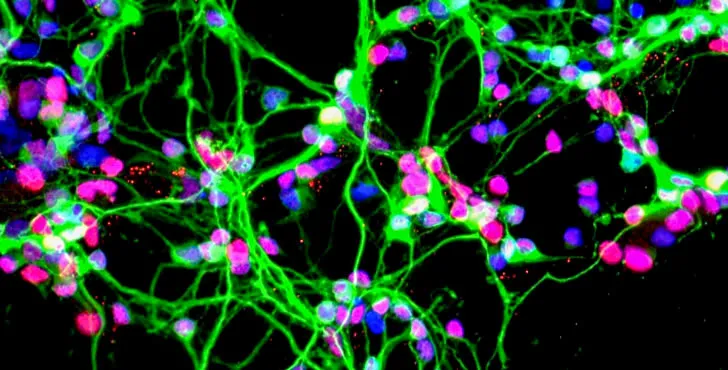
Neurons growing in a culture dish (NASA)

School of Psychology Assistant Professor Apurva Ratan Murty

Graduate Student Mayukh Deb
Researchers at Georgia Tech have taken a critical step forward in creating efficient, useful and brain-like artificial intelligence (AI). The key? A new algorithm that results in neural networks with internal structure more like the human brain.
The study, “TopoNets: High-Performing Vision and Language Models With Brain-Like Topography,” was awarded a spotlight at this year’s International Conference on Learning Representations (ICLR), a distinction given to only 2 percent of papers. The research was led by graduate student Mayukh Deb alongside School of Psychology Assistant Professor Apurva Ratan Murty.
Thirty-two of Tech’s computing, engineering, and science faculty represented the Institute at ICLR 2025, which is globally renowned for sharing cutting-edge research.
“We started with this idea because we saw that AI models are unstructured, while brains are exquisitely organized,” says first-author Deb. “Our models with internal structure showed more than a 20 percent boost in efficiency with almost no performance losses. And this is out-of-the-box — it’s broadly applicable to other models with no extra fine-tuning needed.”
For Murty, the research also underscores the importance of a rapidly growing field of research at the intersection of neuroscience and AI. “There's a major explosion in understanding intelligence right now,” he says. “The neuro-AI approach is exciting because it helps emulate human intelligence in machines, making AI more interpretable.”
“In addition to advancing AI, this type of research also benefits neuroscience because it informs a fundamental question: Why is our brain organized the way it is?,” Deb adds. “Making AI more interpretable helps everyone.”
Brain-inspired blueprints
In the brain, neurons form topographic maps: neurons used for comparable tasks are closer together. The researchers applied this concept to AI by organizing how internal components (like artificial neurons) connect and process information.
This type of organization has been tried in the past but has been challenging, Murty says. “Historically, rules constraining how the AI could structure itself often resulted in lower-performing models. We realized that for this type of biophysical constraint, you simply can’t map everything — you need an algorithmic solution.”
“Our key insight was an algorithmic trick that gives the same structure as brains without enforcing things that models don't respond well to,” he adds. “That breakthrough was what Mayukh (Deb) worked on.”
The algorithm, called TopoLoss, uses a loss function to encourage brain-like organization in artificial neural networks, and it is compatible with many AI systems capable of understanding language and images.
“The resulting training method, TopoNets, is very flexible and broadly applicable,” Murty says. “You can apply it to contemporary models very easily, which is a critical advancement when compared to previous methods.”
Neuro-AI innovations
Murty and Deb plan to continue refining and designing brain-inspired AI systems. “All parts of the brain have some organization — we want to expand into other domains,” Deb says. “On the neuroscience side of things, we want to discover new kinds of organization in brains using these topographic systems.”
Deb also cites possibilities in robotics, especially in situations like space exploration where resources are limited. “Imagine running a model inside a robot with limited power,” he says. “Structured models can help us achieve 80 percent of performance with just 20 percent of energy consumption, saving valuable energy and space. This is still experimental, but it's the direction we are interested in exploring.”
“This success highlights the potential of a new approach, designing systems that benefit both neuroscience and AI — and beyond,” Murty adds. “We can learn so much from the human brain, and this project shows that brain-inspired systems can help current AI be better. We hope our work stimulates this conversation.”
News Contact
Written by Selena Langner
Contact: Jess Hunt-Ralston
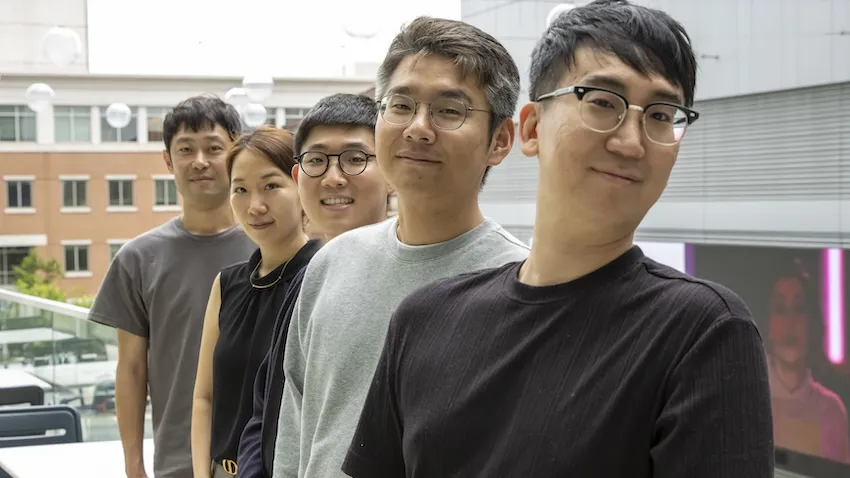
School of Interactive Computing Assistant Professor Sehoon Ha, Neuromeka researchers Joonho Lee and Yunho Kim, School of IC Assistant Professor Jennifer Kim, and Electronics and Telecommunications Research Institute researcher Dongyeop Kang, are collaborating to develop a medical assistant robot to support doctors and nurses in Korea. Photo by Nathan Deen/College of Computing.
Overwhelmed doctors and nurses struggling to provide adequate patient care in South Korea are getting support from Georgia Tech and Korean-based researchers through an AI-powered robotic medical assistant.
Top South Korean research institutes have enlisted Georgia Tech researchers Sehoon Ha and Jennifer G. Kim to develop artificial intelligence (AI) to help the humanoid assistant navigate hospitals and interact with doctors, nurses, and patients.
Ha and Kim will partner with Neuromeka, a South Korean robotics company, on a five-year, 10 billion won (about $7.2 million US) grant from the South Korean government. Georgia Tech will receive about $1.8 million of the grant.
Ha and Kim, assistant professors in the School of Interactive Computing, will lead Tech’s efforts and also work with researchers from the Korea Advanced Institute of Science and Technology and the Electronics and Telecommunications Research Institute.
Neuromeka has built industrial robots since its founding in 2013 and recently decided to expand into humanoid service robots.
Lee, the group leader of the humanoid medical assistant project, said he fielded partnership requests from many academic researchers. Ha and Kim stood out as an ideal match because of their robotics, AI, and human-computer interaction expertise.
For Ha, the project is an opportunity to test navigation and control algorithms he’s developed through research that earned him the National Science Foundation CAREER Award. Ha combines computer simulation and real-world training data to make robots more deployable in high-stress, chaotic environments.
“Dr. Ha has everything we want to put into our system, including his navigation policies,” Lee said. “He works with robots and AI, and there weren’t many candidates in that space. We needed a collaborator who can create the software and has experience running it on robots.”
Ha said he is already considering how his algorithms could scale beyond hospitals and become a universal means of robot navigation in unstructured real-world environments.
“For now, we’re focusing on a customized navigation model for Korean environments, but there are ways to transfer the data set to different environments, such as the U.S. or European healthcare systems,” Ha said.
“The final product can be deployed to other systems and industries. It can help industrial workers at factories, retail stores, any place where workers can get overwhelmed by a high volume of tasks.”
Kim will focus on making the robot’s design and interaction features more human. She’ll develop a large-language model (LLM) AI system to communicate with patients, nurses, and doctors. She’ll also develop an app that will allow users to input their commands and queries.
“This project is not just about controlling robots, which is why Dr. Kim’s expertise in human-computer interaction design through natural language was essential.,” Lee said.
Kim is interviewing stakeholders from three South Korean hospitals to identify service and care pain points. The issues she’s identified so far relate to doctor-patient communication, a lack of emotional support for patients, and an excessive number of small tasks that consume nurses’ time.
“Our goal is to develop this robot in a very human-centered way,” she said. “One way is to give patients a way to communicate about the quality of their care and how the robot can support their emotional well-being.
“We found that patients often hesitate to ask busy nurses for small things like getting a cup of water. We believe this is an area a robot can support.”
The robot’s hardware will be built in Korea, while Ha and Kim will develop the software in the U.S.
Jong-hoon Park, CEO of Neuromeka, said in a press release the goal is to have a commercialized product as soon as possible.
“Through this project, we will solve problems that existing collaborative robots could not,” Park said. “We expect the medical AI humanoid robot technology being developed will contribute to reducing the daily work burden of medical and healthcare workers in the field.”

The College of Sciences is pleased to announce the launch of the AI4Science Center. The center will promote research and collaboration focused on using state-of-the-art artificial intelligence (AI) and machine learning (ML) techniques to address complex scientific challenges.
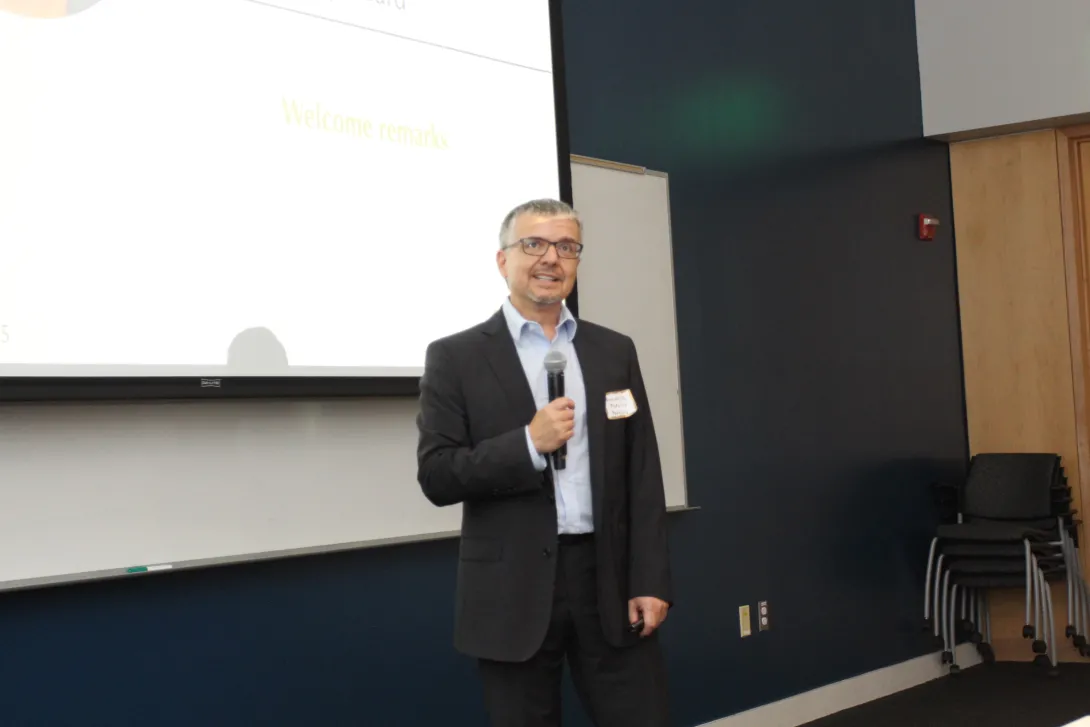
“AI and ML have the potential to revolutionize scientific discovery, but there is a clear need for foundational research centered on AI/ML methodologies and application to scientific problems,” says Dimitrios Psaltis, professor in the School of Physics.
Psaltis will co-lead the center with Molei Tao, professor in the School of Mathematics, and Audrey Sederberg, assistant professor in the School of Psychology.
The new center will combine expertise and resources from various disciplines to foster the creation of robust, reusable tools and methods that can be used across scientific domains. Specifically, the center will organize seminars and an annual conference in addition to providing seed funding for collaborative projects across units.
Nearly 40 faculty members from the College’s six schools have already agreed to participate in activities proposed by the center; additional faculty involvement is expected from across the Institute.
The center builds upon initiatives such as Tech AI, the Machine Learning Center, and the Institute for Data Engineering and Science, which seek to boost Georgia Tech’s leadership in cutting-edge, AI/ML-powered interdisciplinary research and education.
The College’s seed grant program will sponsor the center for three years, starting in fiscal year 2026. Created in 2024, this program funds new centers that seek to increase the College’s research impact and advance its strategic goal of excellence in research through a focus on novel interdisciplinary areas or discipline-specific topics of high impact. The AI4Science Center is the third initiative to be seeded by this program, following the funding of the Center for Sustainable and Decarbonized Critical Energy Mineral Solutions and the Center for Research and Education in Navigation in 2024.
“The AI4Science Center was selected for its approach, timeliness, organization, and strong support from all six of the College’s schools,” says Laura Cadonati, associate dean for Research and professor in the School of Physics. “Faculty enthusiasm about this initiative reflects the growing importance of AI/ML tools in research today and the desire for more interdisciplinary collaboration in this space at the College and beyond.”
News Contact
Writer: Lindsay C. Vidal