
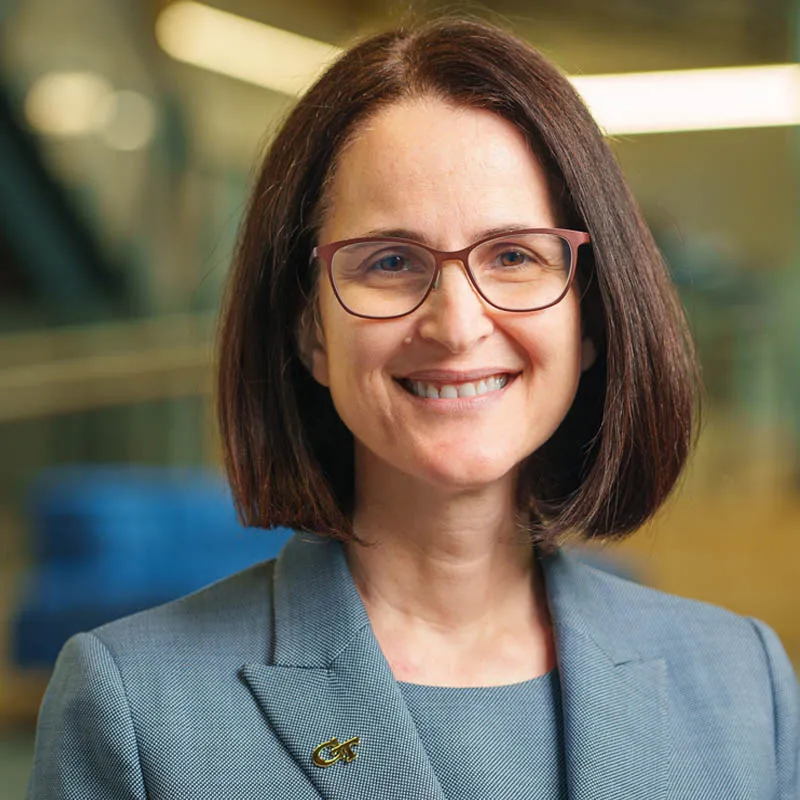
Beril Toktay
Following a nationwide search, Julia Kubanek, vice president for Interdisciplinary Research at Georgia Tech, has named Beril Toktay as the executive director of the Brook Byers Institute for Sustainable Systems (BBISS). Toktay has served as BBISS interim executive director since September 2022.
“As interim executive director, Beril has built the BBISS community, broadened its scope, and developed new programming to grow cross-disciplinary collaboration, community-engaged research, and entrepreneurship,” Kubanek said. “Faculty and students from the liberal arts, social sciences, design, business, computing, and fundamental science are engaging with BBISS in greater numbers, complementing our engineering community’s involvement. These are areas of strength at Georgia Tech that will help amplify the impact of BBISS.”
Toktay is professor of operations management, the Brady Family Chair, and Regents' Professor at the Scheller College of Business. She is an internationally recognized sustainable operations management scholar whose work has been recognized with multiple best paper awards. She is a Distinguished Fellow of the INFORMS Manufacturing & Service Operations Management (MSOM)Society. Through initiatives such as the Drawdown Georgia Business Compact, she has helped translate research insights into actionable business initiatives while fostering regional economic development.
Her academic leadership includes serving as department co-editor for “Health, Environment, and Society” for MSOM, area editor for “Environment, Energy, and Sustainability” at Operations Research, and special issue co-editor on “Business and Climate Change” for Management Science, as well as “Environment” for MSOM. She serves on the board of the Alliance for Research on Corporate Sustainability and the board of directors of the New York Climate Exchange.
Toktay has been instrumental in advancing sustainability at Georgia Tech, serving as founding faculty director of the Ray C. Anderson Center for Sustainable Business, co-architect of the Serve-Learn-Sustain initiative, and co-chair of the Sustainability Next Institute Strategic Plan Implementation Task Force. Her commitment to Ph.D. student success earned her the 2018 Georgia Tech Outstanding Doctoral Thesis Advisor Award. She also co-developed the Carbon Reduction Challenge, an award-winning interdisciplinary, co-curricular program that engages undergraduate students in climate intrapreneurship.
Toktay holds a Ph.D. in operations research from Massachusetts Institute of Technology, an M.S. in industrial engineering from Purdue University, and a B.S. in industrial engineering and mathematics from Boğaziçi University. She joined Georgia Tech in 2005 after serving as faculty at INSEAD business school in Fontainebleau, France.
Since assuming the interim role, Toktay has significantly strengthened BBISS by expanding the faculty leadership team, securing additional funding, establishing seed grant programs that have benefited over 100 researchers across all Colleges, and transforming the Center for Serve-Learn-Sustain into the Center for Sustainable Communities Research and Education.
"Energy and sustainability continue to be top Georgia Tech research priorities, for which we will need new funding strategies," said Tim Lieuwen, executive vice president for Research. "Philanthropy and business partnerships will grow in importance in the coming years. Beril has considerable experience and vision for maximizing these partnerships, which will serve BBISS and the Institute well into the future."
The Brook Byers Institute for Sustainable Systems is one of Georgia Tech’s interdisciplinary research institutes. The vision of BBISS is to grow and mobilize Georgia Tech’s knowledge assets — people and research — to create a sustainable future for all. BBISS is a key partner in the implementation of Georgia Tech’s Sustainability Next 2023-2030 Strategic Plan, a consensus road map to advance Georgia Tech’s vision to address the biggest local, national, and global challenges of our time. BBISS relentlessly serves the public good, catalyzes high-impact research, develops exceptional leaders, and cultivates partnerships that translate knowledge into practice.
"I'm honored to lead BBISS and build on the momentum we've created to date,” Toktay said. “Our vision is to maximize the collective impact of Georgia Tech's remarkable sustainability research community across all colleges and disciplines. By catalyzing collaborative research and connecting our faculty with key external partners and communities, we are positioning Georgia Tech to be a global thought leader in sustainability and to drive meaningful solutions to some of our most pressing environmental and social challenges."
The campus community is invited to a reception celebrating Toktay's appointment on Thursday, May 1, 2025, at 4:30 p.m. at the Collective Food Hall in the Coda building. Contact Susan Ryan for details.
News Contact
Brent Verrill, Research Communications Program Manager, BBISS
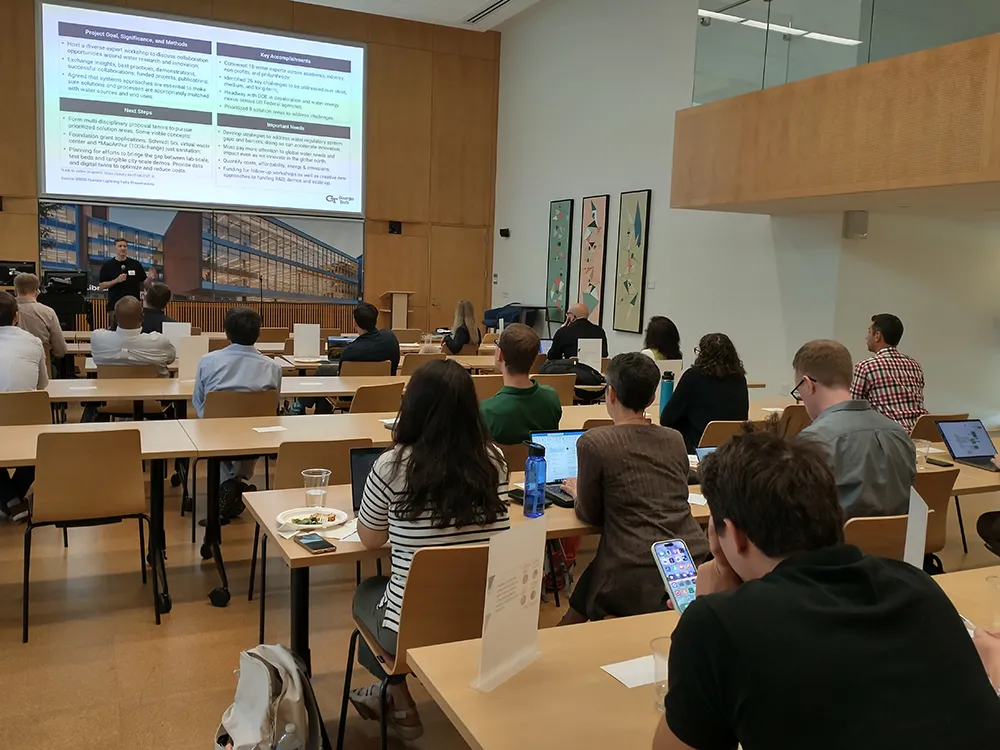
Mark your calendars for February 27 - 28, 2025, as Georgia Tech's Brook Byers Institute for Sustainable Systems (BBISS) hosts the 2025 Sustainability Showcase. This two-day event, held at the Price Gilbert Library Scholars Event Theater, will focus on innovation, collaboration, and inspiration around building a resilient future for our communities, ecosystems, and infrastructure.
Researchers, faculty, students, staff, and partners will explore how we can boost our resilience in the face of a rapidly changing world. With a full agenda featuring lightning talks, panel discussions, and a visioning “Unconference,” attendees will have ample opportunity to engage with cutting-edge research and innovative initiatives.
Event Highlights:
- Networking Breakfast: Start your day by connecting with colleagues over a warm beverage and breakfast refreshments.
- Panel Discussions: Learn from experts about how they view resilience in context with their work and the broader efforts to enhance resilience.
- Alumni Keynote: Laura Solomon will talk about the connection between the oyster aquaculture industry, engaging local communities, and a thriving and resilient coastal ecosystem.
- Lightning Talks: Hear quick, impactful presentations from faculty, students, and staff showcasing their research.
- Resilience Visioning Unconference: Participate in a dynamic, participant-driven meeting to exchange ideas and propose discussions on resilience topics.
Don't miss this opportunity to be part of this annual event and connect with the sustainability community. Whether you're a faculty member or a curious student, whether you can attend a whole day or just one session, the Sustainability Showcase offers something for everyone. Join us and be inspired by the breadth and depth of sustainability work happening at Georgia Tech.
For more information, visit the Sustainability Showcase website.
News Contact
Brent Verrill, Research Communications Program Manager, BBISS
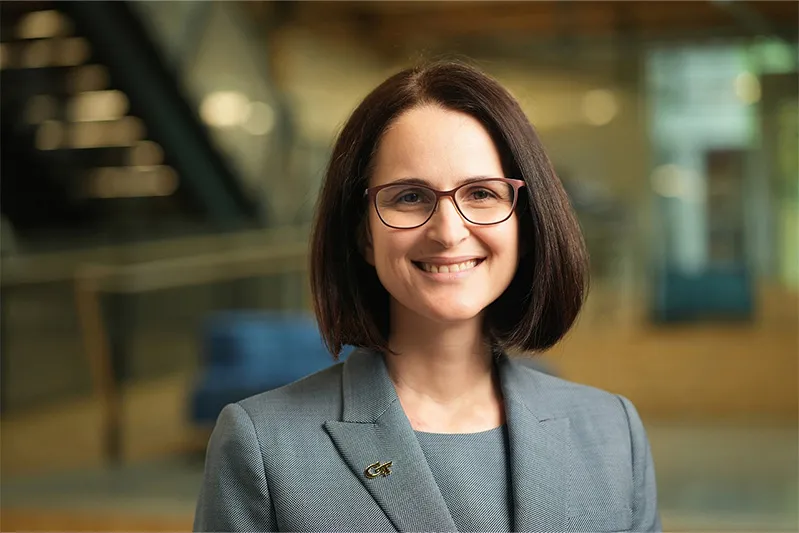
Scheller Business Insights is a dynamic video series that highlights the innovative thought leadership of the esteemed faculty at the Georgia Tech Scheller College of Business. At Scheller, we are committed to exploring ideas that educate and inform others about the profound impact of business on our lives and the world.
In this episode, Beril Toktay, Regents' Professor and faculty director of the Ray C. Anderson Center for Sustainable Business, defines net zero and discusses some ways to alleviate climate change by reducing carbon emissions to the point of net zero emissions.
Globally, most major polluters, such as China, the U.S., India, and the EU, are among over 140 nations with net-zero goals, which encompasses roughly 88 percent of global emissions. Meeting the Paris Agreement's 1.5°C climate threshold requires 45 percent emissions cut by 2030 and net-zero emissions by 2050 (United Nations Climate Action).
Toktay describes ways this can be accomplished in different business sectors. For example, in the energy sectors, this means moving from fossil fuels to renewable technologies, and in the transportation sector, moving to electrification and innovative battery technologies as well as developing the infrastructure to support these initiatives. These efforts help move businesses towards achieving net zero as well as providing cleaner air and water, and better health outcomes to the global population.
Listen as Toktay discusses what net zero means, the importance of getting to net zero, and how businesses can help reduce carbon emissions.
News Contact
Lorrie Burroughs
Written by Benjamin Wright
Josiah Hester likes to build things. Specifically, he likes to build tiny, computerized devices that can be used to help people monitor the environment around them. As a Native Hawaiian he grew up with a passion for sustainability and stewardship of the land. He also found himself drawn to computer programming and how it could be used to create games, graphics, music, and tools. Now he melds those two worlds as an associate professor in Georgia Tech’s College of Computing and Interim Associate Director for Community-Engaged Research in the Brooks Byers Institute for Sustainable Systems.
The idea to apply computer science to sustainability came when Josiah was a college student at Clemson, where he earned his B.S. and Ph.D. in computer science, with his dissertation focusing on low-cost, low-impact, battery-less, and wireless embedded sensing systems. He continued that work as an associate professor at Northwestern, partnering with local tribes in the Great Lakes region to measure and monitor changes in their local environments that they had been experiencing for years. Those projects sparked Josiah’s passion for community engagement based on long term relationships.
The length and depth of community partnerships are vitally important to Josiah. “We want our faculty, researchers, students and staff to be able to work effectively with communities on these important climate resilience opportunities and make sure that those relationships and the ways that we work together are sustaining and nurturing for each party,” he says. The last thing he wants to see is a team of researchers dropping in on a community, conducting a quick research project without getting to know the local needs and challenges, and then leaving a few months later never to be heard from again.
“Both parties bring assets to the table that are critically important. Our researchers have specialized skills and interests that allow them to solve complex problems. The local communities often have very in-depth knowledge of their own environment and the changes that are occurring, whether it’s air quality, heat impact, sea level changes, or water scarcity. Our goal is to match those skills with communities that can put them to use to bring about positive change.”
Along with matching researchers and communities, Josiah and his colleagues at BBISS keep an eye on available funding sources to make sure projects are properly resourced. Sometimes a small project that starts with a seed grant can turn into something larger with funding from the EPA, USDA or NSF.
“Those major projects can then lead to actionable science that can inform policy and governance,” says Josiah. “And at the same time faculty are advancing their fields and producing publishable work while helping local communities.”
What Josiah enjoys most about his role as Interim Associate Director for Community-Engaged Research, is seeing researchers who have spent their careers figuring out the science of a subject go into the community and apply it in a practical hands-on way that makes an impact. He is also excited by the students participating in the BBISS Fellowship and how they are approaching community engagement.
“My generation of faculty is getting better at engaging, but the way these students approach it is just next level. The future is in good hands.”
Away from Georgia Tech Josiah has his hands full with three kids, three dogs, and a love for surfing that is hard to satisfy on the Georgia coast. He also enjoys cooking, music, and spending time in parks.
News Contact
Brent Verrill, Research Communications Program Manager, BBISS

Written by Benjamin Wright
Emma Blandford is the Program & Portfolio Manager for Sustainability Next, an initiative outlined in Georgia Tech’s strategic plan which seeks to establish the Institute as a leader in ethical, economic, and environmental sustainability in Institute operations; sustainable development education; sustainability leadership and transdisciplinary research; culture and organization; climate solutions; and in using the campus as a living learning laboratory. Emma's role is supported by both the Office of Sustainability, where she reports to Associate Vice President of Sustainability Jennifer Chirico, and the Brook Byers Institute for Sustainable Systems (BBISS) where she reports to Interim Executive Director Beril Toktay. She regularly collaborates with members of both organizations and serves as a bridge between them.
As the portfolio manager for Sustainability Next, Emma serves as a facilitator, connecting like-minded people from across campus so they can collaborate while also helping them access available resources. With sustainability being a broad inter and multi-disciplinary field, the opportunities for collaboration are endless, but bringing people from diverse fields can also be a challenge. That is where Emma’s background in team-building and project management comes in.
“It’s my job to make sure that people have what they need to do their jobs,” she says. “They're passionate and they’re incredibly intelligent. In sustainability, it's hard to find people who aren't deeply personally attached to their roles. So my goal is to empower them and help them succeed.”
Emma oversees and supports a variety of teams and projects that are working towards established sustainability goals on campus, tracking their progress, providing access to resources, and removing obstacles when necessary.
On any given day Emma could be talking to researchers, campus communicators, facilities staff, students, or organizational leadership. If their roles touch on sustainability, she wants to hear from them and find ways to help them achieve success while bringing them under the Sustainability Next umbrella. If you are already working in sustainability at Georgia Tech or would like to be, feel free to reach out through the Sustainability Next webpage or to Emma directly.
When she isn’t at work Emma enjoys spending time with her wife, two kids, three dogs, and cat- outdoors when possible. She is originally from Connecticut and holds degrees from UConn and Western New England University.
News Contact
Brent Verrill, Research Communications Program Manager, BBISS
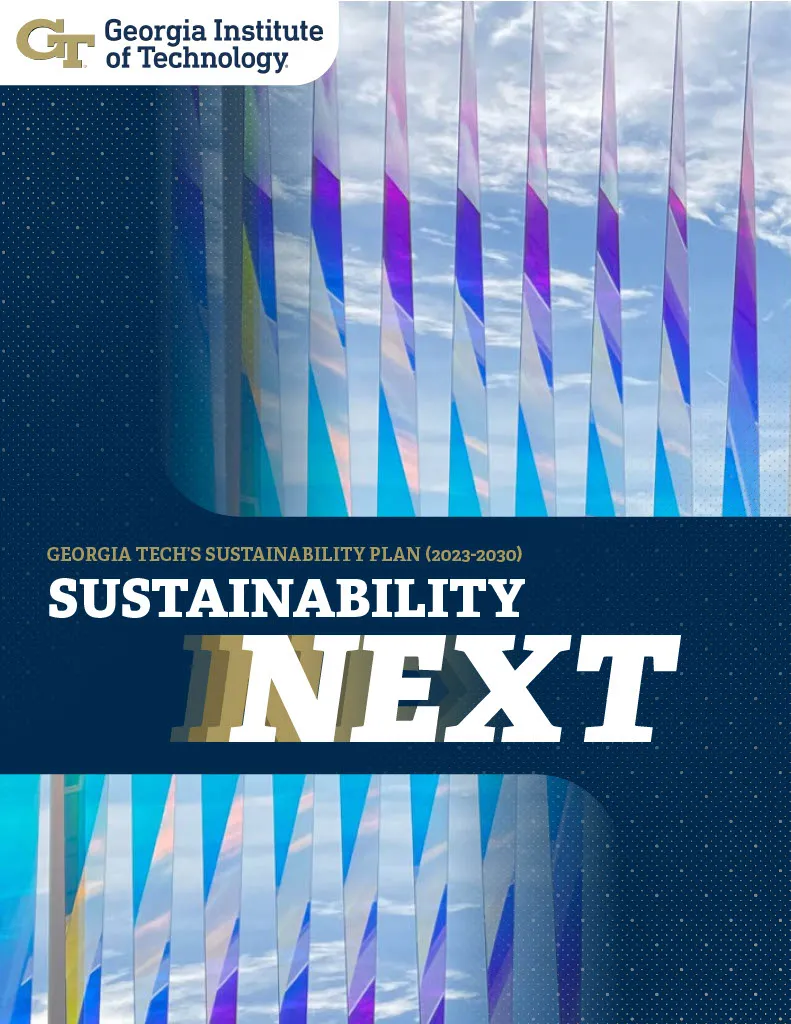
Cover of the Sustainability Next Plan
On the one-year anniversary of the launch of Sustainability Next, a publicly available version of the plan is being released and several plan initiatives are coming to life.
Following the creation of Georgia Tech’s 2020 – 2030 strategic plan, the Institute’s executive leadership team launched a task force to create a strategic sustainability roadmap — the Sustainability Next Plan — to help advance some of its most important goals.
“Sustainability Next is central to Georgia Tech’s commitment to developing leaders who advance technology and improve the human condition,” said President Ángel Cabrera. “As one of the largest technological universities in the world, we have the opportunity and responsibility to help find solutions to the biggest problems we face, achieve the United Nations Sustainable Development Goals, and support a human population that will soon rise to 10 billion while reducing the stress we’re causing on our planet.”
The plan calls on Georgia Tech to:
Be a global sustainability thought leader.
Catalyze innovation through education and research.
Lead by example in the practice and culture of sustainability.
Since the fall of 2022, Sustainability Next has begun to implement projects, including:
The Climate Action Plan to develop a roadmap for integrating climate action strategies across operations, research, and education focusing on climate justice and reducing emissions.
Sustainable X, which supports students interested in and passionate about developing climate tech, sustainability, and social impact startups.
Sustainability Education Innovation Grants for faculty to expand Sustainable Development Goals concept and skill integration across the undergraduate curriculum.
Research Seed Grants to support interdisciplinary climate and sustainability research initiatives.
Living Campus connecting Georgia Tech’s built environment and surrounding landscape to serve as opportunities for collaborations between academics, research, industry, operations, and community partnerships.
These initiatives alone have created collaborations between several sustainability-focused departments on campus, including the Office of Sustainability, the Brook Byers Institute for Sustainable Systems, the Ray C. Anderson Center for Sustainable Business, and the Center for Teaching and Learning.
Creating the Foundation for Successful Implementation
As an outcome of the strategic plan to more intentionally integrate sustainability and lead by example with campus operations, Georgia Tech restructured its facilities management into Infrastructure and Sustainability (I&S) in 2021. The following year, the Office of Campus Sustainability was restructured into the Office of Sustainability within I&S to bridge sustainability efforts across research, education, and operations. It was later expanded to integrate the departments of utilities, sustainable building operations, and The Kendeda Building for Innovative Sustainable Design.
Additionally, Sustainability Next has supported the Brook Byers Institute in becoming a transformative unit focused on climate and sustainability that integrates research and education. It has also strengthened ties in the sustainability cluster of the Vice President for Institutional Research, comprising the Byers Institute, the Renewable Bioproducts Institute, and the Strategic Energy Institute — including the permanent integration of Serve-Learn-Sustain into the newly established Center for Sustainable Communities Research and Education.
Looking Ahead
In the next few months, the Sustainability Next Plan will be supported by a refreshed website, a schedule of sustainability-related events, and calls to action, reinvigorating the sustainability charge set forth in the Institute’s strategic plan.
The Sustainability Next co-chairs invite every member and unit of the Georgia Tech community to join in bringing the Sustainability Next Plan to life and expanding its ambitions over time so that we can build a just, equitable, and sustainable future — together.
For continuous updates and to find out how you can get involved, visit the new Sustainability Next webpage.
News Contact
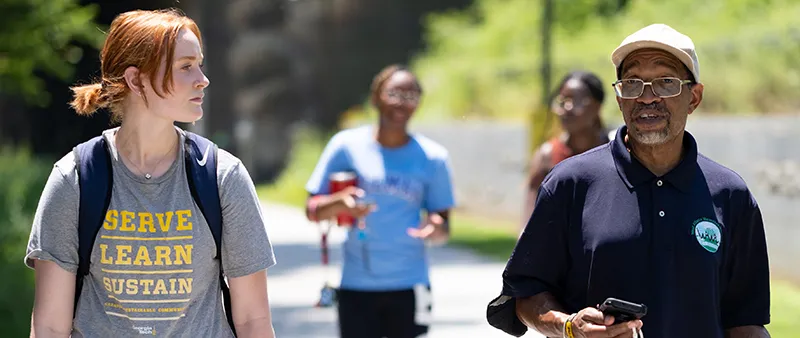
A student wearing a "Serve-Learn-Sustain" tee shirt walks along a campus walkway with a Georgia Tech faculty member. Photo Credit Ben Gray, AJC.
The Vice President for Interdisciplinary Research (VPIR) and the Office of Undergraduate Education (OUE) are excited to announce an institutionalization plan for Serve-Learn-Sustain (SLS) that will advance two of Georgia Tech’s Institute Strategic Plan (ISP) initiatives - Sustainability Next and Transformative Teaching and Learning (TTL) - and strengthen our service learning, community engagement, and sustainability ecosystems at Georgia Tech. Established as Georgia Tech’s last Quality Enhancement Plan (QEP), SLS launched in 2016 as a unit in OUE and concluded its official QEP work in 2021. Its work on the QEP earned Georgia Tech a commendation from the Southern Association of Colleges and Schools Commission on Colleges and established a strong foundation to build on moving forward.
Effective July 1, 2023, the current SLS team will establish a new center, the Center for Sustainable Communities Research and Education (CSCRE), under the VPIR. The Brook Byers Institute for Sustainable Systems (BBISS), which is serving as a hub for coordinating Georgia Tech’s Sustainability Next Strategic Plan initiative, will serve as the administrative home for the new center.
CSCRE will collaborate with the sustainability cluster of the Interdisciplinary Research Institutes (IRIs), including BBISS, the Strategic Energy Institute (SEI), and the Renewable Bioproducts Institute (RBI), as well as Infrastructure and Sustainability, another key Sustainability Next hub, to enhance Georgia Tech’s competitiveness in applying for grants that require meaningful community partnerships as a key component of their research and education plans. It will also continue to support sustainable communities education, in close collaboration with the Center for Teaching and Learning (CTL), OUE, and Education and Learning, to assure the continuity of SLS’s signature programs.
Established as Georgia Tech’s last QEP, Serve-Learn-Sustain launched in 2016 as a unit in OUE and concluded its official QEP work in 2021. Georgia Tech earned a commendation from the Southern Association of Colleges and Schools Commission on Colleges in 2021 for the “exceptional execution” of the 2016 QEP, citing, among other things, that the program “inspired a closer dialogue among faculty regarding research and instructional practices, and thus serves as a model of how a QEP can transform an academic culture.”
To continue advancing and scaling undergraduate service learning and community engagement as a high-impact practice, OUE will establish a new service learning team, as a priority that supports the Transformative Teaching and Learning ISP initiative. Institutionalizing the service-learning functions of SLS within OUE and aligning it with other high impact practices - such as undergraduate research, student innovation programs, first-year seminars, co-op and internships, and learning communities - will position these programs to work collectively in support of the development of Georgia Tech’s next QEP, which will begin in 2025.
Thank you to the SLS staff and to everyone who has collaborated with and supported the work that SLS has spearheaded to make Georgia Tech a better place for our students, our faculty and staff, and our surrounding communities. We look forward to continuing to advance this work, together.
News Contact
Brent Verrill, Research Communications Program Manager, BBISS
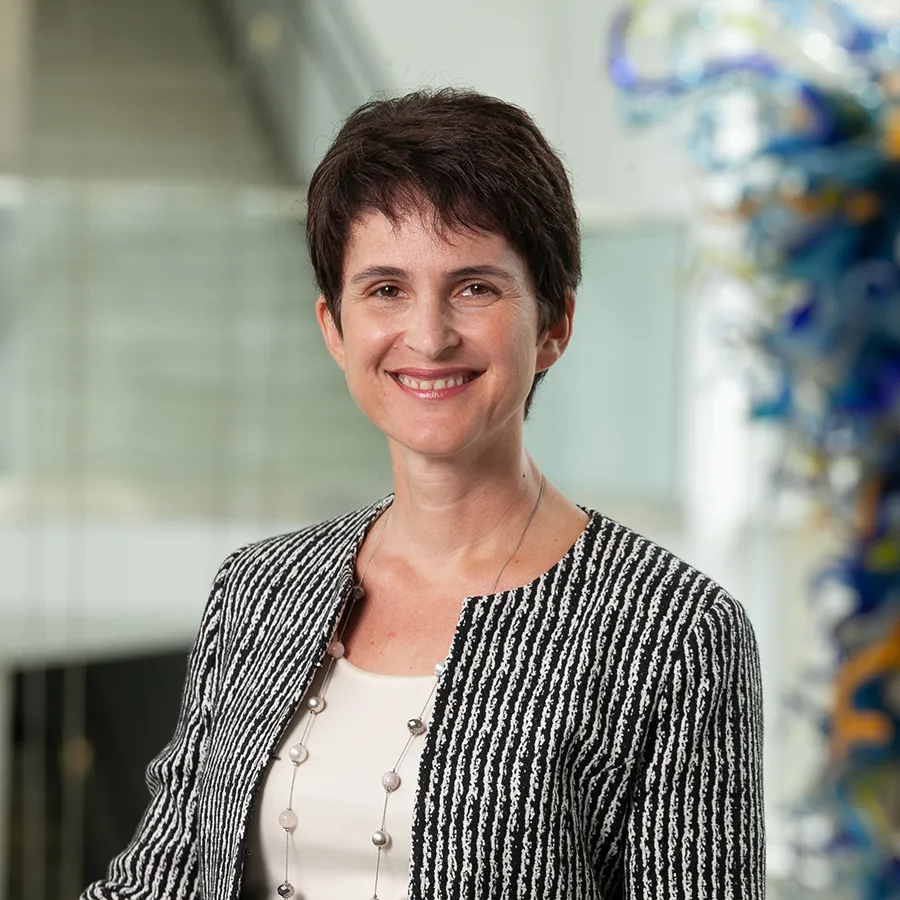
I am excited to step into the interim executive director position at the Brook Byers Institute for Sustainable Systems, with sincere gratitude to John for his pioneering leadership, to the Brook Byers Professors and Faculty Fellows for their high-profile contributions to sustainability research and education, and to Mr. Byers for his generous support of BBISS over the years.
I am also delighted to have the opportunity to work with a very committed team in Mike, Susan, Gay, and Brent, whose combined tenure with BBISS adds up to more than 40 years, not to mention Mike and Brent’s early involvement with defining Georgia Tech’s role in sustainability going back to the late 90s! I invite you all to engage with us over the next year: a small step is to sign up for the BBISS newsletter.
Some colleagues will remember that I had an office at ISTD, BBISS’ precursor, when I was on sabbatical at Georgia Tech from INSEAD about 20 years ago. I was introduced to the campus sustainability community by former executive directors and mentors Carol Carmichael and Bert Bras. When I moved to the Georgia Tech Scheller College of Business in 2005, I was excited to become part of this sustainability community, with whom I have since had many productive and enjoyable collaborations leading to the creation of the Ray C. Anderson Center for Sustainable Business, Serve-Learn-Sustain, the Carbon Reduction Challenge, and more. Rejoining BBISS on its leadership team is bringing things full circle for me and feels a bit like a homecoming.
Over the last year, I have had the privilege of working as co-chair of Sustainability Next, the Georgia Tech Strategic Plan 2020-2030 Implementation Task Force tasked with developing an Institute-wide implementation plan for sustainability cutting across all core missions of Georgia Tech and encompassing both environmental and social sustainability issues defined by UN Sustainable Development Goals. Many of you contributed through the task force, surveys, townhalls, and individual conversations, for which I am grateful. Through this work, I have come to appreciate not only the depth of the sustainability expertise at Georgia Tech but also the unique point at which we find ourselves in terms of the opportunity to have transformative impact in our city, region, nation, and globe.
Assets that collectively provide that opportunity include: the cutting-edge Georgia Tech sustainability research community spanning all six colleges and GTRI; successful sister IRIs, centers, and initiatives; a commitment to campus sustainability exemplified in flagship projects like the Kendeda Building; a student base that is eager to have positive societal impact in their careers; many strong industry partnerships including the Drawdown Georgia Business Compact focused on climate action; federal government and philanthropic dollars poised to invest in climate solutions with an emphasis on social justice; a state government working to bring “new economy” companies into Georgia; many city- and county-level sustainability and climate initiatives; GT-led regional and international sustainability networks including RCE Greater Atlanta and the University Global Coalition; a coalescence around taking Metro Atlanta and Georgia to the next level in entrepreneurial activity; and ELT-level support and resources for sustainability through Institute Strategic Plan funding and Transforming Tomorrow: The Campaign for Georgia Tech theme definition. There is also a set of challenges, of course, but things worth doing are never straightforward!
I look forward to working with you all to capitalize on these assets and the momentum of the present day. My hypotheses about what our priorities should be for this year are the following, and I look forward to hearing your input and suggestions as we finalize them together:
- Grow the community of faculty, students, and staff who see themselves as part of the BBISS family and strengthen ties within;
- Expand BBISS’ research foci to reflect the full richness of sustainability scholarship on campus (here I see a clear focus on climate that draws on all colleges and GTRI as a must);
- Advance BBISS’ capacity to support interdisciplinary grant writing and community-engaged research;
- Partner with schools and colleges to help grow sustainability and climate-related interdisciplinary academic program offerings;
- Accelerate commercialization and entrepreneurship activity in sustainability and climate solutions;
- Contribute to philanthropic success in sustainability both at BBISS and Georgia Tech-wide;
- Grow the visibility of Georgia Tech sustainability thought leadership.
I plan to hold “listening sessions” and a retreat to crystallize BBISS’ research foci and priority activities. To engage with this process and explore whether BBISS is a good “home” for you, please sign up for the BBISS newsletter.
I look forward to working with you all!
Beril
L. Beril Toktay
Professor of Operations Management and Brady Family Chairholder
Interim Executive Director, Brook Byers Institute for Sustainable Systems
Faculty Director, Ray C. Anderson Center for Sustainable Business
Scheller College of Business
Georgia Institute of Technology
News Contact
Brent Verrill, Research Communications Program Manager, BBISS

“Thirty years ago not many folks were interested or thinking about sustainability. BBISS was. At Georgia Tech, we do cover many areas in sustainability, and right now after 30 years, BBISS has the history and the ability that can provide expertise to those that are seeking solutions.”
Chaouki Abdallah, Executive Vice President for Research
The Brook Byers Institute for Sustainable Systems (BBISS) is one of Georgia Tech’s 10 interdisciplinary research institutes.
News Contact
Brent Verrill, Research Communications Program Manager